MCQ
Given below are two statements. One is labelled as Assertion (A) and the other is labelled as Reason (R).
Assertion (A) : A simple pendulum is taken to a planet of mass and radius, 4 times and 2 times, respectively, than the Earth. The time period of the pendulum remains same on earth and the planet.
Reason (R) : The mass of the pendulum remains unchanged at Earth and the other planet. In the light of the above statements, choose the correct answer from the options given below :
  • Both (A) and (R) are true but (R) is NOT the correct explanation of (A)
  • B
    (A) is true but (R) is false
  • C
    (A) is false but (R) is true
  • D
    Both (A) and (R) are true and (R) is the correct explanation of (A)
Answer

Correct option: A.
Both (A) and (R) are true but (R) is NOT the correct explanation of (A)
(A) Both (A) and (R) are true but (R) is NOT the correct explanation of (A)
Sol. $g =\frac{ GM }{ R ^2}$
$g^{\prime}=\frac{G(4 M)}{(2 R)^2}=g$
A is correct, R is correct ; but since $T =2 \pi \sqrt{\frac{\ell}{g}}$
doesn't depend on mass ; R doesn't explain A .

Need a full question paper?

Generate a complete, print-ready paper with questions like this in minutes — across 16+ boards, with answer keys.

Start Generating Free

Similar questions

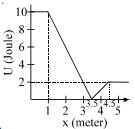
A body with mass $2\, kg$ moves in one direction in the presence of a force which is described by the potential energy graph. If the body is released from rest at $x = 2m$, then its speed when it crosses $x = 5\, m$ is ................ $\mathrm{m}/ \mathrm{s}$
In the elastic collision of objects
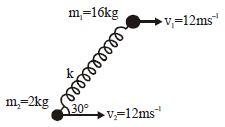
Two particles with mass $m_1$ = $16\ kg$ and $m_2$ = $2\ kg$ slide as unit with a common velocity of $12\ ms^{-1}$ on a level frictionless surface. Between them is a compressed massless spring with spring constant $k$ = $100\ Nm^{-1}$ . The spring, originally compressed by $25\ cm$ , is suddenly released, sending the two masses, which are connected to the spring, flying apart from each other. The orientation of the spring w.r.t. the initial velocity is shown in diagram. What is the relative velocity of separation in $ms^{-1}$ , after the particles lose contact? ................$m/s$
When strain is produced in a body within elastic limit, its internal energy
If a capillary tube is tilted to $45^o$ and $60^o$ from the vertical then the ratio of length $l_1$ and $l_2$ of liquid columns in it will be
The scale of a spring balance reading from $0$ to $10 \,kg$ is $0.25\, m$ long. A body suspended from the balance oscillates vertically with a period of $\pi /10$ second. The mass suspended is ..... $kg$ (neglect the mass of the spring)
In an $EMW$ phase difference between electric and magnetic field vectors $\vec E$ and $\vec B$ is
A disc of radius $1\,m$ and mass $4\,kg$ rolls on a horizontal plane without slipping in such a way that its centre of mass moves with a speed of $10\,cm/\sec .$ Its rotational kinetic energy is
In the absence of intermolecular force of attraction, the observed pressure $P$ will be
A coaxial cable consists of an inner wire of radius $'a'$ surrounded by an outer shell of inner and outer radii ' ${b}$ ' and '$c$' respectively. The inner wire carries an electric current is, which is distributed uniformly across cross-sectional area. The outer shell carries an equal current in opposite direction and distributed uniformly. What will be the ratio of the magnetic field at a distance ${x}$ from the axis when $(i)$ ${x}<{a}$ and $(ii)$ ${a}<{x}<{b}$ ?