MCQ 14 Marks
One die has two faces marked 1 , two faces marked 2 , one face marked 3 and one face marked 4. Another die has one face marked 1 , two faces marked 2 , two faces marked 3 and one face marked 4. The probability of getting the sum of numbers to be 4 or 5 , when both the dice are thrown together, is
- ✓
$\frac{1}{2}$
- B
$\frac{3}{5}$
- C
$\frac{2}{3}$
- D
$\frac{4}{9}$
AnswerCorrect option: A. $\frac{1}{2}$
(A
$a=$ number or dice 1
$b =$ number on dice 2
$
(a, b)=(1,3),(3,1),(2,2),(2,3),(3,2),(1,4),(4,1)
$
Required probability
$
\begin{array}{l}
=\frac{2}{6} \times \frac{2}{6}+\frac{1}{6} \times \frac{1}{6}+\frac{2}{6} \times \frac{2}{6}+\frac{2}{6} \times \frac{2}{6}+\frac{1}{6} \times \frac{2}{6}+\frac{2}{6} \times \frac{1}{6}+\frac{1}{6} \times \frac{2}{6} \\
=\frac{18}{36}=\frac{1}{2}
\end{array}
$
View full question & answer→MCQ 24 Marks
If the system of equations
$
\begin{array}{l}
(\lambda-1) x+(\lambda-4) y+\lambda z=5 \\
\lambda x+(\lambda-1) y+(\lambda-4) z=7 \\
(\lambda+1) x+(\lambda+2) y-(\lambda+2) z=9
\end{array}
$
has infinitely many solutions, then $\lambda^2+\lambda$ is equal to
Answer(B)
$
\begin{array}{l}
(\lambda-1) x+(\lambda-4) y+\lambda z=5 \\
\lambda x+(\lambda-1) y+(\lambda-4) z=7 \\
(\lambda+1) x+(\lambda+2) y-(\lambda+2) z=9
\end{array}
$
For infinitely many solutions
$
\begin{array}{l}
D=\left|\begin{array}{ccc}
\lambda-1 & \lambda-4 & \lambda \\
\lambda & \lambda-1 & \lambda-4 \\
\lambda+1 & \lambda+2 & -(\lambda+2)
\end{array}\right|=0 \\
(\lambda-3)(2 \lambda+1)=0 \\
D_{x}=\left|\begin{array}{ccc}
5 & \lambda-4 & \lambda \\
7 & \lambda-1 & \lambda-4 \\
9 & \lambda+2 & -(\lambda+2)
\end{array}\right|=0 \\
2(3-\lambda)(23-2 \lambda)=0 \\
\lambda=3 \\
\therefore \lambda^2+\lambda=9+3=12
\end{array}
$
View full question & answer→MCQ 34 Marks
If $A , B$ and $\left(\operatorname{adj}\left( A ^{-1}\right)+\operatorname{adj}\left( B ^{-1}\right)\right)$ are non-singular matrices of same order, then the inverse of $A \left(\operatorname{adj}\left( A ^{-1}\right)+\operatorname{adj}\left( B ^{-1}\right)\right)^{-1} B$, is equal to
- A
$A B^{-1}+A^{-1} B$
- B
$\operatorname{adj}\left( B ^{-1}\right)+\operatorname{adj}\left( A ^{-1}\right)$
- ✓
$\frac{1}{| AB |}(\operatorname{adj}( B )+\operatorname{adj}( A ))$
- D
$\frac{ AB ^{-1}}{|A|}+\frac{ BA ^{-1}}{|B|}$
AnswerCorrect option: C. $\frac{1}{| AB |}(\operatorname{adj}( B )+\operatorname{adj}( A ))$
(C)
$\begin{array}{l}{\left[ A \left(\operatorname{adj}\left( A ^{-1}\right)+\operatorname{adj}\left( B ^{-1}\right)\right)^{-1} \cdot B\right]^{-1}} \\ B^{-1} \cdot\left(\operatorname{adj}\left(A^{-1}\right)+\operatorname{adj}\left( B ^{-1}\right)\right) \cdot A ^{-1} \\ B^{-1} \operatorname{adj}\left(A^{-1}\right) A ^{-1}+ B ^{-1}\left(\operatorname{adj}\left(B^{-1}\right)\right) \cdot A ^{-1} \\ B^{-1}\left|A^{-1}\right| I +\left| B ^{-1}\right| IA ^{-1} \\ \frac{B^{-1}}{|A|}+\frac{ A ^{-1}}{|B|} \\ \Rightarrow \frac{\operatorname{adjB}}{| B || A |}+\frac{\operatorname{adj} A }{| A || B |} \\ =\frac{1}{|A|| B |}(\operatorname{adj\mathrm {B}+\operatorname {adjA})}\end{array}$
View full question & answer→MCQ 44 Marks
Let the position vectors of the vertices $A , B$ and C of a tetrahedron ABCD be $\hat{ i }+2 \hat{ j }+\hat{ k }, \hat{ i }+3 \hat{ j }-2 \hat{ k }$ and $2 \hat{i}+\hat{j}-\hat{k}$ respectively. The altitude from the vertex $D$ to the opposite face ABC meets the median line segment through A of the triangle $A B C$ at the point $E$. If the length of $A D$ is $\frac{\sqrt{110}}{3}$ and the volume of the tetrahedron is $\frac{\sqrt{805}}{6 \sqrt{2}}$, then the position vector of E is
- A
$\frac{1}{2}(\hat{ i }+4 \hat{ j }+7 \hat{ k })$
- B
$\frac{1}{12}(7 \hat{ i }+4 \hat{ j }+3 \hat{ k })$
- C
$\frac{1}{6}(12 \hat{i}+12 \hat{j}+\hat{k})$
- ✓
$\frac{1}{6}(7 \hat{ i }+12 \hat{ j }+\hat{ k })$
AnswerCorrect option: D. $\frac{1}{6}(7 \hat{ i }+12 \hat{ j }+\hat{ k })$
(D)
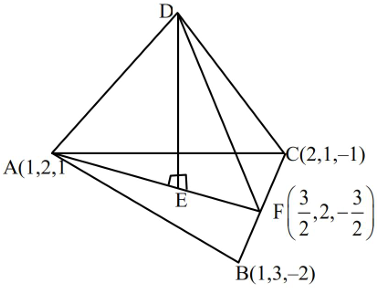
$\begin{array}{l}\text { Area of } \triangle ABC =\frac{1}{2}|\overrightarrow{ AB } \times \overrightarrow{ AC }| \\ =\frac{1}{2}|5 \hat{ i }+3 \hat{ j }+\hat{ k }|=\frac{1}{2} \sqrt{35} \\ \text { volume of tetrahedron } \\ =\frac{1}{3} \times \text { Base area } \times h =\frac{\sqrt{805}}{6 \sqrt{2}} \\ \frac{1}{3} \times \frac{1}{2} \sqrt{35} \times h =\frac{\sqrt{805}}{6 \sqrt{2}} \\ h=\sqrt{\frac{23}{2}} \\ AE ^2= AD ^2- DE ^2=\frac{13}{18} \therefore AE =\sqrt{\frac{13}{18}}\end{array}$
$\begin{array}{l}\overrightarrow{ AE }=| AE | \cdot\left(\frac{\hat{ i }-5 \hat{ k }}{\sqrt{26}}\right) \\ =\sqrt{\frac{13}{18}} \cdot\left(\frac{\hat{ i }-5 \hat{ k }}{\sqrt{26}}\right) \\ =\sqrt{\frac{13}{18}} \cdot\left(\frac{\hat{ i }-5 \hat{ k }}{\sqrt{26}}\right)=\frac{\hat{ i }-5 \hat{ k }}{6} \\ \text { P.V. of } E =\frac{\hat{ i }-5 \hat{ k }}{6}+\hat{ i }+2 \hat{ j }+\hat{ k }=\frac{1}{6}(7 \hat{ i }+12 \hat{ j }+\hat{ k })\end{array}$ View full question & answer→MCQ 54 Marks
Marks obtains by all the students of class 12 are presented in a frequency distribution with classes of equal width. Let the median of this grouped data be 14 with median class interval 12-18 and median class frequency 12. If the number of students whose marks are less than 12 is 18 , then the total number of students is
Answer(B)
medain $=\ell+\left(\frac{\frac{ N }{2}- F }{ f }\right) \times h$
$
\begin{array}{l}
=12+\left(\frac{\frac{N}{2}-18}{12}\right) \times 6=14 \\
\Rightarrow\left(\frac{\frac{N}{2}-18}{12}\right) \times 6=2 \\
\frac{N}{2}-18=4 \Rightarrow N=44
\end{array}
$
View full question & answer→MCQ 64 Marks
The value of $\left(\sin 70^{\circ}\right)\left(\cot 10^{\circ} \cot 70^{\circ}-1\right)$ is
Answer(A)
$\sin 70^{\circ}\left(\cot 10^{\circ} \cot 70^{\circ}-1\right)$
$
\Rightarrow \frac{\cos \left(80^{\circ}\right)}{\sin 10}=1
$
View full question & answer→MCQ 74 Marks
If $\frac{\pi}{2} \leq x \leq \frac{3 \pi}{4}$, then $\cos ^{-1}\left(\frac{12}{13} \cos x+\frac{5}{13} \sin x\right)$ is equal to
- A
$x-\tan ^{-1} \frac{4}{3}$
- ✓
$x-\tan ^{-1} \frac{5}{12}$
- C
$x+\tan ^{-1} \frac{4}{5}$
- D
$x+\tan ^{-1} \frac{5}{12}$
AnswerCorrect option: B. $x-\tan ^{-1} \frac{5}{12}$
(B)
$\frac{\pi}{2} \leq x \leq \frac{3 \pi}{4}$
$\cos ^{-1}\left(\frac{12}{13} \cos x+\frac{5}{12} \sin x\right)$
$\cos ^{-1}(\cos x \cos \alpha+\sin x \sin \alpha)$
$\cos ^{-1}(\cos ( x -\alpha))$
$\Rightarrow x -\alpha$ because $x -\alpha \in\left(-\frac{\pi}{2}, \frac{\pi}{2}\right)$
$\Rightarrow x-\tan ^{-1} \frac{5}{12}$.
View full question & answer→MCQ 84 Marks
Let the area of a $\triangle P Q R$ with vertices $P(5,4), Q(-2,4)$ and $R(a, b)$ be 35 square units. If its orthocenter and centroid are $O \left(2, \frac{14}{5}\right)$ and $C ( c , d )$ respectively, then $c +2 d$ is equal to
- A
$\frac{7}{3}$
- ✓
- C
- D
$\frac{8}{3}$
Answer(B)
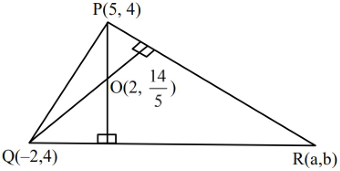
$\begin{array}{l}\text { Equation of lines } QR =5 x +2 y +2=0 \\ \text { Equation of lines } P R=10 x-3 y-38=0 \\ \therefore \text { Point } R(2,-6) \\ \text { Centroid }=\left(\frac{5-2+2}{3}, \frac{4+4-6}{3}\right) \\ =\left(\frac{5}{3}, \frac{2}{3}\right) \\ c +2 d=\frac{5}{3}+\frac{4}{3}=3\end{array}$ View full question & answer→MCQ 94 Marks
The number of words, which can be formed using all the letters of the word "DAUGHTER", so that all the vowels never come together, is
Answer(C)
DAUGHTER
Total words $=8$ !
Total words in which vowels are together $=6!\times 3!$ words in which all vowels are not together$
\begin{array}{l}
=8!-6!\times 3! \\
=6![56-6] \\
=720 \times 50 \\
=36000
\end{array}
$
View full question & answer→MCQ 104 Marks
Let $R=\{(1,2),(2,3),(3,3)\}$ be a relation defined on the set $\{1,2,3,4\}$. Then the minimum number of elements, needed to be added in R so the R becomes an equivalence relation, is :
Answer(D)
$A =\{1,2,3,4\}$
For relation to be reflexive$
R=\{(1,2),(2,3),(3,3)\}
$
Minimum elements added will be $(1,1),(2,2),(4,4)(2,1)(3,2)(3,2)(3,1)(1,3)$
$\therefore$ Minimum number of elements $=7$
View full question & answer→MCQ 114 Marks
Let $\left|\frac{\bar{z}-i}{2 \bar{z}+i}\right|=\frac{1}{3}, z \in C$, be the equation of a circle with center at C . If the area of the triangle, whose vertices are at the points $(0,0), C$ and $(\alpha, 0)$ is 11 square units, then $\alpha^2$ equals
- A
- B
- ✓
$\frac{121}{25}$
- D
$\frac{81}{25}$
AnswerCorrect option: C. $\frac{121}{25}$
(C)
$\begin{array}{l}\left|\frac{\bar{z}-i}{2 \bar{z}+i}\right|=\frac{1}{3} \\ \left|\frac{\bar{z}-i}{\bar{z}+\frac{i}{2}}\right|=\frac{2}{3} \\ 3|x-i y-i|=2\left|x-i y+\frac{i}{2}\right| \\ 9\left(x^2+(y+1)^2\right)=4\left(x^2+(y-1 / 3)^2\right) \\ 9 x^2+9 y^2+18 y+9=4 x^2+4 y^2-4 y+1 \\ 5 x^2+5 y^2+22 y+8=0 \\ x^2+y^2+\frac{22}{5} y+\frac{8}{5}=0 \\ \text { centre } \Rightarrow\left(0,-\frac{11}{5}\right)\end{array}$
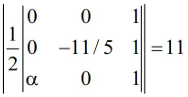
$\begin{array}{l}\Rightarrow\left(-\frac{11}{5} \alpha\right)^2=(11 \times 2)^2 \\ \Rightarrow \alpha^2=100\end{array}$ View full question & answer→MCQ 124 Marks
Let P be the foot of the perpendicular from the point $Q (10,-3,-1)$ on the line $\frac{ x -3}{7}=\frac{ y -2}{-1}=\frac{ z +1}{-2}$. Then the area of the right angled triangle $P Q R$, where $R$ is the point $(3,-2,1)$, is
- A
$9 \sqrt{15}$
- B
$\sqrt{30}$
- C
$8 \sqrt{15}$
- ✓
$3 \sqrt{30}$
AnswerCorrect option: D. $3 \sqrt{30}$
(D)
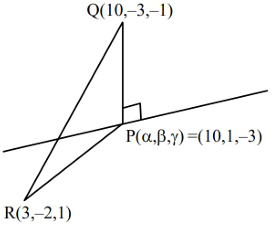
$
\begin{array}{l}
\frac{x-3}{7}=\frac{y-2}{-1}=\frac{z+1}{-2}=\lambda \\
\Rightarrow 7 \lambda+3,-\lambda+2,-2 \lambda-1 \\
\text { dr's of QP } \Rightarrow \\
7 \lambda-7,-\lambda+5,-2 \lambda
\end{array}
$
Now
$
\begin{array}{l}
(7 \lambda-7) \cdot 7-(-\lambda+5)+(2 \lambda) \cdot 2=0 \\
54 \lambda-54=0 \Rightarrow \lambda=1 \\
\therefore P=(10,1,-3) \\
\overrightarrow{PQ}=-4 \hat{j}+2 \hat{k} \\
\overrightarrow{PR}=-7 \hat{i}-3 \hat{j}+4 \hat{k} \\
\text { Area }=\left|\frac{1}{2}\right| \begin{array}{ccc}
i & j & k \\
0 & -4 & 2 \\
-7 & -3 & 4
\end{array}| |=3 \sqrt{30}
\end{array}
$ View full question & answer→MCQ 134 Marks
If the first term of an A.P. is 3 and the sum of its first four terms is equal to one-fifth of the sum of the next four terms, then the sum of the first 20 terms is equal to
Answer(B)
$\begin{array}{l} a =3 \\ S_4=\frac{1}{5}\left(S_8- S _4\right) \\ \Rightarrow 5 S_4= S _8- S _4 \\ \Rightarrow 6 S_4= S _8 \\ \Rightarrow 6 \cdot \frac{4}{2}[2 \times 3+(4-1) \times d ] \\ =\frac{8}{2}[2 \times 3+(8-1) d ] \\ \Rightarrow 12(6+3 d)=4(6+7 d) \\ \Rightarrow 18+9 d=6+7 d \\ \Rightarrow d =-6 \\ S_{20}=\frac{20}{2}[2 \times 3+(20-1)(-6)] \\ =10[6-114] \\ =-1080\end{array}$
View full question & answer→MCQ 144 Marks
Let the arc AC of a circle subtend a right angle at the centre O . If the point B on the arc AC , divides the arc $A C$ such that $\frac{\text { length of } \operatorname{arc} A B}{\text { length of } \operatorname{arc} B C}=\frac{1}{5}$, and $\overrightarrow{ OC }=\alpha \overrightarrow{ OA }+\beta \overrightarrow{ OB }$, then $\alpha=\sqrt{2}(\sqrt{3}-1) \beta$ is equal to
- ✓
$2-\sqrt{3}$
- B
$2 \sqrt{3}$
- C
$5 \sqrt{3}$
- D
$2+\sqrt{3}$
AnswerCorrect option: A. $2-\sqrt{3}$
(A)
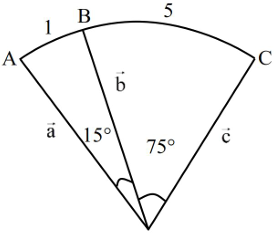
$
\begin{array}{l}
\overrightarrow{c}=\alpha \overrightarrow{a}+\beta \overrightarrow{b} \ldots .(1)
\\
\overrightarrow{a} \cdot \overrightarrow{c}=\alpha \vec{a} \cdot \overrightarrow{a}+\beta \overrightarrow{b} \cdot \overrightarrow{a} \\
0=\alpha+\beta \cos 15^{\circ} \ldots .(2)
\\
(1) \Rightarrow \overrightarrow{b} \cdot \overrightarrow{c}=\alpha \overrightarrow{a} \cdot \vec{b}+\beta \overrightarrow{b} \cdot \overrightarrow{b} \\
\Rightarrow \cos 75^{\circ}=\alpha \cos 15^{\circ}+\beta\quad \quad \ldots \ldots(3)
\end{array}
$
(2) \& (3) $\Rightarrow \cos 75^{\circ}=-\beta \cos ^2 15^{\circ}+\beta$
$
\beta=\frac{\cos 75^{\circ}}{\sin ^2 15^{\circ}}=\frac{1}{\sin 15^{\circ}}=\frac{2 \sqrt{2}}{\sqrt{3}-1}
$
(2) $\Rightarrow \alpha=\frac{-\cos 15^{\circ}}{\sin 15^{\circ}}=\frac{-(\sqrt{3}+1)}{(\sqrt{3}-1)}$
$
\therefore \overrightarrow{c}=\frac{-(\sqrt{3}+1)}{(\sqrt{3}-1)} \overrightarrow{a}+\left(\frac{2 \sqrt{2}}{\sqrt{3}-1}\right) \overrightarrow{b}
$
$\begin{array}{l}\alpha+\sqrt{2}(\sqrt{3}-1) \beta=\frac{-(\sqrt{3}+1)}{(\sqrt{3}-1)}+\frac{\sqrt{2}(\sqrt{3}-1) \cdot 2 \sqrt{2}}{\sqrt{3}-1} \\ =\frac{-(\sqrt{3}+1)^2}{2}+4 \\ =\frac{-3-1-2 \sqrt{3}+8}{2} \\ =2-\sqrt{3}\end{array}$ View full question & answer→MCQ 154 Marks
Let $f(x)=\log _{ c } x$ and $g ( x )=\frac{ x ^4-2 x ^3+3 x ^2-2 x +2}{2 x ^2-2 x +1}$.Then the domain of fog is
- ✓
$R$
- B
$(0, \infty)$
- C
$[0, \infty)$
- D
$[1, \infty)$
Answer(A)
$f(x)=\ln x$
$
g(x)=\frac{x^4-2 x^3+3 x^2-2 x+2}{2 x^2-2 x+1}
$
$
D_{g} \in R
$
$
D_f \in(0, \infty)
$
For $D _{\text {fog }} \Rightarrow g ( x )>0$
$
\begin{array}{l}
\frac{x^4-2 x^3+3 x^2-2 x+2}{2 x^2-2 x+1}>0 \\
\Rightarrow x^4-2 x^3+3 x^2-2 x+2>0
\end{array}
$
Clearly $x <0$ satisfies which are included in option (1) only.
View full question & answer→MCQ 164 Marks
Let a curve $y=f(x)$ pass through the points $(0,5)$ and $\left(\log _c 2, k\right)$. If the curve satisfies the differential equation $2(3+y) e^{2 x} d x-\left(7+e^{2 x}\right) d y=0$, then $k$ is equal to
Answer(B)
$\frac{d y}{d x}=\frac{2(3+y) \cdot e^{2 x}}{7+e^{2 x}}$
$\frac{d y}{d x}-\frac{2 y \cdot e^{2 x}}{7+e^{2 x}}=\frac{6 \cdot e^{2 x}}{7+e^{2 x}}$
I.F. $= e ^{-\int \frac{2 e ^{2 x }}{7+ e ^{2 x }} dx }=\frac{1}{7+ e ^{2 x }}$
$\begin{array}{l}\therefore y \cdot \frac{1}{7+e^{2 x}}=\int \frac{6 e ^{2 x}}{\left(7+3^{2 x}\right)^2} d x \\ \frac{y}{7+ e ^{2 x}}=\frac{-3}{7+ e ^{2 x}}+C \\ (0,5) \Rightarrow \frac{5}{8}=\frac{-3}{8}+C \Rightarrow C=1 \\ \therefore y=-3+7+e^{2 x} \\ y=e^{2 x}+4 \\ \therefore k=8\end{array}$
View full question & answer→MCQ 174 Marks
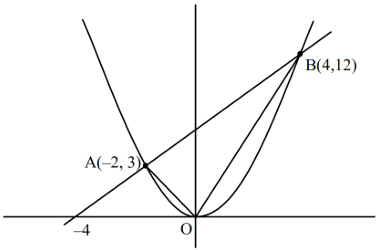
If the line $3 x-2 y+12=0$ intersects the parabola $4 y=3 x^2$ at the points A and B, then at the vertex of the parabola, the line segment AB subtends an angle equal to
- A
$\tan ^{-1}\left(\frac{11}{9}\right)$
- B
$\frac{\pi}{2}-\tan ^{-1}\left(\frac{3}{2}\right)$
- C
$\tan ^{-1}\left(\frac{4}{5}\right)$
- D
$\tan ^{-1}\left(\frac{9}{7}\right)$
View full question & answer→MCQ 184 Marks
If the function
$
f(x)=\left\{\begin{array}{cc}
\frac{2}{x}\left\{\sin \left(k_1+1\right) x+\sin \left(k_2-1\right) x\right\} & , x<0 \\
4 & , x=0 \\
\frac{2}{x} \log _{e}\left(\frac{2+k_1 x}{2+k_2 x}\right) & , x>0
\end{array}\right.
$
is continuous at $x =0$, then $k _1{ }^2+ k _2{ }^2$ is equal to
Answer(D)
$
\begin{array}{l}
\lim _{x \rightarrow 0^{-}} \frac{2}{x}\left\{\sin \left(k_1+1\right) x+\sin \left(k_2-1\right) x\right\}=4 \\
\Rightarrow 2\left(k_1+1\right)+2\left(k_2-1\right)=4 \\
\Rightarrow k_1+k_2=2 \\
\Rightarrow \lim _{x \rightarrow 0^{+}} \frac{2}{x} \ln \left(\frac{2+k_1 x}{2+k_2 x}\right)=4 \\
\Rightarrow \lim _{x \rightarrow 0^{+}} \frac{1}{x} \ln \left(1+\frac{\left(k_1-k_2\right) x}{2+k_2 x}\right)=2 \\
\Rightarrow \frac{k_1-k_2}{2}=2 \\
\Rightarrow k_1-k_2=4 \\
\therefore k_1=3, k_2=-1 \\
k_1^2+k_2^2=9+1=10
\end{array}
$
View full question & answer→Question 194 Marks
Let $I ( x )=\int \frac{ dx }{( x -11)^{\frac{11}{13}}( x +15)^{\frac{15}{13}}}$.
If $I (37)- I (24)=\frac{1}{4}\left(\frac{1}{b^{\frac{1}{13}}}-\frac{1}{ c ^{\frac{1}{13}}}\right), b , c \in N$, then $3(b+c)$ is equal to
Answer(B)
$
\begin{array}{l}
I(x)=\int \frac{dx}{(x-11)^{\frac{11}{13}}(x+15)^{\frac{15}{13}}} \\
\text { Put } \frac{x-11}{x+15}=t \Rightarrow \frac{26}{(x+5)^2} dx=dt \\
I(x)=\frac{1}{26} \int \frac{dt}{t^{1 / 13}}=\frac{1}{26} \cdot \frac{t^{2 / 13}}{2 / 13}
\end{array}
$
$\begin{array}{l} I ( x )=\frac{1}{4}\left(\frac{ x -11}{ x +15}\right)^{2 / 13}+ C \\ I (37)- I (24)=\frac{1}{4}\left(\frac{26}{52}\right)^{2 / 13}-\frac{1}{4}\left(\frac{13}{39}\right)^{2 / 13} \\ =\frac{1}{4}\left(\frac{1}{2^{2 / 13}}-\frac{1}{3^{2 / 13}}\right) \\ =\frac{1}{4}\left(\frac{1}{4^{1 / 13}}-\frac{1}{9^{1 / 13}}\right) \\ \therefore b =4, c =9 \\ 3(b+ c )=39\end{array}$
View full question & answer→MCQ 204 Marks
The value of $\int_{e^2}^{ e ^4} \frac{1}{x}\left(\frac{e^{\left(\left(\log _{ e } x\right)^2+1\right)^{-1}}}{e^{\left(\left(\log _e x\right)^2+1\right)^{-1}}+e^{\left(\left(6-\log _e x\right)^2+1\right)^{-1}}}\right) d x$ is
- A
$\log _{ c } 2$
- B
- ✓
- D
$e ^2$
Answer(C)
Let $\ln x = t \Rightarrow \frac{ dx }{ x }= dt$
$
\begin{array}{l}
I=\int_2^4 \frac{e^{\frac{1}{1+t^2}}}{e^{\frac{1}{1+t^2}}+e^{\frac{1}{1+(6-t)^2}}} d t \\
I=\int_2^4 \frac{\frac{1}{e^{1+(6-t)^2}}}{\frac{1}{e^{1+(6-t)^2}}+e^{\frac{1}{1+t^2}}} d t \\
2 I=\int_2^4 d t=(t)_2^4=4-2=2 \\
I=1
\end{array}
$
View full question & answer→