Questions

SECTION - A [CHEMISTY - MCQ]

Take a timed test

20 questions · auto-graded multiple-choice test.

MCQ 14 Marks
Consider the following reactions
$K _2 Cr _2 O _7 \xrightarrow[- H _2 O ]{ KOH }[ A ] \xrightarrow[- H _2 O ]{ H _2 SO _4}[B]+ K _2 SO _4$
The products [A] and [B], respectively are :
  • A
    $K _2 Cr ( OH )_6$ and $Cr _2 O _3$
  • B
    $K _2 CrO _4$ and $Cr _2 O _3$
  • $K _2 CrO _4$ and $K _2 Cr _2 O _7$
  • D
    $K _2 CrO _4$ and CrO
Answer
Correct option: C.
$K _2 CrO _4$ and $K _2 Cr _2 O _7$
(C)

Image
View full question & answer
MCQ 24 Marks
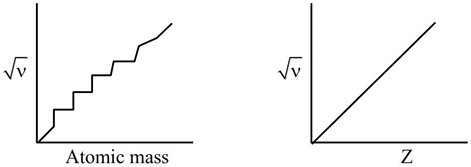
Given below are two statements about X-ray spectra of elements :
Statement (I) : A plot of $\sqrt{v}(v=$ frequency of X-rays emitted) vs atomic mass is a straight line.
Statement (II) : A plot of $v(v=$ frequency of X-rays emitted) vs atomic number is a straight line. In the light of the above statements choose the correct answer from the options given below :
  • A
    Statement I is true but Statement II is false
  • B
    Both Statement I and Statement II are true
  • Both Statement I and Statement II are false
  • D
    Statement I is false but Statement II is true
Answer
Correct option: C.
Both Statement I and Statement II are false
(C)
Image
View full question & answer
MCQ 34 Marks
Consider a binary solution of two volatile liquid components 1 and $2 x _1$ and $y _1$ are the mole fractions of component 1 in liquid and vapour phase, respectively. The slope and intercept of the linear plot of $\frac{1}{x_1}$ vs $\frac{1}{y_1}$ are given respectively as :
  • $\frac{ P _1^0}{ P _2^0}, \frac{ P _2^0- P _1^0}{ P _2^0}$
  • B
    $\frac{ P _2^0}{ P _1^0}, \frac{ P _1^0- P _2^0}{ P _2^0}$
  • C
    $\frac{ P _1^0}{ P _2^0}, \frac{ P _1^0- P _2^0}{ P _2^0}$
  • D
    $\frac{ P _2^0}{ P _1^0}, \frac{ P _2^0- P _1^0}{ P _2^0}$
Answer
Correct option: A.
$\frac{ P _1^0}{ P _2^0}, \frac{ P _2^0- P _1^0}{ P _2^0}$
(A)
$\because$ For liquid solution of two liquids ' 1 ' and ' 2 '
$
\begin{array}{l}
P_1=P_{T y_1}=P_1^{o} x_1 \\
\therefore \frac{P_{T}}{x_1}=\frac{P_1^{o}}{y_1} \\
\therefore \frac{P_2^{o}+x_1\left(P_1^{o}-P_2^{o}\right)}{x_1}=\frac{P_1^{o}}{y_1}
\end{array}
$
$\begin{array}{l}\therefore \frac{ P _2^{ o }}{ x _1}+\left( P _1^{ o }- P _2^{ o }\right)=\frac{ P _1^{ o }}{ y _1} \\ \therefore \frac{1}{ x _1}=\left(\frac{ P _1^{ o }}{ P _2^{ o }}\right)\left(\frac{1}{ y _1}\right)+\left(\frac{ P _2^{ o }- P _1^{ o }}{ P _2^{ o }}\right) \\ \therefore \text { Slope }=\left(\frac{ P _1^{ o }}{ P _2^{ o }}\right) \\ \therefore \text { Intercept }=\left(\frac{ P _2^{ o }- P _1^{ o }}{ P _2^{ o }}\right)\end{array}$
View full question & answer
MCQ 44 Marks
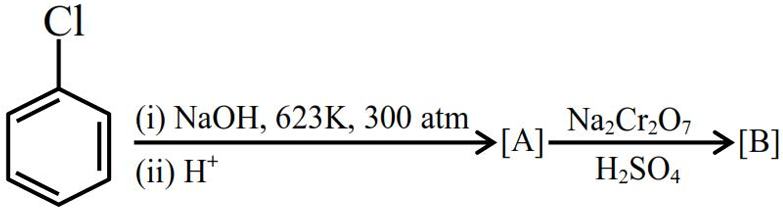
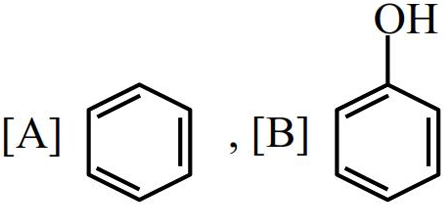
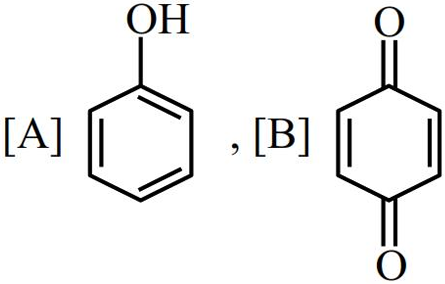
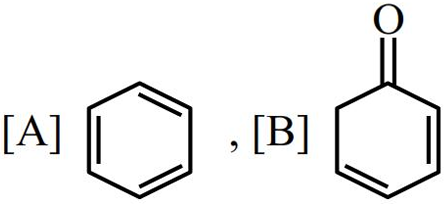
Identify the products $[A]$ and $[B]$, respectively in the following reaction :
Image
  • A
    Image
  • B
    Image
  • Image
  • D
    Image
Answer
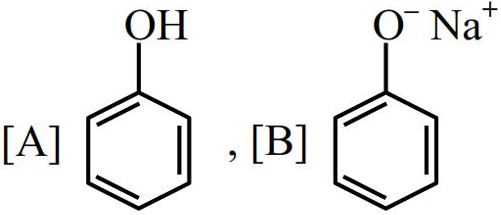
Correct option: C.
Image
(C)
A is phenol and B is para benzoquinone.
View full question & answer
MCQ 54 Marks
pH of water is 7 at $25^{\circ} C$. If water is heated to $80^{\circ} C$, it's pH will :
  • Decrease
  • B
    Remains the same
  • C
    $H ^{+}$concentration increases, $OH ^{-}$concentration decreases
  • D
    Increase
Answer
Correct option: A.
Decrease
(A)
With increase in temperature, $K _{ w }$ of water increases So, degree of dissociation of water increase $\therefore pH$ as well as pOH of water decrease.
View full question & answer
MCQ 64 Marks
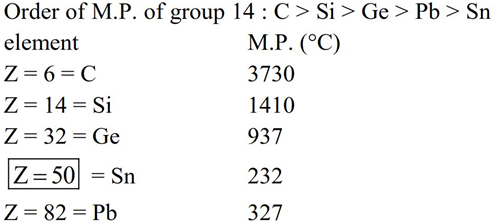
Given below are the atomic numbers of some group 14 elements. The atomic number of the element with lowest melting point is :
  • A
    14
  • B
    6
  • C
    82
  • 50
Answer
Correct option: D.
50
(D)
Image
View full question & answer
MCQ 74 Marks
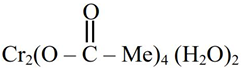
Identify the coordination complexes in which the central metal ion has $d ^4$ configuration.
(A) $\left[ FeO _4\right]^{2-}$
(B) $\left[ Mn ( CN )_6\right]^{3-}$
(C) $\left[ Fe ( CN )_6\right]^{3-}$
(D)
Image
(E) $\left[ NiF _6\right]^{2-}$
Choose the correct answer from the options given below :
  • A
    (C) and (E) only
  • B
    (B), (C) and (D) only
  • (B) and (D) only
  • D
    (A), (B) and (E) only
Answer
Correct option: C.
(B) and (D) only
(C)
$\begin{array}{l} Fe ^{+6}=[ Ar ] 3 d^2 \\ Mn ^{+3}=[ Ar ] 3 d^4 \\ Fe ^{+3}=[ Ar ] 3 d^5 \\ Cr ^{+2}=[ Ar ] 3 d^4 \\ Ni ^{+4}=[ Ar ] 3 d^6\end{array}$
View full question & answer
MCQ 84 Marks
Match list - i with list - ii.
List - IList - II
(A)Bronze(I)Cu,Ni
(B)Brass(II)Fe,Cr,Ni,C
(C)UK silver coin(III)Cu,Zn
(D)Stainless Steel(IV)Cu,Sn
choose the correct answer from the options given below :
  • A
    (A)-(IV), (B)-(II), (C)-(III), (D)-(I)
  • (A)-(IV), (B)-(III), (C)-(I), (D)-(II)
  • C
    (A)-(III), (B)-(I), (C)-(IV), (D)-(II)
  • D
    (A)-(III), (B)-(IV), (C)-(II), (D)-(I)
Answer
Correct option: B.
(A)-(IV), (B)-(III), (C)-(I), (D)-(II)
(B)
Bronze $\rightarrow Cu , Sn$
Brass $\rightarrow Cu , Zn$
UK silver coin $\rightarrow Cu , Ni$
Stainless steel $\rightarrow Fe , Cr , Ni , C$
View full question & answer
MCQ 94 Marks
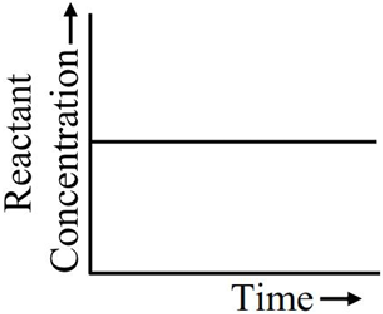
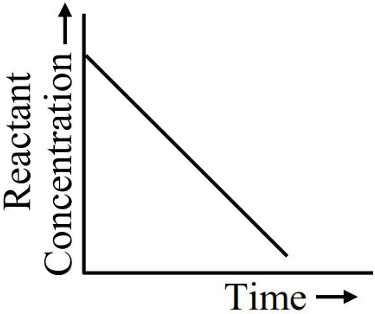
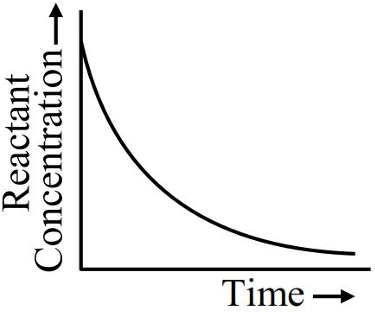
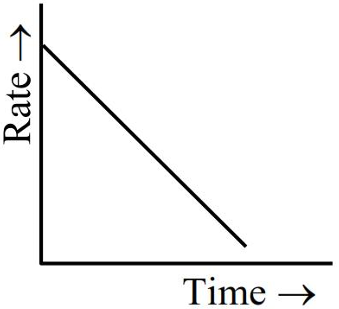
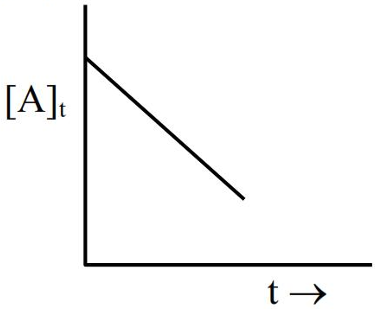
Which of the following graphs most appropriately represents a zero order reaction?
  • A
    Image
  • Image
  • C
    Image
  • D
    Image
Answer
Correct option: B.
Image
(B)
For zero order reaction : $A \rightarrow P$
$
\begin{array}{l}
\text { Rate }=k \\
{[A]_t=a_0-k t}
\end{array}
$
Image
View full question & answer
MCQ 104 Marks
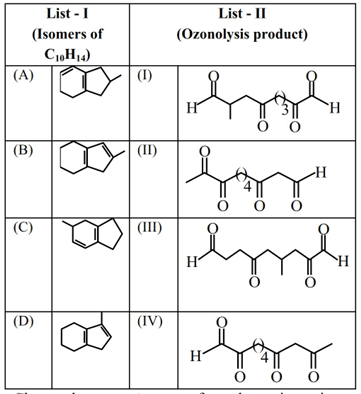
Match list - i with list - ii
Image
choose the correct answer from the option given below :
  • A
    (A)-(II), (B)-(III), (C)-(I), (D)-(IV)
  • (A)-(III), (B)-(IV), (C)-(I), (D)-(II)
  • C
    (A)-(III), (B)-(II), (C)-(I), (D)-(IV)
  • D
    (A)-(I), (B)-(IV), (C)-(III), (D)-(II)
Answer
Correct option: B.
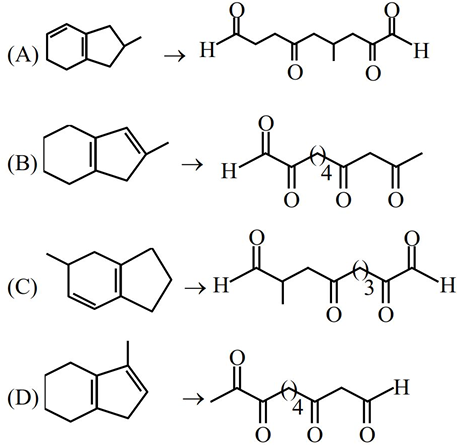
(A)-(III), (B)-(IV), (C)-(I), (D)-(II)
(B)
ozonlysis product
Image
View full question & answer
MCQ 114 Marks
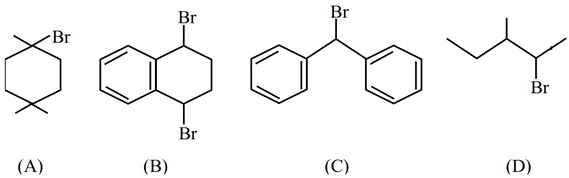
The ascending order of relative rate of solvolysis of following compounds is
Image
  • $($ D $)<$ (A) $<$ (B) $<$ (C)
  • B
    $( C )<( B )<( A )<( D )$
  • C
    (D) $<$ (B) $<$ (A) $<$ (C)
  • D
    $( C )<( D )<( B )<( A )$
Answer
Correct option: A.
$($ D $)<$ (A) $<$ (B) $<$ (C)
(A)
Solvolysis or $S _{ N } 1 \propto$ stability of carboccation Stability order
Image
View full question & answer
MCQ 124 Marks
Given below are two statements:Statement (I): For a given shell, the total number of allowed orbitals is given by $n ^2$.
Statement (II) : For any subshell, the spatial orientation of the orbitals is given by $-l$ to $+l$ values including zero.
In the light of the above statements, choose the correct answer from the options given below:
  • A
    Statement I is true but Statement II is false
  • B
    Statement I is false but Statement II is true
  • Both Statement I and Statement II are true
  • D
    Both Statement I and Statement II are false
Answer
Correct option: C.
Both Statement I and Statement II are true
(C)
For a shell total number of orbitals $=n^2$
Magnetic quantum number have values $(-\ell$ to $+\ell)$ including 0 .
View full question & answer
MCQ 134 Marks
When a non-volatile solute is added to the solvent, the vapour pressure of the solvent decreases by 10 mm of Hg . The mole fraction of the solute in the solution is 0.2 . What would be the mole fraction of the solvent if decrease in vapour pressure is 20 mm of Hg ?
  • 0.6
  • B
    0.4
  • C
    0.2
  • D
    0.8
Answer
Correct option: A.
0.6
(A)
$\because P ^{\circ}- P \propto X _{\text {solute }}$
and $\because 10 \propto 0.2$
$
\begin{array}{l}
\therefore 20 \propto 0.4 \\
\begin{aligned}
\therefore X_{\text {solvent }} & =1-X_{\text {solute }} \\
& =1-0.4 \\
\quad= & 0.6
\end{aligned}
\end{array}
$
View full question & answer
MCQ 144 Marks
Given below are two statements:
Statement (I) : The boiling points of alcohols and phenols increase with increase in the number of C -atoms.
Statement (II) : The boiling points of alcohols and phenols are higher in comparison to other class of compounds such as ethers, haloalkanes.
In the light of the above statements, choose the correct answer from the options given below:
  • A
    Both Statement I and Statement II are false
  • B
    Statement I is false but Statement II is true
  • C
    Statement I is true but Statement II is false
  • Both Statement I and Statement II are true
Answer
Correct option: D.
Both Statement I and Statement II are true
(D)
B.P. $\propto$ M.W.
B.P. $\propto$ Inter molecular hydrogen bondingAlcohol \& Phenol have intermolecular H-bonding
View full question & answer
MCQ 154 Marks
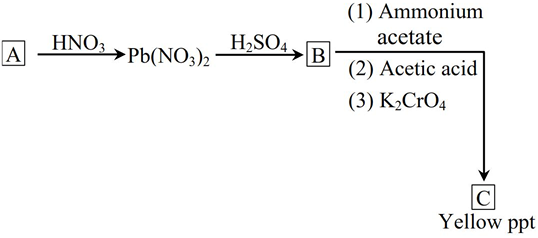
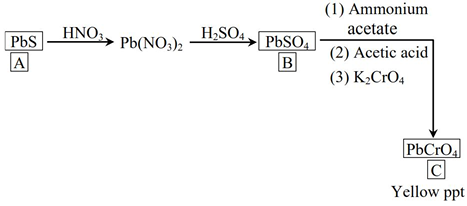
Identify $A , B$ and C in the given below reaction sequence
Image
  • A
    $PbCl _2, PbSO _4, PbCrO _4$
  • $PbS , PbSO _4, PbCrO _4$
  • C
    $PbS , PbSO _4, Pb\left( CH _3 COO \right)_2$
  • D
    $PbCl _2, Pb\left( SO _4\right)_2, PbCrO _4$
Answer
Correct option: B.
$PbS , PbSO _4, PbCrO _4$
(B)
Image
View full question & answer
MCQ 164 Marks
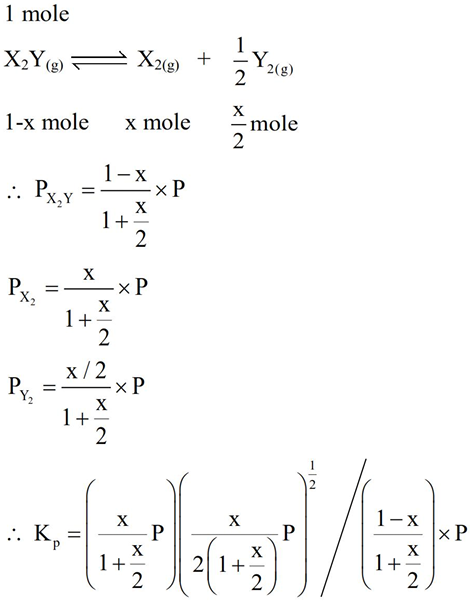
Consider the reaction
$
X_2 Y(g) \rightleftharpoons X_2(g)+\frac{1}{2} Y_2(g)
$
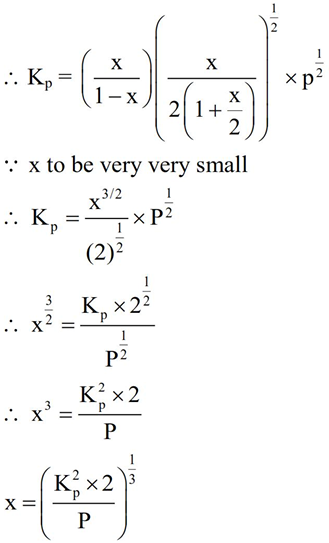
The equation representing correct relationship between the degree of dissociation ( x ) of $X _2 Y ( g )$ with its equilibrium constant Kp is __________.
Assume $x$ to be very very small.
  • A
    $x=\sqrt[3]{\frac{2 K p}{p}}$
  • $x=\sqrt[3]{\frac{2 K p^2}{p}}$
  • C
    $x=\sqrt[3]{\frac{K p}{2 p}}$
  • D
    $x=\sqrt[3]{\frac{K p}{p}}$
Answer
Correct option: B.
$x=\sqrt[3]{\frac{2 K p^2}{p}}$
(B)
Image
Image
View full question & answer
MCQ 174 Marks
Given below are two statements:
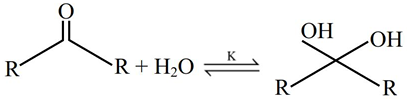
Consider the following reaction
Image

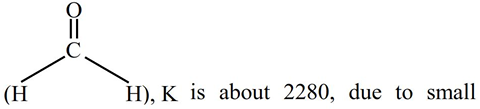
Statement (I) : In the case of formaldehyde
Image
substituents, hydration is faster.
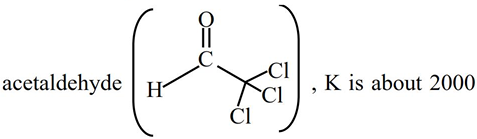
Statement (II) : In the case of trichloro
Image
due to - I effect of - Cl .
In the light of the above statements, choose the correct answer from the options given below:
  • A
    Statement I true but Statement II is false
  • Both Statement I and Statement II are true
  • C
    Statement I is false but Statement II is true
  • D
    Both Statement I and Statement II are false
Answer
Correct option: B.
Both Statement I and Statement II are true
(B)
$k _{ eq }=2280$ is for HCHO
$k _{ eq }=2000$ is for chloral
Both data is given in clayden and warren book.
$k _{ eq }>1$ because HCHO and chloral are more electrophilic.
View full question & answer
MCQ 184 Marks
The $\alpha$-Helix and $\beta$ - Pleated sheet structures of protein are associated with its:
  • A
    quaternary structure
  • B
    primary structure
  • secondary structure
  • D
    tertiary structure
Answer
Correct option: C.
secondary structure
(C)
$\alpha$-helix and $\beta$-pleated sheet belongs to secondary structure of protein, which have hydrogen bonds.
View full question & answer
MCQ 194 Marks
Standard electrode potentials for a few half cells are mentioned below :
$
\begin{array}{l}
E_{Cu^{2+} / Cu}^{o}=0.34 V, E_{Zn^{2+} / Zn}^{o}=-0.76 V \\
E_{Ag^{+} / Ag}^{o}=0.80 V, E_{Mg^{2+} / Mg}^{o}=-2.37 V
\end{array}
$
Which one of the following cells gives the most negative value of $\Delta G ^{ o }$ ?
  • $Zn \left| Zn ^{2+}(1 M ) \| Ag ^{+}(1 M )\right| Ag$
  • B
    $Zn \left| Zn ^{2+}(1 M )\right|\left| Mg ^{2+}(1 M )\right| Mg$
  • C
    $Ag \left| Ag ^{+}(1 M )\right|\left| Mg ^{2+}(1 M )\right| Mg$
  • D
    $Cu \left| Cu ^{2+}(1 M ) \| Ag ^{+}(1 M )\right| Ag$
Answer
Correct option: A.
$Zn \left| Zn ^{2+}(1 M ) \| Ag ^{+}(1 M )\right| Ag$
(A)
$
\begin{array}{l} 
\because \Delta G^{\circ}=-nFE^{\circ} \\
\text { Option (1) } E^{\circ}=0.8+0.76 \\
=1.56 V \\
\therefore \Delta G^{\circ}=-2 \times F \times 1.56 \\
=-3.12 V
\end{array}
$
$
\begin{array}{c}
\text { Option (2) } E^{\circ}=-2.37+0.76 \\
=-1.61 V \\
\therefore \Delta G^{\circ}=-2 \times F \times(-1.61) \\
=+3.22 V
\end{array}
$
$
\begin{array}{c}
\text { Option (3) } \begin{aligned}
E^{\circ} & =-2.37-0.8 \\
& =-3.17 V \\
\therefore \Delta G^{\circ}=-2 & \times F \times(-3.17) \\
& =+6.34
\end{aligned}
\end{array}
$
Option (4)
$
\begin{aligned}
E^{\circ} & =0.8-0.34 \\
& =0.46 V
\end{aligned}
$
$
\begin{aligned}
\Delta G^{\circ} & =-2 \times F \times 0.46 \\
& =-0.92 V
\end{aligned}
$
View full question & answer
MCQ 204 Marks
Image
  • A
    (B) and (D) only
  • B
    (A) and (D) only
  • (B) and (C) only
  • D
    (A) and (C) only
Answer
Correct option: C.
(B) and (C) only
(C)
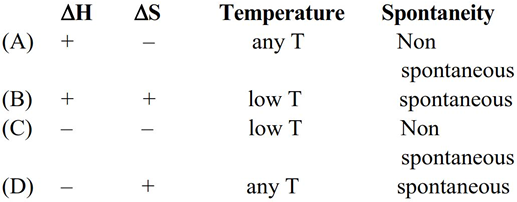
$\because \Delta G =\Delta H - T \Delta S$
For spontaneity of reaction : $\Delta G =- ve$
View full question & answer