MCQ 14 Marks
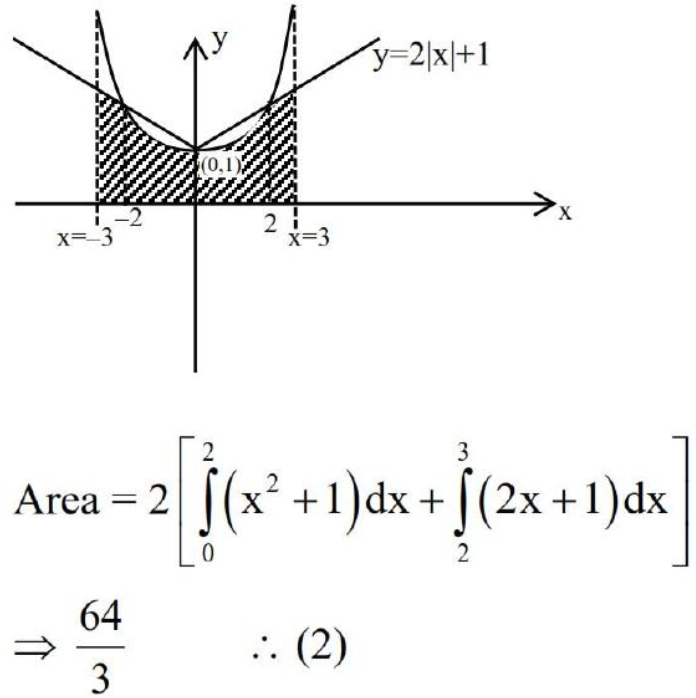
The area (in sq. units) of the region $\left\{(x, y): 0 \leq y \leq 2|x|+1,0 \leq y \leq x^{2}+1,|x| \leq 3\right\}$ is
- A
$\frac{80}{3}$
- B
$\frac{64}{3}$
- C
$\frac{17}{3}$
- D
$\frac{32}{3}$
View full question & answer→MCQ 24 Marks
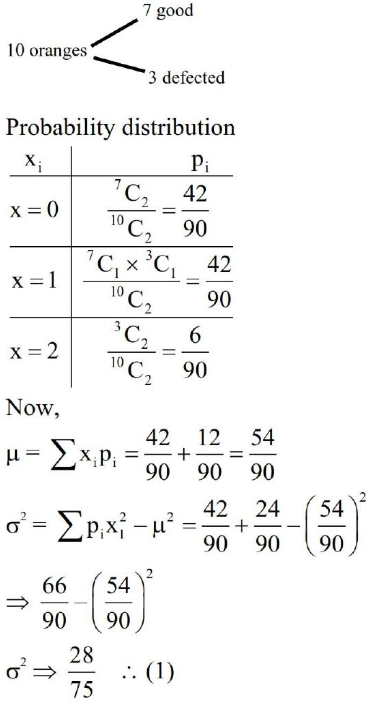
Three defective oranges are accidently mixed with seven good ones and on looking at them, it is not possible to differentiate between them. Two oranges are drawn at random from the lot. If $x$ denote the number of defective oranges, then the variance of x is :
- A
$28 / 75$
- B
$14 / 25$
- C
$26 / 75$
- D
$18 / 25$
View full question & answer→MCQ 34 Marks
Let $O$ be the origin, the point $A$ be $z_{1}=\sqrt{3}+2 \sqrt{2 \mathrm{i}}$, the point $\mathrm{B}\left(\mathrm{z}_{2}\right)$ be such that $\sqrt{3}\left|z_{2}\right|=\left|z_{1}\right|$ and $\arg \left(z_{2}\right)=\arg \left(z_{1}\right)+\frac{\pi}{6}$. Then
AnswerCorrect option: D. ABO is an obtuse angled isosceles triangle
(D)
Sol. $z_{1}=\sqrt{3}+2 \sqrt{2} i \quad \& \frac{\left|z_{2}\right|}{\left|z_{1}\right|}=\frac{1}{\sqrt{3}}$
given $\arg \left(\frac{z_{2}}{z_{1}}\right)=\frac{\pi}{6}$
$z_{2}=\frac{\left|z_{2}\right|}{\left|z_{1}\right|} \cdot z_{1} e^{i\left(\frac{\pi}{6}\right)}$
$z_{2}=\frac{1}{\sqrt{3}} \cdot \frac{(\sqrt{3}+2 \sqrt{2} i)(\sqrt{3}+i)}{2}$
$z_{2}=\frac{(3-2 \sqrt{2})+i(2 \sqrt{6}+\sqrt{3})}{2 \sqrt{3}}$
Now,
$z_{1}-z_{2}=\frac{(3+2 \sqrt{2})+i(2 \sqrt{6}-\sqrt{3})}{2 \sqrt{3}}$
$\left|\mathrm{z}_{1}-\mathrm{z}_{2}\right|=\left|\mathrm{z}_{2}\right| \Rightarrow \triangle \mathrm{ABO}$ is isosceles with angles $\frac{\pi}{6}, \frac{\pi}{6} \& \frac{2 \pi}{3}$
View full question & answer→MCQ 44 Marks
Let ${ }^{n} C_{r-1}=28,{ }^{n} C_{r}=56$ and ${ }^{n} C_{r+1}=70$. Let $\mathrm{A}(4 \cos t, 4 \sin t), \mathrm{B}(2 \sin t,-2 \cos t)$ and $\mathrm{C}\left(3 \mathrm{r}-\mathrm{n}, \mathrm{r}^{2}-\mathrm{n}-1\right)$ be the vertices of a triangle $A B C$, where $t$ is a parameter. If $(3 x-1)^{2}+(3 y)^{2}=\alpha$, is the locus of the centroid of triangle ABC , then $\alpha$ equals :
Answer(A)
Sol. ${ }^{n} C_{r-1}=28,{ }^{n} C_{r}=56$
$\frac{{ }^{n} C_{r-1}}{{ }^{n} C_{r}}=\frac{28}{56}$
$\frac{\frac{n!}{(r-1)!(n-r+1)!}}{\frac{n!}{r!(n-r)!}}=\frac{1}{2}$
$\frac{\mathrm{r}}{(\mathrm{n}-\mathrm{r}+1)}=\frac{1}{2}$
$3 \mathrm{r}=\mathrm{n}+1$
$\frac{{ }^{\mathrm{n}} \mathrm{C}_{\mathrm{r}}}{{ }^{{ }^{n} \mathrm{C}_{\mathrm{r}+1}}}=\frac{56}{70}$
$\frac{(\mathrm{r}+1)}{(\mathrm{n}-\mathrm{r})}=\frac{56}{70} \Rightarrow 9 \mathrm{r}=4 \mathrm{n}-5$
By (i) \& (ii)
( $\mathrm{r}=3$ ), $(\mathrm{n}=8)$
A (4cost, 4sint) B(2sint, $-2 \cos t) \mathrm{C}\left(3 \mathrm{r}-\mathrm{n}, \mathrm{r}^{2}-\mathrm{n}-1\right)$
A (4cost, 4sint) $\quad \mathrm{B}(2 \sin t,-2 \cos t) \mathrm{C}(1,0)$
$(3 x-1)^{2}+(3 y)^{2}=(4 \cos t+2 \sin t)^{2}+(4 \sin t-\cos t)^{2}$
$(3 \mathrm{x}-1)^{2}+(3 \mathrm{y})^{2}=20 \quad \therefore$
View full question & answer→MCQ 54 Marks
Let for some function $y=f(x), \int_{0}^{x} t f(t) d t=x^{2} f(x)$, $x>0$ and $f(2)=3$. Then $f(6)$ is equal to :
Answer(A)
Sol. $\int_{0}^{\mathrm{x}} \mathrm{tf}(\mathrm{t}) \mathrm{dt}=\mathrm{x}^{2}+(\mathrm{x}), \mathrm{x}>0$
Diff. both side w.r. to $x$
$x f(x)=x^{2} f^{\prime}(x)+2 x f(x)$
$-x f(x)=x^{2} f^{\prime}(x)$
$\int \frac{f^{\prime}(x)}{f(x)} d x=\int \frac{-1}{x} d x$
$\operatorname{logdf}(x)=-\log x+\log c$
$f(x)=\frac{c}{x}$
$\mathrm{f}(2)=3 \Rightarrow 3=\frac{\mathrm{c}}{2} \Rightarrow \mathrm{c}=6$
$f(x)=\frac{6}{x}$
$f(6)=1$
View full question & answer→MCQ 64 Marks
The sum, of the squares of all the roots of the equation $x^{2}+|2 x-3|-4=0$, is :
- A
$3(3-\sqrt{2})$
- B
$6(3-\sqrt{2})$
- ✓
$6(2-\sqrt{2})$
- D
$3(2-\sqrt{2})$
AnswerCorrect option: C. $6(2-\sqrt{2})$
(C)Sol. $\quad x^{2}+|2 x-3|-4=0$
Case I: $x \geq \frac{3}{2}$
$
\begin{aligned}
& x^{2}+2 x-3-4=0 \\
& x^{2}+2 x-7=0 \\
& x=2 \sqrt{2}-1
\end{aligned}
$
Case II : $\mathrm{x}<\frac{3}{2}$
$
\begin{aligned}
& x^{2}+3-2 x-4=0 \\
& x^{2}-2 x-1=0 \\
& x=1-\sqrt{2}
\end{aligned}
$
Sum of squares $=(2 \sqrt{2}-1)^{2}+(1-\sqrt{2})^{2}$
$
\begin{align*}
& =8-4 \sqrt{2}+1+1-2 \sqrt{2}+2 \\
& =6(2-\sqrt{2}) \quad \therefore(3) \tag{3}
\end{align*}
$
View full question & answer→MCQ 74 Marks
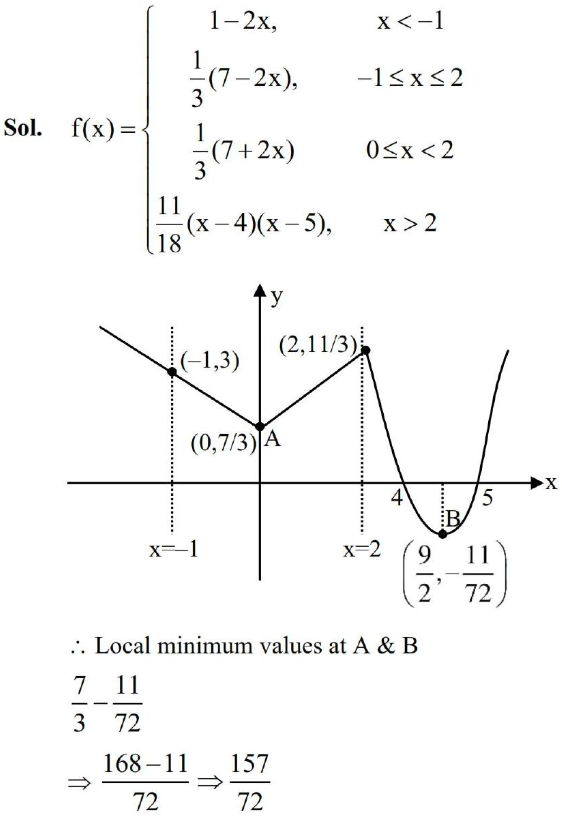
The sum of all local minimum values of the function $f(x)=\left\{\begin{array}{cc}1-2 x, & x<-1 \\ \frac{1}{3}(7+2|x|), & -1 \leq x \leq 2 \\ \frac{11}{18}(x-4)(x-5), & x>2\end{array}\right.$
- A
$\frac{171}{72}$
- B
$\frac{131}{72}$
- C
$\frac{157}{72}$
- D
$\frac{167}{72}$
View full question & answer→MCQ 84 Marks
If $\int_{-\frac{\pi}{2}}^{\frac{\pi}{2}} \frac{96 x^{2} \cos ^{2} x}{\left(1+e^{x}\right)} d x=\pi\left(\alpha \pi^{2}+\beta\right), \alpha, \beta \in Z$, then $(\alpha+\beta)^{2}$ equals :
Answer(C)
Sol. $\int_{-\frac{\pi}{2}}^{\frac{\pi}{2}} \frac{96 x^{2} \cos ^{2} x}{\left(1+e^{x}\right)} d x$ (Apply King Property)
$
\begin{aligned}
& \int_{0}^{\frac{\pi}{2}} 96 x^{2} \cos ^{2} x=48 \int_{0}^{\frac{\pi}{2}} x^{2}(1+\cos 2 x) d x \\
& 48\left[\left(\frac{x^{3}}{3}\right)_{0}^{\pi / 2}+\int_{0}^{\frac{\pi}{2}} x_{\mathrm{I}}^{2} \cos 2 x d x\right]
\end{aligned}
$
$\Rightarrow$ On solving $\pi\left(2 \pi^{2}-12\right)$
$\Rightarrow \alpha=2, \beta=-12$
$\Rightarrow(\alpha+\beta)^{2}=100$
View full question & answer→MCQ 94 Marks
If the image of the point $(4,4,3)$ in the line $\frac{x-1}{2}=\frac{y-2}{1}=\frac{z-1}{3}$ is $(\alpha, \beta, \gamma)$, then $\alpha+\beta+\gamma$ is equal to
Answer(A)
Sol.
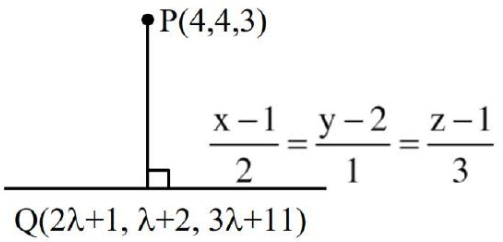
$\overrightarrow{\mathrm{PQ}} \perp(2 \hat{\mathrm{i}}+\hat{\mathrm{j}}+3 \hat{\mathrm{k}})$
$\Rightarrow 2(2 \lambda-3)+1(\lambda-2)+3(3 \lambda-2)=0$
$\Rightarrow 14 \lambda-14=0, \lambda=1$
So, $\mathrm{Q}(3,3,4)$
Let image in $\mathrm{R}(\alpha, \beta, \gamma)$
$\frac{\alpha+4}{2}=3, \frac{\beta+4}{2}=3, \frac{\gamma+3}{2}=4$
$(\alpha, \beta, \gamma)=(2,2,5)$
$\Rightarrow \alpha+\beta+\gamma=9$
View full question & answer→MCQ 104 Marks
Let $T_{r}$ be the $r^{\text {th }}$ term of an A.P. If for some $m$,
$\mathrm{T}_{\mathrm{m}}=\frac{1}{25}, \mathrm{~T}_{25}=\frac{1}{20}$ and $20 \sum_{\mathrm{r}=1}^{25} \mathrm{~T}_{\mathrm{r}}=13$, then $5 \mathrm{~m} \sum_{\mathrm{r}=\mathrm{m}}^{2 \mathrm{~m}} \mathrm{~T}_{\mathrm{r}}$ is equal to :
Answer(B)
Sol. $\mathrm{T}_{\mathrm{m}}=\frac{1}{25}, \mathrm{~T}_{25}=\frac{1}{20}, 20 \sum_{\mathrm{r}=1}^{25} \mathrm{~T}_{\mathrm{r}}=13$
$\mathrm{T}_{\mathrm{m}}=\mathrm{a}+(\mathrm{m}-1) \mathrm{d}=\frac{1}{25}$
$\mathrm{T}_{25}=\mathrm{a}+24 \mathrm{~d}=\frac{1}{20}$
20. $\frac{25}{2}\left[a+\frac{1}{20}\right]=13 \Rightarrow a=\frac{1}{500}$
also, $20 \mathrm{~S}_{25}=20 \cdot \frac{25}{2}[2 \mathrm{a}+24 \mathrm{~d}]=13 \Rightarrow \mathrm{~d}=\frac{1}{500}$
from (1) $\frac{1}{500}+\frac{m-1}{500}=\frac{1}{25} \Rightarrow m=20$
Now,
$5 \mathrm{~m} \sum_{\mathrm{r}=\mathrm{m}}^{2 \mathrm{~m}} \mathrm{~T}_{\mathrm{r}}=100 \sum_{\mathrm{r}=20}^{40} \mathrm{~T}_{\mathrm{r}}=126$
View full question & answer→MCQ 114 Marks
$\cos \left(\sin ^{-1} \frac{3}{5}+\sin ^{-1} \frac{5}{13}+\sin ^{-1} \frac{33}{65}\right)$ is equal to :
- A
- ✓
- C
$\frac{33}{65}$
- D
$\frac{32}{65}$
Answer(B)
Sol. $\cos \left(\sin ^{-1} \frac{3}{5}+\sin ^{-1} \frac{5}{13}+\sin ^{-1} \frac{33}{65}\right)$
$\cos \left(\tan ^{-1} \frac{3}{4}+\tan ^{-1} \frac{5}{12}+\tan ^{-1} \frac{33}{56}\right)$
$\cos \left(\tan ^{-1}\left(\frac{\frac{3}{4}+\frac{5}{12}}{1+\frac{3}{4} \cdot \frac{5}{12}}\right)+\tan ^{-1} \frac{33}{56}\right)$
$\cos \left(\tan ^{-1} \frac{56}{33}+\cot ^{-1} \frac{56}{33}\right)$
$\cos \left(\frac{\pi}{2}\right)=0$
View full question & answer→MCQ 124 Marks
Let $$ be a sequence such that $a_{0}=0, a_{1}=\frac{1}{2}$ and $2 a_{n+2}=5 a_{n+1}-3 a_{n}, n=0,1,2,3, \ldots \ldots$ Then $\sum_{k=1}^{100} a_{k}$ is equal to : - A
$3 \mathrm{a}_{99}-100$
- ✓
$3 \mathrm{a}_{100}-100$
- C
$3 \mathrm{a}_{100}+100$
- D
$3 \mathrm{a}_{99}+100$
AnswerCorrect option: B. $3 \mathrm{a}_{100}-100$
(B)
Sol. $\mathrm{a}_{0}=0, \mathrm{a}_{1}=\frac{1}{2}$
$2 \mathrm{a}_{\mathrm{n}+2}=5 \mathrm{a}_{\mathrm{n}+1}-3 \mathrm{a}_{\mathrm{n}}$
$2 \mathrm{x}^{2}-5 \mathrm{x}+3=0 \Rightarrow \mathrm{x}=1,3 / 2$
$\therefore \mathrm{a}_{\mathrm{n}}=\mathrm{A}(1)^{\mathrm{n}}+\mathrm{B}\left(\frac{3}{2}\right)^{\mathrm{n}}$
$\left.\begin{array}{ll}\mathrm{n}=0 & 0=\mathrm{A}+\mathrm{B} \\ \mathrm{n}=1 & \frac{1}{2}=\mathrm{A}+\frac{3}{2} \mathrm{~B}\end{array}\right] \begin{aligned} & \mathrm{A}=-1 \\ & \mathrm{~B}=1\end{aligned}$
$\Rightarrow \mathrm{a}_{\mathrm{n}}=-1+\left(\frac{3}{2}\right)^{\mathrm{n}}$
$\sum_{k=1}^{100} a_{k}=\sum_{k=1}^{100}(-1)+\left(\frac{3}{2}\right)^{k}$
$=-100+\frac{\left(\frac{3}{2}\right)\left(\left(\frac{3}{2}\right)^{100}-1\right)}{\frac{3}{2}-1}$
$=-100+3\left(\left(\frac{3}{2}\right)^{100}-1\right)$
$=3 .\left(\mathrm{a}_{100}\right)-100$
View full question & answer→MCQ 134 Marks
Let the equation of the circle, which touches $x$-axis at the point $(a, 0), a>0$ and cuts off an intercept of length $b$ on $y$-axis be $x^{2}+y^{2}-\alpha x+\beta y+\gamma=0$. If the circle lies below $x$-axis, then the ordered pair ( $2 \mathrm{a}, \mathrm{b}^{2}$ ) is equal to :
- A
$\left(\alpha, \beta^{2}+4 \gamma\right)$
- B
$\left(\gamma, \beta^{2}-4 \alpha\right)$
- C
$\left(\gamma, \beta^{2}+4 \alpha\right)$
- ✓
$\left(\alpha, \beta^{2}-4 \gamma\right)$
AnswerCorrect option: D. $\left(\alpha, \beta^{2}-4 \gamma\right)$
(D)
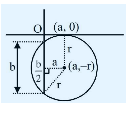
By pytogorus $\mathrm{r}^{2}=\mathrm{a}^{2}+\frac{\mathrm{b}^{2}}{4}=\mathrm{P}^{2}$
$r=\sqrt{\frac{4 \mathrm{a}^{2}+\mathrm{b}^{2}}{4}}$
Equation of circle is $(x-\alpha)^{2}+(y-\beta)^{2}=r^{2}$
$x^{2}+y^{2}-2 a x-2 p y+\alpha^{2}+p^{2}-r^{2}=0$
comparision $x^{2}+y^{2}-\alpha x+\beta y+r=0$
$-\alpha=-2 a, \beta=-2 p, r=a^{2}$
$\Rightarrow 2 \mathrm{a}=\alpha, 4 \mathrm{a}^{2}+\mathrm{b}^{2}=4 \mathrm{p}^{2}$
$
\begin{aligned}
& \alpha^{2}+b^{2}=4 p^{2} \\
& \alpha^{2}+b^{2}=\beta^{2}
\end{aligned}
$So, $\left(2 \mathrm{a}, \mathrm{b}^{2}\right)=\left(\alpha, \beta^{2}-4 \mathrm{r}\right)$
View full question & answer→MCQ 144 Marks
The relation $R=\{(x, y): x, y \in z$ and $x+y$ is even $\}$ is :
- A
reflexive and transitive but not symmetric
- B
reflexive and symmetric but not transitive
- ✓
- D
symmetric and transitive but not reflexive
Answer(C)
Sol. $\mathrm{R}=\{(\mathrm{x}, \mathrm{y}): \mathrm{x}, \mathrm{y} \in \mathrm{z}$ and $\mathrm{x}+\mathrm{y}$ is even $\}$
reflexive $x+x=2 x$ even
symmetric of $x+y$ is even, then $(y+x)$ is also even
transitive of $\mathrm{x}+\mathrm{y}$ is even $\& \mathrm{y}+\mathrm{z}$ is even then $x+z$ is also even
So, relation is an equivalence relation.
View full question & answer→MCQ 154 Marks
Let $\mathrm{A}(\mathrm{x}, \mathrm{y}, \mathrm{z})$ be a point in xy-plane, which is equidistant from three points $(0,3,2),(2,0,3)$ and $(0,0,1)$.
Let $\mathrm{B}=(1,4,-1)$ and $\mathrm{C}=(2,0,-2)$. Then among the statements
(S1): $\triangle \mathrm{ABC}$ is an isosceles right angled triangle and
(S2) : the area of $\triangle \mathrm{ABC}$ is $\frac{9 \sqrt{2}}{2}$.
Answer(B)
Sol. $\mathrm{A}(\mathrm{x}, \mathrm{y}, \mathrm{z})$ Let $\mathrm{P}(0,3,2), \mathrm{Q}(2,0,3), \mathrm{R}(0,0,1)$
$\mathrm{AP}=\mathrm{AQ}=\mathrm{AR}$
$x^{2}+(y-3)^{2}+(z-2)^{2}=(x-2)^{2}+y^{2}+(z-3)^{2}=x^{2}+$
$y^{2}+(z-1)^{2}$
In $x y$ plane $z=0$
So, $x^{2}-4 x+4+y^{2}+9=x^{2}+y^{2}+1$
$\Rightarrow \mathrm{y}=2$
$\mathrm{x}=3$
$9+y^{2}-6 y+9+4=x^{2}+y^{2}+1$
So, $\mathrm{A}(3,2,0)$ also $\mathrm{B}(1,4,-1) \& \mathrm{C}(2,0,-2)$
Now $A B=\sqrt{4+4+1}=3$
$
\begin{aligned}
& \mathrm{AC}=\sqrt{1+4+4}=3 \\
& \mathrm{BC}=\sqrt{1+16+1}=\sqrt{18}
\end{aligned}
$
$\mathrm{AB}=\mathrm{AC}$
isosceles $\Delta \& \mathrm{AB}^{2}+\mathrm{AC}^{2}=\mathrm{BC}^{2}$
right angle $\Delta$
Area of $\triangle \mathrm{ABC}=\frac{1}{2} \times$ base.height
$\frac{1}{2} \times 3 \times 3=\frac{9}{2}$
So only $\mathrm{S}_{1}$ is true
View full question & answer→MCQ 164 Marks
Let $f: R \rightarrow R$ be a function defined by $f(x)=(2+3 a) x^{2}+\left(\frac{a+2}{a-1}\right) x+b, a \neq 1$. If $f(x+y)=f(x)+f(y)+1-\frac{2}{7} x y$, then the value of $28 \sum_{i=1}^{5}|f(i)|$ is:
Answer(D)
Sol. $f(x)=(3 a+2) x^{2}+\left(\frac{a+2}{a-1}\right) x+b$
$f\left(x+\frac{1}{2}\right)=f(x)+f(y)+1-\frac{2}{7} x y$
In (1) Put $x=y=0 \Rightarrow f(0)=2 f(0)+1 \Rightarrow f(0)=-1$ So, $f(0)=0+0+b=-1 \Rightarrow b=-1$
In (1) Put $y=-x \Rightarrow f(0)=f(x)+f(-x)+1+\frac{2}{7} x^{2}$
$-1=2(3 a+2) x^{2}+2 b+1+\frac{2}{7} x^{2}$
$-1=\left(2(3 a+2)+\frac{2}{7}\right) x^{2}+1-2$
$\Rightarrow 6 \mathrm{a}+4+\frac{2}{7}=0$
$a=-\frac{5}{7}$
So $\mathrm{f}(\mathrm{x})=-\frac{1}{7} \mathrm{x}^{2}-\frac{3}{4} \mathrm{x}-1$
$\Rightarrow|\mathrm{f}(\mathrm{x})|=\frac{1}{28}\left|4 \mathrm{x}^{2}+21 \mathrm{x}+28\right|$
Now, $28 \sum_{i=1}^{5}|f(i)|=28(|f(1)|+|f(2)|+\ldots+|f(5)|)$
28. $\frac{1}{28} \cdot 675=675$
View full question & answer→MCQ 174 Marks
If $f(x)=\frac{2^{x}}{2^{x}+\sqrt{2}}, x \in R$, then $\sum_{k=1}^{81} f\left(\frac{k}{82}\right)$ is equal to :
- A
- ✓
$\frac{81}{2}$
- C
- D
$81 \sqrt{2}$
AnswerCorrect option: B. $\frac{81}{2}$
(B)
Sol. $\mathrm{f}(\mathrm{x})=\frac{2^{\mathrm{x}}}{2^{\mathrm{x}}+\sqrt{2}}$
$f(x)+f(1-x)=\frac{2^{x}}{2^{x}+\sqrt{2}}+\frac{2^{1-x}}{2^{1-x}+\sqrt{2}}$
$=\frac{2^{x}}{2^{x}+\sqrt{2}}+\frac{2}{2+\sqrt{2} 2^{x}}=\frac{2^{x}+\sqrt{2}}{2^{x}+\sqrt{2}}=1$
Now, $\sum_{k=1}^{81} f\left(\frac{k}{82}\right)=f\left(\frac{1}{82}\right)+f\left(\frac{2}{82}\right)+\ldots \ldots .+f\left(\frac{81}{82}\right)$
$=\mathrm{f}\left(\frac{1}{82}\right)+\mathrm{f}\left(\frac{2}{82}\right)+\ldots \ldots+\mathrm{f}\left(1-\frac{2}{82}\right)+\mathrm{f}\left(1-\frac{1}{82}\right)$
$
=\left[\mathrm{f}\left(\frac{1}{82}\right)+\mathrm{f}\left(1-\frac{1}{82}\right)\right]+\left[\mathrm{f}\left(\frac{2}{82}\right)+\mathrm{f}\left(1-\frac{2}{82}\right)\right]+\ldots . .40 \text { cases }+\mathrm{f}\left(\frac{41}{82}\right)
$
$=(1+1+\ldots 40$ times $)+\frac{2^{1 / 2}}{2^{1 / 2}+2^{1 / 2}}$
$40+\frac{1}{2}=\frac{81}{2}$
View full question & answer→MCQ 184 Marks
Two number $k_{1}$ and $k_{2}$ are randomly chosen from the set of natural numbers. Then, the probability that the value of $i^{k_{1}}+i^{k_{2}},(i=\sqrt{-1})$ is non-zero, equals
- A
$\frac{1}{2}$
- B
$\frac{1}{4}$
- ✓
$\frac{3}{4}$
- D
$\frac{2}{3}$
AnswerCorrect option: C. $\frac{3}{4}$
(C)
Sol. $\quad i^{k_{1}}+i^{k_{2}} \neq 0 \quad i^{k_{1}} \rightarrow 4$ option for $i,-1,-i, 1$
Total cases $\Rightarrow 4 \times 4=16$
Unfovourble cases $\Rightarrow \mathrm{i}^{\mathrm{k}_{1}}+\mathrm{i}^{\mathrm{k}_{2}}=0$
$\left\{\begin{array}{c}1,-1 \\ -1,1 \\ i,-i \\ -i, i\end{array}\right\}$
4 Cases $\Rightarrow$ Probability $=\frac{16-4}{16}=\frac{3}{4}$
View full question & answer→MCQ 194 Marks
Let $A B C D$ be a trapezium whose vertices lie on the parabola $y^{2}=4 x$. Let the sides $A D$ and $B C$ of the trapezium be parallel to $y$-axis. If the diagonal AC is of length $\frac{25}{4}$ and it passes through the point $(1,0)$, then the area of ABCD is :
- ✓
$\frac{75}{4}$
- B
$\frac{25}{2}$
- C
$\frac{125}{8}$
- D
$\frac{75}{8}$
AnswerCorrect option: A. $\frac{75}{4}$
(A)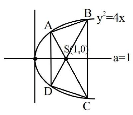
$A\left(\mathrm{at}_{1}^{2}, 2 \mathrm{at}_{1}\right) \& C\left(\frac{\mathrm{a}}{\mathrm{t}_{1}^{2}},-\frac{2 \mathrm{a}}{\mathrm{t}_{1}}\right)$
Length $A C=a\left(t_{1}+\frac{1}{t_{1}}\right)^{2}=\frac{25}{4}, t_{1}+\frac{1}{t_{1}}= \pm \frac{5}{2}$
$\Rightarrow \mathrm{t}_{1}=2$ or $\frac{1}{2}, \mathrm{~A}\left(\frac{1}{2}, 1\right), \mathrm{D}\left(\frac{1}{4},-1\right), \mathrm{B}(4,4), \mathrm{C}(4,-4)$
So, area of trapezium $=\frac{1}{2}(8+2)\left(4-\frac{1}{4}\right)=\frac{75}{4}$
View full question & answer→MCQ 204 Marks
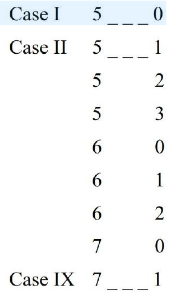
The number of different 5 digit numbers greater than 50000 that can be formed using the digits 0,1 , $2,3,4,5,6,7$, such that the sum of their first and last digits should not be more than 8 , is