Questions

SECTION - B [MATHS - NUMERIC]

Take a timed test

5 questions · self-marked practice — reveal the answer and mark yourself.

Question 14 Marks
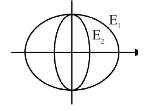
Let $\mathrm{E}_{1}: \frac{\mathrm{x}^{2}}{9}+\frac{\mathrm{y}^{2}}{4}=1$ be an ellipse. Ellipses $\mathrm{E}_{\mathrm{i}}^{\prime}$ 's are constructed such that their centres and eccentricities are same as that of $E_{1}$, and the length of minor axis of $\mathrm{E}_{\mathrm{i}}$ is the length of major axis of $E_{i+1}(i \geq 1)$. If $A_{i}$ is the area of the ellipse $E_{i}$, then $\frac{5}{\pi}\left(\sum_{i=1}^{\infty} \mathrm{A}_{\mathrm{i}}\right)$, is equal to $\qquad$
Answer
Image
$E_{1}=\frac{x^{2}}{9}+\frac{y^{2}}{4} \Rightarrow e=\sqrt{1-\frac{4}{9}}=\frac{\sqrt{5}}{3}$
$\mathrm{E}_{2}: \frac{\mathrm{x}^{2}}{\mathrm{a}^{2}}+\frac{\mathrm{y}^{2}}{4}=1$
$\mathrm{e}=\frac{\sqrt{5}}{3}=\sqrt{1-\frac{\mathrm{a}^{2}}{4}} \Rightarrow \frac{5}{9}=1-\frac{\mathrm{a}^{2}}{4}$
$a^{2}=\frac{16}{9}$
$E_{2}: \frac{x^{2}}{\frac{16}{9}}+\frac{y^{2}}{4}=1$
$\mathrm{E}_{3}: \frac{\mathrm{x}^{2}}{\frac{16}{9}}+\frac{\mathrm{y}^{2}}{\mathrm{~b}^{2}}=1$
$\mathrm{e}=\frac{\sqrt{5}}{3}=\sqrt{1-\frac{\mathrm{b}^{2}}{\frac{16}{9}}} \Rightarrow \mathrm{~b}^{2}=\frac{64}{81}$
$E_{3}=\frac{x^{2}}{\frac{16}{9}}+\frac{y^{2}}{\frac{64}{81}}=1$
$\mathrm{A}_{1}=\pi \times 3 \times 2 \Rightarrow 6 \pi$
$\mathrm{A}_{2}=\pi \times \frac{4}{3} \times 2=\frac{8 \pi}{3}$
$\mathrm{A}_{3}=\pi \times \frac{4}{3} \times \frac{8}{9}=\frac{32 \pi}{81}$
$\sum_{\mathrm{i}=1}^{\infty} \mathrm{A}_{\mathrm{i}}=6 \pi+\frac{8 \pi}{3}+\frac{32 \pi}{81}+\ldots . \infty \Rightarrow \frac{6 \pi}{1-\frac{4}{9}} \Rightarrow \frac{54 \pi}{5}$
$\therefore \frac{5}{\pi} \sum_{\mathrm{i}=1}^{\infty} \mathrm{A}_{\mathrm{i}} \Rightarrow \frac{5}{\pi} \times \frac{54 \pi}{5}=54$
View full question & answer
Question 24 Marks
Let.
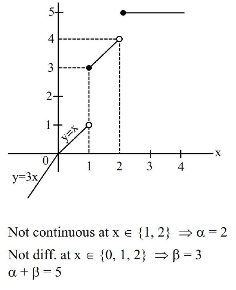
$f(x)=\left\{\begin{array}{cc}3 x, & x<0 \\ \min \{1+x+[x], x+2[x]\}, & 0 \leq x \leq 2 \\ 5, & x>2\end{array}\right.$ where [.] denotes greatest integer function. If $\alpha$ and $\beta$ are the number of points, where f is not continuous and is not differentiable, respectively, then $\alpha+\beta$ equals
Answer
Sol. $f(x)=\left\{\begin{array}{ccc}3 x & ; & x<0 \\ \min \{1+x, x\} & ; & 0 \leq x<1 \\ \min \{2+x, x+2\} & ; & 1 \leq x<2 \\ 5 & ; & x>2\end{array}\right.$
$f(x)=\left\{\begin{array}{ccc}3 x & ; & x<0 \\ x & ; & 0 \leq x<1 \\ x+2 & ; & 1 \leq x<2 \\ 5 & ; & x>2\end{array}\right.$
Image
View full question & answer
Question 34 Marks
Let $\overrightarrow{\mathrm{a}}=\hat{\mathrm{i}}+\hat{\mathrm{j}}+\hat{\mathrm{k}}, \overrightarrow{\mathrm{b}}=2 \hat{\mathrm{i}}+2 \hat{\mathrm{j}}+\hat{\mathrm{k}}$ and $\overrightarrow{\mathrm{d}}=\overrightarrow{\mathrm{a}} \times \overrightarrow{\mathrm{b}}$. If $\vec{c}$ is a vector such that $\vec{a} \cdot \vec{c}=|\overrightarrow{\mathbf{c}}|,|\overrightarrow{\mathbf{c}}-2 \vec{a}|^{2}=8$ and the angle between $\overrightarrow{\mathrm{d}}$ and $\overrightarrow{\mathrm{c}}$ is $\frac{\pi}{4}$, then $|10-3 \overrightarrow{\mathrm{~b}} \cdot \overrightarrow{\mathrm{c}}|+|\overrightarrow{\mathrm{d}} \times \overrightarrow{\mathrm{c}}|^{2}$ is equal to $\ldots .$.
Answer
Sol. $\vec{a}=\hat{i}+\hat{j}+\hat{k}$
$\overrightarrow{\mathrm{b}}=2 \hat{\mathrm{i}}+2 \hat{\mathrm{j}}+\hat{\mathrm{k}}$
$\vec{d}=\vec{a} \times \vec{b}$
$=-\hat{i}+\hat{j}$
$|\overrightarrow{\mathrm{c}}-2 \overrightarrow{\mathrm{a}}|^{2}=8$
$|c|^{2}+4|a|^{2}-4(a . c)=8$
$c^{2}+12-4 c=8$
$c^{2}-4 c+4=0$
$|c|=2$
$\overrightarrow{\mathrm{d}}=\overrightarrow{\mathrm{a}} \times \overrightarrow{\mathrm{b}}$
$\overrightarrow{\mathrm{d}} \times \overrightarrow{\mathrm{c}}=(\overrightarrow{\mathrm{a}} \times \overrightarrow{\mathrm{b}}) \times \overrightarrow{\mathrm{c}}$
$\left(|\mathrm{d}||\mathrm{c}| \sin \frac{\pi}{4}\right)^{2}=((\mathrm{a} . \mathrm{c}) \cdot \mathrm{b}-(\mathrm{b} . \mathrm{c}) \cdot \mathrm{a})^{2}$
$4=4 b^{2}+(b . c)^{2} 2(a)^{2}-2(b . c)(a . b)$
Let $\mathrm{b} . \mathrm{c}=\mathrm{x}$
$4=36+3 x^{2}-20 x$
$3 \mathrm{x}^{2}-20 \mathrm{x}+32=0$
$3 x^{2}-12 x-8 x+32=0$
$\mathrm{x}=\frac{8}{3}, 4$
b.c $=\frac{8}{3}, 4$
b.c $=\frac{8}{3}$Now $|10-3 \mathrm{~b} . \mathrm{c}|+|\mathrm{d} \times \mathrm{c}|^{2}$
$|10-8|+(2)^{2}$
View full question & answer
Question 44 Marks
If $\alpha=1+\sum_{\mathrm{r}=1}^{6}(-3)^{\mathrm{r}-1{ }^{12}} \mathrm{C}_{2 \mathrm{r}-1}$, then the distance of the point $(12, \sqrt{3})$ form the line $\alpha x-\sqrt{3} y+1=0$ is
Answer
Sol. $\alpha=1+\sum_{\mathrm{r}=1}^{6}(-1)^{\mathrm{r}-1}{ }^{12} \mathrm{C}_{2 \mathrm{r}-1} 3^{\mathrm{r}-1}$ \[ \begin{aligned} \alpha & =1+\sum_{\mathrm{r}=1}^{6}{ }^{12} \mathrm{C}_{2 \mathrm{r}-1} \frac{(\sqrt{3} \mathrm{i})^{2 \mathrm{t}-1}}{\sqrt{3} \mathrm{i}} \quad \mathrm{i}=\text { iota, let } \sqrt{3} \mathrm{i}=\mathrm{x} \\ \alpha & =1+\frac{1}{\sqrt{3} \mathrm{i}}\left({ }^{12} \mathrm{C}_{1} \mathrm{x}+{ }^{12} \mathrm{C}_{3} \mathrm{x}^{3}+\ldots .{ }^{12} \mathrm{C}_{11} \mathrm{x}^{11}\right) \\ & =1+\frac{1}{\sqrt{3} \mathrm{i}}\left(\frac{(1+\sqrt{3} \mathrm{i})^{12}-(1-\sqrt{3} \mathrm{i})^{12}}{2}\right) \\ & =1+\frac{1}{\sqrt{3} \mathrm{i}}\left(\frac{\left(-2 \omega^{2}\right)^{12}-(2 \omega)^{12}}{2}\right)=1 \end{aligned} \]
so distance of $(12, \sqrt{3})$ from $x-\sqrt{3} y+1=0$ is $\frac{12-3+1}{2}=5$
View full question & answer
Question 54 Marks
Let M denote the set of all real matrices of order $3 \times 3$ and let $S=\{-3,-2,-1,1,2\}$. Let
$\mathrm{S}_{1}=\left\{\mathrm{A}=\left[\mathrm{a}_{\mathrm{ij}}\right] \in \mathrm{M}: \mathrm{A}=\mathrm{A}^{\mathrm{T}}\right.$ and $\left.\mathrm{a}_{\mathrm{ij}} \in \mathrm{S}, \forall \mathrm{i}, \mathrm{j}\right\}$
$S_{2}=\left\{A=\left[a_{i j}\right] \in M: A=-A^{T}\right.$ and $\left.a_{i j} \in S, \forall i, j\right\}$
$\mathrm{S}_{3}=\left\{\mathrm{A}=\left[\mathrm{a}_{\mathrm{ij}}\right] \in \mathrm{M}: \mathrm{a}_{11}+\mathrm{a}_{22}+\mathrm{a}_{33}=0\right.$ and $\left.\mathrm{a}_{\mathrm{ij}} \in \mathrm{S}, \forall \mathrm{i}, \mathrm{j}\right\}$
If $n\left(S_{1} \cup S_{2} \cup S_{3}\right)=125 \alpha$, then $\alpha$ equals.
Answer
Sol. $\left[\begin{array}{lll}a_{11} & a_{12} & a_{13} \\ a_{21} & a_{22} & a_{23} \\ a_{31} & a_{32} & a_{33}\end{array}\right]$ No. of elements in $\mathrm{S}_{1}: \mathrm{A}=\mathrm{A}^{\mathrm{T}} \Rightarrow 5^{3} \times 5^{3}$ No. of elements in $S_{2}: A=-A^{T} \Rightarrow 0$ since no zero in $\mathrm{S}_{2}$ No. of elements in $\mathrm{S}_{3} \Rightarrow$ \[ \left.\begin{array}{c} \mathrm{a}_{11}+\mathrm{a}_{22}+\mathrm{a}_{33}=0 \Rightarrow(1,2,-3) \Rightarrow 31 \\ \text { or } \\ (1,1,-2) \Rightarrow 3 \\ \text { or } \\ (-1,-1,2) \Rightarrow 3 \end{array}\right\} \Rightarrow 12 \times 5^{6} \]
View full question & answer