Questions

SECTION - B [PHYSICS - NUMERIC]

Take a timed test

5 questions · self-marked practice — reveal the answer and mark yourself.

Question 14 Marks
A double slit interference experiment performed with a light of wavelength 600 nm forms an interference fringe pattern on a screen with $10^{\text {th }}$ bright fringe having its centre at a distance of 10 mm from the central maximum. Distance of the centre of the same $10^{\text {th }}$ bright fringe from the central maximum when the source of light is replaced by another source of wavelength 660 nm would be $\qquad$ mm .
Answer
Sol. In case of YDSE the distance of $\mathrm{n}^{\text {th }}$ maxima from central maxima is given by
$\mathrm{Y}=\frac{\mathrm{n} \lambda \mathrm{D}}{\mathrm{d}}$
Here $\mathrm{n}, \mathrm{D}$ \& d are same
So, $\mathrm{y} \times \lambda$
$\Rightarrow \frac{\mathrm{y}_{2}}{\mathrm{y}_{1}}=\frac{\lambda_{2}}{\lambda_{1}} \Rightarrow \frac{\mathrm{y}_{2}}{10 \mathrm{~mm}}=\frac{660 \mathrm{~nm}}{600 \mathrm{~nm}}$
$\Rightarrow y_{2}=11 \mathrm{~mm}$
View full question & answer
Question 24 Marks
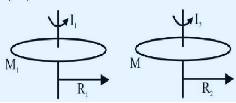
Two iron solid discs of negligible thickness have radii $R_{1}$ and $R_{2}$ and moment of intertia $I_{1}$ and $I_{2}$, respectively. For $R_{2}=2 R_{1}$, the ratio of $I_{1}$ and $I_{2}$ would be $1 / \mathrm{x}$, where $\mathrm{x}=$ $\qquad$
Answer
(16)Image
Given $\mathrm{R}_{2}=2 \mathrm{R}_{1}$
$M_{1}=\sigma \times \pi R_{1}^{2}=M_{0}$
$\mathrm{M}_{2}=\sigma \times \pi \mathrm{R}_{2}^{2}=\mathrm{M}_{\mathrm{o}}$
$\mathrm{M}_{2}=\sigma \times \pi \mathrm{R}_{2}^{2}=\sigma \times \pi\left[2 \mathrm{R}_{1}\right]^{2}=\sigma \times 4 \pi \mathrm{R}_{1}^{2}=4 \mathrm{M}_{\mathrm{o}}$(16)
$
\frac{I_{1}}{I_{2}}=\frac{\frac{\mathrm{M}_{1} \mathrm{R}_{1}^{2}}{2}}{\frac{\mathrm{M}_{2} \mathrm{R}_{2}^{2}}{2}}=\frac{\mathrm{M}_{1} \mathrm{R}_{1}^{2}}{\mathrm{M}_{2} \mathrm{R}_{2}^{2}}=\frac{1}{4} \times \frac{1}{4}=\frac{1}{16}
$
View full question & answer
Question 34 Marks
In a measurement, it is asked to find modulus of elasticity per unit torque applied on the system. The measured quantity has dimension of $\left[M^{a} L^{b} T^{c}\right]$. If $b=3$, the value of $c$ is $\qquad$
Answer
(4)
Sol. $\frac{\text { modulus of elasticity }}{\text { Torque }}=\frac{\text { Stress }}{\text { strain } \times \text { torque }}$
$
\begin{aligned}
& =\frac{[\text { Force }]}{[\text { Area }] \times[\text { Force } \times \text { length }]} \\
& =\frac{1}{[\text { Area } \times \text { length }]}=\left[\mathrm{L}^{-3}\right]
\end{aligned}
$
View full question & answer
Question 44 Marks
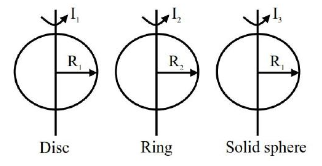
The moment of inertia of a solid disc rotating along its diameter is 2.5 times higher than the moment of inertia of a ring rotating in similar way. The moment of inertia of a solid sphere which has same radius as the disc and rotating in similar way, is $n$ times higher than the moment of inertia of the given ring. Here, $\mathrm{n}=$_________ .
Consider all the bodies have equal masses.
Answer
(4)
Image
$\mathrm{I}_{1}=\frac{\mathrm{MR}_{1}^{2}}{4}, \mathrm{I}_{2}=\frac{\mathrm{MR}_{2}^{2}}{2}, \mathrm{I}_{3}=\frac{2 \mathrm{MR}_{1}^{2}}{5}$
According to problem
$\frac{\mathrm{I}_{1}}{\mathrm{I}_{2}}=2.5 \Rightarrow \frac{\frac{\mathrm{MR}_{1}^{2}}{4}}{\frac{\mathrm{MR}_{2}^{2}}{2}}=\frac{5}{2} \Rightarrow \frac{\mathrm{R}_{1}^{2}}{\mathrm{R}_{2}^{2}}=5$.
Now we are provided with information that
$\frac{\mathrm{I}_{3}}{\mathrm{I}_{2}}=\mathrm{n}$
$\Rightarrow \frac{\frac{2 \mathrm{MR}_{1}^{2}}{5}}{\frac{\mathrm{MR}_{2}^{2}}{2}}=\mathrm{n} \Rightarrow \frac{4 \mathrm{R}_{1}^{2}}{5 \mathrm{R}_{2}^{2}}=\mathrm{n}$
From Eq', (1) and (2)
$\Rightarrow \mathrm{n}=4$
View full question & answer
Question 54 Marks
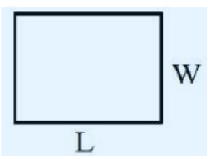
A tiny metallic rectangular sheet has length and breadth of 5 mm and 2.5 mm , respectively. Using a specially designed screw gauge which has pitch of 0.75 mm and 15 divisions in the circular scale, you are asked to find the area of the sheet. In this measurement, the maximum fractional error will be $\frac{\mathrm{x}}{100}$ where x is $\qquad$
Answer
(3)
Image
Since least count of the instrument can be calculated as
Least count $=\frac{\text { pitch length }}{\text { No. of division on circular scale }}$
$=\frac{0.75}{15}=0.05 \mathrm{~mm}$.
Here we are provided $\mathrm{L}=5 \mathrm{~mm} \& \mathrm{~W}=2.5 \mathrm{~mm}$
$\mathrm{L}=5 \mathrm{~mm} \& \mathrm{~W}=2.5 \mathrm{~mm}$
$\because$ We know that
A = L.W
For calculating fractional error, we can write
$\frac{\mathrm{dA}}{\mathrm{A}}=\frac{\mathrm{dL}}{\mathrm{L}}+\frac{\mathrm{dW}}{\mathrm{W}}$
Here $\mathrm{dL}=\mathrm{dW}=0.05 \mathrm{~mm}$
$\frac{\mathrm{dA}}{\mathrm{A}}=\frac{0.05}{5}+\frac{0.05}{2.5}$
$\Rightarrow \frac{\mathrm{dA}}{\mathrm{A}}=\frac{1}{100}+\frac{2}{100}=\frac{3}{100}$,
So, $x=3$
View full question & answer