MCQ 14 Marks
Let $A=\left[a_{i j}\right]=\left[\begin{array}{cc}\log _{5} 128 & \log _{4} 5 \\ \log _{5} 8 & \log _{4} 25\end{array}\right]$. If $\mathrm{A}_{\mathrm{ij}}$ is the cofactor of $\mathrm{a}_{\mathrm{ij}}, \mathrm{C}_{\mathrm{ij}}=\sum_{\mathrm{k}=1}^{2} \mathrm{a}_{\mathrm{ik}} \mathrm{A}_{\mathrm{jk}}, 1 \leq \mathrm{i}$, $\mathrm{j} \leq 2$, and $\mathrm{C}=\left[\mathrm{C}_{\mathrm{ij}}\right]$, then $8|\mathrm{C}|$ is equal to :
Answer(C)
$
\begin{aligned}
& |\mathrm{A}|=\frac{11}{2} \\
& \mathrm{C}_{11}=\sum_{\mathrm{k}=1}^{2} \mathrm{a}_{1 \mathrm{k}} \cdot \mathrm{~A}_{1 \mathrm{k}}=\mathrm{a}_{11} \mathrm{~A}_{11}+\mathrm{a}_{12} \mathrm{~A}_{12}=|\mathrm{A}|=\frac{11}{2} \\
& \mathrm{C}_{12}=\sum_{\mathrm{k}=1}^{2} \mathrm{a}_{1 \mathrm{k}} \cdot \mathrm{~A}_{2 \mathrm{k}}=0 \\
& \mathrm{C}_{21}=\sum_{\mathrm{k}=1}^{2} \mathrm{a}_{2 \mathrm{k}} \cdot \mathrm{~A}_{1 \mathrm{k}}=0 \\
& \mathrm{C}_{22}=\sum_{\mathrm{k}=1}^{2} \mathrm{a}_{2 \mathrm{k}} \cdot \mathrm{~A}_{2 \mathrm{k}}=|\mathrm{A}|=\frac{11}{2} \\
& \mathrm{C}=\left[\begin{array}{cc}
11 / 2 & 0 \\
0 & 11 / 2
\end{array}\right] \\
& |\mathrm{C}|=\frac{121}{4} \\
& 8|\mathrm{C}|=242
\end{aligned}
$
View full question & answer→MCQ 24 Marks
Let $\left|z_{1}-8-2 i\right| \leq 1$ and $\left|z_{2}-2+6 i\right| \leq 2$, $z_{1}, z_{2} \in C$. Then the minimum value of $\left|z_{1}-z_{2}\right|$ is :
Answer(B)
Sol.
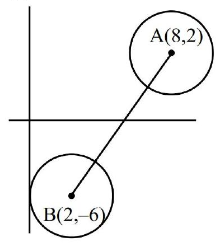
$\because \mathrm{AB}=\sqrt{100}=10$
$\therefore\left|\mathrm{Z}_{1}-\mathrm{Z}_{2}\right|_{\text {min }}=10-2-1=7$ View full question & answer→MCQ 34 Marks
View full question & answer→MCQ 44 Marks
Let $L_{1}: \frac{x-1}{1}=\frac{y-2}{-1}=\frac{z-1}{2}$ and $L_{2}: \frac{x+1}{-1}=\frac{y-2}{2}=\frac{z}{1}$ be two lines.
Let $L_{3}$ be a line passing through the point $(\alpha, \beta, \gamma)$ and be perpendicular to both $\mathrm{L}_{1}$ and $\mathrm{L}_{2}$. If $\mathrm{L}_{3}$ intersects $L_{1}$, then $|5 \alpha-11 \beta-8 \gamma|$ equals :
Answer(C)
Sol. $\quad D R$ 's of $L_{3}=\overrightarrow{\mathrm{m}} \times \overrightarrow{\mathrm{n}}=\left|\begin{array}{ccc}\hat{\mathrm{i}} & \hat{\mathrm{j}} & \hat{\mathrm{k}} \\ 1 & -1 & 2 \\ -1 & 2 & 1\end{array}\right|$
$=-5 \hat{i}-3 \hat{\mathrm{j}}+\hat{\mathrm{k}}$
$L_{3}: \frac{x-\alpha}{-5}=\frac{y-\beta}{-3}=\frac{z-\gamma}{1}=\lambda$
$
\mathrm{A}(\alpha-5 \lambda, \beta-3 \lambda, \gamma+\lambda)
$
$L_{1}: \frac{\mathrm{x}-1}{1}=\frac{\mathrm{y}-2}{-1}=\frac{\mathrm{z}-1}{2}=\mathrm{k}$
$
\mathrm{B}(\mathrm{k}+1,-\mathrm{k}+2,2 \mathrm{k}+1)
$
Now
$
\begin{aligned}
& \alpha-5 \lambda=\mathrm{k}+1 \Rightarrow \alpha=5 \lambda+\mathrm{k}+1 \\
& \beta-3 \lambda=-\mathrm{k}+2 \Rightarrow \beta=3 \lambda-\mathrm{k}+2 \\
& \gamma+\lambda=2 \mathrm{k}+1 \Rightarrow \gamma=-\lambda+2 \mathrm{k}+1 \\
& |5 \alpha-11 \beta-8 \gamma|=|-25| \\
& =25
\end{aligned}
$
View full question & answer→MCQ 54 Marks
The integral $80 \int_{0}^{\frac{\pi}{4}}\left(\frac{\sin \theta+\cos \theta}{9+16 \sin 2 \theta}\right) d \theta$ is equal to :
- A
$3 \log _{\mathrm{e}} 4$
- B
$6 \log _{\mathrm{e}} 4$
- ✓
$4 \log _{\mathrm{e}} 3$
- D
$2 \log _{e} 3$
AnswerCorrect option: C. $4 \log _{\mathrm{e}} 3$
(C)
Sol. $I=80 \int_{0}^{\frac{\pi}{4}}\left(\frac{\sin \theta+\cos \theta}{9+16(2 \sin \theta \cdot \cos \theta)}\right) d \theta$
$
=80 \int_{0}^{\frac{\pi}{4}} \frac{\sin \theta+\cos \theta}{9-16(1-2 \sin \theta \cdot \cos \theta-1)} d \theta
$
$=80 \int_{0}^{\frac{\pi}{4}} \frac{\sin \theta+\cos \theta}{9+16-16(\sin \theta-\cos \theta)^{2}} d \theta$
Let $\sin \theta-\cos \theta=\mathrm{t}$
$(\cos \theta+\sin \theta) d \theta=d t$
$=80 \int_{-1}^{0} \frac{\mathrm{dt}}{25-16 \mathrm{t}^{2}}$
$=\frac{80}{16} \int_{-1}^{0} \frac{\mathrm{dt}}{\left(\frac{5}{4}\right)^{2}-\mathrm{t}^{2}}$
$\left.=\frac{5}{2\left(\frac{5}{4}\right)} \ln \left|\frac{\frac{5}{4}+t}{\frac{5}{4}-t}\right|\right]_{-1}^{0}$
$=2 \ln (1)+4 \ln 3$
$=4 \ln 3$
View full question & answer→MCQ 64 Marks
The value of $\lim _{n \rightarrow \infty}\left(\sum_{K=1}^{n} \frac{k^{3}+6 k^{2}+11 k+5}{(k+3)!}\right)$ is :
- A
$\frac{4}{3}$
- B
- C
$\frac{7}{3}$
- ✓
$\frac{5}{3}$
AnswerCorrect option: D. $\frac{5}{3}$
(D)
Sol. $\lim _{\mathrm{n} \rightarrow \infty} \sum_{\mathrm{k}=1}^{\mathrm{n}} \frac{\mathrm{k}^{3}+6 \mathrm{k}^{2}+11 \mathrm{k}+5}{(\mathrm{k}+3)!}$
$
\begin{aligned}
& =\lim _{n \rightarrow \infty} \sum_{k=1}^{n} \frac{k^{3}+6 k^{2}+11 k+6-1}{(k+3)!} \\
& =\lim _{n \rightarrow \infty} \sum_{k=1}^{n} \frac{(k+1)(k+2)(k+3)-1}{(k+3)!} \\
& =\lim _{n \rightarrow \infty} \sum_{k=1}^{n} \frac{(k+1)(k+2)(k+3)}{(k+3)!}-\frac{1}{(k+3)!} \\
& =\lim _{n \rightarrow \infty} \sum_{k=1}^{n}\left(\frac{1}{k!}-\frac{1}{(k+3)!}\right)
\end{aligned}
$
$
=\lim _{n \rightarrow \infty}\left(\frac{1}{1!}+\frac{1}{2!}+\frac{1}{3!}+\frac{1}{4!} \ldots .+\frac{1}{n!}-\frac{1}{4!}-\frac{1}{5!}-\frac{1}{6!} \ldots .-\frac{1}{(n+3)!}\right)
$
$
=\frac{1}{1}+\frac{1}{2}+\frac{1}{6}=\frac{10}{6}=\frac{5}{3}
$
View full question & answer→MCQ 74 Marks
Let $\overrightarrow{\mathrm{a}}=\hat{\mathrm{i}}+2 \hat{\mathrm{j}}+\hat{\mathrm{k}}$ and $\overrightarrow{\mathrm{b}}=2 \hat{\mathrm{i}}+7 \hat{\mathrm{j}}+3 \hat{\mathrm{k}}$. Let
$L_{1}: \overrightarrow{\mathrm{r}}=(-\hat{\mathrm{i}}+2 \hat{\mathrm{j}}+\hat{\mathrm{k}})+\lambda \overrightarrow{\mathrm{a}}, \lambda \in \mathrm{R}$ and $L_{2}: \vec{r}=(\hat{j}+\hat{k})+\mu \vec{b}, \mu \in R$ be two lines. If the line $L_{3}$ passes through the point of intersection of $L_{1}$ and $L_{2}$, and is parallel to $\vec{a}+\vec{b}$, then $L_{3}$ passes through the point:
- A
$(8,26,12)$
- B
$(2,8,5)$
- C
$(-1,-1,1)$
- D
$(5,17,4)$
View full question & answer→MCQ 84 Marks
Consider an A.P. of positive integers, whose sum of the first three terms is 54 and the sum of the first twenty terms lies between 1600 and 1800 . Then its $11^{\text {th }}$ term is :
Answer(C)
Sol. $\mathrm{S}_{3}=3 \mathrm{a}+3 \mathrm{~d}=54$
$\Rightarrow a+d=18$
$\mathrm{S}_{20}=10(2 \mathrm{a}+19 \mathrm{~d})$
$\Rightarrow 10(36+17 \mathrm{~d})$
$\Rightarrow 1600<10(36+17 \mathrm{~d})<1800$
$\Rightarrow 160<36+17 \mathrm{~d}<180$
$\Rightarrow 124<17 \mathrm{~d}<144$
$\Rightarrow 7 \frac{5}{17}<\mathrm{d}<8 \frac{8}{17}$
Common difference will be natural number
$\Rightarrow d=8 \Rightarrow a=10$
$\Rightarrow \mathrm{a}_{11}=10+10 \times 8=90$
View full question & answer→MCQ 94 Marks
Let the ellipse, $E_{1}: \frac{x^{2}}{a^{2}}+\frac{y^{2}}{b^{2}}=1, a>b$ and $\mathrm{E}_{2}: \frac{\mathrm{x}^{2}}{\mathrm{~A}^{2}}+\frac{\mathrm{y}^{2}}{\mathrm{~B}^{2}}=1, \mathrm{~A}<\mathrm{B}$ have same eccentricity $\frac{1}{\sqrt{3}}$. Let the product of their lengths of latus rectums be $\frac{32}{\sqrt{3}}$, and the distance between the foci of $E_{1}$ be 4. If $E_{1}$ and $E_{2}$ meet at $A, B, C$ and $D$, then the area of the quadrilateral ABCD equals:
- A
$6 \sqrt{6}$
- B
$\frac{18 \sqrt{6}}{5}$
- C
$\frac{12 \sqrt{6}}{5}$
- D
$\frac{24 \sqrt{6}}{5}$
View full question & answer→MCQ 104 Marks
Define a relation R on the interval $\left[0, \frac{\pi}{2}\right)$ by $\mathrm{x} \mathrm{R} y$ if and only if $\sec ^{2} x-\tan ^{2} y=1$. Then $R$ is :
- ✓
- B
both reflexive and transitive but not symmetric
- C
both reflexive and symmetric but not transitive
- D
reflexive but neither symmetric not transitive
Answer(A)
Sol. $\sec ^{2} x-\tan ^{2} x=1 \quad$ (on replacing $y$ with $x$ )
$\Rightarrow$ Reflexive
$\sec ^{2} x-\tan ^{2} y=1$
$\Rightarrow 1+\tan ^{2} \mathrm{x}+1-\sec ^{2} \mathrm{y}=1$
$\Rightarrow \sec ^{2} y-\tan ^{2} x=1$
$\Rightarrow$ symmetric
$\sec ^{2} x-\tan ^{2} y=1$,
$\sec ^{2} y-\tan ^{2} z=1$
Adding both
$\Rightarrow \sec ^{2} x-\tan ^{2} y+\sec ^{2} y-\tan ^{2} z=1+1$
$\sec ^{2} x+1-\tan ^{2} z=2$
$\sec ^{2} x-\tan ^{2} z=1$
$\Rightarrow$ Transitive
hence equivalence relation
Option (1)
View full question & answer→MCQ 114 Marks
Let $y=y(x)$ be the solution of the differential equation
$\cos x\left(\log _{e}(\cos x)\right)^{2} d y+\left(\sin x-3 y \sin x \log _{e}(\cos x)\right) d x=0$, $\mathrm{x} \in\left(0, \frac{\pi}{2}\right)$. If $\mathrm{y}\left(\frac{\pi}{4}\right)=\frac{-1}{\log _{\mathrm{e}} 2}$, then $\mathrm{y}\left(\frac{\pi}{6}\right)$ is :
- A
$\frac{2}{\log _{e}(3)-\log _{e}(4)}$
- B
$\frac{1}{\log _{e}(4)-\log _{e}(3)}$
- C
$-\frac{1}{\log _{e}(4)}$
- ✓
$\frac{1}{\log _{e}(3)-\log _{e}(4)}$
AnswerCorrect option: D. $\frac{1}{\log _{e}(3)-\log _{e}(4)}$
(D)
Sol. $\cos x(\ln (\cos x))^{2} d y+(\sin x-3 y(\sin x) \ln (\cos x)) d x=0$
$
\begin{aligned}
& \cos x(\ln (\cos x))^{2} \frac{d y}{d x}-3 \sin x \cdot \ln (\cos x) y=-\sin x \\
& \frac{d y}{d x}-\frac{3 \tan x}{\ln (\cos x)} y=\frac{-\tan x}{(\ln (\cos x))^{2}} \\
& \frac{d y}{d x}+\frac{3 \tan x}{\ln (\sec x)} y=\frac{-\tan x}{(\ln (\sec x))^{2}} \\
& \text { I.F. }=e^{\int \frac{3 \tan x}{\ln (\sec x)} d x}=(\ln (\sec x))^{3}
\end{aligned}
$
$
\mathrm{y} \times(\ln (\sec \mathrm{x}))^{3}=-\int \frac{\tan \mathrm{x}}{(\ln (\sec \mathrm{x}))^{2}}(\ln (\sec \mathrm{x}))^{3} \mathrm{dx}
$
$
y \times(\ln (\sec x))^{3}=-\frac{1}{2}(\ln (\sec x))^{2}+C
$
$
\text { Given : } \mathrm{x}=\frac{\pi}{4}, \mathrm{y}=-\frac{1}{\ln 2}
$
$
\frac{-1}{\ln 2} \times(\ln \sqrt{2})^{3}=-\frac{1}{2} \times(\ln \sqrt{2})^{2}+\mathrm{C}
$
$
\Rightarrow \frac{-1}{8 \ln 2} \times(\ln 2)^{3}=\frac{-1}{2} \times \frac{1}{4}(\ln 2)^{2}+\mathrm{C}
$
$
-\frac{1}{8}(\ln 2)^{2}=\frac{-1}{8}(\ln 2)^{2}+\mathrm{C}
$
$
\Rightarrow \mathrm{C}=0
$
$\therefore y(\ln (\sec x))^{3}=\frac{-1}{2}(\ln (\sec x))^{2}+0$
$y=\frac{-1}{2 \ln (\sec x)}$
$y=\frac{1}{2 \ln (\cos x)}$
$\therefore y\left(\frac{\pi}{6}\right)=\frac{1}{2 \ln \left(\cos \frac{\pi}{6}\right)}$
$=\frac{1}{2 \ln \left(\frac{\sqrt{3}}{2}\right)}$
$=\frac{1}{2\left(\frac{1}{2} \ln 3-\ln 2\right)}$
$=\frac{1}{\ln 3-\ln 4}$
View full question & answer→MCQ 124 Marks
The number of solutions of the equation $\left(\frac{9}{x}-\frac{9}{\sqrt{x}}+2\right)\left(\frac{2}{x}-\frac{7}{\sqrt{x}}+3\right)=0$ is :
Answer(B)
Sol. Consider $\frac{1}{\sqrt{\mathrm{x}}}=\alpha \quad \mathrm{x}>0$
$\left(9 \alpha^{2}-9 \alpha+2\right)\left(2 \alpha^{2}-7 \alpha+3\right)=0$
$(3 \alpha-2)(3 \alpha-1)(\alpha-3)(2 \alpha-1)=0$
$\alpha=\frac{1}{3}, \frac{1}{2}, \frac{2}{3}, 3$
$x=9,4, \frac{9}{4}, \frac{1}{9}$
So, no. of solutions $=4$
View full question & answer→MCQ 134 Marks
The least value of $n$ for which the number of integral terms in the Binomial expansion of $(\sqrt[3]{7}+\sqrt[12]{11})^{n}$ is 183 , is :
Answer(A)
Sol. General term $={ }^{\mathrm{n}} \mathrm{C}_{\mathrm{r}}\left(7^{1 / 3}\right)^{\mathrm{n}-\mathrm{r}}\left(11^{1 / 12}\right)^{\mathrm{r}}$
$
={ }^{\mathrm{n}} \mathrm{C}_{\mathrm{r}}(7)^{\frac{\mathrm{n}-\mathrm{r}}{3}}(11)^{\mathrm{r} / 12}
$
For integral terms, $r$ must be multiple of 12
$\therefore \mathrm{r}=12 \mathrm{k}, \mathrm{k} \in \mathrm{W}$
Total values of $r=183$
Hence $\max r=12(182)$
$
=2184
$
Min value of $n=2184$
View full question & answer→MCQ 144 Marks
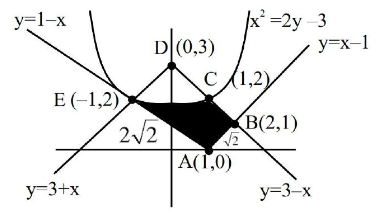
Let the area of the region $\left\{(x, y): 2 y \leq x^{2}+3\right.$, $y+|x| \leq 3, y \geq|x-1|\}$ be A. Then $6 A$ is equal to:
View full question & answer→MCQ 154 Marks
Let $P$ be the set of seven digit numbers with sum of their digits equal to 11 . If the numbers in P are formed by using the digits 1,2 and 3 only, then the number of elements in the set P is :
Answer(D)
Sol. (i) number of numbers created using
$1111133=\frac{7!}{5!2!} \Rightarrow 21$
(ii) number of numbers created using
$1111223=\frac{7!}{4!2!} \Rightarrow 105$
(iii) number of numbers created using
$1112222=\frac{7!}{4!3!} \Rightarrow 35$
Total $=161$
View full question & answer→MCQ 164 Marks
Let $\vec{a}=2 \hat{i}-\hat{j}+3 \hat{k}, \vec{b}=3 \hat{i}-5 \hat{j}+\hat{k}$ and $\vec{c}$ be a vector such that $\overrightarrow{\mathrm{a}} \times \overrightarrow{\mathrm{c}}=\overrightarrow{\mathrm{c}} \times \overrightarrow{\mathrm{b}}$ and $(\vec{a}+\vec{c}) \cdot(\vec{b}+\vec{c})=168$. Then the maximum value of $|\vec{c}|^{2}$ is :
View full question & answer→MCQ 174 Marks
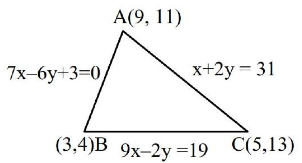
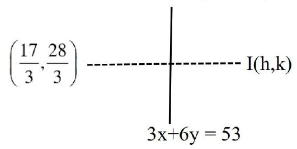
Let ABC be a triangle formed by the lines $7 x-6 y+3=0, x+2 y-31=0$ and $9 x-2 y-19=0$, Let the point $(h, k)$ be the image of the centroid of $\Delta A B C$ in the line $3 x+6 y-53=0$. Then $h^{2}+k^{2}+h k$ is equal to
View full question & answer→MCQ 184 Marks
Two parabolas have the same focus $(4,3)$ and their directrices are the $x$-axis and the $y$-axis, respectively. If these parabolas intersects at the points $A$ and $B$, then $(A B)^{2}$ is equal to
Answer(A)
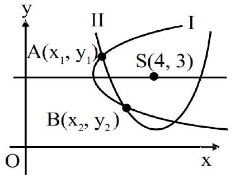
Let intersection points of these two parabolas are
$\mathrm{A}\left(\mathrm{x}_{1}, \mathrm{y}_{1}\right) \& \mathrm{~B}\left(\mathrm{x}_{2}, \mathrm{y}_{2}\right)$
$\because$ equation of parabola I and II are given below
$\therefore(\mathrm{x}-4)^{2}+(\mathrm{y}-3)^{2}=\mathrm{x}^{2}$
$\&(x-4)^{2}+(y-3)^{2}=y^{2}$
Here $A\left(x_{1}, y_{1}\right) \& B\left(x_{2}, y_{2}\right)$ will satisfy the equation
Also from equations (1) \& (2), we get $x=y$..(3)
Put $\mathrm{x}=\mathrm{y}$ in equation (1)
We get $x^{2}-14 x+25=0$
$\mathrm{x}_{1}+\mathrm{x}_{2}=14$
$\mathrm{x}_{1} \mathrm{X}_{2}=25$
$\therefore \mathrm{AB}^{2}=\left(\mathrm{x}_{1}-\mathrm{x}_{2}\right)^{2}+\left(\mathrm{y}_{1}-\mathrm{y}_{2}\right)^{2}$
$=2\left(x_{1}-x_{2}\right)^{2}$
$=2\left[\left(x_{1}+x_{2}\right)^{2}-4 x_{1} x_{2}\right]$
$=192$ View full question & answer→MCQ 194 Marks
Let $M$ and $m$ respectively be the maximum and the minimum values of
$f(x)=\left|\begin{array}{ccc}1+\sin ^{2} x & \cos ^{2} x & 4 \sin 4 x \\ \sin ^{2} x & 1+\cos ^{2} x & 4 \sin 4 x \\ \sin ^{2} x & \cos ^{2} x & 1+4 \sin 4 x\end{array}\right|, x \in R$
Then $M^{4}-m^{4}$ is equal to :
Answer(A)
Sol. $\left|\begin{array}{ccc}1+\sin ^{2} x & \cos ^{2} x & 4 \sin 4 x \\ \sin ^{2} x & 1+\cos ^{2} x & 4 \sin 4 x \\ \sin ^{2} x & \cos ^{2} x & 1+4 \sin 4 x\end{array}\right|, x \in R$
$\mathrm{R}_{2} \rightarrow \mathrm{R}_{2}-\mathrm{R}_{1} \& \mathrm{R}_{3} \rightarrow \mathrm{R}_{3}-\mathrm{R}_{1}$
$f(x)\left|\begin{array}{ccc}1+\sin ^{2} x & \cos ^{2} x & 4 \sin 4 x \\ -1 & 1 & 0 \\ -1 & 0 & 1\end{array}\right|$
Expand about $\mathrm{R}_{1}$, we get
$f(x)=2+4 \sin 4 x$
$\therefore M=$ max value of $f(x)=6$
$m=\min$ value of $f(x)=-2$
$\therefore \mathrm{M}^{4}-\mathrm{m}^{4}=1280$
View full question & answer→MCQ 204 Marks
Let the line $x+y=1$ meet the circle $x^{2}+y^{2}=4$ at the points A and B . If the line perpendicular to AB and passing through the mid point of the chord $A B$ intersects the circle at C and D , then the area of the quadrilateral ADBC is equal to
- A
$3 \sqrt{7}$
- ✓
$2 \sqrt{14}$
- C
$5 \sqrt{7}$
- D
$\sqrt{14}$
AnswerCorrect option: B. $2 \sqrt{14}$
(B)
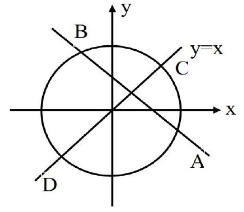
By solving $\mathrm{x}=\mathrm{y}$ with circle
We get
$
\mathrm{C}(\sqrt{2}, \sqrt{2})
$
D $(-\sqrt{2},-\sqrt{2})$
By solving $\mathrm{x}+\mathrm{y}=1$ with
circle $x^{2}+y^{2}=4$
we set
$\mathrm{A}\left(\frac{1+\sqrt{7}}{2}, \frac{1-\sqrt{7}}{2}\right)$
$\& B\left(\frac{1-\sqrt{7}}{2}, \frac{1+\sqrt{7}}{2}\right)$
$\therefore$ Area of Quadrilateral ACBD
$=2 \times$ Area of $\triangle \mathrm{BCD}$
$
=2 \times \frac{1}{2}\left|\begin{array}{ccc}
\sqrt{2} & \sqrt{2} & 1 \\
\frac{1-\sqrt{7}}{2} & \frac{1+\sqrt{7}}{2} & 1 \\
-\sqrt{2} & -\sqrt{2} & 1
\end{array}\right|
$
$=2 \sqrt{14}$ View full question & answer→