Questions

SECTION - B [PHYSICS - NUMERIC]

Take a timed test

5 questions · self-marked practice — reveal the answer and mark yourself.

Question 14 Marks
Two cars P and Q are moving on a road in the same direction. Acceleration of car P increases linearly with time whereas car Q moves with a constant acceleration. Both cars cross each other at time $t=0$, for the first time. The maximum possible number of crossing(s) (including the crossing at $t =0$ ) is _________
Answer
(3)
Sol. $a_p=k t, k$ is constant
$a_Q=a$, $a$ is constant
$
a_{QP}=a_{Q}-a_{p}=a-kt
$
as initial velocities are not mentioned in question, so will have to assume two cases.
Case-I
$u _{ on }$ and $a _{ on }$ in same direction
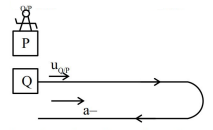
Image
Total number of crossing $=2$
Case-II
$u _{ Op }$ and $a _{ op }$ in opposite direction
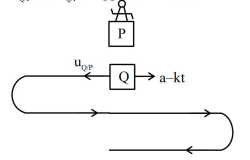
Image
Total number of crossing $=3$
View full question & answer
Question 24 Marks
Two planets, A and B are orbiting a common star in circular orbits of radii $R_A$ and $R_B$, respectively, with $R_B=2 R_A$. The planet $B$ is $4 \sqrt{2}$ times more massive than planet $A$. The ratio $\left(\frac{L_B}{L_A}\right)$ of angular momentum $\left(L_B\right)$ of planet $B$ to that of planet $A\left(L_A\right)$ is closest to integer _________
Answer
(8)
Sol. $L = mv _0 R = m \sqrt{\frac{ GM }{ R } R }= m \sqrt{ GMR }$
here M is mass of star
$
\begin{array}{l}
\frac{L_{B}}{L_{A}}=\frac{m_{B}}{m_{A}} \sqrt{\frac{R_{B}}{R_{A}}} \\
=4 \sqrt{2} \sqrt{\frac{2}{1}} \\
\frac{L_{B}}{L_{A}}=8
\end{array}
$
View full question & answer
Question 34 Marks
A physical quantity Q is related to four observables $a, b, c, d$ as follows : $Q=\frac{a b^4}{c d}$ where, $a =(60 \pm 3) Pa ; b =(20 \pm 0.1) m$; $c =(40 \pm 0.2) Nsm ^{-2}$ and $d =(50 \pm 0.1) m$, then the percentage error in Q is $\frac{ x }{1000}$, where $x =$ _________ (77)
Answer
(77)
$
\begin{array}{l}Sol.\
Q=\frac{a b^4}{c d} \\
\Rightarrow \frac{\Delta Q}{Q} \times 100=\left[\frac{\Delta a}{a}+4 \frac{\Delta b}{b}+\frac{\Delta c}{c}+\frac{\Delta d}{d}\right] \times 100 \\
\Rightarrow \frac{x}{1000}=\left[\frac{3}{60}+4\left(\frac{0.1}{20}\right)+\left(\frac{0.2}{40}\right)+\frac{0.1}{50}\right] \times 100 \\
\Rightarrow x=7700
\end{array}
$
View full question & answer
Question 44 Marks
A parallel plate capacitor consisting of two circular plates of radius 10 cm is being charged by a constant current of 0.15 A . If the rate of change of potential difference between the plates is $7 \times 10^8$ $V / s$ then the integer value of the distance between the parallel plates is -
$\left(\right.$ Take, $\left.\in_0=9 \times 10^{-12} \frac{F}{ m }, \pi=\frac{22}{7}\right)$ _________ $\mu m$.
Answer
(1320)
$\begin{aligned}Sol. \ V & =\frac{Q}{C}=\frac{\text { it }}{\left(\frac{\in_0 A}{d}\right)}=\frac{i t d}{\in_0\left(\pi r^2\right)} \\ & \Rightarrow d=\frac{\in_0\left(\pi r^2\right)}{i}\left(\frac{v}{t}\right) \\ & =\frac{\left(9 \times 10^{-12}\right)\left(\frac{22}{7}\right)(0.1)^2}{0.15}\left(7 \times 10^8\right) m\\ d & =1320 \mu m\end{aligned}$
View full question & answer
Question 54 Marks
The magnetic field inside a 200 turns solenoid of radius 10 cm is $2.9 \times 10^{-4} Tesla$. If the solenoid carries a current of 0.29 A , then the length of the solenoid is _________ $\pi cm$.
Answer
(8)
Sol. Assuming long solenoid
$
\begin{array}{l}
B=\mu_0\left(\frac{N}{\ell}\right) i \\
\ell=\frac{\mu_0 Ni}{B}=\frac{\left(4 \pi \times 10^{-7}\right)(200)(0.29)}{2.9 \times 10^{-4}} m \\
=8 \pi cm
\end{array}
$
View full question & answer