Sample QuestionsJEE Main 29-Jan-2025 Paper - Shift 2 questions
One sample from each question group in this chapter. Select any group above to see the full set with answer keys.
If for the solution curve $y=f(x)$ of the differential equation $\frac{d y}{d x}+(\tan x) y=\frac{2+\sec x}{(1+2 \sec x)^2}$,
$x \in\left(\frac{-\pi}{2}, \frac{\pi}{2}\right), f\left(\frac{\pi}{3}\right)=\frac{\sqrt{3}}{10}$, then $f\left(\frac{\pi}{4}\right)$ is equal to:
- A
$\frac{9 \sqrt{3}+3}{10(4+\sqrt{3})}$
- B
$\frac{\sqrt{3}+1}{10(4+\sqrt{3})}$
- C
$\frac{5-\sqrt{3}}{2 \sqrt{2}}$
- ✓
$\frac{4-\sqrt{2}}{14}$
Answer: D.
View full solution →Let â be a unit vector perpendicular to the vectors $\overrightarrow{ b }=\hat{ i }-2 \hat{ j }+3 \hat{ k }$ and $\overrightarrow{ c }=2 \hat{ i }+3 \hat{ j }-\hat{ k }$, and makes an angle of $\cos ^{-1}\left(-\frac{1}{3}\right)$ with the vector $\hat{ i }+\hat{ j }+\hat{ k }$. If $\hat{ a }$ makes an angle of $\frac{\pi}{3}$ with the vector $\hat{ i }+\alpha \hat{ j }+\hat{ k }$, then the value of $\alpha$ is :
- A
$-\sqrt{3}$
- B
$\sqrt{6}$
- ✓
$-\sqrt{6}$
- D
$\sqrt{3}$
Answer: C.
View full solution →Let $f(x)=\int_0^x t\left(t^2-9 t+20\right) d t, \quad 1 \leq x \leq 5$. If the range of $f$ is $[\alpha, \beta]$, then $4(\alpha+\beta)$ equals:
Answer: A.
View full solution →The remainder, when $7^{103}$ is divided by 23 , is equal to:
Answer: A.
View full solution →Bag 1 contains 4 white balls and 5 black balls, and Bag 2 contains n white balls and 3 black balls. One ball is drawn randomly from Bag 1 and transferred to Bag 2. A ball is then drawn randomly from Bag 2. If the probability, that the ball drawn is white, is $29 / 45$, then n is equal to:
Answer: D.
View full solution →Let $y ^2=12 x$ the parabola and S be its focus. Let PQ be a focal chord of the parabola such that (SP) $(S Q)=\frac{147}{4}$. Let C be the circle described taking PQ as a diameter. If the equation of a circle $C$ is $64 x^2+64 y^2-\alpha x-64 \sqrt{3} y=\beta$, then $\beta-\alpha$ is equal to _________
View full solution →Let integers $a , b \in[-3,3]$ be such that $a + b \neq 0$. Then the number of all possible ordered pairs (a, b), for which $\left|\frac{z-a}{z+b}\right|=1$ and $\left|\begin{array}{ccc}z+1 & \omega & \omega^2 \\ \omega & z+\omega^2 & 1 \\ \omega^2 & 1 & z+\omega\end{array}\right|$$=1, z \in C$, where $\omega$ and $\omega^2$ are the roots of $x^2+x+$ $1=0$, is equal to _________
View full solution →Let $a_1, a_2, \ldots, a_{204}$ be an Arithmetic Progression such that $a _1+\left( a _5+ a _{10}+ a _{19}+\ldots+ a _{2000}\right)+ a _{2254}=$ 2233. Then $a_1+a_2+a_3+\ldots+a_{3034}$ is equal to _________
View full solution →If $\lim _{t \rightarrow 0}\left(\int_0^1(3 x+5)^t d x\right)^{\frac{1}{t}}=\frac{\alpha}{5 e }\left(\frac{8}{5}\right)^{\frac{2}{3}}$, then $\alpha$ is equal to _________ .
View full solution →If $24 \int_0^{\frac{\pi}{4}}\left(\sin \left|4 x-\frac{\pi}{12}\right|+[2 \sin x]\right) d x=2 \pi+\alpha$, where [.] denotes the greatest integer function, then $\alpha$ is equal to _________
View full solution →The number of spectral lines emitted by atomic hydrogen that is in the $4^{\text {t }}$ energy level, is
Answer: A.
View full solution →A cup of coffee cools from $90^{\circ} C$ to $80^{\circ} C$ in t minutes when the room temperature is $20^{\circ} C$. The time taken by the similar cup of coffee to cool from $80^{\circ} C$ to $60^{\circ} C$ at the same room temperature is :
- ✓
$\frac{13}{5} t$
- B
$\frac{10}{13} t$
- C
$\frac{13}{10} t$
- D
$\frac{5}{13} t$
Answer: A.
View full solution →The truth table for the circuit given below is :
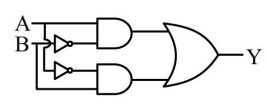
Answer: A.
View full solution →Match List-I with List-II
| | List-I | | List-II |
| (A) | Magnetic induction | (I) | Ampere meter |
| (B) | Magnetic intensity | (II) | Weber |
| (C) | Magnetic flux | (III) | Gauss |
| (D) | Magnetic moment | (IV) | Ampere meter |
Choose the correct answer from the options given below :
- A
(A)-(III), (B)-(IV), (C)-(I), (D)-(II)
- ✓
(A)-(III), (B)-(IV), (C)-(II), (D)-(I)
- C
(A)-(I), (B)-(II), (C)-(III), (D)-(IV)
- D
(A)-(III), (B)-(II), (C)-(I), (D)-(IV)
Answer: B.
View full solution →Match List-I with List-II| | List-I | | List-II |
| (A) | Young's Modulus | (I) | $ML ^{-1} T^{-1}$ |
| (B) | Torque | (II) | $ML ^{-1} T^{-2}$ |
| (C) | Coefficient of Viscosity | (III) | $M ^{-1} L^3 T^{-2}$ |
| (D) | Gravitational Constant | (IV) | $ML ^{2} T^{-2}$ |
Choose the correct answer from the options given below : - A
(A)-(I), (B)-(III), (C)-(II), (D)-(IV)
- B
(A)-(II), (B)-(I), (C)-(IV), (D)-(III)
- C
(A)-(IV), (B)-(II), (C)-(III), (D)-(I)
- ✓
(A)-(II), (B)-(IV), (C)-(I), (D)-(III)
Answer: D.
View full solution →Two cars P and Q are moving on a road in the same direction. Acceleration of car P increases linearly with time whereas car Q moves with a constant acceleration. Both cars cross each other at time $t=0$, for the first time. The maximum possible number of crossing(s) (including the crossing at $t =0$ ) is _________
View full solution →Two planets, A and B are orbiting a common star in circular orbits of radii $R_A$ and $R_B$, respectively, with $R_B=2 R_A$. The planet $B$ is $4 \sqrt{2}$ times more massive than planet $A$. The ratio $\left(\frac{L_B}{L_A}\right)$ of angular momentum $\left(L_B\right)$ of planet $B$ to that of planet $A\left(L_A\right)$ is closest to integer _________
View full solution →A physical quantity Q is related to four observables $a, b, c, d$ as follows : $Q=\frac{a b^4}{c d}$ where, $a =(60 \pm 3) Pa ; b =(20 \pm 0.1) m$; $c =(40 \pm 0.2) Nsm ^{-2}$ and $d =(50 \pm 0.1) m$, then the percentage error in Q is $\frac{ x }{1000}$, where $x =$ _________ (77)
View full solution →A parallel plate capacitor consisting of two circular plates of radius 10 cm is being charged by a constant current of 0.15 A . If the rate of change of potential difference between the plates is $7 \times 10^8$ $V / s$ then the integer value of the distance between the parallel plates is -
$\left(\right.$ Take, $\left.\in_0=9 \times 10^{-12} \frac{F}{ m }, \pi=\frac{22}{7}\right)$ _________ $\mu m$.
View full solution →The magnetic field inside a 200 turns solenoid of radius 10 cm is $2.9 \times 10^{-4} Tesla$. If the solenoid carries a current of 0.29 A , then the length of the solenoid is _________ $\pi cm$.
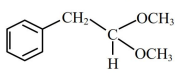
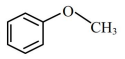
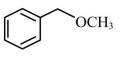
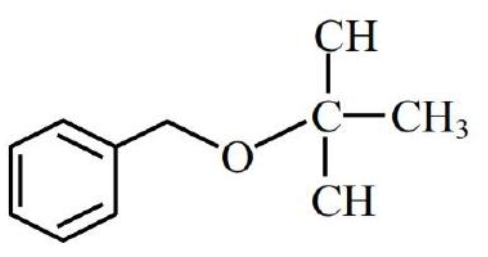
View full solution →Which one of the following, with HBr will give a phenol?
Answer: B.
View full solution →First ionisation enthalpy values of first four group 15 elements are given below. Choose the correct value for the element that is a main component of apatite family :
- ✓
$1012 kJ mol ^{-1}$
- B
$1402 kJ mol ^{-1}$
- C
$834 kJ mol ^{-1}$
- D
$947 kJ mol ^{-1}$
Answer: A.
View full solution →The type of oxide formed by the element among $Li , Na , Be , Mg , B$ and Al that has the least atomic radius is :
- ✓
$A _2 O _3$
- B
$AO _2$
- C
- D
$A _2 O$
Answer: A.
View full solution →Drug X becomes ineffective after $50 \%$ decomposition. The original concentration of drug in a bottle was $16 mg / mL$ which becomes 4 $mg / mL$ in 12 months. The expiry time of the drug in months is _________.
Assume that the decomposition of the drug follows first order kinetics.
Answer: D.
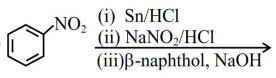
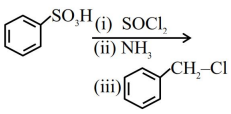
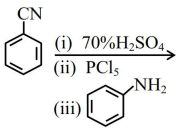
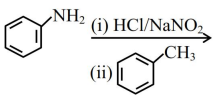
View full solution →Which one of the following reaction sequences will give an azo dye ?
Answer: A.
View full solution →Total number of non bonded electrons present in $NO _2^{-}$ion based on Lewis theory is _________ .
View full solution →In the sulphur estimation, 0.20 g of a pure organic compound gave 0.40 g of barium sulphate. The percentage of sulphur in the compound is _________ $\times 10^{-1} \%$.
(Molar mass : $O =16, S=32, Ba =137$ in $g mol ^{-1}$ )
View full solution →In the Claisen-Schmidt reaction to prepare, dibenzalacetone from 5.3 g benzaldehyde, a total of 3.51 g of product was obtained. The percentage yield in this reaction was _________ \%.
Isomeric hydrocarbons $\rightarrow$ negative Baeyer's test (Molecular formula $C _9 H _{12}$ )
The total number of isomers from above with four different non-aliphatic substitution sites is -
View full solution →Consider the following low-spin complexes$
\begin{array}{l}
K_3\left[Co\left(NO_2\right)_6\right], K 4\left[Fe(CN)_6\right], K_3\left[Fe(CN)_6\right] \\
Cu_2\left[Fe(CN)_6\right] \text { and } Zn 2\left[Fe(CN)_6\right] .
\end{array}
$
The sum of the spin-only magnetic moment values of complexes having yellow colour is _________
B.M. (answer is nearest integer)
View full solution →