Questions

SECTION - A [PHYSICS MCQ]

Take a timed test

20 questions · 6 auto-graded MCQ + 14 self-marked written.

MCQ 14 Marks
Consider following statements for refraction of light through prism, when angle of deviation is minimum.
(A) The refracted ray inside prism becomes parallel to the base.
(B) Larger angle prisms provide smaller angle of minimum deviation.
(C) Angle of incidence and angle of emergence becomes equal.
(D) There are always two sets of angle of incidence for which deviation will be same except at minimum deviation setting.
(E) Angle of refraction becomes double of prism angle.
Choose the correct answer from the options given below.
  • A, C and D Only
  • B
    B, C and D Only
  • C
    A, B and E Only
  • D
    B, D and E Only
Answer
Correct option: A.
A, C and D Only
(A) A, C and D Only
$
\delta=I+e-A
$
For $\delta_{\min } \Rightarrow I = e$ and refracted ray is parallel to base $A , C , D$ are correct
View full question & answer
MCQ 54 Marks
A particle is released from height S above the surface of the earth. At certain height its kinetic energy is three times its potential energy. The height from the surface of the earth and the speed of the particle at that instant are respectively.
  • A
    $\frac{ S }{2}, \sqrt{\frac{3 gS }{2}}$Q
  • B
    $\frac{ S }{2}, \frac{3 gS }{2}$
  • C
    $\frac{ S }{4}, \frac{3 gS }{2}$
  • $\frac{ S }{4}, \sqrt{\frac{3 gS }{2}}$
Answer
Correct option: D.
$\frac{ S }{4}, \sqrt{\frac{3 gS }{2}}$
(D) $\frac{ S }{4}, \sqrt{\frac{3 gS }{2}}$
$
\begin{aligned}
V^2 & =0+2 g(S-x) \\
V^2 & =2 g(S-x)
\end{aligned}
$
At $B$, Potential energy $=m g x$
$
\begin{array}{l}
mgx=3 \times \frac{1}{2} mv^2 \\
gx=\frac{3}{2} \times 2 g(S-x) \\
4 x=S \\
x=\frac{S}{4} \\
\Rightarrow V=\sqrt{2 g \times \frac{3 S}{4}}=\sqrt{\frac{3 gS}{2}}
\end{array}
$
View full question & answer
MCQ 74 Marks
The electrostatic potential on the surface of uniformly charged spherical shell of radius $R =10 cm$ is 120 V . The potential at the centre of shell, at a distance $r =5 cm$ from centre, and at a distance $r =15 cm$ from the centre of the shell respectively, are :
  • A
    $120 V, 120 V, 80 V$
  • B
    $40 V, 40 V, 80 V$
  • C
    $0 V, 0 V, 80 V$
  • D
    $0 V, 120 V, 40 V$
View full question & answer
MCQ 94 Marks
A gas is kept in a container having walls which are thermally non-conducting. Initially the gas has a volume of $800 cm^3$ and temperature $27^{\circ} C$. The change in temperature when the gas is adiabatically compressed to $200 cm^3$ is :
(Take $\gamma=1.5: \gamma$ is the ratio of specific heats at constant pressure and at constant volume)
  • A
    327 K
  • B
    600 K
  • C
    522 K
  • 300 K
Answer
Correct option: D.
300 K
(D) $300k$
$
\begin{array}{l}
V_1=800 cm^3 \quad V_2=200 cm^3 \\
T_1=300 K
\end{array}
$
for adiabatic
$
\begin{array}{l}
TV^{\gamma-1}=\text { const. } \\
(300)(800)^{1.5-1}=T_2(200)^{1.5-1} \\
T_2=300\left[\frac{800}{200}\right]^{0.5}=300 \times\left(2^2\right)^{1 / 2} \\
T_2=600 K \\
\Delta T=600-300=300 K
\end{array}
$
View full question & answer
MCQ 104 Marks
  • A
    $3 n R T \ln \left(\frac{L_1}{L_0}\right)+2 Mg \left(L_1-L_0\right)+\frac{k}{3}\left(L_1^3-L_0^3\right)$
  • B
    $n R T \ln \left(\frac{L_1^2}{L_0^2}\right)+\frac{M g}{2}\left(L_1-L_0\right)+\frac{k}{4}\left(L_1^4-L_0^4\right)$
  • C
    $n R T \ln \left(\frac{L_1}{L_0}\right)+M g\left(L_1-L_0\right)+\frac{k}{4}\left(L_1^4-L_0^4\right)$
  • D
    $n R T \ln \left(\frac{L_1}{L_0}\right)+M g\left(L_1-L_0\right)+\frac{3 k}{4}\left(L_1^4-L_0^4\right)$
Answer
(C) $n R T \ln \left(\frac{L_1}{L_0}\right)+M g\left(L_1-L_0\right)+\frac{k}{4}\left(L_1^4-L_0^4\right)$
Using WET
Total energy supplied $=$ gravitational potential energy + spring potential energy + work done by gas
$
Mg\left(L_1-L_0\right)+\int_{L_0}^{L_1} kx^3 dx+nRT \ell n
$
$\begin{array}{l}{\left[\frac{L_1 A}{L_0 A}\right]+W_{e x t}=0} \\ \frac{K}{4}\left[x^4\right]_{L_0}^{L_1}+M g\left(L_1-L_0\right)+\int_{L_0}^{L_1} k x^3 d x+n R T \ell n \\ {\left[\frac{L_1}{L_0}\right]+W_{e x t}=0}\end{array}$
$\begin{array}{l}\frac{ k }{4}\left(L_1^4- L _0^4\right)+ Mg \left( L _1- L _0\right)+ nRT \ell n \\ {\left[\frac{ L _1}{L_0}\right]+ W _{ ext }=0} \\ W_{ ext }=\frac{ k }{4}\left(L_1^4- L _0^4\right)+ Mg \left( L _1- L _0\right)+ nRT \ell n \left[\frac{ L _1}{L_0}\right]\end{array}$
View full question & answer
MCQ 114 Marks
  • A
    $3.5 m / s ^2$
  • B
    $0.35 m / s ^2$
  • C
    $2.5 m / s ^2$
  • D
    $0.25 m / s ^2$
View full question & answer
MCQ 124 Marks
  • A
    A-IV, B-III, C-II, D-I
  • B
    A-III, B-II, C-I, D-IV
  • C
    A-II, B-IV, C-III, D-I
  • D
    A-I, B-III, C-IV, D-II
View full question & answer
MCQ 134 Marks
  • A
    $\frac{\varepsilon_1 \varepsilon_2^2}{\left(\varepsilon_1+\varepsilon_2\right)^2}$
  • B
    $\frac{4 \varepsilon_1 \varepsilon_2}{\left(\varepsilon_1+\varepsilon_2\right)^2}$
  • C
    $\frac{\varepsilon_1 \varepsilon_2}{\varepsilon_1+\varepsilon_2}$
  • D
    $\frac{\varepsilon_0\left(\varepsilon_1+\varepsilon_2\right)}{2}$
View full question & answer
MCQ 154 Marks
  • A
    A, B, D Only
  • B
    B , C, D Only
  • C
    C, D, E Only
  • D
    A, B, C Only
View full question & answer
MCQ 164 Marks
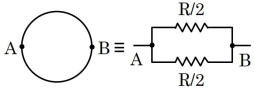
A wire of length 25 m and cross-sectional area $5 mm^2$ having resistivity of $2 \times 10^{-6} \Omega m$ is bent into a complete circle. The resistance between diametrically opposite points will be
  • A
    $12.5 \Omega$
  • B
    $50 \Omega$
  • C
    $100 \Omega$
  • D
    $2.5 \Omega$
View full question & answer
MCQ 174 Marks
  • A
    $1.5 \times 10^{-8}$ Pascals
  • B
    0
  • C
    $6 \times 10^{-8}$ Pascals
  • D
    $3 \times 10^{-8}$ Pascals
View full question & answer
MCQ 194 Marks
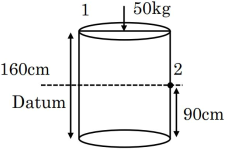
Consider a completely full cylindrical water tank of height 1.6 m and cross-sectional area $0.5 m^2$. It has a small hole in its side at a height 90 cm from the bottom. Assume, the cross-sectional area of the hole to be negligibly small as compared to that of the water tank. If a load 50 kg is applied at the top surface of the water in the tank then the velocity of the water coming out at the instant when the hole is opened is : $\left(g=10 m / s ^2\right)$
  • A
    $3 m / s$
  • B
    $5 m / s$
  • C
    $2 m / s$
  • D
    $4 m / s$
View full question & answer
MCQ 204 Marks
During the melting of a slab of ice at 273 K at atmospheric pressure :
  • A
    Internal energy of ice-water system remains unchanged.
  • B
    Positive work is done by the ice-water system on the atmosphere.
  • C
    Internal energy of the ice-water system decreases.
  • Positive work is done on the ice-water system by the atmosphere.
Answer
Correct option: D.
Positive work is done on the ice-water system by the atmosphere.
(D) Positive work is done on the ice-water system by the atmosphere.
Volume decreases during melting of ice so positive work is done on ice water system by atmosphere
Heat absorbed by ice water so $\Delta Q$ is positive, work done by ice water system is negative
Hence by first law of thermodynamics
$
\Delta U=\Delta Q+\Delta W=\text { Positive }
$
So internal energy increases
View full question & answer