Answer

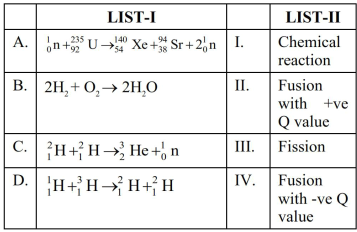
Correct option: B.
A-III, B-I, C-II, D-IV
(B) A-III, B-I, C-II, D-IV 
Conceptual

Need a full question paper?

Generate a complete, print-ready paper with questions like this in minutes — across 16+ boards, with answer keys.

Start Generating Free

Similar questions

A particle of mass $10\, gm$ moves in a field where potential energy per unit mas is given by expression $v = 8 \times 10^4\, x^2\, erg/gm$. If the total energy of the particle is $8 \times 10^7\, erg$ then the relation between $x$ and time $t$ is
A long straight wire carries a current of $\pi \,amp.$ The magnetic field due to it will be $5 \times {10^{ - 5}}{\rm{ }}\,weber/{m^{\rm{2}}}$ at what distance from the wire $[{\mu _o} = $ permeability of air]
A coil of $200$ turns and area $0.20 \mathrm{~m}^2$ is rotated at half a revolution per second and is placed in uniform magnetic field of $0.01 \mathrm{~T}$ perpendicular to axis of rotation of the coil. The maximum voltage generated in the coil is $\frac{2 \pi}{\beta}$ volt. The value of $\beta$ is______________
Two identical adiabatic vessels are filled with oxygen at pressure $P_1$ and $P_2 (P_1 > P_2).$ The vessels are interconnected with each other by a nonconducting pipe. If $U_{01}$ and $U_{02}$ denote initial internal energy of oxygen in first and second vessel respectively and $U_{f_1}$ and  $U_{f_2}$ denote final internal energy values, than :
A car starts from rest and moves with uniform acceleration $'a'$ on a straight road from time $t = 0$ to $t = T$ . After that, a constant deceleration $'a'$ brings it to rest. In this process the average speed of the car is
For which of the following particles will it be most difficult to experimentally verify the deBroglie relationship?
The change in the magnitude of the volume of an ideal gas when a small additional pressure $\Delta P$ is applied at a constant temperature, is the same as the change when the temperature is reduced by a small quantity $\Delta T$ at constant pressure. The initial temperature and pressure of the gas were $300\, K$ and $2\; atm$ respectively. If $|\Delta T|=C|\Delta P|$ then value of $C$ in $(K / a t m)$ is......
The escape velocities of two planets $A$ and $B$ are in the ratio $1: 2$. If the ratio of their radii respectively is $1: 3$, then the ratio of acceleration due to gravity of planet $A$ to the acceleration of gravity of planet $B$ will be:
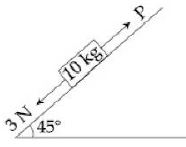
A block of mass $10 \ kg$ is kept on a rough inclined plane as shown in the figure. A force of $3 N$ is applied on the block. The coefficient of static friction between the plane and the block is $0.6$. What should be the minimum value of force $P$, such that the block does not move downward? $($ take $g = 10\ ms^{-2}) ........N$
Which of the following shows the correct relationship between the pressure $'P'$ and density $\rho $ of an ideal gas at constant temperature ?