Questions

SECTION - A [CHEMISTY - MCQ]

Take a timed test

20 questions · self-marked practice — reveal the answer and mark yourself.

MCQ 14 Marks
Consider the following statements related to temperature dependence of rate constants.
Identify the correct statements,
A. The Arrhenius equation holds true only for an elementary homogenous reaction.
B. The unit of A is same as that of k in Arrhenius equation.
C. At a given temperature, a low activation energy means a fast reaction.
D. A and Ea as used in Arrhenius equation depend on temperature.
E. When Ea >> RT. A and Ea become interdependent.
Choose the correct answer from the options given below :
  • A
    A, C and D Only
  • B
    B, D and E Only
  • C
    B and C Only
  • D
    A and B Only
Answer
C. B and C Only
Arrhenious equation hold true for elementary as well as complex reactions.
Unit of A is same as unit of k . Rate of reaction is high if activation energy is low,
A and Ea are temperature independent.
View full question & answer
MCQ 24 Marks
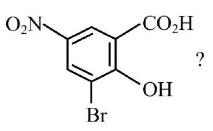
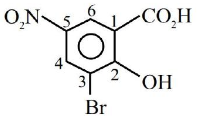
What is the correct IUPAC name of
Image
  • A
    3-Bromo-2-hydroxy-5-nitrobenzoic acid
  • B
    3-Bromo-4-hydroxy-1-nitrobenzoic acid
  • C
    2-Hydroxy-3-bromo-5-nitrobenzoic acid
  • D
    5-Nitro-3-bromo-2-hydroxybenzoic acid
Answer
A. 3-Bromo-2-hydroxy-5-nitrobenzoic acid
Image
IUPAC 3-Bromo-2-hydroxy-5-nitro-Benzoic acid
View full question & answer
MCQ 34 Marks
The correct orders among the following are
Atomic radius : $\mathrm{B}<\mathrm{Al}<\mathrm{Ga}<\mathrm{In}<\mathrm{Tl}$
Electronegativity : $\mathrm{Al}<\mathrm{Ga}<\mathrm{In}<\mathrm{Tl}<\mathrm{B}$
Density: $\mathrm{Tl}<\mathrm{In}<\mathrm{Ga}<\mathrm{Al}<\mathrm{B}$
1st Ionisation Energy : $\mathrm{In}<\mathrm{Al}<\mathrm{Ga}<\mathrm{Tl}<\mathrm{B}$
Choose the correct answer from the options given below :
  • A
    B and D Only
  • B
    A and C Only
  • C
    C and D Only
  • D
    A and B Only
Answer
A. B and D Only
 BAlGaInTl
Atomic radius $(\mathrm{pm})$88143135167170
Electronegativity21.51.61.71.8
Density $\left(\mathrm{g} / \mathrm{cm}^{3}\right)$2.352.75.97.3111.85
Ionisation Energy (kJ/mol $)$801577579558589
Radius Order$\mathrm{T} \ell>\mathrm{In}>\mathrm{A} \ell>\mathrm{Ga}>\mathrm{B}$
EN Order$\mathrm{B}>\mathrm{T} \ell>\mathrm{In}>\mathrm{Ga}>\mathrm{Al}$
Density Order$\mathrm{T} \ell>\mathrm{In}>\mathrm{Ga}>\mathrm{A} \ell>\mathrm{B}$
$\mathrm{IE}_{1}$ Order$\mathrm{B}>\mathrm{T} \ell>\mathrm{Ga}>\mathrm{A} \ell>\mathrm{In}$
View full question & answer
MCQ 44 Marks
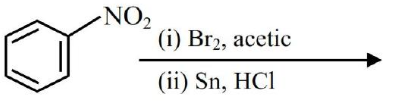
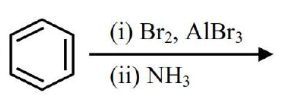
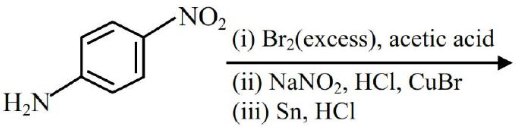
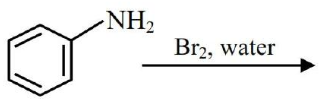
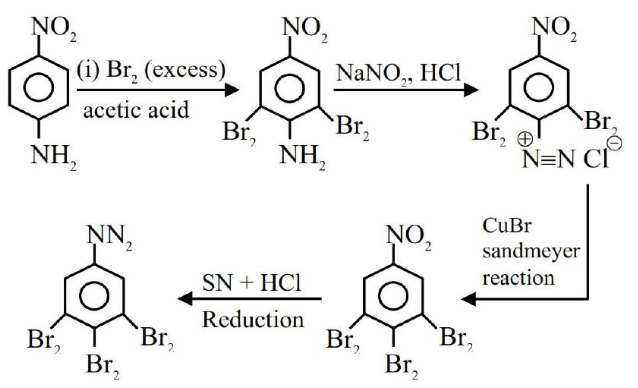
The sequence from the following that would result in giving predominantly $3,4,5$-Tribromoaniline is :
  • A
    Image
  • B
    Image
  • C
    Image
  • D
    Image
Answer
C. Image
Image
3,4,5-tri bromo aniline
View full question & answer
MCQ 54 Marks
Given below are two statements :
Statement I : When a system containing ice in equilibrium with water (liquid) is heated, heat is absorbed by the system and there is no change in the temperature of the system until whole ice gets melted.
Statement II : At melting point of ice, there is absorption of heat in order to overcome intermolecular forces of attraction within the molecules of water in ice and kinetic energy of molecules is not increased at melting point.
In the light of the above statements, choose the correct answer from the options given below:
  • A
    Statement I is true but Statement II is false
  • B
    Both Statement I and Statement II are false
  • C
    Both Statement I and Statement II are true
  • D
    Statement I is false but Statement II is true
Answer
C. Both Statement I and Statement II are true
At melting point when ice melts, supplied heat is utilised to overcome intermolecular attraction within the molecules so temperature remain constant.
View full question & answer
MCQ 64 Marks
Given below are two statements :
Statement I : Hyperconjugation is not a permanent effect.
Statement II : In general, greater the number of alkyl groups attached to a positively charged C -atom, greater is the hyperconjugation interaction and stabilization of the cation.
In the light of the above statements, choose the correct answer from the options given below
  • A
    Statement I is true but Statement II is false
  • B
    Both Statement I and Statement II are false
  • C
    Statement I is false but Statement II is true
  • D
    Both Statement I and Statement II are true
Answer
C. Statement I is false but Statement II is true
Hyper conjugation is permanent effect because external reagent is not required, so Statement-I is false and Statement-II is true. because moore alkyl group, more $\alpha-\mathrm{H}$, so more hyperconjugation which results more stability of carbocation.
View full question & answer
MCQ 74 Marks
Given below are two statements :
Statement I : $\mathrm{CrO}_{3}$ is a stronger oxidizing agent than $\mathrm{MoO}_{3}$
Statement II : $\mathrm{Cr}(\mathrm{VI})$ is more stable than $\mathrm{Mo}(\mathrm{VI})$
In the light of the above statements, choose the correct answer from the options given below
  • A
    Statement I is false but Statement II is true
  • B
    Statement I is true but Statement II is false
  • C
    Both Statement I and Statement II are true
  • D
    Both Statement I and Statement II are false
Answer
B. Statement I is true but Statement II is false
Statement-I is true but statement II is false. $\mathrm{Cr}(\mathrm{VI})$ is less stable than $\mathrm{Mo}(\mathrm{VI})$ Hence, $\mathrm{CrO}_{3}$ easily reduce into $\mathrm{Cr}^{+3}$ as compared to $\mathrm{MoO}_{3}$ and show stronger oxidizing nature.
View full question & answer
MCQ 84 Marks
Given below are two statements :
Statement I : Wet cotton clothes made of cellulose based carbohydrate takes comparatively longer time to get dried than wet nylon polymer based clothes.
Statement II : Intermolecular hydrogen bonding with water molecule is more in nylon-based clothes than in the case of cotton clothes.
In the light of above statements, choose the Correct answer from the options given below
  • A
    Statement I is false but Statement II is true
  • B
    Statement I is true but Statement II is false
  • C
    Both Statement I and Statement II are true
  • D
    Both Statement I and Statement II are false
Answer
B. Statement I is true but Statement II is false
Cellulose derivcative has more number of hydroxy groups, so more H -bonding is present with water in cellulose derivatives cotton cloths.
View full question & answer
MCQ 94 Marks
Mass of magnesium required to produce 220 mL of hydrogen gas at STP on reaction with excess of dil. HCl is
Given : Molar mass of Mg is $24 \mathrm{~g} \mathrm{~mol}^{-1}$.
  • A
    235.7 g
  • B
    0.24 mg
  • C
    236 mg
  • D
    2.444 g
Answer
C. 236 mg
$\mathrm{Mg}+2 \mathrm{HCl} \rightarrow \mathrm{MgCl}_{2}+\mathrm{H}_{2}$
Volume $\mathrm{H}_{2}$ evolved $=220 \mathrm{ml}$
Mole of $\mathrm{H}_{2}=\frac{220 \times 10^{-3}}{22.4}=$ mole of Mg used
$\begin{aligned} \therefore \text { Mass of Mg used } & =\frac{220 \times 10^i}{22.4} \times 24 \\ & -235.7 \times 10^{-3} gm \\ & -235.7 mg \end{aligned}$
View full question & answer
MCQ 104 Marks
In Dumas' method for estimation of nitrogen 0.4 g of an organic compound gave 60 mL of nitrogen collected at 300 K temperature and 715 mm Hg pressure. The percentage composition of nitrogen in the compound is
(Given : Aqueous tension at $300 \mathrm{~K}=15 \mathrm{~mm} \mathrm{Hg}$ )
  • A
    $15.71 \%$
  • B
    $20.95 \%$
  • C
    $17.46 \%$
  • D
    $7.85 \%$
Answer
A. $15.71 \%$
Pressure of $\mathrm{N}_{2}$ gas evolved $=715-15$
$\begin{array}{l}=700 mm Hg \\ =\frac{700}{760} atm .\end{array}$
$\therefore$ Mole of $\mathrm{N}_{2}$ evolved $=\frac{\mathrm{PV}}{\mathrm{RT}}$
$\begin{array}{l}=\frac{700 \times 60 \times 10^{-3}}{760 \times 0.0821 \times 300} \\ =0.0022 mole\end{array}$
$\therefore$ wt. of $\mathrm{N}_{2}$ evolved $=0.0022 \times 28=0.063 \mathrm{gm}$
$\therefore \mathrm{wt} . \%$ of nitrogen in compound
$\begin{array}{l}=\frac{\text { wt. of nitrogen }}{\text { wt. of compound }} \times 100 \\ =\frac{0.063}{0.4} \times 100 \\ =15.71 \%\end{array}$
View full question & answer
MCQ 114 Marks
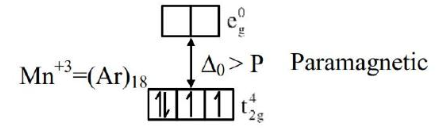
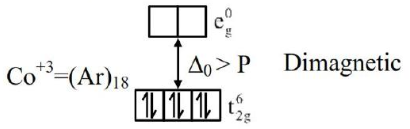
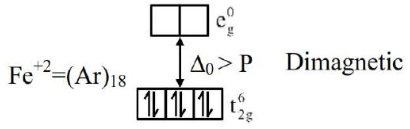
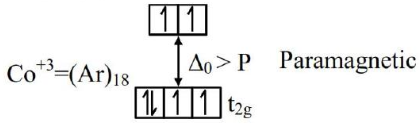
Identify the diamagnetic octahedral complex ions from below ;
A. $\left[\mathrm{Mn}(\mathrm{CN})_{6}\right]^{3-}$$\quad$B. $\left[\mathrm{Co}\left(\mathrm{NH}_{3}\right)_{6}\right]^{3+}$
C. $\left[\mathrm{Fe}(\mathrm{CN})_{6}\right]^{4-}$$\quad$D. $\left[\mathrm{Co}\left(\mathrm{H}_{2} \mathrm{O}\right)_{3} \mathrm{~F}_{3}\right]$
Choose the correct answer from the options given below :
  • A
    B and D Only
  • B
    A and D Only
  • C
    A and C Only
  • D
    B and C Only
View full question & answer
MCQ 124 Marks
The standard cell potential $\left(\mathrm{E}_{\text {cell }}^{\ominus}\right)$ of a fuel cell based on the oxidation of methanol in air that has been used to power television relay station is measured as 1.21 V . The standard half cell reduction potential for $\mathrm{O}_{2}\left(\mathrm{E}_{\mathrm{O}_{2} / \mathrm{H}_{2} \mathrm{O}}^{\mathrm{O}}\right)$ is 1.229 V .
Choose the correct statement:
  • A
    The standard half cell reduction potential for the reduction of $\mathrm{CO}_{2}\left(\mathrm{E}_{\mathrm{CO}_{2} / \mathrm{CH}_{3} \mathrm{OH}}^{0}\right)$ is 19 Mv
  • B
    Oxygen is formed at the anode.
  • C
    Reactants are fed at one go to each electrode.
  • D
    Reduction of methanol takes place at the cathode.
Answer
A. The standard half cell reduction potential for the reduction of $\mathrm{CO}_{2}\left(\mathrm{E}_{\mathrm{CO}_{2} / \mathrm{CH}_{3} \mathrm{OH}}^{0}\right)$ is 19 mV
$\because \mathrm{E}_{\text {cell }}^{\mathrm{o}}=\mathrm{E}_{\text {cathode }}^{\mathrm{o}}-\mathrm{E}_{\text {Anode }}^{\mathrm{o}}$
$1.21=1.229- E _{\text {Anode }}^{ o }$
$\because$ Fuel cell involves oxidation of methanol which will occur at anode and reduction of $\mathrm{O}_{2}$ will occur at cathode.
View full question & answer
MCQ 134 Marks
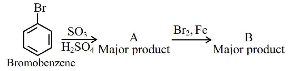
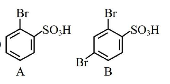
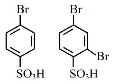
In the following series of reactions identify the major products A & B respectively.
Image
  • A

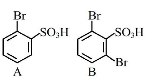
    Image
  • B

    Image
  • C

    Image
  • D

    Image
Answer
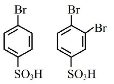
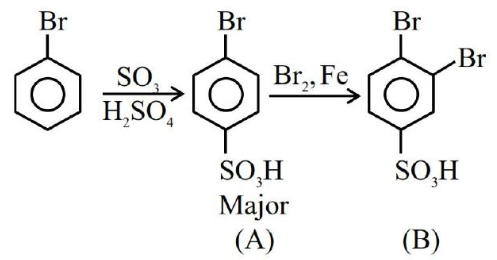
B. Image
Image
Both reactions are electrophilic substitution reaction, $\mathrm{I}^{\text {st }}$ is sulphonation and $\mathrm{II}^{\text {nd }}$ is halogenation :
View full question & answer
MCQ 154 Marks
Compounds that should not be used as primary standards in titrimetric analysis are :
A. $\mathrm{Na}_{2} \mathrm{Cr}_{2} \mathrm{O}_{7}$
B. Oxalic acid
C. NaOH
D. $\mathrm{FeSO}_{4} \cdot 6 \mathrm{H}_{2} \mathrm{O}$
E. Sodium tetraborate
Choose the most appropriate answer from the options given below:
  • A
    B and D Only
  • B
    D and E Only
  • C
    C, D and E Only
  • D
    A, C and D Only
Answer
D. A, C and D Only
The primary standard is a highly pure stable compound with a known exact composition that can be accurately weighed and dissolved to creat a solution of known concentration.
NaOH is hygroscopic and can't be used.
$\mathrm{FeSO}_{4} \cdot 6 \mathrm{H}_{2} \mathrm{O}$ is unstable and can be easily oxidised.
$\mathrm{Na}_{2} \mathrm{Cr}_{2} \mathrm{O}_{7}$ is hygroscopic and can't be used.
View full question & answer
MCQ 164 Marks
For electron in '$2 s$' and '$2 p$' orbitals, the orbital angular momentum values, respectively are :
  • A
    $\sqrt{2} \frac{\mathrm{~h}}{2 \pi}$ and 0
  • B
    $\frac{\mathrm{h}}{2 \pi}$ and $\sqrt{2} \frac{\mathrm{~h}}{2 \pi}$
  • C
    0 and $\sqrt{6} \frac{\mathrm{~h}}{2 \pi}$
  • D
    0 and $\sqrt{2} \frac{\mathrm{~h}}{2 \pi}$
Answer
D. 0 and $\sqrt{2} \frac{\mathrm{~h}}{2 \pi}$
Orbital angular momentum $=\sqrt{\ell(\ell+1)} \frac{\mathrm{h}}{2 \pi}$
$\therefore \quad$ For 2 s orbital $: \ell=0$
Orbital angular momentum $=0$
$\therefore$ For 2 p orbital $: \ell=1$
$\begin{aligned} \text { Orbital angular momentum } & =\sqrt{1(1+2)} \frac{ n }{2 \pi} \\ & =\sqrt{2} \frac{h}{2 \pi}\end{aligned}$
View full question & answer
MCQ 174 Marks
Match the LIST-I with LIST-II.
LIST-I
(Family)
LIST-II
(Symbol of Element)
A.Pnicogen (group 15)I.Ts
B.ChalcogenII.Og
C.HalogenIII.Lv
D.Noble gasIV.Mc
Choose the correct answer from the options given below :
  • A
    A-IV, B-I, C-II, D-III
  • B
    A-IV, B-III, C-I, D-II
  • C
    A-III, B-I, C-IV, D-II
  • D
    A-II, B-III, C-IV, D-I
Answer
B. A-IV, B-III, C-I, D-II
(A) Pnictogen $\Rightarrow$ Mc (Moscovium),
Atomic No. $=115$
(B) Chalcogen $\Rightarrow \mathrm{Lv}$ (Livermorium),
Atomic No. $=116$
(C) Halogen $\Rightarrow$ Ts (Tennessine),
Atomic No. $=117$
(D) Noble gas $\Rightarrow \mathrm{Og}$ (Oganesson),
Atomic No. $=118$
View full question & answer
MCQ 184 Marks
Fat soluble vitamins are :
A. Vitamin $B_{1}$$\quad$B. Vitamin C$\quad$C. Vitamin E$\quad$D. Vitamin $B_{12}$$\quad$E. Vitamin K$\quad$Choose the correct answer from the options given below :
  • A
    C & D Only
  • B
    A & B Only
  • C
    B & C Only
  • D
    C & E Only
Answer
D. C & E Only
Vit D, E, K. A are fat soluble vitamins.
View full question & answer
MCQ 194 Marks
10 mL of 2 M NaOH solution is added to 20 mL of 1 M HCl solution kept in a beaker. Now, 10 mL of this mixture is poured into a volumetric flask of 100 mL containing 2 moles of HCl and made the volume upto the mark with distilled water. The solution in this flask is :
  • A
    0.2 M NaCl solution
  • B
    20 M HCl solution
  • C
    10 M HCl solution
  • D
    Neutral solution
Answer
B. 20 M HCl solution
When $10 \mathrm{ml}, 2 \mathrm{M} \mathrm{NaOH}$ solution is added to 20 ml of 1 M HCl solution :
$\quad\quad\quad\quad NaOH \quad + HCl \rightarrow NaCl + H _2 O$
Initial : $\mathrm{MV}=2 \times 0.1 \quad \mathrm{MV}=1 \times 0.2$
$\begin{array}{lll} & =0.2 \text { mole } & =0.2 \text { mole } \\ \text { Final } & 0 & 0\end{array}$
$\therefore$ Resulting solution becomes neutral.
Now when 10 mol of above solution is poured into a flask containing 2 mole HCl and made solution 100 ml will distilled water.
Molarity of $\mathrm{HCl}=\frac{2}{100} \times 1000=20$
View full question & answer
MCQ 204 Marks
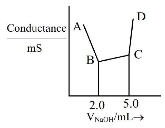
40 mL of a mixture of $\mathrm{CH}_{3} \mathrm{COOH}$ and HCl (aqueous solution) is titrated against 0.1 M NaOH solution conductometrically. Which of the following statement is correct?
Image
  • A
    The concentration of $\mathrm{CH}_{3} \mathrm{COOH}$ in the original mixture is 0.005 M
  • B
    The concentration of HCl in the original mixture is 0.005 M
  • C
    $\mathrm{CH}_{3} \mathrm{COOH}$ is neutralised first followed by neutralisation of HCl
  • D
    Point 'C' indicates the complete neutralisation HCl
Answer
B. The concentration of HCl in the original mixture is 0.005 M
From the given graph 2 ml NaOH solution is used for neutralisation of HCl and 3 ml NaOH solution is used for neutralisation of $\mathrm{CH}_{3} \mathrm{COOH}$.
$\therefore$ Mole of $\mathrm{HCl}=$ Mole of NaOH used
$M \times 40=0.1 \times 2$
$\mathrm{M}=0.005$
$\therefore$ Mole of $\mathrm{CH}_{3} \mathrm{COOH}=$ Mole of NaOaH used
$\mathrm{M} \times 40=0.1 \times 3$
$\mathrm{M}=0.0075$
HCl is strong acid and will be neutralised first.
View full question & answer