MCQ 14 Marks
The sum $1+\frac{1+3}{2!}+\frac{1+3+5}{3!}+\frac{1+3+5+7}{4!}+\ldots$ upto $\infty$ terms, is equal to
AnswerD. $2 e$
$\mathrm{S}=1+\frac{1+3}{2!}+\frac{1+3+5}{3!}+\ldots$
$=\sum_{r=1}^{\infty} \frac{r^{2}}{r!}$
$=\sum_{\mathrm{r}=1}^{\infty} \frac{(\mathrm{r}-1+1)}{(\mathrm{r}-1)!}=\sum_{\mathrm{r}=2}^{\infty} \frac{1}{(\mathrm{r}-2)!}+\sum_{\mathrm{r}=1}^{\infty} \frac{1}{(\mathrm{r}-1)!}$
$=2 \mathrm{e}$
View full question & answer→MCQ 24 Marks
The distance of the point $(7,10,11)$ from the line $\frac{x-4}{1}=\frac{y-4}{0}=\frac{z-2}{3}$ along the line $\frac{x-9}{2}=\frac{y-13}{3}=\frac{z-17}{6}$ is
AnswerB. 14
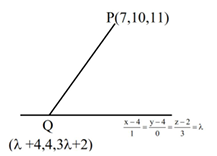
$\because$ line $P Q$ is parallel to line $\frac{x-9}{2}=\frac{y-3}{3}=\frac{z-17}{6}$
$\therefore \frac{\lambda-3}{2}=\frac{-6}{3}=\frac{3 \lambda-9}{6} \Rightarrow \lambda=-1$
$\mathrm{Q}=(3,4,-1)$
$\therefore \mathrm{PQ}=\sqrt{16+36+144}=14$ View full question & answer→MCQ 34 Marks
The shortest distance between the curves $y^{2}=8 x$ and $x^{2}+y^{2}+12 y+35=0$ is :
- A
$2 \sqrt{3}-1$
- B
$\sqrt{2}$
- C
$3 \sqrt{2}-1$
- D
$2 \sqrt{2}-1$
AnswerD. $2 \sqrt{2}-1$
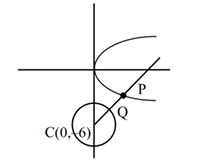
Equation of normal to parabola
$\mathrm{y}^{2}=8 \mathrm{x}$ is $\mathrm{y}=\mathrm{mx}-4 \mathrm{~m}-2 \mathrm{~m}^{3}$
passes through $(0,-6)$ we get
$-6=-4 m-2 m^{3}$
$\Rightarrow \mathrm{m}^{3}+2 \mathrm{~m}-3=0$
$\Rightarrow(\mathrm{m}-1)\left(\mathrm{m}^{2}+\mathrm{m}+3\right)=0 \Rightarrow \mathrm{~m}=-1$
$P=\left(\mathrm{am}^{2},-2 \mathrm{am}\right)=(2,-4)$
$\therefore$ Shortest distance $=\mathrm{PC}-\mathrm{r}$
$=(2 \sqrt{2}-1)$ View full question & answer→MCQ 44 Marks
Let C be the circle of minimum area enclosing the ellipse $E: \frac{x^{2}}{a^{2}}+\frac{y^{2}}{b^{2}}=1$ with eccentricity $\frac{1}{2}$ and foci $( \pm 2,0)$. Let PQR be a variable triangle, whose vertex P is on the circle C and the side QR of length 29 is parallel to the major axis of E and contains the point of intersection of $E$ with the negative $y$-axis. Then the maximum area of the triangle PQR is :
- A
$6(3+\sqrt{2})$
- B
$8(3+\sqrt{2})$
- C
$62+\sqrt{3}$
- D
$82+\sqrt{3}$
AnswerD. $82+\sqrt{3}$
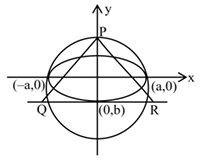
Area of $\triangle \mathrm{PQR}$
$=\frac{1}{2}(2 \mathrm{a})(\mathrm{a} \sin \theta+\mathrm{b})$
$\therefore$ maximum area $=\mathrm{a}(\mathrm{a}+\mathrm{b})$
$=4(4+2 \sqrt{3})=8(2+\sqrt{3})$ View full question & answer→MCQ 54 Marks
The number of solutions of equation $4-\sqrt{3} \sin x$ $-2 \sqrt{3} \cos ^{2} x=-\frac{4}{1+\sqrt{3}}, x \in\left[-2 \pi, \frac{5 \pi}{2}\right]$ is
AnswerD. 5
$(4-\sqrt{3}) \sin x-2 \sqrt{3} \cos ^{2} x=\frac{-4}{1+\sqrt{3}}, x \in\left[-2 \pi, \frac{5 \pi}{2}\right]$
$\Rightarrow(4-\sqrt{3}) \sin x-2 \sqrt{3}\left(1-\sin ^{2} x\right)=2(1-\sqrt{3})$
$\Rightarrow 2 \sqrt{3} \sin ^{2} \mathrm{x}+4 \sin \mathrm{x}-\sqrt{3} \sin \mathrm{x}-2=0$
$\Rightarrow(2 \sin x-1)(\sqrt{3} \sin x+2)=0$
$\Rightarrow \sin \mathrm{x}=\frac{1}{2}$
$\therefore$ Number of solution $=5$
View full question & answer→MCQ 64 Marks
If $z_{1}, z_{2}, z_{3} \in C$ are the vertices of an equilateral triangle, whose centroid is $z_{0}$, then $\sum_{k=1}^{3}\left(z_{k}-z_{0}\right)^{2}$ is equal to
AnswerA. 0
$z_{1}+z_{2}+z_{3}=3 z_{0}$
$\left(z_{1}+z_{2}+z_{3}\right)^{2}=9 z_{0}{ }^{2}$
$\Rightarrow \mathrm{z}_{1}^{2}+\mathrm{z}_{2}^{2}+\mathrm{z}_{3}^{2}+2\left(\mathrm{z}_{1}^{2}+\mathrm{z}_{2}^{2}+\mathrm{z}_{3}^{2}\right)=9 \mathrm{z}_{0}^{2}$
$\Rightarrow \mathrm{z}_{1}^{2}+\mathrm{z}_{2}^{2}+\mathrm{z}_{3}^{2}=3 \mathrm{z}_{6}^{2}$
$\sum_{\mathrm{k}=1}^{3}\left(\mathrm{z}_{\mathrm{k}}-\mathrm{z}_{0}\right)^{2}=\left(\mathrm{z}_{1}-\mathrm{z}_{0}\right)^{2}+\left(\mathrm{z}_{2}-\mathrm{z}_{0}\right)^{2}+\left(\mathrm{z}_{3}-\mathrm{z}_{0}\right)^{2}$ $=\mathrm{z}_{1}^{2}+\mathrm{z}_{2}^{2}+\mathrm{z}_{3}^{2}+3 \mathrm{z}_{0}^{2}-2\left(\mathrm{z}_{1}+\mathrm{z}_{2}+\mathrm{z}_{3}\right) \mathrm{z}_{0}$
$=6 \mathrm{z}_{0}^{2}-6 \mathrm{z}_{0}^{2}$
$=0$
View full question & answer→MCQ 74 Marks
Let $y=y(x)$ be the solution of the differential
equation $\frac{d y}{d x}+3\left(\tan ^{2} x\right) y+3 y=\sec ^{2} x$, $\mathrm{y}(0)=\frac{1}{3}+\mathrm{e}^{3}$. Then $\mathrm{y}\left(\frac{\pi}{4}\right)$ is equal to
AnswerB. $\frac{4}{3}$
$\frac{d y}{d x}+3\left(\sec ^{2} \mathrm{x}\right) \mathrm{y}=\sec ^{2} \mathrm{x}, \mathrm{y}(0)=\frac{1}{3}+\mathrm{e}^{3}$
If $=e^{3 \int \sec ^{2} x d x}=e^{3 \tan x}$
$\therefore$ Solution is
$e^{3 \tan x} y=\int e^{3 \tan x} \sec ^{2} x d x$
$e^{3 \tan x} y=\frac{e^{3 \tan x}}{3}+c$
$\because \mathrm{y}(0)=\frac{1}{3}+\mathrm{e}^{3} \Rightarrow \mathrm{c}=\mathrm{e}^{3}$
$\therefore y\left(\frac{\pi}{4}\right)=\frac{\frac{e^{3}}{3}+e^{3}}{e^{3}}=\frac{4}{3}$
View full question & answer→MCQ 84 Marks
If the probability that the random variable $X$ takes the value x is given by $\mathrm{P}(\mathrm{X}=\mathrm{x})=\mathrm{k}(\mathrm{x}+1) 3^{-\mathrm{x}}$, $\mathrm{x}=0,1,2,3 \ldots \ldots$, where k is a constant, then $\mathrm{P}(\mathrm{X} \geq 3)$ is equal to
- A
$\frac{7}{27}$
- B
$\frac{4}{9}$
- C
$\frac{8}{27}$
- D
$\frac{1}{9}$
AnswerD. $\frac{1}{9}$
$\sum_{x=0}^{\infty} k(x+1) 3^{-x}=1$
$\Rightarrow \frac{1}{\mathrm{k}}=1+\frac{2}{3}+\frac{3}{3^{2}}+\frac{4}{3^{3}}+ \quad\quad...(i)$
$\frac{1}{3 \mathrm{k}}=\frac{1}{3}+\frac{2}{3^{2}}+\frac{3}{3^{3}}+\quad\quad\quad \ldots(ii)$
(i)- (ii) $\Rightarrow \frac{1}{\mathrm{k}}-\frac{1}{3 \mathrm{k}}=1+\frac{1}{3}+\frac{1}{3^{2}}+\ldots$
$\Rightarrow \mathrm{k}=\frac{4}{9}$
$P(x \geq 3)=1-P(x=0)-P(x=1)-P(x=2)$
$=1-\mathrm{k}\left(1+\frac{2}{3}+\frac{3}{9}\right)=\frac{1}{9}$
View full question & answer→MCQ 94 Marks
If the domain of the function
$f(x)=\log _{7}\left(1-\log _{4}\left(x^{2}-9 x+18\right)\right)$ is $(\alpha, \beta) \cup(\gamma, \delta)$, then $\alpha+\beta+\gamma+\delta$ is equal to
AnswerA. 18
Domain $1-\log _{4}\left(x^{2}-9 x+18\right)>0$
Also $x^{2}-9 x+18>0$
$(x-3)(x-6)>0$
$x \in(-\infty, 3) \cup(6, \infty) \quad ...(1)$
also $\mathrm{x}^{2}-9 \mathrm{x}+18<4$
$x^{2}-9 x+14<0$
$x \in(2,7) \quad ...(2)$
$(1) \cap(2) \quad(2,3) \cup(6,7)=(\alpha, \beta) \cup(\gamma, \delta)$
$\Rightarrow \alpha+\beta+\gamma+\delta=18$
View full question & answer→MCQ 104 Marks
The area of the region $\{(x, y):|x-y| \leq y \leq 4 \sqrt{x}\}$ is
- A
- B
$\frac{1024}{3}$
- C
$\frac{512}{3}$
- D
$\frac{2048}{3}$
AnswerB. $\frac{1024}{3}$
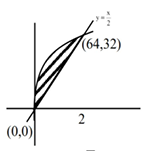
$|x-y| \leq y \leq 4 \sqrt{x}$
Now $y=|x-y|$
$y^{2}=(x-y)^{2}$
$\Rightarrow \mathrm{y}=\frac{\mathrm{x}}{2}$ and $\mathrm{x}=0$
Now area $=\int_{0}^{64}\left(4 \sqrt{x}-\frac{x}{2}\right) d x$
$=\left[\frac{4 \mathrm{x}^{3 / 2}}{3 / 2}-\frac{\mathrm{x}^{2}}{4}\right]_{0}^{64}=\frac{8}{3} .8^{3}-\frac{64^{2}}{4}=64^{2}\left(\frac{1}{12}\right)$
$=\frac{1024}{3}$ View full question & answer→MCQ 114 Marks
Let $f$ be a function such that $f(x)+3 f\left(\frac{24}{x}\right)$ $=4 \mathrm{x}, \mathrm{x} \neq 0$. Then $\mathrm{f}(3)+\mathrm{f}(8)$ is equal to
AnswerA. 11
$f(x)+3 f\left(\frac{24}{x}\right)=4 x$
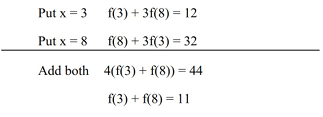
View full question & answer→MCQ 124 Marks
The integral $\int_{0}^{\pi} \frac{8 x d x}{4 \cos ^{2} x+\sin ^{2} x}$ is equal to
- A
$2 \pi^{2}$
- B
$4 \pi^{2}$
- C
$\pi^{2}$
- D
$\frac{3 \pi^{2}}{2}$
AnswerA. $2 \pi^{2}$
$I=\int_{0}^{\pi} \frac{8 x d x}{4 \cos ^{2} x+\sin ^{2} x}$
$I=\int_{0}^{\pi} \frac{8(\pi-x) d x}{4 \cos ^{2} x+\sin ^{2} x}$
$2 I=8 \pi \int_{0}^{\pi} \frac{d x}{4 \cos ^{2} x+\sin ^{2} x}$
$2 I=8 \pi \times 2 \int_{0}^{\pi / 2} \frac{\sec ^{2} x}{4+\tan ^{2} x} d x$
$\mathrm{I}=8 \pi \int_{0}^{\infty} \frac{\mathrm{dt}}{4+\mathrm{t}^{2}}=8 \pi \times \frac{1}{2}\left(\tan ^{-1} \frac{\mathrm{t}}{2}\right]_{0}^{\infty}$
$=4 \pi \times \frac{\pi}{2}=2 \pi^{2}$
View full question & answer→MCQ 134 Marks
Line $L_{1}$ of slope 2 and line $L_{2}$ of slope $\frac{1}{2}$ intersect at the origin O . In the first quadrant, $\mathrm{P}_{1}, \mathrm{P}_{2}, \ldots . \mathrm{P}_{12}$ are 12 points on line $L_{1}$ and $Q_{1}, Q_{2}, \ldots . . Q_{9}$ are 9 points on line $L_{2}$. Then the total number of triangles, that can be formed having vertices at three of the 22 points $\mathrm{O}, \mathrm{P}_{1}, \mathrm{P}_{2}, \ldots \mathrm{P}_{12}$, $\mathrm{Q}_{1}, \mathrm{Q}_{2}, \ldots \mathrm{Q}_{9}$, is:
AnswerB. 1134
Total number of $\Delta$ are
$={ }^{9} \mathrm{C}_{1}{ }^{12} \mathrm{C}_{2}+{ }^{9} \mathrm{C}_{2}{ }^{12} \mathrm{C}_{1}+{ }^{1} \mathrm{C}_{1}{ }^{9} \mathrm{C}_{1}{ }^{12} \mathrm{C}_{1}$
$=594+432+108$
$=1134$
View full question & answer→MCQ 144 Marks
let the equation $x(x+2)(12-k)=2$ have equal roots. Then the distance of the point $\left(\mathrm{k}, \frac{\mathrm{k}}{2}\right)$ from the line $3 x+4 y+5=0$ is
- A
- B
$5 \sqrt{3}$
- C
$15 \sqrt{5}$
- D
AnswerA. 15
$\left(x^{2}+2 x\right)(12-k)=2$
$\lambda \mathrm{x}^{2}+2 \lambda \mathrm{x}-2=0 \quad \mathrm{k} \neq 12$ Let $12-\mathrm{k}=\lambda$
$\mathrm{D}=0$
$4 \lambda^{2}+8 \lambda=0$
$\lambda=0$ or $\lambda=-2$
$\Rightarrow 12-\mathrm{k}=-2$
$\mathrm{k}=14$
So $P\left(k, \frac{k}{2}\right)=(14,7)$
$\mathrm{d}=\left|\frac{3 \times 14+4 \times 7+5}{5}\right|=15$
View full question & answer→MCQ 154 Marks
Let $\mathrm{A}=\{-2,-1,0,1,2,3\}$. let R be a relation on A defined by $x R y$ if and only if $y=\max \{x, 1\}$. Let $l$ be the number of elements in R. Let $m$ and $n$ be the minimum number of elements required to be added in R to make it reflexive and symmetric relations, respectively. Then $l+\mathrm{m}+\mathrm{n}$ is equal to
AnswerA. 12
$\mathrm{A}=\{-2,-1,0,1,2,3\}$
$\mathrm{R}=\{(-2,1),(-1,1),(0,1),(1,1),(2,2),(3,3)\}$
$\ell=6$
$\mathrm{m}=3$
$\mathrm{n}=3$
$\ell+\mathrm{m}+\mathrm{n}=12$
View full question & answer→MCQ 164 Marks
Consider the lines $x(3 \lambda+1)+y(7 \lambda+2)=17 \lambda+5$, $\lambda$ being a parameter, all passing through a point P . One of these lines (say L) is farthest from the origin. If the distance of $L$ from the point $(3,6)$ is $d$, then the value of $d^{2}$ is
AnswerA. 20
$\mathrm{x}(3 \lambda+1)+\mathrm{y}(7 \lambda+2)=17 \lambda+5$
$(x+2 y-5)+\lambda(3 x+7 y-17)=0$
intersection of family of lines
$\mathrm{P}(1,2)$
Let $\mathrm{Q}(3,6)$
$d=P Q=\sqrt{2^{2}+4^{2}}=\sqrt{20}$
$\mathrm{d}^{2}=20$
View full question & answer→MCQ 174 Marks
Let the Mean and Variance of five observations $\mathrm{x}_{1}=1, \mathrm{x}_{2}=3, \mathrm{x}_{3}=\mathrm{a}, \mathrm{x}_{4}=7$ and $\mathrm{x}_{5}=\mathrm{b}, \mathrm{a}>\mathrm{b}$, be 5 and 10 respectively. Then the Variance of the observations $\mathrm{n}+\mathrm{x}_{\mathrm{n}}, \mathrm{n}=1,2, \ldots \ldots . .5$ is
AnswerD.16
$\overline{\mathrm{x}}=\frac{\sum \mathrm{x}_{\mathrm{i}}}{\mathrm{n}}=\frac{1+3+\mathrm{a}+7+\mathrm{b}}{5}=5$
$a+b=14$
$\sigma^{2}=\frac{\sum x_{i}^{2}}{n}-(\overline{\mathrm{x}})^{2}$
$\Rightarrow \frac{1^{2}+3^{2}+\mathrm{a}^{2}+7^{2}+\mathrm{b}^{2}}{5}-25=10$
$a^{2}+b^{2}=116$
$a>b \quad a=10 \quad b=4$
$\mathrm{n}+\mathrm{x}_{\mathrm{n}}: 2,5,13,11,9$
$\sigma^{2}=\frac{2^{2}+5^{2}+13^{2}+11^{2}+9^{2}}{5}-\left(\frac{2+5+13+11+9}{5}\right)^{2}$
$=80-64=16$
View full question & answer→MCQ 184 Marks
If the four distinct points $(4,6),(-1,5),(0,0)$ and $(k, 3 k)$ lie on a circle of radius $r$, then $10 k+r^{2}$ is equal to
AnswerD. 35
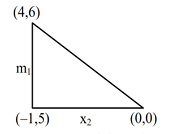
$\mathrm{m}_{1} \mathrm{~m}_{2}=-1$ so right angle equation circle is
$(x-4)(x-0)+(y-6)(y-0)=0$
$x^{2}+y^{2}-4 x-6 y=0$
$(k, 3 k)$ lies on it so
$\mathrm{k}^{2}+9 \mathrm{k}^{2}-4 \mathrm{k}-18 \mathrm{k}=0$
$10 \mathrm{k}^{2}-22 \mathrm{k}=0$
$\mathrm{k}=0, \frac{11}{5}$
$\mathrm{k}=0$ is not possible so $\mathrm{k}=\frac{11}{5}$
also $r=\sqrt{4+9}=\sqrt{13}$
so $10 \mathrm{k}+\mathrm{r}^{2}=10 \cdot \frac{11}{5}+(\sqrt{13})^{2}=35$ View full question & answer→MCQ 194 Marks
Each of the angles $\beta$ and $\gamma$ that a given line makes with the positive $y$ - and $z$-axes, respectively, is half of the angle that this line makes with the positive x -axes. Then the sum of all possible values of the angle $\beta$ is
- A
$\frac{3 \pi}{4}$
- B
$\pi$
- C
$\frac{\pi}{2}$
- D
$\frac{3 \pi}{2}$
AnswerA. $\frac{3 \pi}{4}$
$\beta=\frac{\alpha}{2}, \gamma=\frac{\alpha}{2}$
$\cos ^{2} \alpha+\cos ^{2} \beta+\cos ^{2} \gamma=1$
$\cos ^{2} \alpha+2 \cos ^{2} \frac{\alpha}{2}=1$
$\cos ^{2} \alpha+\cos \alpha=0$
$\cos \alpha(\cos \alpha+1)=0$
$\cos \alpha=0,-1$
$\alpha=\frac{\pi}{2}, \pi$
Now $\beta=\frac{\alpha}{2} \Rightarrow \frac{\pi}{4}, \frac{\pi}{2}$
so sum is $\frac{3 \pi}{4}$
View full question & answer→MCQ 204 Marks
Let $f: R \rightarrow R$ be a function defined by $f(x)=\|x+2|-2| x\|$. If $m$ is the number of points of local minima and $n$ is the number of points of local maxima of $f$, then $m+n$ is
AnswerB. 3
$f(x)=\| x+2|-2| x \mid$
Critical points, $0,-2,2,-\frac{2}{3}$
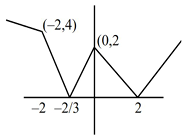
No. of maxima $=1$
No. of minima $=2$ View full question & answer→