Questions

SECTION - A [PHYSICS MCQ]

Take a timed test

20 questions · self-marked practice — reveal the answer and mark yourself.

MCQ 14 Marks
Given below are two statements : one is labelled as Assertion A and the other is labelled as Reason R.
Assertion A : If oxygen ion $\left(\mathrm{O}^{-2}\right)$ and Hydrogen ion $\left(\mathrm{H}^{+}\right)$enter normal to the magnetic field with equal momentum, then the path of $\mathrm{O}^{-2}$ ion has a smaller curvature than that of $\mathrm{H}^{+}$.
Reason R : A proton with same linear momentum as an electron will form a path of smaller radius of curvature on entering a uniform magnetic field perpendicularly.
In the light of the above statement, choose the correct answer from the options given below
  • A
    $\mathbf{A}$ is true but $\mathbf{R}$ is false
  • B
    Both $\mathbf{A}$ and $\mathbf{R}$ are true but $\mathbf{R}$ is NOT the correct explanation of $\mathbf{A}$
  • C
    $\mathbf{A}$ is false but $\mathbf{R}$ is true
  • D
    Both $\mathbf{A}$ and $\mathbf{R}$ are true and $\mathbf{R}$ is the correct explanation of $\mathbf{A}$
Answer
A. $\mathbf{A}$ is true but $\mathbf{R}$ is false
$r=\frac{m v}{q B}=\frac{p}{q B}$
$\mathrm{r} \propto \frac{1}{\mathrm{q}}$
Assertion is true reason is false
View full question & answer
MCQ 24 Marks
A block of mass 1 kg , moving along x with speed $\mathrm{v}_{\mathrm{i}}=10 \mathrm{~m} / \mathrm{s}$ enters a rough region ranging from $\mathrm{x}=0.1 \mathrm{~m}$ to $\mathrm{x}=1.9 \mathrm{~m}$. The retarding force acting on the block in this range is $\mathrm{F}_{\mathrm{r}}=-\mathrm{kx} \mathrm{N}$, with $\mathrm{k}=10 \mathrm{~N} / \mathrm{m}$. Then the final speed of the block as it crosses rough region is
  • A
    $10 \mathrm{~m} / \mathrm{s}$
  • B
    $4 \mathrm{~m} / \mathrm{s}$
  • C
    $6 \mathrm{~m} / \mathrm{s}$
  • D
    $8 \mathrm{~m} / \mathrm{s}$
Answer
D. $8 \mathrm{~m} / \mathrm{s}$
$a=\frac{F}{m}=-10 x$
$v \frac{d v}{d x}=-10 x$
$\int_{10}^{v} v d v=-10 \int_{0.1}^{1.9} x d x$
$\frac{\mathrm{v}^{2}-100}{2}=-10\left(\frac{1.9^{2}-0.1}{2}\right)^{2}$
$\mathrm{v}=8 \mathrm{~m} / \mathrm{s}$
View full question & answer
MCQ 34 Marks
A motor operating on 100 V draws a current of 1 A . If the efficiency of the motor is $91.6 \%$, then the loss of power in units of $\mathrm{cal} / \mathrm{s}$ is
  • A
    4
  • B
    8.4
  • C
    2
  • D
    6.2
Answer
C. 2
$P_{\text {input }}=V i=100 \mathrm{~W}$
$\eta=\frac{P_{\text {out }}}{P_{\text {input }}}=0.916$
$\mathrm{P}_{\text {out }}=91.6 \mathrm{~W}$
Loss $=100-91.6=8.4 \mathrm{~J} / \mathrm{s}=2 \mathrm{cal} / \mathrm{s}$
View full question & answer
MCQ 44 Marks
Pressure of an ideal gas, contained in a closed vessel, is increased by $0.4 \%$ when heated by $1^{\circ} \mathrm{C}$. Its initial temperature must be :
  • A
    $25^{\circ} \mathrm{C}$
  • B
    2500 K
  • C
    250 K
  • D
    $250^{\circ} \mathrm{C}$
Answer
C. 250 K
Isochoric process
$P \propto T$
$\frac{\Delta \mathrm{P}}{\mathrm{P}}=\frac{\Delta \mathrm{T}}{\mathrm{T}}$
$\frac{0.4}{100}=\frac{1}{\mathrm{~T}}$
$\mathrm{T}=250 \mathrm{~K}$
View full question & answer
MCQ 54 Marks
Match the LIST-I with LIST-II
LIST-ILIST-II
A.Boltzmann constantI.$\mathrm{ML}^{2} \mathrm{~T}^{-1}$
B.Coefficient of viscosityII.MLT $^{-3} \mathrm{~K}^{-1}$
C.Planck's constantIII.$\mathrm{ML}^{2} \mathrm{~T}^{-2} \mathrm{~K}^{-1}$
D.Thermal conductivityIV.$\mathrm{ML}^{-1} \mathrm{~T}^{-1}$
Choose the correct answer from the options given below :
  • A
    A-III, B-IV, C-I, D-II
  • B
    A-II, B-III, C-IV, D-I
  • C
    A-III, B-II, C-I, D-IV
  • D
    A-III, B-IV, C-II, D-I
Answer
A. A-III, B-IV, C-I, D-II
(A) $[\mathrm{k}]=\frac{\mathrm{PV}}{\mathrm{NT}}=\frac{\mathrm{ML}^{2} \mathrm{~T}^{-2}}{\mathrm{~K}}=\mathrm{ML}^{2} \mathrm{~T}^{-2} \mathrm{~K}^{-1}$
(B) $[\eta]=\frac{\mathrm{F}}{6 \pi \mathrm{rv}}=\frac{\mathrm{MLT}^{-2}}{\mathrm{~L}^{2} \mathrm{~T}^{-1}}=\mathrm{ML}^{-1} \mathrm{~T}^{-1}$
(C) $[\mathrm{h}]=\frac{\mathrm{E}}{\mathrm{f}}=\frac{\mathrm{ML}^{2} \mathrm{~T}^{-2}}{\mathrm{~T}^{-1}}=\mathrm{ML}^{2} \mathrm{~T}^{-1}$
(D) $\frac{\mathrm{dQ}}{\mathrm{dt}}=\mathrm{k} \frac{\mathrm{AdT}}{\mathrm{dx}}$
$\mathrm{k}=\frac{\left(\mathrm{ML}^{2} \mathrm{~T}^{-3}\right) \mathrm{L}}{\mathrm{L}^{2} \cdot \mathrm{~K}}=\mathrm{MLT}^{-3} \mathrm{~K}^{-1}$
View full question & answer
MCQ 64 Marks
An electric bulb rated as $100 \mathrm{~W}-220 \mathrm{~V}$ is connected to an ac source of rms voltage 220 V . The peak value of current through the bulb is :
  • A
    0.64 A
  • B
    0.45 A
  • C
    2.2 A
  • D
    0.32 A
Answer
A. 0.64 A
$\quad \mathrm{P}=\mathrm{v}_{\mathrm{rms}} \mathrm{i}_{\text {rms }}$
$\mathrm{i}_{\mathrm{rms}}=\frac{100}{220}$
$\mathrm{i}_{0}=\sqrt{2} \mathrm{i}_{\text {rms }}=0.64 \mathrm{~A}$
View full question & answer
MCQ 74 Marks
A particle moves along the $x$-axis and has its displacement $x$ varying with time $t$ according to the equation
$\mathrm{x}=\mathrm{c}_{0}\left(\mathrm{t}^{2}-2\right)+\mathrm{c}(\mathrm{t}-2)^{2}$
where $c_{0}$ and $c$ are constants of appropriate dimensions. Then, which of the following statements is correct?
  • A
    the acceleration of the particle is $2 c_{0}$
  • B
    the acceleration of the particle is 2 c
  • C
    the initial velocity of the particle is 4 c
  • D
    the acceleration of the particle is $2\left(c+c_{0}\right)$
Answer
D. the acceleration of the particle is $2\left(c+c_{0}\right)$
$v=\frac{d x}{d t}=2 \mathrm{tC}_{0}+2 C(t-2)$
$\mathrm{a}=\frac{\mathrm{dv}}{\mathrm{dt}}=2 \mathrm{C}_{0}+2 \mathrm{C}$
View full question & answer
MCQ 94 Marks
A solid steel ball of diameter 3.6 mm acquired terminal velocity $2.45 \times 10^{-2} \mathrm{~m} / \mathrm{s}$ while falling under gravity through an oil of density $925 \mathrm{~kg} \mathrm{~m}^{-3}$. Take density of steel as $7825 \mathrm{~kg} \mathrm{~m}^{-3}$ and g as 9.8 $\mathrm{m} / \mathrm{s}^{2}$. The viscosity of the oil in SI unit is
  • A
    2.18
  • B
    2.38
  • C
    1.68
  • D
    1.99
Answer
D. 1.99
$\mathrm{v}_{\mathrm{T}} \Rightarrow \frac{2}{9} \frac{\left(\rho_{0}-\rho_{\ell}\right) \mathrm{r}^{2} \mathrm{~g}}{\eta}$
$\eta=\frac{2}{9}\left(\frac{7825-925}{2.45 \times 10^{-2}}\right) \times(1.8)^{2} \times 10^{-6} \times 9.8$
$\eta \approx 1.99$
View full question & answer
MCQ 104 Marks
A particle is projected with velocity $u$ so that its horizontal range is three times the maximum height attained by it. The horizontal range of the projectile is given as $\frac{n u^{2}}{25 g}$, where value of $n$ is :
(Given '$g$' is the acceleration due to gravity).
  • A
    6
  • B
    18
  • C
    12
  • D
    24
Answer
D. 24
Range $=3 \mathrm{H}_{\text {max }}$
$\frac{\mathrm{u}^{2} \sin 2 \theta}{\mathrm{~g}}=\frac{3 \mathrm{u}^{2} \sin ^{2} \theta}{2 \mathrm{~g}}$
$2 \sin \theta \cos \theta=\frac{3}{2} \sin ^{2} \theta$
$\tan \theta=\frac{4}{3} \Rightarrow \theta=53^{\circ}$
$R=\frac{u^{2}\left(2 \times \frac{3}{5} \times \frac{4}{5}\right)}{g} \Rightarrow \frac{24 u^{2}}{25 g}$
View full question & answer
MCQ 114 Marks
Image
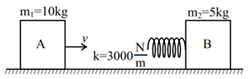
Consider two blocks A and B of masses $m_{1}=10 \mathrm{~kg}$ and $m_{2}=5 \mathrm{~kg}$ that are placed on a frictionless table. The block A moves with a constant speed $v=3 \mathrm{~m} / \mathrm{s}$ towards the block B kept at rest. A spring with spring constant $\mathrm{k}=3000 \mathrm{~N} / \mathrm{m}$ is attached with the block B as shown in the figure. After the collision, suppose that the blocks A and B, along with the spring in constant compression state, move together, then the compression in the spring is, (Neglect the mass of the spring)
  • A
    0.2 m
  • B
    0.4 m
  • C
    0.1 m
  • D
    0.3 m
Answer
C. 0.1 m
$\mathrm{m}_{1} \mathrm{v}_{1}+\mathrm{m}_{2} \mathrm{v}_{2}=\left(\mathrm{m}_{1}+\mathrm{m}_{2}\right) \mathrm{v}_{\mathrm{cm}}$
$\mathrm{v}_{\mathrm{cm}} \Rightarrow \frac{10 \times 3}{10+5} \Rightarrow \frac{30}{15}=2 \mathrm{~m} / \mathrm{s}$
$\frac{1}{2} \mathrm{kx}^{2}=\frac{1}{2}(10)(3)^{2}-\left[\frac{1}{2}(15)(2)^{2}\right]$
$\Rightarrow 90-60=30=3000 \mathrm{x}^{2}$
$x^{2} \Rightarrow \frac{30}{3000}=\frac{1}{100}$
$\mathrm{x} \Rightarrow \frac{1}{10} \mathrm{~m}$.
View full question & answer
MCQ 124 Marks
A monochromatic light of frequency $5 \times 10^{14} \mathrm{~Hz}$ travelling through air, is incident on a medium of refractive index ' 2 '. Wavelength of the refracted light will be :
  • A
    300 nm
  • B
    600 nm
  • C
    400 nm
  • D
    500 nm
Answer
A. 300 nm
$\mathrm{f} \lambda=\mathrm{v} \quad \lambda_{\text {medium }}=\frac{\lambda_{\text {vacuum }}}{\mu}$
$\lambda_{\text {medium }} \Rightarrow \frac{3 \times 10^{8}}{2 \times 5 \times 10^{14}} \Rightarrow 0.3 \times 10^{-6} \Rightarrow 300 \mathrm{~nm}$
View full question & answer
MCQ 134 Marks
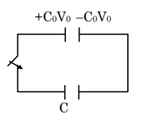
Using a battery, a 100 pF capacitor is charged to 60 V and then the battery is removed. After that, a second uncharged capacitor is connected to the first capacitor in parallel. If the final voltage across the second capacitor is 20 V , its capacitance is : (in pF )
  • A
    600
  • B
    200
  • C
    400
  • D
    100
Answer
B. 200
Image
New potential $=\frac{\mathrm{C}_{0} \mathrm{~V}_{0}}{\mathrm{C}_{0}+\mathrm{C}}=\frac{\mathrm{V}_{0}}{3}$
$3 \mathrm{C}_{0} \mathrm{~V}_{0}=\mathrm{C}_{0} \mathrm{~V}_{0}+\mathrm{CV}_{0}$
$2 \mathrm{C}_{0} \mathrm{~V}_{0}=\mathrm{CV}_{0}$
$\mathrm{C} \Rightarrow 2 \mathrm{C}_{0}$
View full question & answer
MCQ 144 Marks
Given below are two statements : one is labelled as Assertion A and the other is labelled as Reason R.
Assertion A : The Bohr model is applicable to hydrogen and hydrogen-like atoms only.
Reason R : The formulation of Bohr model does not include repulsive force between electrons.
In the light of the above statements, choose the correct answer from the options given below :
  • A
    Both $\mathbf{A}$ and $\mathbf{R}$ are true but $\mathbf{R}$ is NOT the correct explanation of $\mathbf{A}$.
  • B
    $\mathbf{A}$ is false but $\mathbf{R}$ is true.
  • C
    Both $\mathbf{A}$ and $\mathbf{R}$ are true and $\mathbf{R}$ is the correct explanation of $\mathbf{A}$.
  • D
    $\mathbf{A}$ is true but $\mathbf{R}$ is false.
Answer
C. Both $\mathbf{A}$ and $\mathbf{R}$ are true and $\mathbf{R}$ is the correct explanation of $\mathbf{A}$.
Conceptual
View full question & answer
MCQ 154 Marks
Two monochromatic light beams have intensities in the ratio 1:9. An interference pattern is obtained by these beams. The ratio of the intensities of maximum to minimum is
  • A
    $8: 1$
  • B
    $9: 1$
  • C
    $3: 1$
  • D
    $4: 1$
Answer
D. $4: 1$
$\frac{I_{\max }}{I_{\min }}=\frac{\left(\sqrt{\mathrm{I}_{1}}+\sqrt{\mathrm{I}_{2}}\right)^{2}}{\left(\sqrt{\mathrm{I}_{1}}-\sqrt{\mathrm{I}_{2}}\right)^{2}} \Rightarrow \frac{(4)^{2}}{(2)^{2}} \Rightarrow \frac{16}{4}=4$
View full question & answer
MCQ 164 Marks
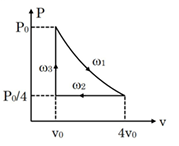
An ideal gas exists in a state with pressure $P_{0}$, volume $V_{0}$.It is isothermally expanded to 4 times of its initial volume $\left(\mathrm{V}_{0}\right)$, then isobarically compressed to its original volume. Finally the system is heated isochorically to bring it to its initial state. The amount of heat exchanged in this process is :
  • A
    $\mathrm{P}_{0} \mathrm{~V}_{0}(2 \ln 2-0.75)$
  • B
    $\mathrm{P}_{0} \mathrm{~V}_{0}(\ln 2-0.75)$
  • C
    $\mathrm{P}_{0} \mathrm{~V}_{0}(\ln 2-0.25)$
  • D
    $\mathrm{P}_{0} \mathrm{~V}_{0}(2 \ln 2-0.25)$
Answer
A. $\mathrm{P}_{0} \mathrm{~V}_{0}(2 \ln 2-0.75)$
Image
$\omega_{1}=\mathrm{P}_{0} \mathrm{v}_{0} \ell \mathrm{n} 4$
$\omega_{2}=\frac{\mathrm{P}_{0}}{4}\left(-3 \mathrm{v}_{0}\right)=-\frac{3 \mathrm{P}_{0} \mathrm{v}_{0}}{4}$
$\omega_{3}=0$
$\mathrm{Q}_{\mathrm{T}}=\Delta \mathrm{U}_{\text {cyclic }}+\omega$
$\mathrm{Q}_{\mathrm{T}}=\omega \quad\left(\Delta \mathrm{U}_{\text {cyclic }}=0\right)$
$\mathrm{Q}_{\mathrm{T}}=\mathrm{P}_{0} \mathrm{~V}_{0}\left(\ell \mathrm{n} 4-\frac{3}{4}\right)$
$=\mathrm{P}_{0} \mathrm{v}_{0}(2 \ell \mathrm{n} 2-0.75)$
View full question & answer
MCQ 174 Marks
Width of one of the two slits in a Young's double slit interference experiment is half of the other slit. The ratio of the maximum to the minimum intensity in the interference pattern is :
  • A
    $(2 \sqrt{2}+1):(2 \sqrt{2}-1)$
  • B
    $(3+2 \sqrt{2}):(3-2 \sqrt{2})$
  • C
    $9: 1$
  • D
    $3: 1$
Answer
B. $(3+2 \sqrt{2}):(3-2 \sqrt{2})$
$\begin{array}{l}I \propto \text { width } \quad I_{\max }=\left(\sqrt{I_1}+\sqrt{I_2}\right)^2 \\ \therefore I_1=I_0, I_2=2 I_0 \quad I_{\min }=\left(\sqrt{I_1}-\sqrt{I_2}\right)^2 \\ \quad \frac{I_{\max }}{I_{\min }}=\frac{(\sqrt{2}+1)^2}{(\sqrt{2}-1)^2} \Rightarrow \frac{3+2 \sqrt{2}}{3-2 \sqrt{2}}\end{array}$
View full question & answer
MCQ 184 Marks
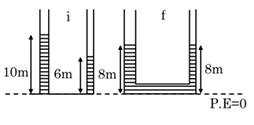
Two cylindrical vessels of equal cross sectional area of $2 \mathrm{~m}^{2}$ contain water upto height 10 m and 6 m , respectively. If the vessels are connected at their bottom then the work done by the force of gravity is : (Density of water is $10^{3} \mathrm{~kg} / \mathrm{m}^{3}$ and $\mathrm{g}=10 \mathrm{~m} / \mathrm{s}^{2}$)
  • A
    $1 \times 10^{5} \mathrm{~J}$
  • B
    $4 \times 10^{4} \mathrm{~J}$
  • C
    $6 \times 10^{4} \mathrm{~J}$
  • D
    $8 \times 10^{4} \mathrm{~J}$
Answer
D. $8 \times 10^{4} \mathrm{~J}$
Image
$\mathrm{U}_{1}=(\rho \mathrm{A} \times 10) \mathrm{g} \times 5+(\rho \mathrm{A} 6) \mathrm{g} \times 3$
$\mathrm{U}_{\mathrm{i}}=\rho \mathrm{Ag}(50+18)$
$\mathrm{U}_{\mathrm{i}}=68 \rho \mathrm{Ag}$
$\mathrm{U}_{\mathrm{f}}=(\rho \mathrm{A} \times 16) \mathrm{g} \times 4$
$=(\rho \mathrm{Ag}) \times 64$
$\omega=\Delta \mathrm{U}=4 \times \rho \mathrm{Ag}$
$=4 \times 1000 \times 2 \times 10=8 \times 10^{4} \mathrm{~J}$
View full question & answer
MCQ 194 Marks
In the resonance experiment, two air columns (closed at one end) of 100 cm and 120 cm long, give 15 beats per second when each one is sounding in the respective fundamental modes. The velocity of sound in the air column is :
  • A
    $335 \mathrm{~m} / \mathrm{s}$
  • B
    $370 \mathrm{~m} / \mathrm{s}$
  • C
    $340 \mathrm{~m} / \mathrm{s}$
  • D
    $360 \mathrm{~m} / \mathrm{s}$
Answer
D. $360 \mathrm{~m} / \mathrm{s}$
Fundamental frequency in close/organ pipe
$(f)=\frac{\mathrm{V}}{4 \ell}$
$\mathrm{f}_{1}=\frac{\mathrm{v}}{4 \ell_{1}} \& \mathrm{f}_{2}=\frac{\mathrm{v}}{4 \ell_{2}}$
Beat $=\left(\mathrm{f}_{1}-\mathrm{f}_{2}\right)=\frac{\mathrm{v}}{4}\left(\frac{1}{\ell_{1}}-\frac{1}{\ell_{2}}\right)$
$15=\frac{\mathrm{v}}{4}\left(\frac{1}{1}-\frac{1}{1.2}\right)$
$\mathrm{v}=\left(\frac{15 \times 4 \times 1.2}{0.2}\right)=60 \times 6=360 \mathrm{~m} / \mathrm{s}$
View full question & answer
MCQ 204 Marks
A magnetic dipole experiences a torque of $80 \sqrt{3} \mathrm{~N} \mathrm{~m}$ when placed in uniform magnetic field in such a way that dipole moment makes angle of $60^{\circ}$ with magnetic field. The potential energy of the dipole is :
  • A
    80 J
  • B
    $-40 \sqrt{3} \mathrm{~J}$
  • C
    - 60 J
  • D
    -80 J
Answer
D. -80 J
$\tau=M \times B=M B \sin 60=\frac{\sqrt{3}}{2} M B=80 \sqrt{3}$
$\mathrm{MB}=160$
$\mathrm{U}=-\mathrm{M} . \mathrm{B}=-\mathrm{MB} \cos 60$
$U=-160 \times 1 / 2=-80 \mathrm{~J}$
View full question & answer