MCQ 14 Marks
If $10 \sin ^{4} \theta+15 \cos ^{4} \theta=6$, then the value of $\frac{27 \operatorname{cosec}^{6} \theta+8 \sec ^{6} \theta}{16 \sec ^{8} \theta}$ is :
- ✓
$\frac{2}{5}$
- B
$\frac{3}{4}$
- C
$\frac{3}{5}$
- D
$\frac{1}{5}$
AnswerCorrect option: A. $\frac{2}{5}$
(A) $\frac{2}{5}$
$10\left(\sin ^{2} \theta\right)^{2}+15\left(1-\sin ^{2} \theta\right)^{2}=6$
Let $\sin ^{2} \theta=\mathrm{t} \Rightarrow 10 \mathrm{t}^{2}+15(1-\mathrm{t})^{2}=16$
$10 t^{2}+15-30 t+15 t^{2}=6$
$25 \mathrm{t}^{2}-30 \mathrm{t}+9=0$
$(5 t-3)^{2}=0$
$\sin ^{2} \theta=\frac{3}{5}$ and $\cos ^{2} \theta=\frac{2}{5}$
$\frac{27 \times \frac{125}{27}+8+\frac{125}{8}}{16\left(\frac{5}{2}\right)^{4}}=\frac{250}{125 \times 5}=\frac{2}{5}$
View full question & answer→MCQ 24 Marks
A box contains 10 pens of which 3 are defective. A sample of 2 pens is drawn at random and let $\text X$ denote the number of defective pens. Then the variance of $\text X$ is
- A
$\frac{11}{15}$
- ✓
$\frac{28}{75}$
- C
$\frac{2}{15}$
- D
$\frac{3}{5}$
AnswerCorrect option: B. $\frac{28}{75}$
(B) $\frac{28}{75}$| $x$ | $x=0$ | $x=1$ | $x=2$ |
| $P(x)$ | $\frac{{ }^7 C _2}{{ }^{10} C _2}$ | $\frac{{ }^7 C _1^3 C _1}{{ }^{10} C _2}$ | $\frac{{ }^3 C _2}{{ }^{10} C _2}$ |
$\mu=\sum \mathrm{x}_{\mathrm{i}} \mathrm{P}\left(\mathrm{x}_{\mathrm{i}}\right)=0+\frac{7}{15}+\frac{2}{15}=\frac{3}{5}$
$\operatorname{Variance}(\mathrm{x})=\Sigma \mathrm{P}_{\mathrm{i}}\left(\mathrm{x}_{\mathrm{i}}-\mu\right)^{2}=\frac{28}{75}$ View full question & answer→MCQ 34 Marks
Consider the equation $\mathrm{x}^{2}+4 \mathrm{x}-\mathrm{n}=0$, where $n \in[20,100]$ is a natural number. Then the number of all distinct values of $n$, for which the given equation has integral roots, is equal to
Answer(C) 6
$\mathrm{x}^{2}+4 \mathrm{x}+4=\mathrm{n}+4$
$(\mathrm{x}+2)^{2}=\mathrm{n}+4$
$x=-2 \pm \sqrt{n+4}$
$\because 20 \leq \mathrm{n} \leq 100$
$\sqrt{24} \leq \sqrt{\mathrm{n}+4} \leq \sqrt{104}$
$\Rightarrow \sqrt{\mathrm{n}+4} \in\{5,6,7,8,9,10\}$
$\therefore$ '6' integral values of '$n$' are possible
View full question & answer→MCQ 44 Marks
The length of the latus-rectum of the ellipse, whose foci are $(2,5)$ and $(2,-3)$ and eccentricity is $\frac{4}{5}$, is
- A
$\frac{6}{5}$
- B
$\frac{50}{3}$
- C
$\frac{10}{3}$
- ✓
$\frac{18}{5}$
AnswerCorrect option: D. $\frac{18}{5}$
(D) $\frac{18}{5}$
$2 \mathrm{be}=8$
be $=4$
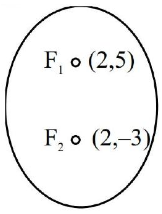
$\mathrm{b}\left(\frac{4}{5}\right)=4 \Rightarrow \mathrm{~b}=5$
$\because c^{2}=b^{2}-a^{2}$
$16=25-a^{2} \Rightarrow a=3$
L.R. $=\frac{2 \mathrm{a}^{2}}{\mathrm{~b}}=\frac{18}{5}$ View full question & answer→MCQ 54 Marks
The value of $\int_{-1}^{1} \frac{(1+\sqrt{|x|-x}) e^{x}+(\sqrt{|x|-x}) e^{-x}}{e^{x}+e^{-x}} d x$ is equal to
- A
$3-\frac{2 \sqrt{2}}{3}$
- B
$2+\frac{2 \sqrt{2}}{3}$
- C
$1-\frac{2 \sqrt{2}}{3}$
- ✓
$1+\frac{2 \sqrt{2}}{3}$
AnswerCorrect option: D. $1+\frac{2 \sqrt{2}}{3}$
(D) $1+\frac{2 \sqrt{2}}{3}$
$I=\int_{-1}^{1} \frac{(1+\sqrt{|-x|-(-x)}) \mathrm{e}^{-\mathrm{x}}+(\sqrt{|-\mathrm{x}|-(-\mathrm{x})}) \mathrm{e}^{-(-\mathrm{x})}}{\mathrm{e}^{-\mathrm{x}}+\mathrm{e}^{-(-\mathrm{x})}} \mathrm{dx}$
$\Rightarrow \mathrm{I}=\int_{-1}^{1} \frac{(1+\sqrt{|\mathrm{x}|+\mathrm{x}}) \mathrm{e}^{-\mathrm{x}}+(\sqrt{|\mathrm{x}|+\mathrm{x}}) \mathrm{e}^{\mathrm{x}}}{\mathrm{e}^{\mathrm{x}}+\mathrm{e}^{\mathrm{x}}} \mathrm{dx}$
$\Rightarrow 2 \mathrm{I}=\int_{-1}^{1} \frac{(1+\sqrt{|\mathrm{x}|+\mathrm{x}}+\sqrt{|\mathrm{x}|-\mathrm{x}})\left(\mathrm{e}^{\mathrm{x}}+\mathrm{e}^{-\mathrm{x}}\right)}{\left(\mathrm{e}^{\mathrm{x}}+\mathrm{e}^{-\mathrm{x}}\right)} \mathrm{dx}$
$\Rightarrow 2 I=\int_{-1}^{1}(1+\sqrt{|x|+x}+\sqrt{|x|-x}) d x$
$\Rightarrow 2 \mathrm{I}=2 \int_{0}^{1}(1+\sqrt{|\mathrm{x}|+\mathrm{x}}+\sqrt{|\mathrm{x}|-\mathrm{x}}) \mathrm{dx}$
$\Rightarrow 2 \mathrm{I}=2 \int_{0}^{1}(1+\sqrt{2 \mathrm{x}}+\sqrt{0}) \mathrm{dx}$
$\Rightarrow \mathrm{I}=\int_{0}^{1}(1+\sqrt{2 \mathrm{x}}) \mathrm{dx}=\left[\mathrm{x}+\frac{2 \sqrt{2}}{3} \mathrm{x}^{3 / 2}\right]_{0}^{1}$
$\Rightarrow \mathrm{I}=\frac{2 \sqrt{2}}{3}+1$
View full question & answer→MCQ 64 Marks
Let the three sides of a triangle are on the lines $4 x-7 y+10=0, x+y=5$ and $7 x+4 y=15.$ Then the distance of its orthocentre from the orthocentre of the triangle formed by the lines $x=0, y=0$ and $x+y=1$ is
- A
$5$
- ✓
$\sqrt{5}$
- C
$\sqrt{20}$
- D
$20$
AnswerCorrect option: B. $\sqrt{5}$
(B) $\sqrt{5}$
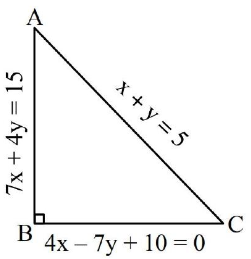
Since triangle is right angle so orthocentre will be at right angle vertex
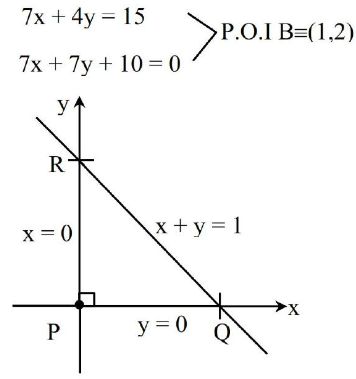
distance between $\text P$ and $\mathrm{B}=\sqrt{5}$ View full question & answer→MCQ 74 Marks
Consider two vectors $\vec{\mathrm{u}}=3 \hat{\mathrm{i}}-\hat{\mathrm{j}}$ and $\vec{\mathrm{v}}=2 \hat{\mathrm{i}}+\hat{\mathrm{j}}-\lambda \hat{\mathrm{k}}, \lambda>0$. The angle between them is given by $\cos ^{-1}\left(\frac{\sqrt{5}}{2 \sqrt{7}}\right)$. Let $\vec{v}=\vec{v}_{1}+\vec{v}_{2}$, where $\vec{v}_{1}$ is parallel to $\vec{\mathrm{u}}$ and $\vec{\mathrm{v}}_{2}$ is perpendicular to $\vec{\mathrm{u}}$. Then the value $\left|\vec{v}_{1}\right|^{2}+\left|\vec{v}_{2}\right|^{2}$ is equal to
- A
$\frac{23}{2}$
- ✓
$14$
- C
$\frac{25}{2}$
- D
$10$
Answer(B) 14
$\vec{\mathrm{u}}=3 \hat{\mathrm{i}}-\hat{\mathrm{j}}, \vec{\mathrm{v}}=2 \hat{\mathrm{i}}+\hat{\mathrm{j}}-\lambda \hat{\mathrm{k}}$,
$\Rightarrow \frac{\vec{\mathrm{u}} \cdot \vec{\mathrm{v}}}{|\vec{\mathrm{u}}||\vec{\mathrm{v}}|}=\cos \theta$
$\Rightarrow \frac{5}{\sqrt{10} \sqrt{5+\lambda^{2}}}=\frac{\sqrt{5}}{2 \sqrt{7}}$
$\Rightarrow \lambda^{2}=9 \quad \Rightarrow \lambda=3(\because \lambda>0)$
$\vec{\mathrm{v}}=\vec{\mathrm{v}}_{1}+\vec{\mathrm{v}}_{2}$
$\Rightarrow|\vec{\mathrm{v}}|^{2}=\vec{\mathrm{v}}_{1}^{2}+\vec{\mathrm{v}}_{2}^{2}+2 \vec{\mathrm{v}}_{1} \cdot \vec{\mathrm{v}}_{2}$
$\Rightarrow 14=\vec{\mathrm{v}}_{1}^{2}+\vec{\mathrm{v}}_{2}^{2}+0 \quad\left(\because \vec{\mathrm{v}}_{1} \perp \vec{\mathrm{v}}_{2}\right)$
$\Rightarrow\left|\vec{\mathrm{v}}_{1}^{2}\right|+\left|\vec{\mathrm{v}}_{1}^{2}\right|=14$
View full question & answer→MCQ 84 Marks
Considering the principal values of the inverse trigonometric functions, $\sin ^{-1}\left(\frac{\sqrt{3}}{2} x+\frac{1}{2} \sqrt{1-x^{2}}\right),-\frac{1}{2} < x < \frac{1}{\sqrt{2}}$, is equal to
- A
$\frac{\pi}{4}+\sin ^{-1} x$
- ✓
$\frac{\pi}{6}+\sin ^{-1} x$
- C
$\frac{-5 \pi}{6}-\sin ^{-1} x$
- D
$\frac{5 \pi}{6}-\sin ^{-1} x$
AnswerCorrect option: B. $\frac{\pi}{6}+\sin ^{-1} x$
(B) $\frac{\pi}{6}+\sin ^{-1} x$
$\sin ^{-1}\left(\frac{\sqrt{3}}{2} x+\frac{1}{2} \sqrt{1-x^{2}}\right), \frac{-1}{2}<x<\frac{1}{\sqrt{2}}$
$\Rightarrow$ Let $\sin ^{-1}(x)=\theta \quad \frac{-\pi}{6}<\theta<\frac{\pi}{4}$
$\Rightarrow \mathrm{x}=\sin \theta$, then
$\Rightarrow \sin ^{-1}\left(\frac{\sqrt{3}}{2} \sin \theta+\frac{1}{2} \cos \theta\right)$
$\Rightarrow \sin ^{-1}\left(\sin \left(\theta+\frac{\pi}{6}\right)\right)=\theta+\frac{\pi}{6}$
$\Rightarrow \sin ^{-1}(x)+\frac{\pi}{6}$
View full question & answer→MCQ 94 Marks
In the expansion of $\left(\sqrt[3]{2}+\frac{1}{\sqrt[3]{3}}\right)^{n}, \mathrm{n} \in \mathrm{N}$, if the ratio of $15^{\text {th }}$ term from the beginning to the $15^{\text {th }}$ term from the end is $\frac{1}{6}$, then the value of ${ }^{n} C_{3}$ is :
Answer(C) 2300
$\mathrm{T}_{\mathrm{r}+1}={ }^{\mathrm{n}} \mathrm{C}_{\mathrm{r}}\left(2^{1 / 3}\right)^{\mathrm{n}-\mathrm{r}}\left(\frac{1}{3^{1 / 3}}\right)^{\mathrm{r}}$
$r=14$
$\mathrm{T}_{15}={ }^{\mathrm{n}} \mathrm{C}_{14}\left(2^{1 / 3}\right)^{\mathrm{n}-14}\left(\frac{1}{3^{1 / 3}}\right)^{14}$
$\mathrm{T}_{15}^{\prime}=15^{\mathrm{h}}$ term from last is $(\mathrm{n}-13)^{\mathrm{h}}$ term from beginning.
$\mathrm{T}_{15}^{\prime}={ }^{\mathrm{n}} \mathrm{C}_{\mathrm{n}-14}\left(2^{1 / 3}\right)^{14}\left(\frac{1}{3^{1 / 3}}\right)^{\mathrm{n}-14}$
$\Rightarrow \frac{\mathrm{T}_{15}}{\mathrm{~T}_{15}^{\prime}}=\frac{{ }^{\mathrm{n}} \mathrm{C}_{14}\left(2^{1 / 3}\right)^{\mathrm{n}-14}\left(\frac{1}{3^{1 / 3}}\right)^{14}}{{ }^{\mathrm{n}} \mathrm{C}_{\mathrm{n}-14}\left(2^{1 / 3}\right)^{14}\left(\frac{1}{3^{1 / 3}}\right)^{\mathrm{n}-14}}=\frac{1}{6}$
$=\left(2^{1 / 3}\right)^{n-28}\left(3^{1 / 3}\right)^{n-28}=\frac{1}{6}$
$=6^{\frac{n-28}{3}}=6^{-1}$
$=\mathrm{n}=25$
So, ${ }^{n} C_{3}={ }^{25} \mathrm{C}_{3}=2300$
View full question & answer→MCQ 104 Marks
$1+3+5^{2}+7+9^{2}+\ldots$ upto 40 terms is equal to
Answer(B) 41880
$\left(1^{2}+5^{2}+9^{2}+\ldots \ldots\right.$ upto 20 terms$)+(3+7+11+\ldots$upto 20 terms)
$=\sum_{\mathrm{r}=1}^{20}(4 \mathrm{r}-3)^{2}+\sum_{\mathrm{r}=1}^{20}(4 \mathrm{r}-1)$
$=\sum_{r=1}^{20}(4 r-3)^{2}+(4 r-1)$
$=4 \sum_{\mathrm{r}=1}^{20}\left(4 \mathrm{r}^{2}-5 \mathrm{r}+2\right)$
$=16 \sum_{\mathrm{r}=1}^{20} \mathrm{r}^{2}-20 \sum_{\mathrm{r}=1}^{20} \mathrm{r}+8 \sum_{\mathrm{r}=1}^{20} 1=41880$
View full question & answer→MCQ 114 Marks
Let $f: \mathbb{R} \rightarrow \mathbb{R}$ be a continuous function satisfying $f(0)=1$ and $f(2 \mathrm{x})-f(\mathrm{x})=\mathrm{x}$ for all $\mathrm{x} \in \mathbb{R}$. If $\lim _{n \rightarrow \infty}\left\{f(x)-f\left(\frac{x}{2^{n}}\right)\right\}=G(x)$, then $\sum_{r=1}^{10} G\left(r^{2}\right)$ is equal to
Answer(B) 385
$f(2 x)-f(x)=x$
$f(x)-f\left(\frac{x}{2}\right)=\frac{x}{2}$
$\mathrm{f}\left(\frac{\mathrm{x}}{2}\right)-\mathrm{f}\left(\frac{\mathrm{x}}{4}\right)=\frac{\mathrm{x}}{4}$
$\mathrm{f}\left(\frac{\mathrm{x}}{4}\right)-\mathrm{f}\left(\frac{\mathrm{x}}{8}\right)=\frac{\mathrm{x}}{8}$
$f\left(\frac{x}{2^{n-1}}\right)-f\left(\frac{x}{2^{n}}\right)=\frac{x}{2^{n}}$
$f(2 x)-f\left(\frac{x}{2^{n}}\right)=x\left\{\frac{1-\left(\frac{1}{2}\right)^{n-1}}{1-\frac{1}{2}}\right\}$
$f(x)-f\left(\frac{x}{2^{n}}\right)=2 x\left(1-\left(\frac{1}{2}\right)^{n+1}\right)$
$\mathrm{f}(\mathrm{x})+\mathrm{x}-\mathrm{f}\left(\frac{\mathrm{x}}{2^{\mathrm{n}}}\right)=2 \mathrm{x}\left(1-\left(\frac{1}{2}\right)^{\mathrm{n}+1}\right)$
$\lim _{n \rightarrow \infty}\left(f(x)-f\left(\frac{x}{2^{n}}\right)\right)=\lim _{n \rightarrow \infty}\left(2 x\left(1-\left(\frac{1}{2}\right)^{n+1}\right)-x\right)$
$G(x)=x$
$\sum_{r=1}^{10} \mathrm{G}\left(\mathrm{r}^{2}\right)=\sum_{\mathrm{r}=1}^{10} \mathrm{r}^{2}=385$
View full question & answer→MCQ 124 Marks
Let A and B be two distinct points on the line $\mathrm{L}: \frac{\mathrm{x}-6}{3}=\frac{\mathrm{y}-7}{2}=\frac{\mathrm{z}-7}{-2}$. Both $A$ and $B$ are at a distance $2 \sqrt{17}$ from the foot of perpendicular drawn from the point $(1,2,3)$ on the line $L$. If $O$ is the origin, then $\overrightarrow{O A} \cdot \overrightarrow{O B}$ is equal to :
Answer(B) 47
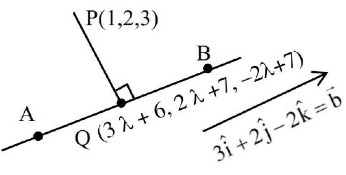
$\overrightarrow{\mathrm{PQ}} \cdot \overrightarrow{\mathrm{b}}=0$
$\Rightarrow 3(3 \lambda+5)+2(2 \lambda+5)-2(-2 \lambda+4)$
$\Rightarrow 17 \lambda=-17 \Rightarrow \lambda=-1$
Q (3,5,9)
Let A $(3 \mu+6,2 \mu+7,-2 \mu+7)$
$(3 \mu+3)^{2}+(2 \mu+2)^{2}+(-2 \mu-2)^{2}=68$
$\Rightarrow \mu^{2}+2 \mu-3=0 \mu=-3$ or $\mu=1$
$\mathrm{A}(-3,1,13)$ and $\mathrm{B}(9,9,5)$
$\overrightarrow{\mathrm{OA}} \cdot \overrightarrow{\mathrm{OB}}=-27+9+65=47$ View full question & answer→MCQ 134 Marks
Let $f:[0, \infty) \rightarrow \mathbb{R}$ be differentiable function such that $f(\mathrm{x})=1-2 \mathrm{x}+\int_{0}^{x} e^{x-t} f(t) \mathrm{dt}$ for all $\mathrm{x} \in[0, \infty)$. Then the area of the region bounded by $\mathrm{y}=f(\mathrm{x})$ and the coordinate axes is
- A
$\sqrt{5}$
- ✓
$\frac{1}{2}$
- C
$\sqrt{2}$
- D
$2$
AnswerCorrect option: B. $\frac{1}{2}$
(B) $\frac{1}{2}$
$y=1-2 x+e^{x} \int_{0}^{x} e^{-t} f(t) d t$
$\frac{d y}{d x}=-2+e^{-x} \cdot e^{x} f(x)+e^{x} \int_{0}^{x} e^{-t} f(t) d t$
$\frac{d y}{d x}=-2+y+y+2 x-1$
$\frac{d y}{d x}-2 y=(2 x-3)$
$y e^{-2 x}=\int(2 x-3) d x \cdot e^{-2 x}$
$y e^{-2 x}=\frac{-(2 x-3)}{2} e^{-2 x}+\int e^{-2 x} d x$
$y e^{-2 x}=\frac{-(2 x-3)}{2} e^{-2 x}-\frac{1}{2} e^{-2 x}+c$
$\mathrm{f}(0)=1 \Rightarrow \mathrm{c}=1-\frac{3}{2}+\frac{1}{2}=0$
$y=-\frac{(2 x-3)}{2}-\frac{1}{2}$
$y=-x+1$
$x+y=1$
area $=\frac{1}{2}(1)(1)=\frac{1}{2}$
View full question & answer→MCQ 144 Marks
If $\lim _{x \rightarrow 1^{+}} \frac{(x-1)(6+\lambda \cos (x-1))+\mu \sin (1-x)}{(x-1)^{3}}=-1$, where $\lambda, \mu \in \mathbb{R}$, then $\lambda+\mu$ is equal to
Answer(A) 18
Put $\mathrm{x}=1+\mathrm{h}$
$\lim _{h \rightarrow 0} \frac{h(6+\lambda \cosh )-\mu \sinh }{h^{3}}=-1$
$\lim _{h \rightarrow 0} \frac{h\left(6+\lambda\left(1-\frac{h^{2}}{2!}\right)\right)-\mu\left(h-\frac{h^{3}}{3!}\right)}{h^{3}}=-1$
$6+\lambda-\mu=0$ and $-\frac{\lambda}{2}+\frac{\mu}{6}=-1$
$\lambda+\mu=18$
View full question & answer→MCQ 154 Marks
Let the shortest distance between the lines $\frac{x-3}{3}=\frac{y-\alpha}{-1}=\frac{z-3}{1}$ and $\frac{x+3}{-3}=\frac{y+7}{2}=\frac{z-\beta}{4}$ be $3 \sqrt{30}$. Then the positive value of $5 \alpha+\beta$ is
Answer(B) 46
$\mathrm{A}(3, \alpha, 3) ~\&~ B(-3,-7, \beta)$
$\overrightarrow{\mathrm{BA}}=6 \hat{\mathrm{i}}+(\alpha+7) \hat{\mathrm{j}}+(3-\beta) \hat{\mathrm{k}}$
$\overrightarrow{\mathrm{p}} \times \overrightarrow{\mathrm{q}}=\left|\begin{array}{ccc}\hat{\mathrm{i}} & \hat{\mathrm{j}} & \hat{\mathrm{k}} \\ 3 & -1 & 1 \\ -3 & 2 & 4\end{array}\right|$
$\frac{|\overrightarrow{\mathrm{BA}} \cdot(\vec{\mathrm{p}} \times \vec{\mathrm{q}})|}{|\vec{\mathrm{p}} \times \vec{\mathrm{q}}|}=3 \sqrt{30}$
$36+15(\alpha+7)-3(3-\beta)=(3 \sqrt{30})^{2}$
$36+15 \alpha+105-9+3 \beta=270$
$15 \alpha+3 \beta=138$
$5 \alpha+\beta=46$
View full question & answer→MCQ 164 Marks
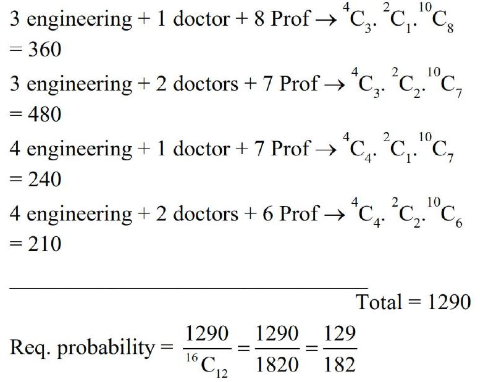
The probability, of forming a 12 persons committee from 4 engineers, 2 doctors and 10 professors containing at least 3 engineers and at least 1 doctor, is :
- ✓
$\frac{129}{182}$
- B
$\frac{103}{182}$
- C
$\frac{17}{26}$
- D
$\frac{19}{26}$
AnswerCorrect option: A. $\frac{129}{182}$
(A) $\frac{129}{182}$
View full question & answer→MCQ 174 Marks
For an integer $\mathrm{n} \geq 2$, if the arithmetic mean of all coefficients in the binomial expansion of $(x+y)^{2 n-3}$ is 16 , then the distance of the point $\mathrm{P}\left(2 \mathrm{n}-1, \mathrm{n}^{2}-4 \mathrm{n}\right)$ from the line $x+y=8$ is :
- A
$\sqrt{2}$
- B
$2 \sqrt{2}$
- C
$5 \sqrt{2}$
- ✓
$3 \sqrt{2}$
AnswerCorrect option: D. $3 \sqrt{2}$
(D) $3 \sqrt{2}$
No. of terms in $(x+y)^{(2 n-3)} \Rightarrow\left[\begin{array}{c}(2 n-3+1) \\ (2 n-2)\end{array}\right.$
$\therefore$ sum of all coefficients $=2^{2 n-3}$
(Put $\mathrm{x}=\mathrm{y}=1$ )
$\therefore$ Arithmetic mean of all coefficients
$=\left(\frac{2^{2 n-3}}{2 n-2}\right)=16$
$\Rightarrow 2^{2 \mathrm{n}-3}=2^{5}(\mathrm{n}-1) \Rightarrow \mathrm{n}=5$
$\therefore \mathrm{P}\left(2 \mathrm{n}-1, \mathrm{n}^{2}-4 \mathrm{n}\right)=(9,5)$
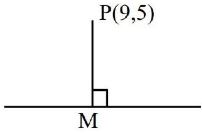
$x+y=8$
$\therefore \mathrm{PM}=\left|\frac{9+5-8}{\sqrt{2}}\right|=\frac{6}{\sqrt{2}}=\frac{3 \times 2}{\sqrt{2}}=3 \sqrt{2}$ View full question & answer→MCQ 184 Marks
Let $A=\{1,6,11,16, \ldots\}$ and $B=\{9,16,23,30, \ldots\}$ be the sets consisting of the first 2025 terms of two arithmetic progressions. Then $\mathrm{n}(\mathrm{A} \cup \mathrm{B})$ is
Answer(C) 3761
$A=\{1,6,11,16,21,26,31,36,41,46,51,56,61$, $66,71,76,81,86,91, \ldots \ldots\}$
$B=\{9,16,23,30,37,44,51,58,65,72,79,86$, $93,100, \ldots \ldots\}$
$A \cap B=\{16,51,86, \ldots\}$
For set '$A$' $\Rightarrow T_{2025}=1+(2025-1)(5)=10121$
For set '$B$' $\Rightarrow T_{2025}=9+(2025-1)(7)=14177$
So, for $(A \cap B) \Rightarrow T_{n}=16+(n-1)(35) \leq 10121$
$(\mathrm{n}-1) \leq \frac{10121-16}{35}=288.71$
$\mathrm{n} \leq 289.71 \Rightarrow \mathrm{n}=289$
$\therefore \mathrm{n}(\mathrm{A} \cup \mathrm{B})=\mathrm{n}(\mathrm{A})+\mathrm{n}(\mathrm{B})-\mathrm{n}(\mathrm{A} \cap \mathrm{B})$
$=2025+2025-289=3761$
View full question & answer→MCQ 194 Marks
Consider the sets $\mathrm{A}=\left\{(\mathrm{x}, \mathrm{y}) \in \mathbb{R} \times \mathbb{R}: \mathrm{x}^{2}+\mathrm{y}^{2}=25\right\}$, $B=\left\{(x, y) \in \mathbb{R} \times \mathbb{R}: x^{2}+9 y^{2}=144\right\}, C=\{(x, y)$ $\left.\in \mathbb{Z} \times \mathbb{Z}: x^{2}+y^{2} \leq 4\right\}$, and $D=A \cap B$. The total number of one-one functions from the set D to the set C is :
Answer(C) 17160
$\mathrm{A}: \mathrm{x}^{2}+\mathrm{y}^{2}=25\qquad\ldots(1)$
$\text B : \frac{x^{2}}{144}+\frac{y^{2}}{16}=1\qquad\ldots(2)$
$\text C: x^{2}+y^{2} \leq 4\qquad\ldots(3)$
Solve (1) & (2)
$x^{2}+9\left(25-x^{2}\right)=144$
$-8 x^{2}=144-225=-81$
$x= \pm \frac{9}{2 \sqrt{2}}$
By $(1) \Rightarrow y= \pm \sqrt{25-x^{2}}$
$= \pm \sqrt{25-\frac{81}{8}}= \pm \frac{\sqrt{119}}{2 \sqrt{2}}$
$\therefore \mathrm{D}=\mathrm{A} \cap \mathrm{B}=$
$\left\{\left(\frac{9}{2 \sqrt{2}}, \frac{\sqrt{119}}{2 \sqrt{2}}\right),\left(\frac{9}{2 \sqrt{2}},-\frac{\sqrt{119}}{2 \sqrt{2}}\right),\left(\frac{-9}{2 \sqrt{2}}, \frac{\sqrt{119}}{2 \sqrt{2}}\right),\left(\frac{-9}{2 \sqrt{2}}, \frac{-\sqrt{119}}{2 \sqrt{2}}\right)\right\}$
No. of elements in set $\mathrm{D}=4$
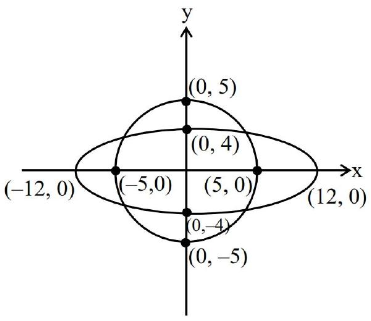
$\because C=\left\{(\mathrm{x}, \mathrm{y}) \in \mathrm{Z} \times \mathrm{Z}: \mathrm{x}^{2}+\mathrm{y}^{2} \leq 4\right\}$
$=\{(0,2),(2,0),(0,-2),(-2,0),(1,1),(-1,-1),$ $(1,-1),(-1,1),(1,0),(0,1),(-1,0),(0,-1),$ $(0,0)\}$
No. of elements in set $\mathrm{C}=13$
Total no. of one-one function from
Set $D$ to $\sec C \Rightarrow 13 \times 12 \times 11 \times 10=17160$
View full question & answer→MCQ 204 Marks
Let $f, \mathrm{~g}:(1, \infty) \rightarrow \mathbb{R}$ be defined as $f(\mathrm{x})=\frac{2 x+3}{5 x+2}$ and $g(x)=\frac{2-3 x}{1-x}$. If the range of the function $fo g:[2,4] \rightarrow \mathbb{R}$ is $[\alpha, \beta]$, then $\frac{1}{\beta-\alpha}$ is equal to
Answer(D) 56
fog $(x)=f(g(x))$
$=f\left(\frac{2-3 x}{1-x}\right)=\frac{2\left(\frac{2-3 x}{1-x}\right)+3}{5\left(\frac{2-3 x}{1-x}\right)+2}$
$=\frac{4-6 x+3-3 x}{10-15 x+2-2 x}=\left(\frac{7-9 x}{12-17 x}\right)$
$\therefore\left[\begin{array}{c}12-7 \mathrm{x} \neq 0 \\ \mathrm{x} \neq \frac{12}{17}\end{array}\right.$
$\left[\begin{array}{l}\operatorname{fog}(2)=\frac{7-9(2)}{12-17(2)}=\frac{-11}{-22}=\frac{1}{2} \\ \operatorname{fog}(4)=\frac{7-9(4)}{12-17(4)}=\frac{-29}{-56}=\frac{29}{56}\end{array}\right.$
Range of fog : $[\alpha, \beta]=\left[\frac{1}{2}, \frac{29}{56}\right]$
$\therefore(\beta-\alpha)=\frac{29}{56}-\frac{1}{2}=\frac{29-28}{56}=\frac{1}{56}$
$\frac{1}{(\beta-\alpha)}=56$
View full question & answer→