MCQ
For an integer $\mathrm{n} \geq 2$, if the arithmetic mean of all coefficients in the binomial expansion of $(x+y)^{2 n-3}$ is 16 , then the distance of the point $\mathrm{P}\left(2 \mathrm{n}-1, \mathrm{n}^{2}-4 \mathrm{n}\right)$ from the line $x+y=8$ is :
  • A
    $\sqrt{2}$
  • B
    $2 \sqrt{2}$
  • C
    $5 \sqrt{2}$
  • $3 \sqrt{2}$

Answer

Correct option: D.
$3 \sqrt{2}$
(D) $3 \sqrt{2}$
No. of terms in $(x+y)^{(2 n-3)} \Rightarrow\left[\begin{array}{c}(2 n-3+1) \\ (2 n-2)\end{array}\right.$
$\therefore$ sum of all coefficients $=2^{2 n-3}$
(Put $\mathrm{x}=\mathrm{y}=1$ )
$\therefore$ Arithmetic mean of all coefficients
$=\left(\frac{2^{2 n-3}}{2 n-2}\right)=16$
$\Rightarrow 2^{2 \mathrm{n}-3}=2^{5}(\mathrm{n}-1) \Rightarrow \mathrm{n}=5$
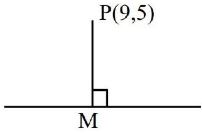
$\therefore \mathrm{P}\left(2 \mathrm{n}-1, \mathrm{n}^{2}-4 \mathrm{n}\right)=(9,5)$
Image
$x+y=8$
$\therefore \mathrm{PM}=\left|\frac{9+5-8}{\sqrt{2}}\right|=\frac{6}{\sqrt{2}}=\frac{3 \times 2}{\sqrt{2}}=3 \sqrt{2}$

Need a full question paper?

Generate a complete, print-ready paper with questions like this in minutes — across 16+ boards, with answer keys.

Start Generating Free

Similar questions

The sides of an equilateral triangle are increasing at the rate of  $2 \,cm/sec$ . The rate at which the area increases, when the side is $ 10 \,cm$ is
Let $y=y(x)$ be the solution of the differential equation $x d y=\left(y+x^{3} \cos x\right) d x$ with $y(\pi)=0$ then $y\left(\frac{\pi}{2}\right)$ is equal to :
Let a be an integer such that $\lim \limits_{x \rightarrow 7} \frac{18-[1-x]}{[x-3 a]}$ exists, where $[ t ]$ is greatest integer $\leq t$. Then a is equal to
Let $[x]$ denote the greatest integer less than or equal to $x$ Then

$\mathop {\lim }\limits_{x \to 0} \,\frac{{\tan \,(\pi \,{{\sin }^2}\,x) + \,{{(\left| x \right|\, - \,\sin \,(x\,[x]))}^2}}}{{{x^2}}}$

If $\cos x = {1 \over {\sqrt {1 + {t^2}} }}$ and $\sin y = {t \over {\sqrt {1 + {t^2}} }}$, then ${{dy} \over {dx}} = $
If $f(x) = \left\{ {\begin{array}{*{20}{c}}
{\sqrt {1 - x} \,\,\,\,\,\,\,\,\,\,\,\,\,0 \le x \le 1}\\
{{{(7x - 6)}^{\frac{{ - 1}}{3}}}\,\,\,\,\,1 < x \le 2}
\end{array}} \right.$ , then $\int\limits_0^2 {{{f}}(x)\,dx} $ is equal to
Let a circle C of radius 1 and closer to the origin be such that the lines passing through the point (3, 2) and parallel to the coordinate axes touch it. Then the shortest distance of the circle C from the point (5 , 5) is :
Let in a $\triangle A B C$, the length of the side $A C$ be 6 , the vertex $B$ be $(1,2,3)$ and the vertices $A, C$ lie on the line $\frac{x-6}{3}=\frac{y-7}{2}=\frac{z-7}{-2}$. Then the area (in sq. units) of $\triangle \mathrm{ABC}$ is
If $A , B$ and $\left(\operatorname{adj}\left( A ^{-1}\right)+\operatorname{adj}\left( B ^{-1}\right)\right)$ are non-singular matrices of same order, then the inverse of $A \left(\operatorname{adj}\left( A ^{-1}\right)+\operatorname{adj}\left( B ^{-1}\right)\right)^{-1} B$, is equal to
If $A = [1\,2\,3],B = \left[ \begin{array}{l}2\\3\\4\end{array} \right]$ and $C = \left[ {\begin{array}{*{20}{c}}1&5\\0&2\end{array}} \right],$ then which of the following is defined