Questions

SECTION - A [CHEMISTY - MCQ]

Take a timed test

20 questions · self-marked practice — reveal the answer and mark yourself.

MCQ 14 Marks
Given below are two statements :
1 M aqueous solution of each of $\mathrm{Cu}\left(\mathrm{NO}_{3}\right)_{2}, \mathrm{AgNO}_{3}$, $\mathrm{Hg}_{2}\left(\mathrm{NO}_{3}\right)_{2} ; \mathrm{Mg}\left(\mathrm{NO}_{3}\right)_{2}$ are electrolysed using inert electrodes,
Given : $\mathrm{E}_{\mathrm{Ag}^{+} / \mathrm{Ag}}^{\theta}=0.80 \mathrm{~V}, \mathrm{E}_{\mathrm{Hg}_{2}^{2+} / \mathrm{Hg}}^{\theta}=0.79 \mathrm{~V}$,
$\mathrm{E}_{\mathrm{Cu}^{2+} / \mathrm{Cu}}^{\theta}=0.24 \mathrm{~V}$ and $\mathrm{E}_{\mathrm{Mg}^{2+} / \mathrm{Mg}}^{\theta}=-2.37 \mathrm{~V}$
Statement (I) : With increasing voltage, the sequence of deposition of metals on the cathode will be $\mathrm{Ag}, \mathrm{Hg}$ and Cu
Statement (II) : Magnesium will not be deposited at cathode instead oxygen gas will be evolved at the cathode.
In the light of the above statement, choose the most appropriate answer from the options given below
  • A
    Both statement I and statement II are incorrect
  • B
    Statement I is correct but statement II is incorrect
  • C
    Both statement I and statement II are correct
  • D
    Statement I is incorrect but statement II is correct
Answer
B. Statement I is correct but statement II is incorrect
Statement-II $\Rightarrow$ At cathode, instead of $\mathrm{Mg}, \mathrm{H}_{2} \mathrm{O}_{(\ell)}$ will reduce & evolve $\mathrm{H}_{2}$ gas.
View full question & answer
MCQ 24 Marks
The correct statements from the following are :
(A) $\mathrm{Tl}^{3+}$ is a powerful oxidising agent
(B) $\mathrm{Al}^{3+}$ does not get reduced easily
(C) Both $\mathrm{Al}^{3+}$ and $\mathrm{Tl}^{3+}$ are very stable in solution
(D) $\mathrm{Tl}^{+}$is more stable than $\mathrm{Tl}^{3+}$
(E) $\mathrm{Al}^{3+}$ and $\mathrm{Tl}^{+}$are highly stable
Choose the correct answer from the options given below :
  • A
    (A), (B), (C), (D) and (E)
  • B
    (A), (B), (D) and (E) only
  • C
    (B), (D) and (E) only
  • D
    (A), (C) and (D) only
Answer
B. (A), (B), (D) and (E) only
(i) True, $\mathrm{T} \ell^{+}$is more stable than $\mathrm{T} \ell^{3+}$, due to inert pair effect. So $T \ell^{3+}$ is a powerful oxidising agent.
(ii) True, $\mathrm{E}_{\mathrm{Al}^{3+/ A 1}}^{0}=-1.66 \mathrm{~V}$. So it is difficult to reduce $\mathrm{A} \ell^{3+}$. So $\mathrm{A} \ell^{3+}$ is highly stable.
(iii) False, as $\mathrm{T} \ell^{3+}$ is unstable
(iv) True, $\mathrm{T} \ell^{+}$is more stable than $\mathrm{T} \ell^{3+}$
(v) True, $\mathrm{A} \ell^{3+}$ and $\mathrm{T} \ell^{+}$are highly stable
View full question & answer
MCQ 34 Marks
The extra stability of half-filled subshell is due to
(A) Symmetrical distribution of electrons
(B) Smaller coulombic repulsion energy
(C) The presence of electrons with the same spin in non-degenerate orbitals
(D) Larger exchange energy
(E) Relatively smaller shielding of electrons by one another
Identify the correct statements
  • A
    (B), (D) and (E) only
  • B
    (A), (B), (D) and (E) only
  • C
    (B), (C) and (D) only
  • D
    (A), (B) and (D) only
Answer
B. (A), (B), (D) and (E) only
Extra stability of half filled is due to :
(i) Symmetrical distribution of electrons
(ii) Large exchange energy
(iii) Smaller coulombic repulsion
(iv) Smaller shielding of electrons by one another
View full question & answer
MCQ 44 Marks
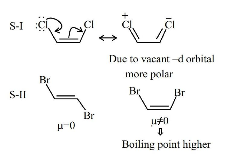
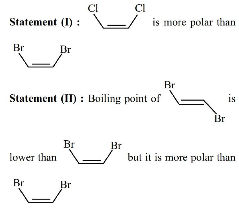
Given below are two statements :
Image
In the light of the above statements, choose the most appropriate answer from the options given below :
  • A
    Statement I is correct but statement II is incorrect
  • B
    Statement I is correct but statement II is incorrect
  • C
    Both statement I and statement II are incorrect
  • D
    Both statement I and statement II are correct
Answer
A. Statement I is correct but statement II is incorrect
Image
View full question & answer
MCQ 54 Marks
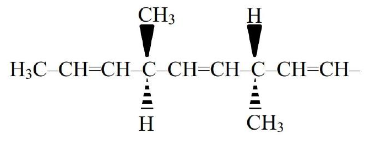
The number of optically active products obtained from the complete ozonolysis of the given compound is :
Image
  • A
    2
  • B
    0
  • C
    1
  • D
    4
Answer
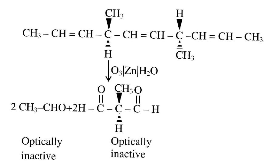
B. 0
Image
View full question & answer
MCQ 64 Marks
The number of unpaired electrons responsible for the paramagnetic nature of the following complex species are respectively :
$\left[\mathrm{Fe}(\mathrm{CN})_{6}\right]^{3-},\left[\mathrm{FeF}_{6}\right]^{3-},\left[\mathrm{CoF}_{6}\right]^{3-},\left[\mathrm{Mn}(\mathrm{CN})_{6}\right]^{3-}$
  • A
    $1,5,4,2$
  • B
    $1,5,5,2$
  • C
    $1,1,4,2$
  • D
    $1,4,4,2$
Answer
A. $1,5,4,2$
$\quad\left[\mathrm{Fe}(\mathrm{CN})_{6}\right]^{3-} \quad \mathrm{Fe}^{3+} \quad 3 \mathrm{~d}^{5} \quad \mathrm{t}_{2 \mathrm{~g}}^{2,2,1} \quad \mathrm{e}_{\mathrm{g}}^{0,0} \quad$ unpaired $\mathrm{e}^{-}=1$
$\left[\begin{array}{lllll}\mathrm{FeF}_{6}\end{array}\right]^{3-} \quad \mathrm{Fe}^{3+} \quad 3 \mathrm{~d}^{5} \quad \mathrm{t}_{2 \mathrm{~g}}^{1,1,1} \quad \mathrm{e}_{\mathrm{g}}^{1,1}$ unpaired $\mathrm{e}^{-}=5$
$\left[\mathrm{CoF}_{6}\right]^{3-} \quad \mathrm{Co}^{3+} 3 \mathrm{~d}^{6} \quad \mathrm{t}_{2 \mathrm{~g}}^{2,1,1} \quad \mathrm{e}_{\mathrm{g}}^{1}$, unpaired $\mathrm{e}^{-}=4$
$\left[\mathrm{Mn}(\mathrm{CN})_{6}\right]^{3-} \mathrm{Mn}^{3+} 3 \mathrm{~d}^{4} \quad \mathrm{t}_{2 \mathrm{~g}}^{2,1,1} \quad \mathrm{e}_{\mathrm{g}}^{0,0} \quad$ unpaired $\mathrm{e}^{-}=2$
View full question & answer
MCQ 74 Marks
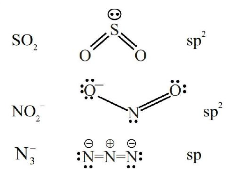
In $\mathrm{SO}_{2}, \mathrm{NO}_{2}^{-}$and $\mathrm{N}_{3}^{-}$the hybridizations at the central atom are respectively :
  • A
    $\mathrm{sp}^{2}, \mathrm{sp}^{2}$ and sp
  • B
    $\mathrm{sp}^{2}, \mathrm{sp}$ and sp
  • C
    $\mathrm{sp}^{2}, \mathrm{sp}^{2}$ and $\mathrm{sp}^{2}$
  • D
    $\mathrm{sp}, \mathrm{sp}^{2}$ and sp
Answer
A. $\mathrm{sp}^{2}, \mathrm{sp}^{2}$ and sp
Image
View full question & answer
MCQ 84 Marks
Match List-I with List-II
List-IList-II
(A)Solution of chloroform and acetone(I)Minimum boiling azeotrope
(B)Solution of ethanol and water(II)Dimerizes
(C)Solution of benzene and toluene(III)Maximum boiling azeotrope
(D)Solution of acetic acid in benzene(IV)$\Delta \mathrm{V}_{\text {mix }}=0$

Choose the correct answer from the options given below :

  • A
    (A)-(III), (B)-(I), (C)-(IV), (D)-(II)
  • B
    (A)-(II), (B)-(IV), (C)-(I), (D)-(III)
  • C
    (A)-(III), (B)-(IV), (C)-(I), (D)-(II)
  • D
    (A)-(II), (B)-(I), (C)-(IV), (D)-(III)
Answer
A. (A)-(III), (B)-(I), (C)-(IV), (D)-(II)
(A) Solution of chloroform and acetone shows -ve deviation, so maximum boiling azeotrope.
(B) Solution of ethanol & water shows +ve deviation. So minimum boiling azeotrope.
(C) Solution of benzene and toluene form ideal solution. $\Delta \mathrm{V}_{\text {mix }}=0$.
(D) Acetic acid in benzene form dimer.
View full question & answer
MCQ 94 Marks
Match List-I with List-II
List-I
Complex
List-II
Primary valency and Secondary valency
(A)$\left[\mathrm{Co}(\mathrm{en})_{2} \mathrm{Cl}_{2}\right] \mathrm{Cl}$(I)3 $\quad$ 6
(B)$\left[\mathrm{Pt}\left(\mathrm{NH}_{3}\right)_{2} \mathrm{Cl}\left(\mathrm{NO}_{2}\right)\right]$(II)3 $\quad$ 4
(C)$\mathrm{Hg}\left[\mathrm{Co}(\mathrm{SCN})_{4}\right]$(III)2 $\quad$ 6
(D)$[\mathrm{Mg}(\mathrm{EDTA})]^{2-}$(IV)2 $\quad$ 4
Choose the correct answer from the options given below :
  • A
    (A)-(III), (B)-(I), (C)-(II), (D)-(IV)
  • B
    (A)-(I), (B)-(IV), (C)-(II), (D)-(III)
  • C
    (A)-(I), (B)-(III), (C)-(II), (D)-(IV)
  • D
    (A)-(II), (B)-(III), (C)-(IV), (D)-(I)
Answer
B. (A)-(I), (B)-(IV), (C)-(II), (D)-(III)
Primary valency $=$ Oxidation state Secondary valency $=$ Co-ordination number
ComplexPrimary valencySecondary valency
(A)$\left[\mathrm{Co}(\mathrm{en})_{2} \mathrm{Cl}_{2}\right] \mathrm{Cl}$36
(B)$\left[\mathrm{Pt}\left(\mathrm{NH}_{3}\right)_{2} \mathrm{Cl}\left(\mathrm{NO}_{2}\right)\right]$24
(C)$\mathrm{Hg}\left[\mathrm{Co}(\mathrm{SCN})_{4}\right]$34
(D)$[\mathrm{Mg}(\mathrm{EDTA})]^{2-}$26
View full question & answer
MCQ 104 Marks
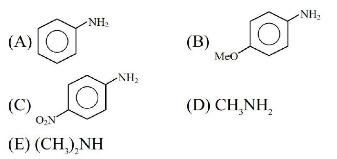
The descending order of basicity of following amines is :
Image
Choose the correct answer from the options given below :
  • A
    B $>$ E $>$ D $>$ A $>$ C
  • B
    E $>$ D $>$ B $>$ A $>$ C
  • C
    E $>$ D $>$ A $>$ B $>$ C
  • D
    E $>$ A $>$ D $>$ C $>$ B
Answer
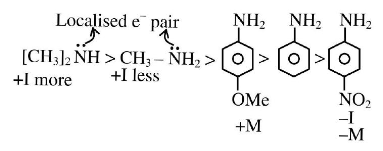
B. E $>$ D $>$ B $>$ A $>$ C
Image
View full question & answer
MCQ 114 Marks
X ' is the number of acidic oxides among $\mathrm{VO}_{2}$,
$\mathrm{V}_{2} \mathrm{O}_{3}, \mathrm{CrO}_{3}, \mathrm{~V}_{2} \mathrm{O}_{5}$ and $\mathrm{Mn}_{2} \mathrm{O}_{7}$. The primary valency of cobalt in $\left[\mathrm{Co}\left(\mathrm{H}_{2} \mathrm{NCH}_{2} \mathrm{CH}_{2} \mathrm{NH}_{2}\right)_{3}\right]_{2}\left(\mathrm{SO}_{4}\right)_{3}$ is Y .
The value of $\mathrm{X}+\mathrm{Y}$ is :
  • A
    5
  • B
    4
  • C
    2
  • D
    3
Answer
A. 5
$\mathrm{CrO}_{3}=$ Acidic
$\mathrm{Mn}_{2} \mathrm{O}_{7}=$ Acidic
$\therefore \mathrm{x}=2$
$\left[{ }^{\text {III }} \mathrm{Co}\left(\mathrm{H}_{2} \mathrm{NCH}_{2} \mathrm{CH}_{2} \mathrm{NH}_{2}\right)_{3}\right]_{2}\left(\mathrm{SO}_{4}\right)_{3} \rightleftharpoons$
$2\left[\mathrm{Col}\left(\mathrm{H}_{2} \mathrm{NCH}_{2} \mathrm{CH}_{2} \mathrm{NH}_{2}\right)_{3}\right]^{3+}+3 \mathrm{SO}_{4}^{2-}$
$\therefore$ Primary valency $=3$
$\therefore \mathrm{x}+\mathrm{y}=5$
View full question & answer
MCQ 124 Marks
Liquid $A$ and $B$ form an ideal solution. The vapour pressure of pure liquids A and B are 350 and 750 mm Hg respectively at the same temperature. If $\mathrm{x}_{\mathrm{A}}$ and $x_{B}$ are the mole fraction of $A$ and $B$ in solution while $y_{A}$ and $y_{B}$ are the mole fraction of $A$ and $B$ in vapour phase then :
  • A
    $\frac{x_{A}}{x_{B}}<\frac{y_{A}}{y_{B}}$
  • B
    $\frac{x_{A}}{x_{B}}=\frac{y_{A}}{y_{B}}$
  • C
    $\frac{x_{A}}{x_{B}}>\frac{y_{A}}{y_{B}}$
  • D
    $\left(\mathrm{x}_{\mathrm{A}}-\mathrm{y}_{\mathrm{A}}\right)<\left(\mathrm{x}_{\mathrm{B}}-\mathrm{y}_{\mathrm{B}}\right)$
Answer
C. $\frac{x_{A}}{x_{B}}>\frac{y_{A}}{y_{B}}$
$\mathrm{P}_{\mathrm{A}}^{\mathrm{o}}<\mathrm{P}_{\mathrm{B}}^{0}$
$\frac{\mathrm{P}_{\mathrm{A}}^{\mathrm{o}}}{\mathrm{P}_{\mathrm{B}}^{\mathrm{o}}}<1$
$\frac{\mathrm{y}_{\mathrm{A}}}{\mathrm{y}_{\mathrm{B}}}=\frac{\mathrm{P}_{\mathrm{A}}^{o}}{\mathrm{P}_{\mathrm{B}}^{o}} \frac{\mathrm{x}_{\mathrm{A}}}{\mathrm{x}_{\mathrm{B}}}$
$\underline{y_{A}}$
$\frac{y_{B}}{x_{A}}<1$
$\mathrm{x}_{\mathrm{B}}$
$\frac{y_{A}}{y_{B}}<\frac{x_{A}}{x_{B}}$
View full question & answer
MCQ 134 Marks
The correct statement amongst the following is :
  • A
    The term 'standard state' implies that the temperature is $0^{\circ} \mathrm{C}$
  • B
    The standard state of pure gas is the pure gas at a pressure of 1 bar and temperature 273 K
  • C
    $\Delta_{f} \mathrm{H}_{298}^{\theta}$ is zero for $\mathrm{O}(\mathrm{g})$
  • D
    $\Delta_{\mathrm{f}} \mathrm{H}_{500}^{\theta}$ is zero for $\mathrm{O}_{2}(\mathrm{~g})$
Answer
D. $\Delta_{\mathrm{f}} \mathrm{H}_{500}^{\theta}$ is zero for $\mathrm{O}_{2}(\mathrm{~g})$
For standard state $\Rightarrow$ pressure $=1$ bar and temperature is specified only
$\Rightarrow\left(\Delta \mathrm{H}_{\mathrm{f}}^{\mathrm{o}}\right)_{\mathrm{O}_{2,(\mathrm{~g})}}=0$
View full question & answer
MCQ 144 Marks
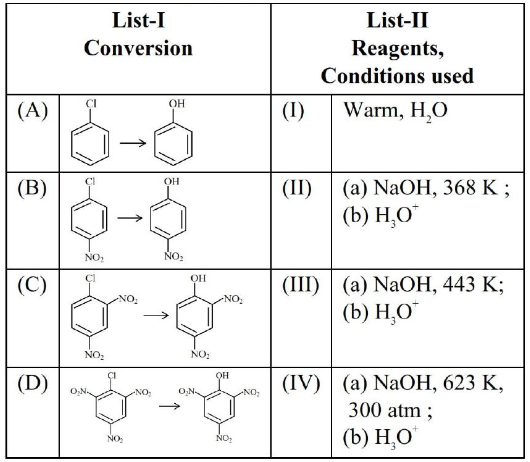
Match List-I with List-II
Image
Choose the correct answer from the options given below :
  • A
    (A)-(II), (B)-(III), (C)-(I), (D)-(IV)
  • B
    (A)-(III), (B)-(IV), (C)-(II), (D)-(I)
  • C
    (A)-(IV), (B)-(III), (C)-(II), (D)-(I)
  • D
    (A)-(IV), (B)-(III), (C)-(I), (D)-(II)
Answer
C. (A)-(IV), (B)-(III), (C)-(II), (D)-(I)
Aromatic halide give nucleophilic substitution reaction at high temperature or in presence of $-\mathrm{I} /-$ $M$ group rate of reaction high even at low temperature.
A-IV
B-III
C-II
D-I
View full question & answer
MCQ 154 Marks
Choose the incorrect trend in the atomic radii (r) of the elements :
  • A
    $\mathrm{r}_{\mathrm{Br}} < \mathrm{r}_{\mathrm{K}}$
  • B
    $\mathrm{r}_{\mathrm{Mg}} < \mathrm{r}_{\mathrm{Al}}$
  • C
    $\mathrm{r}_{\mathrm{Rb}} < \mathrm{r}_{\mathrm{CS}}$
  • D
    $\mathrm{r}_{\mathrm{At}} < \mathrm{r}_{\mathrm{Cs}}$
Answer
B. $\mathrm{r}_{\mathrm{Mg}}<\mathrm{r}_{\mathrm{Al}}$
In a period from left to right atomic size decreases.
View full question & answer
MCQ 164 Marks
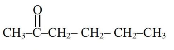
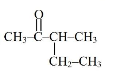
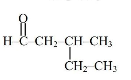
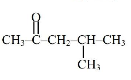
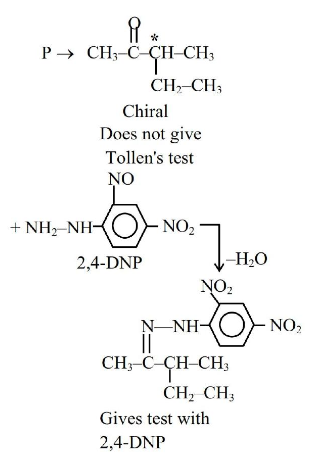
"P" is an optically active compound with molecular formula $\mathrm{C}_{6} \mathrm{H}_{12} \mathrm{O}$. When " P " is treated with 2,4-dinitrophenylhydrazine, it gives a positive test. However, in presence of Tollens reagent, "P" gives a negative test. Predict the structure of "P".
  • A
    Image
  • B
    Image
  • C
    Image
  • D
    Image
Answer
B. Image
Image
View full question & answer
MCQ 174 Marks
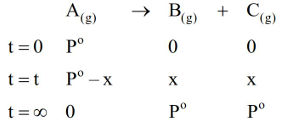
$\mathrm{A}(\mathrm{g}) \rightarrow \mathrm{B}(\mathrm{g})+\mathrm{C}(\mathrm{g})$ is a first order reaction.
TimeT$\infty$
$\mathbf{P}_{\text {system }}$$\mathrm{P}_{\mathrm{t}}$$\mathrm{P}_{\infty}$
The reaction was started with reactant A only. Which of the following expression is correct for rate constant k ?
  • A
    $k=\frac{1}{t} \ln \frac{2\left(p_{\infty}-P_{t}\right)}{P_{t}}$
  • B
    $k=\frac{1}{t} \ln \frac{p_{\infty}}{P_{t}}$
  • C
    $k=\frac{1}{t} \ln \frac{p_{\infty}}{2\left(p_{\infty}-P_{t}\right)}$
  • D
    $k=\frac{1}{t} \ln \frac{p_{\infty}}{\left(p_{\infty}-P_t\right)}$
View full question & answer
MCQ 184 Marks
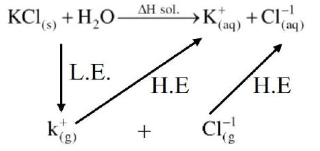
The hydration energies of $\mathrm{K}^{+}$and $\mathrm{Cl}^{-}$are -x and -y $\mathrm{kJ} / \mathrm{mol}$ respectively. If lattice energy of KCl is -z $\mathrm{kJ} / \mathrm{mol}$, then the heat of solution of KCl is :
  • A
    $+x-y-z$
  • B
    $x+y+z$
  • C
    $z-(x+y)$
  • D
    $-z-(x+y)$
Answer
C. $z-(x+y)$
Image
$\begin{aligned} \Delta H _{\text {Sol }^{ n } .} & = L \cdot E \cdot+( H \cdot E )_{ K _{( g )}^{+}}+( HE )_{ Cl _{( g )}^{-1}} \\ & = Z - x - y \\ & = z -( x + y )\end{aligned}$
View full question & answer
MCQ 194 Marks
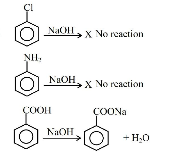
Mixture of 1 g each of chlorobenzene, aniline and benzoic acid is dissolved in 50 mL ethyl acetate and placed in a separating funnel, 5 M NaOH (30 mL ) was added in the same funnel. The funnel was shaken vigorously and then kept aside. The ethyl acetate layer in the funnel contains :
  • A
    benzoic acid
  • B
    benzoic acid and aniline
  • C
    benzoic acid and chlorobenzene
  • D
    chlorobenzene and aniline
Answer
D. chlorobenzene and aniline
Image
Organic layer in funnel are mixture of chloro benzene and aniline
View full question & answer
MCQ 204 Marks
Given below are two statements :
Statement (I): On hydrolysis, oligo peptides give rise to fewer number of $\alpha$-amino acids while proteins give rise to a large number of $\beta$-amino acids.
Statement (II) : Natural proteins are denatured by acids which convert the water soluble form of fibrous proteins to their water insoluble form.
In the light of the above statements, choose the most appropriate answer from the options given below :
  • A
    Both statement I and statement II are correct
  • B
    Statement I is incorrect but Statement II is correct
  • C
    Both statement I and statement II are incorrect
  • D
    Statement I is correct but Statement II is incorrect
Answer
C. Both statement I and statement II are incorrect
(i) Protein does not gives $\beta$-amino acid on hydrolysis
(ii) Fibrous protein are not water soluble
So both statement's are wrong
View full question & answer