Questions

SECTION - A [PHYSICS MCQ]

Take a timed test

20 questions · self-marked practice — reveal the answer and mark yourself.

MCQ 14 Marks
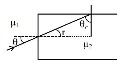
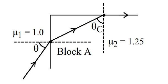
A transparent block A having refractive index $\mu=1.25$ is surrounded by another medium of refractive index $\mu=1.0$ as shown in figure. A light ray is incident on the flat face of the block with incident angle $\theta$ as shown in figure. What is the maximum value of $\theta$ for which light suffers total internal reflection at the top surface of the block ?
Image
  • A
    $\tan ^{-1}(4 / 3)$
  • B
    $\tan ^{-1}(3 / 4)$
  • C
    $\sin ^{-1}(3 / 4)$
  • D
    $\cos ^{-1}(3 / 4)$
Answer
C. $\sin ^{-1}(3 / 4)$
Image
$r+\theta_{\mathrm{c}}=90^{\circ}$
$\mu_{1} \sin \theta=\mu_{2} \sin r$
$\sin \theta=\frac{\mu_{2}}{\mu_{1}} \sin \left(90-\theta_{C}\right)$
$\sin \theta=\frac{\mu_{2}}{\mu_{1}} \cos \theta_{C}$
$\sin \theta_{C}=\frac{\mu_{1}}{\mu_{2}}$
$\sin \theta=\frac{\mu_{2}}{\mu_{1}} \sqrt{1-\frac{\mu_{1}^{2}}{\mu_{2}^{2}}}$
$\sin \theta=\sqrt{\frac{\mu_{2}^{2}-\mu_{1}^{2}}{\mu_{1}^{2}}}=\sqrt{\frac{\frac{25}{16}-1}{1}}$
$\sin \theta=\frac{3}{4}$
$\theta=\sin ^{-1}\left(\frac{3}{4}\right)$
View full question & answer
MCQ 24 Marks
An object with mass 500 g moves along x -axis with speed $v=4 \sqrt{x} \mathrm{~m} / \mathrm{s}$. The force acting on the object is :
  • A
    8 N
  • B
    5 N
  • C
    6 N
  • D
    4 N
Answer
D. 4 N
$\quad \mathrm{F}=\mathrm{M} \times \mathrm{a}$
$\mathrm{v}=4 \sqrt{\mathrm{x}}$
$v^{2}=16 x$
$2 \mathrm{v} \frac{\mathrm{dv}}{\mathrm{dx}}=16$
$\frac{\mathrm{vdv}}{\mathrm{dx}}=\frac{16}{2}=8$
$\mathrm{F}=0.5 \times 8=4 \mathrm{~N}$
View full question & answer
MCQ 34 Marks
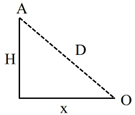
A helicopter flying horizontally with a speed of $360 \mathrm{~km} / \mathrm{h}$ at an altitude of 2 km , drops an object at an instant. The object hits the ground at a point O , 20 s after it is dropped. Displacement of ' O ' from the position of helicopter where the object was released is :
(use acceleration due to gravity $\mathrm{g}=10 \mathrm{~m} / \mathrm{s}^{2}$ and neglect air resistance)
  • A
    $2 \sqrt{5} \mathrm{~km}$
  • B
    4 km
  • C
    7.2 km
  • D
    $2 \sqrt{2} \mathrm{~km}$
View full question & answer
MCQ 44 Marks

Match List-I with List-II.

List-IList-II
(A)Isothermal(I)$\Delta \mathrm{W}$ (work done) $=0$
(B)Adiabatic(II)$\Delta \mathrm{Q}$ (supplied heat) $=0$
(C)Isobaric(III)$\Delta \mathrm{U}$ (change in internal energy) $\neq 0$
(D)Isochoric(IV)$\Delta \mathrm{U}=0$
Choose the correct answer from the options given below :
  • A
    (A)-(III), (B)-(II), (C)-(I), (D)-(IV)
  • B
    (A)-(IV), (B)-(I), (C)-(III), (D)-(II)
  • C
    (A)-(IV), (B)-(II), (C)-(III), (D)-(I)
  • D
    (A)-(II), (B)-(IV), (C)-(I), (D)-(III)
Answer
C. (A)-(IV), (B)-(II), (C)-(III), (D)-(I)
(A) Isothermal $\rightarrow \Delta T=0 \rightarrow \Delta U=0$ (IV)
(B) Adiabatic $\rightarrow \Delta \mathrm{Q}=0$ (II)
(C) Isobaric $\rightarrow \Delta \mathrm{P}=0 \rightarrow \Delta \mathrm{U} \neq 0$ (III)
(D) Isochoric $\rightarrow \Delta \mathrm{V}=0 \rightarrow \Delta \mathrm{~W}=0$ (I)
View full question & answer
MCQ 54 Marks
Which one of the following forces cannot be expressed in terms of potential energy?
  • A
    Coulomb's force
  • B
    Gravitational force
  • C
    Frictional force
  • D
    Restoring force
Answer
C. Frictional force
Potential energy is defined for conservative force only. It is not defined for non-conservative force i.e. frictional force.
View full question & answer
MCQ 64 Marks
Given below are two statements : one is labelled as Assertion (A) and the other is labelled as Reason(R).
Assertion (A) : Magnetic monopoles do not exist.
Reason (R): Magnetic field lines are continuous and form closed loops.
In the light of the above statements, choose the most appropriate answer from the options given below :
  • A
    Both (A) and (R) are correct but (R) is not the correct explanation of (A)
  • B
    (A) is correct but (R) is not correct
  • C
    Both (A) and (R) are correct and (R) is the correct explanation of (A)
  • D
    (A) is not correct but (R) is correct
Answer
C. Both (A) and (R) are correct and (R) is the correct explanation of (A)
Both statements are correct and reason is also the correct explanation of assertion.
View full question & answer
MCQ 74 Marks
Given below are two statements : one is labelled as Assertion (A) and the other is labelled as Reason (R)
Assertion (A) : Refractive index of glass is higher than that of air.
Reason (R) : Optical density of a medium is directly proportionate to its mass density which results in a proportionate refractive index.
In the light of the above statements, choose the most appropriate answer from the options given below :
  • A
    (A) is not correct but (R) is correct
  • B
    Both (A) and (R) are correct and (R) is the correct explanation of (A)
  • C
    (A) is correct but (R) is not correct
  • D
    Both (A) and (R) are correct but (R) is not the correct explanation of (A)
Answer
C. (A) is correct but (R) is not correct
Refractive index has no relation with mass density because both have different meaning. Hence reason is incorrect.
So (A) is correct but (R) is not correct.
View full question & answer
MCQ 84 Marks
The equation of a wave travelling on a string is $y=\sin [20 \pi x+10 \pi t]$, where $x$ and $t$ are distance and time in SI units. The minimum distance between two points having the same oscillating speed is :
  • A
    5.0 cm
  • B
    20 cm
  • C
    10 cm
  • D
    2.5 cm
Answer
A. 5.0 cm
Minimum distance between 2 points having same speed is $\frac{\lambda}{2}$.
$\lambda=\frac{2 \pi}{\mathrm{k}}=\frac{1}{10} \mathrm{~m}=10 \mathrm{~cm}$
Distance $=\frac{\lambda}{2}=5 \mathrm{~cm}$
View full question & answer
MCQ 94 Marks

Match List-I with List-II.

List-IList-II
(A)Mass density(I)$\left[\mathrm{ML}^{2} \mathrm{~T}^{-3}\right]$
(B)Impulse(II)$\left[\mathrm{MLT}^{-1}\right]$
(C)Power(III)$\left[\mathrm{ML}^{2} \mathrm{~T}^{0}\right]$
(D)Moment of inertia(IV)$\left[\mathrm{ML}^{-3} \mathrm{~T}^{0}\right]$
Choose the correct answer from the options given below :
  • A
    (A)-(IV), (B)-(II), (C)-(III), (D)-(I)
  • B
    (A)-(I), (B)-(III), (C)-(IV), (D)-(II)
  • C
    (A)-(IV), (B)-(II), (C)-(I), (D)-(III)
  • D
    (A)-(II), (B)-(III), (C)-(IV), (D)-(I)
Answer
C. (A)-(IV), (B)-(II), (C)-(I), (D)-(III)
(A) Mass density $=\frac{M}{V}=M^{1} L^{-3}$...(iv)
(B) Impulse $=M \times u=M^{1} L^{1} T^{-1}$...(ii)
(C) Power $=\mathrm{F} . \mathrm{V}=\mathrm{M}^{1} \mathrm{~L}^{2} \mathrm{~T}^{-3}$...(i)
(D) Moment of inertia $=\mathrm{Mr}^{2}=\mathrm{M}^{1} \mathrm{~L}^{2}$...(iii)
View full question & answer
MCQ 104 Marks
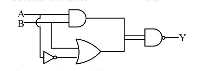
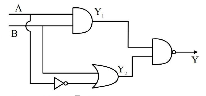
Consider the following logic circuit.
Image
The output is $\mathrm{Y}=0$ when :
  • A
    $\mathrm{A}=1$ and $\mathrm{B}=1$
  • B
    $\mathrm{A}=0$ and $\mathrm{B}=1$
  • C
    $\mathrm{A}=1$ and $\mathrm{B}=0$
  • D
    $\mathrm{A}=0$ and $\mathrm{B}=0$
View full question & answer
MCQ 114 Marks
A dipole with two electric charges of $2 \mu \mathrm{C}$ magnitude each, with separation distance $0.5 \mu \mathrm{~m}$, is placed between the plates of a capacitor such that its axis is parallel to an electric field established between the plates when a potential difference of 5 V is applied. Separation between the plates is 0.5 mm . If the dipole is rotated by $30^{\circ}$ from the axis, it tends to realign in the direction due to a torque. The value of torque is :
  • A
    $5 \times 10^{-9} \mathrm{Nm}$
  • B
    $5 \times 10^{-3} \mathrm{Nm}$
  • C
    $2.5 \times 10^{-12} \mathrm{Nm}$
  • D
    $2.5 \times 10^{-9} \mathrm{Nm}$
Answer
A. $5 \times 10^{-9} \mathrm{Nm}$
$E=\frac{\mathrm{v}}{\mathrm{d}}=\frac{5}{5 \times 10^{-4}}=10^{4} \mathrm{~V} / \mathrm{m}$
$\tau=\mathrm{PE} \sin \theta$
Where $\mathrm{P}=\mathrm{qa}=2 \times 10^{-6} \times 5 \times 10^{-7}$
\begin{equation*}
=1 \times 10^{-12} \mathrm{C}-\mathrm{m}
\end{equation*}
$\tau=1 \times 10^{-12} \times 10^{4} \times \frac{1}{2}=5 \times 10^{-9} \mathrm{~N}-\mathrm{m}$
View full question & answer
MCQ 124 Marks
A mirror is used to produce an image with magnification of $\frac{1}{4}$. If the distance between object and its image is 40 cm , then the focal length of the mirror is __________ .
  • A
    10 cm
  • B
    12.7 cm
  • C
    10.7 cm
  • D
    15 cm
Answer
C. 10.7 cm
$\mathrm{m}=-\frac{\mathrm{v}}{\mathrm{u}}=-\left(\frac{\mathrm{v}}{-\mathrm{u}}\right)=\frac{\mathrm{v}}{\mathrm{u}}$
$\frac{1}{4}=\frac{\mathrm{v}}{\mathrm{u}} \Rightarrow \mathrm{u}=4 \mathrm{v}$
$v+u=40$
$5 \mathrm{v}=40$
$\mathrm{v}=8 \mathrm{~cm}$
$\mathrm{u}=32 \mathrm{~cm}$
$\frac{1}{v}+\frac{v}{u}=\frac{1}{f}$
$\frac{1}{8}-\frac{1}{32}=\frac{1}{\mathrm{f}}$
$\frac{4-1}{32}=\frac{1}{f}$
$\mathrm{f}=\frac{32}{3}=10.7 \mathrm{~cm}$

View full question & answer
MCQ 134 Marks
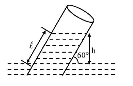
A capillary tube of radius 0.1 mm is partly dipped in water (surface tension $70 \mathrm{dyn} / \mathrm{cm}$ and glass water contact angle $\simeq 0^{\circ}$ ) with $30^{\circ}$ inclined with vertical. The length of water risen in the capillary is __________ cm .
(Take $\mathrm{g}=9.8 \mathrm{~m} / \mathrm{s}^{2}$ )
  • A
    $\frac{82}{5}$
  • B
    $\frac{57}{2}$
  • C
    $\frac{71}{5}$
  • D
    $\frac{68}{5}$
View full question & answer
MCQ 144 Marks
The helium and argon are put in the flask at the same room temperature ( 300 K ). The ratio of average kinetic energies (per molecule) of helium and argon is :
(Give : Molar mass of helium $=4 \mathrm{~g} / \mathrm{mol}$, Molar mass of argon $=40 \mathrm{~g} / \mathrm{mol}$ )
  • A
    $1: 10$
  • B
    $10: 1$
  • C
    $1: \sqrt{10}$
  • D
    $1: 1$
Answer
D. $1: 1$
$\quad \mathrm{K} . \mathrm{E}=\frac{\mathrm{f}}{2} \mathrm{KT}$
For He and $\mathrm{Ar} \mathrm{f}=3$
$\frac{\mathrm{K} \cdot \mathrm{E}_{\mathrm{He}}}{\mathrm{K} \cdot \mathrm{E}_{\mathrm{Ar}}}=\frac{1}{1}$
View full question & answer
MCQ 154 Marks
Given below are two statements : one is labelled as Assertion (A) and the other is labelled as Reason (R).
Assertion (A) : The radius vector from the Sun to a planet sweeps out equal areas in equal intervals of time and thus areal velocity of planet is constant.
Reason (R) : For a central force field the angular momentum is a constant.
In the light of the above statements, choose the most appropriate answer from the options given below :
  • A
    Both (A) and (R) are correct and (R) is the correct explanation of (A)
  • B
    Both (A) and (R) are correct but (R) is not the correct explanation of (A)
  • C
    (A) is correct but (R) is not correct
  • D
    (A) is not correct but (R) is correct
Answer
A. Both (A) and (R) are correct and (R) is the correct explanation of (A)
$\frac{\mathrm{dA}}{\mathrm{dt}}=\frac{\mathrm{L}}{2 \mathrm{~m}}$
Due to central force torque is zero & angular momentum is constant.
View full question & answer
MCQ 164 Marks
A photo-emissive substance is illuminated with a radiation of wavelength $\lambda_{i}$ so that it releases electrons with de-Broglie wavelength $\lambda_{e}$. The longest wavelength of radiation that can emit photoelectron is $\lambda_{0}$. Expression for de-Broglie wavelength is given by :
( m : mass of the electron, h : Planck's constant and c : speed of light)
  • A
    $\lambda_{\mathrm{c}}=\frac{\mathrm{h}}{\sqrt{2 \mathrm{mc}\left(\frac{1}{\lambda_{\mathrm{i}}}-\frac{1}{\lambda_{0}}\right)}}$
  • B
    $\lambda_{\mathrm{e}}=\sqrt{\frac{\mathrm{h} \lambda_{0}}{2 \mathrm{mc}}}$
  • C
    $\lambda_{\mathrm{e}}=\sqrt{\frac{\mathrm{h}}{2 \mathrm{mc}\left(\frac{1}{\lambda_{\mathrm{i}}}-\frac{1}{\lambda_{0}}\right)}}$
  • D
    $\lambda_{\mathrm{c}}=\sqrt{\frac{\mathrm{h} \lambda_{\mathrm{i}}}{2 \mathrm{mc}}}$
Answer
C. $\lambda_{\mathrm{e}}=\sqrt{\frac{\mathrm{h}}{2 \mathrm{mc}\left(\frac{1}{\lambda_{\mathrm{i}}}-\frac{1}{\lambda_{0}}\right)}}$
K.E $=\mathrm{E}-\mathrm{W}$
$\lambda_{\mathrm{e}}=\frac{\mathrm{h}}{\sqrt{2 \mathrm{mK.E}}}, \mathrm{E}=\frac{\mathrm{hc}}{\lambda_{\mathrm{i}}}, \mathrm{W}=\frac{\mathrm{hc}}{\lambda_{0}}$
$\frac{h^{2}}{2 m \lambda_{\mathrm{e}}^{2}}=\frac{\mathrm{hc}}{\lambda_{\mathrm{i}}}-\frac{\mathrm{hc}}{\lambda_{0}}$
$\lambda_{\mathrm{e}}=\sqrt{\frac{\mathrm{h}}{2 \mathrm{mc}\left(\frac{1}{\lambda_{\mathrm{i}}}-\frac{1}{\lambda_{0}}\right)}}$

View full question & answer
MCQ 174 Marks
The dimension of $\sqrt{\frac{\mu_{0}}{\in_{0}}}$ is equal to that of :
( $\mu_{0}=$ Vacuum permeability and $\in_{0}=$ Vacuum permittivity)
  • A
    Voltage
  • B
    Capacitance
  • C
    Inductance
  • D
    Resistance
Answer
D. Resistance
$\mathrm{L}=\frac{\mu_{0} \mathrm{NA}}{\ell}$
$\mathrm{C}=\frac{\mathrm{A} \in_{0}}{\mathrm{~d}}$
$\frac{L}{C} \propto \frac{\mu_{0}}{\in_{0}}$
$\sqrt{\frac{\mu_{0}}{\in_{0}}} \propto \sqrt{\frac{\mathrm{~L}}{\mathrm{C}}}$
$\frac{L}{C}=\frac{\tau R}{(\tau / R)}=R^{2}$
$\sqrt{\frac{\mu_{0}}{\in_{0}}}=\mathrm{R}$
View full question & answer
MCQ 184 Marks
The unit of $\sqrt{\frac{2 I}{\in_{0} c}}$ is :
( $\mathrm{I}=$ intensity of an electromagnetic wave, $\mathrm{c}:$ speed of light)
  • A
    Vm
  • B
    NC
  • C
    Nm
  • D
    $\mathrm{NC}^{-1}$
Answer
D. $\mathrm{NC}^{-1}$
$I=\frac{1}{2} \in_{0} E_{0}^{2} \times C$
$\mathrm{E}_{0}=\sqrt{\frac{2 \mathrm{I}}{\in_{0} \mathrm{C}}}$
$\mathrm{E}_{0}$ : electric field
N/C
View full question & answer
MCQ 194 Marks
Given below are two statements : one is labelled as Assertion (A) and the other is labelled as Reason (R).
Assertion (A) : The density of the copper $\left({ }_{29}^{64} \mathrm{Cu}\right)$ nucleus is greater than that of the carbon $\left({ }_{6}^{12} \mathrm{C}\right)$ nucleus.
Reason (R): The nucleus of mass number A has a radius proportional to $\mathrm{A}^{1 / 3}$.
In the light of the above statements, choose the most appropriate answer from the options given below :
  • A
    (A) is correct but (R) is not correct
  • B
    (A) is not correct but (R) is correct
  • C
    Both (A) and (R) are correct and (R) is the correct explanation of (A)
  • D
    Both (A) and (R) are correct but (R) is not correct explanation of (A)
Answer
B. (A) is not correct but (R) is correct
$\quad \rho=\frac{M}{V}=\frac{m_{n} \times A}{\frac{4}{3} \pi R^{3}}=\frac{m_{n} \times A}{\frac{4}{3} \pi A R_{0}^{3}}$
So $\rho$ is almost is constant
$\mathrm{R}=\mathrm{R}_{0} \mathrm{~A}^{1 / 3}$
$R \propto A^{1 / 3}$
View full question & answer
MCQ 204 Marks
Given below are two statements : one is labelled as Assertion (A) and the other is labelled as Reason (R).
Assertion (A) : The outer body of an air craft is made of metal which protects persons sitting inside from lightning-strikes.
Reason (R): The electric field inside the cavity enclosed by a conductor is zero.
In the light of the above statements, chose the most appropriate answer from the options given below :
  • A
    Both (A) and (R) are correct and (R) is the correct explanation of (A)
  • B
    (A) is correct but (R) is not correct
  • C
    Both (A) and (R) are correct but (R) is not correct explanation of (A)
  • D
    (A) is not correct but (R) is correct
Answer
A. Both (A) and (R) are correct and (R) is the correct explanation of (A)
Electric field of outside charge is zero inside conductor
View full question & answer