MCQ
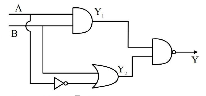
Consider the following logic circuit.
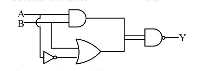
Image
The output is $\mathrm{Y}=0$ when :
  • A
    $\mathrm{A}=1$ and $\mathrm{B}=1$
  • B
    $\mathrm{A}=0$ and $\mathrm{B}=1$
  • C
    $\mathrm{A}=1$ and $\mathrm{B}=0$
  • D
    $\mathrm{A}=0$ and $\mathrm{B}=0$

Need a full question paper?

Generate a complete, print-ready paper with questions like this in minutes — across 16+ boards, with answer keys.

Start Generating Free

Similar questions

The unit of $L/R$ is (where $L$ = inductance and $R$ = resistance)
A body starts moving from rest with constant acceleration covers displacement $S _1$ in first $(p -1)$ seconds and $S _2$ in first $p$ seconds. The displacement $S_1+S_2$ will be made in time :
$A$ vertical pencil of rays comes from bottom of a tank filled with a liquid. When it is accelerated with an acceleration of $7.5\, m/s^2$, the ray is seen to be totally reflected by liquid surface. What is minimum possible refractive index of liquid?
A wire is broken in four equal parts. A packet is formed by keeping the four wires together. The resistance of the packet in comparison to the resistance of the wire will be
The equivalent resistance between $A$ and $B$ is $......$
In $YDSE$, the source placed symmetrically with respect to the slit is now moved parallel to the plane of the slits so that it is closer to the upper slit, as shown. Then,
The density of the atmosphere is $1.29\, kg/m^3$, then how high would the atmosphere extend ? $(g = 9.81\, m/sec^2)$ ........ $km$
Two moles of ideal helium gas are in a rubber balloon at $30^o C$. The balloon is fully expandable and can be assumed to required no energy in its expansion. The temperature of the gas in the balloon is slowly changed to $35^o C$. The amount of heat required in raising the temperature is nearly...... $J$
(take $R$ $=$ $8.31$ $J/mol.K$)
A wire of length ' $r$ ' and resistance $100 \Omega$ is divided into $10$ equal parts. The first $5$ parts are connected in series while the next $5$ parts are connected in parallel. The two combinations are again connected in series. The resistance of this final combination is:
Lenz's law is consequence of the law of conservation of