Question 14 Marks
Let $r$ be the radius of the circle, which touches x -axis at point $(\mathrm{a}, 0), \mathrm{a}<0$ and the parabola $\mathrm{y}^{2}=9 \mathrm{x}$ at the point $(4,6)$. Then $r$ is equal to __________
Answer
View full question & answer→(30)
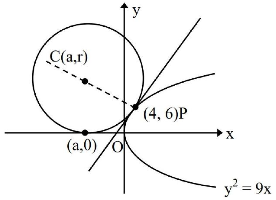
$(x-a)^{2}+(y-r)^{2}=r^{2}$
$(4-a)^{2}+(6-r)^{2}=r^{2}$
$16+a^{2}-8 a+36+r^{2}-12 r=r^{2}$
$a^{2}-8 a-12 r+52=0$
Tangent to parabola at $(4,6)$ is
$6.4=9 .\left(\frac{x+4}{2}\right)$ i.e. $3 x-4 y+12=0$
This is also tangent to the circle
$\therefore \mathrm{CP}=\mathrm{r}$
$\frac{3 a-4 r+12}{5}= \pm r$
$3 a +12=4 r \pm 5 r \left\{_{- r }^{ ar }\right.\quad\ldots(1)$
equation of circle is
$(x-a)^2+(y-r)^2=r^2$
satsty $P(4,6) \Rightarrow a^{2}-8 a-12 r+52=0\quad\ldots(2)$
From equation (1)
If $\mathrm{a}+4=3 \mathrm{r}$ then $\mathrm{a}=+6$ (rejected)
If $3 a+12=-r$ then $a=-14$ and $r=30$
$(x-a)^{2}+(y-r)^{2}=r^{2}$
$(4-a)^{2}+(6-r)^{2}=r^{2}$
$16+a^{2}-8 a+36+r^{2}-12 r=r^{2}$
$a^{2}-8 a-12 r+52=0$
Tangent to parabola at $(4,6)$ is
$6.4=9 .\left(\frac{x+4}{2}\right)$ i.e. $3 x-4 y+12=0$
This is also tangent to the circle
$\therefore \mathrm{CP}=\mathrm{r}$
$\frac{3 a-4 r+12}{5}= \pm r$
$3 a +12=4 r \pm 5 r \left\{_{- r }^{ ar }\right.\quad\ldots(1)$
equation of circle is
$(x-a)^2+(y-r)^2=r^2$
satsty $P(4,6) \Rightarrow a^{2}-8 a-12 r+52=0\quad\ldots(2)$
From equation (1)
If $\mathrm{a}+4=3 \mathrm{r}$ then $\mathrm{a}=+6$ (rejected)
If $3 a+12=-r$ then $a=-14$ and $r=30$