Sample QuestionsJEE Main 8-April-2025 Paper - Shift 2 questions
One sample from each question group in this chapter. Select any group above to see the full set with answer keys.
Given below are two statements :
Statement I : $\lim _{x \rightarrow 0}\left(\frac{\tan ^{-1} x+\log _e \sqrt{\frac{1+x}{1-x}}-2 x}{x^5}\right)=\frac{2}{5}$
Statement II : $\lim _{x \rightarrow 1}\left(x^{\frac{2}{1-x}}\right)=\frac{1}{\mathrm{e}^{2}}$
In the light of the above statements, choose the correct answer from the options given below :
- A
Statement I is false but Statement II is true
- B
Statement I is true but Statement II is false
- C
Both Statement I and Statement II are false
- ✓
Both Statement I and Statement II are true
Answer: D.
View full solution →Let $A=\left[\begin{array}{ccc}2 & 2+p & 2+p+q \\ 4 & 6+2 p & 8+3 p+2 q \\ 6 & 12+3 p & 20+6 p+3 q\end{array}\right]$.
If $\operatorname{det}(\operatorname{adj}(\operatorname{adj}(3 \mathrm{~A})))=2^{\mathrm{m}} \cdot 3^{\mathrm{n}}, \mathrm{m}, \mathrm{n} \in \mathbb{N}$, then $\mathrm{m}+\mathrm{n}$ is equal to
Answer: B.
View full solution →The value of $\cot ^{-1}\left(\frac{\sqrt{1+\tan ^{2}(2)}-1}{\tan (2)}\right)-\cot ^{-1}$ $\left(\frac{\sqrt{1+\tan ^{2}\left(\frac{1}{2}\right)}+1}{\tan \left(\frac{1}{2}\right)}\right)$ is equal to
- ✓
$\pi-\frac{5}{4}$
- B
$\pi-\frac{3}{2}$
- C
$\pi+\frac{3}{2}$
- D
$\pi+\frac{5}{2}$
Answer: A.
View full solution →Let $f(x)=x-1$ and $g(x)=e^{x}$ for $x \in \mathbb{R}$. If $\frac{d y}{d x}=\left(e^{-2 \sqrt{x}} g(f(f(x)))-\frac{y}{\sqrt{x}}\right), y(0)=0$, then $y(1)$ is :-
- A
$\frac{1-e^{2}}{e^{4}}$
- B
$\frac{2 e-1}{e^{3}}$
- ✓
$\frac{e-1}{e^{4}}$
- D
$\frac{1-e^{3}}{e^{4}}$
Answer: C.
View full solution →The number of integral terms in the expansion of $\left(5^{\frac{1}{2}}+7^{\frac{1}{8}}\right)^{1016}$ is
Answer: D.
View full solution →Let $r$ be the radius of the circle, which touches x -axis at point $(\mathrm{a}, 0), \mathrm{a}<0$ and the parabola $\mathrm{y}^{2}=9 \mathrm{x}$ at the point $(4,6)$. Then $r$ is equal to __________
View full solution →The product of the last two digits of $(1919)^{1919}$ is __________
View full solution →Let the area of the triangle formed by the lines $x+2=y-1=z, \frac{x-3}{5}=\frac{y}{-1}=\frac{z-1}{1}$ and $\frac{x}{-3}=\frac{y-3}{3}=\frac{z-2}{1}$ be A. Then $A^{2}$ is equal to __________
View full solution →Let the domain of the function
$f(x)=\cos ^{-1}\left(\frac{4 x+5}{3 x-7}\right)$ be $[\alpha, \beta]$ and the domain of
$\mathrm{g}(\mathrm{x})=\log _{2}\left(2-6 \log _{27}(2 \mathrm{x}+5)\right)$ be $(\gamma, \delta)$.
Then $|7(\alpha+\beta)+4(\gamma+\delta)|$ is equal to __________
View full solution →Let the area of the bounded region $\left\{(x, y): 0 \leq 9 x \leq y^{2}, y \geq 3 x-6\right\}$ be A. Then $6 A$ is equal to __________
View full solution →A block of mass 2 kg is attached to one end of a massless spring whose other end is fixed at a wall. The spring-mass system moves on a frictionless horizontal table. The spring's natural length is 2 m and spring constant is $200 \mathrm{~N} / \mathrm{m}$. The block is pushed such that the length of the spring becomes 1 m and then released. At distance $\mathrm{x} \mathrm{m}(\mathrm{x}<2)$ from the wall. the speed of the block will be :
- A
$10[1-(2-x)]^{3 / 2} \mathrm{~m} / \mathrm{s}$
- ✓
$10\left[1-(2-x)^{2}\right]^{1 / 2} \mathrm{~m} / \mathrm{s}$
- C
$10\left[1-(2-x)^{2}\right] \mathrm{m} / \mathrm{s}$
- D
$10\left[1-(2-x)^{2}\right]^{2} \mathrm{~m} / \mathrm{s}$
Answer: B.
View full solution →For a nucleus of mass number A and radius R, the mass density of nucleus can be represented as
Answer: D.
View full solution →In a Young's double slit experiment, the source is white light. One of the slits is covered by red filter and another by a green filter. In this case
- A
There shall be an interference pattern for red distinct from that for green.
- ✓
There shall be no interference fringes.
- C
There shall be alternate interference fringes of red and green.
- D
There shall be an interference pattern, where each fringe's pattern center is green and outer edges is red.
Answer: B.
View full solution →The amplitude and phase of a wave that is formed by the superposition of two harmonic travelling waves, $\mathrm{y}_{1}(\mathrm{x}, \mathrm{t})=4 \sin (\mathrm{kx}-\omega \mathrm{t})$ and $\mathrm{y}_{2}(\mathrm{x}, \mathrm{t})=2 \sin \left(\mathrm{kx}-\omega \mathrm{t}+\frac{2 \pi}{3}\right)$, are $:$
(Take the angular frequency of initial waves same as $\omega$ )
- A
$\left[6, \frac{2 \pi}{3}\right]$
- B
$\left[6, \frac{\pi}{3}\right]$
- C
$\left[\sqrt{3}, \frac{\pi}{6}\right]$
- ✓
$\left[2 \sqrt{3}, \frac{\pi}{6}\right]$
Answer: D.
View full solution →Two balls with same mass and initial velocity, are projected at different angles in such a way that maximum height reached by first ball is 8 times higher than that of the second ball. $T_{1}$ and $T_{2}$ are the total flying times of first and second ball, respectively, then the ratio of $T_{1}$ and $T_{2}$ is :
- ✓
$2 \sqrt{2}: 1$
- B
$2: 1$
- C
$\sqrt{2}: 1$
- D
$4: 1$
Answer: A.
View full solution →A cube having a side of 10 cm with unknown mass and 200 gm mass were hung at two ends of an uniform rigid rod of 27 cm long. The rod along with masses was placed on a wedge keeping the distance between wedge point and 200 gm weight as 25 cm . Initially the masses were not at balance. A beaker is placed beneath the unknown mass and water is added slowly to it. At given point the masses were in balance and half volume of the unknown mass was inside the water.
(Take the density of unknown mass is more than that of the water, the mass did not absorb water and water density is $1 \mathrm{gm} / \mathrm{cm}^{3}$.) The unknown mass is _______________ kg.
View full solution →A thin solid disk of 1 kg is rotating along its diameter axis at the speed of 1800 rpm . By applying an external torque of $25\ \pi \mathrm\ {Nm}$ for 40s , the speed increases to 2100 rpm . The diameter of the disk is _______________ m.
View full solution →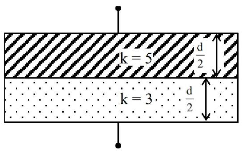
Space between the plates of a parallel plate capacitor of plate area $4 \mathrm{~cm}^{2}$ and separation of (d) 1.77 mm , is filled with uniform dielectric materials with dielectric constants (3 and 5) as shown in figure. Another capacitor of capacitance 7.5 pF is connected in parallel with it. The effective capacitance of this combination is $\qquad$ pF .
(Given $\varepsilon_{0}=8.85 \times 10^{-12} \mathrm{~F} / \mathrm{m}$ )A sample of a liquid is kept at 1 atm. It is compressed to 5 atm which leads to change of volume of $0.8 \mathrm{~cm}^{3}$. If the bulk modulus of the liquid is 2 GPa , the initial volume of the liquid was _______________ litre. (Take $\left.1 \mathrm{~atm}=10^{5} \mathrm{~Pa}\right)$
View full solution →An electron is released from rest near an infinite non-conducting sheet of uniform charge density ' $-\sigma$ '. The rate of change of de-Broglie wave length associated with the electron varies inversely as $\mathrm{n}^{\text {th }}$ power of time. The numerical value of $n$ is _______________ .
View full solution →Given below are two statements :
Statement I : $\mathrm{H}_{2} \mathrm{Se}$ is more acidic than $\mathrm{H}_{2} \mathrm{Te}$.
Statement II : $\mathrm{H}_{2} \mathrm{Se}$ has higher bond enthalpy for dissociation than $\mathrm{H}_{2} \mathrm{Te}$.
In the light of the above statements, choose the correct answer from the options given below.
- A
Both statement I and Statement II are false.
- B
Both statement I and Statement II are true.
- C
Statement I is true but Statement II is false.
- ✓
Statement I is false but Statement II is true.
Answer: D.
View full solution →Match the LIST-I with LIST-IILIST-I
(Complex/Species) | LIST-II
(Shape & magnetic moment) |
| A. | $\left[\mathrm{Ni}(\mathrm{CO})_{4}\right]$ | I. | Tetrahedral, 2.8 BM |
| B. | $\left[\mathrm{Ni}(\mathrm{CN})_{4}\right]^{2-}$ | II. | Square planar, 0 BM |
| C. | $\left[\mathrm{NiCl}_{4}\right]^{2-}$ | III. | Tetrahedral, 0 BM |
| D. | $\left[\mathrm{MnBr}_{4}\right]^{2-}$ | IV. | Tetrahedral, 5.9 BM |
Choose the correct answer from the options given below : View full solution →When
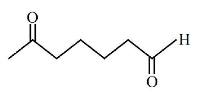
undergoes intramolecular aldol condensation, the major product formed is :
Answer: A.
View full solution →Match the LIST-I with LIST-IILIST-I
(Reagent) | LIST-II
(Functional Group detected) |
| A. | Sodium bicarbonate solution | I. | double bond/unsaturation |
| B. | Neutral ferric chloride | II. | carboxylic acid |
| C. | ceric ammonium nitrate | III. | phenolic – OH |
| D. | alkaline $\mathrm{KMnO}_{4}$ | IV. | alcoholic - OH |
Choose the correct answer from the options given below : Answer: A.
View full solution →The number of species from the following that are involved in $\mathrm{sp}^{3} \mathrm{~d}^{2}$ hybridization is $\left[\mathrm{Co}\left(\mathrm{NH}_{3}\right)_{6}\right]^{3+}, \mathrm{SF}_{6},\left[\mathrm{CrF}_{6}\right]^{3-},\left[\mathrm{CoF}_{6}\right]^{3-},\left[\mathrm{Mn}(\mathrm{CN})_{6}\right]^{3-}$ and $\left[\mathrm{MnCl}_{6}\right]^{3-}$
Answer: C.
View full solution →Consider the following half cell reaction
$\mathrm{Cr}_{2} \mathrm{O}_{7}^{2-}(\mathrm{aq})+6 \mathrm{e}^{-}+14 \mathrm{H}^{+}(\mathrm{aq}) \rightarrow 2 \mathrm{Cr}^{3+}(\mathrm{aq})+7 \mathrm{H}_{2} \mathrm{O}(\mathrm{l})$ The reaction was conducted with the ratio of $\frac{\left[\mathrm{Cr}^{3+}\right]^{2}}{\left[\mathrm{Cr}_{2} \mathrm{O}_{7}^{2-}\right]}=10^{-6}$. The pH value at which the EMF of the half cell will become zero is __________ . (nearest integer value)
[Given : standard half cell reduction potential
$\left.\mathrm{E}_{\mathrm{Cr}_{2} \mathrm{O}_{7}^{2-}, \mathrm{H}^{+} / \mathrm{Cr}^{3+}}^{\mathrm{o}}=1.33 \mathrm{~V}, \frac{2.303 \mathrm{RT}}{\mathrm{F}}=0.059 \mathrm{~V}\right]$
View full solution →The equilibrium constant for decomposition of $\mathrm{H}_{2} \mathrm{O}(\mathrm{g})$
$\mathrm{H}_{2} \mathrm{O}(\mathrm{g}) \rightleftharpoons \mathrm{H}_{2}(\mathrm{~g})+\frac{1}{2} \mathrm{O}_{2}(\mathrm{~g})\left(\Delta \mathrm{G}^{\circ}=92.34 \mathrm{~kJ} \mathrm{~mol}^{-1}\right)$ is $8.0 \times 10^{-3}$ at 2300 K and total pressure at equilibrium is 1 bar. Under this condition, the degree of dissociation $(\alpha)$ of water is __________ $\times 10^{-2}$ (nearest integer value).
[Assume $\alpha$ is negligible with respect to 1]
View full solution →20 mL of sodium iodide solution gave 4.74 g silver iodide when treated with excess of silver nitrate solution. The molarity of the sodium iodide solution is __________ M. (Nearest Integer value)
(Given : $\mathrm{Na}=23, \mathrm{I}=127, \mathrm{Ag}=108, \mathrm{~N}=14$, $\mathrm{O}=16 \mathrm{~g} \mathrm{~mol}^{-1}$ )
View full solution →The energy of an electron in first Bohr orbit of H-atom is -13.6 eV . The magnitude of energy value of electron in the first excited state of $\mathrm{Be}^{3+}$ is __________ eV . (nearest integer value)
View full solution →View full solution →