Questions

SECTION - B [PHYSICS - NUMERIC]

Take a timed test

5 questions · self-marked practice — reveal the answer and mark yourself.

Question 14 Marks
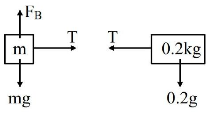
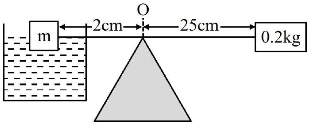
A cube having a side of 10 cm with unknown mass and 200 gm mass were hung at two ends of an uniform rigid rod of 27 cm long. The rod along with masses was placed on a wedge keeping the distance between wedge point and 200 gm weight as 25 cm . Initially the masses were not at balance. A beaker is placed beneath the unknown mass and water is added slowly to it. At given point the masses were in balance and half volume of the unknown mass was inside the water.
(Take the density of unknown mass is more than that of the water, the mass did not absorb water and water density is $1 \mathrm{gm} / \mathrm{cm}^{3}$.) The unknown mass is _______________ kg.
View full question & answer
Question 24 Marks
A thin solid disk of 1 kg is rotating along its diameter axis at the speed of 1800 rpm . By applying an external torque of $25\ \pi \mathrm\ {Nm}$ for 40s , the speed increases to 2100 rpm . The diameter of the disk is _______________ m.
Answer
(40)
Given, $\mathrm{m}=1 \mathrm{~kg}$
$\omega_{\mathrm{i}}=1800 \mathrm{rpm}=1800 \times \frac{2 \pi}{60}=60 \pi \frac{\mathrm{rad}}{\mathrm{sec}}$
$\omega_{\mathrm{f}}=2100 \mathrm{rpm}=2100 \times \frac{2 \pi}{60}=70 \pi \frac{\mathrm{rad}}{\mathrm{sec}}$
$\tau_{\text {ext }}=25 \pi \mathrm{Nm}$
$\mathrm{t}=40 \mathrm{sec}$
Using equation of motion
$\omega_{\mathrm{f}}=\omega_{\mathrm{i}}+\alpha \mathrm{t}$
$70 \pi=60 \pi+\alpha(40)$
$\alpha=\frac{\pi}{4} \mathrm{rad} / \mathrm{sec}^{2}$
Also, $\tau=\mathrm{I} \alpha$
$\tau=\frac{\mathrm{mR}^{2}}{4} \alpha$
$25 \pi=\frac{1 \times \mathrm{R}^{2}}{4} \times \frac{\pi}{4}$
$\mathrm{R}=20 \mathrm{~m}$
Hence, diameter of disk $=2 \mathrm{R}=2 \times 20=40 \mathrm{~m}$
View full question & answer
Question 34 Marks
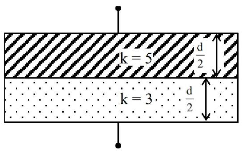
Image
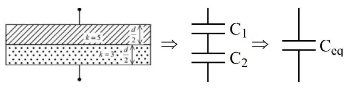
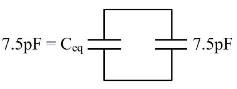
Space between the plates of a parallel plate capacitor of plate area $4 \mathrm{~cm}^{2}$ and separation of (d) 1.77 mm , is filled with uniform dielectric materials with dielectric constants (3 and 5) as shown in figure. Another capacitor of capacitance 7.5 pF is connected in parallel with it. The effective capacitance of this combination is $\qquad$ pF .
(Given $\varepsilon_{0}=8.85 \times 10^{-12} \mathrm{~F} / \mathrm{m}$ )
View full question & answer
Question 44 Marks
A sample of a liquid is kept at 1 atm. It is compressed to 5 atm which leads to change of volume of $0.8 \mathrm{~cm}^{3}$. If the bulk modulus of the liquid is 2 GPa , the initial volume of the liquid was _______________ litre. (Take $\left.1 \mathrm{~atm}=10^{5} \mathrm{~Pa}\right)$
Answer
(4)
Given, Initial pressure of liquid $\left(\mathrm{P}_{\mathrm{i}}\right)=1 \mathrm{~atm}$
Final pressure of liquid $\left(\mathrm{P}_{\mathrm{f}}\right)=5 \mathrm{~atm}$
Change in pressure $(\mathrm{dP})=\mathrm{P}_{\mathrm{f}}-\mathrm{P}_{\mathrm{i}}=4 \mathrm{~atm}$
$=4 \times 10^{5} \mathrm{~Pa}$
Change in volume $(\mathrm{dV})=-0.8 \mathrm{~cm}^{3}$
Bulk modulus $(\mathrm{B})=2 \times 10^{9} \mathrm{~Pa}$
Now, $B=\frac{-d P}{(d V / V)} \Rightarrow V=-B\left(\frac{d V}{d P}\right)$
$\Rightarrow \mathrm{V}=-2 \times 10^{9} \times \frac{\left(-0.8 \times 10^{-6}\right)}{4 \times 10^{5}}$
$=4 \times 10^{-3} \mathrm{~m}^{3}=4$ litre
View full question & answer
Question 54 Marks
An electron is released from rest near an infinite non-conducting sheet of uniform charge density ' $-\sigma$ '. The rate of change of de-Broglie wave length associated with the electron varies inversely as $\mathrm{n}^{\text {th }}$ power of time. The numerical value of $n$ is _______________ .
Answer
(2)
Let the momentum of $\mathrm{e}^{-}$ at any time t is p and its de-broglie wavelength is $\lambda$.
Then, $\mathrm{p}=\frac{\mathrm{h}}{\lambda}$
$\frac{\mathrm{dp}}{\mathrm{dt}}=\frac{-\mathrm{h}}{\lambda^{2}} \frac{\mathrm{~d} \lambda}{\mathrm{dt}}$
$\mathrm{ma}=\mathrm{F}=-\frac{\mathrm{h}}{\lambda} \frac{\mathrm{d} \lambda}{\mathrm{dt}} [\mathrm{m}=$ mass of e$]$
Where, -ve sign represents decrease in $\lambda$ with time $\mathrm{ma}=\frac{-\mathrm{h}}{(\mathrm{h} / \mathrm{p})^{2}} \frac{\mathrm{~d} \lambda}{\mathrm{dt}}$
$a=-\frac{p^{2}}{m h} \frac{d \lambda}{d t}$
$\mathrm{a}=-\frac{\mathrm{mv}}{}{ }^{2} \frac{\mathrm{~d} \lambda}{\mathrm{dt}}$
$\frac{ d \lambda}{ dt }=-\frac{ ah }{ mv ^2}$$\ldots(1)$
here, $\mathrm{a}=\frac{\mathrm{qE}}{\mathrm{m}}=\frac{\mathrm{e}}{\mathrm{m}} \frac{\sigma}{2 \varepsilon_{0}}$
$\mathrm{a}=\frac{\sigma \mathrm{e}}{2 \mathrm{~m} \varepsilon_{0}}$
and $\mathrm{v}=\mathrm{u}+$ at
$\mathrm{v}=\mathrm{at}$
Substituting values of $\mathrm{a} \& \mathrm{v}$ in equation (1)
$\frac{\mathrm{d} \lambda}{\mathrm{dt}}=-\frac{2 \mathrm{~h} \varepsilon_{0}}{\sigma \mathrm{et}^{2}}$
$\Rightarrow \frac{\mathrm{d} \lambda}{\mathrm{dt}} \propto \frac{1}{\mathrm{t}^{2}}$
$\Rightarrow \mathrm{n}=2$
View full question & answer