MCQ 1011 Mark
$\frac{{{{( - 1 + i\sqrt 3 )}^{15}}}}{{{{(1 - i)}^{20}}}} + \frac{{{{( - 1 - i\sqrt 3 )}^{15}}}}{{{{(1 + i)}^{20}}}}$ is equal to
- ✓
$-64$
- B
$-32$
- C
$-16$
- D
$\frac{1}{{16}}$
Answera
(a)${2^{15}}\left[ {\frac{{{{\left( { - \frac{1}{2} + \frac{{i\sqrt 3 }}{2}} \right)}^{15}}}}{{{{(1 - i)}^{20}}}} + \frac{{{{\left( {\frac{{ - 1}}{2} - \frac{{i\sqrt 3 }}{2}} \right)}^{15}}}}{{{{(1 + i)}^{20}}}}} \right]$
= ${2^{15}}\left[ {\frac{{{\omega ^{15}}}}{{{{(1 - i)}^{20}}}} + \frac{{{\omega ^{30}}}}{{{{(1 + i)}^{20}}}}} \right]$=${2^{15}}\left[ {\frac{1}{{{{(1 - i)}^{20}}}} + \frac{1}{{{{(1 + i)}^{20}}}}} \right]$
= ${2^{15}}\left[ {\frac{{{{(1 + i)}^{20}} + {{(1 - i)}^{20}}}}{{{{(1 - {i^2})}^{20}}}}} \right]$=$\frac{{{2^{15}}}}{{{2^{20}}}}[{(1 + i)^{20}} + {(1 - i)^{20}}]$
= $\frac{1}{{{2^5}}}[{(i - {i^2})^{20}} + {(1 - i)^{20}}]$ = $\frac{1}{{{2^5}}}({i^{20}} + 1)\,{(1 - i)^{20}}$
$ = \frac{2}{{{2^5}}}{(1 - i)^{20}}$ = $\frac{1}{{{2^4}}}{(1 - i)^{20}}$= $\frac{1}{{{2^4}}}{[{(1 - i)^2}]^{10}}$
$ = \frac{1}{{{2^4}}}{[1 + {i^2} - 2i]^{10}}$=$\frac{1}{{{2^4}}}{( - 2i)^{10}}$
= $\frac{{{{( - 2)}^{10}}{i^{10}}}}{{{2^4}}} = - {2^6} = - 64$.
View full question & answer→MCQ 1021 Mark
If $\omega$ is a complex root of the equation ${z^3} = 1$, then $\omega + {\omega ^{\left( {\frac{1}{2}\, + \,\frac{3}{8}\, + \,\frac{9}{{32}}\, + \,\frac{{27}}{{128}}\, + ...} \right)}}$ is equal to
Answera
(a)$\omega + {\omega ^{\left( {\frac{1}{2} + \frac{3}{8} + \frac{9}{{32}} + \frac{{27}}{{128}} + .....} \right)}}$
$⇒$ $\omega + {\omega ^{\left( {\frac{{1/2}}{{1 - 3/4}}} \right)}}$
$ \Rightarrow $ $\omega + {\omega ^2} = - 1$
$[\because 1 + \omega + {\omega ^2} = 0]$
View full question & answer→MCQ 1031 Mark
If cube root of $1$ is $\omega $, then the value of ${(3 + \omega + 3{\omega ^2})^4}$ is
- A
$0$
- B
$16$
- ✓
$16\,\omega $
- D
$16\,{\omega ^2}$
AnswerCorrect option: C. $16\,\omega $
c
(c)${(3 + \omega + 3{\omega ^2})^4}$$ = \,{( - 3\omega + \omega )^4}$
$[\because \,\,\omega + {\omega ^2} = - 1]$
= ${( - 2\omega )^4} = 16{\omega ^4} = 16\omega $.
View full question & answer→MCQ 1041 Mark
The value of $(1 - \omega + {\omega ^2})\,{(1 - {\omega ^2} + \omega )^6}$, where $\omega ,{\omega ^2}$ are cube roots of unity
- A
$128 \omega $
- B
$ - 128{\omega ^2}$
- ✓
$ - 128\omega $
- D
$128{\omega ^2}$
AnswerCorrect option: C. $ - 128\omega $
c
(c)$(1 - \omega + {\omega ^2})\,{(1 - {\omega ^2} + \omega )^6}$$ = ( - 2\omega )\,{( - 2{\omega ^2})^6} = - 128\omega .$
View full question & answer→MCQ 1051 Mark
If $1,\omega ,{\omega ^2}$ are the cube roots of unity, then their product is
Answerd
(d) $1.\,\omega \,.\,{\omega ^2} = {\omega ^3} = 1.$
View full question & answer→MCQ 1061 Mark
If $z = \frac{{\sqrt 3 + i}}{{ - 2}}$, then ${z^{69}}$ is equal to
Answerc
(c)$z = \frac{{\sqrt 3 + i}}{{ - 2}}$ $ \Rightarrow $ $iz = - \frac{{ - 1 + \sqrt {3i} }}{2} = - \omega $
$ \Rightarrow $ $z = \frac{{ - \omega }}{i} = i\omega $
$ \Rightarrow $${z^{69}} = {i^{69}}.{\omega ^{69}} = i$
$(\because {\omega ^{3n}} = {i^{4n}} = 1)$
View full question & answer→MCQ 1071 Mark
Let ${\omega _n} = \cos \left( {\frac{{2\pi }}{n}} \right) + i\,\sin \left( {\frac{{2\pi }}{n}} \right)\,,\,{i^2} = - 1$, then $(x + y{\omega _3} + z{\omega _3}^2)$ $(x + y{\omega _3}^2 + z{\omega _3})$ is equal to
AnswerCorrect option: C. ${x^2} + {y^2} + {z^2} - yz - zx - xy$
c
(c)${\omega _n} = \cos \left( {\frac{{2\pi }}{n}} \right) + i\sin \left( {\frac{{2\pi }}{n}} \right)$
$ \Rightarrow {\omega _3} = \cos \frac{{2\pi }}{3} + i\sin \frac{{2\pi }}{3} = - \frac{1}{2} + \frac{{i\sqrt 3 }}{2} = \omega $
and $\omega _3^2 = {\left( {\cos \frac{{2\pi }}{3} + i\sin \frac{{2\pi }}{3}} \right)^2} = \cos \frac{{4\pi }}{3} + i\sin \frac{{4\pi }}{3}$
$ = - \frac{1}{2} - \frac{{i\sqrt 3 }}{2} = {\omega ^2}.$
$\therefore \,\,\,(x + y{\omega _3} + z\omega _3^2)\,(x + y\omega _3^2 + z{\omega _3})$
$ = (x + y\omega + z{\omega ^2})\,(x + y{\omega ^2} + z\omega )$
$ = {x^2} + {y^2} + {z^2} - xy - yz - zx$.
View full question & answer→MCQ 1081 Mark
If $z + {z^{ - 1}} = 1,\,{\rm{then }}\,{z^{100}} + {z^{ - 100}}$ is equal to
Answerd
(d)$z + {z^{ - 1}}$$ = 1 \Rightarrow {z^2} - z + 1 = 0$$ \Rightarrow $$z = - \omega $ or $ - {\omega ^2}$
For $z = - \omega ,$ ${z^{100}} + {z^{ - 100}} = {( - \omega )^{100}} + {( - \omega )^{ - 100}}$
= $\omega + \frac{1}{\omega } = \omega + {\omega ^2} = - 1$
For $z = -$ $ - {\omega ^2}$, ${z^{100}} + {z^{ - 100}} = {( - {\omega ^2})^{100}} + {( - {\omega ^2})^{ - 100}}$
$ = \,{\omega ^{200}} + \frac{1}{{{\omega ^{200}}}}$$ = {\omega ^2} + \frac{1}{{{\omega ^2}}} = {\omega ^2} + \omega $$ = - 1.$
View full question & answer→MCQ 1091 Mark
If $\frac{{1 + \sqrt 3 \,i}}{2}$ is a root of equation ${x^4} - {x^3} + x - 1 = 0$ then its real roots are
- A
$1, 1$
- B
$-1, -1$
- ✓
$1, -1$
- D
$1, 2$
AnswerCorrect option: C. $1, -1$
c
(c)${x^4} - {x^3} + x - 1 = 0$
$⇒$ ${x^3}(x - 1) + 1(x - 1) = 0$
$x - 1 = 0$ or ${x^3} + 1 = 0$
$⇒$ $x = 1,\, - 1,\,\frac{{1 + \sqrt 3 i}}{2},\,\,\frac{{1 - \sqrt 3 i}}{2}$
so its real roots are $1$ and $-1.$
View full question & answer→MCQ 1101 Mark
If ${\left( {\frac{{1 + i\sqrt 3 }}{{1 - i\sqrt 3 }}} \right)^n}$ is an integer, then $n$ is
Answerc
(c) $\frac{{1 + i\sqrt 3 }}{{1 - i\sqrt 3 }} = \left( {\frac{{1 + i\sqrt 3 }}{{1 - i\sqrt 3 }}} \right)\,\left( {\frac{{1 + i\sqrt 3 }}{{1 + i\sqrt 3 }}} \right) = \frac{{ - 2 + i2\sqrt 3 }}{4}$
$ = \,\frac{{ - 1 + i\sqrt 3 }}{2} = \omega $
${\left( {\frac{{1 + i\sqrt 3 }}{{1 - i\sqrt 3 }}} \right)^n} = {\omega ^n} = {\omega ^3} = 1 \Rightarrow n = 3$.
View full question & answer→MCQ 1111 Mark
Find the value of ${(1 + 2\omega + {\omega ^2})^{3n}} - {(1 + \omega + 2{\omega ^2})^{3n}} = $
- ✓
$0$
- B
$1$
- C
$\omega $
- D
${\omega ^2}$
Answera
(a)${[(1 + \omega + {\omega ^2}) + \omega ]^{3n}} - {[(1 + \omega + {\omega ^2}) + {\omega ^2}]^{3n}}$
$ = {\omega ^{3n}} - {({\omega ^2})^{3n}}$$ = \,{({\omega ^3})^n} - {({\omega ^3})^{2n}}$$ = {1^n} - {1^{2n}} = 0$.
View full question & answer→MCQ 1121 Mark
If $\omega $ is a non real cube root of unity, then $(a + b)$ $(a + b\omega )$ $(a + b{\omega ^2})$ is
- ✓
${a^3} + {b^3}$
- B
${a^3} - {b^3}$
- C
${a^2} + {b^2}$
- D
${a^2} - {b^2}$
AnswerCorrect option: A. ${a^3} + {b^3}$
a
(a)$(a + b)\,(a + b\omega )\,(a + b{\omega ^2})$
$ = \,(a + b)\,({a^2} + ab\,(\omega + {\omega ^2}) + {b^2}{\omega ^3})$
$ = (a + b)\,({a^2} - ab + {b^2})\, = \,{a^3} + {b^3}$.
View full question & answer→MCQ 1131 Mark
The value of ${(8)^{1/3}}$ is
- A
$ - 1 + i\sqrt 3 $
- B
$ - 1 - i\sqrt 3 $
- C
$2$
- ✓
Answerd
(d)${(8)^{1/3}} = x \Rightarrow {x^3} - 8 = 0$
==> $(x - 2)\,({x^2} + 2x + 4) = 0$.
==> $x = 2,\,2\omega ,\,2{\omega ^2}$ or $x = 2,\, - 1 + i\sqrt 3 ,\, - 1 - i\sqrt 3 $.
View full question & answer→MCQ 1141 Mark
If $\omega $ is a complex cube root of unity, then $225 + $${(3\omega + 8{\omega ^2})^2}$$ + {(3{\omega ^2} + 8\omega )^2} = $
Answerd
(d)$225 + {(3\omega + 8{\omega ^2})^2} + {(3{\omega ^2} + 8\omega )^2}$
$ = 225 + {(5{\omega ^2} - 3)^2} + {(5\omega - 3)^2}$
$ = 225 + 18 - 5(\omega + {\omega ^2})$
$ = 225 + 18 - 5( - 1) = 225 + 18 + 5 = 248.$
View full question & answer→MCQ 1151 Mark
If $\omega = \frac{{ - 1 + \sqrt 3 i}}{2}$then ${(3 + \omega + 3{\omega ^2})^4}$=
- A
$16$
- B
$-16$
- ✓
$16 \omega $
- D
$16 {\omega ^2}$
AnswerCorrect option: C. $16 \omega $
c
(c)${(3 + \omega + 3{\omega ^2})^4} = [{(3 + 3{\omega ^2} + \omega )^4}]$
$ = {[\,3\,(1 + {\omega ^2}) + \omega ]^4}$$ = {[3( - \omega ) + \omega ]^4}$
.$= {[\, - 2\omega ]^4} = 16{\omega ^4} = 16\omega $
View full question & answer→MCQ 1161 Mark
If $1,\,\omega ,\,{\omega ^2}$ are the roots of unity, then ${(1 - 2\omega + {\omega ^2})^6}$ is equal to
Answera
(a)${(1 - 2\omega + {\omega ^2})^6}$ = ${(1 + {\omega ^2} - 2\omega )^6}$
= ${( - \omega - 2\omega )^6} = {( - 3\omega )^6}$
$ = {( - 3)^6}{({\omega ^3})^2}$
[Since $1 + \omega + {\omega ^2} = 0,\,{\omega ^3} = 1$]
$= 729.$
View full question & answer→MCQ 1171 Mark
If $\omega $ is a complex cube root of unity, then the value of ${\omega ^{99}} + {\omega ^{100}} + {\omega ^{101}}$ is
Answerd
(d)${\omega ^{99}} + {\omega ^{1\omega }} + {\omega ^{101}}$
= ${\omega ^{99}}[1 + \omega + {\omega ^2}]$
[Since $1 + \omega + {\omega ^2} = 0,\,{\omega ^3} = 1$]
$= 0.$
View full question & answer→MCQ 1181 Mark
Let $x = \alpha + \beta ,\,y = \alpha \omega + \beta {\omega ^2},\,z = \alpha {\omega ^2} + \beta \omega ,\,\omega $ is an imaginary cube root of unity. Product of $xyz$ is
- A
${\alpha ^2} + {\beta ^2}$
- B
${\alpha ^2} - {\beta ^2}$
- ✓
${\alpha ^3} + {\beta ^3}$
- D
${\alpha ^3} - {\beta ^3}$
AnswerCorrect option: C. ${\alpha ^3} + {\beta ^3}$
c
(c)$x = \alpha + \beta ,\,y = \alpha \omega + \beta {\omega ^2},\,z = \alpha {\omega ^2} + \beta \omega $
$\therefore $ $xyz = (\alpha + \beta )\,(\alpha \omega + \beta {\omega ^2})(\alpha {\omega ^2} + \beta \omega )$
= $(\alpha + \beta )\,[{\alpha ^2} + \alpha \beta (\omega + {\omega ^2}) + {\beta ^2}]$
= $(\alpha + \beta )\,({\alpha ^2} - \alpha \beta + {\beta ^2}) = {\alpha ^3} + {\beta ^3}$.
View full question & answer→MCQ 1191 Mark
If $x = \cos \theta + i\sin \theta $ and $y = \cos \varphi + i\sin \phi $, then ${x^m}{y^n} + {x^{ - m}}{y^{ - n}}$ is equal to
- A
$\cos (m\theta + n\phi )$
- B
$\cos (m\theta + n\phi )$
- ✓
$2\cos (m\theta + n\phi )$
- D
$2\cos (m\theta - n\phi )$
AnswerCorrect option: C. $2\cos (m\theta + n\phi )$
c
(c)$x = \cos \theta + i\sin \theta = {e^{i\theta }},y = \cos \phi + i\sin \phi = {e^{i\phi }}$
$\therefore \,\,\,\,\,{x^m}{y^n} + {x^{ - m}}{y^{ - n}} = {e^{im\theta }}{e^{in\phi }} + {e^{ - im\theta }}{e^{ - in\phi }}$
$ = {e^{i(m\theta + n\phi )}} + {e^{ - i\,\,(m\theta \, + n\phi )}}$$ = \cos (m\theta + n\phi ) + i\sin (m\theta + n\phi )$
$ + \cos (m\theta + n\phi ) - i\sin (m\theta + n\phi )$
$ = 2\cos (m\theta + n\phi )$
View full question & answer→MCQ 1201 Mark
Let $\omega $ is an imaginary cube roots of unity then the value of $2(\omega + 1)({\omega ^2} + 1) + 3(2\omega + 1)(2{\omega ^2} + 1) + .....$ $ + (n + 1)(n\omega + 1)(n{\omega ^2} + 1)$ is
- ✓
${\left[ {\frac{{n(n + 1)}}{2}} \right]^2} + n$
- B
${\left[ {\frac{{n(n + 1)}}{2}} \right]^2}$
- C
${\left[ {\frac{{n(n + 1)}}{2}} \right]^2} - n$
- D
AnswerCorrect option: A. ${\left[ {\frac{{n(n + 1)}}{2}} \right]^2} + n$
a
(a)$2\,(\omega + 1)\,({\omega ^2} + 1) + 3(2\omega + 1)\,(2{\omega ^2} + 1) + $
$......+ (n + 1)\,(n\omega + 1)\,\,(n{\omega ^2} + 1)$
= $\sum\limits_{r = 1}^n {(r + 1)\,(r\omega + 1)\,\,(r{\omega ^2} + 1)} $
= $\sum\limits_{r = 1}^n {(r + 1)\,({r^2}{\omega ^3} + r\omega + r{\omega ^2} + 1)} $
= $\sum\limits_{r = 1}^n {(r + 1)\,({r^2} - r + 1)} $= $\sum\limits_{r = 1}^n {({r^3} - {r^2} + r + {r^2} - r + 1)} $
= $\sum\limits_{r = 1}^n {({r^3}) + \sum\limits_{r = 1}^n {(1} )} $ = ${\left[ {\frac{{n(n + 1)}}{2}} \right]^2} + n$.
View full question & answer→MCQ 1211 Mark
If the cube roots of unity are $1,\omega ,{\omega ^2}$ then the roots of the equation ${(x - 2)^3} + 27 = 0$ are
- A
$ - 1, - 1, - 1$
- B
$ - 1, - \omega , - {\omega ^2}$
- C
$ - 1,2 + 3\omega ,2 + 3{\omega ^2}$
- ✓
$ - 1,\,\,2 - 3\omega ,2 - 3{\omega ^2}$
AnswerCorrect option: D. $ - 1,\,\,2 - 3\omega ,2 - 3{\omega ^2}$
d
(d) Here ${1^{1/3}} = 1,\omega ,{\omega ^2}$
For the equation ${(x - 2)^3} + 27 = 0$
==> ${(x - 2)^3} = - 27 = - {3^3}$
==> $x - 2 = - 3{(1)^{1/3}} = - 3(1,\omega ,{\omega ^2}) = - 3, - 3\omega ,3{\omega ^2}$
==> $x = - 1,2 - 3\omega ,2 - 3{\omega ^2}$.
View full question & answer→MCQ 1221 Mark
The minimum value of the expression $|z|+|z-1|+|z-1-i|+|z-i|$, where $z$ is a complex number and $i=\sqrt{-1}$, is
- A
$2+\sqrt{2}$
- ✓
$2 \sqrt{2}$
- C
$\sqrt{2}$
- D
$2$
AnswerCorrect option: B. $2 \sqrt{2}$
b
(b)
For minimum, $Z =\frac{1}{2}+\frac{1}{2} ;$ minimum value
$=\frac{1}{\sqrt{2}}+\frac{1}{\sqrt{2}}+\frac{1}{\sqrt{2}}+\frac{1}{\sqrt{2}}=2 \sqrt{2}$
View full question & answer→MCQ 1231 Mark
The figure in the complex plane given by $10 z \bar{z}-3\left(z^2+z^{-2}\right)+4 i\left(z^2-z^{-2}\right)=0$ is
Answera
(a)
Let $z=x+i y$ then $\bar{z}=x-i y$
$\Rightarrow \quad z^2=x^2-y^2+2 i x y$
and $\bar{z}^2=x^2-y^2-2 i x y$
$\therefore \quad 10 z \bar{z}-3\left(z^2+\bar{z}^2\right)+4 i\left(z^2-\bar{z}^2\right)=0$ $\Rightarrow \quad 10\left(x^2+y^2\right)-3 \cdot 2\left(x^2-y^2\right)+4 i \cdot(4 i x y)=0$
$\Rightarrow \quad \quad 10\left(x^2+y^2\right)-6 x^2+6 y^2-16 x y=0$
$\Rightarrow \quad 2 x^2+8 y^2-8 x y=0$
$\Rightarrow \quad x^2-4 x y+4 y^2=0 \Rightarrow \quad(x-2 y)^2=0$
Which represents a straight line.
View full question & answer→MCQ 1241 Mark
Let $z=x+i y$ and $w=u+i v$ be complex numbers on the unit circle such that $z^2+w^2=1$. Then the number of ordered pairs $(z, w)$ is
Answerc
(c)
lt is given that complex numbers $z=x+i y$ and $w=u+i v$ are on the unit circle such that $z^2+w^2=1$
So, $\quad\left(z^2\right)+\left(w^2\right)=1$
$\Rightarrow \frac{1}{z^2}+\frac{1}{w^2}=1 \Rightarrow z^2+w^2=z^2 w^2$
$\Rightarrow \quad z^2 w^2=1 \quad \ldots (ii)$
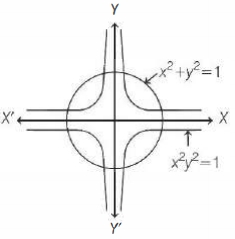
$\because$ The number of solution of equations $x^2+y^2=1$ and $x^2 y^2=1$ is eight
$\therefore$ Number of ordered pair $(z, w)$ is also eight.
View full question & answer→MCQ 1251 Mark
On any given arc of positive length on the unit circle $|z|=1$ in the complex plane.
- A
there need not be any root of unity
- B
there lies exactly one root of unity
- C
there are more than one but finitely many roots of unity
- ✓
there are infinitely many roots of unity
AnswerCorrect option: D. there are infinitely many roots of unity
d
(d)
We have,
$|z| =1$
$z^n =1$
$z^n =e^{i 2 k \pi} ; k \in I$
$k \in(0, n-1)$
All roots of unity lie on arc of circle.
$\therefore$ There are infinitely many roots of unity.
View full question & answer→MCQ 1261 Mark
Let $a=\cos 1^{\circ}$ and $b=\sin 1^{\circ}$. We say that a real number is algebraic if it is a root of a polynomial with integer coefficients. Then,
- A
$a$ is algebraic but $b$ is not algebraic
- B
$b$ is algebraic but $a$ is not algebraic
- ✓
both $a$ and $b$ are algebraic
- D
neither $a$ nor $b$ is algerbraic
AnswerCorrect option: C. both $a$ and $b$ are algebraic
c
(c)
We have,
$a=\cos 1^{\circ}$ and $b=\sin 1^{\circ}$
$(\cos x+i \sin x)^n=\cos n x+i \sin n x$
$(\cos x-i \sin x)^n=\cos n x-i \sin n x$
$2 \cos n x=(\cos x+i \sin x)^n +(\cos x-i \sin x)^n$
Put $x=1^{\circ}$ and $n=60 =2 \cos 60^{\circ}=2\left(\cos ^{60} 1^{\circ}+{ }^6 C_2 \cos ^{58} 1\right.$
Change all $\sin 1^{\circ}$ to $\cos 1^{\circ}$ using the identity $\cos ^2 1^{\circ}=1-\sin ^2 1^{\circ}$ equation with root $\cos 1^{\circ}$ so it is algebraic.
Similarly, for $b=\sin 1^{\circ}$
View full question & answer→MCQ 1271 Mark
Suppose $z$ is any root of $11 z^8+21 i z^7+10 i z-22=0$ where $i=\sqrt{-1}$. Then, $S=|z|^2+|z|+1$ satisfies
- A
$S \leq 3$
- ✓
$3 < S < 7$
- C
$7 \leq S < 13$
- D
$S \geq 13$
AnswerCorrect option: B. $3 < S < 7$
b
(b)
We have,
$11 z^8+20 i z^7+10 i z-22 =0$
$z^8+\frac{20}{11} i z^7+\frac{10 i}{11} z-2 =0$
Root of equation are $z_1, z_2, z_3, z_4, z_5, \ldots, z_8$ $\sum_{i=1}^8 z i=\frac{20}{11} i$
$z_1 z_2 z_3 z_4 z_5 z_6 z_7 z_8=2$
$\mid z_1\left\|z_2\right\| z_3\left\|z_4\right\| z_4\left\|z_5\right\| z_6\left\|z_7\right\| z_8 \|=2$
$1<\left|z_i\right|<2$
$1+1+1<|z|^2+|z|+1<2^2+2+1$
$3<|z|^2+|z|+1<7$
$3 < S < 7$
View full question & answer→MCQ 1281 Mark
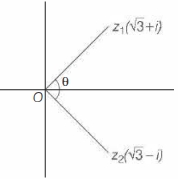
In the complex plane, let $z_1=\sqrt{3}+i$ and $z_2=\sqrt{3}-i$ be two adjacent vertices of an $n$-sided regular polygon centered at the origin. Then, $n$ equals
Answerb
(b)
Given, $z_1=\sqrt{3}+i$ and $z_2=\sqrt{3}-i$ are two adjacent vertices of $n$-sided regular polygon centred of origin.
$z_1 =\sqrt{3}+i$
$\arg \left(z_1\right) =\tan ^{-1}\left(\frac{1}{\sqrt{3}}\right)=\frac{\pi}{6}$
$z_2 =\sqrt{3}-i$
$\arg \left(z_2\right) =\tan ^{-1}\left(-\frac{1}{\sqrt{3}}\right)=-\frac{\pi}{6}$
$\angle z_2 O z_1 =\frac{\pi}{3}$
$\frac{n \pi}{3} =2 \pi$
$n =6$
View full question & answer→MCQ 1291 Mark
Let $z_1, z_2, \ldots, z_7$ be the vertices of a regular heptagon that is inscribed in the unit circle with centre at the origin in the complex plane. Let $w =\sum \limits_{1 \leq j \leq 7} z _{ i } z _{ j }$ then $|w|$ is equal to
Answera
(a)
As the vertices lie on a unit circle with centre at origin in a complex plane, it can be argued that the vertices are the roots of the equation $z^7-1=0$.
Considering this polynomial equation, it evident that the sum of roots, the sum of roots taken $2$ at a time and so on upto roots taken $6$ at a time are all $0$ as the corresponding coefficients in the polynomial equation are $0$ .
View full question & answer→MCQ 1301 Mark
Let $\alpha$ be a fixed non-zero complex number with $| a | < 1$ and $w=\left(\frac{z-\alpha}{1-\bar{a} z}\right)$, where $z$ is a complex number. Then,
- A
there exists a complex number $z$ with $|z| < 1$ such that $|w| > 1$
- B
$|u| > 1$ for all $z$ such that $|z| < 1$
- ✓
$|w| < 1$ for all $z$ such that $|z| < 1$
- D
there exists $z$ such that $|z|<1$ and $|w|=1$
AnswerCorrect option: C. $|w| < 1$ for all $z$ such that $|z| < 1$
c
(c)
We have,
$w=\left(\frac{z-a}{1-\bar{a} z}\right),|a| < 1$
$\Rightarrow w(1-\bar{a} z)=z-a$
$\Rightarrow \quad(w-w \bar{a} z)=z-a$
$\Rightarrow \quad w+a=z(1+w \bar{a})$
$\Rightarrow \quad z=\frac{w+a}{1+w \bar{a}}$
When $|z| < 1$
$\left|\frac{w+a}{1+w}\right| < 1$
$\Rightarrow \quad|w+a|<|1+w \bar{a}|$
$\Rightarrow(w+a)(\bar{w}+\bar{a}) < (1+w \bar{a})(1+\bar{w} a)$
$\Rightarrow \quad w \bar{w}+w \bar{a}+a \bar{w}+a \bar{a} < 1+\bar{w} a$
$+w \bar{a}+w \bar{w} a \bar{a}$
$\Rightarrow \quad|w|^2+|a|^2 < 1+|u|^2|\alpha|^2$
$\Rightarrow|w|^2|a|^2-|w|^2-|a|^2+1 > 0$
$\Rightarrow \quad\left(|w|^2-1\right)\left(|a|^2-1\right) > 0$
$\Rightarrow \quad|u|^2-1 < 0 \quad[\because|a| < 1]$
$\therefore \quad|w| < 1,|z| < 1$
View full question & answer→MCQ 1311 Mark
For any real number $r$, let $A_r=\left\{e^{i \pi r n}: n\right.$ is a natural number $\}$; be a set of complex numbers. Then,
- A
$A_1, A \frac{1}{\pi}, A_{0.3}$ are all infinite sets
- B
$A_1$ is a finite set and $A \frac{1}{\pi}, A_{0.3}$ are infinite sets
- C
$A_1, A \frac{1}{\pi}, A_{33}$ are all finnite sets $A_1$
- ✓
$A_{0.3}$ are finite sets and $A \frac{1}{\pi}$ is an infinite set
AnswerCorrect option: D. $A_{0.3}$ are finite sets and $A \frac{1}{\pi}$ is an infinite set
d
(d)
Given,
$A_r=\left\{e^{j \pi r n}: n\right.$ is a natural number $\}$
$A_1=e^{i n \pi}$ which is finite.
$A_{0.3}=e^{j 0 \cdot 3 n \pi}$ is also finite
$A \frac{1}{\pi}=e^{n i}$ is infinite set
$\therefore$ Option $(d)$ is correct.
View full question & answer→MCQ 1321 Mark
If $z$ is a complex number satisfying $\left|z^3+z^{-3}\right| \leq 2$, then the maximum possible value of $\left|z+z^{-1}\right|$ is
- ✓
$2$
- B
$\sqrt[3]{2}$
- C
$2 \sqrt{2}$
- D
$1$
Answera
(a)
We have, $\left|z^3+z^{-3}\right| \leq 2$
Now, $\left|z^3+\frac{1}{z^3}\right| \leq 2$
$\Rightarrow \quad\left|z^3+\frac{1}{z^3}\right| \leq\left|z^3\right|+\frac{1}{\left|z^3\right|}$
$\left.\Rightarrow \frac{|z|^3+\frac{1}{|z|^3}}{2} \geq \sqrt{|z|^3 \frac{1}{|z|^3}} \quad \because \text { AM } \geq GM \right]$
$\Rightarrow|z|^3+\frac{1}{|z|^3} \geq 2 \Rightarrow|z|^3+\frac{1}{|z|^3}=2$
$\therefore \quad|z|=1$
$\therefore \text { Maximum value of }\left|z+\frac{1}{z}\right| \leq|z|+\frac{1}{|z|}=2$
View full question & answer→MCQ 1331 Mark
Let $\left(1+x+x^2\right)^{2014}=a_0+a_1 x+a_2 x^2+a_3 x^3$
$+\ldots+a_{4028} x^{4028}$ and let $A=a_0-a_3+a_6-\ldots+a_{4026}$,
$B=a_1-a_4+a_7-\ldots-a_{4027}$
$C=a_2-a_5+a_8-\ldots+a_{4028}$ Then,
- A
$|A|=|B|>|C|$
- B
$|A|=|B|<|C|$
- C
$|A|=|C|>|B|$
- ✓
$|A|=|C|<|B|$
AnswerCorrect option: D. $|A|=|C|<|B|$
d
(d)
We have, $\left(1+x+x^2\right)^{2014}$
$=a_0+a_1 x+a_2 x^2+\ldots+a_{4028} x^{4028}$
Put $x=-1$
$1=a_0-a_1+a_2-a_3+a_4-\ldots+a_{4028} \ldots$ (i)
Put $x=-\omega$
$\left(1-\omega+\omega^2\right)^{2014} =(2 \omega)^{2014}$
$\quad=a_0-a_1 \omega+a_2 \omega^2-a_3+\ldots \ldots \text { (ii) }$
$\text { Put }$ $x =-\omega^2$
$\left(1-\omega^2+\omega\right)^{2014} =\left(2 \omega^2\right)^{2014}$
$\quad=a_0-\omega_1 \omega^2+a_2(1)-\alpha_3+a_4 \omega^2+\ldots \ldots \text { (iii) }$
On adding Eqs. $(i), (ii)$ and $(iii)$, we get
$1+(2 \omega)^{2014}+\left(2 \omega^2\right)^{2014}$
$\quad=3\left(a_0-a_3+a_6+\ldots\right)$
$\Rightarrow a_0-a_3+a_6+\ldots=\frac{1+2^{2014} \omega+2^{2014} \omega}{3}$
$\Rightarrow A=\frac{1-2^{2014}}{3}-$
$\Rightarrow |A|=\frac{2^{2014}-1}{3}$
and Eq.$(i)$ $+ Eq$. $(ii)$ $\omega+ Eq$. $(iii)$ $\omega^2$,
we get
$\frac{1+2^{2014} \omega^{2014} \omega+2^{2014}\left(\omega^2\right)^{2014} \omega^2}{3}$
$=a_2-a_5+a_8+\ldots$
$\Rightarrow \quad C=\frac{1+2^{2014} \omega^{2015}+\omega^{2014} \omega^{4030}}{3}$
$\Rightarrow \quad C=\frac{1-2^{2014}}{3}$
$\Rightarrow|C|=\frac{2^{2014}-1}{-}=|A|$ and Similarly,
Eq. $(i)$ $+$ Eq.$(ii)$ $\omega^2+$ Eq.$(iii)$ $\omega$, we get
$\frac{1+2^{2014} \cdot \omega^{2014} \omega^2+2^{2014}\left((\omega)^2\right)^{2014} \cdot \omega}{3}$
$=a_1-a_4+a_7+\ldots$
$\Rightarrow \quad B=\frac{1+2^{2014} \omega^{2016}+2^{2014} \omega^{4029}}{3}$
$\Rightarrow \quad B=\frac{1+2^{2014}+2^{2014}}{3}=\frac{1+2^{2015}}{3}$
$\Rightarrow|B| > |A|=|C|$
View full question & answer→MCQ 1341 Mark
If $n$ is a positive integer and $\omega \neq 1$ is a cube root of unity, the number of possible values of $\left|e^{\sum \limits_{k=0}^n C_k \omega^k}\right|$ is
Answerc
(c)
We have, $\left|e^{\sum \limits_{k=0}^n c_k \omega^k}\right|$, where $\omega$ is cube root of unity.
$\sum \limits_{k=0}^n{ }^n C_k \omega{ }^k={ }^n C_0+{ }^n C_1 \omega+{ }^n C_2 \omega{ }^2+{ }_{\left.\ldots+{ }^n C_n \omega\right)^n}$
$=(1+\omega)^n$
$=\left(-\omega^2\right)^n \quad\left[\because 1+w+w^2=0\right]$
$=(-1)^n \omega^{2 n} \quad$
$\left|e^{\sum \limits_{k=0}^n C_k \omega^k}\right|=\left|e^{(-1)^n \omega^{2 n}}\right|=\left|e^{\left(-\omega^2\right)^n}\right|$
$=\left|e^{\left(-\cos \frac{4 \pi}{3}-i \sin \frac{4 \pi}{3}\right)^n \mid}\right|$
$=\left|e^{\left(\cos \frac{\pi}{3}+i \sin \frac{\pi}{3}\right)^n}\right|$
$=e^{\cos \frac{n \pi}{3}+i \sin \frac{n \pi}{3}}$
$=\left|e^{\cos \frac{n \pi}{3}}\right| \cdot\left|e^{i \sin \frac{n \pi}{3}}\right|$
$=\left|e^{\cos \frac{n \pi}{3}}\right| \quad\left[\because\left|e^{i \theta}\right|=1\right]$
$=e^1, e^{1 / 2}, e^{-1 / 2}, e^{-1}$
only four values possible.
View full question & answer→MCQ 1351 Mark
Let $\omega$ be a cube root of unity not equal to 1 . Then, the maximum possible value of $\left| a +b \omega+c \omega^2\right|$, where $a, b, c \in\{+1,-1\}$ is
- A
$0$
- ✓
$2$
- C
$\sqrt{3}$
- D
$1+\sqrt{3}$
Answerb
(b)
We have,
$\left|a+b \omega+c \omega^2\right|, a, b, c \in\{-1,1\}$
For maximum put $a=1, b=-1, c=-1$
$\left|1-\omega-\omega^2\right|$
$\left|1-\left(\omega+\omega^2\right)\right|=\mid 1+ 1 \mid=2$
${\left[\because \omega+\omega^2=-1\right] }$
View full question & answer→MCQ 1361 Mark
Let $1, \omega$ and $\omega)^2$ be the cube roots of unity. The least possible degree of a polynomial with real coefficients, having $2 \omega \omega^2, 3+4 \omega, 3+4 \omega^2$ and $5-\omega-\omega^2$ as roots is
Answerb
(b)
Given, $1, \omega, \omega^2$ are cube roots of unity.
Let the roots of polynomials are
$ \alpha = 2 \omega^2, \quad \beta = 3 + 4 \omega $
$ \gamma = 3 + 4 \omega^2, \quad \delta = 5 - \omega + \omega^2 $
$ = 5 - (\omega + \omega^2) = 5 + 1 = 6 $
$\left[\because 1+\omega+\omega^2=0\right]$
If $\alpha=2 \omega^2$ is a root the $2 \omega$ has to be also root.
$\therefore$ Total roots of polynomial $=5$.
Hence, minimum degree of polynomial $=5$.
View full question & answer→MCQ 1371 Mark
If $z=x+i y, x y \neq 0$, satisfies the equation $z^2+i \bar{z}=0$, then $\left|z^2\right|$ is equal to:
- A
$9$
- ✓
$1$
- C
$4$
- D
$\frac{1}{4}$
Answerb
$ z^2=-i \bar{z} $
$ \left|z^2\right|=|i \bar{z}|$
$ \left|z^2\right|=|z|$
$ |z|^2-|z|=0$
$ |z|(|z|-1)=0$
$ |z|=0 \text { (not acceptable) } $
$ \therefore|z|=1 $
$ \therefore|z|^2=1$
View full question & answer→MCQ 1381 Mark
Let $\mathrm{z}$ be a complex number such that $|\mathrm{z}+2|=1$ and $\operatorname{Im}\left(\frac{z+1}{z+2}\right)=\frac{1}{5}$. Then the value of $|\operatorname{Re}(\overline{z+2})|$ is :
- A
$\frac{\sqrt{6}}{5}$
- B
$\frac{1+\sqrt{6}}{5}$
- C
$\frac{24}{5}$
- ✓
$\frac{2 \sqrt{6}}{5}$
AnswerCorrect option: D. $\frac{2 \sqrt{6}}{5}$
d
$ |z+2|=1, \operatorname{Im}\left(\frac{z+1}{z+2}\right)=\frac{1}{5} $
$ \text { Let } z+2=\cos \theta+i \sin \theta $
$ \frac{1}{z+2}=\cos \theta-i \sin \theta $
$ \Rightarrow \frac{z+1}{z+2}=1-\frac{1}{z+2}=1-(\cos \theta-i \sin \theta) $
$ =(1-\cos \theta)+\operatorname{isin} \theta $
$ \operatorname{Im}\left(\frac{z+1}{z+2}\right)=\sin \theta, \sin \theta=\frac{1}{5} $
$ \cos \theta= \pm \sqrt{1-\frac{1}{25}}= \pm \frac{2 \sqrt{6}}{5} $
$ |\operatorname{Re}(\overline{z+2})|=\frac{2 \sqrt{6}}{5}$
View full question & answer→MCQ 1391 Mark
If the complex number $z=2-i\left(2 \tan \frac{5 \pi}{8}\right)$ has modulus $r$ and argument $\theta$, then what are $(r, \theta)$ ?
- ✓
$\left(2 \sec \frac{3 \pi}{8}, \frac{3 \pi}{8}\right)$
- B
$\left(2 \sec \frac{3 \pi}{8}, \frac{5 \pi}{8}\right)$
- C
$\left(2 \sec \frac{5 \pi}{8}, \frac{3 \pi}{8}\right)$
- D
$\left(2 \sec \frac{11 \pi}{8}, \frac{11 \pi}{8}\right)$
AnswerCorrect option: A. $\left(2 \sec \frac{3 \pi}{8}, \frac{3 \pi}{8}\right)$
a
$ z=2-i\left(2 \tan \frac{5 \pi}{8}\right)=x+i y(\text { let }) $
$ r=\sqrt{x^2+y^2} \theta=\tan ^{-1} \frac{y}{x} $
$ r=\sqrt{(2)^2+\left(2 \tan \frac{5 \pi}{8}\right)^2} $
$ =\left|2 \sec \frac{5 \pi}{8}\right|=\left|2 \sec \left(\pi-\frac{3 \pi}{8}\right)\right|$
$ =2 \sec \frac{3 \pi}{8} $
$ \theta=\tan ^{-1}\left(\left.\frac{-2 \tan \frac{5 \pi}{8}}{2} \right)\,\right. $
$ =\tan ^{-1}\left(\tan \left(\pi-\frac{5 \pi}{8}\right)\right) $
$ =\frac{3 \pi}{8}$
View full question & answer→MCQ 1401 Mark
If $S=\{z \in C:|z-i|=|z+i|=|z-1|\}$, then, $n(S)$ is:
Answera
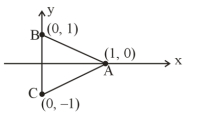
$|z-i|=|z+i|=|z-1|$
$\mathrm{ABC}$ is a triangle. Hence its circum-centre will be the only point whose distance from$ A$, $B$, $C$ will be same.
So $n(S)=1$
View full question & answer→MCQ 1411 Mark
If $z$ is a complex number such that $|z| \geq 1$, then the minimum value of $\left|z+\frac{1}{2}(3+4 i)\right|$ is:
- A
$\frac{5}{2}$
- B
$2$
- C
$3$
- ✓
$\frac{3}{2}$
AnswerCorrect option: D. $\frac{3}{2}$
d
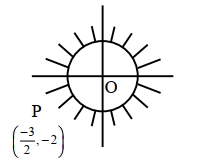
$|z| \geq 1$
Min. value of $\left|z+\frac{3}{2}+2 i\right|$ is actually zero.
View full question & answer→MCQ 1421 Mark
If the set $R=\{(a, b) ; a+5 b=42, a, b \in \mathbb{N}\}$ has $m$ elements and $\sum_{n=1}^m\left(1+i^{n !}\right)=x+i y$, where $I=\sqrt{-1}$, then the value of $m+x+y$ is :
Answerb
$ a+5 b=42, a, b \in N $
$ a=42-5 b, b=1, a=37 $
$ b=2, a=32 $
$ b=3, a=27 $
$ \vdots $
$ b=8, a=2 $
$ R \text { has "8" elements } \Rightarrow \mathrm{m}=8 $
$ \sum_{n=1}^8\left(1-i^{n !}\right)=x+i y $
$ \text { for } n \geq 4, i^{n !}=1 $
$ \Rightarrow(1-i)+\left(1-i^{2 !}\right)+\left(1-i^{3 !}\right) $
$ =1-I+2+1+1 $
$ =5-I=x+i y $
$ m+x+y=8+5-1=12$
View full question & answer→MCQ 1431 Mark
The sum of all possible values of $\theta \in[-\pi, 2 \pi]$, for which $\frac{1+i \cos \theta}{1-2 i \cos \theta}$ is purely imaginary, is equal to
- A
$2 \pi$
- ✓
$3 \pi$
- C
$5 \pi$
- D
$4 \pi$
AnswerCorrect option: B. $3 \pi$
b
$ Z=\frac{1+i \cos \theta}{1-2 i \cos \theta} $
$ Z=-\bar{Z} \Rightarrow \frac{1+i \cos \theta}{1-2 i \cos \theta}=-\left(\frac{\overline{1+i \cos \theta}}{1-2 i \cos \theta}\right) $
$ (1+i \cos \theta)(\overline{1-2 i \cos \theta})=-(1-2 i \cos \theta)(\overline{1+i \cos \theta}) $
$ (1+i \cos \theta)(1+2 i \cos \theta)=-(1-2 i \cos \theta)(1-i \cos \theta) $
$ 1+3 i \cos \theta-2 \cos ^2 \theta=-\left(1-3 i \cos \theta-2 \cos ^2 \theta\right) $
$ 2-4 \cos ^2 \theta=0 $
$ \Rightarrow \cos ^2 \theta=\frac{1}{2} \Rightarrow \theta=-\frac{\pi}{4},-\frac{3 \pi}{4}, \frac{\pi}{4}, \frac{3 \pi}{4}, \frac{5 \pi}{4}, \frac{7 \pi}{4} $
$ \text { sum }=3 \pi$
View full question & answer→MCQ 1441 Mark
If $z=\frac{1}{2}-2 i$, is such that $|z+1|=\alpha z+\beta(1+i), i=\sqrt{-1}$ and $\alpha, \beta \in R \quad$, then $\alpha+\beta$ is equal to
Answerb
$ \mathrm{z}=\frac{1}{2}-2 \mathrm{i} $
$ |\mathrm{z}+1|=\alpha \mathrm{z}+\beta(1+\mathrm{i}) $
$ \left|\frac{3}{2}-2 \mathrm{i}\right|=\frac{\alpha}{2}-2 \alpha \mathrm{i}+\beta+\beta \mathrm{i} $
$ \left|\frac{3}{2}-2 \mathrm{i}\right|=\left(\frac{\alpha}{2}+\beta\right)+(\beta-2 \alpha) \mathrm{i} $
$ \beta=2 \alpha \text { and } \frac{\alpha}{2}+\beta=\sqrt{\frac{9}{4}+4} $
$ \alpha+\beta=3$
View full question & answer→MCQ 1451 Mark
If $\alpha$ denotes the number of solutions of $|1-i|^x=2^x$ and $\beta=\left(\frac{|z|}{\arg (z)}\right)$, where $z=\frac{\pi}{4}(1+i)^4\left(\frac{1-\sqrt{\pi i}}{\sqrt{\pi}+i}+\frac{\sqrt{\pi}-i}{1+\sqrt{\pi} \mathrm{i}}\right), i=\sqrt{-1}$, then the distance of the point $(\alpha, \beta)$ from the line $4 x-3 y=7$ is
Answerb
$(\sqrt{2})^x=2^x \Rightarrow x=0 \Rightarrow \alpha=1$
$z=\frac{\pi}{4}(1+i)^4\left[\frac{\sqrt{\pi}-\pi i-i-\sqrt{\pi}}{\pi+1}+\frac{\sqrt{\pi}-i-\pi i-\sqrt{\pi}}{1+\pi}\right]$
$=-\frac{\pi i}{2}\left(1+4 i+6 i^2+4 i^3+1\right)$
$=2 \pi i$
$\beta=\frac{2 \pi}{\frac{\pi}{2}}=4$
Distance from $(1,4)$ to $4 x-3 y=7$
Will be $\frac{15}{5}=3$
View full question & answer→MCQ 1461 Mark
Let $z_1$ and $z_2$ be two complex number such that $z_1$ $+z_2=5$ and $z_1^3+z_2^3=20+15 i$. Then $\left|z_1^4+z_2^4\right|$ equals-
- A
$30 \sqrt{3}$
- ✓
$75$
- C
$15 \sqrt{15}$
- D
$25 \sqrt{3}$
Answerb
$z_1+z_2=5$
$z_1^3+z_2^3=20+15 i$
$z_1^3+z_2^3=\left(z_1+z_2\right)^3-3 z_1 z_2\left(z_1+z_2\right)$
$z_1^3+z_2^3=125-3 z_1 \cdot z_2(5)$
$\Rightarrow 20+15 i=125-15 z_1 z_2$
$\Rightarrow 3 z_1 z_2=25-4-3 i$
$\Rightarrow 3 z_1 z_2=21-3 i$
$\Rightarrow z_1 \cdot z_2=7-i$
$\Rightarrow\left(z_1+z_2\right)^2=25$
$\Rightarrow z_1^2+z_2^2=25-2(7-i)$
$\Rightarrow 11+2 i$
$\left(z_1^2+z_2^2\right)^2=121-4+44 i$
$\Rightarrow z_1^4+z_2^4+2(7-i)^2=117+44 i$
$\Rightarrow z_1^4+z_2^4=117+44 i-2(49-1-14 i)$
$\Rightarrow\left|z_1^4+z_2^4\right|=75$
View full question & answer→MCQ 1471 Mark
Lets $S=\{z \in C:|z-1|=1$ and $(\sqrt{2}-1)(z+\bar{z})-i(z-\bar{z})=2 \sqrt{2}\}$. Let $\mathrm{z}_1, \mathrm{z}_2$ $\in S$ be such that $\left|z_1\right|=\max _{z \in S}|z|$ and $\left|z_2\right|=\min _{z \in S}|z|$. Then $\left|\sqrt{2} z_1-z_2\right|^2$ equals :
Answerd
Let $Z=x+i y$
Then $(x-1)^2+y^2=1 \rightarrow(1)$
$(\sqrt{2}-1)(2 x)-i(2 i y)=2 \sqrt{2}$
$\quad \Rightarrow(\sqrt{2}-1) x+y=\sqrt{2} \rightarrow(2)$
Solving $(1) and (2)$ we get
Either $\mathrm{x}=1$ or $x=\frac{1}{2-\sqrt{2}} \rightarrow$ $(3)$
On solving $(3)$ with $(2)$ we get
For $x=1 \Rightarrow y=1 \Rightarrow Z_2=1+i$ and for
$x=\frac{1}{2-\sqrt{2}} \Rightarrow y=\sqrt{2}-\frac{1}{\sqrt{2}} \Rightarrow Z_1=\left(1+\frac{1}{\sqrt{2}}\right)+\frac{i}{\sqrt{2}}$
Now
$\left|\sqrt{2} z_1-z_2\right|^2$
$=\left|\left(\frac{1}{\sqrt{2}}+1\right) \sqrt{2}+i-(1+i)\right|^2$
$=(\sqrt{2})^2$
$=2$
View full question & answer→MCQ 1481 Mark
Let $\alpha$ and $\beta$ be the sum and the product of all the non-zero solutions of the equation $(\bar{z})^2+|z|=0, z \in C$. Then $4\left(\alpha^2+\beta^2\right)$ is equal to :
Answerb
$z=x+i y $
$\bar{z}=x-i y $
$\bar{z}^2=x^2-y^2-2 i x y $
$\Rightarrow x^2-y^2-2 i x y+\sqrt{x^2+y^2}=0 $
$\Rightarrow x=0 \quad \text { or } $$ y=0 $
$-y^2+|y|=0 $ $ x^2+|x|=0 $
$|y|=|y|^2 $ $ \Rightarrow x=0 $
$y=0, \pm 1 $ $ \Rightarrow \alpha=i-i=0 $
$\Rightarrow i,-i $ $ \beta=i(-i)=1 $
are roots $ 4(0+1)=4$
are roots
View full question & answer→MCQ 1491 Mark
Consider the following two statements :
Statement $I$ : For any two non-zero complex numbers $\mathrm{z}_1, \mathrm{z}_2$
$\left(\left|z_1\right|+\left|z_2\right|\right)\left|\frac{z_1}{\left|z_1\right|}+\frac{z_2}{\left|z_2\right|}\right| \leq 2\left(\left|z_1\right|+\left|z_2\right|\right)$ and
Statement $II$ : If $\mathrm{x}, \mathrm{y}, \mathrm{z}$ are three distinct complex numbers and a, b, c are three positive real numbers such that $\frac{a}{|y-z|}=\frac{b}{|z-x|}=\frac{c}{|x-y|}$, then
$\frac{\mathrm{a}^2}{\mathrm{y}-\mathrm{z}}+\frac{\mathrm{b}^2}{\mathrm{z}-\mathrm{x}}+\frac{\mathrm{c}^2}{\mathrm{x}-\mathrm{y}}=1$
Between the above two statements,
- A
both Statement $I$ and Statement $II$ are incorrect.
- B
Statement $I$ is incorrect but Statement $II$ is correct.
- ✓
Statement $I$ is correct but Statement $II$ is incorrect.
- D
both Statement $I$ and Statement $II$ are correct.
AnswerCorrect option: C. Statement $I$ is correct but Statement $II$ is incorrect.
c
Statement $I$ :
$\left(\left|z_1\right|+\left|z_2\right|\right)\left|\frac{z_1}{\left|z_1\right|}+\frac{z_2}{\left|z_2\right|}\right|$
Since $\left|\frac{z_1}{\left|z_1\right|}+\frac{z_2}{\left|z_2\right|}\right| \leq\left|\frac{z_1}{\left|z_1\right|}\right|+\left|\frac{z_2}{\left|z_2\right|}\right|$
$ \left|\frac{z_1}{\left|z_1\right|}+\frac{z_2}{\left|z_2\right|}\right| \leq \frac{\left|z_1\right|}{\left|z_1\right|}+\frac{\left|z_2\right|}{\left|z_2\right|} $
$ \left|\frac{z_1}{\left|z_1\right|}+\frac{z_2}{\left|z_2\right|}\right| \leq 2$
$\left(\left|z_1\right|+\left|z_2\right|\right)\left(\left|\frac{z_1}{\left|z_1\right|}+\frac{z_2}{\left|z_2\right|}\right|\right) \leq 2\left(\left|z_1\right|+\left|z_2\right|\right)$
$\therefore$ statement $I$ is correct
For Statement $II$ :
$ \frac{a}{|y-z|}=\frac{b}{|z-x|}=\frac{c}{|x-y|} $
$ \frac{a^2}{|y-z|^2}=\frac{b^2}{|z-x|^2}=\frac{c^2}{|x-y|^2}=\lambda $
$ a^2=\lambda\left(|y-z|^2\right)=\lambda(y-z)(\bar{y}-\bar{z}) $
$ b^2=\lambda(z-x)(\bar{z}-\bar{x}) \text { and } c^2=\lambda(x-y)(\bar{x}-\bar{y}) $
$ \frac{a^2}{y-z}+\frac{b^2}{z-x}+\frac{c^2}{x-y}=\lambda(\bar{y}-\bar{z}+\bar{z}-\bar{x}+\bar{x}-\bar{y})=0$
Statement $II$ is false
View full question & answer→MCQ 1501 Mark
Let the complex numbers $\alpha$ and $\frac{1}{\bar{\alpha}}$ lie on the circles $\left|z-z_0\right|^2=4$ and $z-\left.z_0\right|^2=16$ respectively, where $z_0=1+i$. Then, the value of $100|\alpha|^2$ is.
Answerb
$ \left|z-z_0\right|^2=4 $
$ \Rightarrow\left(\alpha-z_0\right)\left(\bar{\alpha}-\bar{z}_0\right)=4 $
$ \Rightarrow \alpha \bar{\alpha}-\alpha \bar{z}_0-z_0 \bar{\alpha}+\left|z_0\right|^2=4 $
$ \Rightarrow|\alpha|^2-\alpha \bar{z}_0-z_0 \bar{\alpha}=2 \ldots \ldots .$$...............(i)$
$ \left|z-z_0\right|^2=16$
$ \Rightarrow\left(\frac{1}{\bar{\alpha}}-z_0\right)\left(\frac{1}{\alpha}-\bar{z}_0\right)=16 $
$ \Rightarrow\left(1-\bar{\alpha} z_0\right)\left(1-\alpha \bar{z}_0\right)=16|\alpha|^2 $
$ \Rightarrow 1-\bar{\alpha} z_0-\alpha \bar{z}_0+|\alpha|^2\left|z_0\right|^2=16|\alpha|^2 $
$ \Rightarrow 1-\bar{\alpha} z_0-\alpha \bar{z}_0=14|\alpha|^2 \ldots \ldots \ldots$ .$.........(ii)$
From $(1)$ and $(2)$
$\Rightarrow 5|\alpha|^2=1 $
$\Rightarrow 100|\alpha|^2=20$
View full question & answer→