MCQ 1511 Mark
Let $P=\{z \in \mathbb{C}:|z+2-3 i| \leq 1\}$ and $Q=\{z \in \mathbb{C}: z(1+i)+\bar{z}(1-i) \leq-8\}$. Let in $\mathrm{P} \cap \mathrm{Q},|\mathrm{z}-3+2 \mathrm{i}|$ be maximum and minimum at $z_1$ and $z_2$ respectively. If $\left|z_1\right|^2+2|z|^2=\alpha+\beta \sqrt{2}$, where $\alpha, \beta$ are integers, then $\alpha+\beta$ equals______.
Answerc
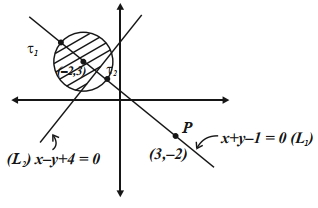
Clearly for the shaded region $z_1$ is the intersection of the circle and the line passing through $\mathrm{P}\left(\mathrm{L}_1\right)$ and $\mathrm{z}_2$ is intersection of line $\mathrm{L}_1 \& \mathrm{~L}_2$
Circle : $(x+2)^2+(y-3)^2=1$
$L_1: x+y-1=0 $
$L_2: x-y+4=0$
On solving circle $\mathrm{L}_1$ we get
$z_1:\left(-2-\frac{1}{\sqrt{2}}, 3+\frac{1}{\sqrt{2}}\right)$
On solving $\mathrm{L}_1$ and $\mathrm{z}_2$ is intersection of line $\mathrm{L}_1 \& \mathrm{~L}_2$ we get $z_2:\left(\frac{-3}{2}, \frac{5}{2}\right)$
$\left|z_1\right|^2+2\left|z_2\right|^2=14+5 \sqrt{2}+17$
$=31+5 \sqrt{2}$
So $\alpha=31$
$\beta=5$
$\alpha+\beta=36$
View full question & answer→MCQ 1521 Mark
The area (in sq. units) of the region $\mathrm{S}=\{\mathrm{z} \in \mathbb{C} ;|\mathrm{z}-1| \leq 2 ;(\mathrm{z}+\overline{\mathrm{z}})+\mathrm{i}(\mathrm{z}-\overline{\mathrm{z}}) \leq 2, \operatorname{lm}(\mathrm{z}) \geq 0\}$ is
- A
$\frac{7 \pi}{3}$
- ✓
$\frac{3 \pi}{2}$
- C
$\frac{17 \pi}{8}$
- D
$\frac{7 \pi}{4}$
AnswerCorrect option: B. $\frac{3 \pi}{2}$
b
Put $z=x+i y$
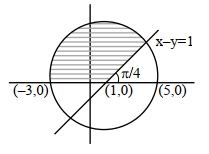
$ |z-1| \leq 2 \Rightarrow(x-1)^2+y^2 \leq 4 $
$ (z+\bar{z})+i(z-\bar{z}) \leq 2 \Rightarrow 2 x+i(2 i y) \leq 2 $
$ \Rightarrow x-y \leq 1 $
$ \operatorname{Im}(z) \geq 0 \Rightarrow y \geq 0$
$Image$
Required area
Area of semi-circle - area of sector A
$ \frac{1}{2} \pi(2)^2-\frac{\pi}{2} $
$ =\frac{3 \pi}{2}$
View full question & answer→MCQ 1531 Mark
Let $S_1=\{z \in C:|z| \leq 5\}$,
$S_2=\left\{z \in C: I m\left(\frac{z+1-\sqrt{3} i}{1-\sqrt{3} i}\right) \geq 0\right\}$ and
$\mathrm{S}_3=\{\mathrm{z} \in \mathrm{C}: \operatorname{Re}(\mathrm{z}) \geq 0\}$. Then
- A
$\frac{125 \pi}{6}$
- B
$\frac{125 \pi}{24}$
- C
$\frac{125 \pi}{4}$
- ✓
$\frac{125 \pi}{12}$
AnswerCorrect option: D. $\frac{125 \pi}{12}$
d
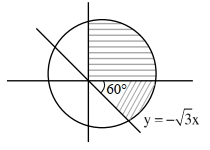
$ S_1: x^2+y^2 \leq 25 $
$ S_2: \operatorname{Im} \text { of } \frac{z+(1-\sqrt{3} i)}{(1-\sqrt{3} i)} \geq 0 $
$ \operatorname{Im} \text { of }\left(\frac{x+i y}{1-\sqrt{3} i}+1\right) \geq 0 $
$ \operatorname{Im} \text { of }\left(\frac{(x+i y)(1+\sqrt{3} i)}{4}\right) \geq 0 $
$ \Rightarrow \sqrt{3} x+y \geq 0 $
$ S_3: x \geq 0 $
$ \text { Area }=\frac{5}{12}\left(\pi(5)^2\right)$
View full question & answer→MCQ 1541 Mark
If $z_1, z_2$ are two distinct complex number such that $\left|\frac{z_1-2 z_2}{\frac{1}{2}-z_1 \bar{z}_2}\right|=2$, then
- ✓
either $z_1$ lies on a circle of radius 1 or $z_2$ lies on a circle of radius $\frac{1}{2}$
- B
either $z_1$ lies on a circle of radius $\frac{1}{2}$ or $z_2$ lies on a circle of radius $1$ .
- C
$z_1$ lies on a circle of radius $\frac{1}{2}$ and $z_2$ lies on a circle of radius $1$ .
- D
both $z_1$ and $z_2$ lie on the same circle.
AnswerCorrect option: A. either $z_1$ lies on a circle of radius 1 or $z_2$ lies on a circle of radius $\frac{1}{2}$
a
$ \frac{z_1-2 z_2}{\frac{1}{2}-z_1 \bar{z}_2} \times \frac{\bar{z}_1-2 \bar{z}_2}{\frac{1}{2}-\bar{z}_1 z_2}=4 $
$ \left|z_1\right|^2 2 z_1 \bar{z}_2-2 \bar{z}_1 z_2+4\left|z_2\right|^2 $
$ =4\left(\frac{1}{4}-\frac{\bar{z}_1 z_2}{2}-\frac{z_1 \bar{z}_2}{2}+\left|z_1\right|^2\left|z_2\right|^2\right)$
$\mathrm{z}_1 \overline{\mathrm{z}}_1+2 \mathrm{z}_2 \cdot 2 \overline{\mathrm{z}}_2-\mathrm{z}_1 \overline{\mathrm{z}}_1 2 \mathrm{z}_2 2 \overline{\mathrm{z}}_2-1=0$
$ \left(z, \bar{z}_1-1\right)\left(1-2 z_2 \cdot 2 \bar{z}_2\right)=0 $
$ \left(\left|z_1\right|^2-1\right)\left(\left|2 z_2\right|^2-1\right)=0$
View full question & answer→MCQ 1551 Mark
The sum of the square of the modulus of the elements in the set
$\{z=a+i b: a, b \in Z, z \in C,|z-1| \leq 1,|z-5| \leq|z-5 i|\}$ is ........
Answerb
$ |z-1| \leq 1 $
$ \Rightarrow|(x-1)+i y| \leq 1 $
$ \Rightarrow \sqrt{(x-1)^2+y^2} \leq 1 $
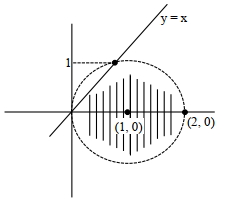
$ \Rightarrow(x-1)^2+y^2 \leq 1 ............(1)$
Also $|z-5| \leq|z-5 i|$
$ (x-5)^2+y^2 \leq x^2+(y-5)^2 $
$ -10 x \leq-10 y $
$ \Rightarrow x \geq y.........(2)$
Solving ($1$) and ($2$)
$ \Rightarrow(\mathrm{x}-1)^2+\mathrm{x}^2=1 $
$ \Rightarrow 2 \mathrm{x}^2-2 \mathrm{x}=0 $
$ \Rightarrow \mathrm{x}(\mathrm{x}-1)=0 $
$ \Rightarrow \mathrm{x}=0 \text { or } \mathrm{x}=1 $
$ \mathrm{y}=0 \text { or } \mathrm{y}=1$
$Image$
Given $\mathrm{x}, \mathrm{y} \in \mathrm{I}$
Points $(0,0),(1,0),(2,0),(1,1),(1,-1)$ to find
$\left|z_1\right|^2+\left|z_2\right|^2+\left|z_3\right|^2+\left|z_4\right|^2+\left|z_5\right|^2 $
$ =0+1+4+1+1+1+1=9$
View full question & answer→MCQ 1561 Mark
Let $z$ be a complex number such that the real part of $\frac{z-2 i}{z+2 i}$ is zero. Then, the maximum value of $|\mathrm{z}-(6+8 \mathrm{i})|$ is equal to :
Answera
$ \frac{z-2 i}{z+2 i}+\frac{\bar{z}+2 i}{\bar{z}-2 i}=0 $
$ z \bar{z}-2 i \bar{z}-2 i z+4(-1) $
$ +z \bar{z}+2 z i+2 \bar{z} i+4(-1)=0 $
$ \Rightarrow 2|z|^2=8 \Rightarrow|z|=2 $
$ |z-(6+8 i)|_{\text {maximum }}=10+2=12$
View full question & answer→MCQ 1571 Mark
If $\alpha$ satisfies the equation $x^2+x+1=0$ and $(1+\alpha)^7=\mathrm{A}+\mathrm{B} \alpha+\mathrm{C}^2, \mathrm{~A}, \mathrm{~B}, \mathrm{C} \geq 0$, then $5(3 A-2 B-C)$ is equal to..........................
Answerb
$x^2+x+1=0 \Rightarrow x=\omega, \omega^2=\alpha$
Let $\alpha=\omega$
Now $(1+\alpha)^7=-\omega^{14}=-\omega^2=1+\omega$
$ A=1, B=1, C=0 $
$ \therefore 5(3 A-2 B-C)=5(3-2-0)=5$
View full question & answer→MCQ 1581 Mark
Let $\alpha, \beta$ be the roots of the equation $x^2-\sqrt{6} x+3=0$ such that $\operatorname{Im}(\alpha)>\operatorname{Im}(\beta)$. Let $a, b$ be integers not divisible by $3$ and $n$ be a natural number such that $\frac{\alpha^{99}}{\beta}+\alpha^{98}=3^n(a+i b), i=\sqrt{-1}$. Then $\mathrm{n}+\mathrm{a}+\mathrm{b}$ is equal to_.....................
Answera
$ x^2-\sqrt{6} x+6=0 $
$ x=\frac{\sqrt{6} \pm i \sqrt{6}}{2}=\frac{\sqrt{6}}{2}(1 \pm i) $
$ \alpha=\sqrt{3}\left(e^{i \frac{\pi}{4}}\right), \beta=\sqrt{3}\left(e^{-i \frac{\pi}{4}}\right) $
$ \therefore \frac{\alpha^{99}}{\beta}+\alpha^{98}=\alpha^{98}\left(\frac{\alpha}{\beta}+1\right) $
$ =\frac{\alpha^{98}(\alpha+\beta)}{\beta}=3^{49}\left(e^{i 99 \frac{\pi}{4}}\right) \times \sqrt{2} $
$ =3^{49}(-1+i) $
$ =3^n(a+i b) $
$ \therefore n=49, a=-1, b=1$
$ \therefore n+a+b=49-1+1=49$
View full question & answer→MCQ 1591 Mark
If $\mathrm{z}$ is a complex number, then the number of common roots of the equation $z^{1985}+z^{100}+1=0$ and $z^3+2 z^2+2 z+1=0$, is equal to :
Answerb
$z^{1985}+z^{100}+1=0 \quad \& z^3+2 z^2+2 z+1=0 $
$(z+1)\left(z^2-z+1\right)+2 z(z+1)=0$
$(z+1)\left(z^2+z+1\right)=0$
$\begin{aligned} & (\mathrm{z}+1)\left(\mathrm{z}^2+\mathrm{z}+1\right)=0 \\ \Rightarrow \quad & \mathrm{z}=-1, \mathrm{z}=\mathrm{w}, \mathrm{w}^2\end{aligned}$
Now put $\mathrm{z}=\mathrm{w}$
$\begin{array}{ll}\Rightarrow & \mathrm{w}^{1985}+\mathrm{w}^{100}+1 \\ \Rightarrow & \mathrm{w}^2+\mathrm{w}+1=0 \\ & \text { Also, } \mathrm{z}=\mathrm{w}^2 \\ \Rightarrow & \mathrm{w}^{3970}+\mathrm{w}^{200}+1 \\ \Rightarrow & \mathrm{w}+\mathrm{w}^2+1=0\end{array}$
Two common root
View full question & answer→MCQ 1601 Mark
Let the complex number $z=x+$ iy be such that $\frac{2 z-3 i}{2 z+i}$ is purely imaginary. If $x + y ^2=0$, then $y^4+y^2-y$ is equal to :
- A
$\frac{3}{2}$
- B
$\frac{4}{3}$
- C
$\frac{2}{3}$
- ✓
$\frac{3}{4}$
AnswerCorrect option: D. $\frac{3}{4}$
d
$\frac{2 z-3 i}{2 z+i}$ is purely imaginary
$\therefore \frac{2 z-3 i}{2 z+i}+\frac{2 \bar{z}+3 i}{2 \bar{z}-i}=0$
$z=x+i y$
$\Rightarrow 4 x^2+4 y^2-4 y-3=0$
Given that $x+y^2=0$
$y^4+y^2-y=3 / 4$
View full question & answer→MCQ 1611 Mark
Let $\quad S=\left\{z=x+i y: \frac{2 z-3 i}{4 z+2 i}\right.$ is a real number $\}$. Then which of the following is NOT correct?
- A
$y + x ^2+ y ^2 \neq-\frac{1}{4}$
- B
$x=0$
- ✓
$( x , y )=\left(0,-\frac{1}{2}\right)$
- D
$y \in\left(-\infty,-\frac{1}{2}\right) \cup\left(-\frac{1}{2}, \infty\right)$
AnswerCorrect option: C. $( x , y )=\left(0,-\frac{1}{2}\right)$
c
$\frac{2 z-3 i}{q z+2 i} \in R$
$\frac{2(x+i y)-3 i}{4(x+i t)+2 i}=\frac{2 x+(2 y-3) i}{4 x+(4 y+2) i} \times \frac{4 x-(4 y+2) i}{4 x-(4 y+2) i}$
$4 x(2 y-3)-2 x(4 y+2)=0$
$x=0 \quad y \neq-\frac{1}{2}$
$\text { Ans. }=3$
View full question & answer→MCQ 1621 Mark
Let $A =\left\{\theta \in(0,2 \pi): \frac{1+2 i \sin \theta}{1- i \sin \theta}\right.$ is purely imaginary $\}$. Then the sum of the elements in $A$ is
- A
$\pi$
- B
$2 \pi$
- ✓
$4 \pi$
- D
$3 \pi$
AnswerCorrect option: C. $4 \pi$
c
$z=\frac{1+2 i \sin \theta}{1-i \sin \theta} \times \frac{1+i \sin \theta}{1+i \sin \theta}$
$z=\frac{1-2 \sin ^2 \theta+i(3 \sin \theta)}{1+\sin ^2 \theta}$
$\operatorname{Re}(z)=0$
$\frac{1-2 \sin ^2 \theta}{1+\sin ^2 \theta}=0$
$\sin \theta=\frac{ \pm 1}{\sqrt{2}}$
$A=\left\{\frac{\pi}{4}, \frac{3 \pi}{4}, \frac{5 \pi}{4}, \frac{7 \pi}{4}\right\}$
$\text { sum }=4 \pi(\text { Option } 3)$
View full question & answer→MCQ 1631 Mark
For two non-zero complex number $z_1$ and $z_2$, if $\operatorname{Re}\left(z_1 z_2\right)=0$ and $\operatorname{Re}\left(z_1+z_2\right)=0$, then which of the following are possible ?
$(A)$ $\operatorname{Im}\left(z_1\right) > 0$ and $\operatorname{Im}\left(z_2\right) > 0$
$(B)$ $\operatorname{Im}\left(z_1\right) < 0$ and $\operatorname{Im}\left(z_2\right) > 0$
$(C)$ $\operatorname{Im}\left(z_1\right) > 0$ and $\operatorname{Im}\left(z_2\right) < 0$
$(D)$ $\operatorname{Im}\left( z _1\right) < 0$ and $\operatorname{Im}\left( z _2\right) < 0$
Choose the correct answer from the options given below :
- A
$B$ and $D$
- ✓
$B$ and $C$
- C
$A$ and $B$
- D
$A$ and $C$
AnswerCorrect option: B. $B$ and $C$
b
$z _1= x _1+ i y _1$
$z _2= x _2+ iy _2$
$\operatorname{Re}\left(z_1 z_2\right)=x_1 x_2-y_1 y_2=0$
$\operatorname{Re}\left(z_1+z_2\right)=x_1+x_2=0$
$x_1$ and $x_2$ are of opposite sign
$y_1$ and $y_2$ are of opposite sign
View full question & answer→MCQ 1641 Mark
Let $\alpha=8-14 i , A=\left\{ z \in C : \frac{\alpha z -\bar{\alpha} \overline{ z }}{ z ^2-(\overline{ z })^2-112 i }=1\right\}$ and $B =\{ z \in C :| z +3 i |=4\}$ Then $\sum_{z \in A \cap B}(\operatorname{Re} z-\operatorname{Im} z)$ is equal to $...............$.
Answera
$\alpha=8-14 i$
$z=x+i y$
$a z=(8 x+14 y)+i(-14 x+8 y)$
$z +\overline{ z }=2 x \quad z -\overline{ z }=2 iy$
Set A: $\frac{2 i(-14 x+8 y)}{i(4 x y-112)}=1$
$(x-4)(y+7)=0$
$x=4 \quad \text { or } \quad y=-7$
Set B: $x^2+(y+3)^2=16$
when $x=4 \quad y=-3$
when $y =-7 \quad x =0$
$\therefore A \cap B=\{4-3 i, 0-7 i\}$
So, $\sum_{z \in A \cap B}(\operatorname{Re} z-\operatorname{Im} z)=4-(-3)+(0-(-7))=14$
View full question & answer→MCQ 1651 Mark
Let $z =1+ i$ and $z _1=\frac{1+ i \overline{ z }}{\overline{ z }(1- z )+\frac{1}{ z }}$. Then $\frac{12}{\pi}$ $\arg \left(z_1\right)$ is equal to $..........$.
Answerd
$z=1+i$
$z_1=\frac{1+i \bar{z}}{\bar{z}(1-z)+\frac{1}{z}}$
$z_1=\frac{1+i(1-i)}{(1-i)(1-1-i)+\frac{1}{1+i}}$
$=\frac{1+i-i^2}{(1-i)(-i)+\frac{1-i}{2}}$
$=\frac{2+i}{-3 i-1}=\frac{4+2 i}{-3 i-1}$
$=\frac{-(4+2 i)(3 i-1)}{(3 i)^2-(1)^2}$
$\therefore \frac{12}{\pi} \arg \left(z_1\right)=\frac{12}{\pi} \times \frac{3 \pi}{4}=9$
View full question & answer→MCQ 1661 Mark
Let $a \neq b$ be two non-zero real numbers.Then the number of elements in the set $X =\left\{ z \in C : \operatorname{Re}\left(a z^2+ bz \right)= a \text { and }\operatorname{Re}\left(b z^2+ az \right)= b \right\}$ is equal to
Answerc
$\operatorname{Re}\left(a z^2+b z\right)=a$
$a z^2+b z+a \bar{z}^2+b \bar{z}=2 a$
$a\left(z^2+\bar{z}^2\right)+ b ( z +\overline{ z })=2 a$
$\operatorname{Re}\left( bz z^2+ az \right)= b$
$b z^2+a z+b \bar{z}^2+ az =2 b$
$b \left( z ^2+\overline{ z }^2\right)+ a ( z +\overline{ z })=2 b$
$(1) \times b-(2) \times(a)$
$\Rightarrow\left(b^2-a^2\right)(z+\bar{z})=0$
$\Rightarrow \quad(z+\bar{z})=0 \quad\left(a^2 \neq b^2\right)$
$(1) \times a-(2) \times(b)$
$\Rightarrow \quad\left(a^2-b^2\right)(z+\bar{z})=2\left(a^2-b^2\right) \quad\left(a^2 \neq b^2\right)$
$z^2+\bar{z}^2=2$
$\Rightarrow(z+\bar{z})^2-2 z \bar{z}=2$
$z \bar{z}=-1$
$\Rightarrow 1+1^2=-1$
$\Rightarrow \text { No solution }$
$\text { But when } a=-b$
$\operatorname{Re}\left(a z^2-a z\right)=a$
$\Rightarrow \quad \operatorname{Re}\left(a\left(x^2-y^2+i 2 x y\right)-a(x+i y)\right)=a$
$\Rightarrow a\left(x^2-y^2\right)-a x=a$
$\Rightarrow x^2-y^2-x=1$
$\Rightarrow x^2-x-1=y^2$
For any real values of $y$ there two values of $x$, hence infinite complex numbers are possible.
View full question & answer→MCQ 1671 Mark
If for $z=\alpha+i \beta,|z+2|=z+4(1+i)$, then $\alpha+\beta$ and $\alpha \beta$ are the roots of the equation
- ✓
$x^2+7 x+12=0$
- B
$x^2+3 x-4=0$
- C
$x^2+2 x-3=0$
- D
$x ^2+ x -12=0$
AnswerCorrect option: A. $x^2+7 x+12=0$
a
$|z+2|=|\alpha+i \beta+2|$
$=\alpha+i \beta+4+4 i$
$\sqrt{(\alpha+2)^2+\beta^2}=(\alpha+4)+ i (\beta+4)$
$\beta+4=0$
$(\alpha+2)^2+16=(\alpha+4)^2$
$\beta=-4$
$\alpha^2+4+4 \alpha+16=\alpha^2+16+8 \alpha$
$4=4 \alpha$
$\alpha=1$
$\alpha=1, \beta=-4$
$\alpha+\beta=-3, \alpha \beta=-4$
$\text { Sum of roots }=-7$
$\text { Product of roots }=12$
$x^2+7 x+12=0$
View full question & answer→MCQ 1681 Mark
For $a \in C$, let $A =\{z \in C: \operatorname{Re}( a +\overline{ z }) > \operatorname{Im}(\bar{a}+z)\}$ and $B=\{z \in C: \operatorname{Re}(a+\bar{z}) < \operatorname{Im}(\bar{a}+z)\}$. Then among the two statements :
$(S 1)$ : If $\operatorname{Re}(A), \operatorname{Im}(A) > 0$, then the set $A$ contains all the real numbers
$(S2)$: If $\operatorname{Re}(A), \operatorname{Im}(A) < 0$, then the set $B$ contains all the real numbers,
- A
Only $(S1)$ is true
- ✓
- C
Only $(S2)$ is true
- D
Answerb
Let $a=x_1+i y_1 z=x+i y$
Now $\operatorname{Re}(a+\bar{z}) > \operatorname{Im}(\bar{a}+z)$
$\therefore x _1+ x >- y _1+ y$
$x _1=2, y _1=10, x =-12, y =0$
Given inequality is not valid for these values.
$S 1$ is false.
Now $\operatorname{Re}(a+\bar{z})<\operatorname{Im}(\bar{a}+z)$
$x _1+ x < - y _1+ y$
$x _1=-2, y _1=-10, x =12, y =0$
Given inequality is not valid for these values.
$S2$ is false.
View full question & answer→MCQ 1691 Mark
Let $S=\left\{Z \in C: \bar{z}=i\left(z^2+\operatorname{Re}(\bar{z})\right)\right\}$. Then $\sum_{z \in S}|z|^2$ is equal to
- A
$\frac{7}{2}$
- ✓
$4$
- C
$\frac{5}{2}$
- D
$3$
Answerb
Let $Z=x+$ iy, $x \in R, y \in R$
$x-i y=i\left(x^2-y^2+(2 x y) i+x\right)$
$x =- 2 x x$
$- y =- y ^2+ x ^2+ x$
$\Rightarrow x=0, y=-\frac{1}{2}(\text { from }(1))$
If $x \neq 0$, then $y =0,1$
If $y =-\frac{1}{2}$, then $x =\frac{1}{2},-\frac{3}{2}$
$Z =0+ i 0,0+ i , \frac{1}{2}-\frac{ i }{2},-\frac{3}{2}-\frac{ i }{2}$
View full question & answer→MCQ 1701 Mark
If the set $\left\{\operatorname{Re}\left(\frac{z-\bar{z}+z \bar{z}}{2-3 z+5 \bar{z}}\right): z \in C , \operatorname{Re}(z)=3\right\}$ is equal to the interval $(\alpha, \beta]$, then $24(\beta-\alpha)$ is equal to
Answerd
Let $z_1=\left(\frac{z-\bar{z}+z \bar{z}}{2-3 z+5 \bar{z}}\right)$
Let $z=3+i y$
$\bar{z}=3-i y$
$z_1=\frac{2 i y+\left(9+y^2\right)}{2-3(3+i y)+5(3-i y)}$
$=\frac{9+y^2+i(2 y)}{8-8 i y}$
$=\frac{\left(9+y^2\right)+i(2 y)}{8(1-i y)}$
$\operatorname{Re}\left(z_1\right)=\frac{\left(9+y^2\right)-2 y^2}{8\left(1+y^2\right)}$
$=\frac{9-y^2}{8\left(1+y^2\right)}$
$=\frac{1}{8}\left[\frac{10-\left(1+ y ^2\right)}{\left(1+ y ^2\right)}\right]$
$=\frac{1}{8}\left[\frac{10}{1+ y ^2}-1\right]$
$1+ y ^2 \in[1, \infty]$
$\frac{1}{1+ y ^2} \in(0,1]$
$\frac{10}{1+ y ^2} \in(0,10]$
$\frac{10}{1+ y ^2}-1 \in(-1,9]$
$\operatorname{Re}\left( z _1\right) \in\left(\frac{-1}{8}, \frac{9}{8}\right]$
$\alpha=\frac{-1}{8}, \beta=\frac{9}{8}$
$24(\beta-\alpha)=24\left(\frac{9}{8}+\frac{1}{8}\right)=30$
View full question & answer→MCQ 1711 Mark
The complex number $z=\frac{i-1}{\cos \frac{\pi}{3}+i \sin \frac{\pi}{3}}$ is equal to $.....$
- ✓
$\sqrt{2}\left(\cos \frac{5 \pi}{12}+ i \sin \frac{5 \pi}{12}\right)$
- B
$\cos \frac{\pi}{12}- i \sin \frac{\pi}{12}$
- C
$\sqrt{2}\left(\cos \frac{\pi}{12}+ i \sin \frac{\pi}{12}\right)$
- D
$\sqrt{2} i \left(\cos \frac{5 \pi}{12}- i \sin \frac{5 \pi}{12}\right)$
AnswerCorrect option: A. $\sqrt{2}\left(\cos \frac{5 \pi}{12}+ i \sin \frac{5 \pi}{12}\right)$
a
$Z =\frac{ i -1}{\cos \frac{\pi}{3}+ i \sin \frac{\pi}{3}}=\frac{ i -1}{\frac{1}{2}+\frac{\sqrt{3}}{2} i }$
$=\frac{ i -1}{\frac{1}{2}+\frac{\sqrt{3}}{2} i } \times \frac{\frac{1}{2}-\sqrt{\frac{3}{2} i }}{\frac{1}{2}-\sqrt{3 / 2} i }=\frac{\sqrt{3}-1}{2}+\frac{\sqrt{3}+1}{2} i$
Apply polar form,
$r \cos \theta=\frac{\sqrt{3}-1}{2}r$
$\sin \theta=\frac{\sqrt{3}+1}{2}$
Now, $\tan \theta=\frac{\sqrt{3}+1}{\sqrt{3}-1}$
So, $\quad \theta=\frac{5 \pi}{12}$
View full question & answer→MCQ 1721 Mark
Let $z_1=2+3 i$ and $z_2=3+4 i$. The set $S =\left\{ z \in C :\left| z - z _1\right|^2-\left|z-z_2\right|^2=\left|z_1-z_2\right|^2\right\}$ represents a
- ✓
straight line with sum of its intercepts on the coordinate axes equals $14$
- B
hyperbola with the length of the transverse axis $7$
- C
straight line with the sum of its intercepts on the coordinate axes equals $-18$
- D
hyperbola with eccentricity $2$
AnswerCorrect option: A. straight line with sum of its intercepts on the coordinate axes equals $14$
a
$\left((x-2)^2+(y-3)^2\right)-\left((x-3)^2-(y-4)^2\right)=1+1$
$\Rightarrow x + y =7$
View full question & answer→MCQ 1731 Mark
Let $z$ be a complex number such that $\left|\frac{z-2 i}{z+i}\right|=2, z \neq-i$. Then $z$ lies on the circle of radius $2$ and centre
- A
$(2,0)$
- B
$(0,0)$
- C
$(0,2)$
- ✓
$(0,-2)$
AnswerCorrect option: D. $(0,-2)$
d
$( z -2 i )(\overline{ z }+2 i )=4( z + i )(\overline{ z }- i )$
$z \overline{ z }+4+2 i ( z -\overline{ z })=4( z \overline{ z }+1+ i (\overline{ z }- z ))$
$3 z \overline{ z }-6 i ( z -\overline{ z })=0$
$x ^2+ y ^2-2 i (2 iy )=0$
$x ^2+ y ^2+4 y =0$
View full question & answer→MCQ 1741 Mark
For all $z \in C$ on the curve $C _1:| z |=4$, let the locus of the point $z +\frac{1}{ z }$ be the curve $C _2$. Then
- ✓
the curves $C_1$ and $C_2$ intersect at $4$ points
- B
the curves $C_1$ lies inside $C_2$
- C
the curves $C_1$ and $C_2$ intersect at $2$ points
- D
the curves $C_2$ lies inside $C_1$
AnswerCorrect option: A. the curves $C_1$ and $C_2$ intersect at $4$ points
a
Let $w = z +\frac{1}{ z }=4 e ^{ i \theta}+\frac{1}{4} e ^{- i \theta}$
$\Rightarrow w =\frac{17}{4} \cos \theta+ i \frac{15}{4} \sin \theta$
So locus of $w$ is ellipse $\frac{x^2}{\left(\frac{17}{4}\right)^2}+\frac{y^2}{\left(\frac{15}{4}\right)^2}=1$
Locus of $z$ is circle $x ^2+ y ^2=16$
So intersect at $4$ points
View full question & answer→MCQ 1751 Mark
If the center and radius of the circle $\left|\frac{z-2}{z-3}\right|=2$ are respectively $(\alpha, \beta)$ and $\gamma$, then $3(\alpha+\beta+\gamma)$ is equal to
Answerd
$\sqrt{(x-2)^2+y^2}=2 \sqrt{(x-3)^2+y^2}$
$=x^2+y^2-4 x+4=4 x^2+4 y^2-24 x+36$
$=3 x^2+3 y^2-20 x+32=0$
$=x^2+y^2-\frac{20}{3} x +\frac{32}{3}=0$
$=(\alpha, \beta)=\left(\frac{10}{3}, 0\right)$
$\gamma=\sqrt{\frac{100}{9}-\frac{32}{3}}=\sqrt{\frac{4}{9}}=\frac{2}{3}$
$3(\alpha, \beta, \gamma)=3\left(\frac{10}{3}+\frac{2}{3}\right)$
$=12$
View full question & answer→MCQ 1761 Mark
Let $a, b$ be two real numbers such that $a b < 0$. If the complex number $\frac{1+ ai }{ b + i }$ is of unit modulus and $a+i b$ lies on the circle $|z-1|=|2 z|$, then a possible value of $\frac{1+[ a ]}{4 b }$, where $[ t ]$ is greatest integer function, is :
- ✓
$-\frac{1}{2}$
- B
$-1$
- C
$1$
- D
$\frac{1}{2}$
AnswerCorrect option: A. $-\frac{1}{2}$
a
$a b < 0\left|\frac{1+a i}{b+i}\right|=1$
$|1+a i l=| b+i l$
$a^2+1=b^2+1 \Rightarrow a=\pm b \Rightarrow b=-a \quad \text { as } a b < 0$
$(a, b) \text { lies on }| z -1|=|2 z |$
$la + ib -1 \mid=2 l a + ibl$
$( a -1)^2+ b ^2=4\left( a ^2+ b ^2\right)$
$( a -1)^2= a ^2=4\left(2 a ^2\right)$
$1-2 a =6 a ^2 \Rightarrow 6 a ^2+2 a -1=0$
$a =\frac{-2 \pm \sqrt{28}}{12}=\frac{-1 \pm \sqrt{7}}{6}$
$a =\frac{\sqrt{7}-1}{6}$ and $b =\frac{1-\sqrt{7}}{6}$
${[ a ]=0}$
$\therefore \frac{1+[ a ]}{4 b }=\frac{6}{4(1-\sqrt{7})}=-\left(\frac{1+\sqrt{7}}{4}\right.$
$\text { or }[ a ]=0$
Similarly it is not matching with $a =\frac{-1-\sqrt{7}}{6}$
No answer is matching.
View full question & answer→MCQ 1771 Mark
For $\alpha, \beta, z \in C$ and $\lambda>1$, if $\sqrt{\lambda-1}$ is the radius of the circle $|z-\alpha|^2+|z-\beta|^2=2 \lambda$, then $|\alpha-\beta|$ is equal to $.............$.
Answerc
For circle :
$\left|z-z_1\right|^2+\left|z-z_2\right|^2=\left|z_1-z_2\right|^2$
$r =\frac{\left|z_1-z_2\right|}{2}=\frac{|\alpha-\beta|}{2}=\sqrt{\lambda-1}$
$2 \lambda=|\alpha-\beta|^2$
$|\alpha-\beta|=2 \sqrt{\lambda-1}$
$|\alpha-\beta|^2=4 \lambda-4=2 \lambda$
$\lambda=2$
$\Rightarrow|\alpha-\beta|^2=4$
$|\alpha-\beta|=2$
View full question & answer→MCQ 1781 Mark
Let $w _1$ be the point obtained by the rotation of $z_1=5+4 i$ about the origin through a right angle in the anticlockwise direction, and $w_2$ be the point obtained by the rotation of $z_2=3+5 i$ about the origin through a right angle in the clockwise direction. Then the principal argument of $w _1- w _2$ is equal to $...........$.
- A
$-\pi+\tan ^{-1} \frac{33}{5}$
- B
$-\pi-\tan ^{-1} \frac{33}{5}$
- C
$-\pi+\tan ^{-1} \frac{8}{9}$
- ✓
$\pi-\tan ^{-1} \frac{8}{9}$
AnswerCorrect option: D. $\pi-\tan ^{-1} \frac{8}{9}$
d
$W _1= z _{ i } i =(5+4 i ) i =-4+5 i$
$W _2= z _2(- i )=(3+5 i )(- i )=5-3 i$
$W _1- W _2=-9+8 i$
$\text { Principal argument }=\pi-\tan ^{-1}\left(\frac{8}{9}\right)$
View full question & answer→MCQ 1791 Mark
Let $\omega=z \bar{z}+k_1 z+k_2 i z+\lambda(1+i), k_1, k_2 \in R$. Let $\operatorname{Re}(\omega)=0$ be the circle $C$ of radius 1 in the first quadrant touching the line $y=1$ and the $y$-axis. If the curve $\operatorname{Im}(\omega)=0$ intersects $C$ at $A$ and $B$, then $30(A B)^2$ is equal to $.......$.
Answerc
$\omega=z \bar{z}+k_1 z+k_2 i z+\lambda(1+i)$
$\operatorname{Re}(w)=x^2+y^2+k_1 x-k_2 y+\lambda=0$
$\text { Centre } \equiv\left(\frac{-k_1}{2}, \frac{k_2}{2}\right) \equiv(1,2)$
$\Rightarrow k_1=-2, k_2=4$
$\text { radius }=1 \Rightarrow \lambda=4$
$\operatorname{Im}=k_1 y+k_2 x+\lambda=0$
$\therefore 2 x-y+2=0$
$d=\frac{2}{\sqrt{5}}$
$\frac{1^2}{4}=1-\frac{4}{5}=\frac{1}{5}$
$\therefore 301^2=24$
View full question & answer→MCQ 1801 Mark
Let $p , q \in R$ and $(1-\sqrt{3} i )^{200}=2^{199}( p + iq )$, $i =\sqrt{-1}$ Then $p + q + q ^2$ and $p - q + q ^2$ are roots of the equation.
- A
$x ^2+4 x -1=0$
- ✓
$x^2-4 x+1=0$
- C
$x^2+4 x+1=0$
- D
$x ^2-4 x -1=0$
AnswerCorrect option: B. $x^2-4 x+1=0$
b
$(1-\sqrt{3} i )^{200}=2^{199}( p + iq )$
$2^{200}\left(\cos \frac{\pi}{3}- i \sin \frac{\pi}{3}\right)^{200}=2^{199}( p + iq )$ $2\left(-\frac{1}{2}- i \frac{\sqrt{3}}{2}\right)= p + iq$
$p =-1, q =-\sqrt{3}$
$\alpha= p + q + q ^2=2-\sqrt{3}$
$\beta= p - q + q ^2=2+\sqrt{3}$
$\alpha+\beta=4$
$\alpha \cdot \beta=1$
equation $x^2-4 x+1=0$
View full question & answer→MCQ 1811 Mark
The value of $\left(\frac{1+\sin \frac{2 \pi}{9}+i \cos \frac{2 \pi}{9}}{1+\sin \frac{2 \pi}{9}-i \cos \frac{2 \pi}{9}}\right)^3$ is
- A
$\frac{-1}{2}(1-i \sqrt{3})$
- B
$\frac{1}{2}(1-i \sqrt{3})$
- ✓
$\frac{-1}{2}(\sqrt{3}-i)$
- D
$\frac{1}{2}(\sqrt{3}+i)$
AnswerCorrect option: C. $\frac{-1}{2}(\sqrt{3}-i)$
c
Let $\sin \frac{2 \pi}{9}+ i \cos \frac{2 \pi}{9}= z$
$\left(\frac{1+ z }{1+\bar{z}}\right)^3=\left(\frac{1+ z }{1+\frac{1}{ z }}\right)^3= z ^3$
$\Rightarrow\left( i \left(\cos \frac{2 \pi}{9}- i \sin \frac{2 \pi}{9}\right)\right)^3$
$=- i \left(\cos \frac{2 \pi}{3}- i \sin \frac{2 \pi}{3}\right)=- i \left(\frac{-1}{2}- i \frac{\sqrt{3}}{2}\right)$
$\Rightarrow \frac{-1}{2}(\sqrt{3}-i)$
View full question & answer→MCQ 1821 Mark
Let $\alpha, \beta$ be the roots of the quadratic equation $x^2+\sqrt{6} x+3=0$. Then $\frac{\alpha^{23}+\beta^{23}+\alpha^{14}+\beta^{14}}{\alpha^{15}+\beta^{15}+\alpha^{10}+\beta^{10}}$ is equal to
Answerc
$\alpha, \beta=\frac{-\sqrt{6} \pm \sqrt{6-12}}{2}=\frac{-\sqrt{6} \pm \sqrt{6} i }{2}$
$=\sqrt{3} e ^{ \pm \frac{3 \pi i }{4}}$
Required expression
$=\frac{(\sqrt{3})^{23}\left(2 \cos \frac{69 \pi}{4}\right)+(\sqrt{3})^{14}\left(2 \cos \frac{42 \pi}{4}\right)}{(\sqrt{3})^{15}\left(2 \cos \frac{45 \pi}{4}\right)+(\sqrt{3})^{10}\left(2 \cos \frac{30 \pi}{4}\right)}$
$(\sqrt{3})^8=81$
View full question & answer→MCQ 1831 Mark
Let $\alpha, \beta$ be the roots of the equation $x^2-\sqrt{2} x+2=0$. Then $\alpha^{14}+\beta^{14}$ is equal to
- A
$-64 \sqrt{2}$
- B
$-128 \sqrt{2}$
- C
$-64$
- ✓
$-128$
AnswerCorrect option: D. $-128$
d
$x^2-\sqrt{2} x+2=0$
$x=\frac{\sqrt{2} \pm \sqrt{2-8}}{2}=\frac{\sqrt{2} \pm \sqrt{6} i}{2}$
$\alpha=\frac{\sqrt{2}+\sqrt{6} i}{2}=\sqrt{2} e^{\frac{i \pi}{3}}$ $\beta=\sqrt{2} e^{\frac{-i \pi}{3}}$
$\alpha^{14}=2^7 e^{\frac{i 14 \pi}{3}}=128\left[e^{\frac{i 2 \pi}{3}}\right]$
$\beta^{14}=128\left[e^{\frac{-i 2 \pi}{3}}\right]$
$\alpha^{14}+\beta^{14}=128(2) \cos \left(\frac{2 \pi}{3}\right)=-128$
View full question & answer→MCQ 1841 Mark
Let $\quad S=\left\{z \in C-\{i, 2 i\}: \frac{z^2+8 i z-15}{z^2-3 i z-2} \in R \right\}$. $\alpha-\frac{13}{11} i \in S , \alpha \in R -\{0\}$, then $242 \alpha^2$ is equal to
- ✓
$1680$
- B
$1681$
- C
$1682$
- D
$1683$
AnswerCorrect option: A. $1680$
a
$\left(\frac{z^2+81 z-15}{z^2-3 i z-2}\right) \in R$
$\Rightarrow 1+\frac{(11 i z-13)}{\left(z^2-3 i z-2\right)} \in R$
Put $z=\alpha-\frac{13}{11} i$
$\Rightarrow\left(z^2-3 i z-2\right)$ is imaginary
Put $z=x+i y$
$\Rightarrow\left(x^2-y^2+2 x y i-3 i x+3 y-2\right) \in \text { Imaginary }$
$\Rightarrow \operatorname{Re}\left(x^2-y^2+3 y-2+(2 x y-3 x) i\right)=0$
$\Rightarrow x^2-y^2+3 y-2=0$
$x^2=y^2-3 y+2$
$x^2=y^2-3 y+2$
$x^2=(y-1)(y-2) \therefore z=\alpha-\frac{13}{11} i$
Put $x=\alpha, y=\frac{-13}{11}$
$\alpha^2=\left(\frac{-13}{11}-1\right)\left(\frac{-13}{11}-2\right)$
$\alpha^2=\frac{(24 \times 35)}{121}$
$242 \alpha^2=48 \times 35=1680$
View full question & answer→MCQ 1851 Mark
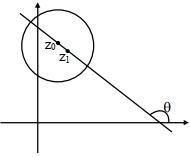
Let $C$ be the circle in the complex plane with centre $z_0=\frac{1}{2}(1+3 i)$ and radius $r=1$. Let $z_1=1+$ $i$ and the complex number $z_2$ be outside the circle $C$ such that $\left|z_1-z_0\right|\left|z_2-z_0\right|=1$. If $z_0, z_1$ and $z_2$ are collinear, then the smaller value of $\left|z_2\right|^2$ is equal to $.............$.
- A
$\frac{13}{2}$
- ✓
$\frac{5}{2}$
- C
$\frac{3}{2}$
- D
$\frac{7}{2}$
AnswerCorrect option: B. $\frac{5}{2}$
b
$\left|z_1-z_0\right|=\left|\frac{1-i}{2}\right|=\frac{1}{\sqrt{2}}$
$\Rightarrow\left|z_2-z_{\circ}\right|=\sqrt{2} ; \text { centre }\left(\frac{1}{2}, \frac{3}{2}\right)$
$z_{0}\left(\frac{1}{2}, \frac{3}{2}\right) \text { and } z_1(1,1)$
$\tan \theta=-1 \Rightarrow \theta=135^{\circ}$
$z_2\left(\frac{1}{2}+\sqrt{2} \cos 135^{\circ}, \frac{3}{2}+\sqrt{2} \sin 135^{\circ}\right)$
or
$\left(\frac{1}{2}-\sqrt{2} \cos 135^{\circ}, \frac{3}{2}-\sqrt{2} \sin 135^{\circ}\right)$
$\Rightarrow z_2\left(-\frac{1}{2}, \frac{5}{2}\right) \text { or } z_2\left(\frac{3}{2}, \frac{1}{2}\right)$
$\Rightarrow\left|z_2\right|^2=\frac{26}{4}, \frac{5}{2}$
$\Rightarrow\left|z_2\right|_{\min }^2=\frac{5}{2}$
View full question & answer→MCQ 1861 Mark
Let $z _{1}$ and $z _{2}$ be two complex numbers such that $\overline{ z }_{1}=i \overline{ z }_{2}$ and $\arg \left(\frac{ z _{1}}{\overline{ z }_{2}}\right)=\pi$. Then
- A
$\arg z _{2}=\frac{\pi}{4}$
- B
$\arg z _{2}=-\frac{3 \pi}{4}$
- ✓
$\arg z _{1}=\frac{\pi}{4}$
- D
$\arg z _{1}=-\frac{3 \pi}{4}$
AnswerCorrect option: C. $\arg z _{1}=\frac{\pi}{4}$
c
$\overline{ z }_{1}= i _{2}$
$z _{1}=- iz _{2}$
$\arg \left(\frac{ z _{1}}{\overline{ z }_{2}}\right)=\pi$
$\arg \left(- i \frac{ z _{2}}{\overline{ z }_{2}}\right)=\pi \quad \arg \left( z _{2}\right)=\theta$
$-\frac{\pi}{2}+\theta+\theta=\pi$
$2 \theta=\frac{3 \pi}{2}$
$\arg \left( z _{2}\right)=\theta=\frac{3 \pi}{4}, \arg z _{1}=\frac{\pi}{4}$
View full question & answer→MCQ 1871 Mark
If $z =2+3 i$, then $z ^{5}+(\overline{ z })^{5}$ is equal to.
Answera
$z^{5}+(\bar{z})^{5}=(2+3 i)^{5}+(2-3 i)^{5}$
$=2\left({ }^{5} C_{0} 2^{5}+{ }^{5} C_{2} 2^{3}(3 i)^{2}+{ }^{5} C_{4} 2^{1}(3 i)^{4}\right)$
$=2(32+10 \times 8(-9)+5 \times 2 \times 81)=244$
View full question & answer→MCQ 1881 Mark
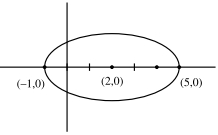
The number of points of intersection of $| z -(4+3 i )|=2$ and $| z |+| z -4|=6, z \in C$ is
Answerc
$C:(x-4)^{2}+(y-3)^{2}=4$
$E: \frac{(x-2)^{2}}{9}+\frac{y^{2}}{5}=1$
Lower Extremity of vertical diameter of circle $\rightarrow(4,1)$
Put in ellipse $\Rightarrow \frac{(4-2)^{2}}{9}+\frac{1}{5}-1$
$=\frac{4}{9}+\frac{1}{5}-1$
$=\frac{29}{45}-1<0$
Two Solutions
Answer (C)
View full question & answer→MCQ 1891 Mark
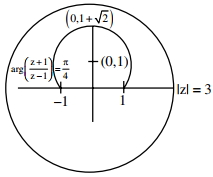
Let $\arg ( z )$ represent the principal argument of the complex number $z$. The, $| z |=3$ and $\arg ( z -1)-$ $\arg ( z +1)=\frac{\pi}{4}$ intersect
- A
- B
- ✓
- D
At infinitely many points.
Answerc
View full question & answer→MCQ 1901 Mark
For $z \in C$ if the minimum value of $(|z-3 \sqrt{2}|+|z-p \sqrt{2} i|)$ is $5 \sqrt{2}$, then a value of $P$ is $.......$
- A
$3$
- B
$\frac{7}{2}$
- ✓
$4$
- D
$\frac{9}{2}$
Answerc
It is sum of distance of $z$ from $(3 \sqrt{2}, 0)$ and $(0, p \sqrt{2})$
For minimising, $z$ should lie on $A B$ and $A B=5 \sqrt{2}$
$(A B)^{2}=18+2 p^{2}$
$p=\pm 4$
View full question & answer→MCQ 1911 Mark
Let $\alpha$ be a root of the equation $1+x^{2}+x^{4}=0$. Then the value of $\alpha^{1011}+\alpha^{\text {2022 }}-\alpha^{\text {3033}}$ is equal to
- ✓
$1$
- B
$\alpha$
- C
$1+\alpha$
- D
$1+2 \alpha$
Answera
$x^{4}+x^{2}+1=0$
$\Rightarrow\left(x^{2}+x+1\right)\left(x^{2}-x+1\right)=0$
$\Rightarrow x=\pm \;\omega, \pm \;\omega^{2}$ where $\omega=1^{1 / 3}$ and imaginary.
So $\alpha^{1011}+\alpha^{2002}-\alpha^{3033}=1+1-1=1$
View full question & answer→MCQ 1921 Mark
Let $\alpha$ and $\beta$ be the roots of the equation $x^{2}+(2 i -$ $1)=0$. Then, the value of $\left|\alpha^{8}+\beta^{8}\right|$ is equal to
- ✓
$50$
- B
$250$
- C
$1250$
- D
$1500$
Answera
$X^{2}=1-2 i \quad \Rightarrow \alpha^{2}=1-2 i , \quad \beta^{2}=1-2 i$
Hence $\alpha^{8}=\beta^{8}$
$\left|\alpha^{8}+\beta^{8}\right|=\left|2 \alpha^{8}\right|=2\left|\alpha^{2}\right|^{4}$
$=2 \sqrt{5}^{4}=50$
View full question & answer→MCQ 1931 Mark
Sum of squares of modulus of all the complex numbers $z$ satisfying $\bar{z}=i z^{2}+z^{2}-z$ is equal to
Answerb
$z +\overline{ z }=i z ^{2}+ z ^{2}$
Consider $z=x+i y$
$2 x=(i+1)\left(x^{2}-y^{2}+2 x y i\right)$
$\Rightarrow 2 x=x^{2}-y^{2}-2 x y \text { and } x^{2}-y^{2}+2 x y=0$
$\Rightarrow 2 x=-4 x y$
$\Rightarrow x=0 \text { or } y=\frac{-1}{2}$
Case $1: x=0 \Rightarrow y=0$ here $z=0$
$\text { Case } 2: y=\frac{-1}{2}$
$\Rightarrow 4 x^{2}-4 x-1=0$
$(2 x-1)^{2}=2$
$2 x-1=\pm \sqrt{2}$
$x=\frac{1 \pm \sqrt{2}}{2}$
Here $z =\frac{1+\sqrt{2}}{2}-\frac{ i }{2}$ or $z =\frac{1-\sqrt{2}}{2}-\frac{ i }{2}$
Sum of squares of modulus of $z$
$=0+\frac{(1+\sqrt{2})^{2}+1}{4}+\frac{(1-\sqrt{2})^{2}+1}{4}=\frac{8}{4}=2$
View full question & answer→MCQ 1941 Mark
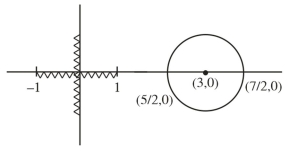
Let $S_{1}=\left\{z_{1} \in C:\left|z_{1}-3\right|=\frac{1}{2}\right\}$ and $S_{2}=\left\{z_{2} \in C:\left|z_{2}-\right| z_{2}+1||=\left|z_{2}+\right| z_{2}-1||\right\} . \quad$ Then, for $z_{1} \in S_{1}$ and $z_{2} \in S_{2}$, the least value of $\left|z_{2}-z_{1}\right|$ is.
- A
$0$
- B
$\frac{1}{2}$
- ✓
$\frac{3}{2}$
- D
$\frac{5}{2}$
AnswerCorrect option: C. $\frac{3}{2}$
c
$\left|z_{2}+\right| z_{2}-1||^{2}=\left|z_{2}-\right| z_{2}+1||^{2}$
$\left|z_{2}+\right| z_{2}-1||\left(\bar{z}_{2}+\left|z_{2}-1\right|\right)=\left(z_{2}-\left|z_{2}+1\right|\right)\left(\bar{z}_{2}-\left(z_{2}+1\right)\right)$
$z_{2}\left|\bar{z}_{2}+12_{2}-1\right|-\left(\bar{z}_{2}-\left|z_{2}+1\right|\right)+\bar{z}_{2}\left(\left|z_{2}-1\right|+\left|z_{2}+1\right|\right)$
$=\left|z_{2}+1\right|^{2}=\left|z_{2}-1\right|^{2}$
${\left[z_{2}+\bar{z}_{2}\right)\left(\left|z_{2}-1\right|\right)+\left(z_{2}+1 \mid\right)=2\left(z_{2}+\bar{z}_{2}\right) }$
$\left(z_{2}+\bar{z}_{2}\right)\left(\left|z_{2}-1\right|+\left|z_{2}+1\right|-2\right)=0$
$z_{2}+\bar{z}_{2}=0$ or $\left|z_{2}-1\right|+\left|z_{2}+1\right|-2=0$
$\therefore z_{2}+\bar{z}_{2}=0 \text { or }\left|z_{2}-1\right|+\left|z_{2}+1\right|-2=0$
$\therefore z _{2}$ lie on imaginary axis. Or on real axis with in $[-1,1]$
Also $\left|z_{1}-3\right|=\frac{1}{2}$ lie on circle having centre 3 and radius $\frac{1}{2}$
Clearly $\left|z_{1}-z_{2}\right| \min =\frac{5}{2}-1=\frac{3}{2}$
View full question & answer→MCQ 1951 Mark
If $z \neq 0$ be a complex number such that $\left| z -\frac{1}{ z }\right|=2$, then the maximum value of $|z|$ is.
- A
$\sqrt{2}$
- B
$1$
- C
$\sqrt{2}-1$
- ✓
$\sqrt{2}+1$
AnswerCorrect option: D. $\sqrt{2}+1$
d
$| z -1 / z |=2$
|| $z \left|-\frac{1}{| z |}\right| \leq\left| z -\frac{1}{ z }\right| \leq| z |+\frac{1}{| z |}$
$\left| r -\frac{1}{ r }\right| \leq 2 \leq r +\frac{1}{ r }$
$\left| r -\frac{1}{ r }\right| \leq 2 \& r +\frac{1}{ r } \geq 2$ always true
$r -\frac{1}{ r } \geq-2 \& r -\frac{1}{ r } \leq 2$
$r ^{2}-1 \leq 2 r$
$r ^{2}-2 r \leq 1$
$( r -1)^{2} \leq 2$
$r -1 \leq \sqrt{2}$
$\left.\therefore z \right|_{\max }=1+\sqrt{2}$
View full question & answer→MCQ 1961 Mark
If $z = x + iy$ satisfies $|z|-2=0$ and $|z-i|-|z+5 i|=0$, then
- A
$x +2 y -4=0$
- B
$x^{2}+y-4=0$
- ✓
$x^{2}+y-4=0$
- D
$x^{2}-y+3=0$
AnswerCorrect option: C. $x^{2}+y-4=0$
c
$|z-i|-|z+5 i|=0$
$|x+(y-1) i|=|x+(y+5) i|$
$x^{2}+(y-1)^{2}=x^{2}+(y+5)^{2}$
$(y-1)^{2}-(y+5)^{2}=0$
$(2 y+4)(-6)=0$
$y=-2$
$\therefore x^{2}+(-2)^{2}=4$
$x=0$
$Z \equiv(0,-2)$, check options
View full question & answer→MCQ 1971 Mark
Let $S=\left\{z \in C : z^{2}+\bar{z}=0\right\}$. Then $\sum \limits_{z \in S}(\operatorname{Re}(z)+\operatorname{Im}(z))$ is equal to$......$
Answerd
$S=\left\{z \in C: z^{2}+\bar{z}=0\right\}$
Let $z = x + iy$
$z ^{2}= x ^{2}- y ^{2}+2 ixy$
$\bar{z}=x-i y$
$z^{2}+\bar{z}=x^{2}-y^{2}+x+i(2 x y-y)=0$
$x^{2}+x-y^{2}=0 \text { \& } 2 x y-y=0$
$y=0$ or $x=\frac{1}{2}$
If $y =0 ; x =0,-1$
If $x=\frac{1}{2} ; y=\frac{\sqrt{3}}{2}, \frac{-\sqrt{3}}{2}$
$\sum_{z \in S}(\operatorname{Re}(z)+\operatorname{Im}(z)=\left(0-1+\frac{1}{2}+\frac{1}{2}\right)$
$+0+0+\frac{\sqrt{3}}{2}-\frac{\sqrt{3}}{2})$
View full question & answer→MCQ 1981 Mark
Let for some real numbers $\alpha$ and $\beta$, a $=\alpha-i \beta$. If the system of equations $4 ix +(1+ i ) y =0$ and $8\left(\cos \frac{2 \pi}{3}+i \sin \frac{2 \pi}{3}\right) x+\bar{a} y=0$ has more than one solution then $\frac{\alpha}{\beta}$ is equal to
- A
$-2+\sqrt{3}$
- ✓
$2-\sqrt{3}$
- C
$2+\sqrt{3}$
- D
$-2-\sqrt{3}$
AnswerCorrect option: B. $2-\sqrt{3}$
b
$a =\alpha- i \beta ; \alpha \in R ; \beta \in R$
$4 ix +(1+ i ) y =0$ and
$8\left(\cos \frac{2 \pi}{3}+ i \sin \frac{2 \pi}{3}\right) x +\overline{ a } y =0$
$\left|\begin{array}{cc}4 i \quad 1+ i \\ 8 e ^{ i 2 \pi / 3} \quad \overline{ a }\end{array}\right|=0$
$\Rightarrow 4 i \overline{ a }-(1+ i ) 8 e ^{ i 2 \pi / 3}=0$
$\Rightarrow 4 i (\alpha+ i \beta)-8(1+ i )\left(\frac{-1+ i \sqrt{3}}{2}\right)=0$
$\Rightarrow i \alpha-\beta+1+\sqrt{3}+ i (1-\sqrt{3})=0$
$\Rightarrow \beta=\sqrt{3}+1$
$\alpha=\sqrt{3}-1$
So, $\frac{\alpha}{\beta}$
$\frac{\alpha}{\beta}=\frac{\sqrt{3}-1}{\sqrt{3}+1}=2-\sqrt{3}$
View full question & answer→MCQ 1991 Mark
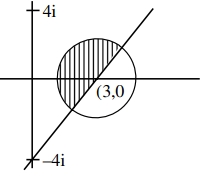
Let $S=\{z \in C :|z-3| \leq 1$ and $z(4+3 i)+\bar{z}(4-3 i) \leq 24\}$.
If $\alpha+i \beta$ is the point in $S$ which is closest to $4 i$, then $25(\alpha+\beta)$ is equal to
Answerc
$|z-3| \leq 1$
represent pt. i/s circle of radius $1 $ centred at $(3,0)$
$z(4+3 i)+\bar{z}(4-3 i) \leq 24$
$(x+i y)(4+3 i)+(x-i y)(4-3 i) \leq 24$
$4 x+3 x i+4 i y-3 y+4 x-3 i x-4 i y-3 y \leq 24$
$8 x-6 y \leq 24$
$4 x-3 y \leq 12$
minimum of $(0,4)$ from circle $=\sqrt{3^{2}+4^{2}}-1=4$ will lie along line joining $(0,4) \&(3,0)$
$\therefore$ equation line
$\frac{x}{3}+\frac{y}{4}=1 \Rightarrow 4 x+3 y=12 \ldots \text { (i) }$
equation circle $(x-3)^{2}+y^{2}=1 \ldots$ $(ii)$
$\left(\frac{12-3 y}{4}-3\right)^{2}+y^{2}=1$
$\left(\frac{-3 y}{4}\right)^{2}+y^{2}=1$
$\frac{25 y^{2}}{16}=1 \Rightarrow y=\pm \frac{4}{5}$
for minimum distance $y=\frac{4}{5}$
$\therefore x=\frac{12}{5}$
$\therefore 25(\alpha+\beta)=25\left(\frac{4}{5}+\frac{12}{5}\right)$
$=16 \times 5=80$
View full question & answer→MCQ 2001 Mark
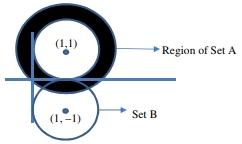
Let $A=\{z \in C: 1 \leq 1 z-(1+i) \leq 2\}$ and $B=\{z \in A:|z-(1-i)|=1\}$. Then, $B$
- A
- B
contains exactly two elements
- C
contains exactly three elements
- ✓
Answerd
$A=\{z \in C: 1 \leq z-(1+i) \leq 2\}$
$B=\{z \in A:|z-(1-i)|=1\}$
$A \cap B$ has infinite set
View full question & answer→