Question 14 Marks
A man running a racecourse notes that the sum of the distances from the two flag posts from him is always 10m and the distance between the flag posts is 8m. Find the equation of the posts traced by the man.
AnswerLet A and B be the positions of the two flag posts and P(x, y) be the position of the man. Accordingly, PA + PB = 10. We know that if a point moves in a plane in such a way that the sum of its distances from two fixed points is constant, then the path is an ellipse and this constant value is equal to the length of the major axis of the ellipse. Therefore, the path described by the man is an ellipse where the length of the major axis is 10 m, while points A and B are the foci. Taking the origin of the coordinate plane as the centre of the ellipse, while taking the major axis along the x-axis, the ellipse can be diagrammatically represented as, 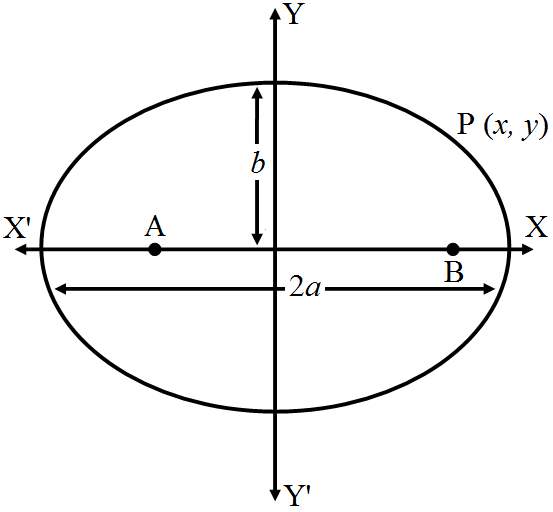 The equation of the ellipse will be of the form $\frac{\text{x}^2}{\text{a}^2}+\frac{\text{y}^2}{\text{b}^2}=1,$, where a is the semi-major axis Accordingly, 2a = 10 ⇒ a = 5 Distance between the foci (2c) = 8 On using the relation $\text{c}=\sqrt{\text{a}^2-\text{b}^2},$ we obtain $4=\sqrt{25-\text{b}^2}$ $\Rightarrow 16=25-\text{b}^2$ $\Rightarrow \text{b}^2=25-16=9$ $\Rightarrow \text{b}=3$ Thus, the equation of the path traced by the man is $\frac{\text{x}^2}{25}+\frac{\text{y}^2}{9}=1.$
 View full question & answer→Question 24 Marks
An equilateral triangle is inscribed in the parabola $y^2 = 4 ax$, where one vertex is at the vertex of the parabola. Find the length of the side of the triangle.
AnswerLet OAB be the equilateral triangle inscribed in parabola $y^2 = 4ax$. Let AB intersect the x-axis at point $C$. 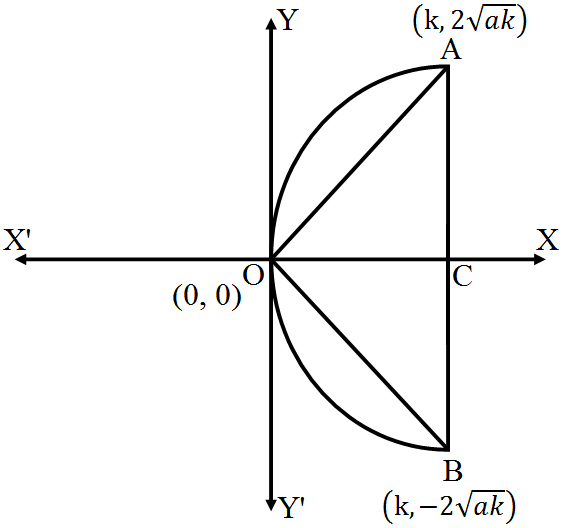
Let OC = k From the equation of the given parabola, we have $y^2 = 4ak \Rightarrow \text{y} =\pm2\sqrt{\text{ak}}$ $\therefore$ The respective coordinates of points A and B are $\big(\text{k},2\sqrt{\text{ak}}\big),$ and $\big(\text{k}-2\sqrt{\text{ak}}\big)$ AB = CA + CB $=2\sqrt{\text{ak}}+2\sqrt{\text{ak}}=4\sqrt{\text{ak}}$ Since OAB is an equilateral triangle, $OA^2 = AB^2$. $\therefore \text{k}^2+\big(2\sqrt{\text{ak}}\big)^2=\big(4\sqrt{\text{ak}}\big)^2$ $\Rightarrow \text{k}^2+4\text{ak}=16\text{ak}$ $\Rightarrow \text{k}^2=12\text{ak}$ $\Rightarrow \text{k}=12\text{a}$ $\therefore \text{AB}=4\sqrt{\text{ak}}=4\sqrt{\text{a}\times12\text{a}}=4\sqrt{12\text{a}^2}=8\sqrt{3\text{a}}$ Thus, the side of the equilateral triangle inscribed in parabola $y^2 = 4ax$ is $8\sqrt{3}\text{a}$. View full question & answer→Question 34 Marks
Find the coordinates of the foci, the vertices, the length of major axis, the minor axis, the eccentricity and the length of the latus rectum of the ellipse. $36x^2 + 4y^2 = 144$
AnswerThe given equation is $36x^2 + 4y^2 = 144$. It can be written as $36x^2 + 4y^2 = 144$ Or, $\frac{\text{x}^2}{4}+\frac{\text{y}^2}{36}=1$Or $\frac{\text{x}^2}{2^2}+\frac{\text{y}^2}{6^2}=1\ .....\text{(i)}$
Here, the denominator of $\frac{\text{y}^2}{6^2}$ is greater than the denominator of $\frac{\text{x}^2}{2^2}$.
Therefore, the major axis is along the y-axis, while the minor axis is along the x-axis. On comparing equation (i) with $\frac{\text{x}^2}{\text{b}^2}+\frac{\text{y}^2}{\text{a}^2}=1,$
we obtain b = 2 and a = 6. $\therefore \text{c}=\sqrt{\text{a}^2-\text{b}^2}=\sqrt{36-4}=\sqrt{32}=4\sqrt{2}$
Therefore, The coordinates of the foci are $(0,\pm4\sqrt{2})$ The coordinates of the vertices are $(0, \pm6)$ Length of major axis = 2a = 12 Length of minor axis = 2b = 4 Eccentricity, $\text{e}=\frac{\text{c}}{\text{a}}=\frac{4\sqrt{2}}{6}=\frac{2\sqrt{2}}{3}$ Length of latus rectum $=\frac{2\text{b}^2}{\text{a}}=\frac{2\times4}{6}=\frac{4}{3}.$
View full question & answer→Question 44 Marks
The cable of a uniformly loaded suspension bridge hangs in the form of a parabola. The roadway which is horizontal and $100m$ long is supported by vertical wires attached to the cable, the longest wire being $30m$ and the shortest being 6m. Find the length of a supporting wire attached to the roadway 18m from the middle.
AnswerThe vertex is at the lowest point of the cable. The origin of the coordinate plane is taken as the vertex of the parabola, while its vertical axis is taken along the positive y-axis. This can be diagrammatically represented as
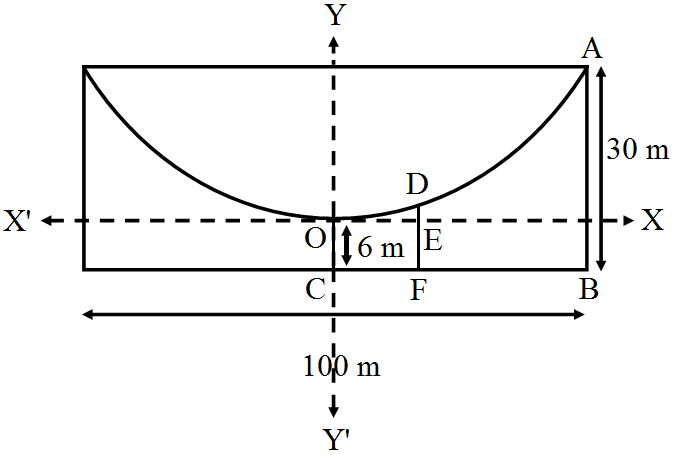
Here, $A B$ and $O C$ are the longest and the shortest wires, respectively, attached to the cable. $D F$ is the supporting wire attached to the roadway, 18 m from the middle. Here, $A B=30 \mathrm{~m}, O C=6 \mathrm{~m}$, and $B C=\frac{100}{2}=50 \mathrm{~m}$. The equation of the parabola is of the form $x^2=4$ ay (as it is opening upwards). The coordinates of point $A$ are $(50,30-6)=(50,24)$. Since $A(50,24)$ is a point on the parabola, $(50)^2=4 a(24) \Rightarrow a=\frac{50 \times 50}{4 \times 24}=\frac{625}{24} \therefore$ Equation of the parabola, $x^2=4 \times \frac{625}{24} \times y$ or $6 x^2=625 y$ The $x$-coordinate of point $D$ is 18 . Hence, at $x=18,6(18)^2=625 y \Rightarrow y=\frac{6 \times 18 \times 18}{625}$ $\Rightarrow \mathrm{y}=3.11$ (approx) $\therefore \mathrm{DE}=3.11 \mathrm{~m} D F=D E+E F=3.11 \mathrm{~m}+6 \mathrm{~m}=9.11 \mathrm{~m}$ Thus, the length of the supporting wire attached to the roadway 18 m from the middle is approximately 9.11 m . View full question & answer→Question 54 Marks
Find the equations of the hyperbola satisfying the given conditions. Foci $\big(0,\pm\sqrt{10}\big),$ passing through $(2, 3)$.
AnswerFoci $(0, \pm \sqrt{10})$, passing through $(2,3)$ Here, the foci are on the $y$-axis. Therefore, the equation of the hyperbola is of the form $\frac{y^2}{a^2}-\frac{x^2}{b^2}=1$. Since the foci are $(0, \pm \sqrt{10}), c=\sqrt{10}$. We know that $a^2+b^2=c^2 . \therefore a^2+b^2=10 \Rightarrow b^2$
$=10-a^2 \ldots . .$. (i) Since the hyperbola passes through point $(2,3), \frac{9}{a^2}-\frac{4}{b^2}=1 \ldots \ldots$ (ii) From equations (i) and (ii), we obtain $\frac{9}{a^2}-\frac{4}{\left(10-a^2\right)}=1$
$\Rightarrow 9\left(10-a^2\right)-4 a^2=a^2\left(10-a^2\right)$
$\Rightarrow 90-9 a^2-4 a^2=10 a^2-a^4 \Rightarrow a^4-23 a^2+90=0 \Rightarrow a^4$
$-18 a^2-5 a^2+90=0 \Rightarrow a^2\left(a^2-18\right)-5\left(a^2-18\right)=0 \Rightarrow\left(a^2-18\right)\left(a^2-5\right)=0 \Rightarrow a^2=18$ or $5 \ln$ hyperbola, $c>a$, i.e., $c^2>$
$a^2 \Rightarrow b^2=10-a^2=10-5=5$ Thus, the equation of the hyperbola is $\frac{y^2}{5}-\frac{x^2}{5}=1$.
View full question & answer→Question 64 Marks
Find the equation of the circle with radius $5$ whose centre lies on x-axis and passes through the point $(2, 3)$.
AnswerLet the equation of the required circle be $(x-h)^2+(y-k)^2=r^2$. Since the radius of the circle is 5 and its centre lies on the $x$-axis, $k=0$ and $r=5$. Now, the equation of the circle becomes $(x-h)^2+y^2=25$. It is given that the circle passes through point $(2,3) . $
$\therefore(2-h) 2+32=25 \Rightarrow(2-h) 2=25-9$
$\Rightarrow(2-h) 2=16 \Rightarrow 2-h \pm \sqrt{16}= \pm 4$ If $2-h$
$=4$, then $h=-2$ If $2-h=-4$, then $h=6$ When $h=-2$, the equation of the circle becomes $(x+2)^2+y^2=25 x^2+4 x+$
$4+y^2=25 x^2+y^2+4 x-21=0$ When $h=6$, the equation of the circle becomes $(x-6)^2+y^2=25 x^2-12 x+36+y^2$
$=25 x^2+y^2-12 x+11=0$
View full question & answer→Question 74 Marks
Find the equations of the hyperbola satisfying the given conditions. Foci $(\pm4,0),$ the latus rectum is of length $12$.
AnswerFoci $( \pm 4,0)$, the latus rectum is of length 12 . Here, the foci are on the $x$-axis. Therefore, the equation of the hyperbola is of the form $\frac{x^2}{a^2}-\frac{y^2}{b^2}=1$ Since the foci are $( \pm 4,0), c=4$. Lenght of latus rectum $=12 \Rightarrow \frac{2 b^2}{a}=12$
$\Rightarrow b^2=6 a$ We know that $a^2+b^2=c^2$.
$\therefore a^2+6 a=16 \Rightarrow a^2+6 a-16=0 \Rightarrow a^2+8 a-2 a-16=0 \Rightarrow(a+8)(a-2)=$
$0 \Rightarrow a=-8,2$ Since $a$ is non-negative, $a=2$.
$\therefore b^2=6 a=6 \times 2=12$ Thus, the equation of the hyperbola is $\frac{x^2}{4}-\frac{y^2}{12}=1$.
View full question & answer→Question 84 Marks
Find the coordinates of the foci, the vertices, the length of major axis, the minor axis, the eccentricity and the length of the latus rectum of the ellipse. $\frac{\text{x}^2}{100}+\frac{\text{y}^2}{400}=1$
AnswerThe given equation is $\frac{\text{x}^2}{100}+\frac{\text{y}^2}{400}=1$ or $\frac{\text{x}^2}{{10}^2}+\frac{\text{y}^2}{{20}^2}=1$ Here, the denominator of $\frac{\text{y}^2}{400}$ is greater than the denominator of $\frac{\text{x}^2}{100}$. Therefore, the major axis is along the y-axis, while the minor axis is along the x-axis. On comparing the given equation with $\frac{\text{x}^2}{\text{b}^2}+\frac{\text{y}^2}{\text{a}^2}=1,$ we obtain b = 7 and a = 6. $\therefore \text{c}=\sqrt{\text{a}^2-\text{b}^2}=\sqrt{400-100}=\sqrt{300}=10\sqrt{3}$ Therefore, The coordinates of the foci are $(0,\pm10\sqrt{13})$ The coordinates of the vertices are $(0,\pm20)$ Length of major axis = 2a = 40 Length of minor axis = 2b = 20 Eccentricity, $\text{e}=\frac{\text{c}}{\text{a}}=\frac{10\sqrt{3}}{20}=\frac{\sqrt{3}}{2}$ Lenght of lacus rectum $=\frac{2\text{b}^2}{\text{a}}=\frac{2\times100}{20}=10$
View full question & answer→Question 94 Marks
Find the coordinates of the foci, the vertices, the length of major axis, the minor axis, the eccentricity and the length of the latus rectum of the ellipse. $\frac{\text{x}^2}{49}+\frac{\text{y}^2}{36}=1$
AnswerThe given equation is $\frac{\text{x}^2}{49}+\frac{\text{y}^2}{36}=1$ or $\frac{\text{x}^2}{7^2}+\frac{\text{y}^2}{6^2}=1$ Here, the denominator of $\frac{\text{x}^2}{49}$ is greater than the denominator of $\frac{\text{y}^2}{36}$. Therefore, the major axis is along the y-axis, while the minor axis is along the x-axis. On comparing the given equation with $\frac{\text{x}^2}{\text{b}^2}+\frac{\text{y}^2}{\text{a}^2}=1,$ we obtain b = 7 and a = 6. $\therefore \text{c}=\sqrt{\text{a}^2-\text{b}^2}=\sqrt{49-36}=\sqrt{75}=\sqrt{13}$ Therefore, The coordinates of the foci are $(\pm\sqrt{13},0)$ The coordinates of the vertices are $(\pm7, 0)$ Length of major axis = 2a = 14 Length of minor axis = 2b = 12 Eccentricity, $\text{e}=\frac{\text{c}}{\text{a}}=\frac{\sqrt{13}}{7}$ Lenght of lacus rectum $=\frac{2\text{b}^2}{\text{a}}=\frac{2\times36}{7}=\frac{72}{7}$
View full question & answer→Question 104 Marks
Find the coordinates of the foci and the vertices, the eccentricity and the length of the latus rectum of the hyperbolas. $16x^2 - 9y^2 = 576$
AnswerThe given equation is $16x^2 - 9y^2 = 576$ It can be written as
$16x^2 - 9y^2 = 576$
Or $\frac{\text{x}^2}{36}-\frac{\text{y}^2}{64}=1$
Or $\frac{\text{x}^2}{6^2}-\frac{\text{y}^2}{8^2}=1\ .....\text{(i)}$
On comparing this equation (i) with the standard equation of hyperbola i.e., $\frac{\text{x}^2}{\text{a}^2}-\frac{\text{y}^2}{\text{b}^2}=1,$ we obtain $a = 6$ and $b = 8$
We know that $a^2 + b^2 = c^2$.
$\therefore c^2 = 36 + 64 = 100$
$\Rightarrow c = 10$
Therefore,
The coordinates of the foci are $(\pm10,0)$
The coordinates of the vertices are $(\pm6,0)$
Eccentricity, $\text{e}=\frac{\text{c}}{\text{a}}=\frac{10}{6}=\frac{5}{3}$
Length of latus rectum $=\frac{2\text{b}^2}{\text{a}}=\frac{2\times64}{6}=\frac{64}{3}$
View full question & answer→Question 114 Marks
Find the coordinates of the foci, the vertices, the length of major axis, the minor axis, the eccentricity and the length of the latus rectum of the ellipse. $\frac{\text{x}^2}{25}+\frac{\text{y}^2}{100}=1$
AnswerThe given equation is $\frac{\text{x}^2}{25}+\frac{\text{y}^2}{100}=1$ or $\frac{\text{x}^2}{5^2}+\frac{\text{y}^2}{10^2}=1$ Here, the denominator of $\frac{\text{y}^2}{100}$ is greater than the denominator of $\frac{\text{x}^2}{25}$. Therefore, the major axis is along the y-axis, while the minor axis is along the x-axis. On comparing the given equation with $\frac{\text{x}^2}{\text{b}^2}+\frac{\text{y}^2}{\text{a}^2}=1,$ we obtain b = 5 and a = 10. $\therefore \text{c}=\sqrt{\text{a}^2-\text{b}^2}=\sqrt{100-25}=\sqrt{75}=5\sqrt{3}$ Therefore, The coordinates of the foci are $(0,\pm5\sqrt{3})$ The coordinates of the vertices are $(0,\pm10)$ Length of major axis = 2a = 20 Length of minor axis = 2b = 10 Eccentricity, $\text{e}=\frac{\text{c}}{\text{a}}=\frac{5\sqrt{3}}{10}=\frac{\sqrt{3}}{2}$ Lenght of lacus rectum $=\frac{2\text{b}^2}{\text{a}}=\frac{2\times25}{10}=5$
View full question & answer→Question 124 Marks
Find the equations of the hyperbola satisfying the given conditions. Foci $(\pm3\sqrt{5},0),$ the latus rectum is of length $8$.
AnswerFoci $( \pm 3 \sqrt{5}, 0)$, the latus rectum is of length 8 . Here, the foci are on the $x$-axis. Therefore, the equation of the hyperbola is of the form $\frac{\mathrm{x}^2}{\mathrm{a}^2}-\frac{\mathrm{y}^2}{\mathrm{~b}^2}=1$ Since the foci are $( \pm 3 \sqrt{5}, 0), \mathrm{c}= \pm 3 \sqrt{5}$. Lenght of latus rectum $=8$
$\Rightarrow \frac{2 b^2}{a}=8 \Rightarrow b^2=4 a$ We know that $a^2+b^2=c^2 . \therefore a^2+4 a=45 \Rightarrow a^2+4 a-45=0 \Rightarrow a^2+9 a-5 a-45=0 \Rightarrow(a$
$+9)(a-5)=0 \Rightarrow a=-9,5$ Since $a$ is non-negative, $a=5 . \therefore b^2=4 a=4 \times 5=20$ Thus, the equation of the hyperbola is $\frac{x^2}{25}-\frac{y^2}{20}=1$.
View full question & answer→Question 134 Marks
Find the coordinates of the foci and the vertices, the eccentricity and the length of the latus rectum of the hyperbolas. $5y^2 - 9x^2 = 36$
AnswerThe given equation is $5y^2 - 9x^2 = 36$
$\Rightarrow \frac{\text{y}^2}{\Big(\frac{36}{5}\Big)^2}-\frac{\text{x}^2}{4}=1$
$\Rightarrow \frac{\text{y}^2}{\Big(\frac{6}{\sqrt{5}}\Big)^2}-\frac{\text{x}^2}{2^2}=1$ On comparing equation (i) with the standard equation of hyperbola i.e., $\frac{\text{y}^2}{\text{a}^2}-\frac{\text{x}^2}{\text{b}^2}=1$ we obtain $\text{a}=\frac{6}{\sqrt{5}}$ and b = 2. We know that $a^2 + b^2 = c^2$.
$\therefore \text{c}^2=\frac{36}{5}+4=\frac{56}{5}$
$\Rightarrow \text{c}=\sqrt{\frac{56}{5}}=\frac{2\sqrt{14}}{\sqrt{5}}$ Therefore, the coordinates of the foci are $\Big(0,\pm\frac{2\sqrt{14}}{\sqrt{5}}\Big)$ The coordinates of the vertices are $\Big(0,\pm\frac{6}{\sqrt{5}}\Big)$ Eccentricity, $\text{e}=\frac{\text{c}}{\text{a}}=\frac{\Big(\frac{2\sqrt{14}}{\sqrt{5}}\Big)}{\Big(\frac{6}{\sqrt{5}}\Big)}=\frac{\sqrt{14}}{3}$ Lenght of latus rectum $=\frac{2\text{b}^2}{\text{a}}=\frac{2\times4}{\Big(\frac{6}{\sqrt{5}}\Big)}=\frac{4\sqrt{5}}{3}$
View full question & answer→Question 144 Marks
An arch is in the form of a semi-ellipse. It is 8m wide and 2m high at the centre. Find the height of the arch at a point 1.5m from one end.
AnswerSince the height and width of the arc from the centre is 2m and 8m respectively, it is clear that the length of the major axis is 8m, while the length of the semi-minor axis is 2m. The origin of the coordinate plane is taken as the centre of the ellipse, while the major axis is taken along the x-axis. Hence, the semi-ellipse can be diagrammatically represented as, 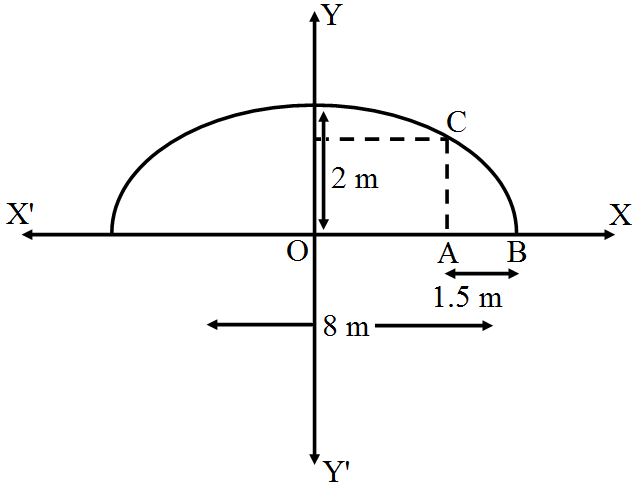 The equation of the semi-ellipse will be of the form $\frac{\text{x}^2}{\text{a}^2}+\frac{\text{y}^2}{\text{b}^2}=1,\text{y}\geq0,$, where a is the semi-major axis Accordingly, 2a = 8 ⇒ a = 4 ⇒ b = 2 Therefore, the equation of the semi-ellipse is $\frac{\text{x}^2}{16}+\frac{\text{y}^2}{4}=1,\text{y}\geq0\ .....\text{(i)}$ Let A be a point on the major axis such that AB = 1.5 m. Draw AC ⊥ OB. OA = (4 - 1.5) m = 2.5 m The x-coordinate of point C is 2.5. On substituting the value of x with 2.5 in equation (i), we obtain $\frac{(2.5)^2}{16}+\frac{\text{y}^2}{4}=1$ $\Rightarrow \frac{6.25}{16}+\frac{\text{y}^2}{4}=1$ $\Rightarrow \text{y}^2=4\Big(1-\frac{6.25}{16}\Big)$ $\Rightarrow \text{y}^2=4\Big(\frac{9.75}{16}\Big)$ $\Rightarrow \text{y}^2=2.4375$ $\Rightarrow \text{y}=1.56\text{(approx.)}$ $\therefore \text{AC}=1.56\text{m}$ Thus, the height of the arch at a point 1.5m from one end is approximately 1.56m.
 View full question & answer→Question 154 Marks
Find the coordinates of the foci and the vertices, the eccentricity and the length of the latus rectum of the hyperbolas. $\frac{\text{x}^2}{16}-\frac{\text{y}^2}{9}=1$
AnswerThe given equation is $\frac{\text{x}^2}{16}-\frac{\text{y}^2}{9}=1$ or $\frac{\text{x}^2}{4^2}-\frac{\text{y}^2}{3^2}=1$ On comparing this equation with the standard equation of hyperbola i.e., $\frac{\text{x}^2}{\text{a}^2}-\frac{\text{y}^2}{\text{b}^2}=1,$ we obtain a = 4 and b = 3. We know that $a^2 + b^2 = c^2$. $\therefore c^2 = 4^2 + 3^2 = 25 \Rightarrow c = 5$ Therefore, The coordinates of the foci are $(\pm5, 0)$ The coordinates of the vertices are $(\pm4, 0)$ Eccentricity, $\text{e}=\frac{\text{c}}{\text{a}}=\frac{5}{4}$ Length of latus rectum $=\frac{2\text{b}^2}{\text{a}}=\frac{2\times9}{4}=\frac{9}{2}$
View full question & answer→Question 164 Marks
Find the equation of the circle passing through the points $(4, 1)$ and $(6, 5)$ and whose centre is on the line $4x + y = 16$.
AnswerLet the equation of the required circle be $(x-h)^2+(y-k)^2=r^2$. Since the circle passes through points $(4,1)$ and $(6$, 5), $(4-h)^2+(1-k)^2=r^2 \ldots .$. (i) $(6-h)^2+(5-k)^2=r^2 \ldots .$. (ii) Since the centre $(h, k)$ of the circle lies on line $4 x+y=16$, $4 h+k=16 \ldots$ (iii) From equations (i) and (ii), we obtain $(4-h)^2+(1-k)^2=(6-h)^2+(5-k)^2 \Rightarrow 16-8 h+h^2+1-2 k$
$+k^2=36-12 h+h^2+25-10 k+k^2 \Rightarrow 16-8 h+1-2 k=36-12 h+25-10 k \Rightarrow 4 h+8 k=44 \Rightarrow h+2 k=11 \ldots$ (iv)
On solving equations (iii) and (iv), we obtain $h=3$ and $k=4$. On substituting the values of $h$ and $k$ in equation (i), we obtain $(4-3)^2+(1-4)^2=r^2 \Rightarrow(1)^2+(-3)^2=r^2 \Rightarrow 1+9=r^2 \Rightarrow r^2=10 \Rightarrow r=\sqrt{10}$ Thus, the equation of the required circle is $(\mathrm{x}-3)^2+(\mathrm{y}-4)^2=(\sqrt{10})^2$
$x^2-6 x+9+y^2-8 y+16=10 x^2+y^2-6 x-8 y+15=0$
View full question & answer→Question 174 Marks
Find the coordinates of the foci, the vertices, the length of major axis, the minor axis, the eccentricity and the length of the latus rectum of the ellipse. $16x^2 + y^2 = 16$
AnswerThe given equation is $16x^2 + y^2 = 16$. It can be written as $16x^2 + y^2 = 16$ Or, $\frac{\text{x}^2}{1}+\frac{\text{y}^2}{16}=1$Or $\frac{\text{x}^2}{1^2}+\frac{\text{y}^2}{4^2}=1\ .....\text{(i)}$
Here, the denominator of $\frac{\text{y}^2}{4^2}$ is greater than the denominator of $\frac{\text{x}^2}{1^2}$. Therefore, the major axis is along the y-axis, while the minor axis is along the x-axis. On comparing equation (i) with $\frac{\text{x}^2}{\text{b}^2}+\frac{\text{y}^2}{\text{a}^2}=1,$ we obtain b = 1 and a = 4. $\therefore \text{c}=\sqrt{\text{a}^2-\text{b}^2}=\sqrt{16-1}=\sqrt{15}$ Therefore, The coordinates of the foci are $(0,\pm\sqrt{15})$ The coordinates of the vertices are $(0, \pm4)$ Length of major axis = 2a = 8 Length of minor axis = 2b = 2 Eccentricity, $\text{e}=\frac{\text{c}}{\text{a}}=\frac{\sqrt{15}}{4}$ Length of latus rectum $=\frac{2\text{b}^2}{\text{a}}=\frac{2\times1}{4}=\frac{1}{2}.$
View full question & answer→Question 184 Marks
Find the area of the triangle formed by the lines joining the vertex of the parabola $x^2 = 12y$ to the ends of its latus rectum.
AnswerThe given parabola is $x^2=12 y$. On comparing this equation with $x^2=4 a y$, we obtain $4 a=12 \Rightarrow a=3 \therefore$. The coordinates of foci are $S(0, a)=S(0,3)$ Let $A B$ be the latus rectum of the given parabola. The given parabola can be roughly drawn as,
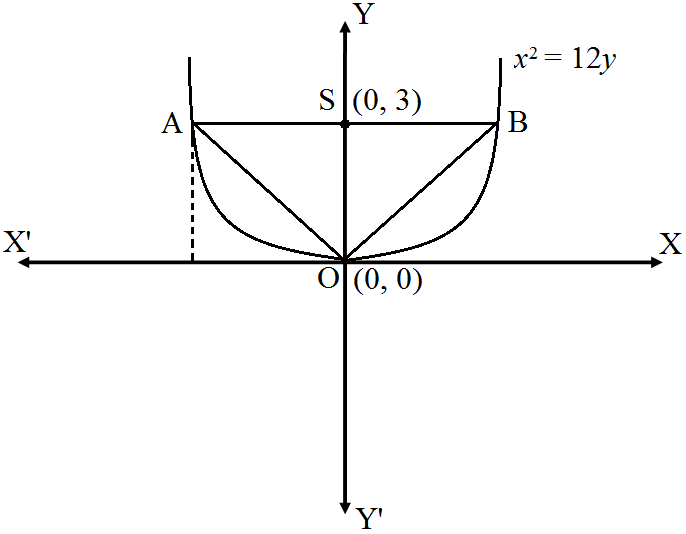
At $y = 3, x^2 = 12 (3) \Rightarrow x^2 = 36$
$\Rightarrow \text{x} = \pm6$
$\therefore$ The coordinates of A are (-6, 3), while the coordinates of B are (6, 3). Therefore, the vertices of $\triangle\text{OAB}$ are O(0, 0), A(-6, 3), and B(6, 3). Area of $\triangle\text{OAB}=\frac{1}{2}\big|0(3-3)+(-6)(3-0)+6(0-3)\big|\text{units}^2$ $=\frac{1}{2}\big|(-6)(3)+6(-3)\big|\text{unit}^2$ $=\frac{1}{2}\big|-18-18\big|\text{unit}^2$ $=\frac{1}{2}\big|-36\big|\text{unit}^2$ $=\frac{1}{2}\times36\text{ unit}^2$ $=18\text{ unit}^2$ Thus, the required area of the triangle is $18 unit^2$. View full question & answer→Question 194 Marks
Find the coordinates of the foci, the vertices, the length of major axis, the minor axis, the eccentricity and the length of the latus rectum of the ellipse. $\frac{\text{x}^2}{4}+\frac{\text{y}^2}{25}=1$
AnswerThe given equation is $\frac{\text{x}^2}{4}+\frac{\text{y}^2}{25}=1$ or $\frac{\text{x}^2}{2^2}+\frac{\text{y}^2}{5^2}=1$ Here, the denominator of $\frac{\text{y}^2}{25}$ is greater than the denominator of $\frac{\text{x}^2}{4}$. Therefore, the major axis is along the y-axis, while the minor axis is along the x-axis. On comparing the given equation with $\frac{\text{x}^2}{\text{b}^2}+\frac{\text{y}^2}{\text{a}^2}=1,$ we obtain b = 2 and a = 5. $\therefore \text{c}=\sqrt{\text{a}^2-\text{b}^2}=\sqrt{25-4}=\sqrt{21}$ The coordinates of the foci are $(0,\sqrt{21})$ or $(0,-\sqrt{21})$ The coordinates of the vertices are (0, 5) and (0, -5) Length of major axis = 2a = 10 Length of minor axis = 2b = 4 Eccentricity, $\text{e}=\frac{\text{c}}{\text{a}}=\frac{\sqrt{21}}{5}$ Lenght of lacus rectum $=\frac{2\text{b}^2}{\text{a}}=\frac{2\times4}{5}=\frac{8}{5}.$
View full question & answer→Question 204 Marks
Find the equation of the circle passing through the points $(2, 3)$ and $(-1, 1)$ and whose centre is on the line $x - 3y - 11 = 0$.
AnswerLet the equation of the required circle be $(x - h)^2 + (y - k)^2 = r^2$. Since the circle passes through points $(2, 3)$ and $(-1, 1), (2 - h)^2 + (3 - k)^2 = r^2 ..... (i) (-1 - h)^2 + (1 - k)^2 = r^2 .....$ (ii) Since the centre (h, k) of the circle lies on line $x - 3y - 11 = 0, h - 3k = 11 ....$. (iii) From equations (i) and (ii),
we obtain $(2 - h)^2+ (3 - k)^2 = (-1 - h)^2 + (1 - k)^2$
$\Rightarrow 4 - 4h + h^2 + 9 - 6k + k^2 = 1 + 2h + h^2 + 1 - 2k + k^2 $
$\Rightarrow 4 - 4h + 9 - 6k = 1 + 2h + 1 - 2k $
$\Rightarrow 6h + 4k = 11 … $(iv) On solving equations (iii) and (iv), we obtain $\text{h}=\frac{7}{2}$ and $\text{k}=\frac{-5}{2}$ On substituting the values of h and k in equation (i), we obtain $\Big(\text{x}-\frac{7}{2}\Big)^2+\Big(\text{y}+\frac{5}{2}\Big)^2=\frac{130}{4}$ $\Big(\frac{2\text{x}-7}{2}\Big)^2+\Big(\frac{2\text{y}+5}{2}\Big)^2=\frac{130}{4}$ $4\text{x}^2-28\text{x}+49+4\text{y}^2+20\text{y}+25=130$ $4\text{x}^2+4\text{y}^2-28\text{x}+20\text{y}-56=0$ $4(\text{x}^2+\text{y}^2-7\text{x}+5\text{y}-14)=0$ $\text{x}^2+\text{y}^2-7\text{x}+5\text{y}-14=0$
View full question & answer→Question 214 Marks
Find the equation for the ellipse that satisfies the given conditions: Vertices $(\pm5, 0),$ foci $(\pm4, 0).$
AnswerVertices $(\pm5, 0)$, foci $(\pm4, 0)$ Here, the vertices are on the x-axis. Therefore, the equation of the ellipse will be of the form $\frac{\text{x}^2}{\text{a}^2}+\frac{\text{y}^2}{\text{b}^2}=1,$ where a is the semi-major axis. Accordingly, a = 5 and c = 4. It is know that $a^2 = b^2 + c^2$.
$\therefore 5^2 = b^2 + 4^2$
$\Rightarrow 25 = b^2 + 16$
$\Rightarrow b^2 = 25 - 16$
$\Rightarrow \text{b}=\sqrt{9}=3$
Thus, the equation of the ellipse is $\frac{\text{x}^2}{5^2}+\frac{\text{y}^2}{3^2}=1$ or $\frac{\text{x}^2}{25}+\frac{\text{y}^2}{9}=1.$
View full question & answer→Question 224 Marks
Does the point $(-2.5, 3.5)$ lie inside, outside or on the circle $x^2 + y^2 = 25$?
AnswerThe equation of the given circle is $x^2 + y^2 = 25. x^2 + y^2 = 25 $
$\Rightarrow (x - 0)^2 + (y - 0)^2 = 5^2$, which is of the form $(x - h)^2 + (y - k)^2 = r^2$, where h = 0, k = 0, and r = 5.
$\therefore$ Centre = (0, 0) and radius = 5 Distance between point (-2.5, 3.5) and centre (0, 0) $=\sqrt{(-2.5-0)^2+(3.5-0)^2}$ $=\sqrt{6.25+12.25}$ $=\sqrt{18.5}$
$=4.3(\text{approx.})<5$ Since the distance between point (-2.5, 3.5) and centre (0, 0) of the circle is less than the radius of the circle, point (-2.5, 3.5) lies inside the circle.
View full question & answer→Question 234 Marks
Find the equations of the hyperbola satisfying the given conditions. Vertices $(\pm7,0),\text{e} = \frac{4}{3}.$
AnswerVertices $(\pm7,0),\text{e}=\frac{4}{3}$ Here, the vertices are on the x-axis. Therefore, the equation of the hyperbola is of the form $\frac{\text{x}^2}{\text{a}^2}-\frac{\text{y}^2}{\text{b}^2}=1.$. Since the vertices are $(\pm7, 0), \text{a} = 7.$ It is given that $\text{e}=\frac{4}{3}$ $\therefore \frac{\text{c}}{\text{a}}=\frac{4}{3}\Big[\text{e}=\frac{\text{c}}{\text{a}}\Big]$ $\Rightarrow \frac{\text{c}}{7}=\frac{4}{3}$ $\Rightarrow \text{c}=\frac{28}{3}$ We know that $a^2 + b^2 = c^2$. $\therefore 7^2+\text{b}^2=\Big(\frac{28}{3}\Big)^2$ $\Rightarrow \text{b}^2=\frac{784}{9}-49$ $\Rightarrow \text{b}^2=\frac{784-441}{9}=\frac{343}{9}$ Thus, the equation of the huperbola is $\frac{\text{x}^2}{49}-\frac{9\text{y}^2}{343}=1.$
View full question & answer→Question 244 Marks
An arch is in the form of a parabola with its axis vertical. The arch is $10m$ high and 5m wide at the base. How wide is it $2m$ from the vertex of the parabola?
AnswerThe origin of the coordinate plane is taken at the vertex of the arch in such a way that its vertical axis is along the negative y-axis. This can be diagrammatically represented as,
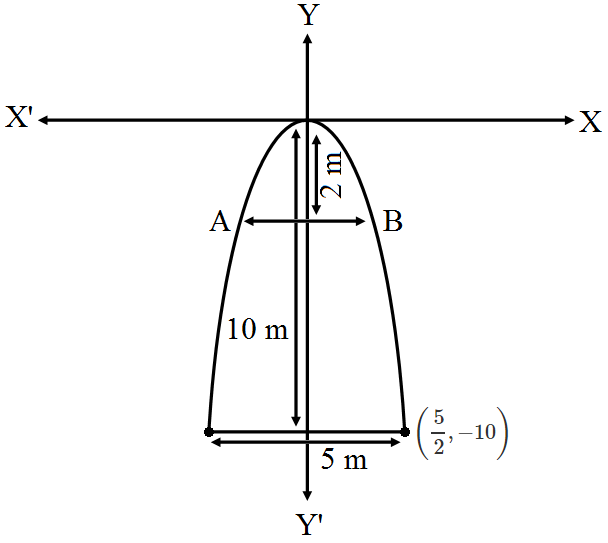
The equation of the parabola is of the form $x^2 = -4ay$ (as it is opening downwards). It can be clearly seen that the parabola passes through point $\Big(\frac{5}{2},10\Big)$
$\Big(\frac{5}{2}\Big)^2=4\text{a}(10)$
$\Rightarrow \text{a}=\frac{25}{54\times4\times10}=\frac{5}{32}$
Therefore, the arch is in the form of a parabola whose equation is $\text{x}^2=\frac{5}{8}\text{y}.$ When y = 2m, $\text{x}^2=\frac{5}{8}\times2$
$\Rightarrow \text{x}^2=\frac{5}{4}$ $\Rightarrow \sqrt{\frac{5}{4}}\text{m}$
$\therefore \text{AB}=2\times \sqrt{\frac{5}{4}}\text{m}=2\times1.118\text{m (approx.)}=2.23\text{m (approx.)}$
Hence, when the arch is 2m from the vertex of the parabola, its width is approximately 2.23m. View full question & answer→Question 254 Marks
Find the coordinates of the foci, the vertices, the length of major axis, the minor axis, the eccentricity and the length of the latus rectum of the ellipse. $\frac{\text{x}^2}{16}+\frac{\text{y}^2}{9}=1$
AnswerThe given equation is $\frac{\text{x}^2}{16}+\frac{\text{y}^2}{9}=1$ or $\frac{\text{x}^2}{4^2}+\frac{\text{y}^2}{3^2}=1$ Here, the denominator of $\frac{\text{x}^2}{16}$ is greater than the denominator of $\frac{\text{y}^2}{9}$. Therefore, the major axis is along the y-axis, while the minor axis is along the x-axis. On comparing the given equation with $\frac{\text{x}^2}{\text{b}^2}+\frac{\text{y}^2}{\text{a}^2}=1,$ we obtain b = 4 and a = 3. $\therefore \text{c}=\sqrt{\text{a}^2-\text{b}^2}=\sqrt{16-9}=\sqrt{7}$ The coordinates of the foci are $(\pm\sqrt{7},0)$ The coordinates of the vertices are $(\pm4,0)$ Length of major axis = 2a = 8 Length of minor axis = 2b = 6 Eccentricity, $\text{e}=\frac{\text{c}}{\text{a}}=\frac{\sqrt{7}}{4}$ Lenght of lacus rectum $=\frac{2\text{b}^2}{\text{a}}=\frac{2\times9}{4}=\frac{9}{2}.$
View full question & answer→Question 264 Marks
Find the coordinates of the foci, the vertices, the length of major axis, the minor axis, the eccentricity and the length of the latus rectum of the ellipse. $\frac{\text{x}^2}{36}+\frac{\text{y}^2}{16}=1$
AnswerThe given equation is $\frac{\text{x}^2}{36}+\frac{\text{y}^2}{16}=1$ Here, the denominator of $\frac{\text{x}^2}{36}$ is greater than the denominator of $\frac{\text{y}^2}{16}$. Therefore, the major axis is along the x-axis, while the minor axis is along the y-axis. On comparing the given equation with $\frac{\text{x}^2}{\text{a}^2}+\frac{\text{y}^2}{\text{b}^2}=1,$ we obtain a = 6 and b = 4. $\therefore \text{c}=\sqrt{\text{a}^2-\text{b}^2}=\sqrt{36-16}=\sqrt{20}=2\sqrt{5}$ The coordinates of the foci are $(2\sqrt{5},0)$ and $(-2\sqrt{5},0)$ The coordinates of the vertices are (6, 0) and (–6, 0) Length of major axis = 2a = 12 Length of minor axis = 2b = 8 Eccentricity, $\text{e}=\frac{\text{c}}{\text{a}}=\frac{2\sqrt{5}}{6}=\frac{\sqrt{5}}{3}$ Length of latus rectum $=\frac{2\text{b}^2}{\text{a}}=\frac{2\times16}{6}=\frac{16}{3}$
View full question & answer→Question 274 Marks
A rod of length 12cm moves with its ends always touching the coordinate axes. Determine the equation of the locus of a point P on the rod, which is 3cm from the end in contact with the x-axis.
AnswerLet AB be the rod making an angle $\theta$ with OX and P (x, y) be the point on it such that AP = 3cm. Then, PB = AB - AP = (12 - 3)cm = 9cm [AB = 12cm] From P, draw PQ $\bot$ OY and PR $\bot$ OX. 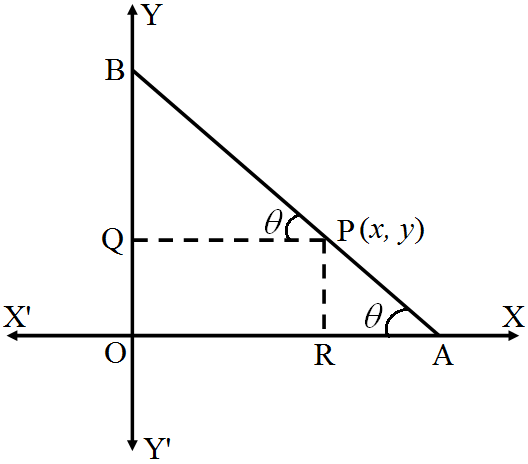 In $\triangle\text{PBQ},\cos\theta=\frac{\text{PQ}}{\text{PB}}=\frac{\text{x}}{9}$ In $\triangle\text{PRA},\sin\theta=\frac{\text{PR}}{\text{PA}}=\frac{\text{y}}{3}$ $\Big(\frac{\text{y}}{3}\Big)^2+\Big(\frac{\text{x}}{9}\Big)^2=1$ Or, $\frac{\text{x}^2}{81}+\frac{\text{y}2}{9}=1$ Thus, the equation of the locus of point P on the rod is $\frac{\text{x}^2}{81}+\frac{\text{y}^2}{9}=1.$
 View full question & answer→Question 284 Marks
Find the equation of the circle passing through $(0, 0)$ and making intercepts a and b on the coordinate axes.
AnswerLet the equation of the required circle be $(x - h)^2 + (y - k)^2 = r^2$. Since the circle passes through $(0, 0), (0 - h)^2 + (0 - k)^2 = r^2 \Rightarrow h^2 + k^2 = r^2$ The equation of the circle now becomes $(x - h)^2 + (y - k)^2 = h^2 + k^2$. It is given that the circle makes intercepts a and b on the coordinate axes. This means that the circle passes through points (a, 0) and (0, b). Therefore, $(a - h)^2 + (0 - k)^2 = h^2 + k^2 ..... (i) (0 - h)^2 + (b - k)^2 = h^2 + k^2 ..... (ii)$ From equation (i), we obtain $a^2 - 2ah + h^2 + k^2 = h^2 + k^2 \Rightarrow a^2 - 2ah = 0 \Rightarrow a(a - 2h) = 0 \Rightarrow a = 0 or (a - 2h) = 0$ However, $\text{a} \neq 0,$ hence, (a - 2h) = 0 $\Rightarrow \text{h}=\frac{\text{a}}{2}.$ From equation (ii), we obtain $h^2 + b^2 - 2bk + k^2 = h^2 + k^2 \Rightarrow b^2 - 2bk = 0 \Rightarrow b(b - 2k) = 0 \Rightarrow b = 0 or (b - 2k) = 0$ However, $\text{b} \neq 0,$ hence, (b - 2k) = 0 $\Rightarrow \text{k}=\frac{\text{b}}{2}.$ Thus, the equation of the required circle is $\Big(\text{x}-\frac{\text{a}}{2}\Big)^2+\Big(\text{y}-\frac{\text{b}}{2}\Big)^2=\Big(\frac{\text{a}}{2}\Big)^2+\Big(\frac{\text{b}}{2}\Big)^2$
$\Rightarrow \Big(\frac{2\text{x}-\text{a}}{2}\Big)^2+\Big(\frac{2\text{y}-\text{b}}{2}\Big)^2=\frac{\text{a}^2+\text{b}^2}{4}$
$\Rightarrow 4\text{x}^2-4\text{ax}+\text{a}^2+4\text{y}^2-4\text{by}+\text{b}^2=\text{a}^2+\text{b}^2$
$\Rightarrow 4\text{x}^2+4\text{y}^2-4\text{ax}-4\text{by}=0$
$\Rightarrow \text{x}^2+\text{y}^2-\text{ax}-\text{by}=0$
View full question & answer→Question 294 Marks
Find the coordinates of the foci, the vertices, the length of major axis, the minor axis, the eccentricity and the length of the latus rectum of the ellipse. $4x^2 + 9y^2 = 36$
AnswerThe given equation is $4x^2 + 9y^2 = 36$. It can be written as $4x^2 + 9y^2 = 36$ Or, $\frac{\text{x}^2}{9}+\frac{\text{y}^2}{4}=1$Or $\frac{\text{x}^2}{3^2}+\frac{\text{y}^2}{2^2}=1\ .....\text{(i)}$
Here, the denominator of $\frac{\text{x}^2}{3^2}$ is greater than the denominator of $\frac{\text{y}^2}{2^2}$.
Therefore, the major axis is along the y-axis, while the minor axis is along the x-axis. On comparing equation (i) with $\frac{\text{x}^2}{\text{b}^2}+\frac{\text{y}^2}{\text{a}^2}=1,$ we obtain b = 3 and a = 2.
$\therefore \text{c}=\sqrt{\text{a}^2-\text{b}^2}=\sqrt{9-4}=\sqrt{5}$
Therefore, The coordinates of the foci are $(\pm\sqrt{15},0)$
The coordinates of the vertices are $(\pm3,0)$ Length of major axis = 2a = 6 Length of minor axis = 2b = 4 Eccentricity, $\text{e}=\frac{\text{c}}{\text{a}}=\frac{\sqrt{5}}{3}$ Length of latus rectum $=\frac{2\text{b}^2}{\text{a}}=\frac{2\times4}{3}=\frac{8}{3}.$
View full question & answer→Question 304 Marks
Find the coordinates of the foci and the vertices, the eccentricity and the length of the latus rectum of the hyperbolas. $\frac{\text{y}^2}{9}-\frac{\text{x}^2}{27}=1$
AnswerThe given equation is $\frac{\text{x}^2}{9}-\frac{\text{y}^2}{27}=1$ or $\frac{\text{x}^2}{3^2}-\frac{\text{y}^2}{\big(\sqrt{27}\big)^2}=1$ On comparing this equation with the standard equation of hyperbola i.e., $\frac{\text{x}^2}{\text{a}^2}-\frac{\text{y}^2}{\text{b}^2}=1,$ we obtain a = 3 and $\text{b} = \sqrt{27}$ We know that $a^2 + b^2 = c^2$. $\therefore\text{c}^2=3^2+\big(\sqrt{27}\big)^2=9+27=36$$\Rightarrow \text{c}=6$
Therefore, The coordinates of the foci are $(0,\pm6)$ The coordinates of the vertices are $(0,\pm3)$ Eccentricity, $\text{e}=\frac{\text{c}}{\text{a}}=\frac{6}{3}=2$ Length of latus rectum $=\frac{2\text{b}^2}{\text{a}}=\frac{2\times27}{2}=18$
View full question & answer→Question 314 Marks
Find the coordinates of the foci and the vertices, the eccentricity and the length of the latus rectum of the hyperbolas. $49y^2 - 16x^2 = 784$
AnswerThe given equation is $49y^2 - 16x^2 = 784$.It can be written as
$49y^2 - 16x^2 = 784$.
Or $\frac{\text{y}^2}{16}-\frac{\text{x}^2}{49}=1$
$\frac{\text{y}^2}{4^2}-\frac{\text{x}^2}{7^2}=1\ .....\text{(i)}$
On comparing equation (i) with the standard equation of hyperbola i.e., $\frac{\text{y}^2}{\text{a}^2}-\frac{\text{x}^2}{\text{b}^2}=1$ we obtain a = 4 and b = 7.
We know that $a^2 + b^2 = c^2$.
$\therefore c^2 = 16 + 49 = 65$
$\Rightarrow \text{c}=\sqrt{65}$
The coordinates of the foci are $(0,\pm\sqrt{65})$
The coordinates of the vertices are $(0,\pm4)$
Eccentricity, $\text{e}=\frac{\text{c}}{\text{a}}=\frac{\sqrt{65}}{4}$
Lenght of latus rectum $=\frac{2\text{b}^2}{\text{a}}=\frac{2\times49}{4}=\frac{49}{2}$
View full question & answer→Question 324 Marks
Find the coordinates of the foci and the vertices, the eccentricity and the length of the latus rectum of the hyperbolas. $9y^2 - 4x^2 = 36$
AnswerThe given equation is $9y^2 - 4x^2 = 36$ It can be written as $9y^2 - 4x^2 = 36$ Or $\frac{\text{y}^2}{4}-\frac{\text{x}^2}{9}=1$ Or $\frac{\text{y}^2}{2^2}-\frac{\text{x}^2}{3^2}=1\ .....\text{(i)}$ On comparing this equation with the standard equation of hyperbola i.e., $\frac{\text{x}^2}{\text{a}^2}-\frac{\text{y}^2}{\text{b}^2}=1,$ we obtain a = 3 and b = 3 We know that $a^2 + b^2 = c^2$.
$\therefore c^2 = 4 + 9 = 13$
$\Rightarrow \text{c}=\sqrt{13}$
Therefore, The coordinates of the foci are $(0,\pm\sqrt{13})$ The coordinates of the vertices are $(0,\pm2)$ Eccentricity, $\text{e}=\frac{\text{c}}{\text{a}}=\frac{\sqrt{13}}{2}$ Length of latus rectum $=\frac{2\text{b}^2}{\text{a}}=\frac{2\times9}{2}=9$
View full question & answer→Question 334 Marks
Find the coordinates of the focus, axis of the parabola, the equation of the directrix and the length of the latus rectum. $x^2 = 6y$.
AnswerThe given equation is $x^2 = 6y$. Here, the coefficient of y is positive. Hence, the parabola opens upwards. On comparing this equation with $x^2 = 4ay$, we obtain $\Rightarrow4\text{a}=6$ $\Rightarrow \text{a}=\frac{3}{2}$ $\therefore$ Coordinates of the focus $= (0, \text{a}) =\Big(0,\frac{3}{2}\Big)$ Since the given equation involves $x^2$, the axis of the parabola is the y-axis. Equation of directrix, y = -a i.e., $\text{y}=-\frac{3}{2}$ Length of latus rectum = 4a = 6
View full question & answer→Question 344 Marks
Find the equation for the ellipse that satisfies the given conditions: Vertices $(0,\pm13),$ foci $(0,\pm5).$
AnswerVertices $(0,\pm13)$, foci $(0,\pm5)$ Here, the vertices are on the x-axis. Therefore, the equation of the ellipse will be of the form $\frac{\text{x}^2}{\text{a}^2}+\frac{\text{y}^2}{\text{b}^2}=1,$ where a is the semi-major axis. Accordingly, a = 13 and c = 5. It is know that $a^2 = b^2 + c^2$.
$\therefore 13^2 = b^2 + 5^2$
$ \Rightarrow 169 = b^2 + 25$
$\Rightarrow b^2 = 169 - 25$
$\Rightarrow \text{b}=\sqrt{144}=12$ Thus, the equation of the ellipse is $\frac{\text{x}^2}{12^2}+\frac{\text{y}^2}{13^2}=1$ or $\frac{\text{x}^2}{144}+\frac{\text{y}^2}{169}=1.$
View full question & answer→