MCQ 11 Mark
Two lines are said to be perpendicular if the product of their slope is equal to:
Answer
- -1
Solution:
When two lines are perpendicular, then the product of their slope is equal to -1. If two lines are perpendicular with slope $m_1$ and $m_2$, then $m_1.m_2$ = -1. View full question & answer→MCQ 21 Mark
If slope of a line is 4 and y-intercept made by the line is 2 then the equation of line will be:
AnswerLet general equation of line be y = m × x + c.
Given, m = 4 and c = 2.
⇒ y = 4x + 2
View full question & answer→MCQ 31 Mark
Given the three straight lines with equations 5x + 4y = 0, x + 2y - 10 = 0 and 2x + y + 5 = 0, then these lines are:
- A
- B
The sides of a right angled triangle
- ✓
- D
The sides of an equilateral triangle
View full question & answer→MCQ 41 Mark
Choose the correct answer. A point equidistant from the lines 4x + 3y + 10 = 0, 5x – 12y + 26 = 0 and 7x + 24y – 50 = 0 is:
Answer
- (0, 0)
Solution:
Given equation are
$4x + 3y + 10 = 0 .....(i)$
$5x - 12y + 26 = 0 .....(ii)$
and $7x + 27y - 50 = 0 .....(iii)$
Let $(x_1, y_1)$ be any point equidistant from eq. (i), eq. (ii) and eq. (iii).
Distance of $(x_1, y_1)$ from eq. (i)
$=\Big|\frac{4\text{x}_1+3\text{y}_1+10}{\sqrt{16+9}}\Big|=\Big|\frac{4\text{x}_1+3\text{y}_1+10}{5}\Big|$
Distance of $(x_1, y_1)$ from eq. (iii)
$=\Big|\frac{5\text{x}_1-12\text{y}_1+26}{\sqrt{25+144}}\Big|=\Big|\frac{5\text{x}_1-12\text{y}_1+26}{13}\Big|$
Distance of $(x_1, y_1)$ from eq. (iii)
$=\Big|\frac{7\text{x}_1+24\text{y}_1-50}{\sqrt{49+576}}\Big|=\Big|\frac{7\text{x}_1+24\text{y}_1-50}{25}\Big|$
If the point $(x_1, y_1)$ is equidistant from the given lines, then
$\Big|\frac{4\text{x}_1+3\text{y}_1+10}{5}\Big|=\Big|\frac{5\text{x}_1-12\text{y}_!+26}{13}\Big|=\Big|\frac{7\text{x}_1+24\text{y}_1-50}{25}\Big|$
We see that putting $x_1 = 0$ and $y_1 = 0$, the above relation is satisfied i.e.,
$=\frac{10}{5}=\frac{26}{13}=\frac{50}{25}=2$
Hence, the correct option is (c). View full question & answer→MCQ 51 Mark
Find the equation of line parallel to 4x + y = 2 and pass through (2, 5):
AnswerLine 4x + y = 2 hasslope -4 Line parallel to it has
slope -4 and pass through (2, 5)
so equation will be y - 5 = (-4) (x - 2)
⇒ 4x + y - 13 = 0
View full question & answer→MCQ 61 Mark
If slope of a line is positive then its inclination is:
Answer
- Acute angle.
Solution:
If inclination is $\alpha$ slope is given by $\tan\alpha$ Given that slope of line is positive which means $\tan\alpha$ is positive. We know, $\tan\alpha$ is positive in $1^{st}$ quadrant i.e. $\alpha$ should be acute angle. View full question & answer→MCQ 71 Mark
What is the distance of (5, 12) from origin?
Answer
- 13 units.
Solution:
We know, distance between two points $(x_1, y_1)$ and $(x_2, y_2)$ is $\sqrt{({\text{x}}_{1}-{\text{x}}_{2})^{2}+({\text{y}}_{1}-{\text{y}}_{2})^{2}}$
So, distance between (5, 12) from origin (0, 0) is $\sqrt{({5-0})^{2}+({12-0})^{2}} = \sqrt{({5})^{2}+({12})^{2}} =13\text{ unit}.$ View full question & answer→MCQ 81 Mark
Three vertices of a parallelogram taken in order are (-1, -6), (2, -5) and (7, 2). The fourth vertex is:
Answer
- (4, 1)
Solution:
Let A(-1, -6), B(2, -5) and C(7, 2) be the given vertex. Let D(h, k) be the fourth vertex.
The midpoints of AC and BD are (3, -2) and $\Big(\frac{2+\text{h}}{2},\frac{-5+\text{k}}{2}\Big)$ respectively.
We know that the diagonals of a parallelogram bisect each other.
$\therefore3=\frac{2+\text{h}}{2}$ and $-2=\frac{-5+\text{k}}{2}$
$\Rightarrow\text{h}=4$ and $\text{k}=1$ View full question & answer→MCQ 91 Mark
If slope of a line is $\frac{2}{3}$ then find the slope of line perpendicular to it:
- ✓
$\frac{-3}{2}$
- B
$\frac{3}{2}$
- C
$\frac{2}{3}$
- D
$\frac{-2}{3}$
AnswerCorrect option: A. $\frac{-3}{2}$
- $\frac{-3}{2}$
Solution:
If lines with slopes $m_1$ and $m_2$ are perpendicular then $m_1 \times m_2 = -1$.
If $\text{m}_{1} = \frac{2}{3}$ then $\text{m}_{2} = \frac{-3}{2} $ View full question & answer→MCQ 101 Mark
The point which divides the join of (1, 2) and (3, 4) externally in the ratio 1 : 1:
- A
Lies in the III quadrant.
- B
- C
- ✓
Answer
- Cannot be found.
Solution:
The point which divides the join of (1, 2) and (3, 4) externally in the ratio 1 : 1 is
$\Big(\frac{1\times3-1\times1}{1-1},\frac{1\times4-1\times2}{1-1}\Big)$
which is not defined.
Therefore, it is not possible to externally divide the line joining two points in the ratio 1 : 1 View full question & answer→MCQ 111 Mark
Find the equation of line parallel to y-axis and passing through (3, 4):
Answer
- x = 3
Solution:
Let general equation of line be y = m (x - d)
$\Rightarrow\text{x} = \frac{\text{y}}{\text{m + d}}$
Since line is parallel to y-axis so, $\text{m}=\frac{1}{0}$ or $\frac{1}{\text{m}} =0$
⇒ x = d
⇒ x = 3 by substituting the point (3, 4). View full question & answer→MCQ 121 Mark
Choose the correct answer. Equation of the line passing through (1, 2) and parallel to the line y = 3x - 1 is:
Answer
- y - 2 = 3 (x - 1)
Solution:
Given equation is y = 3x - 1
Slope = 3
Slope of the line passing through the given point (1, 2) and parallel to the given line = 3
So, the equation of the required line is
y - 2 = 3(x - 1)
Hence, the correct option is (c).
View full question & answer→MCQ 131 Mark
Choose the correct answer. The tangent of angle between the lines whose intercepts on the axes are a, -b and b, -a, respectively, is
- A
$\frac{\text{a}^2-\text{b}^2}{\text{ab}}$
- B
$\frac{\text{b}^2-\text{a}^2}{2}$
- ✓
$\frac{\text{b}^2-\text{a}^2}{2\text{ab}}$
- D
AnswerCorrect option: C. $\frac{\text{b}^2-\text{a}^2}{2\text{ab}}$
- $\frac{\text{b}^2-\text{a}^2}{2\text{ab}}$
Solution:
Intercepts of line are a and -b; i.e., line passes through the points (a, 0), (0, -b).
$\therefore$ Slope of line, $\text{m}_1=\frac{-\text{b}-0}{0-\text{a}}=\frac{\text{b}}{\text{a}}$
Intercepts of line are b, -a; i.e., line passes through the points (b, 0), (0, -a).
$\therefore$ Slope of line, $\text{m}_2=\frac{-\text{a}-0}{0-\text{b}}=\frac{\text{a}}{\text{b}}$
If $\theta$ is the angle between the lines, then
$\tan=\theta=\frac{\frac{\text{b}}{\text{a}}-\frac{\text{a}}{\text{b}}}{1+\frac{\text{a}}{\text{b}}\times\frac{\text{b}}{\text{a}}}=\frac{\frac{\text{b}^2-\text{a}^2}{\text{ab}}}{2}=\frac{\text{b}^2-\text{a}^2}{2\text{ab}}$ View full question & answer→MCQ 141 Mark
Find slope of line passing through origin and (3, 6):
- ✓
$2$
- B
$3$
- C
$\frac{1}{3}$
- D
$\frac{1}{2}$
Answer
- $2$
Solution:
We know, slope of line joining two points ($x_1, y_1$) and ($x_2, y_2$) is given by $\frac{(\text{y}_{2}-\text{y}_{1})}{(\text{x}_{2}-\text{x}_{1})}$
So, slope of line joining (0, 0) and (3, 6) is $\frac{(6-0)}{(3-0)} = \frac{6}{3} = 2$ View full question & answer→MCQ 151 Mark
A triangle ABC is right angled at A has points A and B as (2, 3) and (0, -1) respectively. If BC = 5, then point C may be:
MCQ 161 Mark
L is a variable line such that the algebraic sum of the distances of the points (1, 1), (2, 0) and (0, 2) from the line is equal to zero. The line L will always pass through:
Answer
- (1,1)
Solution:
Let ax + by + c = 0 be the variable line. It is given that the algebraic sum of the distances of the points (1, 1), (2, 0) and (0, 2) from the line is equal to zero
$\therefore \ \frac{\text{a}+\text{b}+\text{c}}{\sqrt{\text{a}^2+\text{b}^2}}+\frac{2\text{a}+0+\text{c}}{\sqrt{\text{a}^2+\text{b}^2}}+\frac{0+2\text{b}+\text{c}}{\sqrt{\text{a}^2+\text{b}^2}}=0$
$\Rightarrow3\text{a}+3\text{b}+3\text{c}=0$
$\Rightarrow\text{a}+\text{b}+\text{c}=0$
Substituting c = -a - b in ax + by + c = 0, we get:
$\text{ax}+\text{by}-\text{a}-\text{b}=0$
$\Rightarrow\text{a}(\text{x}-1)+\text{b}(\text{y}-1)=0$
$\Rightarrow(\text{x}-1)+\frac{\text{a}}{\text{b}}(\text{y}-1)=0$
This line is of the form $\text{L}_1+\lambda\text{L}_2=0$ which passes through the intersection of $L_1 =0$ and $L_2 =0$,i.e. x - 1 = 0 and y - 1 = 0.
⇒ x = 1, y = 1 View full question & answer→MCQ 171 Mark
Equation of horizontal line below x-axis at 5 units from x-axis is:
Answer
- y = -5
Solution:
Equation of x-axis is y = 0. Horizontal line is parallel to x-axis and below it by 5 units so, equation of line is y = -5.
View full question & answer→MCQ 181 Mark
Choose the correct answer. The equation of the line passing through the point (1, 2) and perpendicular to the line x + y + 1 = 0 is:
AnswerSlope of the given line +1 = 0 is -1.
So, slope of line perpendicular to above line is 1.
Line passes through the point (1, 2).
Therefore, equation of the required linens:
⇒ y - 2 = 1(x - 1)
⇒ y - x - 1 = 0.
View full question & answer→MCQ 191 Mark
Choose the correct answer. The equations of the lines passing through the point (1, 0) and at a distance $\frac{\sqrt{3}}{2}$ from the origin, are
- A
$\sqrt{3}\text{x}+\text{y}-\sqrt{3}=0,\sqrt{3}\text{x}-\text{y}-\sqrt{3}=0$
- B
$\sqrt{3}\text{x}+\text{y}+\sqrt{3}=0,\sqrt{3}\text{x}-\text{y}+\sqrt{3}=0$
- C
$\text{x}+\sqrt{3}\text{y}-\sqrt{3}=0,\text{x}-\sqrt{3}\text{y}-\sqrt{3}=0$
- ✓
AnswerEquation of any line passing through (1, 0) is
⇒ y - 0 = m(x - 1)
⇒ mx - y - m = 0
Distance of the line from origin is $\frac{\sqrt{3}}{2}$
$\therefore \frac{\sqrt{3}}{2} =\Big|\frac{\text{m}\times0-0-\text{m}}{\sqrt{1+\text{m}^2}}\Big|$
$\Rightarrow \frac{\sqrt{3}}{2}=\Big|\frac{-\text{m}}{\sqrt{1+\text{m}^2}}\Big|$
Squaring both sides, we get
$\frac{3}{4}=\frac{\text{m}^2}{1+\text{m}^2}$
$\Rightarrow 4\text{m}^2=3+3\text{m}^2$
$\Rightarrow 4\text{m}^2-3\text{m}^2=3$
$\Rightarrow \text{m}^2=3$
$\therefore \text{m}=\pm\sqrt{3}$
$\therefore$ Required equations are
$\pm\sqrt{3}\text{x}-\text{y}\mp\sqrt{3}=0$
i.e., $\sqrt{3}\text{x}-\text{y}-\sqrt{3}=0=0$ and $-\sqrt{3}\text{x}-\text{y}+\sqrt{3}=0=0$
$\Rightarrow \sqrt{3}\text{x}+\text{y}-\sqrt{3}=0$
Hence, the correct option is (a).
View full question & answer→MCQ 201 Mark
If the points A (1, 2), B (2, 4) and C (3, a) are collinear, what is the length BC?
MCQ 211 Mark
If the two lines with slope $m_1$ and $m_2$ are perpendicular then their slopes has relation:
- A
$m_1+m_2=1$
- B
$m_1 \times m_2=1$
- ✓
$m_1 \times m_2=-1$
- D
$m_1+m_2=-1$
AnswerCorrect option: C. $m_1 \times m_2=-1$
- $m_1 \times m_2=-1$
Solution:
If the two lines are perpendicular then if one line form angle $\alpha$ with positive x-axis then the other line form angle $90^\circ + \alpha$
If $\text{m}_{1} = \tan \alpha$ then $m_2$ will be $\tan (90^\circ + \alpha) = -\cot\alpha = \frac{-1}{\tan\alpha}$
$\Rightarrow m_1 \times m_2 = -1$. View full question & answer→MCQ 221 Mark
If P (1, 2), Q (3, 5), R (7, 9) form a triangle then find the equation of median through P:
AnswerMidpoint of QR line is $\Big(\frac{3+7}{2},\frac{5+9}{2}\Big) = (5, 7)$
Equation of line joining (1, 2) and (5, 7) is $\frac{\text{y - 2}}{7 - 2} = \frac{\text{x - 1}}{5-1}$
$\Rightarrow\frac{\text{y}-2}{5} = \frac{\text{x}-1}{4}$
⇒ 4y - 8 = 5x - 5
⇒ 5x - 4y + 3 = 0.
View full question & answer→MCQ 231 Mark
A line passes through (2, 2) and is perpendicular to the line 3x + y = 3. Its y-intercept is:
- A
$\frac{1}{3}$
- B
$\frac{2}{3}$
- C
$1$
- ✓
$\frac{4}{3}$
AnswerCorrect option: D. $\frac{4}{3}$
View full question & answer→MCQ 241 Mark
The acute angle between the medians drawn from the acute angles of a right angled isosceles triangle is:
- A
$\cos^{-1}\big(\frac{2}{3}\big)$
- ✓
$\cos^{-1}\big(\frac{3}{4}\big)$
- C
$\cos^{-1}\big(\frac{4}{5}\big)$
- D
$\cos^{-1}\big(\frac{5}{6}\big)$
AnswerCorrect option: B. $\cos^{-1}\big(\frac{3}{4}\big)$
- $\cos^{-1}\big(\frac{3}{4}\big)$
Solution:
Let the coordinates of the right-angled isosceles triangle be O(0, 0), A(a, 0) and B(0, a).
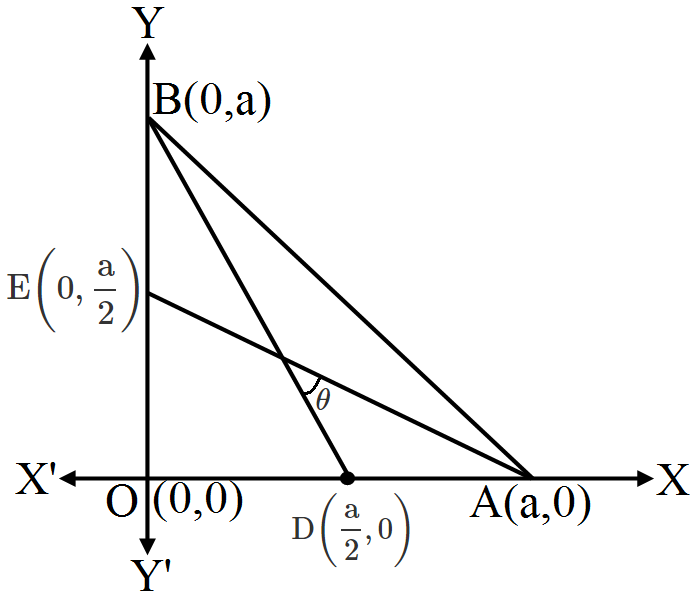
Here, BD and AE are the medians drawn from the acute angles B and A, respectively.
$\therefore$ Slope of $BD = m_1$
$=\frac{0-\text{a}}{\frac{\text{a}}{2}-0}$
$=-\frac{1}{2}$
Let $\theta$ be the angle between BD and AE.
$\tan\theta=\Big|\frac{-2+\frac{1}{2}}{1+1}\Big|$
$=\frac{3}{4}$
$\Rightarrow\cos\theta=\frac{4}{\sqrt{3^2+4^2}}$
$\Rightarrow\cos\theta=\frac{4}{5}$
$\Rightarrow\theta=\cos^{-1}\Big(\frac{4}{5}\Big)$
Hence, the acute angle between the medians is $\cos^{-1}\Big(\frac{4}{5}\Big).$ View full question & answer→MCQ 251 Mark
..... is the midpoint of (1, 2) and (5, 8):
Answer
- (3, 5)
Solution:
We know, midpoint of $(x_1, y_1)$ and $(x_2, y_2)$ is $\Big(\frac{{\text{x}}_{1}+{\text{x}}_{2}}{2}, \frac{{\text{y}}_{1}+{\text{y}}_{2}}{2}\Big)$
So, midpoint of (1, 2) and (5, 8) is $\Big(\frac{1+5}{2}, \frac{2+8}{2}\Big)$ is (3, 5) View full question & answer→MCQ 261 Mark
If line joining (1, 2) and (5, 7) is parallel to line joining (3, 4) and (11, x):
Answer
- 14
Solution:
We know, slope of line joining two points $(x_1, y_1)$ and $(x_2, y_2)$ is given by $\frac{(\text{y}_{2}-\text{y}_{1})}{(\text{x}_{2}-\text{x}_{1})}$
Lines are parallel means slope is equal.
$\Rightarrow\frac{(\text{x}-4)}{(11-3)} =\frac {(7-2)}{(5-1)}$
$\text{x}-4 = 5\times\frac{8}{4} = 10$
⇒ x = 14 View full question & answer→MCQ 271 Mark
If (-4, 5) is one vertex and 7x - y + 8 = 0 is onediagonal of a square, then the equation of second diagonal is:
MCQ 281 Mark
Slope of a line is given by if inclination of line is $\alpha$:
- A
$\sin\alpha$
- B
$\cos\alpha$
- ✓
$\tan\alpha$
- D
$\cot\alpha$
AnswerCorrect option: C. $\tan\alpha$
Slope of a line is given by $\tan\alpha$ if inclination of line is $\alpha$. Slope is denoted by tangent of the inclination angle.
View full question & answer→MCQ 291 Mark
Equation of vertical line to the right of y-axis at 5 units from y-axis is:
AnswerEquation of y-axis is x = 0. Vertical line is parallel to y-axis and to the right by 5 units so, equation of line is x = 5.
View full question & answer→MCQ 301 Mark
In what ratio does the line y - x + 2 = 0 cut the line joining (3, -1) and ( 8, 9)?
MCQ 311 Mark
The medians AD and BE of a triangle with vertices A(0, b), B(0, 0) and C(a, 0) are perpendicular to each other, if
- A
$\text{a}=\frac{\text{b}}{2}$
- B
$\text{b}=\frac{\text{a}}{2}$
- C
$\text{ab}=1$
- ✓
$\text{a}=\pm\sqrt{2}\text{b}$
AnswerCorrect option: D. $\text{a}=\pm\sqrt{2}\text{b}$
The midpoints of BC and AC are $\text{D}\Big(\frac{\text{a}}{2},0\Big)$ and $\text{E}\Big(\frac{\text{a}}{2},\frac{\text{b}}{2}\Big)$
Slope of $\text{AD}=\frac{0-\text{b}}{\frac{\text{a}}{2}-0}$
Slope of $\text{BE}=\frac{-\frac{\text{b}}{2}}{\frac{\text{-a}}{2}}$
It is given that the medians are perpendicular to each other.
$\frac{0-\text{b}}{\frac{\text{a}}{2}-0}\times\frac{-\frac{\text{b}}{2}}{-\frac{\text{a}}{2}}=-1$
$\Rightarrow\text{a}=\pm\sqrt{2}\text{b}$
View full question & answer→MCQ 321 Mark
Choose the correct answer. Slope of a line which cuts off intercepts of equal lengths on the axes is:
AnswerIntercept form of a line is
$\frac{\text{x}}{\text{a}}+\frac{\text{y}}{\text{b}}=1$
$\Rightarrow \frac{\text{x}}{\text{a}}+\frac{\text{y}}{\text{a}}=1(\because \text{a}=\text{b})$
⇒ x + y = a
⇒ y =- -x + a
$\therefore$ Slope is -1
Hence, the correct option is (a).
View full question & answer→MCQ 331 Mark
If the two lines are perpendicular then difference of their inclination angle is:
AnswerIf the two lines are perpendicular then if one line form angle $\alpha$ with positive x-axis then the other line form angle $90^\circ+\alpha$
View full question & answer→MCQ 341 Mark
If the area of the triangle with vertices (x, 0), (1, 1) and (0, 2) is 4 square unit, then the value of x is:
MCQ 351 Mark
What is the inclination of a line which is parallel to x-axis?
AnswerIf a line is parallel to x-axis then angle formed by it with x-axis is zero. So, its inclination is zero.
View full question & answer→MCQ 361 Mark
The line segment joining the points (-3, -4) and (1, -2) is divided by y-axis in the ratio:
AnswerLet the points (-3, -4) and (1, -2) be divided by y-axis at (0, t) in the ratio m : n.
$\therefore\Big(\frac{\text{m}-3\text{n}}{\text{m}+\text{n}},\frac{-2\text{m}-4\text{n}}{\text{m}+\text{n}}\Big)=(0,\text{t})$
$\Rightarrow0=\frac{\text{m}-3\text{n}}{\text{m}+\text{n}}$
$\Rightarrow\text{m}:\text{n}=3:1$
View full question & answer→MCQ 371 Mark
If a line with slope m makes x-intercept d. Then equation of the line is:
MCQ 381 Mark
The condition for the points (x, y), (-2, 2) and (3, 1) to be collinear is:
Answerx (2 - 1) -1(1 - y) + 3 (y - 2) = 0 or x + 5y = 8
View full question & answer→MCQ 391 Mark
If equation of a line is y = 3x - 4 then find the slope of line:
AnswerComparing the above equation with general equation y = m × x + c,
m = 3 which is the slope of line.
View full question & answer→MCQ 401 Mark
The equation of a line that passes through the points (1, 5) and (2, 3) is:
Answer
- 2x + y - 7 = 0
Solution:
We know that the equation of a line passes through two points $\left(x_1, y_1\right)$ and $\left(x_2, y_2\right)$ is
$\frac{\left(y-y_1\right)}{\left(x_{-1}\right)}=\frac{\left(y_2-y_1\right)}{\left(x_2-x_1\right)}$
$\left(x_1, y_1\right)=(1,5)$
$\left(x_2, y_2\right)=(2,3)$
Now, substitute the values in the formula, we get
$\frac{(y-5)}{(x-1)}=\frac{(3-5)}{(2-1)}$
$\frac{(y-5)}{(x-1)}=\frac{(-2)}{(1)}$
$y-5=-2(x-1)$
$y-5=-2 x+2$
$2 x+y-5-2=0$
$2 x+y-7=0$
$\therefore$ The equation of a line that passes through the points $(1,5)$ and $(2,3)$ is $2 x+y-7=0$. View full question & answer→MCQ 411 Mark
The locus of a point, whose abscissa and ordinate are always equal is:
AnswerLet the abscissa and ordinate of a point “P” be (x, y)
Given condition: Abscissa = Ordinate
(i.e) x = y
The locus of a point is x - y = 0.
View full question & answer→MCQ 421 Mark
Find the equation of line parallel to 4x + y = 2 and pass through (2, 5):
AnswerLine 4x + y = 2 has slope -4. Line parallel to it has slope -4 and pass through (2, 5)
so equation will be y - 5 = (-4) (x - 2)
⇒ 4x + y - 13 = 0
View full question & answer→MCQ 431 Mark
Choose the correct answer. A line cutting off intercept -3 from the y-axis and the tengent at angle to the xaxis is $\frac{3}{5}$, its equation is:
Answer
- 5y - 3x + 15 = 0
Solution:
Since the lines cut off intercepts -3 on $y$-axis then the line is passing through the point $(0,-3)$.
Given that: $\tan \theta=\frac{3}{5}$
$\Rightarrow$ Slope of the line $\mathrm{m}=\frac{3}{5}$
So, the equation of the line is
$y-y_1=m\left(x-x_1\right)$
$\Rightarrow y+3=\frac{3}{5}(x-0)$
$\Rightarrow 5 y+15=3 x$
$\Rightarrow 3 x-5 y-15=0$
$\Rightarrow 5 y-3 x+15=0$
Hence, the correct option is (a). View full question & answer→MCQ 441 Mark
The number of real values of $\lambda$ for which the lines $\text{x} - 2\text{y} + 3 = 0, \lambda\text{x} + 3\text{y} + 1 = 0$ and $4\text{x} - \lambda\text{y} + 2 = 0$ are concurrent is:
Answer$\text{x} - 2\text{y} + 3 = 0 \ ...(\text{i})$
$\lambda\text{x} + 3\text{y} + 1 = 0 \ ...(\text{ii})$
$4\text{x} - \lambda\text{y} + 2 = 0 \ ...(\text{iii})$
It is given that (1), (2) and (3) are concurrent.
$\therefore\begin{vmatrix} 1&-2&3\\\lambda&3&1\\4&-\lambda&2\end{vmatrix}=0$
$\Rightarrow(6+\lambda)+2(2\lambda-4)+3(-\lambda^2-12)=0$
$\Rightarrow6+\lambda+4\lambda-8-3\lambda^2-36=0$
$\Rightarrow5\lambda-3\lambda^2-38=0$
$\Rightarrow3\lambda^2-5\lambda+38=0$
The discriminant of this equation is $25 - 4 \times 3 \times 38 = -431$
Hence, there is no real value of $\lambda$ for which the lines $\text{x} - 2\text{y} + 3 = 0, \lambda\text{x} + 3\text{y} + 1 = 0$ and $4\text{x} - \lambda\text{y} + 2 = 0$ are concurrent.
View full question & answer→MCQ 451 Mark
Find slope of line if inclination made by the line is 60°.
- A
$\frac{1}{2}$
- B
$\frac{1}{\sqrt{3}}$
- ✓
$\sqrt{3}$
- D
$1$
AnswerCorrect option: C. $\sqrt{3}$
Slope of a line is given by $\tan\alpha$ if inclination of line is $\alpha$ If inclination is 60° the slope is $\tan 60^\circ = \sqrt{3}$
View full question & answer→MCQ 461 Mark
If the point (5, 2) bisects the intercept of a line between the axes, then its equation is:
AnswerLet the equation of the line be $\frac{\text{x}}{\text{a}}+\frac{\text{y}}{\text{b}}=1$
The coordinates of the intersection of this line with the coordinate axes are (a, 0) and (0, b).
The midpoint of (a, 0) and (0, b) is $\Big(\frac{\text{a}}{2},\frac{\text{b}}{2}\Big)$
According to the question:
$\Big(\frac{\text{a}}{2},\frac{\text{b}}{2}\Big)=(5,2)$
$\Rightarrow\frac{\text{a}}{2}=5,\frac{\text{b}}{2}=2$
$\Rightarrow\text{a}=10,\text{b}=4$
The equation of the required line is given below:
$\frac{\text{x}}{10}+\frac{\text{y}}{4}=1$
$\Rightarrow2\text{x}+5\text{y}=20$
View full question & answer→MCQ 471 Mark
Choose the correct answer. One vertex of the equilateral triangle with centroid at the origin and one side as x + y - 2 = 0 is:
[Hint: Let ABC be the equilateral triangle with vertex A (h, k) and let $\text{D}(\alpha,\beta)$ be the point on BC. Then $\frac{2\alpha+\text{h}}{3}=0=\frac{2\beta+\text{k}}{3}.$ Also $\alpha+\beta-2=0$ and $\frac{\text{k}-0}{\text{h}-0}\times(-1)=-1\Big].$
AnswerLet ABC be the equilateral triangle with vertex A(h, k).
Also, centroid is G(0, 0).
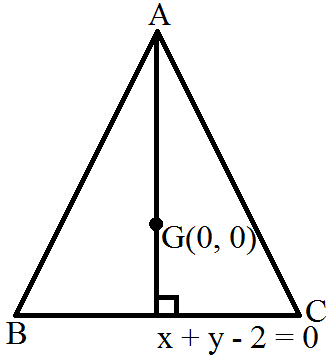
Now, $\text{AG}\bot\text{BC}$
Slope of line BC or x + y - 2 = 0 is -1.
$\therefore$ Slope of $\text{AG},\frac{\text{k}}{\text{h}}=1$ or h = k.
Now distance of origin from $\text{BC}=\frac{|0+0-2}{\sqrt{1^2+1^2}|}=\sqrt{2}$
$\therefore$ Distance of A form $\text{BC}=3\sqrt{2}=\frac{|\text{h}+\text{k}-2|}{\sqrt{1^2+1^2}}$
$\therefore$ |h + k - 2| = 6
⇒ h + k - 8 = 0 or h + k + 4 = 0
⇒ h + k - 8 = 0 or h + k + 4 = 0
⇒ h = 4 or h = -2
$\therefore$ Vertex is (-2, -2). View full question & answer→MCQ 481 Mark
What is the distance between (1, 3) and (5, 6):
Answer
- 5 units
Solution:
We know, distance between two points $(x_1, y_1)$ and $(x_2, y_2)$ is $\sqrt{(\text{x}_{1}−\text{x}_{2})^2+(\text{y}_{1}−\text{y}_{2})^2.}$
So, distance between (1, 3) and (5, 6) is $\sqrt{{(1-5)}^2+{(3-6)}^2}$
= $(4)^2+ (3)^2 = 5$ units View full question & answer→MCQ 491 Mark
Choose the correct answer. If the line $\frac{\text{x}}{\text{a}} + \frac{\text{y}}{\text{b}} =1$ passes through the points (2, -3) and (4, -5), then (a, b) is:
AnswerEquation of line passing through the points (2, -3) and (4, -5) is
$\text{y}+3=\frac{-5+3}{4-2}(\text{x}-2)$
$\Rightarrow \text{y}+3=\frac{-2}{2}(\text{x}-2)$
$\Rightarrow \text{y}+3=-(\text{x}-2)$
$\Rightarrow \text{y}+3=-\text{x}+2$
$\Rightarrow \text{x}+\text{y}=-1$
$\Rightarrow \frac{\text{x}}{-1}+\frac{\text{y}}{-1}=1$ (intercept from)
$\therefore \text{a}=-1,\text{b}=-1$
Hence, the correct option is (d).
View full question & answer→MCQ 501 Mark
The points $(-a, -b), (0 , 0), (a, b)$ and $(a^2, ab)$ are:
- A
- B
Vertices of a parallelogram
- ✓
- D
View full question & answer→MCQ 511 Mark
Distance between the lines 5x + 3y - 7 = 0 and 15x + 9y + 14 = 0 is:
- A
$\frac{35}{\sqrt{34}}$
- B
$\frac{1}{3\sqrt{34}}$
- ✓
$\frac{35}{3\sqrt{34}}$
- D
$\frac{35}{2\sqrt{34}}$
AnswerCorrect option: C. $\frac{35}{3\sqrt{34}}$
The given lines can be written as
$5\text{x}+3\text{y}-7=0 \ ...(1)$
$5\text{x}+3\text{y}+\frac{14}{3}=0 \ ...(2)$
Let d be the distance between the lines 5x + 3y - 7 = 0 and 15x + 9y + 14 = 0
Then, $\text{d}=\Bigg|\frac{-7-\frac{14}{3}}{\sqrt{5^2+3^2}}\Bigg|$
$\Rightarrow\text{d}=\frac{35}{3\sqrt{34}}$
View full question & answer→MCQ 521 Mark
Choose the correct answer. For specifying a straight line, how many geometrical parameters should be known?
Answer
- 2
Solution:
Different form of equation of straight line are slope intercept form, y = mx + c, Paramerer = 2
Intercept form, $\frac{\text{x}}{\text{a}}+\frac{\text{y}}{\text{b}}=1,$ parameter = 2
One-point from, $y - y_1 = m(x - x_1)$, parameter = 2
Normal form, $\text{x}\cos \text{w}+\text{y}\sin\text{w}=\text{P},$ Parameter = 2
Hence, the correct option is (b). View full question & answer→MCQ 531 Mark
A line passes through P (1, 2) such that its intercept between the axes is bisected at P. The equation of the line is:
MCQ 541 Mark
Find the equation of line parallel to x-axis and passing through (3, 4):
AnswerLet general equation of line be y = m × x + c.
Since line is parallel to x-axis so, m = 0.
⇒ y = c
⇒ y = 4 by substituting the point (3, 4).
View full question & answer→MCQ 551 Mark
If -40°F is equal to -40°C and 0°C is equal to 32°F then find the value of 40°C:
AnswerLet general equation be F = m × c + k
-40 = -40m + k
and 32 = 0 + k
⇒ -40 = -40m + 32
$\text{ m}=\frac{72}{40} = \frac{18}{10}$
$\text{F}=\frac{18}{10} \times 40 + 32$
= 72 + 32 = 104.
View full question & answer→MCQ 561 Mark
The area of a triangle with vertices at (-4, -1), (1, 2) and (4, -3) is:
AnswerLet A be the area of the triangle formed by the points (-4, -1), (1, 2) and (4, -3).
$\therefore\text{A}=\frac{1}{2}\big|\{\text{x}_1(\text{y}_2-\text{y}_3)+\text{x}_2(\text{y}_3-\text{y}_1)+\text{x}_3(\text{y}_1-\text{y}_2)\}\big|$
$\Rightarrow\text{A}=\frac{1}{2}\big|\{-4(2+3)+1(-3+1)+4(-1-2)\}\big|$
$\Rightarrow\text{A}=17$
View full question & answer→MCQ 571 Mark
If equation of line is y = 5x + 10 then find the value of x-intercept made by the line:
- A
- B
$\frac{1}{2}$
- C
$\frac{-1}{2}$
- ✓
AnswerGiven, equation is y = 5x + 10. X-intercept means value of x when y is zero 0 = 5x + 10
⇒ x = -2
View full question & answer→MCQ 581 Mark
The distance between M (-1, 5) and N (x, 5) is 8 units. The value of x is:
Answer$\sqrt{[\text{x}-(-1)^{2}] + (5-5)^{2}} = 8$
$\Rightarrow(\text{x+1})^2=8^2$
$\Rightarrow\text{x}+1=\underline{+}8$
$\therefore\text{x}=-9,7$
View full question & answer→MCQ 591 Mark
The equation of the straight line which passes through the point (-4, 3) such that the portion of the line between the axes is divided internally by the point in the ratio 5 : 3 is:
AnswerLet the required line intersects the coordinate axis at (a, 0) and (0, b).
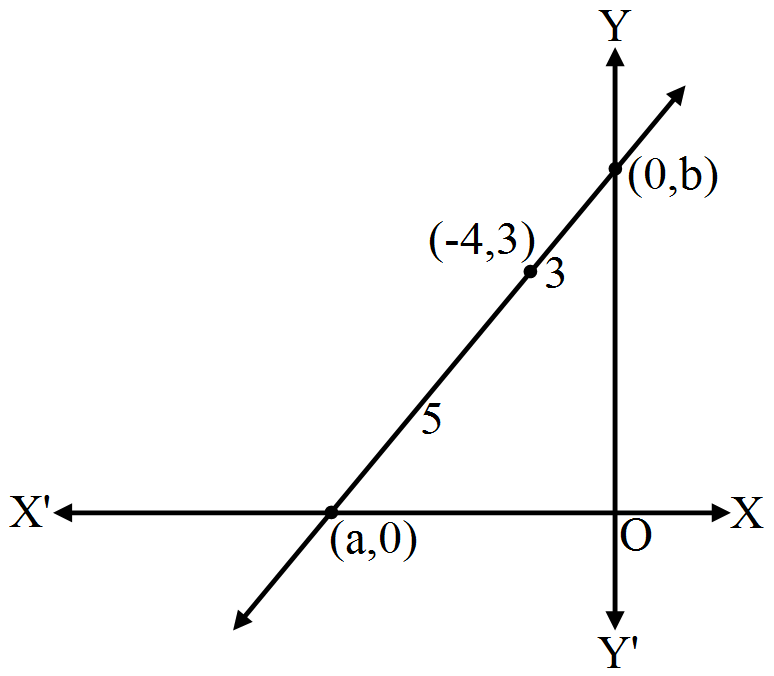
The point (−4, 3) divides the required line in the ratio 5 : 3
$\therefore \ -4=\frac{5\times0+3\times\text{a}}{5+3}$ and $3=\frac{5\times\text{b}+3\times0}{5+3}$
$\Rightarrow\text{a}=\frac{ -32}{3}$ and $\text{b}=\frac{ 24}{5}$
Hence, The equation of the required line is given below:
$\frac{\text{x}}{\frac{-32}{3}}+\frac{\text{y}}{\frac{24}{5}}=1$
$\Rightarrow\frac{-3\text{x}}{32}+\frac{5\text{y}}{24}=1$
$\Rightarrow-9\text{x}+20\text{y}=96$
$\Rightarrow9\text{x}-20\text{y}+96=0$ View full question & answer→MCQ 601 Mark
The slope of a line ax + by + c = 0 is:
- A
$\frac{\text{a}}{\text{b}}$
- ✓
$\frac{\text{-a}}{\text{b}}$
- C
$\frac{\text{c}}{\text{b}}$
- D
$\frac{\text{-c}}{\text{b}}$
AnswerCorrect option: B. $\frac{\text{-a}}{\text{b}}$
We know that the general equation of a line is ax + by + c = 0.
Rearranging the equation, we get
⇒ by = -ax - c
$\Rightarrow\text{y} =\big(\frac{\text{-a}}{\text{b}})\text{ x}-\big(\frac{\text{-c}}{\text{b}}) ...(1)$
This is of the form, y = mx + c … (2)
By comparing (1) and (2), we get
Slope, $\text{m} = \frac{\text{-a}}{\text{b}}$
View full question & answer→MCQ 611 Mark
Two vertices of a triangle are (-2, -1) and (3, 2) and third vertex lies on the line x + y = 5. If the area of the triangle is 4 square units, then the third vertex is:
AnswerLet (h, k) be the third vertex of the triangle.
It is given that the area of the triangle with vertices (h, k), (-2, -1) and (3, 2) is 4 square units.
$\frac{1}{2}\big|\text{h}(-1-2)-3(-1-\text{K})-2(2-\text{K})\big|=4$
$\Rightarrow3\text{h}-5\text{k}+1=\pm 8$
Taking positive sign, we get,
3h - 5k + 1 = 8
3h - 5k - 7 = 0 ...(1)
Taking negative sign, we get,
3h - 5k + 9 = 0 ...(2)
The vertex (h, k) lies on the line x + y = 5.
h + k - 5 = 0 ...(3)
On solving (1) and (3), we find (4, 1) to be the coordinates of the third vertex.
Similarly, on solving (2) and (3), we find (2, 3) to be the coordinates of the third vertex.
View full question & answer→MCQ 621 Mark
If x-intercept of a line is 4 and its y-intercept is 2 then find the equation of line:
AnswerIf x-intercept of a line is a and y-intercept of line is b so, equation of line is $\frac{\text{x}}{\text{a}}+\frac{\text{y}}{\text{b}} = 1$
Equation of line is $\frac{\text{x}}{4}+\frac{\text{y}}{2} = 1$
⇒ x + 2y - 4 = 0.
View full question & answer→MCQ 631 Mark
Find the distance between 2x + y + 4 = 0 and 2x + y + 8 = 0:
- ✓
$\frac{4}{\sqrt5}$
- B
$\frac{3}{\sqrt5}$
- C
$\frac{9}{\sqrt5}$
- D
$\frac{3}{\sqrt5}$
AnswerCorrect option: A. $\frac{4}{\sqrt5}$
- $\frac{4}{\sqrt5}$
Solution:
Distance between parallel lines $ax + by + c_1 = 0$ and $ax + by + c_2 = 0$ is $\mid\frac{\text{c}_{1}-\text{c}_{2}}{\sqrt{\text{a}^2+\text{b}^2}}\mid$
So, distance 2x + y + 4 = 0 and 2x + y + 8 = 0 is $\mid\frac{8-4}{\sqrt2^2+1^2}\mid=\frac{4}{\sqrt5}$ View full question & answer→MCQ 641 Mark
If equation of a line is y = 3x - 4 then find the slope of line:
AnswerComparing the above equation with general equation y = m × x + c,
m = 3 which is the slope of line.
View full question & answer→MCQ 651 Mark
Choose the correct answer. The distance between the lines $y = mx + c_1$ and $y = mx + c_2$ is:
- A
$\frac{\text{c}_1-\text{c}_2}{\sqrt{\text{m}^2+1}}$
- ✓
$\frac{|\text{c}_1-\text{c}_2|}{\sqrt{1+\text{m}^2}}$
- C
$\frac{c_2 - c_1}{\sqrt{1+m^2}}$
- D
$0$
AnswerCorrect option: B. $\frac{|\text{c}_1-\text{c}_2|}{\sqrt{1+\text{m}^2}}$
Let any point on the line y $= mx + c_1$ be $P(x_1, y_1).$
The equation of the other line is: $y = mx + c_2$
$\Rightarrow mx - y + c_2 = 0$
Distance of point P from this line, $\text{d}=\frac{|\text{mx}_1-\text{y}_1+\text{c}_2|}{\sqrt{\text{m}^2+1}}$
Since P line on the first line, we get
$\Rightarrow y_1 = mx_1 + c_1$
$\Rightarrow mx_1 - y_1 = -c_1$
$\therefore \text{d}=\frac{|\text{c}_1-\text{c}_2|}{\sqrt{\text{m}^2+1}}$
View full question & answer→MCQ 661 Mark
Angle made by line with measured anticlockwise is called inclination of the line:
AnswerWe know, inclination of line is always measured with positive x-axis in anticlockwise direction.
View full question & answer→MCQ 671 Mark
Choose the correct answer. If the coordinates of the middle point of the portion of a line intercepted between the coordinate axes is (3, 2), then the equation of the line will be:
AnswerLet the given the line meets the axes at A(a, 0) and B(0, b).
Given that C(3, 2) is the mid-point of AB
$\therefore 3=\frac{\text{a}+0}{2}\Rightarrow \text{a}=6$
and $2=\frac{0+\text{b}}{2}\Rightarrow \text{b}=4$
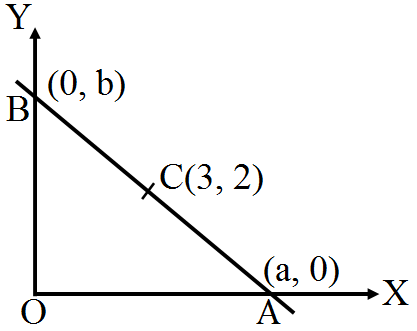
Intercept form of the line AB
$\Rightarrow \frac{\text{x}}{6}+\frac{\text{y}}{4}=1$
$\Rightarrow 2\text{x}+3\text{y}=12$
Hence, the correct option is (a). View full question & answer→MCQ 681 Mark
If slope of a line is negative then its inclination is:
Answer
- Obtuse angle.
Solution:
If inclination is $\alpha$ slope is given by $\tan\alpha$ Given that slope of line is negative which means $\tan\alpha$ is negative. We know, $\tan\alpha$ is negative in $2^{nd}$ quadrant i.e. $\alpha$ should be obtuse angle. View full question & answer→MCQ 691 Mark
Choose the correct answer. Equations of diagonals of the square formed by the lines x = 0, y = 0, x = 1 and y = 1 are:
AnswerGiven lines are plotted on coordinate plane as shown in the adjacent figure.
From the figure, equation of diagonal OB is y = x.
Equation of the diagonal AC is x + y = 1 (using intercept form).
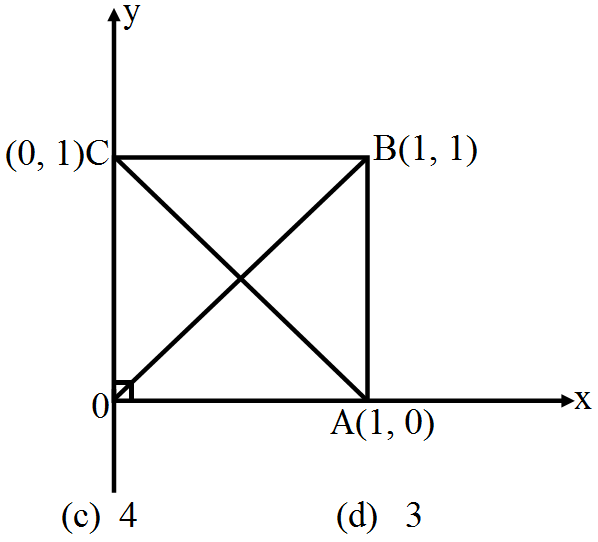
View full question & answer→MCQ 701 Mark
If p be the length of the perpendicular from the origin on the line $\frac{\text{x}}{\text{a}}+\frac{\text{y}}{\text{b}}=1,$ then:
- A
$\text{p}^2=\text{a}^2+\text{b}^2$
- B
$\text{p}^2=\frac{1}{\text{a}^2}+\frac{1}{\text{b}^2}$
- ✓
$\frac{1}{\text{p}^2}=\frac{1}{\text{a}^2}+\frac{1}{\text{b}^2}$
- D
AnswerCorrect option: C. $\frac{1}{\text{p}^2}=\frac{1}{\text{a}^2}+\frac{1}{\text{b}^2}$
It is given that p is the length of the perpendicular from the origin on the line
$\frac{\text{x}}{\text{a}}+\frac{\text{y}}{\text{b}}=1$
$\frac{1}{\text{a}}\text{x}+\frac{1}{\text{b}}\text{y}-1=0$
$\therefore\text{p}=\begin{vmatrix}\frac{0+0+1}{\sqrt{\frac{1}{\text{a}^2}+\frac{1}{\text{b}^2}}} \end{vmatrix}$
Squaring both sides,
$\Rightarrow\frac{1}{\text{p}^2}=\frac{1}{\text{a}^2}+\frac{1}{\text{b}^2}$
View full question & answer→MCQ 711 Mark
If equation of line is y = 5x + 10 then find the value of x-intercept made by the line:
- A
$2$
- B
$\frac{1}{2}$
- C
$\frac{-1}{2}$
- ✓
$-2$
AnswerGiven, equation is y = 5x + 10. X-intercept means value of x when y is zero. 0 = 5x + 10
⇒ x = -2
View full question & answer→MCQ 721 Mark
Slope of a line is given by if inclination of line is $\alpha$:
- A
$\sin\alpha$
- B
$\cos\alpha$
- ✓
$\tan\alpha$
- D
$\cot\alpha$
AnswerCorrect option: C. $\tan\alpha$
Slope of a line is given by $\tan\alpha$ if inclination of line is $\alpha$ Slope is denoted by tangent of the inclination angle.
View full question & answer→MCQ 731 Mark
The ratio in which the line 3x + 4y + 2 = 0 divides the distance between the line 3x + 4y + 5 = 0 and 3x + 4y - 5 = 0 is:
AnswerHere, in all equations the coefficient of x is same.
It means all the lines have same slope
So, all the lines are parallel.
Now, the distance between the line 3x + 4y + 2 = 0 and 3x + 4y + 5 = 0 is given by
$\frac{|2-5|}{\sqrt{3^2+4^2}}$
$=\frac{3}{\sqrt{25}}=\frac{3}{5}$
Hence, the ratio is given by
$\frac{3}{5}:\frac{7}{5}$
$=3:7$
View full question & answer→MCQ 741 Mark
If a line makes an angle a with the positive direction of x-axis, then the slope of the line is given by:
- A
$\text{m} = \sin\text{a}$
- B
$\text{m} = \cos\text{a}$
- ✓
$\text{m} = \tan\text{a}$
- D
$\text{m} = \sec\text{a}$
AnswerCorrect option: C. $\text{m} = \tan\text{a}$
- $\text{m} = \tan\text{a}$
View full question & answer→MCQ 751 Mark
The equation of a straight line that passes through the point (3, 4) and perpendicular to the line 3x + 2y + 5 = 0 is:
AnswerThe equation of a straight line perpendicular to 3x + 2y + 5 = 0 is $2\text{x}-3\text{y}+\lambda=0 …(1)$
This passes through the point (3, 4).
Now, substitute in equation (1), we get
$2(2) - 3(4) +\lambda = 0$
$4-12+\lambda =0$
$-6+\lambda =0$
$\lambda=6$
Substituting $\lambda=6 $ in (1), we get 2x - 3y + 6 = 0, which is the required equation.
View full question & answer→MCQ 761 Mark
The inclination of the straight line passing through the point (-3, 6) and the mid-point of the line joining the point (4, -5) and (-2, 9) is:
- A
$\frac{\pi}{4}$
- B
$\frac{\pi}{6}$
- C
$\frac{\pi}{3}$
- ✓
$\frac{3\pi}{4}$
AnswerCorrect option: D. $\frac{3\pi}{4}$
The midpoint of the line joining the points (4, -5) and (-2, 9) is (1, 2).
Let $\theta$ be the inclination of the straight line passing through the points (-3, 6) and (1, 2).
Then, $\tan\theta=\frac{ 2-6}{1+3}=-1$
$\Rightarrow\theta=\frac{3\pi}{4}$
View full question & answer→MCQ 771 Mark
If slope of a line is 4 and x-intercept made by the line is 2 then the equation of line will be:
AnswerLet general equation of line be y = m × x + c.
Given, m = 4 and value of x when y = 0 is 2.
C = -m × 2 = -4 × 2 = -8.
⇒ y = 4x - 8
View full question & answer→MCQ 781 Mark
The angle between the lines 2x - y + 3 = 0 and x + 2y + 3 = 0 is:
Answer
- 90°
Solution:
Let $m_1$ and $m_2$ be the slope of the lines 2x - y + 3 = 0 and x + 2y + 3 = 0, respectively.
Let $\theta$ be the angle between them.
Here, $m_1 = 2$ and $\text{m}_2=-\frac{1}{2}$
$\because\text{m}_1\text{m}_2=-1$
Therefore, the angle between the given lines is 90°. View full question & answer→MCQ 791 Mark
If A (6, 4) and B (2, 12) are the two points, then the slope of a line perpendicular to line AB is:
- A
$-2$
- B
$2$
- ✓
$\frac{1}{2}$
- D
$\frac{-1}{2}$
AnswerCorrect option: C. $\frac{1}{2}$
- $\frac{1}{2}$
Solution:
Given points: $A(6,4)=\left(x_1, y_1\right)$
$B(2,12)=\left(x_2, y_2\right)$
We know that the slope of a line passing through two points $\left(x_1, y_1\right)$ and $\left(x_2, y_2\right)$ is $\frac{\left(y_2-y_1\right)}{\left(x_2-x_1\right)}$
$\mathrm{m}=\frac{(12-4)}{(2-6)}=\frac{8}{-4}=-2 .$
We know that the slope of two perpendicular lines $\mathrm{m}_{1,} \mathrm{~m}_2=-1$.
The slope of a line perpendicular to line $A B$ is $\frac{-1}{\mathrm{~m}}=\frac{-1}{-2}=\frac{1}{2}$ View full question & answer→MCQ 801 Mark
A(6, 3), B(-3, 5), C(4, -2) and D(x, 3x) are four points. If $\triangle\text{DBC} : \triangle\text{ABC}= 1 : 2,$ then x is equal to:
- ✓
$\frac{11}{8}$
- B
$\frac{8}{11}$
- C
- D
AnswerCorrect option: A. $\frac{11}{8}$
The area of a triangle with vertices D(x, 3x), B(-3, 5) and C(4, -2) is given below:
Area of $\triangle\text{DBC}=\frac{1}{2}\{\text{x}(5+2)-3(-2-3\text{x})+4(3\text{x}-5)\}$
⇒ Area of $\triangle\text{DBC}=(14\text{x}-7)\text{sq units}$
Similarly, the area of a triangle with vertices A(6, 3), B(-3, 5) and C(4, -2) is given below:
$\triangle\text{ABC}=\frac{1}{2}\{6(5+2)-3(-2-3)+4(3-5)\}$
$\triangle\text{ABC}=\frac{49}{2}\text{sq units}$
Given:
$\triangle\text{DBC}:\triangle\text{ABC}=1:2$
$\frac{2(14\text{x}-7)}{49}=\frac{1}{2}$
$\Rightarrow8\text{x}-4=7$
$\Rightarrow\text{x}=\frac{11}{8}$
View full question & answer→MCQ 811 Mark
The equation $\frac{(2 \text{x})}{2} - \frac{(\text{y}{ 2})}{2} = -3,$ if x = -2, then y is equal to:
View full question & answer→MCQ 821 Mark
Equation of vertical line to the left of y-axis at 5 units from y-axis is:
AnswerEquation of y-axis is x = 0. Vertical line is parallel to y-axis and to the left by 5 units so, equation of line is x = -5.
View full question & answer→MCQ 831 Mark
Find the equation perpendicular to 2x - y = 4 and pass through (2, 4):
AnswerLine 2x - y = 4 has slope 2. Line perpendicular to given line has slope $\frac{-1}{2}$
equation is $(\text{y}-4) = \big(\frac{-1}{2}\big) (\text{x}-2)$
2y - 8 = -x + 2
⇒ x + 2y - 10 = 0
View full question & answer→MCQ 841 Mark
Which of the following lines is farthest from the origin?
MCQ 851 Mark
Equation of horizontal line above x-axis at 5 units from x-axis is:
AnswerEquation of x-axis is y = 0. Horizontal line is parallel to x-axis and above it by 5 units so, equation of line is y = 5.
View full question & answer→MCQ 861 Mark
The inclination of the line x - y + 3 = 0 with the positive direction of x-axis is:
MCQ 871 Mark
What is the inclination of a line which is parallel to y-axis?
AnswerIf a line is parallel to y-axis then angle formed by it with x-axis is 90°. So, its inclination is 90°.
View full question & answer→MCQ 881 Mark
Find the equation of line parallel to x-axis and passing through (3, 4):
AnswerLet general equation of line be y = m × x + c. Since line is parallel to x-axis so, m = 0.
⇒ y = c
⇒ y = 4 by substituting the point (3, 4).
View full question & answer→MCQ 891 Mark
Equation of horizontal line above x-axis at 5 units from x-axis is:
AnswerEquation of x-axis is y = 0. Horizontal line is parallel to x-axis and above it by 5 units so, equation of line is y = 5
View full question & answer→MCQ 901 Mark
The equations of the sides AB, BC and CA of $\triangle \text{ABC}$ are y - x = 2, x + 2y = 1 and 3x + y + 5 = 0 respectively. The equation of the altitude through B is:
AnswerThe equation of the sides AB, BC and CA of $\triangle \text{ABC}$ are y - x = 2, x + 2y = 1 and 3x + y + 5 = 0, respectively.
Solving the equations of AB and BC, i.e. y - x = 2 and x + 2y = 1, we get:
x = -1, y = 1
So, the coordinates of B are (-1, 1).
The altitude through B is perpendicular to AC.
$\therefore$ Slope of AC = -3
Thus, slope of the altitude through B is 13. Thus, slope of the altitude through B is $\frac{1}{3}.$
Equation of the required altitude is given below:
$\text{y}-1+\frac{1}{3}(\text{x}+1)$
$\Rightarrow\text{x}-3\text{y}+4=0$
View full question & answer→MCQ 911 Mark
For specifying a straight line, how many geometrical parameters should be known:
MCQ 921 Mark
Two lines are said to be parallel if the difference of their slope is:
Answer
- 0
Solution:
We know that two lines are said to be parallel if their slope is equal. If $m_1$ and $m_2$ are the slopes of two parallel lines, then it is represented as $m_1 = m_2$.
The difference of their slope should be $m_1- m_2 = 0$. View full question & answer→MCQ 931 Mark
The distance between the lines 3x + 4y = 9 and 6x + 8y = 15 is:
- A
$\frac{3}{2}$
- ✓
$\frac{3}{10}$
- C
$6$
- D
$\frac{9}{4}$
AnswerCorrect option: B. $\frac{3}{10}$
View full question & answer→MCQ 941 Mark
If equation of line is x + y = 2 then find the angle made by line with x-axis:
AnswerGiven, equation is x + y = 2. Reducing the above equation to normal form
$\frac{(\text{x + y})}{\sqrt2} ={\sqrt2}.$
$\text{x} \cos45° + \text{y} \sin 45^\circ = {\sqrt2}$
Angle made with x-axis is 45°.
View full question & answer→MCQ 951 Mark
Angle made by line with measured anticlockwise is called inclination of the line:
AnswerWe know, inclination of line is always measured with positive x-axis in anticlockwise direction.
View full question & answer→MCQ 961 Mark
If a + b + c = 0, then the family of lines 3ax + by + 2c = 0 pass through fixed point:
- A
$\Big(2,\frac{2}{3}\Big)$
- ✓
$\Big(\frac{2}{3},2\Big).$
- C
$\Big(-2,\frac{2}{3}\Big)$
- D
AnswerCorrect option: B. $\Big(\frac{2}{3},2\Big).$
- $\Big(\frac{2}{3},2\Big).$
Solution:
Given:
a + b + c = 0
Substituting c = -a - b in 3ax + by + 2c = 0, we get:
$3\text{ax}+\text{by}-2\text{a}-2\text{b}=0$
$\Rightarrow\text{a}(3\text{x}-2)+\text{b}(\text{y}-2)=0$
$\Rightarrow(3\text{x}-2)+\frac{\text{b}}{\text{a}}(\text{y}-2)=0$
This line is of the form $\text{L}_1+\lambda\text{L}_2=0,$ which passes through the intersection of the lines $L_1$ and $L_2$ i.e. 3x - 2 = 0 and y - 2 = 0.
Solving 3x - 2 = 0 and y - 2 = 0, we get
$\text{x}=\frac{2}{3},\text{y}=2$
Hence, the required fixed point is $\Big(\frac{2}{3},2\Big).$ View full question & answer→MCQ 971 Mark
Equation of the straight line making equal intercepts on the axes and passing through the point (2, 4) is:
MCQ 981 Mark
Equation of vertical line to the right of y-axis at 5 units from y-axis is:
AnswerEquation of y-axis is x = 0. Vertical line is parallel to y-axis and to the right by 5 units so, equation of line is x = 5.
View full question & answer→MCQ 991 Mark
What can be said regarding a line if its slope is negative?
AnswerCorrect option: B. $\theta$ is an obtuse angle
The line with a negative slope makes an obtuse angle with a positive x-axis when measured in the anti-clockwise direction.
View full question & answer→MCQ 1001 Mark
The centroid of the triangle with vertices (2, 6), (-5, 6) and (9,3) is:
Answer$\text{G}=\Big(\frac{\text{x}_{1}+\text{x}_{2}+\text{x}_{3}}{3},\frac{\text{y}_{1}+\text{y}_{2}+\text{y}_{3}}{3}\Big)$
$=\Big(\frac{2 - 5 + 9}{3},\frac{6 + 6 + 6}{3}\Big) = (2.5)$
View full question & answer→MCQ 1011 Mark
If a line has slope 3 and pass through point (1, 2) then the equation of line is:
AnswerLet general equation of line be y = m × x + c.
Given m = 3
⇒ y = 3x + c
Substituting the point (1, 2) in above equation we get 2 = 3 × 1 + c
⇒ c = -1
So, equation of line will be y = 3x - 1.
View full question & answer→MCQ 1021 Mark
The inclination of the line 5x - 5y + 8 = 0 is:
MCQ 1031 Mark
The equation of the line through the points (1, 5) and (2, 3) is:
MCQ 1041 Mark
The centroid of the triangle with vertices (2, 6), (-5, 6) and (9, 3) is:
Answer$\text{G} =\Big(\frac{ {\text{x}_{1}+\text{x}_{2}+\text{x}_{3}}}{3},\frac{ {\text{y}_{1}+\text{y}_{2}+\text{y}_{3}}}{3}\Big)$
$=\Big(\frac {2-5+9}{3}, \frac{6+6+6}{3}\Big) = (2.5)$
View full question & answer→MCQ 1051 Mark
If the lines x + q = 0, y - 2 = 0 and 3x + 2y + 5 = 0 are concurrent, then the value of q will be:
AnswerThe lines x + q = 0, y - 2 = 0 and 3x + 2y + 5 = 0 are concurrent.
$\therefore\begin{vmatrix}1&0&\text{q}\\0&1&-2\\3&2&5 \end{vmatrix}=0$
$\Rightarrow1(5+4)-0+\text{q}(0-3)=0$
$\Rightarrow3\text{q}=9$
$\Rightarrow\text{q}=3$
View full question & answer→MCQ 1061 Mark
The distance of the point ($x_1, y_1$) from the origin:
- A
$\text{x}\frac{2}{1}+\text{y}\frac{2}{1}$
- ✓
$\sqrt{\text{x}\frac{2}{1}+\text{y}\frac{2}{1}}$
- C
$\frac{1}{\sqrt{\text{x}\frac{2}{1}+\text{y}\frac{2}{1}}}$
- D
$\frac{1}{\text{x}\frac{2}{1}+\text{y}\frac{2}{1}}$
AnswerCorrect option: B. $\sqrt{\text{x}\frac{2}{1}+\text{y}\frac{2}{1}}$
- $\sqrt{\text{x}\frac{2}{1}+\text{y}\frac{2}{1}}$
Solution:
We can use the distance formula to find the length of the line.
Distance between points $\sqrt{(\text{x}_{2}-\text{x}_{1}+(\text{y}_{2}-\text{y}_{1})}$
But given that one of the co-ordinates is (0, 0)
Distance from (0, 0) is $=\sqrt{(\text{x}_{1})^{2}+(\text{y}_{1})^{2}}$ View full question & answer→MCQ 1071 Mark
A point equidistant from the line 4x + 3y + 10 = 0, 5x - 12y + 26 = 0 and 7x + 24y - 50 = 0 is:
AnswerLet the coordiantes of the point be (a, b)
Now, the distance of the point (a, b) from 4x + 3y + 10 = 0 is given by
$\Bigg|\frac{4\text{a}+3\text{b}+10}{\sqrt{4^2+3^2}}\Bigg|$
$=\Bigg|\frac{4\text{a}+3\text{b}+10}{5}\Bigg|$
Again, the distance of the point (a, b) from 5x - 12y + 26 = 0 is given by
$\Bigg|\frac{5\text{a}-12\text{b}+26}{\sqrt{5^2+(-12)^2}}\Bigg|$
$=\Bigg|\frac{5\text{a}-12\text{b}+26}{13}\Bigg|$
Again, the distance of the point (a, b) from 7x + 24y - 50 = 0 is is given by
$\Bigg|\frac{7\text{a}+24\text{b}-50}{\sqrt{7^2+(24)^2}}\Bigg|$
$=\Bigg|\frac{7\text{a}+24\text{b}-50}{25}\Bigg|$
Now,
$\Bigg|\frac{4\text{a}+3\text{b}+10}{5}\Bigg|=\Bigg|\frac{5\text{a}-12\text{b}+26}{13}\Bigg|=\Bigg|\frac{7\text{a}+24\text{b}-50}{25}\Bigg|$
Only a = 0 and b = 0 is satisfying the above equation
Hence, the correct answer is option (c).
View full question & answer→MCQ 1081 Mark
Equation of the line passing through (0, 0) and slope m is:
MCQ 1091 Mark
Area of the triangle formed by the points ((a + 3)(a + 4), a + 3), ((a + 2)(a + 3), (a + 2)) and ((a + 1)(a + 2), (a + 1)) is:
- A
$25 a^2$
- B
$5 \mathrm{a}^2$
- C
$24 a^2$
- ✓
Answer
- None of these.
Solution:
The given points are {(a + 3)(a + 4), a + 3), ((a + 2)(a + 3), (a + 2)) and ((a + 1)(a + 2), (a + 1)}
Let A be the area of the triangle formed by these points.
Then, $\text{A}=\frac{1}{2}[\text{x}_1(\text{y}_2-\text{y}_3)+\text{x}_2(\text{y}_3-\text{y}_1)+\text{x}_3(\text{y}_1-\text{y}_2)]$
$\Rightarrow\text{A}=\frac{1}{2}[(\text{a}+3)(\text{a}+4)(\text{a}+2-\text{a}-1)+(\text{a}+2)(\text{a}+3)\$\text{a}+1-\text{a}-3)+(\text{a}+1)(\text{a}+2)(\text{a}+3-\text{a}-2)]$
$\Rightarrow\text{A}=\frac{1}{2}[(\text{a}+3)(\text{a}+4)-2(\text{a}+2)(\text{a}+3)+(\text{a}+1)(\text{a}+2)]$
$\Rightarrow\text{A}=\frac{1}{2}[\text{a}^2+7\text{a}+12-2\text{a}^2-10\text{a}-12+\text{a}^2+3\text{a}+2]$
$\Rightarrow\text{A}=1$ View full question & answer→MCQ 1101 Mark
If slope of a line is negative then its inclination is:
AnswerIf inclination is α slope is given by $\tan\alpha$ Given that slope of line is negative which means $\tan\alpha$ is negative. We know, $\tan\alpha$ is negative in 2nd quadrant i.e. $\alpha$ should be obtuse angle
View full question & answer→MCQ 1111 Mark
Choose the correct answer. The ratio in which the line 3x + 4y + 2 = 0 divides the distance between the lines 3x + 4y + 5 = 0 and 3x + 4y - 5 = 0 is:
AnswerGiven lines are:
3x + 4y + 5 = 0 .....(i)
3x + 4y - 5 = 0 .....(ii)
The third line is: 3x + 4y + 2 = 0
Distance between the line (i) and (iii) $=\frac{|5-2|}{\sqrt{9+16}}=\frac{3}{5}$
Distance between the lines (ii) and (iii) $=\frac{|-5-2|}{\sqrt{9+16}}=\frac{7}{5}$
Hence, the required ratio is $\frac{3}{5}:\frac{7}{5}$ or 3 : 7.
View full question & answer→MCQ 1121 Mark
The area of the triangle formed by the points (a, b + c), (b, c + a) and (c, a + b) is:
AnswerArea $=\frac{1}{2}[\text{a}(\text{c + a - a - b})+\text{b }(\text{a + b - b - c})+\text{c }(\text{b + c - c - a})]=0$
View full question & answer→MCQ 1131 Mark
If two vertices of a triangle are (3, -2) and (-2, 3) and its orthocenter is (-6, 1) then its third vertex is:
MCQ 1141 Mark
The equation of the line with slope $-\frac{3}{2}$ and which is concurrent with the lines 4x + 3y - 7 = 0 and 8x + 5y - 1 = 0 is:
AnswerGiven:
4x + 3y - 7 = 0 ...(1)
8x + 5y - 1 = 0 ...(2)
The equation of the line with slope $-\frac{3}{2}$ is given below:
$\text{y}=-\frac{3}{2}\text{x}+\text{c}$
$\Rightarrow\frac{3}{2}\text{x}+\text{y}-\text{C}=0 \ ...(3)$
The lines (1), (2) and (3) are concurrent.
$\therefore\begin{vmatrix}4&3&-7\\8&5&-1\\\frac{3}{2}&1&\text{-c} \end{vmatrix}=0$
$\Rightarrow4(-5\text{c}+1)-3\Big(-8\text{c}+\frac{3}{2}\Big)-7\Big(8-\frac{15}{2}\Big)=0$
$\Rightarrow-20\text{c}+4+24\text{c}-\frac{9}{2}-56+\frac{105}{2}=0$
$\Rightarrow\frac{-40\text{c}+8+48\text{c}-9-112+105}{2}=0$
$\Rightarrow8\text{c}=8$
$\Rightarrow\text{c}=1$
On substituting c = 1 in $\text{y}=-\frac{3}{2}\text{x}+\text{c},$ we get:
$\text{y}=-\frac{3}{2}\text{x}+1,$
$\Rightarrow3\text{x}+2\text{y}-2=0$
View full question & answer→MCQ 1151 Mark
Choose the correct answer. The point (4, 1) undergoes the following two successive transformations:
- Reflection about the line y = x.
- Translation through a distance 2 units along the positive x-axis.
Then the final coordinates of the point are:
AnswerReflection of A(4, 1) in y = x is 5(1, 4).
Now translation of point B through a distance '2' units along the positive x-axis shifts B to C(1 + 2, 4) or C(3, 4).
View full question & answer→MCQ 1161 Mark
Choose the correct answer. The distance of the point of intersection of the lines 2x - 3y + 5 = 0 and 3x + 4y = 0 from the line 5x - 2y = 0 is:
AnswerCorrect option: A. $\frac{130}{17\sqrt{29}}$
Given lines are:
2x - 3y + 5 = 0 .....(i)
and 3x + 4y = 0 .....(ii)
Solving these lines, we get point of intersection as $\Big(\frac{-20}{17},\frac{15}{17}\Big).$
$\therefore$ Distance of this point from the line '5x - 2y = 0'
$=\frac{\Big|5\times\Big(-\frac{20}{17}\Big)-2\Big(\frac{15}{17}\Big)\Big|}{\sqrt{25+4}}=\frac{\Big|\frac{-100}{17}-\frac{30}{17}\Big|}{\sqrt{25}}$
$=\frac{130}{17\sqrt{29}}$
View full question & answer→MCQ 1171 Mark
If line joining (1, 2) and (5, 7) is parallel to line joining (3, 4) and (11, x):
Answer
- 14
Solution:
We know, slope of line joining two points $(x_1, y_1)$ and $(x_2,y_2)$ is given by $\frac{(\text{y}_{2}- \text{y}_{1})}{(\text{x}_{2}-\text{x}_{1})}$
Lines are parallel means slope is equal
$\Rightarrow\frac{(\text{x}-4)}{(11-3)} = \frac{(7-2)}{(5-1)}$
$\Rightarrow \text{x}-4 = \frac{5\times8}{4} = 10$
⇒ x = 14 View full question & answer→MCQ 1181 Mark
The distance between (6, 5) and (-3, 4) is:
- ✓
$\sqrt{82}$
- B
$\sqrt{83}$
- C
$\sqrt{84}$
- D
AnswerCorrect option: A. $\sqrt{82}$
The given points are (6, 5) and (-3, 4)
The distance is given as $=\sqrt {(\text{x}_2-\text{x}_1)^2+(\text{y}_2-\text{y}_1)^2}$
$=\sqrt {(6+3)^2+(4-5)^2}$
$=\sqrt {9^2+1^2}$
$=\sqrt {81+1}=\sqrt {82}$
View full question & answer→MCQ 1191 Mark
Choose the correct answer. The coordinates of the foot of perpendiculars from the point (2, 3) on the line y = 3x + 4 is given by
- A
$\frac{37}{10},\frac{-1}{10}$
- ✓
$\frac{-1}{10},\frac{37}{10}$
- C
$\frac{10}{37},-10$
- D
$\frac{2}{3},-\frac{1}{3}$
AnswerCorrect option: B. $\frac{-1}{10},\frac{37}{10}$
Let the foot of perpendicular from the point P(2, 3) on the line 3x - y + 4 = 0 be M(h, k).
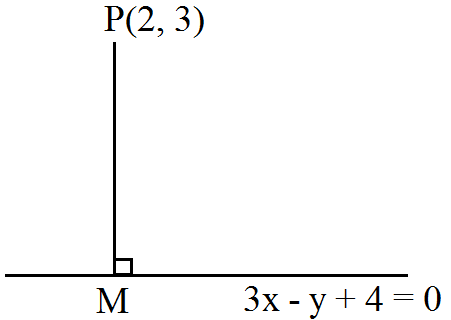
M(h, k) lies on the given line,
$\therefore$ 3h - k + 4 = 0 .....(i)
Also, slopw of the given line is 3.
$\therefore$ Slope of $\text{PM}=-\frac{1}{3}=\frac{\text{k}-3}{\text{h}-2}$ or h + 3k - 11 = 0 .....(ii)
Solving (1) and (ii), we get $(\text{h},\text{k})\equiv\Big(-\frac{1}{10},\frac{37}{10}\Big)$ View full question & answer→MCQ 1201 Mark
If the coordinates of the middle point of the portion of a line intercepted between the coordinate axes is (3, 2) then the equation of the line will be:
MCQ 1211 Mark
The tangent of angle between the lines whose intercepts on the axes are a, -b and b, -a respectively, is:
- A
$\frac{\text{a}^2-\text{b}^2}{\text{ab}}$
- B
$\frac{\text{b}^2-\text{a}^2}{\text{ab}}$
- ✓
$\frac{\text{b}^2-\text{a}^2}{\text{2ab}}$
- D
AnswerCorrect option: C. $\frac{\text{b}^2-\text{a}^2}{\text{2ab}}$
- $\frac{\text{b}^2-\text{a}^2}{\text{2ab}}$
View full question & answer→MCQ 1221 Mark
Line through the points (-2, 6) and (4, 8) is perpendicular to the line through the points (8, 12) and (x, 24). Find the value of x:
MCQ 1231 Mark
Find the distance between the following pair of points. (5, 7) and the origin:
- ✓
$\sqrt{74}$
- B
$\sqrt{64}$
- C
$\sqrt{34}$
- D
AnswerCorrect option: A. $\sqrt{74}$
- $\sqrt{74}$
Solution:
Take points A (5, 7) and B (0, 0)
To find the distance between two point A $(x_1, y_1)$ and B $(x_2, y_2)$, distance formula is used which is given by:
$\text{AB} =\sqrt{ (\text{x}_{1}-\text{x}_{2})^2+(\text{y}_{1}-\text{y}_{2})^2}$
so, $\text{AB} =\sqrt{ (5-0)^{2}+(7-0)^{2}} = \sqrt{(25+49)} = \sqrt{(74)}$ View full question & answer→MCQ 1241 Mark
If $p_1$ and $p_2$ are the lengths of the perpendiculars from the origin upon the lines $\text{x} \sec \theta + \text{y} \text{cosec}\theta = \text{a}$ and $\text{x} \cos \theta - \text{y} \sin \theta = \text{a} \cos 2 \theta$ respectively, then:
- ✓
$4\text{p}_1^2 + \text{p}_2^2 = \text{a}^2$
- B
$\text{p}_1^2 + 4\text{p}_2^2 = \text{a}^2$
- C
$\text{p}_1^2 + 4\text{p}_2^2 = \text{a}^2$
- D
AnswerCorrect option: A. $4\text{p}_1^2 + \text{p}_2^2 = \text{a}^2$
- $4\text{p}_1^2 + \text{p}_2^2 = \text{a}^2$
Solution:
The given lines are
$\text{x} \sec \theta + \text{y} \text{cosec}\theta = \text{a} \ ...(1)$
$\text{x} \cos \theta - \text{y} \sin \theta = \text{a} \cos 2 \theta \ ...(2)$
$p_1$ and $p_2$ are the perpendiculars from the origin upon the lines (1) and (2), respectively.
$\text{p}_1=\Big|\frac{-\text{a}}{\sqrt{\sec^2\theta+\text{cosec}^2}\theta}\Big|$ and $\text{p}_2=\Big|\frac{-\text{a}\cos2\theta}{\sqrt{\cos^2\theta+\sin^2}\theta}\Big|$
$\Rightarrow\text{p}_1=\Big|\frac{-\text{a}\sin\theta\cos\theta}{\sqrt{\sin^2\theta+\cos^2}\theta}\Big|$ and $\text{p}_2=\big|-\text{a}\cos2\theta\big|$
$\Rightarrow\text{p}_1=\frac{1}{2}\big|-\text{a}\times2\sin\theta\cos\theta\big|$ and $\text{p}_2=\big|-\text{a}\cos2\theta\big|$
$\Rightarrow\text{p}_1=\frac{1}{2}\big|-\text{a}\times\sin2\theta\big|$ and $\text{p}_2=\big|-\text{a}\cos2\theta\big|$
$\Rightarrow4\text{p}_1^2+\text{p}_2^2=\text{a}^2(\sin^22\theta+\cos^22\theta)$
$=\text{a}^2$ View full question & answer→MCQ 1251 Mark
If slope of a line is positive then its inclination is:
AnswerIf inclination is $\alpha$ slope is given by $\tan\alpha$ Given that slope of line is positive which means $\tan\alpha$ is positive. We know, $\tan\alpha$ is positive in 1st quadrant i.e. $\alpha$ should be acute angle
View full question & answer→MCQ 1261 Mark
If equation of line is x + y = 2 then find the perpendicular distance of line from origin:
- ✓
$\sqrt{2}$
- B
$\sqrt{3}$
- C
$\frac{1}{\sqrt2}$
- D
$\frac{1}{\sqrt3}$
AnswerCorrect option: A. $\sqrt{2}$
Given, equation is x + y = 2. Reducing the above equation to normal form
$\frac{(\text{x + y})}{\sqrt2} =\sqrt{2}$
$\text{x} \cos45^\circ + \text{y} \sin 45^\circ = \sqrt{2}$
Perpendicular distance from origin is $\sqrt{2}$
View full question & answer→MCQ 1271 Mark
Two lines are perpendicular if the product of their slopes is:
MCQ 1281 Mark
The figure formed by the lines $\text{ax} \pm \text{by} \pm \text{c} = 0 $ is:
AnswerThe given lines can be written separately in the following manner:
ax + by + c = 0 ...(1)
ax + by - c = 0 ...(2)
ax - by - c = 0 ...(3)
ax - by - c = 0 ...(4)
Graph of the given lines is given below:
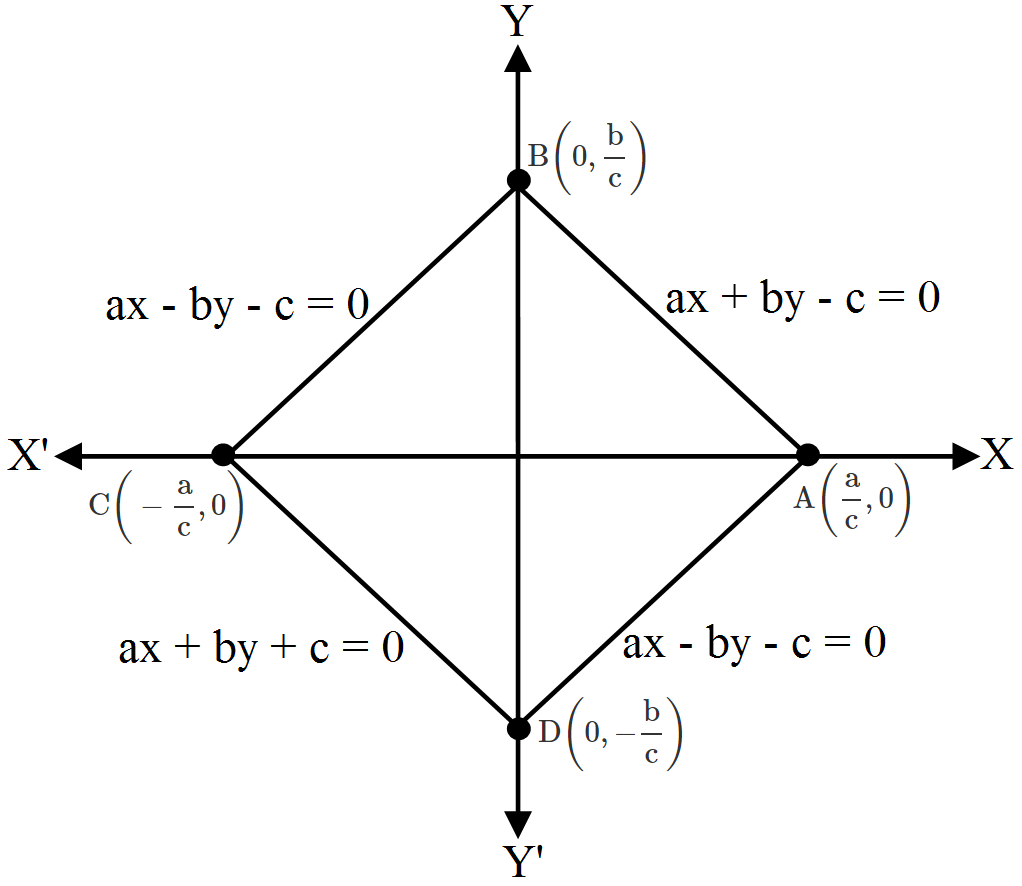
Clearly, $\text{AB}=\text{BC}=\text{CD}=\text{DA}=\sqrt{\frac{\text{a}^2}{\text{c}^2}+\frac{\text{b}^2}{\text{c}^2}}=\frac{\sqrt{\text{a}^2+\text{b}^2}}{|\text{c}|}$
Thus, the region formed by the given lines is ABCD, which is a rhombus. View full question & answer→MCQ 1291 Mark
The line segment joining the points (1, 2) and (-2, 1) is divided by the line 3x + 4y = 7 in the ratio:
AnswerLet the line segment joining the points (1, 2) and (−2, 1) be divided by the line 3x + 4y = 7 in the ratio m:n.
Then, the coordinates of this point will be $\Big(\frac{-2\text{m}+\text{n}}{\text{m}+\text{n}},\frac{\text{m}+2\text{n}}{\text{m}+\text{n}}\Big)$ that lie on the line.
$3\text{x}+4\text{y}=7$
$3\times\frac{-2\text{m}+\text{n}}{\text{m}+\text{n}}+4\times\frac{\text{m}+2\text{n}}{\text{m}+\text{n}}=7$
$\Rightarrow-2\text{m}+11\text{n}=7\text{m}+7\text{n}$
$\Rightarrow-9\text{m}=-4\text{n}$
$\Rightarrow\text{m}:\text{n}=4:9$
View full question & answer→MCQ 1301 Mark
Equation of horizontal line above x-axis at 5 units from x-axis is:
AnswerEquation of x-axis is y = 0. Horizontal line is parallel to x-axis and above it by 5 units so, equation of line is y = 5
View full question & answer→MCQ 1311 Mark
The line x + y = 4 divides the line joining the points (-1, 1) and (5, 7) in the ratio:
MCQ 1321 Mark
The perpendicular distance of a line 4x + 3y + 5 = 0 from the point (-1, 2) is:
MCQ 1331 Mark
A line passes through the point (2, 2) and is perpendicular to the line 3x + y = 3. Its y-intercept is:
- A
$\frac{1}{3}$
- B
$\frac{2}{3}$
- C
- ✓
$\frac{4}{3}$
AnswerCorrect option: D. $\frac{4}{3}$
The equation of the line perpendicular to 3x + y = 3 is given below:
$\text{x}-3\text{y}+\lambda=0$
This line passes through (2, 2).
$2-6+\lambda=0$
$\Rightarrow\lambda=4$
So, the equation of the line will be
x - 3y + 4 = 0
$\Rightarrow\text{y}=\frac{1}{3}\text{x}+\frac{4}{3}$
Hence, the y-intercept is $\frac{4}{3}.$
View full question & answer→MCQ 1341 Mark
If slope of a line is 4 and y-intercept made by the line is 2 then the equation of line will be:
AnswerLet general equation of line be y = m × x + c.
Given, m = 4 and c = 2
View full question & answer→MCQ 1351 Mark
Which of the following points are 10 units from the origin:
Answer$\text{A} =\sqrt{ (6-0)^{2}+(4-0)^{2}} = \sqrt{52}$
$\text{B} =\sqrt{ (6-0)^{2}+(8-0)^{2}} =10$
$\text{C} =\sqrt{ (6-0)^{2}+(-8-0)^{2}} =10$
$\text{D} =\sqrt{ (-6-0)^{2}+(-8-0)^{2}} =10$
View full question & answer→MCQ 1361 Mark
If equation of a line is 3x + 2y - 6 = 0 then x-intercept is and y-intercept is:
AnswerReducing the above equation to intercept form $\frac{\text{x}}{\text{a}} +\frac{\text{y}}{\text{b}} =1,$
we get $\frac{\text{x}}{2} +\frac{\text{y}}{3} =1$
a = 2 which is x-intercept and b = 3 which is y-intercept.
View full question & answer→MCQ 1371 Mark
What is the slope of a line which is parallel to y-axis?
AnswerIf a line is parallel to y-axis then angle formed by it with x-axis is zero. So, its inclination is 90°. $\text{slope} = \tan 90^\circ$ which is not defined.
View full question & answer→MCQ 1381 Mark
If line joining (1, 2) and (7, 6) is perpendicular to line joining (3, 4) and (11, x):
Answer
- -16
Solution:
We know, slope of line joining two points $(x_1, y_1)$ and $(x_2, y_2)$ is given by $\frac{(\text{y}_{2}-\text{y}_{1})}{(\text{x}_{2}-\text{x}_{1})}$
Lines are perpendicular means $m_1\times m_2 = -1$
$\Rightarrow\big(\frac{\text{x}-4}{11-3}\big), \big(\frac{6-2}{7-1}\big) = -1$
⇒ (x - 4) (4) = (-1) (8) (6)
⇒ x - 4 = -12
⇒ x = -16. View full question & answer→MCQ 1391 Mark
Equation of vertical line to the left of y-axis at 5 units from y-axis is:
AnswerEquation of y-axis is x = 0. Vertical line is parallel to y-axis and to the left by 5 units so, equation of line is x = -5
View full question & answer→MCQ 1401 Mark
What is the distance of (5, 12) from the origin?
Answer
- 13 units
Solution:
Let the points be A (0, 0) and B (5, 12).
A (0, 0) = $(x_1, y_1)$
B (5, 12) = $(x_2, y_2)$
The distance between two points, $\text{AB} = [(\text{x}_{2}-\text{x}_{1})^2+(\text{y}_{2}-\text{y}_{1})^2]$
$\text{AB} = [(5-0)^{2}+(12-0)^2]$
$\text{AB}=\sqrt{(25+144)}$
$\text{AB}=\sqrt{(169)}$
$\text{AB}=13$
The distance of (5, 12) from the origin is 13 units. View full question & answer→MCQ 1411 Mark
If p be the length of the perpendicular from the origin on the straight line x + 2by = 2p, then what is the value of b:
- A
$\frac{1}{\text{p}}$
- B
$\text{p}$
- C
$\frac{1}{2}$
- ✓
$\frac{3}{2}$
AnswerCorrect option: D. $\frac{3}{2}$
View full question & answer→MCQ 1421 Mark
If the lines ax + 12y + 1 = 0, bx + 13y + 1 = 0 and cx + 14y + 1 = 0 are concurrent, then a, b, c are in:
AnswerThe given lines are
ax + 12y + 1 = 0 ...(1)
bx + 13y + 1 = 0 ...(2)
cx + 14y + 1 = 0 ...(3)
It is given that (1), (2) and (3) are concurrent.
$\begin{vmatrix} \text{a}&12&1\\\text{b}&13&1\\\text{c}&14&1\end{vmatrix}=0$
$\Rightarrow\text{a}(13-14)-12(\text{b}-\text{c})+14\text{b}-13\text{c}=0$
$\Rightarrow-\text{a}-12\text{b}+12\text{c}+14\text{b}-13\text{c}=0$
$\Rightarrow-\text{a}+2\text{b}-\text{c}=0$
$\Rightarrow2\text{b}=\text{a}+\text{c}$
Hence, a, b and c are in AP.
View full question & answer→MCQ 1431 Mark
The relation between a, b, a’ and b’ such that the two lines ax + by = c and a’x + b’y = c’ are perpendicular is:
MCQ 1441 Mark
Choose the correct answer. The equations of the lines which pass through the point (3, -2) and are inclined at 60° to the line $\sqrt{3} \text{x} + \text{y} = 1$ is:
- ✓
$\sqrt{3}\text{x}+\text{y}-\sqrt{3}=0,\sqrt{3}\text{x}-\text{y}-\sqrt{3}=0$
- B
$\sqrt{3}\text{x}+\text{y}+\sqrt{3}=0,\sqrt{3}\text{x}-\text{y}+\sqrt{3}=0$
- C
$\text{x}+\sqrt{3}\text{y}-\sqrt{3}=0,\text{x}-\sqrt{3}\text{y}-\sqrt{3}=0$
- D
AnswerCorrect option: A. $\sqrt{3}\text{x}+\text{y}-\sqrt{3}=0,\sqrt{3}\text{x}-\text{y}-\sqrt{3}=0$
Slope of the given line $\sqrt{3}\text{x}+\text{y}=1$ is, $\text{m}=-\sqrt{3}.$
Let the slope of the required line which makes an angle of 60° with the above line is m.
$\therefore \tan 60^\circ=\bigg|\frac{-\sqrt{3}-\text{m}}{1-\sqrt{3}\text{m}}\bigg|$
$\Rightarrow \bigg|\frac{-\sqrt{3}-\text{m}}{1-\sqrt{3}\text{m}}\bigg|=\sqrt{3}$
$\Rightarrow -\sqrt{3}-\text{m}=\sqrt{3}-3\text{m}$ or $-\sqrt{3}-\text{m}=-\sqrt{3}+3\text{m}$
$\Rightarrow \text{m}=\sqrt{3}$ or m = 0
Line is passing throught the point (3, -2).
Thus, the equation of the required line is: $\text{y}+2=\sqrt{3}(\text{x}-3)$ or y + 2 = 0
$\Rightarrow \sqrt{3}\text{x}-\text{y}-2-3\sqrt{3}=0$ and y + 2 = 0
View full question & answer→MCQ 1451 Mark
The lines x + 2y - 5 = 0, 2x - 3y + 4 = 0, 6x + 4y - 13 = 0:
- A
- ✓
Form a right angled triangle
- C
Form an isosceles triangle
- D
Form an equilateral triangle
AnswerCorrect option: B. Form a right angled triangle
- Form a right angled triangle
View full question & answer→MCQ 1461 Mark
The vertices of a triangle are (6, 0), (0, 6) and (6, 6). The distance between its circumcentre and centroid is:
- A
$2\sqrt{2}$
- B
$2$
- ✓
$\sqrt{2}$
- D
$1$
AnswerCorrect option: C. $\sqrt{2}$
Let A(0, 6), B(6, 0) and C(6, 6) be the vertices of the given triangle.
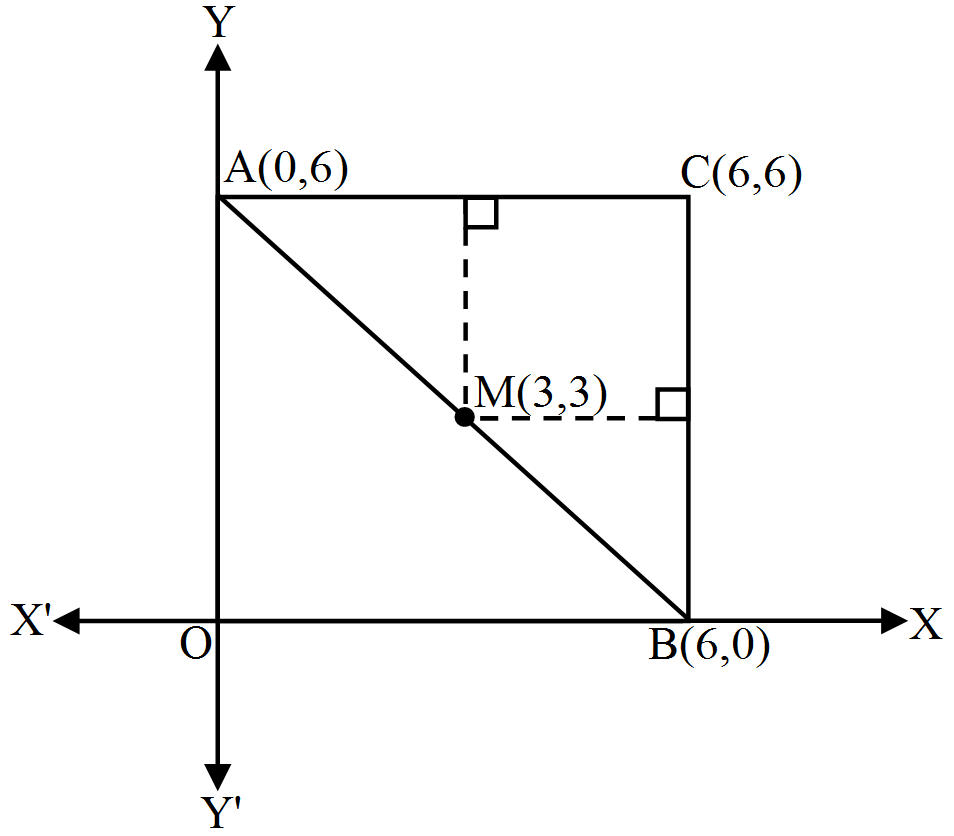
Centroid of $\triangle\text{ABC}=\Big(\frac{0+6+6}{3},\frac{6+0+6}{3}\Big)$
$=(4,4)$
Coordinates of $\text{N}=\Big(\frac{6+6}{2},\frac{6+0}{2}\Big)$
$=(6,3)$
Coordinates of $\text{P}=\Big(\frac{0+6}{2},\frac{6+6}{2}\Big)$
$=(3,6)$
Equation of MN is y = 3
Equation of MP is x = 3
As, we know that circumcentre of a triangle is the intersection of the perpendicular bisectors of any two sides.
Therefore, coordinates of circumcentre is (3, 3)
Thus, the coordinates of the circumcentre are (3, 3) and the centroid of the triangle is (4, 4).
Let d be the distance between the circumcentre and the centroid.
$\therefore\text{d}\sqrt{(4-3)^2+(4-3)^2}=\sqrt{2}$ View full question & answer→MCQ 1471 Mark
What is the distance between (1, 3) and (5, 6)?
Answer
- 5 units.
Solution:
We know, distance between two points ($x_1, y_1$) and ($x_2, y_2$) is $\sqrt{(\text{x}_{1}-\text{x}_{2}) ^{2}+{(\text{y}_{1}-\text{y}_{2})} ^{2}}$
So, distance between (1, 3) and (5, 6) is $\sqrt{{(1-5)}^{2}+(3-6)^{2}} = \sqrt{{(4)}^{2}+(3)^{2}} = 5\text{ units}.$ View full question & answer→MCQ 1481 Mark
The equation of the line passing through (1, 5) and perpendicular to the line 3x - 5y + 7 = 0 is:
AnswerA line perpendicular to 3x - 5y + 7 = 0 is given by
$5\text{x}+3\text{y}+\lambda=0$
This line passes through (1, 5)
$5+15+\lambda=0$
$\Rightarrow\lambda=-20$
Therefore, the equation of the required line is 5x + 3y - 20 = 0.
View full question & answer→MCQ 1491 Mark
The reflection of the point (4, -13) about the line 5x + y + 6 = 0 is:
AnswerLet the reflection point be A(h, k)
Now, the mid point of line joining (h, k) and (4, -13) will lie on the line 5x + y + 6 = 0
$\therefore5\Big(\frac{\text{h}+4}{2}\Big)+\frac{\text{k}-13}{2}+6=0$
$\Rightarrow5\text{h}+20+\text{k}-13+12=0$
$\Rightarrow5\text{h}+\text{k}+19=0 \ ...(1)$
Now, the slope of the line joining points (h, k) and (4, -13) are perpendicular to the line 5x + y + 6 = 0.
slope of the line = -5
slope of line joining by points (h, k) and (4, -13)
$\frac{\text{k}+13}{\text{h}-4}$
$\therefore\frac{\text{k}+13}{\text{h}-4}(-5)=-1$
$\Rightarrow5\text{k}-\text{h}+60=0 \ ...(2)$
Solving (1) and (2), we get
h = -1 and k = -14
View full question & answer→MCQ 1501 Mark
The equation of the locus of a point equidistant from the point A (1, 3) and B (-2, 1) is:
MCQ 1511 Mark
The value of $\lambda$ for which the lines $3\text{x} + 4\text{y} = 5, 5\text{x} + 4\text{y} =4$ and $\lambda\text{x} + 4\text{y} = 6$ meet at a point is:
AnswerIt is given that the lines $3\text{x} + 4\text{y} = 5, 5\text{x} + 4\text{y} =4$ and $\lambda\text{x} + 4\text{y} = 6$ meet at a point. In other words, the given lines are concurrent.
$\begin{vmatrix}3&4&-5\\5&4&-4\\\lambda&4&-6 \end{vmatrix}=0$
$\Rightarrow3(-24+16)-4(-30+4\lambda)-5(20-4\lambda)=0$
$\Rightarrow-24+120-16\lambda-100+20\lambda=0$
$\Rightarrow4\lambda=4$
$\Rightarrow\lambda=1$
View full question & answer→MCQ 1521 Mark
Find the equation of line parallel to y-axis and passing through (3, 4):
AnswerLet general equation of line be y = m (x - d)
$\Rightarrow\text{x} =\frac{ \text{y}}{\text{m + d}}$ Since line is parallel to y-axis so, $\text{m}=\frac{1}{0} $ or $\frac{1}{\text{m}} =0$
⇒ x = d
⇒ x = 3 by substituting the point (3, 4)
View full question & answer→MCQ 1531 Mark
The locus of the point of intersection of lines $\text{x} \cos \text{a} + \text{y} \sin \text{a = a}$ and $\text{x} \sin \text{a - y} \cos \text{a = b}$ (a is a variable):
AnswerCorrect option: C. $x^2+y^2=a^2+b^2$
View full question & answer→MCQ 1541 Mark
The centroid of a triangle is (2, 7) and two of its vertices are (4, 8) and (-2, 6). The third vertex is:
AnswerLet A(4, 8) and B(-2, 6) be the given vertex. Let C(h, k) be the third vertex.
The centroid of $\triangle\text{ABC}$ is $\Big(\frac{4-2+\text{h}}{3},\frac{8+6+\text{k}}{3}\Big)$
It is given that the centroid of triangle ABC is (2, 7).
$\therefore\frac{4-2+\text{h}}{3}=2,\frac{8+6+\text{k}}{3}=7$
$\Rightarrow\text{h}=4,\text{h}=7$
Thus, the third vertex is (4, 7).
View full question & answer→MCQ 1551 Mark
Find slope of line joining (1, 2) and (4, 11):
- A
$\frac{1}{3}$
- ✓
$3$
- C
$9$
- D
$\frac{1}{9}$
Answer
- $3$
Solution:
We know, slope of line joining two points ($x_1, y_1$) and ($x_2, y_2$) is given by $\frac{{\text{y}}_{2}-{\text{y}}_{1}}{{\text{x}}_{2}-{\text{x}}_{1}}$
So, slope of line joining (1, 2) and (4, 11) is $\frac{11-2}{4-1} = \frac{9}{3} = 3$ View full question & answer→MCQ 1561 Mark
Slope of a line which cuts off intercepts of equal lengths on the axes is:
MCQ 1571 Mark
The distance between the orthocentre and circumcentre of the triangle with vertices $(1, 2), (2, 1)$ and $\Big(\frac{3+\sqrt{3}}{2},\frac{3+\sqrt{3}}{2}\Big)$ is:
AnswerLet A(1, 2), B(2, 1) and C $\Big(\frac{3+\sqrt{3}}{2},\frac{3+\sqrt{3}}{2}\Big)$ be the given points.
$\therefore \ \text{AB}=\sqrt{(2-1)^2+(1-2)^2}$
$=\sqrt{2}$
$\text{BC}=\sqrt{\Big(\frac{3+\sqrt{3}}{2}-2\Big)^2,\Big(\frac{3+\sqrt{3}}{2}-1\Big)^2}$
$=\sqrt{2}$
$\text{AC}=\sqrt{\Big(\frac{3+\sqrt{3}}{2}-1\Big)^2,\Big(\frac{3+\sqrt{3}}{2}-2\Big)^2}$
$=\sqrt{2}$
Thus, ABC is an equilateral triangle.
We know that the orthocentre and the circumcentre of an equilateral triangle are same.
So, the distance between the the orthocentre and the circumcentre of the triangle with vertices $(1, 2), (2, 1)$ and $\Big(\frac{3+\sqrt{3}}{2},\frac{3+\sqrt{3}}{2}\Big)$ is $0.$
View full question & answer→MCQ 1581 Mark
Choose the correct answer. A line passes through (2, 2) and is perpendicular to the line 3x + y = 3. Its yintercept is:
- A
$\frac{1}{3}$
- B
$\frac{2}{3}$
- C
$1$
- ✓
$\frac{4}{3}$
AnswerCorrect option: D. $\frac{4}{3}$
Any line perpendicular to 3x + y = 3
$\text{x}-3\text{y}=\lambda \ (\lambda=\text{constant})$
If is passes through the point (2, 2) then
$2-3(2)=\lambda\Rightarrow \lambda=-4$
$\therefore$ Required equation is x - 3y = -4
$\Rightarrow 3\text{y}=-\text{x}-4$
$\Rightarrow \text{y}=\frac{1}{3}\text{x}+\frac{4}{3}\big[\because \text{y}=\text{mx}+\text{c}\big]$
So, the y-intercept is $\frac{4}{3}.$
Hence, the correct option is (d).
View full question & answer→MCQ 1591 Mark
If equation of line is y = 5x + 10 then find the value of x-intercept made by the line:
- ✓
$10$
- B
$\frac{1}{10}$
- C
$\frac{-1}{10}$
- D
$-10$
AnswerGiven, equation is y = 5x + 10. Y-intercept means value of y when x is zero. y = 0 + 10
⇒ y = 10
View full question & answer→MCQ 1601 Mark
The distance between the points (a, b) and (-1, -b) is:
AnswerDistance between two points $({\text{x}_{1, }}{\text{y}_{1}})$ and $({\text{x}_{2, }}{\text{y}_{2}})$ can be calculated using the formula
$\sqrt{{(\text{x}_{2}-\text{x}_{1})}^2+{(\text{y}_{2}-\text{y}_{1})}^2}$
Distance between the points (a, b) and (-1, -b)
$(-1-\text{a})^2+(\text{b - b})^2 = \sqrt{1+\text{a}^2+2\text{b}+4\text{b}^2}$
View full question & answer→MCQ 1611 Mark
The coordinates of the foot of the perpendicular from the point (2, 3) on the line x + y - 11 = 0 are:
AnswerLet the coordinates of the foot of the perpendicular from the point (2, 3) on the line x + y - 11 = 0 be (x, y)
Now, the slope of the line x + y - 11 = 0 is -1
So, the slope of the perpendicular = 1
The equation of the perpendicular is given by
y - 3 = 1(x - 2)
⇒ x - y + 1 = 0
Solving x + y - 11 = 0 and x - y + 1 = 0, we get
x = 5 and y = 6
View full question & answer→MCQ 1621 Mark
Choose the correct answer. The equation of the straight line passing through the point (3, 2) and perpendicular to the line y = x is:
AnswerSlope of the given line y = x is 1.
Thus, slope of line perpendicular to y = x is -1.
Line passes through the point (3, 2).
So, equation of the required line is:
y - 2 = -1(x - 3)
⇒ x + y = 5
View full question & answer→MCQ 1631 Mark
Two lines are given $(x - 2y)^2+ k (x - 2y) = 0$. The value of k, so that the distance between them is 3, is:
AnswerCorrect option: B. $\text{k} = \underline{+} 3 \sqrt{5}$
- $\text{k} = \underline{+} 3 \sqrt{5}$
View full question & answer→MCQ 1641 Mark
What is the slope of a line which is parallel to x-axis?
AnswerIf a line is parallel to x-axis then angle formed by it with x-axis is zero. So, its inclination is zero. $\text{slope}= \tan 0^\circ= 0.$
View full question & answer→MCQ 1651 Mark
If slope of a line is 4 and x-intercept made by the line is 2 then the equation of line will be:
AnswerLet general equation of line be y = m × x + c.
Given m = 4 and value of x when y = 0 is 2.
C = -m × 2 = -4 × 2 = -8.
⇒ y = 4x - 8.
View full question & answer→MCQ 1661 Mark
The distance between A (-6, 7) and B (-1, -5) is:
AnswerDistance between A and B is given by $\mid\text{A-B}\mid\mid\text{AB}\mid^{2} = (-6+1)^{2}+(5+7)^{2} = 25+144=169$
Then $\mid\text{A - B}\mid = 13$
View full question & answer→MCQ 1671 Mark
In a $\triangle\text{ABC}$ if A is the point (1, 2) and equations of the median through B and C are respectively x + y = 5 and x = 4, then B is:
View full question & answer→MCQ 1681 Mark
Let the perpendiculars from any point on the line 7x + 56y = 0 upon 3x + 4y = 0 and 5x - 12y = 0 be p and p, then:
MCQ 1691 Mark
Equation of horizontal line below x-axis at 5 units from x-axis is:
AnswerEquation of x-axis is y = 0. Horizontal line is parallel to x-axis and below it by 5 units so, equation of line is y = -5
View full question & answer→MCQ 1701 Mark
If the projections of a line segment on the x, y and z axes in 3-dimensional space are 2, 3 and 6 respectively, then the length of line segment is:
AnswerGiven, projections are 2, 3 and 6
$\therefore\text{AB} = ({\text{x}_{1}}-{\text{x}_{2}})^2+({\text{y}_{1}}-{\text{y}_{2}})^2+({\text{z}_{1}}-{\text{z}_{2}})^2$
$\Rightarrow\text{AB} = \sqrt{4+9+36} = \sqrt{49} = 7$
View full question & answer→