MCQ
The figure formed by the lines $\text{ax} \pm \text{by} \pm \text{c} = 0 $ is:
  • A
    a rectangle.
  • B
    a square.
  • a rhombus.
  • D
    None of these.

Answer

Correct option: C.
a rhombus.
The given lines can be written separately in the following manner:
ax + by + c = 0 ...(1)
ax + by - c = 0 ...(2)
ax - by - c = 0 ...(3)
ax - by - c = 0 ...(4)
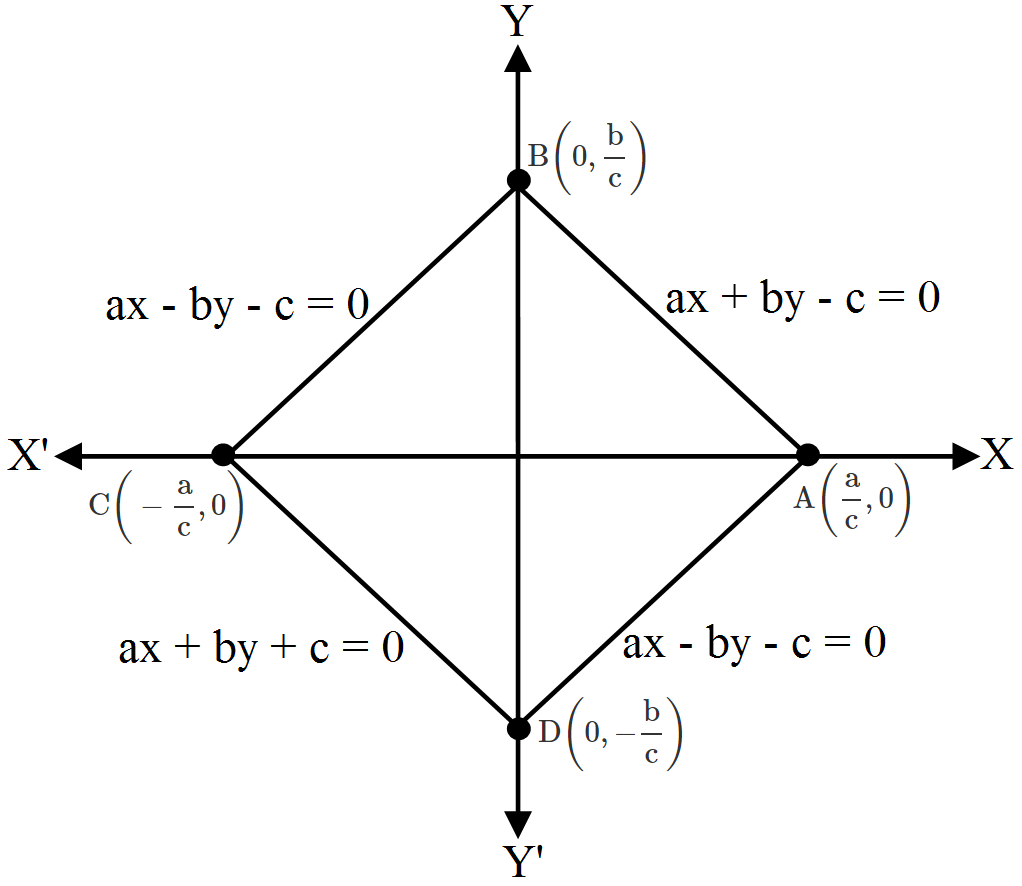
Graph of the given lines is given below:

Clearly, $\text{AB}=\text{BC}=\text{CD}=\text{DA}=\sqrt{\frac{\text{a}^2}{\text{c}^2}+\frac{\text{b}^2}{\text{c}^2}}=\frac{\sqrt{\text{a}^2+\text{b}^2}}{|\text{c}|}$
Thus, the region formed by the given lines is ABCD, which is a rhombus.

Need a full question paper?

Generate a complete, print-ready paper with questions like this in minutes — across 16+ boards, with answer keys.
Start Generating Free

Similar questions

Let $A B C D$ be a quadrilateral such that there exists a point $E$ inside the quadrilateral satisfying $A E=B E=C E=D E$. Suppose $\angle D A B, \angle A B C, \angle B C D$ is an arithmetic progression. Then the median of the set $\{\angle D A B, \angle A B C, \angle B C D\}$ is
Let $C$ be the centre of the circle $x^{2}+y^{2}-x+2 y=$ $\frac{11}{4}$ and $P$ be a point on the circle. A line passes through the point $C$, makes an angle of $\frac{\pi}{4}$ with the line $C P$ and intersects the circle at the points $Q$ and $R$. Then the area of the triangle $P Q R$ (in unit ${ }^{2}$ ) is.
If $C_r= ^{100}{C_r}$ , then $1.C^2_0 - 2.C^2_1 + 3.C^2_3 - 4.C^2_0 + 5.C^2_4 - .... + 101.C^2_{100}$ is equal to
If the variance of the frequency distribution is $160$ , then the value of $\mathrm{c} \in \mathrm{N}$ is
$X$ $c$ $2c$ $3c$ $4c$ $5c$ $6c$
$f$ $2$ $1$ $1$ $1$ $1$ $1$
Let $\alpha ,\beta$ be the roots of the quadratic equation ${x^2} + px + {p^3} = 0\,\,(p \ne 0)$. If $(\alpha ,\beta )$ is a point on the parabola ${y^2} = x,$ then the roots of the quadratic equation are
Let $\left(1+x+2 x^{2}\right)^{20}=a_{0}+a_{1} x+a_{2} x^{2}+\ldots+a_{40} x^{40}$ then $a _{1}+ a _{3}+ a _{5}+\ldots+ a _{37}$ is equal to
The number of $3 \times 3$ matrices $A$ whose entries are either $0$ or $1$ and for which the system $\mathrm{A}\left[\begin{array}{l}\mathrm{x} \\ \mathrm{y} \\ \mathrm{z}\end{array}\right]=\left[\begin{array}{l}1 \\ 0 \\ 0\end{array}\right]$ has exactly two distinct solutions, is
The length of common chord of the circles $x^2 + y^2 + 2x + 4y -20 = 0$ and $x^2 + y^2 + 6x -8y + 10 = 0$ is
If ${({a^m})^n} = {a^{{m^n}}}$, then the value of $'m'$ in terms of $'n'$ is
For all n∈N, 72n − 48n−1 is divisible by: