Questions

SECTION - A [ZOOLOGY - MCQ]

Take a timed test

45 questions · self-marked practice — reveal the answer and mark yourself.

MCQ 14 Marks
Bioprospecting includes:
  • A
    Preserving knowledge of indigenous forms by activists.
  • B
    Exploitative appreciation of indigenous forms of knowledge by commercial actors.
  • C
    Exploitative appreciation of indigenous forms of knowledge by naturalists.
  • D
    Exploitative appreciation of foreign knowledge by commercial actors.
Answer
B.  Exploitative appreciation of indigenous forms of knowledge by commercial actors.
Explanation:
Bioprospecting is the process of discovery and commercialization of new products based on biological resources. Despite indigenous knowledge being intuitively helpful, bioprospecting has only recently begun to incorporate such knowledge in focusing screening efforts for bioactive compounds.
Bioprospecting may involve biopiracy, the exploitative appropriation of indigenous forms of knowledge by commercial actors, and also includes the search for previously unknown compounds in organisms that have never been used in traditional medicine before.
View full question & answer
MCQ 24 Marks
Vaccine for small pox was developed by:
  • A
    Louis Pasteur
  • B
    Salman Waksman
  • C
    Cesor Milstein
  • D
    Edward Jenner
Answer
D. Edward Jenner
View full question & answer
MCQ 34 Marks
The significance of heat shock method in bacterial transformation is to facilitate:
  • A
    Uptake of DNA through membrane transport proteins
  • B
    Binding of DNA to the cell wail
  • C
    Expression of antibiotic resistance gene
  • D
    Uptake of DNA through transient pores in the bacterial cell wall
Answer
D. Uptake of DNA through transient pores in the bacterial cell wall
View full question & answer
MCQ 44 Marks
Enzyme Taq polymerase used in PCR, has been isolated from bacterium,
  • A
    Escherichia coli
  • B
    Agrobacterium tumefaciens
  • C
    Streptomyces albus
  • D
    Thermus aquaticus
Answer
D. Thermus aquaticus
Explanation:
Taq DNA polymerase is isolated from a thermophilic bacterium, Thermus aquaticus.
View full question & answer
MCQ 64 Marks
Which of the following sequences is truly a systemic circulation pathway?
  • A
    Left auricle → Left ventricle →Pulmonary aorta → Tissues → Right auricle
  • B
    Left auricle → Left ventricle → Aorta →Arteries → Tissues → Veins → Right atrium
  • C
    Right ventricle → Pulmonary aorta → Tissues → Pulmonary veins → Left auricle
  • D
    Right auricle → Left ventricle → Aorta →Tissues → Veins →Right auricle
Answer
B. Left auricle → Left ventricle → Aorta →Arteries → Tissues → Veins → Right atrium
Explanation:
Systemic circulation is the movement of the blood between heart and rest of the body (tissues) and the back to the heart. The oxygenated blood moves from the left auricle into the left ventricle. From here the blood moves into the aorta which ultimately divides into arteries that carry oxygenated blood to various tissues in the body. From the tissues deoxygenated blood is carried by the veins into the right atrium via superior vena cava and inferior vena cava.
View full question & answer
MCQ 74 Marks
The haemoglobin content per 100 ml of blood of a normal healthy human adult is:
  • A
    12-16 mg
  • B
    25-30 mg
  • C
    5-11 mg
  • D
    17-20 mg
Answer
A. 12-16 mg
Explanation:
The haemoglobin content per 100 mL of blood of a normal healthy human adult is $12-16 mg$.
View full question & answer
MCQ 84 Marks
Which of the following is the correct statement about the circulatory system of cockroach?
  • A
    It has a closed type of circulatory system.
  • B
    It has a complicated type of circulatory system.
  • C
    It has 13 chambered heart and in each segment one pair of ostia are present.
  • D
    It takes place without the participation of tissue.
Answer
C. It has 13 chambered heart and in each segment one pair of ostia are present.
Explanation:
The cockroach is an arthropod in which the circulatory system is open type where the blood pumped by the heart passes through large vessels into open spaces or body cavities called sinuses.
View full question & answer
MCQ 94 Marks
State whether true or false:
A. Gastrointestinal tract, kidney and heart also produce hormones.
B. Pars distalis produces six trophic hormones.
C. B-lymphocytes provide cell-mediated immunity.
D. Insulin resistance results in a disease called diabetes mellitus.
  • A
    (A)-T, (B)-T, (C)-F, (D)-T
  • B
    (A)-F, (B)-F, (C)-T, (D)-T
  • C
    (A)-T, (B)-T, (C)-F, (D)-F
  • D
    (A)-T, (B)-F, (C)-T, (D)-T
Answer
A. (A) $- T ,( B )- T ,( C )- F ,( D )- T$
View full question & answer
MCQ 104 Marks
Given below is an incomplete table on hormones, their source glands and one major effect of each human body. Identify the option representing correct grouping of hormone its gland and effect.
GlandSecretionEffect on body
AOestrogenMaintenance of secondary sexual characters
Alpha cells of Islets of LangerhansBRaises blood sugar level
Anterior pituitaryCOver secretion leads to gigantism
  • A
    (A) - Ovary, (B) - Insulin, (C) Calcitonin
  • B
    (A) - Placenta, (B) - Insulin, (C) - Vasoperssin
  • C
    (A) - Ovary, (B) - Glucagon, (C) - Growth hormone
  • D
    (A) - Placenta, (B) - Glucagon, (C) - Calcitonin
Answer
C. (A) - Ovary, (B) - Glucagon, (C) - Growth hormone
Explanation:
The correct option for the three blanks A, B, and C are ovary, glucagon and growth hormone respectively. Oestrogens are secreted by the Graafian follicle, which surrounds the mature ovum in the ovary. They stimulate the female reproductive tract to grow to full size and become functional. They also stimulate the differentiation of ova (oogenesis) in the ovary and stimulate the development of accessory sex characters such as enlargement of breasts, broadening of pelvis, growth of pubic and auxiliary hair, deposition of fat in the thigh; and onset of menstrual cycle. Glucagon is secreted by the alpha cells of the islets of Langerhans in response to a fall in the blood-glucose level. Somatotropic or growth hormone (STH or GH ) or somatotropin hormone is secreted by the anterior lobe of pituitary. Growth hormone stimulates growth and development of all tissues by accelerating protein-synthesis and celldivision and by retaining calcium in the body. Over secretion of growth hormone leads to gigantism.
View full question & answer
MCQ 124 Marks
Alzheimer's disease in humans is associated with the deficiency of
  • A
    acetylcholine
  • B
    glutamic acid
  • C
    gamma-aminobutyric acid (GABA).
  • D
    dopamine
Answer
A. acetylcholine
Explanation:
Alzheimer's disease is a neurological disease characterized by progressive loss of intellectual ability. The disease is associated with the following:
i. general shrinkage of the brain tissue, with deposits of $\beta$-amyloid protein and abnormal filaments composed of tau protein in the brain, and
ii. changes in the neurotransmitter systems within the brain that include a loss in the activity of cholinergic neurons (neurons releasing acetylcholine).
View full question & answer
MCQ 134 Marks
Which cranial nerve has the highest number of branches?
  • A
    Trigeminal nerve
  • B
    Facial nerve
  • C
    Vagus nerve
  • D
    Optic nerve
Answer
A. Trigeminal nerve
Explanation:
Trigeminal nerve is the largest 5th cranial nerve. It has three branches. Vagus nerve is the 10th cranial nerve and innervates larynx, trachea, oesophagus, stomach, lungs, heart and intestines.
Facial nerve is the 7th cranial nerve and innervates muscles of face and back, taste buds and salivary glands.
View full question & answer
MCQ 144 Marks
Which of the following statements is correct regarding the organ of sight-eye?
  • A
    The space between cornea and lens is filled with transparent gel.
  • B
    When all cones are stimulated equally, a sensation of no light (dark) is produced.
  • C
    The anterior transparent portion of choroid is called cornea.
  • D
    Rhodopsin is purplish red protein, hence called visual purple.
Answer
D. Rhodopsin is purplish red protein, hence called visual purple.
Explanation:
The space between the cornea and the lens is called the aqueous chamber and contains a thin watery fluid called the aqueous humour. When all the cones are stimulated equally, a sensation of white light is produced. The anterior transparent portion of sclera is called cornea.
View full question & answer
MCQ 154 Marks
Blind spot is called so because of
  • A
    the presence of photoreceptor cells.
  • B
    the absence of optic nerves.
  • C
    the absence of photoreceptor cells.
  • D
    the presence of optic nerves.
Answer
C. the absence of photoreceptor cells.
Explanation:
The optic nerves leave the eye and the retinal blood vessels enter it at a point medial to and slightly above the posterior pole of the eyeball. Photoreceptor cells are not present in that region and hence it is called the blind spot. At the posterior pole of the eye, lateral to the blind spot there is a yellowish pigmented spot called macula lutea with a central pit called the fovea.
View full question & answer
MCQ 184 Marks
The cervical vertebrae are characterized by the presence of:
  • A
    Odontoid process
  • B
    Transverse process
  • C
    Vertebra-arterial canals
  • D
    Amphiplateus centrum
Answer
C. Vertebra-arterial canals
Explanation:
There are 7 cervical vertebrae. All cervical vertebrae have apertures in their transverse processes, known as Foramina transversalis, which form vertebro-arterial-canals on either side for a vertebral artery to pass through to supply the brain and spinal cord.
View full question & answer
MCQ 194 Marks
Waste product of adenine and guanine metabolism are excreted by man as
  • A
    Urea
  • B
    Allantoin
  • C
    Ammonia
  • D
    Uric acid
Answer
D. Uric acid
Explanation:
Adenine and guanine are purines which are converted to xanthine and then enzyme xanthine oxidase converts xanthine to uric acid in liver and small intestine. Hence, the final waste product of adenine and guanine metabolism is uric acid.
View full question & answer
MCQ 204 Marks
A person who is not taking food or beverages will have in urine:
  • A
    Excess urea
  • B
    Little fat
  • C
    Less urea
  • D
    Little glucose
Answer
C. Less urea
Explanation:
Urea is a nitrogenous waste formed as a result of metabolism of various food/bevarages in the body and is excreted in the urine. So, if a person is not taking food/beverages he will have less urea in his urine.
View full question & answer
MCQ 214 Marks
Given below are few layers between the glomerular and Bowman's capsule through which the filtration takes place.
i. Endothelium of the glomerular blood vessel.
ii. Middle lamella.
iii. Basement membrane between the endothelium of glomerular blood vessels and epithelium of the Bowman's capsule.
iv. Epithelium of the Bowman's capsule.
Identify the correct layers.
  • A
    (i), (iii), and (iv)
  • B
    (ii), (iii), and (iv)
  • C
    (i), (ii), and (vi)
  • D
    (i), (ii), and (iii)
Answer
A. (i), (iii), and (iv)
Explanation:
Layers between the glomerular and Bowman's capsule through which the filtration takes place are as follows:
i. Endothelium of the glomerular blood vessel.
ii. Basement membrane between the endothelium of glomerular blood vessels and epithelium of the Bowman's capsule.
iii. Epithelium of the Bowman's capsule.
View full question & answer
MCQ 224 Marks
Duct of Bellini opens on :
  • A
    Renal papilla
  • B
    Ureter
  • C
    Duodenum
  • D
    DCT
Answer
A. Renal papilla
Explanation:
ZIFT-
The distal convoluted tubules of a number of adjacent nephrons open into a common collecting duct or tubule. Collecting ducts (present in medullary pyramids) are long tubules, which traverse through the medulla in the pyramids and opens in the papilla of the medulla (in rabbit) or papilla of the individual medullary pyramid (in human). Several adjacent collecting ducts converge to open into a common short and thick duct of Bellini (present in papilla of medulla). All ducts of Bellini then open at the tip of the papillae into the pelvis.
View full question & answer
MCQ 234 Marks
Which of the following fossil men had religious feelings of worship and used burial customs?
  • A
    African ape men
  • B
    Neanderthal men
  • C
    Peking men
  • D
    Java men
Answer
B. Neanderthal men
View full question & answer
MCQ 244 Marks
The golden age of reptiles was
  • A
    Coenozoic era
  • B
    Palaeozoic era
  • C
    Proterozoic era
  • D
    Mesozoic era
Answer
D. Mesozoic era
Explanation:- About 66 million years ago the Mesozoic era is known as the golden age of reptiles as reptiles became dominant during this period.
View full question & answer
MCQ 254 Marks
In which of the following techniques, the embryos are transferred to assist those females who cannot conceive?
  • A
    GIFT and ICSI
  • B
    ZIFT and IUT
  • C
    GIFT and ZIFT
  • D
    ICSI and ZIFT
Answer
B. ZIFT and IUT
Explanation:
ZIFT-
Zygote intrafallopian transfer, is an infertility treatment used when a blockage in the fallopian tubes prevents the normal binding of sperm to the egg. Egg cells are removed from a woman's ovaries, and in vitro fertilized. The resulting zygote is placed into the fallopian tube by the use of laparoscopy.
IUT- is the technique in which an embryo of more than 8 blastomeres is transferred into the uterus.
View full question & answer
MCQ 264 Marks
According to the 2001 census report, the population growth rate was still around 1.7 percent, our population could double in 33 years. How the government check this population growth rate?
  • A
    Motivate smaller families by using various contraceptive methods
  • B
    Incentives given to couples with small families
  • C
    All of these
  • D
    Statutory raising of marriageable age
Answer
C. All of these
View full question & answer
MCQ 274 Marks
In a test-tube baby programme which of the following is not occurring?
  • A
    IVF followed by IUT
  • B
    In Vitro Fertilization (IVF) and Embryo Transfer (ET)
  • C
    In Vivo Fertilization-Embryo Recovery-Embryo Transfer
  • D
    In Vitro Fertilization (IVF) and ZIFT or IUT
Answer
C. In Vivo Fertilization-Embryo Recovery-Embryo Transfer
View full question & answer
MCQ 284 Marks
First menstrual cycle is known as:
  • A
    Menopause
  • B
    Amenorrhoea
  • C
    Menarche
  • D
    Metastasis
Answer
C. Menarche
Explanation:
The first menstruation begins at puberty and is called menarche.
View full question & answer
MCQ 294 Marks
How many statements are correct for fertilization?
i. The motile sperms swim rapidly enter into the uterus after insemination and finally reach fallopian tube.
ii. Fertilisation only occurs at the ampullary- isthmic junction.
iii. During fertilisation, a sperm comes in contact with the zona pellucida layer of the ovum and induces changes in the membrane that block the entry of additional sperms.
iv. The secretions of the acrosome help the sperm enter into the cytoplasm of the ovum and induce the completion of the meiotic division of the secondary oocyte.
v. Scientifically it is correct to say that the sex of the body is determined by the father and not by the mother.
  • A
    Four
  • B
    Two
  • C
    Five
  • D
    One
Answer
A. Four
View full question & answer
MCQ 304 Marks
Choose the incorrect pair.
a. Antrum - Fluid-filled cavity in secondary follicle
b. Tertiary follicle - Primary oocyte completes its first meiotic division inside it
c. Secondary oocyte - Haploid cell formed after first meiotic division
d. Graafian follicle - Mature secondary follicle which ruptures during ovulation
  • A
    Option (c) is incorrect pair
  • B
    Option (a) is incorrect pair.
  • C
    Option (d) is incorrect pair.
  • D
    Option (b) is incorrect pair.
Answer
D. Option (b) is incorrect pair.
View full question & answer
MCQ 314 Marks
Liver and pancreas are derived from:
  • A
    Mesentery
  • B
    Endoderm
  • C
    Both Ectoderm and Mesentery
  • D
    Ectoderm
Answer
B. Endoderm
View full question & answer
MCQ 324 Marks
Which of the following organ receives electrical messages from the brain for breathing in and out?
  • A
    Trachea
  • B
    Diaphragm
  • C
    Bronchioles
  • D
    Alveoli
Answer
B. Diaphragm
Explanation:
Diaphragm which receives electrical messages from the brain for breathing in and out, is a domeshaped muscular partition which separates thorax from the abdomen in mammals. It plays major role in breathing, as its contraction increases the volume of the thorax and so inflates the lung.
View full question & answer
MCQ 334 Marks
When temperature decreases, oxy-Hb curve becomes
  • A
    more steep
  • B
    steeper
  • C
    parabola
  • D
    straight
Answer
B. steeper
Explanation:
When temperature decreases, oxy- Hb curve will become steeper. The steep rise of the curve indicates high affinity of Hb for $O _2$.
View full question & answer
MCQ 344 Marks
Bulk of oxygen diffuses from the plasma into the red blood corpuscles where it joins loosely with $Fe ^{2+}$ ions of hemoglobin (Hb) to form bright red oxyhemoglobin $\left( HbO _2\right)$. The process is called
  • A
    dehydrogenation
  • B
    oxidation
  • C
    oxygenation
  • D
    hydration
Answer
C. oxygenation
Explanation:
Bulk of oxygen diffuses from the plasma into the red blood corpuscles where it joins loosely with $Fe ^{2+}$ ions of hemoglobin $( Hb )$ to form bright red oxyhemoglobin $\left( HbO _2\right)$. The process is called oxygenation.
View full question & answer
MCQ 354 Marks
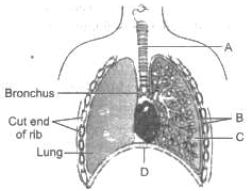
The figure shows a diagrammatic view of the human respiratory system with labels A, B, C, and D. Select the option which gives correct identification and main function and/or characteristic.
Image
  • A
    B-pleural membrane - surround ribs on both sides to provide cushion against rubbing
  • B
    D-Lower end of lungs -diaphragm pulls it down during inspiration
  • C
    A-trachea - long tube supported by complete cartilaginous rings for conducting inspired air
  • D
    C-Alveoli - thin walled vascular bag like structures for exchange of gases
Answer
D. C-Alveoli - thin walled vascular bag like structures for exchange of gases
Explanation:
In the given figure $A , B , C$ and D are respectively trachea, pleural membranes, alveoli and diaphragm.
Trachea is supported by incomplete cartilaginous rings which prevent its collapse during inspiration and abdominal cavities. It is the principal muscle of respiration.
View full question & answer
MCQ 364 Marks
Oxyhemoglobin dissociates into oxygen and deoxyhemoglobin at
  • A
    low $O _2$ pressure in tissue.
  • B
    all times irrespective of $O _2$ pressure.
  • C
    high $O _2$ pressure in tissue.
  • D
    equal $O _2$ pressure inside and outside tissue.
Answer
A. low $O _2$ pressure in tissue.
Explanation:
Oxyhemoglobin is the bright red hemoglobin which is formed by the combination of hemoglobin and oxygen from the lungs. Oxyhemoglobin transports oxygen to the cells of the body. It dissociates into oxygen and deoxyhemoglobin at low pressure in tissue.
View full question & answer
MCQ 374 Marks
Select the correct events that occur during inspiration.
i. Contraction of diaphragm
ii. Contraction of external intercostal muscles
iii. Pulmonary volume decreases
iv. Intra pulmonary pressure increases
  • A
    Option (i)
  • B
    Option (iii) and (iv)
  • C
    Option (i), (ii) and (iv)
  • D
    Option (i) and (ii)
Answer
D. Option (i) and (ii)
Explanation:
During Inspiration: Contraction of diaphragm takes place. This downward movement of the diaphragm causes less intra-pulmonary pressure than the atmosphere. Simultaneously, the external intercostal muscles also contract and cause the rib cage to be able to move outward. This further increases the pulmonary space and decreases the pulmonary pressure. Both of these movements cause inspiration.
View full question & answer
MCQ 384 Marks
Desmosomes are associated with:
  • A
    Cell division
  • B
    Cytolysis
  • C
    Cell excretion
  • D
    Attachment of cells
Answer
D. Attachment of cells
Explanation:
Desmosomes are intercellular junctions that provide strong adhesion between cells.
View full question & answer
MCQ 394 Marks
The dorsal surface of the body is marked by a dark median mid-dorsal line along the longitudinal axis of the body represents:
  • A
    Ventral blood vessel
  • B
    Heart
  • C
    All of these
  • D
    Dorsal blood vessel
Answer
D. Dorsal blood vessel
Explanation:
The body of an earthworm is segmented and there are about 100 to 120 metameres or short segments. There is a dark median mid-dorsal blood vessel that is seen on the dorsal surface of the body. The ventral surface of the body has genital openings or pores. Hence, the dorsal surface of the body is marked by a dark median mid-dorsal line along the longitudinal axis of the body representing the dorsal blood vessel.
View full question & answer
MCQ 404 Marks
Which of the following statement(s) is/are correct about nervous system of cockroach?
i. It consists of a series of fused segmentally arranged ganglia joined by paired longitudinal connectives on the ventral side.
ii. There are six ganglia which lie in the thorax, and three in the abdomen.
iii. The sense organs are antennae, eyes, maxillary pulps, labial pulps, and anal cerci etc.
iv. Each eye consists of about 5000 hexagonal ommatidia.
  • A
    Only (iii)
  • B
    Both (i) and (iii)
  • C
    Only (ii)
  • D
    Both (i) and (iv)
Answer
B. Both (i) and (iii)
Explanation:
Statement (i) and (iii) are correct and statement (ii) and (iv) are incorrect. There are three ganglia lie in the thorax, and six in the abdomen. Each eye consists of about 2000 hexagonal ommatidia.
View full question & answer
MCQ 414 Marks
Which of the following group of animals are the members of Class Aves?
  • A
    Clarias, Betta, Pterophyllum
  • B
    Neophron, Hemidactylus, Naja
  • C
    Pteropus, Camelus, Macaca
  • D
    Struthio, Pavo, Aptenodytes, Neophron
Answer
D. Struthio, Pavo, Aptenodytes, Neophron are the members of Class Aves.
View full question & answer
MCQ 424 Marks
Which one of the following is a distinctive character of Class Bivalvia of the phylum Mollusca?
  • A
    Presence of a coiled shell
  • B
    Presence of arms or tentacles around the mouth
  • C
    Absence of gills
  • D
    Absence of a head
Answer
D. Absence of a head
Explanation:
Bivalvia is a Class of Mollusca having a shell composed of the right and left halves. They lack a head. Hence, the absence of the head is a characteristic of Class Bivalvia.
View full question & answer
MCQ 434 Marks
Which one of the following is a matching set of a phylum with its three examples?
  • A
    Porifera: Spongilla, Euplectella, Pennatula
  • B
    Platyhelminthes: Planaria, Schistosoma, Enterobius
  • C
    Mollusca: Loligo, Teredo, Octopus
  • D
    Cnidaria: Bonellia, Physalia, Aurelia
Answer
C. Mollusca: Loligo, Teredo, Octopus
Explanation:
Loligo, Teredo, and Octopus belong to phylum Mollusca which are bilaterally symmetrical, triploblastic and coelomate animals.
View full question & answer
MCQ 444 Marks
Match the name of the animal (Column I) with one characteristic (Column II) and the phylum/class (Column III) to which it belongs.
Column IColumn IIColumn III
(a) IchthyophisTerrestrialReptile
(b) LimulusBody covered by chitinous exoskeletonPisces
(c) AdamsiaRadially symmetricalPorifera
(d) PetromyzonEctoparasiteCyclostomata
  • A
    Coloumn I - Limulus,Coloumn II- Body covered by chitinous exoskeleton, Coloumn III - Pisces
  • B
    Coloumn I - Adamsia, Coloumn II - Radially symmetrical, Coloumn III - Porifera
  • C
    Coloumn I - Petromyzon, Coloumn II - Ectoparasite, Coloumn III - Cyclostomata
  • D
    Coloumn I - Ichthyophis, Coloumn II -Terrestrial, Coloumn III - Reptile
Answer
C. Coloumn I - Petromyzon, Coloumn II - Ectoparasite, Coloumn III - Cyclostomata
Explanation:
Petromyzon is an ectoparasite on some fishes. It belongs to Class Cyclostomata.
View full question & answer
MCQ 454 Marks
Which is free swimming stage in the life history of Fasciola?
  • A
    Miracidium
  • B
    Both (Redia) and (Sporozoite)
  • C
    Redia
  • D
    Sporozoite
Answer
A. Miracidium
Explanation:
Miracidium is a free-swimming ciliated larval stage in which a parasitic fluke passes from the egg to its first host, typically a snail.
View full question & answer