MCQ 14 Marks
A motor of power $P_0$ is used to deliver water at a certain rate through a given horizontal pipe. To increase the rate of flow of water through the same pipe $n$ times, the power of the motor is increased to $P_1$. The ratio of $P_1$ to $P_0$ is :
- A
$n: 1$
- B
$n^2: 1$
- ✓
$n^3: 1$
- D
$n^4: 1$
AnswerCorrect option: C. $n^3: 1$
(C) $n^3: 1$
Force exerted by flowing water $=\rho Q v$
Power generated $=F . v=\rho Q v^2$
But we know that, $Q = F . v$, where A is area of pipe
$
\begin{array}{ll}
\text { Power }=\frac{\rho Q^3}{A^2} & \text { Power } \propto Q^3 \\
\frac{P_1}{P_0}=\frac{(n Q)^3}{(Q)^3}=\frac{n^3}{1} &
\end{array}
$
View full question & answer→MCQ 24 Marks
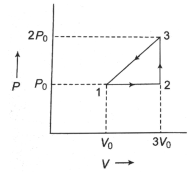
Answer(A) 1
Work done in process $1 \rightarrow 2$,
$W _1=$ Area under curve $1 \rightarrow 2$
$
=\left(3 V_0-V_0\right)\left(p_0\right)=2 p_0 V_0
$
Work done in process $2 \rightarrow 3$,
$W _2$ =Area under curve $2 \rightarrow 3$
$\because \quad$ Volume is constant
$
\therefore \quad W_2=0
$
Work done in process $3 \rightarrow 1$,
$W _3=$ Area under curve $3 \rightarrow 1$
$
\begin{array}{l}
=-\left[2 p_0 V_0+\frac{1}{2}\left(2 p_0-p_0\right)\left(3 V_0-V_0\right)\right] \\
=-2 p_0 V_0-p_0 V_0=-3 p_0 V_0
\end{array}
$
Now, the total work done in cyclic process
$\begin{aligned}1 \rightarrow 2 & \rightarrow 3 \rightarrow 1, \\
W & =W_1+W_2+W_3 \\
& =2 p_0 V_0+0+\left(-3 p_0 V_0\right)=-p_0 V_0 \\
& =-n p_0 V_0 \text { (Given) } \\
\therefore n & =1
\end{aligned}
$
View full question & answer→MCQ 34 Marks
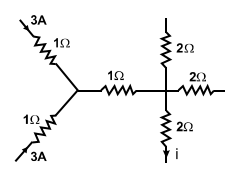
Figure shows a part of electrical circuit, then value of current $i$ is
View full question & answer→MCQ 44 Marks
A pure inductor of 25 mH is connected to an AC source of 220 V and the frequency of the source is 50 Hz , the rms current in the circuit is
Answer(B) 28 A
Here, $L =25 mH =25 \times 10^{-3} H$
$f =50 Hz, V _{ ms }=220 V$
The inductive reactance,
$
\begin{aligned}
X_L & =2 \pi f L \\
& =2 \times \frac{22}{7} \times 50 \times 25 \times 10^{-3} \Omega
\end{aligned}
$
The rms current in the circuit,
$
\begin{aligned}
I_{ms} & =\frac{V_{rms}}{X_L} \\
& =\frac{220}{2 \times \frac{22}{7} \times 50 \times 25 \times 10^{-3}} \\
& =\frac{7 \times 1000}{2 \times 5 \times 25} A=28 A .
\end{aligned}
$
View full question & answer→MCQ 54 Marks
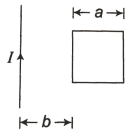
In the given figure, what will be the coefficient of mutual inductance?
- A
$\frac{\mu_0 a}{2 \pi} \ln \left(1+\frac{a}{2 b}\right)$
- B
$\frac{\mu_0 a }{\pi} \ln \left(1+\frac{ b }{2 a }\right)$
- ✓
$\frac{\mu_0 a}{2 \pi} \ln \left(1+\frac{a}{b}\right)$
- D
$\frac{\mu_0 a}{2 \pi} \ln \left(1+\frac{b}{a}\right)$
AnswerCorrect option: C. $\frac{\mu_0 a}{2 \pi} \ln \left(1+\frac{a}{b}\right)$
(C) $\frac{\mu_0 a}{2 \pi} \ln \left(1+\frac{a}{b}\right)$
Magnetic field due to wire,
$
\begin{array}{l}
\qquad B=\frac{\mu_0}{2 \pi x} \cdot i \\
d A=a d x \\
\text { and } \quad d \phi=B \cdot d A \\
\int d \phi=\int B d A \\
\phi=\frac{\mu_0 i}{2 \pi} \int_b^{a+b} \frac{a \cdot d x}{x} \\
\phi=\frac{\mu_0 i}{2 \pi} a \ln [x]_b^{a+b}=\frac{\mu_0 i}{2 \pi} a[\ln (a+b)-\ln b] \\
=\frac{\mu_0 i}{2 \pi} a\left[\ln \left(1+\frac{a}{b}\right)\right]=M i
\end{array}
$
where, $M =$ coefficient of mutual inductance.
$
M=\frac{\mu_0 a}{2 \pi} \ln \left(1+\frac{a}{b}\right)
$
View full question & answer→MCQ 64 Marks
In an experiment, the measurement of diameter of a wire of length 5.0 cm with help of screw gauge, the main scale reads 1 mm and 48th division on circular scale coincides with reference line. There are 100 divisions are on circular scale. If the pitch of the screw gauge is 1 mm , then volume of the wire is
- A
$0.019 cm^3$
- B
$0.026 cm^3$
- ✓
$0.086 cm^3$
- D
$0.046 cm^3$
AnswerCorrect option: C. $0.086 cm^3$
(C) $0.086 cm^3$
Given, length of the wire, I $=5.0 cm$
Pitch $=1 mm$
Least count of screw gauge,
$
\begin{aligned}
LC & =\frac{\text { pitch }}{\text { number of division on circular scale }} \\
& =\frac{1 mm}{100}=0.01 mm
\end{aligned}
$
Diameter of the river, d
$
\begin{array}{l}
=\text { Reading of main scale }+ \text { Reading of circular scale } \\
=1 mm+48 \times LC \\
=1 mm+48 \times 0.01=1.48 mm=1.48 \times 10^{-1} cm
\end{array}
$
Volume of the wire $=\pi r^2 I$
$
\begin{array}{l}
=\pi\left(\frac{d}{2}\right)^2 I=\frac{\pi d^2 I}{4} \quad\left(\because R=\frac{d}{2}\right) \\
=\frac{3.14 \times\left(1.48 \times 10^{-1} cm\right)^2 \times 5 cm}{4} \\
=0.0859732 cm^3=0.086 cm^3
\end{array}
$
View full question & answer→MCQ 74 Marks
The ratio of the energy required to move a satellite upto a height $h$ above the earth's surface of radius R to that the kinetic energy of satellite into that orbit is given by
Answer(D) h : 2R
Energy required to move the satellite to the height of $h$ from earth's surface is given by
$
\begin{aligned}
U & =-\frac{GMm}{(R+h)}-\left(-\frac{GMm}{R}\right) \\
& =\frac{GMmh}{R(R+h)}
\end{aligned}
$
Now, the kinetic energy of the satellite is
$
\begin{aligned}
KE & =\frac{1}{2} m v_0^2 \\
& =\frac{1}{2} m \frac{GM}{(R+h)}
\end{aligned}
$
So, the ratio of energy required to the kinetic energy is given by
$
\begin{array}{l}
\frac{U}{K E}=\frac{\frac{G M m h}{R(R+h)}}{\frac{1}{2} m \frac{G M}{(R+h)}}=\frac{2 h}{R} \\
\frac{U}{K E}=\frac{2 h}{R}
\end{array}
$
View full question & answer→MCQ 84 Marks
The respective speeds of five molecules are 1, 2, 3, 4 and $5 km / s$. The ratio of their rms velocity and the average velocity will be
- ✓
$\sqrt{11}: 3$
- B
$3: \sqrt{11}$
- C
$1: 2$
- D
$3: 4$
AnswerCorrect option: A. $\sqrt{11}: 3$
(A) $\sqrt{11}: 3$
$v _{ rms }=\sqrt{\frac{ v _1^2+ v _2^2+ v _3^2+\ldots \ldots+ v _{ n }^2}{ n }}$
$
=\sqrt{\frac{1^2+2^2+3^2+4^2+5^5}{5}}=\sqrt{11} km / s
$
$
v_{avg}=\frac{v_1+v_2+v_3+\ldots .+v_{n}}{n}
$
$
=\frac{1+2+3+4+5}{5}=3 km / s
$
$\therefore \quad \frac{v_{\text {rms }}}{v_{\text {avg }}}=\frac{\sqrt{11}}{3}=\sqrt{11}: 3$
View full question & answer→MCQ 94 Marks
Match List-I with List II.| List-I | List - II |
| (Spectral Lines of Hydrogen for transitions from) | (Wavelengths (nm)) |
| A. $n _2=3$ to $n _1=2$ | I. 410.2 |
| B. $n _2=4$ to $n _1=2$ | II 434.1 |
| C. $n _2=5$ to $n _1=2$ | III 656.3 |
| D. $n_2=6$ to $n_1=2$ | IV 486.1 |
Answer(A) A-III, B-IV, C-II, D-I
For $n _2=3$ to $n _1=2, \lambda=656.3 nm$
For $n_2=4$ to $n_1=2, \lambda=486.4 nm$
For $n_2=5$ to $n_1=2, \lambda=434.2 n m$
For $n_2=6$ to $n_1=2, \lambda=410.4 nm$
View full question & answer→MCQ 104 Marks
Two waves each of amplitude $a$ and frequency $f$ have a phase difference $\frac{\pi}{2}$. The amplitude and frequency of resultant wave due to their superposition will be
AnswerCorrect option: D. $\sqrt{2} a, f$
(D) $\sqrt{2} a, f$
$
\begin{aligned}
y_1 & =a \sin (2 \pi f t) \\
y_2 & =a \sin \left(2 \pi f t+\frac{\pi}{2}\right) \\
\therefore \quad y & =y_1+y_2 \\
& =2 a \sin \left(2 \pi f t+\frac{\pi}{4}\right) \cos \frac{\pi}{4} \\
& =\frac{2 a}{\sqrt{2}} \sin \left(2 \pi f t+\frac{\pi}{4}\right) \\
& =\sqrt{2} a \sin \left(2 \pi f t+\frac{\pi}{4}\right)
\end{aligned}
$
Thus, amplitude $=\sqrt{2} a$, frequency $=f$
View full question & answer→MCQ 114 Marks
In the relation, $p=\frac{\alpha}{\beta} e^{\frac{-\alpha z}{k \theta}}$, where $p$ is pressure, $z$ is distance, $K$ is Boltzmann constant and $\theta$ is temperature. The dimensional formula of $\beta$ will be
- ✓
$\left[M^0 L^2 T^0\right]$
- B
$\left[ ML ^2 T\right]$
- C
$\left[ ML ^0 T ^{-1}\right]$
- D
$\left[M^0 L^2 T^{-1}\right]$
AnswerCorrect option: A. $\left[M^0 L^2 T^0\right]$
(A) $\left[M^0 L^2 T^0\right]$
$\begin{aligned} \therefore \quad \alpha & =\frac{ K \theta}{ Z } \\ & =\frac{\left[ ML ^2 T^{-2} K^{-1}\right] \times[ K ]}{[ L ]} \\ & =\left[ MLT ^{-2}\right]\end{aligned}$
Also, $p=\frac{\alpha}{\beta}$
$
\begin{aligned}
\Rightarrow \quad[\beta] & =\left[\frac{\alpha}{p}\right] \\
& =\frac{\left[MLT^{-2}\right]}{\left[ML^{-1} T^{-2}\right]}=\left[M^0 L^2 T^0\right]
\end{aligned}
$
View full question & answer→MCQ 124 Marks
A lift of mass 1000 kg is supported by thick steel ropes. If maximum upward acceleration of the lift be $1.2 ms^{-2}$ and the breaking stress for the ropes be $1.4 \times 10^8 Nm ^{-2}$, what should be the minimum diameter of rope?( $\left.g=9.8 m / s ^2\right)$
Answer(A) 1 cm
$\begin{array}{l}\text { Here, } m =1000 kg, a =1.2 ms^{-2} \\ \text { Tension in the rope, } T = m ( g + a ) \\ =1000(9.8+1.2)=11000 N\end{array}$
$\begin{aligned} \text { Breaking stress } & =\frac{\text { Force }}{\text { Area }} \\ & =\frac{ T }{\pi D ^2 / 4}=\frac{4 T}{\pi D ^2}\end{aligned}$
$\begin{array}{l}1.4 \times 10^8=\frac{4 \times 11000 \times 7}{22 \times D^2} \\ D^2=\frac{2 \times 1000 \times 7}{1.4 \times 10^8}=10^{-4} m^2 \\ D=10^{-2} m=1 cm\end{array}$
View full question & answer→MCQ 134 Marks
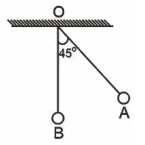
The bob $A$ of simple pendulum is released, then the string makes an angle of $45^{\circ}$ with the vertical. It hits another bob B of the same material and same mass kept at rest on the table. If the collision is elastic, then
- A
Both A and B rise of the same height.
- B
Both A and B come at rest at B .
- C
Both A and B move with the same velocity of A.
- ✓
A comes to rest and B moves with the velocity of A.
AnswerCorrect option: D. A comes to rest and B moves with the velocity of A.
(D) A comes to rest and B moves with the velocity of A.
As bob B is of same material and same mass as that of bob A, therefore on elastic collision, their velocities are exchanged.
By momentum conservation and $e=1$, we have
$e=\frac{\text { Speed of separation }}{\text { Speed of approach }}=\frac{v_2-v_1}{u_1}=1$
$\Rightarrow v_2-v_1=u_1$ $\quad$.....(i)
$\quad$$mu _1=m v _1+ mv _2$
$\quad$$v _2+ v _1= u _1$ $\quad$.....(ii)
Using eqs. (i) and (ii), we get
$
v_1=0 \text { and } v_2=u_1
$
Bob A comes to rest and $B$ moves with the velocity of $A$.
View full question & answer→MCQ 144 Marks
If $\frac{4}{3}$ and $\frac{3}{2}$ are the refractive indices of water and glass, respectively. A ray of light travelling in water is incident on the water-glass interface at $30^{\circ}$. The angle of refraction is given by
- ✓
$\sin ^{-1}\left(\frac{4}{9}\right)$
- B
$\sin ^{-1}\left(\frac{3}{2}\right)$
- C
$\sin ^{-1}\left(\frac{18}{8}\right)$
- D
$\sin ^{-1}\left(\frac{4}{3}\right)$
AnswerCorrect option: A. $\sin ^{-1}\left(\frac{4}{9}\right)$
(A) $\sin ^{-1}\left(\frac{4}{9}\right)$
$
\begin{array}{l}
\mu_{w}^{u}=\frac{4}{3} \\
\mu_{g}^{a}=\frac{3}{2} \\
\mu_{g}^{w}=\frac{\mu_{g}^{a}}{\mu_{w}^{a}}=\frac{3 / 2}{4 / 3}=\frac{9}{8}
\end{array}
$
As, $i=30^{\circ}$
$\begin{aligned} & \frac{\operatorname{sini}}{\sin r}=\mu_{ g }^{ w }=\frac{9}{8} \\ \Rightarrow & \sin r=\frac{8}{9} \sin i =\frac{8}{9} \sin 30^{\circ}=\frac{8}{9} \times \frac{1}{2}=\frac{4}{9} \\ \Rightarrow & r=\sin ^{-1}\left(\frac{4}{9}\right)\end{aligned}$
View full question & answer→MCQ 154 Marks
In the following electric circuit, calculate the effective resistance between $A$ and $B$.
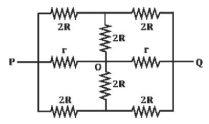
AnswerCorrect option: A. $\frac{2 R r}{R+r}$
View full question & answer→MCQ 164 Marks
A block of mass 10 kg is moving horizontally with a speed of $1.5 ms^{-1}$ on a smooth plane. If a constant vertical force of 10 N acts on it, then the displacement of the block from the point of application of the force at the end of 4 s is
Answer(D) 10 m
$
a=\frac{F}{m}=\frac{10}{10}=1 ms^{-2}
$
Distance in vertical direction in 4 s ,
$
s_{y}=\frac{1}{2} a, t^2=\frac{1}{2} \times 1 \times 16=8 m
$
Distance in horizontal direction in 4 s ,
$
s_{x}=1.5 \times 4=6 m
$
$
\begin{aligned}
\text { Displacement } & =\sqrt{s_x^2+s_y^2} \\
& =\sqrt{8^2+6^2}=10 m
\end{aligned}
$
View full question & answer→MCQ 174 Marks
The two statements are given below.
Statement - I : When unpolarised light is incident on the polariser, the intensity of the transmitted polarised light remains unchanged.
Statement - II : Polarisation is convincing proof of transverse nature of light wave.
- A
Both Statement I and Statement II are correct.
- B
Both Statement I and Statement II are incorrect.
- C
Statement I is correct but Statement II is incorrect.
- ✓
Statement I is incorrect but Statement II is correct.
AnswerCorrect option: D. Statement I is incorrect but Statement II is correct.
View full question & answer→MCQ 184 Marks
A satellite is revolving around the earth, close to its surface with a kinetic energy $E$, then the energy required to be given to it, so that it escape from the earth is
Answer(C) E
The escape velocity and orbital velocity are related as $v_e=\sqrt{2} v_e$
Energy in a orbital velocity,
$
KE_{n}=\frac{1}{2} mv_0^2=E
$
Energy for escape velocity,
$
KE_{e}=\frac{1}{2} m v_{e}^2=\frac{1}{2} m\left(\sqrt{2} v_{e}\right)^2=2 E
$
Thus, energy required
$
=KE_r-KE_0=2 E-E=E
$
View full question & answer→MCQ 194 Marks
Charge $q_2$ of mass $m$ revolves around a stationary charge $q_1$ in a circular orbit of radius $r$. The orbital periodic time of $q_2$ would be
- A
$\left[\frac{4 \pi^2 m r^2}{q_1 q_2}\right]^{1 / 2}$
- B
$\left[\frac{ kq _1 q _2}{4 \pi^2 mr ^2}\right]^{1 / 2}$
- ✓
$\left[\frac{4 \pi^2 m r^3}{k q_1 q_2}\right]^{1 / 2}$
- D
$\left[\frac{4 \pi^2 m r^4}{q_1 q_2}\right]^{1 / 2}$
AnswerCorrect option: C. $\left[\frac{4 \pi^2 m r^3}{k q_1 q_2}\right]^{1 / 2}$
(C) $\left[\frac{4 \pi^2 m r^3}{k q_1 q_2}\right]^{1 / 2}$
As we know, force
$
F=\frac{1}{4 \pi \varepsilon_0} \frac{q_1 q_2}{r^2}\qquad\ldots(i)
$
Also, $F = mr \omega^2=\frac{4 \pi^2 mr }{ T ^2}\left(\because \omega=\frac{2 \pi}{T}\right)\qquad\ldots(ii)$
By Eqs. (i) and (ii), we get
$
T^2=\frac{\left(4 \pi \varepsilon_0\right) r^2\left(4 \pi^2 mr\right)}{q_1 q_2}
$
So, $T=\left[\frac{4 \pi^2 m r^3}{k q_1 q_2}\right]^{1 / 2}$
View full question & answer→MCQ 204 Marks
Identify the logic gates marked $X$ and $Y$ in the following figure.
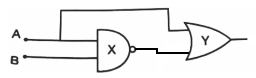
Answer(B) NAND, OR
X is NAND gate and Y is OR gate.
View full question & answer→MCQ 214 Marks
A tuning fork of frequency 520 Hz is used in an experiment for measuring speed of sound (v) in air by resonance tube method. Resonance is observed to occur at two successive lengths of air column, $I _1=30 cm$ and $I _2=70 cm$. Then, v is equal to
- A
$385 m / s$
- B
$395 m / s$
- ✓
$416 m / s$
- D
$428 m / s$
AnswerCorrect option: C. $416 m / s$
(C) $416 m / s$
Given, $f=520 Hz$,
Resonance lengths, $I_1=30 cm=0.3 m$
$
I_2=70 cm=0.7 m
$
$\therefore \quad$ The speed of sound in air,
$
\begin{aligned}
v & =2 f\left(I_1-I_1\right) \\
& =2 \times 520 \times(0.7-0.3) \\
& =416 m / s
\end{aligned}
$
View full question & answer→MCQ 224 Marks
If $n$ equal resistors are used to produce a total resistance in circuit, the ratio of maximum to the minimum resistance is
- A
$1: n ^2$
- ✓
$n ^2: 1$
- C
$1: 1$
- D
AnswerCorrect option: B. $n ^2: 1$
(B) $n ^2: 1$
Resistance will be maximum when connected in series,
$\therefore R _{\text {seeies }}= R + R + R . \ldots . . .$. upto n
$R _{\text {series }}=n R$
Resistance will be minimum when connected in parallel,
$\begin{array}{l}\therefore \frac{1}{R_{\text {parallel }}}=\frac{1}{R}+\frac{1}{R}+\ldots \text { upto } n \\ \Rightarrow R_{\text {parallel }}=\frac{R}{n} \\ \therefore \frac{R_{\text {series }}}{R_{\text {parallel }}}=\frac{n R}{R / n}=\frac{n^2}{1}\end{array}$
View full question & answer→MCQ 234 Marks
Let $F$ be the force acting on a particle having position vector $r$ and $\tau$ is the torque of this force about origin, then
- A
$\tau . F=0$ and $\tau . r \neq 0$
- B
$\tau . F \neq 0$ and $\tau . r =0$
- C
$\tau . F \neq 0$ and $\tau . r \neq 0$
- ✓
$\tau . F=0$ and $\tau . r=0$
AnswerCorrect option: D. $\tau . F=0$ and $\tau . r=0$
(D) $\tau . F=0$ and $\tau . r=0$
$\begin{array}{ll} & \tau=r \times F \\ \therefore \quad & \tau \perp r \text { and } \tau \perp F \\ & \text { Hence, } \tau \cdot r =0 \text { and } \tau . F =0\end{array}$
View full question & answer→MCQ 244 Marks
Power dissipated across the $8 \Omega$ resistor in the circuit shown here is 2 W . The power dissipated in watt units across the $3 \Omega$ resistor is
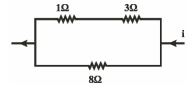
Answer(D) 3.0
As voltage drop across $8 \Omega$
$
=\sqrt{2 \times 8}=4 V \quad\left(P=\frac{V^2}{R}\right)
$
Therefore, voltage drop across $3 \Omega$
$
=\left(\frac{3}{1+3}\right) \cdot 4=3 V
$
Hence, power dissipated in $3 \Omega=\frac{(3)^2}{3}=3 W$.
View full question & answer→MCQ 254 Marks
The velocity of electromagnetic wave is parallel to
- A
$B+E$
- B
$E$
- ✓
$E \times B$
- D
$B$
AnswerCorrect option: C. $E \times B$
View full question & answer→MCQ 264 Marks
A ray of light falls on a transparent glass slab of refractive index 1.73 . If the reflected ray and the refracted ray are mutually perpendicular, the angle of incidence is
- A
$30^{\circ}$
- B
$48^{\circ}$
- ✓
$60^{\circ}$
- D
$75.2^{\circ}$
AnswerCorrect option: C. $60^{\circ}$
(C) $60^{\circ}$
$\begin{array}{l} \text { As, } \mu=\tan \theta_p \\ \therefore \quad \text { Here, } \theta_p=\theta_1=\tan ^{-1} 1.73 \\ =\tan ^{-1} \sqrt{3}=60^{\circ} .\end{array}$
View full question & answer→MCQ 274 Marks
Positive and negative changes of equal magnitude are kept at $A(0,0, \sqrt{a})$ and $B(0,0,-\sqrt{a})$ respectively. The work done by the electric field when another positive point charge is moved from $(-2 a, 0,0)$ to $(0,2 a, 0)$ is
- ✓
- B
- C
- D
charges are not given so data insufficient
View full question & answer→MCQ 284 Marks
If potential energy of first excited state of hydrogen atom is taken zero, then kinetic energy of ground state electron in the hydrogen atom is
MCQ 294 Marks
The ratio of the energies of the hydrogen atom is its first to second excited state is
Answer(A) 9/4
The energy of an electron in nth orbit of the hydrogen atom is given by
$
\therefore \quad E_n=\frac{-13.6}{n^2} e V
$
For the first excited state, $n =2$
$
\therefore \quad E_2=\frac{-13.6}{2^2} eV
$
For the second excited stute, $n =3$
$
\begin{array}{ll}
\therefore & E_3=\frac{-13.6}{3^2} eV \\
\therefore & \frac{E_2}{E_3}=\frac{3^2}{2^2}=\frac{9}{4}
\end{array}
$
View full question & answer→MCQ 304 Marks
From the top of a tower 19.6 m high, a ball is thrown horizontally. If the line joining the point of projection to the point where it hits the ground makes an angle of $45^{\circ}$ with the horizontal, then the initial velocity of the ball is
- A
$28 ms^{-1}$
- ✓
$9.8 ms^{-1}$
- C
$49 ms^{-1}$
- D
$14.7 ms^{-1}$
AnswerCorrect option: B. $9.8 ms^{-1}$
(B) $9.8 ms^{-1}$
Since, angle with the horizontal is $45^{\circ}$, therefore vertical height = range
$
\begin{array}{l}
\tan 45^{\circ}=\frac{H}{x}=1 \\
x=H=19.6
\end{array}
$
Time of flight, $t=\sqrt{\frac{2 H }{ g }}=\sqrt{\frac{2 \times 19.6}{9.8}}$
$
\begin{aligned}
t & =2 s \\
u & =\frac{x}{t} \\
\Rightarrow u & =\frac{19.6}{2}=9.8 ms^{-1}
\end{aligned}
$
View full question & answer→MCQ 314 Marks
The work functions of three metals $A, B$ and $C$ are $1.92 eV , 2 eV$ and $5 eV$ , respectively. Which metals will emit photoelectrons for a radiation of wavelength $4100 $ Å ?
Answer(C) Both A and B
$W _0=\frac{ hc }{\lambda}=\frac{6.62 \times 10^{-34} \times 3 \times 10^8}{4100 \times 10^{-10}}$
$
\begin{array}{l}
\quad=4.8 \times 10^{-19} J=3 eV \\
W_{A}=1.92 eV \\
W_{B}=2 eV \\
W_{C}=5 eV \\
\text { Since, } W_{A}<W_0 \\
W_{B}<W_0
\end{array}
$
Hence, $A$ and $B$ will emit photoelectrons.
View full question & answer→MCQ 324 Marks
The displacement of body along $X$-axis depends on time as $\sqrt{x}=t+1$, then the velocity of body
Answer(A) increases with time
Given, $\sqrt{ x }= t +1$
$
\begin{array}{l}
\Rightarrow x=(t+1)^2 \quad \Rightarrow \frac{dx}{dt}=2 t+2 \\
\Rightarrow v=2 t+2 \\
\Rightarrow v \propto t
\end{array}
$
View full question & answer→MCQ 334 Marks
A solid conducting sphere having a charge $Q$ is surrounded by an uncharged concentric conducting hollow spherical shell. Let the potential difference between the surface of solid sphere and that of the outer surface of hollow shell be V. What will be the new potential difference between the same two surfaces, if the shell is given a charge $-3 Q$ ?
View full question & answer→MCQ 344 Marks
In a particular medium there is an EM wave, if $E_0=9 N / C$ and speed of light in that space is $3 \times 10^8 ms^{-1}$. The amplitude of magnetic field will be
- A
$1 \times 10^{-8} T$
- B
$2 \times 10^{-8} T$
- ✓
$3 \times 10^{-8} T$
- D
$2.5 \times 10^{-8} T$
AnswerCorrect option: C. $3 \times 10^{-8} T$
(C) $3 \times 10^{-8} T$
$\begin{array}{l}\text { Speed of light }=\frac{\text { Amplitude of electric field }}{\text { Amplitude of magnetic field }} \\ 3 \times 10^8=\frac{9}{B_0} \\ B_0=\frac{9}{3} \times 10^{-8} T \\ B _0=3 \times 10^{-8} T\end{array}$
View full question & answer→MCQ 354 Marks
An $\alpha$-particle after passing through a potential difference of $V$ volts collides with a nucleus. If the atomic number of the nucleus is $Z$, then the distance of closest approach of $\alpha$-particle to the nucleus will be
AnswerCorrect option: A. $14.4 \frac{Z}{V} Å$
(A) $14.4 \frac{Z}{V} Å$
For closest approach, Initial kinetic energy of $\alpha$-particle = Potential energy of $\alpha$-particle at closest approach
$
\begin{array}{l}
(2 e) V=\frac{1}{4 \pi \varepsilon_0} \frac{(2 e)(Ze)}{d} \\
d=\frac{1}{4 \pi \varepsilon_0} \frac{Ze}{V}=\left(9 \times 10^9\right) \frac{Z}{V}\left(1.6 \times 10^{-19}\right)=14.4 \frac{Z}{V} Å
\end{array}
$
View full question & answer→MCQ 364 Marks
A thief is running away on a straight road in a jeep moving with a speed of $9 ms^{-1}$. A policeman chases him on a motor cycle moving at a speed of $10 ~ m s ^{-1}$. If the instantaneous separation of the jeep from the motorcycles is 100 m , how long will it take for the police man to catch the thief?
Answer(A) 100s
$
v_{P T}=v_P-v_T=10-9=1 m / s
$
So time taken,
$
\begin{array}{l}
t=\frac{100}{v_{P T}}=\frac{100}{1} \\
t=100 s .
\end{array}
$
View full question & answer→MCQ 374 Marks
22 g of $CO _2$ at $27^{\circ} C$ is mixed 16 g of $O _2$ at $37^{\circ} C$. The temperature of mixture is
[Assume degree of freedom of $CO _2=7$ and degree of freedom of $O _2=5$ ]
- ✓
$31.16^{\circ} C$
- B
$27^{\circ} C$
- C
$37^{\circ} C$
- D
$30^{\circ} C$
AnswerCorrect option: A. $31.16^{\circ} C$
(A) $31.16^{\circ} C$
$
\begin{array}{l}
n_{co_2}=\frac{22}{44}=\frac{1}{2}, f_{co_2}=7, T_{co_2}=300 K \\
n_{o_2}=\frac{16}{32}=\frac{1}{2}, f_{o_2}=5, T_{o_2}=310 K
\end{array}
$
where, $n =$ number of moles,
$f =$ degree of freedom
and $\quad T =$ initial temperature
$T _{\min }=\frac{ n _{ CO _2} f _{ CO _2} T_{ CO _2}+ n _{ O _2} f _{ O _2} T_{ O _2}}{ n _{ CO _2} f _{ CO _2}+ n _{ O _2} f _{ O _2}}$
$=\frac{\left[\frac{1}{2} \times 7 \times 300\right]+\left[\frac{1}{2} \times 5 \times 310\right]}{\left[7 \times \frac{1}{2}\right]+\left[5 \times \frac{1}{2}\right]}$
$=\frac{\frac{2100}{2}+\frac{1550}{2}}{\frac{7+5}{2}}=304.16 K$ or $31.16^{\circ} C$
View full question & answer→MCQ 384 Marks
If number of turns per unit length of a coil of solenoid is doubled, the self-inductance of the solenoid will
Answer(D) become four times
Self-inductance of solenoid $=\mu n ^2 Al$
$n =$ number of turns per unit length
$\therefore$ Self-induction $\propto n ^2$
So, inductance becomes 4 times when n is doubled.
View full question & answer→MCQ 394 Marks
Let the moment of inertia of a hollow cylinder of length 30 cm , inner radius 11 cm and outer radius 15 cm about its axis be $l$. The radius of a thin cylinder of the same mass such that its moment of inertia about its axis is also $l$, is found to be $x cm$, then the value of $x$ is
View full question & answer→MCQ 404 Marks
For a coil having $L =2 mH$, current flows through it is $i=t^2 e^{-t}$, then the time at which emf becomes zero
Answer(D) 2 s
As, $i=t^2 e^{-i}$ and $|e|=L \frac{d i}{d t}$
So, emf will be zero when $\frac{ di }{ dt }=0$
$
\begin{aligned}
& \text { Now, } \frac{d i}{d t}=2 t e^{-i}-t^2 e^{-i}=0 \\
\Rightarrow & 2 t e^{-i}-t^2 e^{-i}=0 \\
\Rightarrow & t e^{-i}(t-2)=0 \\
& \text { As, } t \neq \infty \text { and } t \neq 0 \\
\therefore \quad & t=2 s
\end{aligned}
$
View full question & answer→MCQ 414 Marks
A block of mass 10 kg is pushed up on a smooth inclined plane of inclination $30^{\circ}$, so that it has acceleration $2 m / s ^2$. The applied force is
Answer(D) 70N
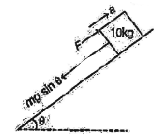
$\begin{aligned} & F-m g \sin \theta=m a \\ \Rightarrow & F-10 \times 10 \times \sin 30^{\circ}=10 \times 2 \\ \Rightarrow & F-50=20 \quad \Rightarrow \quad F=70 N\end{aligned}$ View full question & answer→MCQ 424 Marks
An $\alpha$-particle is accelerated by V volt, experiences a force $F$, when it enters in a uniform magentic field. When $\alpha$-particle is accelerated by 3 V , in same magnetic field, then force experienced by $\alpha$-particle is
- ✓
$\sqrt{3} F$
- B
$\sqrt{2} F$
- C
$\frac{F}{3}$
- D
$\frac{F}{\sqrt{2}}$
AnswerCorrect option: A. $\sqrt{3} F$
(A) $\sqrt{3} F$
Work done = Kinetic energy
$
qV=\frac{1}{2} mV^2 \Rightarrow v=\sqrt{\frac{2 q V}{m}}
$
Force experienced by $\alpha$-particle
$
\begin{array}{l}
F=BqV=Bq \sqrt{\frac{2 q V}{m}} \\
F=\sqrt{V} \Rightarrow \frac{F_2}{F}=\sqrt{\frac{V_2}{V}}=\sqrt{3} \quad F_2=\sqrt{3} F
\end{array}
$
View full question & answer→MCQ 434 Marks
The masses of neutron and proton are 1.0087 and 1.0073 amu , respectively. If neutrons and protons combine to form helium nucleus of mass 4.0015 amu, the binding energy of the helium nucleus will be
Answer(A) 28.4 MeV
Mass defect, $\Delta m=2\left(m_n+m_p\right)-m_{\text {He }}$
(as helium nucleus has two protons and two neutrons)
$\begin{array}{l}\Delta m=2(1.0087+1.0073)-4.0015 \\
\begin{aligned}
\Delta m=4.032-4.0015=0.0305 amu
\end{aligned} \\
\text { binding energy, } E_{p}=\Delta m \times 931 MeV \\
=0.0305 \times 931=28.4 MeV\end{array}$
View full question & answer→MCQ 444 Marks
For an ideal gas of $n$ moles, the temperature is increased from temperature T to 4 T at pressure $p = a T ^{-1}$, where a is a constant. What will be the work done by the gas?
Answer(D) 6 nRT
From the ideal gas equation
$pV = nRT$
$\Rightarrow V =\frac{ nRT }{ p } \quad \Rightarrow$ $V =\frac{ nRT { }^2}{ a }$ $\left(\because p = a T ^{-1}\right)$
$\Rightarrow dV =\frac{2 nRT }{ a } dT\qquad\ldots (i)$
Now, the work done by the gas is given by $dW = pdV$
$\begin{array}{l}W=\int_T^{4 T} \frac{a}{T} \frac{2 n R T}{a} d T=[2 n R T]_T^{4 T} \\ W=6 n R T\end{array}$
View full question & answer→MCQ 454 Marks
The position $x$ of a particle varies with time $t$ as $x=6+12 t-2 t^2$, where $x$ is in metres and $t$ is in seconds. The distance travelled by the particle in first five seconds is
Answer(B) 26m
$
\begin{array}{l}
x=6+12 t-2 t^2 \\
\frac{d x}{d t}=12-4 t
\end{array}
$
When particle stops travelling in forward direction,
$
v=0
$
$
12-4 t=0
$
$
t=3 s
$
Position at $t =0 s$,
$
\begin{array}{l}
x=6+12(0)-2(0)^2 \\
x=6 m
\end{array}
$
Position at $t =3 s$,
$
x=6+12(3)-2(3)^2=24 m
$
Position at $t =5 s$,
$
x_3=6+12(5)-2(5)^2=16 m
$
Distance from 0 s to $3 s, \Delta x=|24-6|=16 m$
Distance from 3 s to 5 s ,
$
\Delta x^{\prime}=|16-24|=8 m
$
Total distance travelled in 5 s
$
=18+8=26 m
$
View full question & answer→