Question types

12 . kinetic theory of gases question types

766 questions across 1 question group — pick any mix to generate a Physics paper with step-by-step answer keys.

766
Questions
1
Question groups
5
Question types
Sample Questions

12 . kinetic theory of gases questions

One sample from each question group in this chapter. Select any group above to see the full set with answer keys.

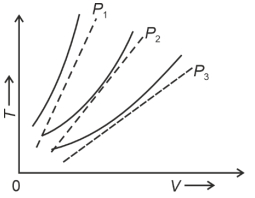
The following graph represents the $T-V$ curves of an ideal gas (where $T$ is the temperature and $V$ the volume) at three pressures $P_1, P_2$ and $P_3$ compared with those of Charles's law represented as dotted lines.

Then the correct relation is:
  • A
    $P_1>P_3>P_2$
  • B
    $P_2>P_1>P_3$
  • $P_1>P_2>P_3$
  • D
    $P_3>P_2>P_1$

Answer: C.

View full solution
The temperature of a gas is $-50^{\circ}\,C$. To what temperature the gas should be heated so that the rms speed is increased by $3$ times?
  • A
    $223\,K$
  • B
    $669^{\circ}\,C$
  • $3295^{\circ}\,C$
  • D
    $3097\,K$

Answer: C.

View full solution
The volume occupied by the molecules contained in $4.5\,kg$ water at $STP$, if the intermolecular forces vanish away is ........ $m ^{3}$
  • A
    $5.6 \times 10^{3}$
  • B
    $5.6 \times 10^{-3}$
  • $5.6$
  • D
    $5.6 \times 10^{6}$

Answer: C.

View full solution
Three vessels of equal capacity have gases at the same temperature and pressure. The first vessel contains helium (monoatomic), the second contains fluorine (diatomic) and the third contains sulfur hexafluoride (polyatomic). The correct statement, among the following is
  • A
    All vessels contain unequal number of respective molecules
  • B
    The root mean square speed of molecules is same in all three cases
  • The root mean square speed of helium is the largest
  • D
    The root mean square speed of sulfur hexafluoride is the largest

Answer: C.

View full solution
Match Column $- I$ and Column $- II$ and choose the correct match from the given choices.
Column $- I$ Column $- II$
$(A)$ Root mean square speed of gas molecules $(P)$ $\frac{1}{3} \mathrm{n} m \bar{v}^{2}$
$(B)$ Pressure exerted by ideal gas $(Q)$ $\sqrt{\frac{3 \mathrm{RT}}{\mathrm{M}}}$
$(C)$ Average kinetic energy of a molecule $(R)$ $\frac{5}{2} \mathrm{RT}$
$(D)$ Total internal energy  of $1$ mole of a diatomic gas $(S)$ $\frac{3}{2} \mathrm{k}_{\mathrm{B}} \mathrm{T}$
  • A
    $(A) - (R), (B) - (P), (C) - (S), (D) - (Q)$
  • B
    $(A) - (Q), (B) - (R), (C) - (S), (D) - (P)$
  • $(A) - (Q), (B) -(\mathrm{P}),(\mathrm{C})-(\mathrm{S}),(\mathrm{D})-(\mathrm{R})$
  • D
    $(A) - (R), (B) - (Q), (C) - (P), (D) - (S)$

Answer: C.

View full solution

Generate a 12 . kinetic theory of gases paper free

Pick question groups from the list above, set marks and difficulty, and export a branded PDF with step-by-step answer keys. First 3 chapters free — no signup.

Download App