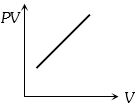
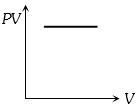
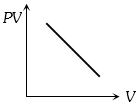
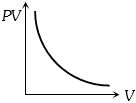
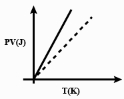
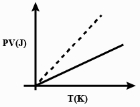
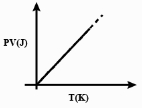
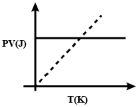
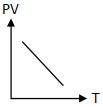
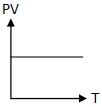
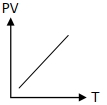
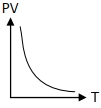
MCQ 11 Mark
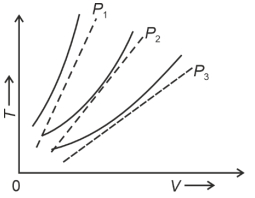
The following graph represents the $T-V$ curves of an ideal gas (where $T$ is the temperature and $V$ the volume) at three pressures $P_1, P_2$ and $P_3$ compared with those of Charles's law represented as dotted lines.
Then the correct relation is:
- A
$P_1>P_3>P_2$
- B
$P_2>P_1>P_3$
- ✓
$P_1>P_2>P_3$
- D
$P_3>P_2>P_1$
AnswerCorrect option: C. $P_1>P_2>P_3$
c
At same temperature, curve with higher volume corresponds to lower pressure.
$V_3>V_2>V_1$
$\Rightarrow P_1>P_2>P_3$
(We draw a straight line parallel to volume axis to get this)
View full question & answer→MCQ 21 Mark
The temperature of a gas is $-50^{\circ}\,C$. To what temperature the gas should be heated so that the rms speed is increased by $3$ times?
- A
$223\,K$
- B
$669^{\circ}\,C$
- ✓
$3295^{\circ}\,C$
- D
$3097\,K$
AnswerCorrect option: C. $3295^{\circ}\,C$
c
$v _{ rms } \propto \sqrt{ T }$
$\frac{ v _1}{ v _2}=\sqrt{\frac{ T _1}{ T _2}}$
$=$ let initial speed is $v$
As speed is increased by $3$ times so final speed become $4 v$
$\Rightarrow \frac{v}{4 v}=\sqrt{\frac{223}{T}}$
$T=3568\,K$
So temp. in ${ }^{\circ} C =3568-273=3295^{\circ}\,C$
View full question & answer→MCQ 31 Mark
The volume occupied by the molecules contained in $4.5\,kg$ water at $STP$, if the intermolecular forces vanish away is ........ $m ^{3}$
- A
$5.6 \times 10^{3}$
- B
$5.6 \times 10^{-3}$
- ✓
$5.6$
- D
$5.6 \times 10^{6}$
Answerc
$V =$ (no. of moles) ($22.4$ litre)
$=\frac{\text { mass }}{\text { molar mass }}\left(22.4 \times 10^{-3} m ^{3}\right)$
$=\frac{4.5 \times 10^{3}}{18} \times 22.4 \times 10^{-3} m ^{3}$
View full question & answer→MCQ 41 Mark
Three vessels of equal capacity have gases at the same temperature and pressure. The first vessel contains helium (monoatomic), the second contains fluorine (diatomic) and the third contains sulfur hexafluoride (polyatomic). The correct statement, among the following is
- A
All vessels contain unequal number of respective molecules
- B
The root mean square speed of molecules is same in all three cases
- ✓
The root mean square speed of helium is the largest
- D
The root mean square speed of sulfur hexafluoride is the largest
AnswerCorrect option: C. The root mean square speed of helium is the largest
c
$V_{ rms }=\sqrt{\frac{3 KT }{ m }} \propto \frac{1}{\sqrt{ m }}$
$=\text { maximum for } He$
View full question & answer→MCQ 51 Mark
Match Column $- I$ and Column $- II$ and choose the correct match from the given choices.
| Column $- I$ |
Column $- II$ |
| $(A)$ Root mean square speed of gas molecules |
$(P)$ $\frac{1}{3} \mathrm{n} m \bar{v}^{2}$ |
| $(B)$ Pressure exerted by ideal gas |
$(Q)$ $\sqrt{\frac{3 \mathrm{RT}}{\mathrm{M}}}$ |
| $(C)$ Average kinetic energy of a molecule |
$(R)$ $\frac{5}{2} \mathrm{RT}$ |
| $(D)$ Total internal energy of $1$ mole of a diatomic gas |
$(S)$ $\frac{3}{2} \mathrm{k}_{\mathrm{B}} \mathrm{T}$ |
- A
$(A) - (R), (B) - (P), (C) - (S), (D) - (Q)$
- B
$(A) - (Q), (B) - (R), (C) - (S), (D) - (P)$
- ✓
$(A) - (Q), (B) -(\mathrm{P}),(\mathrm{C})-(\mathrm{S}),(\mathrm{D})-(\mathrm{R})$
- D
$(A) - (R), (B) - (Q), (C) - (P), (D) - (S)$
AnswerCorrect option: C. $(A) - (Q), (B) -(\mathrm{P}),(\mathrm{C})-(\mathrm{S}),(\mathrm{D})-(\mathrm{R})$
c
$(A)$ $V_{r m s}=\sqrt{\frac{3 R T}{M}}$
$(B)$ $P=\frac{1}{3} n m V_{m}^{2}$
$(C)$ $\mathrm{E}=\frac{3}{2} \mathrm{kT}$
$(D)$ $E_{\text {Total }}=\mathrm{n} \frac{\mathrm{f}}{2} \mathrm{R} T=\frac{5}{2} \mathrm{RT}$
View full question & answer→MCQ 61 Mark
A cylinder contains hydrogen gas at pressure of $249\; kPa$ and temperature $27^{\circ} C$. Its density is$.............kg / m ^{3}$ $\left( R =8.3\, J\, mol ^{-1} K ^{-1}\right)$
- A
$0.02$
- B
$0.5$
- ✓
$0.2$
- D
$0.1$
Answerc
For an ideal gas sample
$\frac{P}{\rho}=\frac{R T}{M w}$
$\rho=\frac{ PMw }{ RT }=\frac{249 \times 10^{3} \times 2 \times 10^{-3}}{8.314 \times 300}=0.199$
$\rho=0.2\, kg / m ^{3}$
View full question & answer→MCQ 71 Mark
An ideal gas equation can be written as $P=\frac{\rho R T}{M_{0}}$ where $\rho$ and $M_{0}$ are respectively,
- A
Number density, mass of the gas
- B
Mass density, mass of the gas
- C
Number density, molar mass
- ✓
Answerd
Perfect gas equation can be written as
$PV =\mu RT$
$PV =\frac{ M }{ M _{0}} RT$
$P =\left(\frac{M}{V}\right) \frac{R T}{M_{0}}$
$P=\frac{\rho R T}{M_{0}}$
where $\rho$ is mass density and $M _{0}$ is molar mass.
View full question & answer→MCQ 81 Mark
The average thermal energy for a mono$-$atomic gas is : $\left( k _{ B }\right.$ is Boltzmann constant and $T ,$ absolute $e$. temperature)
- A
$\frac{7}{2} k _{ B } T$
- B
$\frac{1}{2} k _{ B } T$
- ✓
$\frac{3}{2} k _{ B } T$
- D
$\frac{5}{2} k_{B} T$
AnswerCorrect option: C. $\frac{3}{2} k _{ B } T$
c
Average thermal energy $=\frac{3}{2} K _{ B }\, T$
where $3$ is translational degree of freedom For monoatomic gas total degree of freedom
$f =3$ (translational degree of freedom)
View full question & answer→MCQ 91 Mark
The mean free path for a gas, with molecular diameter $d$ and number density $n$ can be expressed as :
- A
$\frac{1}{\sqrt{2} n ^{2} \pi^{2} d ^{2}}$
- B
$\frac{1}{\sqrt{2} n \pi d }$
- ✓
$\frac{1}{\sqrt{2} n \pi d ^{2}}$
- D
$\frac{1}{\sqrt{2} n ^{2} \pi d ^{2}}$
AnswerCorrect option: C. $\frac{1}{\sqrt{2} n \pi d ^{2}}$
c
Mean free path for a gas sample
$\lambda_{ m }=\frac{1}{\sqrt{2} \pi d ^{2} n }$
where $d$ is diameter of a gas molecule and $n$ is molecular density
View full question & answer→MCQ 101 Mark
The Mean Free Path $\ell$ for a gas molecule depends upon diameter, $d$ of the molecule as
AnswerCorrect option: B. $\ell \propto \frac{1}{d^{2}}$
b
Mean free path $(\ell)$
$\ell=\frac{1}{\sqrt{2} n \pi d^{2}}$
$\ell \propto \frac{1}{d^{2}}$
View full question & answer→MCQ 111 Mark
The value of $\gamma\left(=\frac{\mathrm{C}_{\mathrm{p}}}{\mathrm{C}_{\mathrm{v}}}\right),$ for hydrogen, hellium and another ideal diatomic gas $X$(whose molecules are not rigid but have an additional vibrational mode), are respectively equal to
- ✓
$\frac{7}{5}, \frac{5}{3}, \frac{9}{7}$
- B
$\frac{5}{3}, \frac{7}{5}, \frac{9}{7}$
- C
$\frac{5}{3}, \frac{7}{5}, \frac{7}{5}$
- D
$\frac{7}{5}, \frac{5}{3}, \frac{7}{5}$
AnswerCorrect option: A. $\frac{7}{5}, \frac{5}{3}, \frac{9}{7}$
a
Hydrogen $\rightarrow 7 / 5$ (diatomic), Helum $\rightarrow 5 / 3$ (monoatomic), $\mathrm{X} \rightarrow 9 / 7$
View full question & answer→MCQ 121 Mark
Increase in temperature of a gas filled in a container would lead to
- A
- ✓
increase in its kinetic energy
- C
- D
decrease in intermolecular distance
AnswerCorrect option: B. increase in its kinetic energy
b
$KE\; \propto$ Temperature
As temperature increases $\mathrm{KE}$ also increases
View full question & answer→MCQ 131 Mark
At what temperature will the $rms$ speed of oxygen molecules become just sufficient for escaping from the Earth's atmosphere $?$ (Given: Mass of oxygen molecule $(m)= 2.76 \times 10^{-26}\,kg$ Boltzmann's constant $k_B= 1.38 \times 10^{-23}\,\, JK^{-1}$)
- A
$2.508 \times10^4\,K$
- ✓
$8.360 \times10^4\, K$
- C
$1.254 \times 10^4\, K$
- D
$5.016 \times 10^4\, K$
AnswerCorrect option: B. $8.360 \times10^4\, K$
b
Escape velocity from the Earth's surface is
$v_{\text {escape }}=11200 \mathrm{ms}^{-1}$
Say at temperature $T,$ oxygen molecule attains escape velocity.
So, $v_{\text {escape }}=\sqrt{\frac{3 k_{B} T}{m_{\mathrm{O}_{2}}}} \Rightarrow 11200=\sqrt{\frac{3 \times 1.38 \times 10^{-23} \times T}{2.76 \times 10^{-26}}}$
On solving, $T=8.360 \times 10^{4} \mathrm{K}$
View full question & answer→MCQ 141 Mark
When the temperature of a gas is raised from $30^o C$ to $90^o C$ , the percentage increase in the $r.m.s.$ velocity of the molecules will be
Answerd
$T_1=273+30=303 K \quad T_2=273+90=373 K$
$V_{r m s} \propto \sqrt{T}$
$\frac{V_1}{V_2}=\sqrt{\frac{T_1}{T_2}}=\sqrt{\frac{303}{363}}$
$\frac{V_1}{V_2}=1.1$
$\frac{V_2}{V_1}-1=1.1-1 \quad[\because$ Subtract 1 from both sides $]$
$\frac{\Delta V}{V} \times 100$
Percentage incrase $\frac{\Delta V}{V}=10 \%$
View full question & answer→MCQ 151 Mark
A given sample of an ideal gas occupies a volume $V$ at a pressure $P$ and absolute temperature $T.$ The mass of each molecule of the gas is $m.$ Which of the following gives the density of the gas $?$
- A
$\frac{P}{{kTV}}$
- B
$mKT$
- C
$\;\frac{P}{{kT}}$
- ✓
$\;\frac{{Pm}}{{kT}}$
AnswerCorrect option: D. $\;\frac{{Pm}}{{kT}}$
d
As $P V=n R T$ or $n=\frac{P V}{R T}=\frac{\text { mass }}{\text { molar mass }}$
$. . .(i)$
Density, $\rho=\frac{\text { mass }}{\text { volume }}=\frac{(\text { molar mass }) P}{R T}=\frac{\left(m N_{A}\right) P}{R T}$
$[\text { From eqn. (i) }]$
$\rho=\frac{m P}{k T}$ $\left(\because R=N_{A} k\right)$
View full question & answer→MCQ 161 Mark
The molecules of a given mass of a gas have $r.m.s.$ velocity of $200 \,m s^{-1}$ at $27^o C$ and $1.0 \times 10^5 \,Nm^{-2}$ pressure. When the temperature and pressure of the gas are respectively, $127^o C$ and $0.05 \times 10^5 \,Nm^{-2},$ the $r.m.s.$ velocity of its molecules in $m s^{-1}$ is
AnswerCorrect option: A. $\frac{{400}}{{\sqrt 3 }}$
a
${\text { As, } v_{\operatorname{ms}}=\sqrt{\frac{3 k_{B} T}{m}}} $
${\therefore \frac{v_{27}}{v_{127}}=\sqrt{\frac{27+273}{127+273}}=\sqrt{\frac{300}{400}}=\frac{\sqrt{3}}{2}} $
${\text { or } v_{127}=\frac{2}{\sqrt{3}} \times v_{27}=\frac{2}{\sqrt{3}} \times 200 \mathrm{m} \mathrm{s}^{-1}=\frac{400}{\sqrt{3}} \mathrm{m} \mathrm{s}^{-1}}$
View full question & answer→MCQ 171 Mark
One mole of an ideal monatomic gas undergoes a process described by the equation $PV^3 =$ constant. The heat capacity of the gas during this process is
- A
$2R$
- ✓
$R$
- C
$\frac{3}{2}R$
- D
$\frac{5}{2}R$
Answerb
Process described by the equation,
$PV^3=constant$
For a Polytropic process, $PV^\alpha=constant$
$C = {C_v} + \frac{R}{{1 - \alpha }} = \frac{3}{2}R + \frac{R}{{1 - 3}} = R$
View full question & answer→MCQ 181 Mark
Two identical bodies are made of a material for which the heat capacity increases with temperature. One of these is held at a temperature of $100^{\circ} C$, while the other one is kept at $0^{\circ} C$. If the two are brought into contact, then assuming no heat loss to the environment, the final temperature that they will reach is
AnswerCorrect option: D. more than $50^{\circ} C$
d
Since, heat capacity of material increases with increase in temperature So, body at $100^{\circ}\,C$ has more heat capacity than body at $10^{\circ}\,C$.
Hence, final common temperature of the system will be closer to $100^{\circ}\,C$.
$\therefore T _{ c }=50^{\circ}\,C$
View full question & answer→MCQ 191 Mark
For matter to exist simultaneously in gas and liquid phases
AnswerCorrect option: C. The temperature must be less than the critical temperature
c
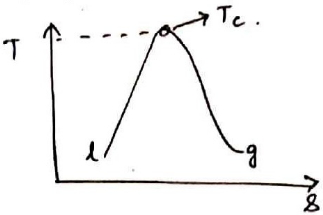
The following graph below illustrates a $(T-b)$ diagram of a matter.
The line $l$ corresponds to a liquid line saturated. The line $g$ corresponds to a saturated gas line:
The vegion between is the wet region (both lignid and gas). $T_{c}$ corresponds to the critical temperature.
So, it is clear that the temp must be below the critical temperature for a matler to exist simultaneously as gas and liquid.
Correct choice - option-$C$
View full question & answer→MCQ 201 Mark
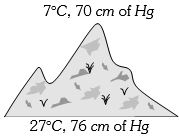
At the top of a mountain a thermometer reads $7°C$ and a barometer reads $70\, cm$ of $Hg.$ At the bottom of the mountain these read $27°C$ and $76 \,cm$ of $Hg$ respectively. Comparison of density of air at the top with that of bottom is
- ✓
$75/76$
- B
$70/76$
- C
$76/75$
- D
$76/70$
AnswerCorrect option: A. $75/76$
a
Ideal gas equation in terms of density $\frac{{{P_1}}}{{{\rho _1}{T_1}}} = \frac{{{P_2}}}{{{\rho _2}{T_2}}} = $ constant
$\therefore$ $\frac{{{\rho _1}}}{{{\rho _2}}} = \frac{{{P_1}}}{{{P_2}}} \times \frac{{{T_2}}}{{{T_1}}}$
$\frac{{{\rho _{top}}}}{{{\rho _{bottom}}}} = \frac{{{P_{top}}}}{{{P_{bottom}}}} \times \frac{{{T_{bottom}}}}{{{T_{top}}}} = \frac{{70}}{{76}} \times \frac{{300}}{{280}} = \frac{{75}}{{76}}$
View full question & answer→MCQ 211 Mark
An air bubble of volume $1.0\; cm ^{3}$ rises from the bottom of a lake $40\; m$ deep at a temperature of $12\,^{\circ} C$. To what volume (in $cm^3$) does it grow when it reaches the surface, which is at a temperature of $35\,^{\circ} C ?$
- A
$2.65$
- ✓
$5.26$
- C
$7.48$
- D
$9.67$
AnswerCorrect option: B. $5.26$
b
Volume of the air bubble, $V_{1}=1.0 cm ^{3}=1.0 \times 10^{-6} m ^{3}$
Bubble rises to height, $d=40 m$
Temperature at a depth of $40 m , T_{1}=12^{\circ} C =285 K$
Temperature at the surface of the lake, $T_{2}=35^{\circ} C =308 K$
The pressure on the surface of the lake:
$P_{2}=1 atm =1 \times 1.013 \times 10^{5} Pa$
The pressure at the depth of $40 m$
$P_{1}=1 atm +d\rho g$ Where $, \rho$ is the density of
water $=10^{3} kg / m ^{3} g$ is the acceleration due
to gravity $=9.8 m / s ^{2}$
$\therefore P_{1}=1.013 \times 10^{5}+40 \times 10^{3} \times 9.8=493300 Pa$
We have: $\frac{P_{1} V_{1}}{T_{1}}=\frac{P_{2} V_{2}}{T_{2}}$
Where, $V_{2}$ is the volume of the air bubble when it reaches the surface $V_{2}=\frac{P_{1} V_{1} T_{2}}{T_{1} P_{2}}$
$=\frac{(493300)\left(1.0 \times 10^{-6}\right) 308}{285 \times 1.013 \times 10^{5}}$
$=5.263 \times 10^{-6}\; m ^{3}$ or $5.263 \;cm ^{3}$
Therefore, when the air bubble reaches the surface, its volume becomes $5.263 \;cm ^{3} .$
View full question & answer→MCQ 221 Mark
A vessel of volume 20L contains a mixture of hydrogen and helium at temperature of $27^{\circ} C$ and pressure $2 atm$. The mass of mixture is $5 g$. Assuming the gases to be ideal, the ratio of mass of hydrogen to that of helium in the given mixture will be
- A
$1: 2$
- B
$2: 3$
- C
$2: 1$
- ✓
$2: 5$
AnswerCorrect option: D. $2: 5$
d
(d)
Let there are $n_1$ moles of hydrogen and $n_2$ moles of helium in the given mixture. As $Pv = nRT$
Then the pressure of the mixture
$P =\frac{ n _1 RT }{ V }+\frac{ n _2 RT }{ V }=\left( n _1+ n _2\right) \frac{ RT }{ V }$
$\Rightarrow 2 \times 101.3 \times 10^3=\left( n _1+ n _2\right) \times \frac{(8.3 \times 300)}{20 \times 10^{-3}}$
$\text { or, } \left( n _1+ n _2\right)=\frac{2 \times 101.3 \times 10^3 \times 20 \times 10^{-3}}{(8.3)(300)}$
$\text { or, } \quad n _1+ n _2=1.62$
The mass of the mixture is (in grams) $n _1 \times 2+ n _2 \times 4=5$
$\Rightarrow \quad\left(n_1+2 n_2\right)=2.5 \quad \ldots(2)$
Solving the eqns. (1) and (2), we get $n _1=0.74$ and $n _2=0.88$
Hence, $\frac{ m _{ H }}{ m _{ He }}=\frac{0.74 \times 2}{0.88 \times 4}=\frac{1.48}{3.52}=\frac{2}{5}$
View full question & answer→MCQ 231 Mark
The temperature of a gas at pressure $P$ and volume $V$ is $27°C.$ Keeping its volume constant if its temperature is raised to $927°C,$ then its pressure will be
- A
$2\,P$
- B
$3\,P$
- ✓
$4\,P$
- D
$6 \,P$
AnswerCorrect option: C. $4\,P$
c
Using Charle’s law $\frac{{{P_1}}}{{{P_2}}} = \frac{{{T_1}}}{{{T_2}}}$
or ${P_2} = \frac{{{P_1}{T_2}}}{{{T_1}}}$ $ = \frac{{P(273 + 927)}}{{(273 + 27)}}$ $=4P$
View full question & answer→MCQ 241 Mark
$4$ moles of an ideal gas is at $0°C.$ At constant pressure it is heated to double its volume, then its final temperature will be ...... $^oC$
Answerb
$\frac{{{V_1}}}{{{V_2}}} = \frac{{{T_1}}}{{{T_2}}}$
$\Rightarrow {T_2} = 2 \times {T_1}$ $ = 2 \times (273 + 0) = 546K$
$\Rightarrow$ ${T_2} = 273 \times 2 = 546K$
$\Rightarrow 273^\circ C$ $\Rightarrow 273$ $^\circ$$ C$
View full question & answer→MCQ 251 Mark
A perfect gas at $27°C$ is heated at constant pressure so as to triple its volume. The temperature of the gas will be ...... $^oC$
Answerc
$V \propto T$$⇒$ $\frac{{{V_1}}}{{{V_2}}} = \frac{{{T_1}}}{{{T_2}}}$ $⇒$ $\frac{V}{{3V}} = \frac{{(273 + 27)}}{{{T_2}}}$
$\Rightarrow$ ${T_2} = 900K$ $⇒$ $627°C$ $[ T(K) = 273 + t°C]$
View full question & answer→MCQ 261 Mark
The density of a gas at normal pressure and $27°C$ temperature is $24.$ Keeping the pressure constant, the density at $127°C$ will be
Answerc
given that
The density of a gas at normal pressure and $27^{\circ} C$ or $300 K$ temperature $=24$
then the density at $127^{\circ} C$ on $400 K$, pressure is constant,
So. We know,
$d=\frac{P M}{R T}$
$d \propto \frac{1}{T}$
$\Rightarrow \frac{d_{1}}{d_{2}} =\frac{T_{2}}{T_{1}}$
$\Rightarrow d_{2} =\frac{24 \times 300}{400}$
$d_{2} =18$
Thus, density at $127^{\circ} C , 18$ option $(c)$ is correct.
View full question & answer→MCQ 271 Mark
The volume of a gas at $20°C$ is $200\, ml$. If the temperature is reduced to $-20°C$ at constant pressure, its volume will be ...... $ml$
- ✓
$172.6$
- B
$17.26 $
- C
$192.7$
- D
$19.27$
AnswerCorrect option: A. $172.6$
a
$V \propto T$
$\Rightarrow$ $\frac{{{V_1}}}{{{V_2}}} = \frac{{{T_1}}}{{{T_2}}}$
$\Rightarrow$ $\frac{{200}}{{{V_2}}} = \frac{{(273 + 20)}}{{(273 - 20)}} = \frac{{293}}{{253}}$
$\Rightarrow$ ${V_2} = \frac{{200 \times 253}}{{293}} = 172.6\,ml$
View full question & answer→MCQ 281 Mark
If pressure of a gas contained in a closed vessel is increased by $0.4\%$ when heated by $1°C,$ the initial temperature must be
- ✓
$250\, K$
- B
$250°C$
- C
$2500 \,K$
- D
$25°C$
AnswerCorrect option: A. $250\, K$
a
We know that $\frac{ P _{1}}{ T _{1}}=$ constant for constant volume.
Let the initial pressure be $P_{1}$ and initial temperature be $T_{1}$.
Thus final pressure $P_{2}=1.004 P_{1}$ and final temperature $T_{2}=T_{1}+1$.
Using $\frac{P_{1}}{T_{1}}=\frac{P_{2}}{T_{2}}$
So, $\frac{ P _{1}}{ T _{1}}=\frac{1.004 P _{1}}{ T _{1}+1}$
Or $T _{1}+1=1.004 T _{1}$
Or $0.004 T _{1}=1$
$\Rightarrow T _{1}=250 \; K$
View full question & answer→MCQ 291 Mark
A gas at the temperature $250\, K$ is contained in a closed vessel. If the gas is heated through $1\,K,$ then the percentage increase in its pressure will be .... $\%$
Answera
$P \propto T$
$\Rightarrow$ $\frac{{{P_1}}}{{{P_2}}} = \frac{{{T_1}}}{{{T_2}}}$
$\Rightarrow$ $\frac{{{P_2} - {P_1}}}{{{P_1}}} = \frac{{{T_2} - {T_1}}}{{{T_2}}}$
$\Rightarrow$ $\left( {\frac{{\Delta P}}{P}} \right)\,\% $$ = \left( {\frac{{251 - 250}}{{250}}} \right) \times 100$ $= 0.4 \%$
View full question & answer→MCQ 301 Mark
A cylinder of $5$ litre capacity, filled with air at $N.T.P.$ is connected with another evacuated cylinder of $30$ litres of capacity. The resultant air pressure in both the cylinders will be ...... $cm$ of $Hg$
- A
$38.85$
- B
$21.85$
- ✓
$10.85$
- D
$14.85$
AnswerCorrect option: C. $10.85$
c
Boyle's law states that $P_{1} V_{1}=P_{2} V_{2}$
Here, at $NTP$, pressure $=76 cm$ of $Hg = P _{1}$
$V _{1}=5 L$
$V _{2}=30 L +5 L$
Now
$P _{1} \times(5)= P _{2} \times(35)$
$P _{1}=7 P _{2}$
$P _{2}=76 / 7=10.8 cm$ of $Hg$
So, pressure in both cylender $=10.8 cm$
View full question & answer→MCQ 311 Mark
A perfect gas at $27^\circ C$ is heated at constant pressure to $327^\circ C$. If original volume of gas at $27^\circ C$ is $V$ then volume at $327^\circ C$ is
- A
$V$
- B
$3\, V$
- ✓
$2 \,V$
- D
$V / 2$
AnswerCorrect option: C. $2 \,V$
c
$V \propto T$
$\Rightarrow$ $\frac{{{V_1}}}{{{V_2}}} = \frac{{{T_1}}}{{{T_2}}}$
$\Rightarrow$ $\frac{V}{{{V_2}}} = \frac{{(273 + 27)}}{{(273 + 327)}} = \frac{{300}}{{600}} = \frac{1}{2}$
$\Rightarrow$ ${V_2} = 2V$
View full question & answer→MCQ 321 Mark
Hydrogen gas is filled in a balloon at $20^\circ C$. If temperature is made $40^\circ C$, pressure remaining same, what fraction of Hydrogen will come out
- ✓
$0.07$
- B
$0.25$
- C
$0.5$
- D
$0.75$
AnswerCorrect option: A. $0.07$
a
$V \propto T$
$\Rightarrow$ $\frac{{{V_2}}}{{{V_1}}} = \frac{{{T_2}}}{{{T_1}}}$
$\Rightarrow$ $\frac{{{V_2} - {V_1}}}{{{V_1}}} = \frac{{{T_2} - {T_1}}}{{{T_1}}}$
$\Rightarrow$ $\frac{{\Delta V}}{V} = \frac{{(273 + 40) - (273 + 20)}}{{(273 + 20)}}$
$ = \frac{{(313 - 293)}}{{293}} = 0.07$
View full question & answer→MCQ 331 Mark
At constant temperature on increasing the pressure of a gas by $5\%$ will decrease its volume by ..... $\%$
- A
$5$
- B
$5.26$
- C
$4.26$
- ✓
$4.76$
AnswerCorrect option: D. $4.76$
d
Given: $T=$ constant, $P \hat{i} \; 5 \%$, find change in Volume $\%$
Initial state $P_{0},V_{0},T_{0}\longrightarrow$ Fianl state $1.05 P_{0},V,T_{0}$
Using Boyles law
$P_{1} V_{1}=P_{2} v_{2}$
$P_{0} V_{0}=1.05 P_{0} V$
$V=0.9524 V_{0}$
$\Delta V \%$
$=\frac{V_{f}-V_{i}}{V_{i}} \times 100$
$=\left(\frac{V_{0}-0.9524 V_{0}}{V_{0}}\right) \times 100$
$=4.76 \%$
View full question & answer→MCQ 341 Mark
The molecular weights of $O_2$ and $N_2$ are $32$ and $28$ respectively. At $15°C,$ the pressure of $1 \,gm$ $O_2$ will be the same as that of $1 \,gm$ $N_2$ in the same bottle at the temperature ...... $^oC$
Answera
Temperature of $O _{2}=273+15=298 K$
Temperature of $N _{2}= x$
As $P \propto n T$, as pressure is same.
$\Rightarrow n _{1} T _{1}= n _{2} T _{2} \Longrightarrow\left(\frac{1}{32}\right)(298)=\left(\frac{1}{28}\right)( x )$
$\Longrightarrow x =\frac{28}{32} \times 298=260.75 K$
Temperature in ${ }^{\circ} C =260.75-273=-13^{\circ} C$
View full question & answer→MCQ 351 Mark
At $NTP$ the mass of one litre of air is $1.293\, gm.$ The value of specific gas constant will be ...... $J/K-gm$
- ✓
$0.29$
- B
$4.2$
- C
$8.3$
- D
$16.5$
AnswerCorrect option: A. $0.29$
a
The conditions given are in $NTP$.
At $NTP$,
Pressure, $P=1 \; atm =101325 Pa$
Temperature, $T=20^{\circ} C =\left(20+273.15^{-}\right) K =293.15 K$
Volume given, $V=1$ litre $=10^{-3} m ^{3}$
mass, $m=1.293 gm$
USe equation, $P V=m R T$
$(101325)\left(10^{-3}\right)$
$=(1.293) \cdot R \cdot(293.15)$
$R=0.2673 \; J / K - gm$
View full question & answer→MCQ 361 Mark
The volume of a gas at $21°C$ temperature and $768 \,mm$ pressure is $1\, litre$. If the density of the gas is $1.2\, gm/litre$ at $NTP,$ then its mass will be ..... $gm$
AnswerCorrect option: C. $1.13$
c
We know that the gas follows Ideal gas law, which states $\frac{P}{\rho T}=$ constant or
$\frac{P_{1}}{\rho_{1} T_{1}}=\frac{P_{2}}{\rho_{2} T_{2}}$
Given that Density at NTP is $\rho_{2}=1.2 \; g / L$
$T _{2}=20^{\circ} C =293.15 K$ and $P _{2}=76 \; cm$ of $Hg$
We have $T _{1}=21^{\circ} C =294.15 \; K$ and $P _{1}=71.8 \; cm$ of $Hg$
Thus $\rho_{1}=\rho_{2} \times \frac{ T _{2}}{ T _{1}} \times \frac{ P _{1}}{ P _{2}}=1.2 \times \frac{293.15}{294.15} \times \frac{71.8}{76}=1.13 \; g / L$
Thus mass of the gas $=\rho_{2} \times V_{2}=1.13 \; g / L \times 1 L =1.13 \; g$
View full question & answer→MCQ 371 Mark
The number of molecules in a gas at pressure $1.64 \times {10^{ - 3}}$atmospheres and temperature $200\, K$ having the volume $1 \,cc$ are
- ✓
$6.02 \times {10^{16}}$
- B
$2.63 \times {10^{16}}$
- C
$3.01 \times {10^{19}}$
- D
$12.04 \times {10^{19}}$
AnswerCorrect option: A. $6.02 \times {10^{16}}$
a
$PV = NkT$ $\Rightarrow$ $N = \frac{{PV}}{{kT}}$
$ = \frac{{(1.64 \times {{10}^{ - 3}} \times 1.01 \times {{10}^5}) \times (1 \times {{10}^{ - 6}})}}{{1.38 \times {{10}^{ - 23}} \times 200}}$
$ = 6.02 \times {10^{16}}$
View full question & answer→MCQ 381 Mark
A sample of an ideal gas occupies a volume $V$ at a pressure $P$ and absolute temperature $T,$ the mass of each molecule is $m.$ The expression for the density of gas is ($k =$ Boltzmann’s constant)
- A
$mkT$
- B
$P/kT$
- C
$P/kTV$
- ✓
$Pm/kT$
AnswerCorrect option: D. $Pm/kT$
d
$PV = kT$
$\Rightarrow$ $P\left( {\frac{m}{\rho }} \right) = kT$
$\Rightarrow$ $\rho = \frac{{Pm}}{{kT}}$
View full question & answer→MCQ 391 Mark
A balloon contains $500\,{m^3}$ of helium at $27°C$ and $1$ atmosphere pressure. The volume of the helium at $-3°C$ temperature and $0.5$ atmosphere pressure will be ..... $m^3$
- A
$500$
- B
$700$
- ✓
$900$
- D
$1000$
Answerc
$\frac{{{P_1}{V_1}}}{{{T_1}}} = \frac{{{P_2}{V_2}}}{{{T_2}}}$
$\Rightarrow \frac{{1 \times 500}}{{300}} = \frac{{0.5 \times {V_2}}}{{270}} $
$\Rightarrow {V_2} = 900{m^3}$
View full question & answer→MCQ 401 Mark
$1$ mole of gas occupies a volume of $100\, ml$ at $50\, mm$ pressure. What is the volume occupied by two moles of gas at $100\, mm$ pressure and at same temperature ..... $ml$
Answerb
$PV = \mu RT$
$\Rightarrow$ $\frac{{{P_1}{V_1}}}{{{P_2}{V_2}}} = \frac{{{\mu _1}}}{{{\mu _2}}}$
$\Rightarrow$ $\frac{{50 \times 100}}{{100 \times {V_2}}} = \frac{1}{2}$
$\Rightarrow$ $V_2$ $= 100\, ml$
View full question & answer→MCQ 411 Mark
A given mass of a gas is allowed to expand freely until its volume becomes double. If ${C_b}$ and ${C_a}$ are the velocities of sound in this gas before and after expansion respectively, then ${C_a}$ is equal to
AnswerCorrect option: C. $\sqrt 2 \,{C_b}$
c
Velocily of Sound in gas,
$V=\sqrt{\frac{\gamma R T}{M}}$
Volume before expansion $=V_{b}$
Volume after expansion $=V_{a}$
Temp before expansion $=T_{b}$
Temp after expansion $=T_{a}$.
As, Volume os Temperature,
$\frac{V_{b}}{V_{a}}=\frac{T_{b}}{T_{a}}=\frac{V_{b}}{2 V_{b}}=\frac{1}{2}$
$\therefore \frac{T_{b}}{T_{a}}=\frac{1}{2}$
Whow, Before expansion,
$C_{b}=\sqrt{\frac{\gamma R T_{b}}{I M}}$ $\dots \; (1)$
After exparsion,
$C_{a}=\sqrt{\frac{\gamma R T_{a}}{M}}$ $\dots \; (2)$
eq. $1/2$
$\frac{c_{b}}{c_{a}}=\sqrt{1 / 2} \quad \therefore \quad c_{a}=\sqrt{2} c_{b}$.
View full question & answer→MCQ 421 Mark
One litre of Helium gas at a pressure $76\, cm$ of $Hg$ and temperature ${27}^\circ$ is heated till its pressure and volume are doubled. The final temperature attained by the gas is ..... $^oC$
Answera
$\frac{{{P_1}{V_1}}}{{{T_1}}} = \frac{{{P_2}{V_2}}}{{{T_2}}} $
$\Rightarrow \frac{{76 \times 1}}{{300}} = \frac{{152 \times 2}}{{{T_2}}}$
$ \Rightarrow {T_2} = 1200K = 927^\circ C$
View full question & answer→MCQ 431 Mark
A flask is filled with $13\, gm$ of an ideal gas at ${27}^o C$ and its temperature is raised to ${52}^o C$. The mass of the gas that has to be released to maintain the temperature of the gas in the flask at ${52}^o C$ and the pressure remaining the same is ..... $g$
Answerd
Since $P , V , M$ and $R$ are constants,
$m _{1} T _{1}= m _{2} T _{2}$
$13 \times 300= m _{2} \times 325$
$m _{2}=12 \; gm$
Hence mass to be removed $=13-12=1 \; gm$
View full question & answer→MCQ 441 Mark
The molecular weight of a gas is $44$. The volume occupied by $2.2\, g$ of this gas at $0^\circ C$ and $2\, atm.$ pressure will be ....... $lit$
- ✓
$0.56$
- B
$1.2$
- C
$2.4$
- D
$5.6$
AnswerCorrect option: A. $0.56$
a
$PV = mrT$$ = m\left( {\frac{R}{M}} \right)T$
$\Rightarrow$ $V = \left( {\frac{m}{M}} \right)\frac{{RT}}{P}$=$\left( {\frac{{2.2}}{{44}}} \right) \times \frac{{8.31 \times (273 + 0)}}{{2 \times (1 \times {{10}^5})}}$
= $5.67 \times {10^{ - 4}}{m^3}$ $= 0.56 \; liter$
View full question & answer→MCQ 451 Mark
A gas at ${27}^\circ C$ temperature and $30$ atmospheric pressure is allowed to expand to the atmospheric pressure. If the volume becomes $10$ times its initial volume, then the final temperature becomes ...... $^oC$
- A
$100$
- B
$173$
- C
$273$
- ✓
$-173$
AnswerCorrect option: D. $-173$
d
$\frac{{{P_1}{V_1}}}{{{T_1}}} = \frac{{{P_2}{V_2}}}{{{T_2}}}$
$\Rightarrow {T_2} = \frac{{{P_2}{V_2}}}{{{P_1}{V_1}}} \times {T_1}$
$ \Rightarrow {T_2} = \frac{1}{{30}} \times \frac{{10}}{1} \times 300 = 100\,K = - 173^\circ C$
View full question & answer→MCQ 461 Mark
A balloon contains $1500 \,m^3$ of helium at $27^\circ C$ and $4$ atmospheric pressure. The value of helium at $ - \,3^\circ C$ temperature and $2$ atmospheric pressure will be ...... $m^3$
- A
$1500$
- B
$1700$
- C
$1900$
- ✓
$2700$
AnswerCorrect option: D. $2700$
d
$\frac{{{P_1}{V_1}}}{{{T_1}}} = \frac{{{P_2}{V_2}}}{{{T_2}}}$
$\Rightarrow {V_2} = \frac{{{P_1}{V_1}}}{{{T_1}}} \times \frac{{{T_2}}}{{{P_2}}}$
$ \Rightarrow {V_2} = \frac{{1500 \times 4 \times 270}}{{300 \times 2}} = 2700{m^3}$
View full question & answer→MCQ 471 Mark
A gas at $27^o C$ has a volume $V$ and pressure $P.$ On heating its pressure is doubled and volume becomes three times. The resulting temperature of the gas will be ...... $^oC$
- A
${1800}$
- B
${162}$
- ✓
${1527}$
- D
${600}$
AnswerCorrect option: C. ${1527}$
c
$\frac{{{P_1}{V_1}}}{{{T_1}}} = \frac{{{P_2}{V_2}}}{{{T_2}}}$
${T_2} = \frac{{{P_2}{V_2}}}{{{P_1}{V_1}}}{T_1} = \frac{2}{1} \times \frac{3}{1} \times 300 $
$= 1800K = 1527^o C$
View full question & answer→MCQ 481 Mark
The equation of state corresponding to $8 \,g$ of ${O_2}$ is
- A
$PV = 8RT$
- ✓
$PV = RT/4$
- C
$PV = RT$
- D
$PV = RT/2$
AnswerCorrect option: B. $PV = RT/4$
b
$PV = mrT$
$ = m\left( {\frac{R}{M}} \right)T$ $ = \frac{8}{{32}}RT$ $[\because M_{O_2} = 32]$
$\Rightarrow$ $PV = \frac{{RT}}{4}$
View full question & answer→MCQ 491 Mark
${O_2}$ gas is filled in a vessel. If pressure is doubled, temperature becomes four times. How many times its density will become
Answerd
$PV = nRT$
$Density =( mass ) /( Volume )$
i.e. $\rho=( M / V )$
$\therefore P \times( M / \rho)= nRT$
$\therefore P =\{( nRT \rho) / M \}$
$( P / \rho T )=\text { constant }$
Given: pressure is doubled, Temper attire is $4$ times.
As $\left(P_{2} / P_{1}\right)=\left\{\left(\rho_{2} T_{2}\right) /\left(\rho_{1} T_{1}\right)\right\}$
$\therefore\left\{2 P _{1} / P _{1}\right\}=\left(\rho_{2} / \rho_{1}\right) \cdot\left\{4 T _{1} / T _{1}\right\}$
$\therefore\left(\rho_{1} / \rho_{1}\right)=(1 / 2)$
$\therefore \rho_{2}=\left(\rho_{1} / 2\right)$
Hence density is halved.
View full question & answer→MCQ 501 Mark
The volume of a gas will be double of what it is at $0°C$ (pressure remaining constant) at
- A
$1092 \,K$
- B
$273\, K$
- C
$546°C$
- ✓
$273°C$
AnswerCorrect option: D. $273°C$
d
$V \propto T$
$\Rightarrow$ $\frac{{{V_1}}}{{{V_2}}} = \frac{{{T_1}}}{{{T_2}}}$
$\Rightarrow$ $\frac{V}{{2V}} = \frac{{(273 + 0)}}{{{T_2}}}$
$\Rightarrow$ ${T_2} = 546\,K = 273^\circ C$
View full question & answer→MCQ 511 Mark
The pressure and temperature of two different gases is $P$ and $T$ having the volume $V$ for each. They are mixed keeping the same volume and temperature, the pressure of the mixture will be
Answerc
${\mu _1} = \frac{{PV}}{{RT}},\,\,{\mu _2} = \frac{{PV}}{{RT}}$
$P' = \frac{{({\mu _1} + {\mu _2})RT}}{V} = \frac{{2PV}}{{RT}} \times \frac{{RT}}{V} = 2P$
View full question & answer→MCQ 521 Mark
A vessel is filled with an ideal gas at a pressure of $10$ atmospheres and temperature ${27}^\circ C$. Half of the mass of the gas is removed from the vessel and temperature of the remaining gas is increased to ${87}^\circ C$. Then the pressure of the gas in the vessel will be ...... $atm$
Answerb
$PV = mrT = P \propto mT$
$\Rightarrow$ $\frac{{{P_1}}}{{{P_2}}} = \frac{{{m_1}}}{{{m_2}}} \times \frac{{{T_1}}}{{{T_2}}}$
$\Rightarrow$ $\frac{{10}}{{{P_2}}} = \frac{m}{{m/2}} \times \frac{{(273 + 27)}}{{(273 + 87)}}$
$\Rightarrow$ ${P_2} = 6\,atm$
View full question & answer→MCQ 531 Mark
When a gas in a closed vessel was heated so as to increase its temperature by ${5^o}C$, there occurred an increase of $1\%$ in its pressure. The original temperature of the gas was ...... $^oC$
Answerc
$P \propto T$
$\Rightarrow \frac{{{P_1}}}{{{P_2}}} = \frac{{{T_1}}}{{{T_2}}}$
$\Rightarrow \frac{{{P_1}}}{{(1.01){P_1}}} = \frac{{{T_1}}}{{{T_1} + 5}}$
$ \Rightarrow {T_1} = 500\;K$$= 227°C$
View full question & answer→MCQ 541 Mark
The gas in vessel is subjected to a pressure of $20$ atmosphere at a temperature $27°C.$ The pressure of the gas in a vessel after one half of the gas is released from the vessel and the temperature of the remainder is raised by $50°C$ is ....... $atm$
- A
$8.5$
- B
$10.8$
- ✓
$11.7$
- D
$17 $
AnswerCorrect option: C. $11.7$
c
$PV = \mu RT = \frac{m}{M}RT$
$\Rightarrow$ $P \propto mT$
$\Rightarrow$ $\frac{{{P_2}}}{{{P_1}}} = \frac{{{m_2}}}{{{m_1}}}\frac{{{T_2}}}{{{T_1}}}$$ = \frac{1}{2} \times \frac{{(273 + 27 + 50)}}{{(273 + 27)}} = \frac{7}{{12}}$
$\Rightarrow$ ${P_2} = \frac{7}{{12}}{P_1} = \frac{7}{{12}} \times 20 = 11.67atm. \approx 11.7\,atm$
View full question & answer→MCQ 551 Mark
At $0°C $ the density of a fixed mass of a gas divided by pressure is $x.$ At $100°C,$ the ratio will be
- A
$x$
- ✓
$\frac{{273}}{{373}}x$
- C
$\frac{{373}}{{273}}x$
- D
$\frac{{100}}{{273}}x$
AnswerCorrect option: B. $\frac{{273}}{{373}}x$
b
$PV = \mu \,RT = \frac{m}{M}RT$
$\Rightarrow$ $\frac{m}{{VP}}$ $\Rightarrow$ $\frac{{density}}{{P}} = \frac{M}{{RT}}$
${\left( {\frac{{density}}{P}} \right)_{at\,0^\circ C\;}} = \frac{M}{{R(273)}} = x$ …...$(i)$
${\left( {\frac{{density}}{P}} \right)_{at\,100^\circ C\;}} = \frac{M}{{R(373)}}$ …..$(ii)$
$\Rightarrow$ ${\left( {\frac{{density}}{P}} \right)_{at\,100^\circ C\;}}$$ = \frac{{273x}}{{373}}$
View full question & answer→MCQ 561 Mark
$2\, gm$ of ${O_2}$ gas is taken at $27°C$ and pressure $76\, cm.$ Of $Hg$. Then find out volume of gas (in litre)
- ✓
$1.53$
- B
$2.44$
- C
$3.08$
- D
$44.2$
AnswerCorrect option: A. $1.53$
a
$PV = \mu \,RT = \frac{m}{M}RT$ $\Rightarrow$ $V = \frac{{mRT}}{{MP}}$
$ = \frac{{2 \times {{10}^{ - 3}} \times 8.3 \times 300}}{{32 \times {{10}^{ - 3}} \times {{10}^5}}}$=$1.53 \times {10^{ - 3}}{m^3}$ $= 1.53 \,litre$
View full question & answer→MCQ 571 Mark
An electron tube was sealed off during manufacture at a pressure of $1.2 \times {10^{ - 7}}$ $mm$ of mercury at $27°C.$ Its volume is $100\, cm^3$. The number of molecules that remain in the tube is
- A
$2 \times {10^{16}}$
- B
$3 \times {10^{15}}$
- ✓
$3.86 \times {10^{11}}$
- D
$5 \times {10^{11}}$
AnswerCorrect option: C. $3.86 \times {10^{11}}$
c
$P = nkT$
$n =\frac{ P }{ kT }=\frac{h dg }{ kT }$
Number of molecules in the electron tube is $= n \times V =\frac{ hdgV }{ kT }$
$\Rightarrow n =\frac{ hdg }{ kT }=\frac{1.2 \times 10^{-10} \times 13600 \times 9.8 \times 100 \times 10^{-6}}{1.38 \times 10^{-23} \times 300}=3.86 \times 10^{11}$
View full question & answer→MCQ 581 Mark
If the pressure of an ideal gas contained in a closed vessel is increased by $0.5\%,$ the increase in temperature is $2K.$ The initial temperature of the gas is ...... $^oC$
Answerb
$P \propto T$ $\Rightarrow$ $\frac{{{P_1}}}{{{P_2}}} = \frac{{{T_1}}}{{{T_2}}}$
$\Rightarrow$ $\frac{P}{{P + \frac{{0.5}}{{100}}P}} = \frac{T}{{T + 2}}$
$\Rightarrow$ $\frac{{200}}{{201}} = \frac{T}{{T + 2}}$
$\Rightarrow$ $T = 400 \,K = 127°C$
View full question & answer→MCQ 591 Mark
Air is filled in a bottle at atmospheric pressure and it is corked at $35°C.$ If the cork can come out at $3$ atmospheric pressure than upto what temperature should the bottle be heated in order to remove the cork ...... $^oC$
Answerc
We know that $\rho_{1} V=n R T_{1}$
$\Rightarrow 1 \times V=n R(35+273)$
$=n R \times 308$ $\dots \; (i)$
$\text { and } \rho_{2} V=n R T_{2}$
$\Rightarrow 3 \times V=n R T_{2}$ $\dots \; (ii)$
$\text { On dividing Eq. (ii) by Eq. (i), we get }$
$3=T_{2} / 308$
$\Rightarrow T_{2}=924 K$
$T_{2}=924-273$
$=651^{\circ} C$
View full question & answer→MCQ 601 Mark
A gas is collected over the water at $25°C.$ The total pressure of moist gas was $735 \,mm$ of mercury. If the aqueous vapour pressure at $25°C$ is $23.8\, mm.$ Then the pressure of dry gas is..... $mm$
- A
$760$
- B
$758.8$
- C
$710.8$
- ✓
$711.2$
AnswerCorrect option: D. $711.2$
d
Given,
Total pressure of moist gas $=735 \; mm$ of mercury
Aqueous vapour pressure $=23.8 \; mm$
According to Dalton's law of partial pressure,
Total pressure of moist gas $=$ Pressure of dry gas + Aqueous vapour presere
$735 \; mm =$ Pressure of dry gas $+23.8 \; mm$
$\therefore$ Pressure of ary gas $=(735-23.8) \; mm$
Pressure of drygas $=711.2 \; mm$
correct choice - option $-D$
View full question & answer→MCQ 611 Mark
$125\, ml$ of gas $A$ at $0.60$ atmosphere and $150\, ml$ of gas $B$ at $0.80$ atmosphere pressure at same temperature is filled in a vessel of $1$ litre volume. What will be the total pressure of mixture at the same temperature ............... $\mathrm{atmosphere}$
- A
$0.140$
- B
$0.120$
- ✓
$0.195$
- D
$0.212$
AnswerCorrect option: C. $0.195$
c
$V_{1}=125 ml \quad V_{2}=150 m 1$
$P_{1}=0.60 \quad \; P_{2}=0.80$
we know that,
$P_{1} v_{1}+P_{2} v_{2} =P\left(v_{1}+v_{2}\right)$
$0.60 \times 125+0.80 \times 150=P(125+150)$
$0.60 \times 0.125 +0.80 \times 0.150=P(0.125+0.150)$
$0.195 =P 00.275$
$P =0.709$
View full question & answer→MCQ 621 Mark
Air is pumped into an automobile tube upto a pressure of $200\, kPa$ in the morning when the air temperature is $22°C.$ During the day, temperature rises to $42°C$ and the tube expands by $2\%.$ The pressure of the air in the tube at this temperature, will be approximately ...... $kPa$
- A
$212 $
- ✓
$209$
- C
$206$
- D
$200$
Answerb
$\frac{{PV}}{T} = R$
$\Rightarrow$ $\frac{{{P_1}{V_1}}}{{{T_1}}} = \frac{{{P_2}{V_2}}}{{{T_2}}}$
$\Rightarrow$ $\frac{{200 \times V}}{{(273 + 22)}} = \frac{{{P_2} \times 1.02V}}{{(273 + 42)}}$ $({V_2} = V + 0.02V)$
$\Rightarrow$ ${P_2} = \frac{{200 \times 315}}{{295 \times 1.02}} = 209\,kPa$
View full question & answer→MCQ 631 Mark
At what temperature volume of an ideal gas at $0°C$ becomes triple ....... $^oC$
Answera
According to ontial data we have
$V _{1}= V , T _{1}=273$
$V _{2}=3 V , T _{2}=?$
We know that at constant pressure
$\frac{ V _{2}}{ T _{2}}=\frac{ V _{1}}{ T _{1}}$
$T _{2}=\frac{3 V \times 273}{ V }$
$T _{2}=819 \; k$
$=546^o$
View full question & answer→MCQ 641 Mark
If an ideal gas has volume $V$ at $27°C$ and it is heated at a constant pressure so that its volume becomes $1.5V.$ Then the value of final temperature will be ....... $^oC$
Answerb
${T_2} = \left( {\frac{{{V_2}}}{{{V_1}}}} \right){T_1} = \left( {\frac{{1.5V}}{V}} \right) \times (273 + 27) = 450K $
$\Rightarrow 177^\circ C$
View full question & answer→MCQ 651 Mark
The temperature of an ideal gas at atmospheric pressure is $300\,K$ and volume $1\,m^3$. If temperature and volume become double, then pressure will be
AnswerCorrect option: A. ${10^5}N/{m^2}$
a
$\frac{ P _{1} V _{1}}{ T _{1}}=\frac{ P _{2} V _{2}}{ T _{2}}$
$\Rightarrow \frac{10^{5} \times\left(1 m ^{3}\right)}{300 K }=\frac{ P (2)}{600}$
$\Rightarrow P =10^{5} N / m ^{2}$
Hence,
option $A$ is correct answer.
View full question & answer→MCQ 661 Mark
What is the mass of $2$ litres of nitrogen at $22.4$ atmospheric pressure and $273\,K$
- ✓
$28\,g$
- B
$14 \times 22.4$ $g$
- C
$56\, g$
- D
AnswerCorrect option: A. $28\,g$
a
Consider $STP$ conditions:
$(1)$ $1 \; mol =22.4 L$ of gas; $1 \; mol$ of Nitrogen gas $=14 g$
$(2)$ Therefore, $22.4 \; L$ Nitrogen gas $=14 \; g \rightarrow 2 \; L$ Nitrogen $=1.25 \; g$
$(3)$ This is at a standard pressure of $1 \; atm$. So, $22.4 \; atm$ pressure corresponds to $22.4 \times 1.25=28 \; g$
View full question & answer→MCQ 671 Mark
The value of $PV/T$ for one mole of an ideal gas is nearly equal to ......... $J\, mol^{-1}K^{-1}$
Answerd
$PV = RT$
$\Rightarrow$ $\frac{{PV}}{T} = R \approx 2 \frac{{cal}}{{mol{\rm{ - }}K}}$
View full question & answer→MCQ 681 Mark
If the volume of the gas containing $n$ number of molecules is $V,$ then the pressure will decrease due to force of intermolecular attraction in the proportion
- A
$n/v$
- B
$n/{V^2}$
- ✓
${(n/V)^2}$
- D
$1/{V^2}$
AnswerCorrect option: C. ${(n/V)^2}$
c
Given: $n \rightarrow$ number of molecules
$V \rightarrow$ volume of the gas
Van der waals equation $\Rightarrow\left(P+\frac{a n^{2}}{V^{2}}\right)(V-n b)=n R T$
Coefficient a represents the strength of intermolecular attractive forces. We know that molar volume $\left(V_{m}\right)$ is given by $\Rightarrow V_{m}=\frac{V}{n}$. It shows how the molecules experience the attractive force. The force toward the center experienced by a molecule at the edge should be proportional to $\left(\frac{1}{V_{m}}\right)$. Now, number of molecules at the edge of the container should be proportional to $\left(\frac{1}{V_{m}}\right)$. By combining proportionality constants into a single constant $(a)$
we get,
$\left(\frac{a}{V_{m}^{2}}\right)=\left(\frac{a n^{2}}{V^{2}}\right).$
Answer: Proportion in which press ure will decrease is $\left(\frac{n}{v}\right)^{2}$.
Option $(C)$ is the carrect answer.
View full question & answer→MCQ 691 Mark
Equation of gas in terms of pressure $(P),$ absolute temperature $(T)$ and density $(d)$ is
- ✓
$\frac{{{P_1}}}{{{T_1}{d_1}}} = \frac{{{P_2}}}{{{T_2}{d_2}}}$
- B
$\frac{{{P_1}{T_1}}}{{{d_1}}} = \frac{{{P_2}{T_2}}}{{{d_2}}}$
- C
$\frac{{{P_1}{d_2}}}{{{T_1}}} = \frac{{{P_2}{d_1}}}{{{T_1}}}$
- D
$\frac{{{P_1}{d_1}}}{{{T_1}}} = \frac{{{P_2}{d_2}}}{{{T_2}}}$
AnswerCorrect option: A. $\frac{{{P_1}}}{{{T_1}{d_1}}} = \frac{{{P_2}}}{{{T_2}{d_2}}}$
a
$PV = \mu RT = \frac{m}{M}RT$
$\Rightarrow$ $P = \frac{d}{M}RT$ (density $d = \frac{m}{V}$)
$\Rightarrow$ $\frac{P}{{dT}} = $ constant
$\frac{{{P_1}}}{{{d_1}{T_1}}} = \frac{{{P_2}}}{{{d_2}{T_2}}}$
View full question & answer→MCQ 701 Mark
At constant pressure, the ratio of increase in volume of an ideal gas per degree raise in kelvin temperature to it's original volume is $(T =$ absolute temperature of the gas$)$
- A
$T^2$
- B
$T$
- ✓
$\frac{1}{T}$
- D
$\frac{1}{{{T^2}}}$
AnswerCorrect option: C. $\frac{1}{T}$
c
According to ideal gas law,
$PV = RT \Rightarrow V =\left(\frac{ R }{ P }\right) T$
$V \propto T$ (at constant pressure).
Hence, $\frac{ V _{1}}{ V _{2}}=\frac{ T _{1}}{ T _{2}}$
$\Rightarrow \frac{ V _{2}}{ V _{1}}=\frac{ T _{2}}{ T _{1}}$
where, $V _{2}$ is the final volume.
$\frac{ V _{2}}{ V _{1}}-1=\frac{ T _{2}}{ T _{1}}-1$
$\Rightarrow \frac{ V _{2}- V _{1}}{ V _{1}}=\frac{ T _{2}- T _{1}}{ T _{1}} \quad\left[\because T _{2}- T _{1}=1 K \right]$
$\Rightarrow \frac{ V _{2}- V _{1}}{ V _{1}}=\frac{1}{ T _{1}}=\frac{1}{ T }$
View full question & answer→MCQ 711 Mark
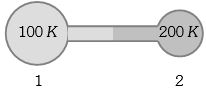
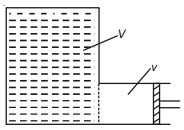
Figure shows two flasks connected to each other. The volume of the flask $1$ is twice that of flask $2.$ The system is filled with an ideal gas at temperature $100\, K$ and $200 \,K $ respectively. If the mass of the gas in $1$ be $m$ then what is the mass of the gas in flask $2$
- A
$m$
- B
$\frac{m}{2}$
- ✓
$\frac{m}{4}$
- D
$\frac{m}{8}$
AnswerCorrect option: C. $\frac{m}{4}$
c
$PV = \frac{m}{M}RT$ $\Rightarrow$ $V \propto mT$
$\Rightarrow$ $\frac{{{V_1}}}{{{V_2}}} = \frac{{{m_1}}}{{{m_2}}}.\frac{{{T_1}}}{{{T_2}}}$
$\Rightarrow$ $\frac{{2V}}{V} = \frac{m}{{{m_2}}} \times \frac{{100}}{{200}}$
$\Rightarrow$ ${m_2} = \frac{m}{4}$
View full question & answer→MCQ 721 Mark
A gas is filled in a cylinder, its temperature is increased by $20\%$ on Kelvin scale and volume is reduced by $10\%.$ How much percentage of the gas will leak out ........ $\%$
Answerd
$PV = nRT [ n \rightarrow$ Np.of moles $]$
$\log ( PV )=\log ( nRT )$
$\log P +\log V =\log n+\log R t$
Differentiate it
$\frac{\Delta P }{ P }+\frac{\Delta V }{ V }=\frac{\Delta n }{ n }+\frac{\Delta T }{ T }$
$\because$ It is filled in a rigid cylinder
$\Delta P =0$
$\frac{\Delta V }{ V } \times 100=-10$
$\frac{\Delta T }{ T } \times 100=20$
$\therefore-10=\frac{\Delta n }{ n } \times 100+20$
$\frac{\Delta n }{ n } \times 100=-30$
$\because n =\frac{ m }{ M }$
Where $m \rightarrow$ Mass of gas leaked
$M \rightarrow$ Molar mass
$\therefore \frac{\Delta m }{ m } \times 100=-30$
$\therefore 30 \%$ gas will leak out
View full question & answer→MCQ 731 Mark
The air density at Mount Everest is less than that at the sea level. It is found by mountaineers that for one trip lasting a few hours, the extra oxygen needed by them corresponds to $30,000\, cc$ at sea level (pressure $1$ atmosphere, temperature $27°C$). Assuming that the temperature around Mount Everest is $-73°C$ and that the oxygen cylinder has capacity of $5.2 \,litre,$ the pressure at which ${O_2}$ be filled (at site) in cylinder is .... $atm$
- ✓
$3.86$
- B
$5.00$
- C
$5.77$
- D
$1$
AnswerCorrect option: A. $3.86$
a
Since moles of gas must remain constant,
$\frac{ P _{1} V _{1}}{ T _{1}}=\frac{ P _{2} V _{2}}{ T _{2}}$
$\frac{1(30000)}{300}=\frac{P(5200)}{143}$
$P =3.86 \; atm$
View full question & answer→MCQ 741 Mark
A gas in container $A$ is in thermal equilibrium with another gas in container $B.$ both contain equal masses of the two gases in the respective containers. Which of the following can be true
- A
$\frac {P_A}{V_A}$ = $\frac {P_B}{V_B}$
- B
${P_A} = {P_B},\;{V_A} \ne {V_B}$
- C
${P_A} \ne {P_B},\;{V_A} = {V_B}$
- ✓
${P_A}{V_A} = {P_B}{V_B}$
AnswerCorrect option: D. ${P_A}{V_A} = {P_B}{V_B}$
d
A gas in containes $A$ and othes gas B Containes They are in Thermal equillibrium.
$T_{A}=T_{B}$
As we know $P V=n R T$
$P_{A} V_{A}=n R T_{A} \; \dots (1)$
$P_{B} V_{B}=n R T_{B} \; \dots (2)$
$T_{A}=T_{B}$
Therefore, $P_{A} V_{A}=P_{B} V_{B}$
View full question & answer→MCQ 751 Mark
A closed vessel contains $8\,gm$ of oxygen and $7\,gm$ of nitrogen. The total pressure is $10\, atm$ at a given temperature. If now oxygen is absorbed by introducing a suitable absorbent the pressure of the remaining gas in atm will be
Answerd
According to the question,
Dalton's law of partial pressures that
$p =\left( n _{1}+ n _{2}\right) \frac{ RT }{ V }$
$p _{1}=\frac{ n _{1} RT }{ V }$
$p _{2}=\frac{ n _{1} RT }{ V }$
$n _{1}= n _{2}=\frac{1}{4}$
$p _{1}= p _{2}$
$p _{1}= p _{2}=10$
$p _{1}=5 \; atm$
View full question & answer→MCQ 761 Mark
If the intermolecular forces vanish away, the volume occupied by the molecules contained in $4.5 \,kg$ water at standard temperature and pressure will be
- ✓
$5.6\,{m^3}$
- B
$4.5\,{m^3}$
- C
$11.2 \,litre$
- D
$11.2\,{m^3}$
AnswerCorrect option: A. $5.6\,{m^3}$
a
$\mu=\frac{\text { Mass of water }}{\text { Molecular wt. of water }}=\frac{4.5 kg }{18 \times 10^{-3} kg }=250$
$T =273 K$ and $P =10^{5} N / m ^{2}( STP )$
From $\quad PV =\mu RT$
$\Rightarrow V =\frac{\mu RT }{ P }=\frac{250 \times 8.3 \times 273}{10^{5}}=5.66 \; m ^{3}$
View full question & answer→MCQ 771 Mark
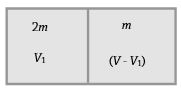
Inside a cylinder having insulating walls and closed at ends is a movable piston, which divides the cylinder into two compartments. On one side of the piston is a mass $m$ of a gas and on the other side a mass $2 m$ of the same gas. What fraction of volume of the cylinder will be occupied by the larger mass of the gas when the piston is in equilibrium $?$ Consider that the movable piston is conducting so that the temperature is the same throughout
- A
$0.25$
- B
$0.33$
- C
$0.5$
- ✓
$0.67$
AnswerCorrect option: D. $0.67$
d
From, $PV = \mu RT$
$P(V - {V_1}) = \frac{m}{M}RT$ $... (i)$
and $P{V_1} = \frac{{2m}}{M}RT$ $... (ii)$
$\Rightarrow$ $\frac{{{V_1}}}{V} = \frac{2}{3}$
View full question & answer→MCQ 781 Mark
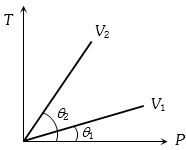
From the following $P-T$ graph what interference can be drawn
- ✓
${V_2} > {V_1}$
- B
${V_2} < {V_1}$
- C
${V_2} = {V_1}$
- D
AnswerCorrect option: A. ${V_2} > {V_1}$
a
${\theta _2} > {\theta _1}$
$\Rightarrow$ $\tan {\theta _2} > \tan {\theta _1}$
$\Rightarrow$ ${\left( {\frac{T}{P}} \right)_2} > {\left( {\frac{T}{P}} \right)_1}$
and $PV = \mu RT$ से $\frac{T}{P} \propto V$
$\Rightarrow$ ${V_2} > {V_1}$
View full question & answer→MCQ 791 Mark
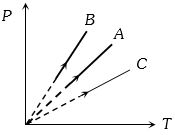
Pressure versus temperature graph of an ideal gas at constant volume $V$ of an ideal gas is shown by the straight line $A$. Now mass of the gas is doubled and the volume is halved, then the corresponding pressure versus temperature graph will be shown by the line
Answerb
Pressure-temperature graph
Volume $= V$
According to Charle's and Boyle's law,
$\frac{P_{1} V_{1}}{T_{1}}=\frac{P_{2} V_{2}}{T_{2}}$
or, $\frac{ PV }{ T }=\frac{2 P \lambda V / 2}{ T _{1}}$
or, $T_{1}=T$
View full question & answer→MCQ 801 Mark
Which one the following graphs represents the behaviour of an ideal gas
Answerb
For ideal gas, $PV = nRT$
if $T$ is constant,
$PV =$ constant
View full question & answer→MCQ 811 Mark
A closed hollow insulated cylinder is filled with gas at ${0^o}C$ and also contains an insulated piston of negligible weight and negligible thickness at the middle point. The gas on one side of the piston is heated to ${100^o}C.$ If the piston moves $5\,cm,$ the length of the hollow cylinder is ..... $cm$
- A
$13.65$
- B
$27.3$
- C
$38.6$
- ✓
$64.6$
AnswerCorrect option: D. $64.6$
d
(d) Using Boyle’s law, we have $\frac{V}{T} = $ constant
==> $\frac{{\frac{l}{2} + 5}}{{373}} = \frac{{\frac{l}{2} - 5}}{{273}}$
As the piston moves 5 cm, the length of one side will be $\left( {\frac{l}{2} + 5} \right)$ and other side $\left( {\frac{l}{2} - 5} \right)$. On solving this equation, we get $l = 64.6 cm.$
View full question & answer→MCQ 821 Mark
A pressure cooker contains air at $1$ atm and $30^o C$. If the safety value of the cooler blows when the inside pressure $ \ge 3$ atm, then the maximum temperature of the air, inside the cooker can be .... $^oC$
Answerb
(b) Since volume is constant,
Hence $\frac{{{P_1}}}{{{P_2}}} = \frac{{{T_1}}}{{{T_2}}}$==> $\frac{1}{3} = \frac{{(273 + 30)}}{{{T_2}}}$
==> ${T_2} = 909K = 636^\circ C$
View full question & answer→MCQ 831 Mark
A cylinder contains $10\, kg$ of gas at pressure of ${10^7}\,\,N/{m^2}.$ The quantity of gas taken out of the cylinder, if final pressure is $2.5 \times {10^6}\,N/{m^2},$ will be ..... $kg$ (Temperature of gas is constant)
Answerd
(d) $PV = mrT$ ==> $P \propto \,m \,\,[V, r, T \to constant]$
==> $\frac{{{m_1}}}{{{m_2}}} = \frac{{{P_1}}}{{{P_2}}}$
==> $\frac{{10}}{{{m_2}}}$= $\frac{{{{10}^7}}}{{2.5 \times {{10}^6}}}$==> $m2 = 2.5\, kg$.
Hence mass of the gas taken out of the cylinder
$ = 10 - 2.5 = 7.5kg.$
View full question & answer→MCQ 841 Mark
Air is filled at $60^o C$ in a vessel of open mouth. The vessel is heated to a temperature $T$ so that $1/4^{th}$ part of air escapes. Assuming the volume of the vessel remaining constant, the value of $T$ is ....... $^oC$
Answerd
(d) For open mouth vessel, pressure is constant.
Volume is also given constant
Hence from $PV = \mu RT = \left( {\frac{m}{M}} \right)RT$==>$T \propto \frac{1}{m}$==> $\frac{{{T_1}}}{{{T_2}}} = \frac{{{m_2}}}{{{m_1}}}$
$\because$ $\frac{1}{4}th$ part escapes, so remaining mass in the vessel ${m_2} = \frac{3}{4}{m_1}$==> $\frac{{(273 + 60)}}{T} = \frac{{3/4\,{m_1}}}{{{m_1}}}$
==> $T = 444K$ $= 171°C$
View full question & answer→MCQ 851 Mark
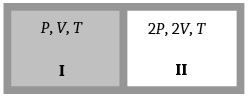
A partition divides a container having insulated walls into two compartments $I$ and $II$. the same gas fills the two compartments. The ratio of the number of molecules in compartments $I$ and $II$ is
Answerd
(d) $n = \frac{{PV}}{{kT}}$ Now, $n' = \frac{{(2P)(2V)}}{{kT}} = 4\frac{{PV}}{{kT}} = 4n$ or $\frac{n}{{n'}} = \frac{1}{4}$.
View full question & answer→MCQ 861 Mark
Find the approx. number of molecules contained in a vessel of volume $7$ litres at $0^oC$ at $1.3 \times 10^5$ pascal
- ✓
$2.4 \times 10^{23}$
- B
$3 \times 10^{23}$
- C
$6 \times 10^{23}$
- D
$4.8 \times 10^{23}$
AnswerCorrect option: A. $2.4 \times 10^{23}$
a
$V=7 L=7 \times 10^{-3} \mathrm{m}^{3}$
$T=273 \mathrm{K}$
$P=1.3 \times 10^{5} \mathrm{Pa}$
$\therefore \mathrm{m}=\frac{\mathrm{PV}}{\mathrm{RT}}=\frac{1.3 \times 10^{5} \times 7 \times 10^{-3}}{8.314 \times 273}$
$=0.4$ moles
$\therefore$ No. of molecules $=0.4 \times 6.02 \times 10^{23}$
$=2.4 \times 10^{23}$ molecules
View full question & answer→MCQ 871 Mark
A rigid tank contains $35 \,\,kg$ of nitrogen at $6$ atm. Sufficient quantity of oxygen is supplied to increase the pressure to $9$ atm, while the temperature remains constant. Amount of oxygen supplied to the tank is .... $kg$
Answerc
$P \propto n \Rightarrow \frac{P_{1}}{P_{2}}=\frac{n_{1}}{n_{2}}$
$n_{1}=\frac{35}{28} \times 1000=1250$
$\Rightarrow n_{2}=\frac{1250}{6} \times 9=1250 \times \frac{3}{2}=1875$
$n_{2}=n_{N_{2}}+n_{\circ_{2}}=1875=1250+n_{\mathrm{o}_{2}}$
$n_{\mathrm{o}_{2}}=625$ mole
mass $=$ no. of mole $\times$ molecular weigh $20 \mathrm{kg}$
View full question & answer→MCQ 881 Mark
A vessel contains $1$ mole of $O_2$ gas (molar mass $32$) at a temperature $T$. The pressure of the gas is $P$. An identical vessel containing one mole of $He$ gas (molar mass $4$) at a temperature $2T$ has a pressure of
Answerc
Ideal gas equation $P V=n R T$
For $O_{2}$ gas$:$ $P=P, V=V, T=T.$
For $H e$ gas$:$ $P=P_{2}, V=V_{2}=V, T=T_{2}=2 T$
By comparing them $P_{2}=2 P$
View full question & answer→MCQ 891 Mark
A container $X$ has volume double that of contianer $Y$ and both are connected by a thin tube. Both contains same ideal gas. The temperature of $X$ is $200\,\,K$ and that of $Y$ is $400\,\,K$. If mass of gas in $X$ is $m$ then in $Y$ it will be:
Answerc
Ideal gas equation $P V=n R T$
For gas $\mathrm{x}: P=P, V=2 V,(n=m / a) ; T=200 \mathrm{K}$
Final position$:$ $P=P, V=V,\left(n=m_{2} / a\right), T=400 K$
By comparing them, $m_{2}=(m / 4)$
View full question & answer→MCQ 901 Mark
In an ideal gas at temperature $T$, the average force that a molecule applies on the walls of a closed container depends on $T$ as ${T^q }$ . A good estimate for $q$ is
- A
$2$
- B
$\frac{1}{2}$
- C
$\frac{1}{4}$
- ✓
$1$
Answerd
$\mathrm{F}=\frac{\mathrm{mv}^{2}}{\mathrm{L}} \propto \mathrm{T}$
$\left(\because \mathrm{v}^{2} \propto \mathrm{T}\right)$
View full question & answer→MCQ 911 Mark
You have two containers of equal volume. One is full of helium gas. The other holds an equal mass of nitrogen gas. Both gases have the same pressure. How does the temperature of the helium compare to the temperature of the nitrogen ?
- A
$T_{helium} > T_{nitrogen}$
- B
$T_{helium} = T_{nitrogen}$
- ✓
$T_{helium} < T_{nitrogen}$
- D
AnswerCorrect option: C. $T_{helium} < T_{nitrogen}$
c
$\mathrm{PV}=\frac{\mathrm{m}}{\mathrm{M}} \mathrm{RT}$
$\frac{P V M}{R_{m}}=T$
$\mathrm{T} \square \mathrm{M}" \mathrm{T}_{\mathrm{He}}<\mathrm{T}_{\mathrm{N}_{2}}$
View full question & answer→MCQ 921 Mark
The air density at Mount Everest is less than that at the sea level. It is found by mountaineers that for one trip lasting a few hours, the extra oxygen needed by them corresponds to $30,000\ cc$ at sea level (pressure $1$ atmosphere, temperature $27^oC).$ Assuming that the temperature around Mount Everest is $-73^oC$ and that the oxygen cylinder has capacity of $5.2\ litre,$ the pressure at which $O_2$ be filled (at site) in cylinder is ..... $atm$
- ✓
$3.86$
- B
$5.00$
- C
$5.77$
- D
$1$
AnswerCorrect option: A. $3.86$
a
since moles of gas must remain constant,
$\frac{P_{1} V_{1}}{T_{1}}=\frac{P_{2} V_{2}}{T_{2}}$
$\frac{1(30000)}{300}=\frac{P(5200)}{143}$
$P=3.86 a t m$
View full question & answer→MCQ 931 Mark
A gas at $ 27\ ^oC$ has a volume $V$ and pressure $P$. On heating its pressure is doubled and volume becomes three times. The resulting temperature of the gas will be ....... $^oC$
- A
$1800$
- B
$162$
- ✓
$1527$
- D
$ 600$
AnswerCorrect option: C. $1527$
c
From ideal gas equation $P V=\neq R T$
we get $\frac{T_{2}}{T_{1}}=\left(\frac{P_{2}}{P_{1}}\right)\left(\frac{V_{2}}{V_{1}}\right)=\left(\frac{2 P_{1}}{P_{1}}\right)\left(\frac{3 V_{1}}{V_{1}}\right)=6$
$\therefore T_{2}=6 T_{1}=6 \times 300=1800 K=1527^{\circ} \mathrm{C}$
View full question & answer→MCQ 941 Mark
A monoatomic ideal gas of two moles is taken through a cyclic process starting from $1$ as shown. $\frac{{{V_2}}}{{{V_1}}} = 2$ and $\frac{{{V_4}}}{{{V_1}}} = 4$ and temperature iast : $1$ is $T_1 = 27\,^oC$. The temperature at $2$ i.e., $T_2$ ...... $K$
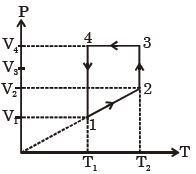
Answera
In $1 \rightarrow 2$ process
$\frac{\mathrm{V}_{1}}{\mathrm{T}_{1}}=\frac{\mathrm{V}_{2}}{\mathrm{T}_{2}} \Rightarrow \mathrm{T}_{2}=\frac{\mathrm{V}_{2}}{\mathrm{V}_{1}} \cdot \mathrm{T}_{1}=2(27+273)=600 \mathrm{K}$
View full question & answer→MCQ 951 Mark
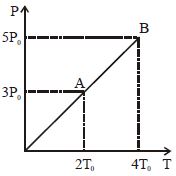
Pressure $Vs$ temperature graph of an ideal gas is shown in figure. Density of the gas at point $A$ is $\rho _0$ , Density at $B$ will be
- A
$\frac{{3{\rho _0}}}{4}$
- B
$\frac{{2{\rho _0}}}{3}$
- ✓
$\frac{{5{\rho _0}}}{6}$
- D
$\frac{{4{\rho _0}}}{5}$
AnswerCorrect option: C. $\frac{{5{\rho _0}}}{6}$
View full question & answer→MCQ 961 Mark
Open container contains $x$ mole of gas at $T$ $kelvin$ If temperature is tripled, then the amount of gas exit the container is
- A
$\frac{x}{3}$
- B
$3x$
- ✓
$\frac{2x}{3}$
- D
$\frac{3x}{2}$
AnswerCorrect option: C. $\frac{2x}{3}$
c
open container $:$
$P=$ constant $: V=$ constant
$\mu \mathrm{T}=$ constant $\quad \mathrm{PV}=\mu \mathrm{R} \mathrm{T}$
$\mu_{1} \mathrm{T}_{1}=\mu_{2} \mathrm{T}_{2}$
$\mathrm{x} \times \mathrm{T}=\mu_{2} \times(3 \mathrm{T})$
$\left[\mu_{2}=\frac{\mathrm{x}}{3}\right]$ left in the container
Exit $:$ form container $x-\frac{x}{3}=\frac{2 x}{3}$
View full question & answer→MCQ 971 Mark
Indicator diagram is a ...........
- A
$P-T$ curve
- ✓
$P-V$ curve
- C
$V-T$ curve
- D
$Q-T$ curve
AnswerCorrect option: B. $P-V$ curve
b
(b)
A graph that indicates changes in pressure with respect to volume within the cylinder of a reciprocating engine is known as an indicator diagram. Only one option shows a graph between pressure and volume.
View full question & answer→MCQ 981 Mark
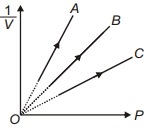
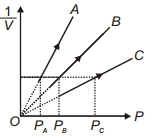
Figure shows the isotherms of a fixed mass of an ideal gas at three temperatures $T_A, T_B$ and $T_C$, then
- A
$T_A > T_B > T_C$
- ✓
$T_A < T_B < T_C$
- C
$T_B < T_A < T_C$
- D
$T_A=T_B=T_C$
AnswerCorrect option: B. $T_A < T_B < T_C$
b
(b)
$\because P V=R T$
$\frac{R T}{V}=P$
$\because$ For constant $\frac{1}{V} \quad$ So, $P \propto T$
$\because P_C > P_B > P_A$ then
$T_C > T_B > T_A$
View full question & answer→MCQ 991 Mark
An ideal gas is enclosed in a container of volume $V$ at a pressure $P$. It is being pumped out of the container by using a pump with stroke volume $v$. What is final pressure in container after $n$-stroke of the pump? (assume temperature remains same)
AnswerCorrect option: A. $P\left(\frac{V}{V+v}\right)^n$
a
(a)
After stroke $P V=$ constant
$P V=P_1(V+v)$
$P_1=\frac{P V}{(V+v)}$
Similarly after $2^{\text {nd }}$ stroke
$P_2=P\left(\frac{V}{V+v}\right)^2$
After $n^{\text {th }}$ stroke
$P_n=P\left(\frac{V}{V+V}\right)^n$
View full question & answer→MCQ 1001 Mark
Nitrogen gas $N _2$ of mass $28 \,g$ is kept in a vessel at pressure of $10 \,atm$ and temperature $57^{\circ} C$. Due to leakage of $N _2$ gas its pressure falls to $5 \,atm$ and temperature to $27^{\circ} C$. The amount of $N _2$ gas leaked out is .......... $g$
- A
$\frac{5}{63}$
- ✓
$\frac{63}{5}$
- C
$\frac{28}{63}$
- D
$\frac{63}{28}$
AnswerCorrect option: B. $\frac{63}{5}$
b
(b)
Mass $=28 \,g$
$P_i=10 \,atm \quad T_i=57^{\circ} C =330 \,K$
$P_f=5 \,atm \quad T_f=27^{\circ} C =300 \,K$
Volume is kept constant.
$P_i=K \times n_i T_i \quad \dots (i)$
$P_f=K \times n_f T_f \quad \dots (ii)$
Dividing $(i)$ by $(ii)$
$\frac{P_i}{P_f}=\frac{n_i}{n_f} \frac{T_i}{T_f}$
$\frac{n_i}{n_f}=\frac{10}{5} \times \frac{300}{330}$
or $\frac{n_i}{n_f}=2 \times \frac{10}{11}$
$\frac{n_i}{n_f}=\frac{20}{11}$
Now $n_i=1$ mole of $N _2$ $n_f=\frac{11}{20}$ moles
or Mass of $N _2$ left $=\frac{11}{20} \times 28$
$\therefore \text { Quantity released }=28-\frac{11}{20} \times 28$
$=\frac{9}{20} \times 28=\frac{63}{5} g$
View full question & answer→MCQ 1011 Mark
A narrow glass tube, $80 \,cm$ long and opens at both ends, is half immersed in mercury, now the top of the tube is closed and is taken out of mercury. A column of mercury $20 \,cm$ long remains in the tube. Find atmospheric pressure
- A
$20 \,cm$ of air column
- ✓
$60 \,cm$ of $Hg$ column
- C
$60 \,cm$ of air column
- D
$20 \,cm$ of $Hg$ column
AnswerCorrect option: B. $60 \,cm$ of $Hg$ column
b
(b)
$P V=$ constant
$P_1 V_1=P_2 V_2 \quad\left[P_1=P_0\right.$ atmospheric pressure $]$
$P_0 \times 40=P_1 \times 60 \quad \ldots (i)$
$P_1+20=P_0 \quad... (ii)$
From $(i)$
$P_1=\frac{2 P_0}{3}$
From $(ii)$
$\frac{2 P_0}{3}+20=P_0 \Rightarrow P_0=60 cm \text { of } Hg .$
View full question & answer→MCQ 1021 Mark
Two closed containers of equal volume filled with air at pressure $P_0$ and temperature $T_0$. Both are connected by a narrow tube. If one of the container is maintained at temperature $T_0$ and other at temperature $T$, then new pressure in the containers will be
AnswerCorrect option: A. $\frac{2 P_0 T}{T+T_0}$
a
(a)
$\frac{P}{T}=$ constant
Initially $\frac{P_0}{T_0}+\frac{P_0}{T_0}=\frac{2 P_0}{T_0}$
For two containers
$\frac{P_0}{T_0}+\frac{P}{T}=\frac{2 P_0}{T_0}$
$P=\frac{2 P_0 \times T \times T_0}{T_0\left(T+T_0\right)}$
or $P=\frac{2 P_0 T}{\left(T+T_0\right)}$
View full question & answer→MCQ 1031 Mark
Gas at a pressure ${P_0}$ in contained is a vessel. If the masses of all the molecules are halved and their speeds are doubled, the resulting pressure $P$ will be equal to
- A
$4{P_0}$
- ✓
$2{P_0}$
- C
${P_0}$
- D
$\frac{{{P_0}}}{2}$
AnswerCorrect option: B. $2{P_0}$
b
${v_{rms}} = \sqrt {\frac{{3P}}{\rho }} = \sqrt {\frac{{3PV}}{m}} $
$\Rightarrow$ ${v_{rms}} \propto \sqrt {\frac{P}{m}} $
$\Rightarrow$ $\frac{{{v_1}}}{{{v_2}}} = \sqrt {\frac{{{P_1}}}{{{P_2}}} \times \frac{{{m_2}}}{{{m_1}}}} $ $\Rightarrow$ $\frac{v}{{2v}} = \sqrt {\frac{{{P_0}}}{{{P_2}}} \times \frac{{m/2}}{m}} $ $\Rightarrow$ ${P_2} = 2{P_0}$
View full question & answer→MCQ 1041 Mark
A cylinder of capacity $20$ litres is filled with ${H_2}$ gas. The total average kinetic energy of translatory motion of its molecules is $1.5 \times {10^5}\,J$. The pressure of hydrogen in the cylinder is
- A
$2 \times {10^6}\,N/{m^2}$
- B
$3 \times {10^6}\,N/{m^2}$
- C
$4 \times {10^6}\,N/{m^2}$
- ✓
$5 \times {10^6}\,N/{m^2}$
AnswerCorrect option: D. $5 \times {10^6}\,N/{m^2}$
d
$E = \frac{3}{2}PV$$ \Rightarrow P = \frac{{2E}}{{3V}}$$ = \frac{2}{3} \times \frac{{1.52 \times {{10}^5}}}{{20 \times {{10}^{ - 3}}}}$
$ = \frac{{{{10}^5}}}{{20 \times {{10}^{ - 2}}}} = 5 \times {10^6}N/{m^2}$
View full question & answer→MCQ 1051 Mark
The root mean square speed of hydrogen molecules of an ideal hydrogen gas kept in a gas chamber at $0°C$ is $3180$ metres/second. The pressure on the hydrogen gas is ..... $atm$ (Density of hydrogen gas is $8.99 \times {10^{ - 2}}\,kg/{m^3}$, $1$ atmosphere $ = 1.01 \times {10^5}\,N/{m^2})$
Answerd
${v_{rms}} = \sqrt {\frac{{3P}}{\rho }} $
$\Rightarrow$ $P = \frac{{v_{rms}^2\rho }}{3} = \frac{{{{(3180)}^2} \times 8.99 \times {{10}^{ - 2}}}}{3}$
$ = 3 \times {10^5}\,N/{m^2} = 3\,atm$
View full question & answer→MCQ 1061 Mark
If the mean free path of atoms is doubled then the pressure of gas will become
Answerb
Mean force path, $\lambda=\frac{11}{P} \sqrt{\frac{\pi R T}{2 M}}$
where, $\mu=$ viscerity $P=$ Pressure $R=$ gass constant $T=$ Temperature $M=$Molecular weight
$\Rightarrow \lambda \alpha \frac{1}{p}$
If $p \propto \frac{1}{\lambda}$
If we double the mean force
Path, the pressure will be $1 / 2$.
So, The correct answer is $\frac{p}{2}$
View full question & answer→MCQ 1071 Mark
Relationship between $P,V,$ and $E$ for a gas is
- A
$P = \frac{3}{2}\,EV$
- B
$V = \frac{2}{3}\,EP$
- C
$PV = \frac{3}{2}\,E$
- ✓
$PV = \frac{2}{3}\,E$
AnswerCorrect option: D. $PV = \frac{2}{3}\,E$
d
$P = \frac{2}{3} \times $ (unit volume energy) $ = \frac{2}{3}\frac{E}{V}$
$\Rightarrow$ $PV = \frac{2}{3}E$
View full question & answer→MCQ 1081 Mark
The value of universal gas constant is $8.3\, J/mole/K,$ the mean kinetic energy of $32\, gm$ of oxygen at $-73°C$ will be ...... $J$
- A
$480$
- B
$4980$
- ✓
$2490 $
- D
The information is incomplete
AnswerCorrect option: C. $2490 $
c
Kinetic energy of one mole ${O_2}$ $(32\, gm)$
$ = \frac{3}{2}RT = \frac{3}{2} \times 8.3 \times 200 = 2490\,J$
View full question & answer→MCQ 1091 Mark
The average kinetic energy of a gas at $-23°C$ and $75\, cm$ pressure is $5 \times {10^{ - 14}}\,erg$ for ${H_2}$. The mean kinetic energy of the ${O_2}$ at $227°C$ and $150\, cm$ pressure will be
- A
$80 \times {10^{ - 14}}\,erg$
- B
$20 \times {10^{ - 14}}\,erg$
- C
$40 \times {10^{ - 14}}\,erg$
- ✓
$10 \times {10^{ - 14}}\,erg$
AnswerCorrect option: D. $10 \times {10^{ - 14}}\,erg$
d
average kinetic energy
=$E = \frac{3}{2}kT$
$\Rightarrow$ $\frac{{{E_1}}}{{{E_2}}} = \frac{{{T_1}}}{{{T_2}}} = \frac{{(273 - 23)}}{{(273 + 227)}} = \frac{{250}}{{500}} = \frac{1}{2}$
$\Rightarrow$ ${E_2} = 2{E_1} = 2 \times 5 \times {10^{ - 14}} = 10 \times {10^{ - 14}}\,erg$
View full question & answer→MCQ 1101 Mark
The ratio of mean kinetic energy of hydrogen and nitrogen at temperature $300 \,K$ and $450\, K$ respectively is
- A
$3:2$
- ✓
$2:3$
- C
$2:21$
- D
$4:9$
Answerb
$\frac{{{E_1}}}{{{E_2}}} = \frac{{{T_1}}}{{{T_2}}} = \frac{{300}}{{450}} = \frac{2}{3}$
View full question & answer→MCQ 1111 Mark
At which of the following temperature would the molecules of a gas have twice the average kinetic energy they have at $20°C$
Answerc
Average keinetic energy $\propto$ Temperature
$\frac{{{E_1}}}{{{E_2}}} = \frac{{{T_1}}}{{{T_2}}}$ Þ $\frac{E}{{2E}} = \frac{{{T_1}}}{{{T_2}}}$ ${T_2} = 2{T_1}$
${T_2} = 2(273 + 20) = 586\,K = 313^\circ C$
View full question & answer→MCQ 1121 Mark
The kinetic energy of translation of $20\, gm$ of oxygen at $47°C$ is (molecular wt. of oxygen is $32 \,gm/mol$ and $R = 8.3\, J/mol/K)$
- ✓
$2490 \,joules$
- B
$2490 \,ergs$
- C
$830 \,joules$
- D
$124.5\, joules$
AnswerCorrect option: A. $2490 \,joules$
a
given data:
Mass of oxygen, $m=20 gm$
No. of moles, $n=\frac{m}{M}=\frac{m}{\text { molar mass }}$
$\therefore n=\frac{20}{32}$
Temperature, $T=47^{\circ} C =320 K$
The kinetic energy of $0_{2}, E=\frac{3}{2} n R T$
$E=\frac{3}{2} \times\left(\frac{20}{32}\right) \times(8.3) \times(320)$
$E=2490 \; J$
the kintic energy of $0_{2}$ is $2490 \; J$
View full question & answer→MCQ 1131 Mark
The translatory kinetic energy of a gas per $gm$ is
AnswerCorrect option: B. $\frac{3}{2}\frac{{RT}}{M}$
b
Kinetic energy of $1$ gram of gas $\Rightarrow$ ${E}$(transferential) $= \frac{3}{2}rT = \frac{3}{2}\frac{{RT}}{M}$
View full question & answer→MCQ 1141 Mark
The kinetic energy of one gram molecule of a gas at normal temperature and pressure is $(R = 8.31\,J/mole - K)$
- A
$0.56 \times {10^4}\,J$
- B
$1.3 \times {10^2}\,J$
- C
$2.7 \times {10^2}\,J$
- ✓
$3.4 \times {10^3}\,J$
AnswerCorrect option: D. $3.4 \times {10^3}\,J$
d
Given,
$R =8.31 J / molK$
$T =273 \;K$
Kinetic energy,
$K =\frac{3}{2} RT$
$K =\frac{3}{2} \times 8.31 \times 273=3.4 \times 10^{3} \; J$
View full question & answer→MCQ 1151 Mark
The mean kinetic energy of a gas at $300 K$ is $100 J.$ The mean energy of the gas at $450 K$ is equal to ...... $J$
- A
$100$
- B
$3000$
- C
$450$
- ✓
$150$
Answerd
average kinetic energy $\propto$ Temperature
$\Rightarrow$ $\frac{{{E_1}}}{{{E_2}}} = \frac{{{T_1}}}{{{T_2}}}$ $\Rightarrow$ $\frac{{100}}{{{E_2}}} = \frac{{300}}{{450}}$ $\Rightarrow$ ${E_2} = 150\,J$
View full question & answer→MCQ 1161 Mark
At what temperature is the kinetic energy of a gas molecule double that of its value of $27°C$
- A
$54°C$
- B
$300 K$
- ✓
$327°C$
- D
$108°C$
AnswerCorrect option: C. $327°C$
c
$\frac{{{E_1}}}{{{E_2}}} = \frac{{{T_1}}}{{{T_2}}}$
$\Rightarrow$ $\frac{E}{{2E}} = \frac{{(273 + 27)}}{{{T_2}}}$
$\Rightarrow$ ${T_2} = 600\,K = 327^\circ C$
View full question & answer→MCQ 1171 Mark
At $27°C$ temperature, the kinetic energy of an ideal gas is ${E_1}$. If the temperature is increased to $327°C,$ then kinetic energy would be
AnswerCorrect option: A. $2{E_1}$
a
$K E \propto T$
So, $\frac{K E_{1}}{K E_{2}} =\frac{T_{1}}{T_{2}} \Rightarrow \frac{(27+273) K}{(327+273) K}=\frac{E_{1}}{E_{2}}$
$\frac{E_{1}}{E_{2}} =\frac{300}{600}=\frac {1}{2} \Rightarrow {E_{2}=2 E_{1}}$
View full question & answer→MCQ 1181 Mark
A box contains a mixture of ${H_2}$ and $He$ gases. Which of the following statements are corrects
- A
The average translational kinetic energies of ${H_2}$ molecules and $He$ atoms are same
- B
The average energies of ${H_2}$ molecules and $He$ atoms are same
- C
${H_2}$ molecules have greater average energy than that of $He$ atoms
- ✓
Both $(a)$ and $(c)$
AnswerCorrect option: D. Both $(a)$ and $(c)$
d
Average translational $KE$ energy depends only on the temprature and average energy depends on the degree of freodom.
So, $K E_{avg}$ for $H_{2}=$ $KE_{avg}$ for He.
and $E_{avg}$ for $H _{2} > E_{avg}$ for $He [\because H _{2}$ has $5$ degree of freedom$]$
View full question & answer→MCQ 1191 Mark
The temperature of a gas is $ -68^\circ C$. At ...... $^oC$ temperature will the average kinetic energy of its molecules be twice that of at $ -68^\circ C$
- ✓
$ 137$
- B
$ 127$
- C
$ 100$
- D
$ 105$
AnswerCorrect option: A. $ 137$
a
$\frac{{{E_2}}}{{{E_1}}} = \frac{{{T_2}}}{{{T_1}}}$
$\Rightarrow 2 = \frac{{{T_2}}}{{{T_1}}} $
$\Rightarrow {T_2} = 2{T_1}$
$ \Rightarrow {T_2} = 2(273 - 68) = 410K = 137^\circ C$
View full question & answer→MCQ 1201 Mark
Two gases are at absolute temperatures $300 K $ and $350 K$ respectively. Ratio of average kinetic energy of their molecules is
- A
$7:6$
- ✓
$6:7$
- C
$36:49$
- D
$49:36$
Answerb
$E \propto T$
$\Rightarrow$ $\frac{{{E_1}}}{{{E_2}}} = \frac{{{T_1}}}{{{T_2}}} = \frac{{300}}{{350}} = \frac{6}{7}$
View full question & answer→MCQ 1211 Mark
A gas mixture consists of molecules of type $1, 2$ and $3$, with molar masses ${m_1} > {m_2} > {m_3}.$ ${V_{rms}}$ and $\overline K $ are the $r.m.s.$ speed and average kinetic energy of the gases. Which of the following is true
- ✓
$(V_{rms})_1 < (V_{rms})_2 < (V_{rms})_3$ and ${(\overline K )_1} = {(\overline K )_2} = ({\overline K _3})$
- B
$(V_{rms})_1 = (V_{rms})_2 = (V_{rms})_3$ and ${(\overline K )_1} = {(\overline K )_2} > {(\overline K )_3}$
- C
$(V_{rms})_1 > (V_{rms})_2 > (V_{rms})_3$ and ${(\overline K )_1} < {(\overline K )_2} > ({\overline K _3})$
- D
$(V_{rms})_1 > (V_{rms})_2 > (V_{rms})_3$ and ${(\overline K )_1} < {(\overline K )_2} < {(\overline K )_3}$
AnswerCorrect option: A. $(V_{rms})_1 < (V_{rms})_2 < (V_{rms})_3$ and ${(\overline K )_1} = {(\overline K )_2} = ({\overline K _3})$
a
${v_{rms}} \propto \frac{1}{{\sqrt M }} \Rightarrow {({v_{rms}})_1} < {({v_{rms}})_2} < {({v_{rms}})_3}$
the temperature of each gas in the mixture will be same, so the kinetic energy will also be same.
View full question & answer→MCQ 1221 Mark
The mean kinetic energy of a gas at $300\, K$ is $100\, J.$ The mean energy of the gas at $450\, K$ is equal to ...... $J$
- A
$100 $
- B
$3000 $
- C
$450 $
- ✓
$150 $
AnswerCorrect option: D. $150 $
d
$\frac{{{E_1}}}{{{E_2}}} = \frac{{{T_1}}}{{{T_2}}}$
$\Rightarrow {E_2} = {E_1}\frac{{{T_2}}}{{{T_1}}} = 100 \times \frac{{450}}{{300}} = 150J$
View full question & answer→MCQ 1231 Mark
The capacity of a vessel is $3$ litres. It contains $6 \,gm$ oxygen, $8\, gm$ nitrogen and $5\, gm$ $C{O_2}$ mixture at $27°C.$ If $R = 8.31\, J/mole$ $ \times $ $kelvin,$ then the pressure in the vessel in $N/{m^2}$ will be (approx.)
- ✓
$5 \times {10^5}$
- B
$5 \times {10^4}$
- C
${10^6}$
- D
${10^5}$
AnswerCorrect option: A. $5 \times {10^5}$
a
by partial pressure law ${P_{total}} = ({n_1} + {n_2} + {n_3})\frac{{RT}}{V}$
$ = \left( {\frac{6}{{32}} + \frac{8}{{28}} + \frac{5}{{44}}} \right) \times \frac{{8.31 \times 300}}{{3 \times {{10}^{ - 3}}}} = 5 \times {10^5}N/{m^2}$
View full question & answer→MCQ 1241 Mark
The total momentum of the molecules of $1 \,gm$ $mol$ of a gas in a container at rest of $300 \,K$ is
- A
$2 \times \sqrt {3R \times 300} \,gm \times cm/\sec $
- B
$2 \times 3 \times R \times 300\,gm \times cm/\sec $
- C
$1 \times \sqrt {3 \times R \times 300} \,gm \times cm/\sec $
- ✓
$0$
Answerd
Average momentum of molecule of gas
$\vec{P}_{a v}=M\vec V_{a v}$
$\left[\vec{V}_{a v}=0\right. Average\, velocity\, of\, gas\, molecules\, at\, any\, temperature\, is\, always\, zero]$
Hence, $\vec{P}_{a v}=0$
View full question & answer→MCQ 1251 Mark
Two ideal gases at absolute temperature $T_1$ and $T_2$ are mixed. There is no loss of energy. The masses of the molecules are $m_1$ and $m_2$ and the number of molecules in the gases are $n_1$ and $n_2$ respectively. The temperature of mixture will be
- A
$\frac{{{T_1} + {T_2}}}{2}$ energy
- B
$\frac{{{T_1} + {T_2}}}{{{n_1}{n_2}}}$
- ✓
$\frac{{{n_1}{T_1} + {n_2}{T_2}}}{{{n_1} + {n_2}}}$
- D
$({T_1} + {T_2})$
AnswerCorrect option: C. $\frac{{{n_1}{T_1} + {n_2}{T_2}}}{{{n_1} + {n_2}}}$
c
energy conservation, $E = {E_1} + {E_2}$
$\frac{f}{2}({n_1} + {n_2})kT$$ = \frac{f}{2}{n_1}k{T_1} + \frac{f}{2}{n_2}k{T_2}$
$\Rightarrow$ $T = \frac{{{n_1}{T_1} + {n_2}{T_2}}}{{{n_1} + {n_2}}}$
View full question & answer→MCQ 1261 Mark
Mean kinetic energy per degree of freedom of gas molecules is
- A
$\frac{3}{2}kT$
- B
$kT$
- ✓
$\frac{1}{2}KT$
- D
$\frac{3}{2}RT$
AnswerCorrect option: C. $\frac{1}{2}KT$
c
mean kinetic energy, $KE_{m}$ $=\frac{f}{2} K_ B T$
Where, $f$ is the degree of frecdem.
So, $\frac{K E _m}{f}=\frac{K_ B T}{2}$
View full question & answer→MCQ 1271 Mark
The temperature at which the average translational kinetic energy of a molecule is equal to the energy gained by an electron in accelerating from rest through a potential difference of $1\, volt$ is
- A
$4.6 \times {10^3}K$
- B
$11.6 \times {10^3}K$
- C
$23.2 \times {10^3}K$
- ✓
$7.7 \times {10^3}K$
AnswerCorrect option: D. $7.7 \times {10^3}K$
d
$\frac{3}{2}kT = 1\;eV$
$\Rightarrow$ $T = \frac{2}{3}\frac{{eV}}{k} = \frac{{\frac{2}{3} \times 1.6 \times {{10}^{ - 19}}}}{{1.38 \times {{10}^{ - 23}}}} = 7.7 \times {10^3}K$
View full question & answer→MCQ 1281 Mark
The average translational kinetic energy of a hydrogen gas molecules at $NTP$ will be
[Boltzmann’s constant ${k_B} = 1.38 \times {10^{ - 23}}J/K]$
- A
$0.186 \times {10^{ - 20}}$Joule
- B
$0.372 \times {10^{ - 20}}$Joule
- ✓
$0.56 \times {10^{ - 20}}$ Joule
- D
$5.6 \times {10^{ - 20}}$Joule
AnswerCorrect option: C. $0.56 \times {10^{ - 20}}$ Joule
c
$E_{(avg)}$ $= \frac{f}{2}kT = \frac{3}{2} \times 1.38 \times {10^{ - 23}} \times 273$$ = 0.56 \times {10^{ - 20}}J$
View full question & answer→MCQ 1291 Mark
If $r.m.s.$ velocity of a gas is ${V_{rms}} = 1840m/s$ and its density $\rho = 8.99 \times {10^{ - 2}}kg/{m^3},$ the pressure of the gas will be
- A
$1.01\, N/m^2$
- B
$1.01 \times {10^3}N/m^2$
- ✓
$1.01 \times {10^5}N/m^2$
- D
$1.01 \times {10^7}N/m^2$
AnswerCorrect option: C. $1.01 \times {10^5}N/m^2$
c
${v_{rms}} = \sqrt {\frac{{3P}}{\rho }} $ or $P = \frac{{\rho v_{rms}^2}}{3}$
$ = \frac{{8.99 \times {{10}^{ - 2}} \times 1840 \times 1840}}{3}$$ = 1.01 \times {10^5}N/{m^2}$
View full question & answer→MCQ 1301 Mark
The kinetic energy of one mole gas at $300K$ temperature, is $E.$ At $400K$ temperature kinetic energy is $E'.$ The value of $E'/E$ is
AnswerCorrect option: A. $1.33$
a
$E = \frac{3}{2}RT$
$\Rightarrow$ $\frac{{E'}}{E} = \frac{{T'}}{T} = \frac{{400}}{{300}} = \frac{4}{3} = 1.33$
View full question & answer→MCQ 1311 Mark
$\frac{1}{2} $ mole of helium gas is contained in a container at $S.T.P.$ The heat energy needed to double the pressure of the gas, keeping the volume constant (specific heat of the gas $ = 3\,J\,g{m^{ - 1}}\,{K^{ - 1}})$ is ...... $J$
- A
$3276$
- ✓
$1638$
- C
$819$
- D
$409.5$
AnswerCorrect option: B. $1638$
b
Here, $n =\frac{1}{2}, c _{ v }=3 Jg ^{-1} K ^{-1}, M =4 g mol ^{-1}$
$\therefore C _{ V }= M _{ CV } 4 \times 3=12 \; J mol ^{-1} K ^{-1}$
At constant volume $P \propto T$.
$\therefore \frac{ P _{2}}{ P _{1}}=\frac{ T _{2}}{ T _{1}}=2, T _{2}=2 T _{1}$
Rise in temperature $\Delta T = T _{2}- T _{1}=2 T _{1}- T _{1}= T _{1}=273 \; K$
Heat required, $\Delta Q = NC V \Delta T =\frac{1}{2} \times 12 \times 273=1638 \; J$
View full question & answer→MCQ 1321 Mark
A box containing $N$ molecules of a perfect gas at temperature ${T_1}$ and pressure ${P_1}$. The number of molecules in the box is doubled keeping the total kinetic energy of the gas same as before. If the new pressure is ${P_2}$ and temperature ${T_2}$, then
- A
${P_2} = {P_1},\;{T_2} = {T_1}$
- ✓
${P_2} = {P_1},\;{T_2} = \frac{{{T_1}}}{2}$
- C
${P_2} = 2{P_1},\;{T_2} = {T_1}$
- D
${P_2} = 2{P_1},\;{T_2} = \frac{{{T_1}}}{2}$
AnswerCorrect option: B. ${P_2} = {P_1},\;{T_2} = \frac{{{T_1}}}{2}$
b
${E_{total}} = \frac{f}{2}NkT$ $\Rightarrow$ $T \propto \frac{1}{N}$ [$\because$ ${E_{total}} , f, k =$ determinant]
$\Rightarrow$ $\frac{{{T_2}}}{{{T_1}}} = \frac{{{N_1}}}{{{N_2}}} = \frac{1}{2}$ $\Rightarrow$ ${T_2} = \frac{{{T_1}}}{2}$
and $PV = NkT$ $\Rightarrow$ $P \propto NT$
$\Rightarrow$ $\frac{{{P_1}}}{{{P_2}}} = \frac{{{N_1}}}{{{N_2}}}.\frac{{{T_1}}}{{{T_2}}} = \frac{1}{2} \times \frac{2}{1} = \frac{1}{1}$
View full question & answer→MCQ 1331 Mark
$C{O_2}(O - C - O)$ is a triatomic gas. Mean kinetic energy of one gram gas will be (If $N-$Avogadro's number, $k-$Boltzmann's constant and molecular weight of $C{O_2} = 44$)
- A
$(3/88)NkT$
- B
$(5/88)NkT$
- C
$6/88NkT$
- ✓
$(7/88)NkT$
AnswerCorrect option: D. $(7/88)NkT$
d
Mean kinetic energy for $n$ mole gas $=\mu \cdot \frac{f}{2} R T$
$\therefore E=\mu \frac{7}{2} R T=\left(\frac{m}{M}\right) \frac{7}{2} N k T$
$=\frac{1}{44}\left(\frac{7}{2}\right) N k T=\frac{7}{88} N k T$
[As $f=7$ and $M=44$ for $CO _{2}$ ]
View full question & answer→MCQ 1341 Mark
$40$ calories of heat is needed to raise the temperature of $1\, mole$ of an ideal monoatomic gas from $20°C$ to $30°C$ at a constant pressure. The amount of heat required to raise its temperature over the same interval at a constant volume $(R = 2\,calorie\,mol{e^{ - 1}}{K^{ - 1}})$ is ..... $calorie$
Answera
At constant pressure, the amount of heat required is
$Q = nC _{ p } \Delta T$
$40=1 \times C_{p} \times 10$
Thus, $C _{ p }=4$
Now, $\gamma=\frac{ C _{ p }}{ C _{ v }}$
$\gamma$ for monoatomic gas $=1.67$
Thus, $C _{v}=\frac{ C _{p}}{\gamma}=\frac{4}{1.67}=2.4$
For a constant volume process,
$Q = nC _{ v } \Delta T$
Thus,
$Q=1 \times 2.4 \times 10$
$Q =24 cal \approx 20 cal$
View full question & answer→MCQ 1351 Mark
The temperature of $5$ moles of a gas which was held at constant volume was changed from ${100^o}C$ to ${120^o}C$. The change in internal energy was found to be $80$ Joules. The total heat capacity of the gas at constant volume will be equal to ...... $J/K$
Answerc
${(\Delta Q)_V} = \mu \,{C_V}\Delta T = {\rm{W}}\,\Delta T$ $(W =$ heat capacity$)$
$\Rightarrow$ $W = \frac{{{{(\Delta Q)}_V}}}{{\Delta T}} = \frac{{\Delta U}}{{\Delta T}}$ $[\because \,\,{(\Delta Q)_V} = \Delta V]$
$\Rightarrow$ $W = \frac{{80}}{{(120 - 100)}} = 4\,J/K$
View full question & answer→MCQ 1361 Mark
Molar specific heat of oxygen at constant pressure ${C_p} = 7.2\,cal/mol^\circ C$ and $R = 8.3 joule/mol/K$. At constant volume, $5\, mol$ of oxygen is heated from $10°C$ to $20°C$, the quantity of heat required is approximately ........ $cal$
Answerc
Molar heat capacity at constant volume, $C _{ v }= C _{ p }- R$ $=5 \; cal / molK$
No. of moles $= n =5$,
change in temperature $=\Delta T =10 K$
Amount of heat absorbed $=\Delta Q = nC _{v} \Delta T$
$=(5 \times 5 \times 10) \; cal$
$=250 \; cal$
View full question & answer→MCQ 1371 Mark
The graph which represent the variation of mean kinetic energy of molecules with temperature $t°C$ is
Answerc
Mean kinetic energy of molecules $E =\frac{3}{2} kT + C$
where $C$ is the mean kinetic energy of molecule at 0 $K$ temperature.
So, $EVs T$ is a straight line having intercept on positive $y$-axis as shown in figure $C$.
View full question & answer→MCQ 1381 Mark
The expansion of unit mass of a perfect gas at constant pressure is shown in the diagram. Here
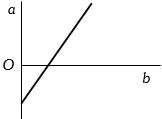
- A
$a =$ volume, $b = °C$ temperature
- B
$a =$ volume, $b = K$ temperature
- ✓
$a = °C$ temperature, $b =$ volume
- D
$a = K$ temperature, $b =$ volume
AnswerCorrect option: C. $a = °C$ temperature, $b =$ volume
c
Given :- Pressure of perfect gas is constant i.e, $\frac{V}{T}$ is Constant
To Find :- Value of $a$ and $b$ in graph
Solution :- Since we know that Volume cannot be negative any more
$\therefore$ Here, $(b)$ is Volume
($\because$ a also contains negative value)
Since we know that Kelvin Temperature cannot be negative
$\therefore$ a is temperature $\left({ }^{\circ} C \right)$
View full question & answer→MCQ 1391 Mark
A volume $V$ and pressure $P$ diagram was obtained from state $1$ to state $2$ when a given mass of a gas is subjected to temperature changes. During this process the gas is
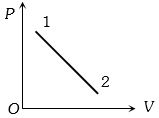
- A
- B
- ✓
Heated in the beginning and cooled towards the end
- D
Cooled in the beginning and heated towards the end
AnswerCorrect option: C. Heated in the beginning and cooled towards the end
c
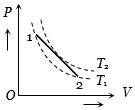
View full question & answer→MCQ 1401 Mark
The change in volume $V$ with respect to an increase in pressure $P$ has been shown in the figure for a non-ideal gas at four different temperatures ${T_1},\,{T_2},\,{T_3}$ and ${T_4}$. The critical temperature of the gas is
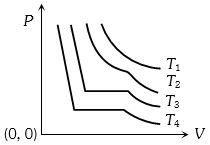
- A
${T_1}$
- ✓
${T_2}$
- C
${T_3}$
- D
${T_4}$
AnswerCorrect option: B. ${T_2}$
b
At critical temperature, the horizontal part of the $P-V$ curve ends, as is the case at temperature $T_2$.
View full question & answer→MCQ 1411 Mark
The lowest pressure (the best Vacuum) that can be created in the laboratory at $27$ degree is $10^{-11} \;{mm}$ of $Hg$. At this pressure, the number of ideal gas molecules per ${cm}^{3}$ will be
- A
$3.22 \times 10^{12}$
- B
$1.61 \times 10^{12}$
- C
$3.21 \times 10^6$
- ✓
$3.22 \times 10^5$
AnswerCorrect option: D. $3.22 \times 10^5$
d
$PV = nRT$
$\frac{ PV }{ nT }= R \quad$ (R here is a constant)
$ \frac{ P _{1} V _{1}}{ n _{1} T _{1}}=\frac{ P _{2} V _{2}}{ n _{2} T _{2}}$
$P _{1}=760 mm$ of $Hg$
$V _{1}=22400 cm ^{3}$
$T _{1}=273 K$
$P _{2}=10^{-11} mm$ of $Hg$
$T _{2}=300 K$
$n _{1}=6.02 \times 10^{23}$
$\frac{ n _{2}}{ V _{2}}=\frac{ P _{2} n _{1} T _{1}}{ P _{1} V _{1} T _{2}}$
$\frac{ n _{2}}{ V _{2}}=\frac{10^{-11} \times 6.02 \times 10^{23} \times 273}{760 \times 22400 \times 300}=3.32 \times 10^{5} \;molecules / cm ^{3}$
View full question & answer→MCQ 1421 Mark
A vessel of volume $8\, litre$ contains an ideal gas at $300\, K$ and $2\, atm$ pressure. The gas is allowed to leak till pressure become $125\, kpa$ calculate amount of moles which leak out if temperature remain constant ...... $moles$
- ✓
$0.24$
- B
$1.54$
- C
$0.87$
- D
$1.21$
AnswerCorrect option: A. $0.24$
a
Initial $\mathrm{PV}=\mathrm{nRT}$
$\mathrm{n}=\frac{2 \times 10^{5} \times 8 \times 10^{-3}}{8.31 \times 300}=0.64 \mathrm{\,mole}$
at same Temp. $P \propto \mu$
$\frac{P_{2}}{P_{1}}=\frac{\mu_{2}}{\mu_{1}} $
$\Rightarrow \frac{125 \times 10^{3}}{2 \times 10^{5}}=\frac{\mu_{2}}{0.64} $
$\Rightarrow \mu_{2}=0.4$ $mole$
leaked moles $=0.64-0.40=0.24$ $moles$
View full question & answer→MCQ 1431 Mark
The pressure and temperature of an ideal gas in a closed vessel are $720\, kPa$ and $40^oC$ respectively. If $\frac{1}{4}^{th}$ of the gas is released from the vessel and the temperature of the remaining gas is raised to $353^oC,$ the final pressure of the gas is ....... $kPa$
- A
$1440$
- ✓
$1080$
- C
$720$
- D
$540$
AnswerCorrect option: B. $1080$
b
(b) ${P_1} = 720kpa,$ ${T_1} = 40^\circ C = 273 + 40 = 313K$
$P \propto mT \Rightarrow \frac{{{P_2}}}{{{P_1}}} = \frac{{{m_2}}}{{{m_1}}}\frac{{{T_2}}}{{{T_1}}} = \frac{3}{4} \times \frac{{626}}{{313}}= 1.5$
==> ${P_2} = 1.5{P_1} = 1.5 \times 720 = 1080\,kPa$
View full question & answer→MCQ 1441 Mark
A cylinder of fixed capacity $44.8$ litre. contains a monatomic gas at standard temperature and pressure. The amount of heat required to cylinder by $10^o C$ will be. ($R=$ universal gas constant)
Answerd
(d) As we know $1$ mol of any ideal gas at $STP$ occupies a volume of $22.4$ litres.
Hence number of moles of gas $\mu = \frac{{44.8}}{{22.4}} = 2$
Since the volume of cylinder is fixed,
Hence ${(\Delta Q)_V} = \mu \omega \;\Delta T$
$ = 2 \times \frac{3}{2}R \times 10 = 30R$
View full question & answer→MCQ 1451 Mark
One mole of an ideal monatomic gas requires $210 \,J$ heat to raise the temperature by $10\, K$, when heated at constant temperature. If the same gas is heated at constant volume to raise the temperature by $10\, K$ then heat required is ....... $J$
Answerb
(b) ${(\Delta Q)_P} = \mu {C_P}\Delta T$ and ${(\Delta Q)_V} = \mu {C_V}\Delta T$
==> $\frac{{{{(\Delta Q)}_V}}}{{{{(\Delta Q)}_P}}} = \frac{{{C_V}}}{{{C_P}}} = \frac{{\frac{3}{2}R}}{{\frac{5}{2}R}} = \frac{3}{5}$ $\left[ {\because \,{{({C_V})}_{mono}} = \frac{3}{2}R,\,{{({C_P})}_{mono}} = \frac{5}{2}R} \right]$
==> ${(\Delta Q)_V} = \frac{3}{5} \times {(\Delta Q)_P} = \frac{3}{5} \times 210 = 126\,J$
View full question & answer→MCQ 1461 Mark
Graph between volume and temperature for a gas is shown in figure. If $\alpha$ = Volume coefficient of gas = $\frac{1}{273}$ per $^o C$,then what is the volume of gas at a temperature of $819 ^o C$
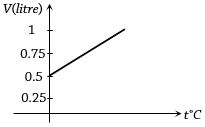
- A
$1 \times {10^{ - 3}}$ ${m^3}$
- ✓
$2 \times {10^{ - 3}}$ ${m^3}$
- C
$3 \times {10^{ - 3}}$ ${m^3}$
- D
$4 \times {10^{ - 3}}$ ${m^3}$
AnswerCorrect option: B. $2 \times {10^{ - 3}}$ ${m^3}$
b
(b) ${V_t} = {V_0}(1 + \alpha t) = 0.5\left( {1 + \frac{1}{{273}} \times 819} \right)$
$ = 2$ litre=$2 \times {10^{ - 3}}$${m^3}$
View full question & answer→MCQ 1471 Mark
Abarometer tube, containing mercury, is lowered in a vessel containing mercury until only $50\,\, cm$ of the tube is above the level of mercury in the vessel. If the atmospheric pressure is $75 \,\,cm$ of mercury, what is the pressure at the top of the tube?
- ✓
$33.3 \,\,kPa$
- B
$66.7 \,\,kPa$
- C
$3.33 \,\,MPa$
- D
$6.67\,\, MPa$
AnswerCorrect option: A. $33.3 \,\,kPa$
a
since the mercury rises only $50 \mathrm{cm}$ it implies the rest of the excess atmospheric pressure is being countered by the pressure at the top of the tube.
So pressure at top $=$ atmospheric pressure $-50 \mathrm{cm}$ of $\mathrm{Hg}=(75-50) \mathrm{cm}=25 \mathrm{cm}$ of $\mathrm{Hg}=$ $1 / 3 \times 100 k P a=33.33 k P a$
View full question & answer→MCQ 1481 Mark
The expansion of an ideal gas of mass $m$ at a constant pressure $P$ is given by the straight line $B$. Then the expansion of the same ideal gas of mass $2 \,\,m$ at a pressure $2P$ is given by the straight line
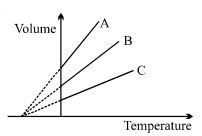
Answerc
since from ideal gas equation, $P V=n R T$
Hence, at constant pressure, $\frac{V}{T}=\frac{m}{M} \frac{R}{P}$
In the second case,
$\frac{V}{T}=\frac{2 m}{M} \frac{R}{2 P}=\frac{m}{M} \frac{R}{P}$
since the slope in two cases is same. Hence, new line will also be $B$. Curve does not pass through $0,0$ due to non idealities at low temperature and pressure.
Answer is option $C.$
View full question & answer→MCQ 1491 Mark
The ratio of average translational kinetic energy to rotational kinetic energy of a diatomic molecule at temperature $T$ is
Answerd
For diatomic molecule
Translational degree of freedoms $=3$
Rotational degree of freedoms $=2$
Ratio $=\frac{3 \mathrm{KT}}{2 \mathrm{KT}}=\frac{3}{2}$
View full question & answer→MCQ 1501 Mark
A diatomic gas of molecules weight $30\,\, gm/mole$ is filled in a container at $27\,^oC$. It is moving at a velocity $100\,\, m/s$. If it is suddenly stopped, the rise in temperature of gas is :
AnswerCorrect option: A. $\frac{{60}}{R}$
a
$K E=\Delta U$
$\frac{1}{2} m v^{2}=n C_{v} \Delta T$
$\frac{1}{2} \times \frac{30}{1000} \times 100^{2}=1 \times \frac{R}{\gamma-1} \times \Delta T$
Here $\gamma$ is 1.4 for a diatomic gas, so $150=\frac{R}{1.4-1} \times \Delta T$
$\Delta T=\frac{60}{R}$
View full question & answer→MCQ 1511 Mark
Five moles of helium are mixed with two moles of hydrogen to form a mixture. Take molar mass of helium $M_1=4\ g$ and that of hydrogen $M_2=2\ g$ If the internal energy of He sample of $100\,\,J$ and that of the hydrogen sample is $200\,\,J$, then the internal energy of the mixture is ..... $J$
- A
$900$
- B
$128.5$
- C
$171.4$
- ✓
$300 $
AnswerCorrect option: D. $300 $
d
Internal energy $\quad H e=100 J$
Internal energy $\quad H=200 J$
while mixing, they don't interact Internal energy of $\operatorname{mix}(100+200) J=300 J$
View full question & answer→MCQ 1521 Mark
One mole of an ideal monoatomic gas at temperature $T_0$ expands slowly according to the law $P/V$ = constant. If the final temperature is $2 \,\,T_0$, heat supplied to the gas is :
- ✓
$2\,R\,{T_0}$
- B
$\frac{3}{2}\,R\,{T_0}$
- C
$\,R\,{T_0}$
- D
$\frac{1}{2}\,R\,{T_0}$
AnswerCorrect option: A. $2\,R\,{T_0}$
a
In a process $P V^{x}=$ constant, molar heat capacity is given by $C=\frac{R}{\gamma+1}+\frac{R}{1-x}$
As the process is $\frac{P}{V}=$ constant
i.e., $P V^{-1}=$ constant, therefore, $x=-1$
For an ideal monatomic gas, $\gamma=\frac{5}{3}$
$\therefore C=\frac{R}{\frac{5}{3}-1}+\frac{R}{1-(-1)}=\frac{3}{2} R+\frac{R}{2}=2 R$
$\Delta Q=n C(\Delta T)=1(2 R)\left(2 T_{0}-T_{0}\right)=2 R T_{0}$
View full question & answer→MCQ 1531 Mark
According to kinetic theory of gases, which of following statement will be true.
- ✓
Ideal gases can not be liquified
- B
The molecules of ideal gas do not obey newtons laws of motion.
- C
Pressure of gas is always inversely proportional to its volume
- D
molecules of gas never move in straight line.
AnswerCorrect option: A. Ideal gases can not be liquified
View full question & answer→MCQ 1541 Mark
According to kinetic theory of gases,
AnswerCorrect option: D. The mean translational $K.E$. of a diatomic gas increases with increase in absolute temperature.
d
As we know.
$K E=\frac{3}{2} R T$ so
$K E \propto T$
means, mean transitional kinetic energy of the molecules is proportional to the absolute temperature.
View full question & answer→MCQ 1551 Mark
A gas is enclosed in a vessel at a constant temperature at a pressure of $5$ atmosphere and volume $4$ litre. Due to a leakage in the vessel, after some time, the pressure is reduced to $4$ atmosphere. As a result, the
- A
volume of the gas decreased by $20\%$
- B
average $K.E$. of gas molecule decreases by $20\%$
- ✓
$20\%$ of the gas escaped due to the leakage
- D
$25\% $ of the gas escaped due to the leakage
AnswerCorrect option: C. $20\%$ of the gas escaped due to the leakage
c
$n^{\prime}=\frac{P^{\prime}}{P} \times n=\frac{4}{5} \times n=0.8 n$
Thus amount of gas escaped is $n-0.8 n=0.2 n$ or $20 \%$
View full question & answer→MCQ 1561 Mark
In case of hydrogen and oxygen at $N.T.P.$, which of the following quantities is $/$ are the same?
- A
average momentum per molecule
- B
average kinetic energy per molecule
- C
kinetic energy per unit volume
- ✓
Answerd
The average kinetic energy is given as, $K=\frac{3 R T}{2 V_{A}}$
So, the kinetic energy is proportional to the temperature.
The per unit mass of molecule will change So, the volume and momentum will also be changed.
Thus, in case of hydrogen and oxygen at NTP the average kinetic energy per molecule will be same.
View full question & answer→MCQ 1571 Mark
Two non-reactive monoatomic ideal gases have their atomic masses in the ratio $2 : 3$. The ratio of their partial pressures, when enclosed in a vessel kept at a constant temperature, is $4 : 3$. The ratio of their densities is :-
- A
$1 : 4$
- B
$1 : 2$
- C
$6 : 9$
- ✓
$8 : 9$
AnswerCorrect option: D. $8 : 9$
d
$P=\frac{\rho}{M} \mathrm{RT}$
$\Rightarrow \frac{\mathrm{P}_{1}}{\mathrm{P}_{2}}=\frac{\rho_{1} \mathrm{M}_{2}}{\rho_{2} \mathrm{M}_{1}}=\frac{4}{3} \Rightarrow \frac{\rho_{1}}{\rho_{2}}=\frac{4}{3} \times \frac{2}{3}=\frac{8}{9}$
View full question & answer→MCQ 1581 Mark
Two moles of ideal helium gas are in a rubber balloon at $30^o C$. The balloon is fully expandable and can be assumed to required no energy in its expansion. The temperature of the gas in the balloon is slowly changed to $35^o C$. The amount of heat required in raising the temperature is nearly...... $J$
(take $R$ $=$ $8.31$ $J/mol.K$)
Answerd
$\Delta Q=\Delta U+\Delta W=\frac{f}{2} n R \Delta T+P \Delta V=\left(\frac{f}{2}+1\right) n R \Delta T$
$=\left(\frac{3}{2}+1\right)(2 \times 8.31)(5)=208 \mathrm{J}$
View full question & answer→MCQ 1591 Mark
One kg of a diatomic gas is at a pressure of $8 × 10^4\ N/m^2$. The density of the gas is $4\ kg/m^3$. What is the energy of the gas due to its thermal motion ?
- A
$6 × 10^4\ J$
- B
$7 × 10^4\ J$
- C
$3 × 10^4\ J$
- ✓
$5× 10^4\ J$
AnswerCorrect option: D. $5× 10^4\ J$
d
$U=\frac{5}{2} \mu R T$ for diatomic gases. ( $5$ is the degrees of freedom as the gas is diatomic)
But $P V=\mu R T$
$V=\frac{\text { mass }}{\text { density }}=\frac{1 \mathrm{kg}}{4 \mathrm{kg} / \mathrm{m}^{3}}=\frac{1}{4} \mathrm{m}^{3}$
$P=8 \times 10^{4} \mathrm{N} / \mathrm{m}^{2}$
$\therefore U=\frac{5}{2} \times 8 \times 10^{4} \times \frac{1}{4}=5 \times 10^{4} \mathrm{J}$
View full question & answer→MCQ 1601 Mark
Statement$-1 :$ Internal energy of gas $U = nC_VT$ is due to random motion of gas molecules.
Statement$-2 :$ A container is moving with speed $v$. It is suddenly stopped by a force, temperature of gas increases.
- A
Statement$-1$ is True, Statement$-2$ is True ; Statement$-2$ is a correct explanation for Statement$-1.$
- ✓
Statement$-1$ is True, Statement$-2$ is True ; Statement$-2$ is not a correct explanation for Statement$-1$.
- C
Statement$-1$ is True, Statement$-2$ is False.
- D
Statement$-1$ is False, Statement$-2$ is True.
AnswerCorrect option: B. Statement$-1$ is True, Statement$-2$ is True ; Statement$-2$ is not a correct explanation for Statement$-1$.
View full question & answer→MCQ 1611 Mark
A mixture of two moles of hydrogen and one mole of argon gas is taken in a closed container at room temperature. Consider the following two statements
$(i)$ The average kinetic energy of each molecule of $H_2$ and $Ar$ are the same.
$(ii)$ The partial pressure due to argon gas is more than that due to hydrogen gas
- A
Both statement $(i)$ and $(ii)$ are correct
- B
Statement $(i)$ is correct while statement $(ii)$ is incorrect
- ✓
Both statement $(i)$ and $(ii)$ are incorrect
- D
Statement $(i)$ is incorrect while statement $(ii)$ is correct
AnswerCorrect option: C. Both statement $(i)$ and $(ii)$ are incorrect
c
$\mathrm{K}_{\mathrm{av}}=\frac{5}{2} \mathrm{kT}\left\{\mathrm{H}_{2}\right\}$
$\mathrm{K}_{\mathrm{av}}=\frac{3}{2} \mathrm{kT}\{\mathrm{Ar}\}$
$\mathrm{p}_{1}=\frac{\mathrm{n}_{1}}{\mathrm{n}_{1}+\mathrm{n}_{2}} \times \mathrm{p}$
$\mathrm{n}_{1}>\mathrm{n}_{2} \Rightarrow \mathrm{p}_{1}>\mathrm{p}_{2}$
View full question & answer→MCQ 1621 Mark
An insulated container contains $4\, moles$ of an ideal diatomic gas at temperature $T$. Heat $Q$ is supplied to this gas, due to which $2\, moles$ of gas are dissociated into atoms but temperature of the gas remains constant. Then:
- A
$Q = 2 \,RT$
- ✓
$Q = RT$
- C
$Q= 3 \,RT$
- D
$Q = 4\, RT$
AnswerCorrect option: B. $Q = RT$
b
$\mathrm{Q}+\frac{5}{2} \times 4 \mathrm{RT}=4 \times \frac{3}{2} \mathrm{RT}+2 \times \frac{5}{2} \mathrm{RT}$
$\mathrm{Q}=\mathrm{RT}$
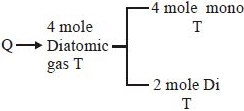
View full question & answer→MCQ 1631 Mark
An insulated box containing a diatomic gas of molar mass $M$ is moving with a velocity $v$. The box is suddenly stopped. The resulting change in temperature is
- A
$\frac{{M{V^2}}}{{2R}}$
- B
$\frac{{M{V^2}}}{{3R}}$
- ✓
$\frac{{M{V^2}}}{{5R}}$
- D
$\frac{{2M{V^2}}}{{5R}}$
AnswerCorrect option: C. $\frac{{M{V^2}}}{{5R}}$
c
work energy theorem
$\Delta \mathrm{KE}=\Delta \mathrm{U}$
$\Rightarrow \frac{1}{2} \mathrm{mV}^{2}=\mu \mathrm{C}_{\mathrm{v}} \mathrm{d} \mathrm{T}\left[\mathrm{C}_{\mathrm{v}}=\frac{5}{2} \mathrm{R}\right]$
$\Rightarrow \frac{1}{2} \mathrm{mV}^{2}=\frac{\mathrm{m}}{\mathrm{M}} \times \frac{5}{2} \mathrm{R} \times \Delta \mathrm{T}$
$\Rightarrow \Delta \mathrm{T}=\frac{\mathrm{MV}^{2}}{5 \mathrm{R}}$
View full question & answer→MCQ 1641 Mark
The ratio of total energy of all molecules of one mole $O_2$ to the total energy of all molecules of two moles of $He$ at the same temprature is
- A
$2 : 1$
- B
$1 : 2$
- C
$5 : 4$
- ✓
$5 : 6$
AnswerCorrect option: D. $5 : 6$
d
Total energy of $\mu$ mole of $\mathrm{gas}=\frac{\mathrm{F}}{2} \mu \mathrm{RT}$
$\frac{\mathrm{U}_{\mathrm{O}_{2}}}{\mathrm{U}_{\mathrm{He}}}=\frac{\left[\frac{(1)(5) \mathrm{RT}}{2}\right]}{\left[\frac{(2)(3) \mathrm{RT}}{2}\right]}=\frac{5}{6}$
View full question & answer→MCQ 1651 Mark
A mole of an ideal diatomic gas undergoes a transition from $A$ to $B$ along a path $AB$ as shown in the figure, The change in internal energy of the gas during the transition is ...... $kJ$
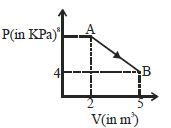
Answera
$\Delta \mathrm{U}=\frac{\mathrm{f}}{2} \mu \mathrm{R}(\Delta \mathrm{T})=\frac{\mathrm{f}}{2}\left(\mu \mathrm{R} \mathrm{T}_{2}-\mu \mathrm{R} \mathrm{T}_{1}\right)$
$\Delta \mathrm{U}=\frac{\mathrm{f}}{2}\left(\mathrm{P}_{2} \mathrm{V}_{2}-\mathrm{P}_{1} \mathrm{V}_{1}\right)=\frac{5}{2}(4 \times 5-8 \times 2) \times 10^{3}$
$\Delta \mathrm{U}=\frac{5}{2}(20-16) \times 10^{3}=10 \mathrm{kJ}$
View full question & answer→MCQ 1661 Mark
A gas at absolute temperature $300\,K$ has pressure $= 4 \times 10^{-10}\,N /m^2$ . Boltzmann constant, $k = 1.38 \times 10^{-23}\,J / K$ . The number of molecules per $cm^3$ is of the order of
- A
$100$
- ✓
$10^5$
- C
$10^8$
- D
$10^{11}$
AnswerCorrect option: B. $10^5$
b
$\mathrm{n}=\mathrm{p} / \mathrm{KT}=4 \times 10^{-10} / 1.38 \times 10^{-23} \times 300 \cong 10^{11} \mathrm{per} \mathrm{m}^{3}=10^{5} / \mathrm{cm}^{3}$
View full question & answer→MCQ 1671 Mark
A gas has volume $V$ and pressure $P$. The total translational kinetic energy of all the molecules of the gas is
- A
$\frac {3}{2}\,PV$ only if the gas is monoatomic
- B
$\frac {3}{2}\,PV$ only if the gas is diatomic
- C
$>\frac {3}{2}\,PV$ only if the gas is diatomic
- ✓
$\frac {3}{2}\,PV$ in all cases
AnswerCorrect option: D. $\frac {3}{2}\,PV$ in all cases
d
$3 / 2 P V$
explanation$:$ when a gas has volume $\mathrm{v}$ and pressure $\mathrm{P}$, total translational kinetic energy of all molecules of gas is $3 / 2 P V$.
actually, Translational kinetic energy depends upon translational degree of freedom. and we know, there are only three degree of freedom in translational motion for any gas (monoatomic, diatomic or triatomic etc.)
Hence under same pressure, equal volumes of gaseous molecules have same translational kinetic energy i.e. $(3 / 2) P V$
View full question & answer→MCQ 1681 Mark
The pressure of an ideal gas is written as $E = \frac{3PV}{2}$ . Here $E$ stands for
- ✓
total translational kinetic energy
- B
rotational kinetic energy
- C
average translational kinetic energy
- D
AnswerCorrect option: A. total translational kinetic energy
a
As translation $\mathrm{KE}$ is $=\frac{3}{2} \mathrm{nRT}$
$E=\frac{3}{2} \mathbf{P V}$
where $E=$ total translational $\mathrm{K} E$
View full question & answer→MCQ 1691 Mark
The expansion of an ideal gas of mass $m$ at a constant pressure $P$ is given by the straight line $B$. Then the expansion of the same ideal gas of mass $2\, m$ at a pressure $2\,P$ is given by the straight line
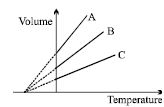
Answerc
$\mathrm{v}=\frac{\mathrm{mR}}{\mathrm{PM}}(\mathrm{t}+273)$
for Both gas slope will be same.
View full question & answer→MCQ 1701 Mark
The average degree of freedom per molecule of a gas is $6.$ The gas performs $25 \,J$ work, while expanding at constant pressure. The heat absorbed by the gas is ...... $J$
Answerb
For constant pressure process, Work done $(\mathrm{W})=\mathrm{nR} \Delta \mathrm{T}$
$\therefore \Delta \mathrm{T}=\left(\frac{25}{\mathrm{nR}}\right)$
Now, for above process $f=6$
So, $C_{P}\left(1+\frac{f}{2}\right) R=4 R$
Heat absorbed $=\mathrm{nC}_{\mathrm{P}} \Delta \mathrm{T}=\mathrm{n} \times 4 \mathrm{R} \times \frac{25}{\mathrm{nR}}=100 \mathrm{J}$
View full question & answer→MCQ 1711 Mark
A certain amount of an ideal monatomic gas needs $20 \,J$ of heat energy to raise its temperature by $10^{\circ} C$ at constant pressure. The heat needed for the same temperature rise at constant volume will be ........ $J$
Answerb
(b)
$\Delta Q=n C_P \Delta T$
$20=n C_P \times 10 \quad \ldots(1)$
$\Delta U=n C_V \Delta T$
$\Delta U=n \frac{C_P}{\gamma} \Delta T$ $\left\{\because \gamma_{\text {mono }}=5 / 3\right\}$
$\Delta U=12 \,J$
View full question & answer→MCQ 1721 Mark
A container is filled with $20$ moles of an ideal diatomic gas at absolute temperature $T$. When heat is supplied to gas temperature remains constant but $8$ moles dissociate into atoms. Heat energy given to gas is .........
- ✓
$4 R T$
- B
$6 R T$
- C
$3 R T$
- D
$5 R T$
AnswerCorrect option: A. $4 R T$
a
(a)
Heat supplied $=\Delta U=U_{\text {final }}-U_{\text {initial }}$
$U_{\text {initial }}=\frac{5}{2} \times 20 \times R T, U_{\text {final }}=\frac{5}{2} \times(20-8) R T+\frac{3}{2} \times(2 \times 8) R T$
$\Delta U=\frac{1}{2} \times 8 \times R T$
$=4 R T$
$\Rightarrow$ Heat energy given is $4 R T$.
View full question & answer→MCQ 1731 Mark
A triatomic, diatomic and monatomic gas is supplied same amount of heat at constant pressure, then
- A
Fractional energy used to change internal energy is maximum in monatomic gas
- B
Fractional energy used to change internal energy is maximum in diatomic gas
- ✓
Fractional energy used to change internal energy is maximum in triatomic gases
- D
Fractional energy used to change internal energy is same in all the three gases
AnswerCorrect option: C. Fractional energy used to change internal energy is maximum in triatomic gases
c
(c)
$\frac{\Delta U}{\Delta Q}=\frac{n C_V \Delta T}{n C_P \Delta T}=\frac{C_V}{C_P}=\frac{1}{\gamma}$
$\left(\frac{\Delta U}{\Delta Q}\right)_{\text {mono }}=\frac{1}{\gamma_{\text {mono }}}=\frac{3}{5}$
$\left(\frac{\Delta U}{\Delta Q}\right)_{\text {dia }}=\frac{1}{\gamma_{\text {dia }}}=\frac{5}{7}$
$\left(\frac{\Delta U}{\Delta Q}\right)_{\text {tria }}=\frac{1}{\gamma_{\text {tria }}}=\frac{3}{4}$
Fractional energy used to change internal energy is maximum in Triatomic gas.
View full question & answer→MCQ 1741 Mark
$105$ calories of heat is required to raise the temperature of $3$ moles of an ideal gas at constant pressure from $30^{\circ} C$ to $35^{\circ} C$. The amount of heat required in calories to raise the temperature of the gas through the range $\left(60^{\circ} C\right.$ to $\left.65^{\circ} C \right)$ at constant volume is ........ $cal$ $\left(\gamma=\frac{C_p}{C_v}=1.4\right)$
Answerb
(b)
At constant pressure heat absorbed $=\Delta Q=n C_P \Delta T \quad \dots (1)$
At constant volume heat absorbed $=\Delta U=n C_v \Delta T \quad \dots (2)$
Dividing $(1)$ by $(2)$,
$\frac{\Delta Q}{\Delta U}=\frac{C_P}{C_V}=\gamma=1.4 \Rightarrow \frac{105}{\Delta U}=1.4$
$\therefore \Delta U_V=75 \,cal$
View full question & answer→MCQ 1751 Mark
To an ideal triatomic gas $800 \,cal$ heat energy is given at constant pressure. If vibrational mode is neglected, then energy used by gas in work done against surroundings is ......... $cal$
Answera
(a)
Heat at constant pressure
$\Delta Q=n C_p \Delta T$
Heat for doing work
$\Delta W=n R \Delta T$
Then $\frac{\Delta W}{\Delta Q}=\frac{n R \Delta T}{n C_P \Delta T}$
$\frac{\Delta W}{800}=\left(\frac{\gamma-1}{\gamma}\right)$
$\frac{\Delta W}{800}=1-\frac{1}{\gamma}$
$\frac{\Delta W}{800}=1-\frac{3}{4}$
$\Delta W=200 \,cal$
View full question & answer→MCQ 1761 Mark
A closed cylindrical vessel contains $N$ moles of an ideal diatomic gas at a temperature $T$. On supplying heat, temperature remains same, but $n$ moles get dissociated into atoms. The heat supplied is .........
- A
$\frac{5}{2}(N-n) R T$
- B
$\frac{5}{2} n R T$
- ✓
$\frac{1}{2} n R T$
- D
$\frac{3}{2} n R T$
AnswerCorrect option: C. $\frac{1}{2} n R T$
c
(c)
Heat supplied $=\Delta U=U_{\text {final }}-U_{\text {initial }}$
Total internal energy initially $=\frac{5}{2} N R T$ [Only diatomic gas is present]
Total internal energy when
' $n$ ' moles get dissociated $=\frac{5}{2}(N-n) R T+\frac{3}{2}(2 n) R T$ [diatomic and monoatomic both are present]
$\Delta U=\left\{\frac{5}{2}(N-n) R T+\frac{3}{2}(2 n) R T\right\}-\frac{5}{2} N R T$
Solving this we get
$\Delta U=\frac{1}{2} n R T$
$\therefore$ Heat supplied is $\frac{1}{2} n R T$.
View full question & answer→MCQ 1771 Mark
A container has $N$ molecules at absolute temperature $T$. If the number of molecules is doubled but kinetic energy in the box remain the same as before, the absolute temperature of the gas is ...........
- A
$T$
- ✓
$\frac{T}{2}$
- C
$3 T$
- D
$4 T$
AnswerCorrect option: B. $\frac{T}{2}$
b
(b)
Initial energy of gas = Final energy
Let K.E. of each molecule initially be $E_0$
$\therefore$ Total kinetic energy $=E_0 \times n$
Let final kinetic energy of each molecule be $E_f$
$E_0 \times n=E_f \times 2 n$
$E_f=\frac{E_0}{2}$
Since temperature is the average kinetic energy of molecules.
$T_0=K E_0 \quad T_f=\frac{K E_0}{2}$
$\therefore$ Temperature becomes $T_f=\frac{T_0}{2}$
View full question & answer→MCQ 1781 Mark
A mixture of ideal gases has $2$ moles of He, $4$ moles of oxygen and $1$ mole of ozone at absolute temperature $T$. The internal energy of mixture is ............. $RT$
Answerc
(c)
Degrees of freedom of $He \left(f_{ He }\right)=3$
Degrees of freedom of $O _2\left(f_{ O _2}\right)=5$
Degrees of freedom of $O _3\left( f _{ O _3}\right)=6$
$n_{ He }=2, \quad n_{ O _2}=4 \quad n_{ O _3}=1$
Energy of mixture = Sum of individual energies
$=\left(n_{ He}f_{ He }+n_{ O _2} f_{ O _2}+n_{ O _3} f_{ O _3}\right) \frac{R T}{2}$
$=(2 \times 3+4 \times 5+1 \times 6) \frac{R T}{2}$
$=(3+10+3) R T$
$=16 R T$
View full question & answer→MCQ 1791 Mark
$14 \,g$ of $CO$ at $27^{\circ} C$ is mixed with $16 g$ of $O _2$ at $47^{\circ} C$. The temperature of mixture is .......... $^{\circ} C$ (vibration mode neglected)
Answerc
(c)
$1$ mole of $CO$ and $1$ mole of $O _2$ are mixed.
Net internal energy $=\frac{f_1}{2} R T_{ CO }+\frac{f_2}{2} R T_{ O _2}$
$=\frac{5}{2} R 300+\frac{5}{2} R 350$
$=\frac{5}{2} R(650)$
$=5 R(325)$
$=1625 R$
$1625=\frac{5}{2} R T_{\text {final }} \times n_{\text {final }}$
$\frac{1625 \times 2}{5}=T_{\text {final }} \times n_{\text {final }}$
$325 \times 2=T_{\text {final }} \times 2$
$T_{\text {final }}=325 K$
$T_{\text {final }}=37^{\circ} C$
View full question & answer→MCQ 1801 Mark
Variation of atmospheric pressure, with height from earth is ................
Answerc
(c)
Variation of atmospheric pressure due to height is given by the barometric formula
$P_h=P_0 e ^{-m g h / R T}$
Hence the decrease will be exponential.
View full question & answer→MCQ 1811 Mark
A diatomic gas of molecular mass $40 \,g / mol$ is filled in a rigid container at temperature $30^{\circ} C$. It is moving with velocity $200 \,m / s$. If it is suddenly stopped, the rise in the temperature of the gas is .........
- A
$\frac{32}{R}^{\circ} C$
- ✓
$\frac{320}{R}{ }^{\circ} C$
- C
$\frac{3200}{R}{ }^{\circ} C$
- D
$\frac{3.2}{R}{ }^{\circ} C$
AnswerCorrect option: B. $\frac{320}{R}{ }^{\circ} C$
b
(b)
Let there by $n$ moles of gas.
Mass of gas $=40 n g$ or $\frac{40 n}{1000}$ or $0.04 n kg$
$\text { K.E. of gas in container }=\frac{1}{2} \times 0.04 n \times(200)^2$
$=0.02 \times n \times 4 \times 10^4$
$=8 \times 10^2 \times n J$
Now heat capacity of gas $(C)=\frac{f}{2} n R$
or $C=\frac{5}{2} R \times n$
or $C \Delta T=8 \times 10^2 \times n$
or $\frac{5}{2} \times R \times n \Delta T=8 \times 10^2 \times n$
$\Delta T=\frac{8 \times 10^2}{R} \times \frac{2}{5}$
$\Delta T=\frac{16}{5} \times 10^2=\frac{320}{R}{ }^{\circ} C$
View full question & answer→MCQ 1821 Mark
In the kinetic theory of gases, which of these statements is/are true ?
$(i)$ The pressure of a gas is proportional to the mean speed of the molecules.
$(ii)$ The root mean square speed of the molecules is proportional to the pressure.
$(iii)$ The rate of diffusion is proportional to the mean speed of the molecules.
$(iv)$ The mean translational kinetic energy of a gas is proportional to its kelvin temperature.
AnswerCorrect option: D. $(iii)$ and $(iv)$ only
View full question & answer→MCQ 1831 Mark
Two gases occupy two containers $A$ and $B$ the gas in $A$, of volume $0.10\,m ^3$, exerts a pressure of $1.40\,MPa$ and that in $B$ of volume $0.15 m ^3$ exerts a pressure $0.7\,MPa$. The two containers are united by a tube of negligible volume and the gases are allowed to intermingle. Then if the temperature remains constant, the final pressure in the container will be (in MPa)
- A
$0.70$
- ✓
$0.98$
- C
$1.40$
- D
$210$
AnswerCorrect option: B. $0.98$
b
(b)
We know that
$P_A V_A=n_A R T, P_B V_B=n_B R T$
and $P_f\left(V_A+V_B\right)=\left(n_A+n_B\right) R T$
$P_f\left(V_A+V_B\right)=P_A V_A+P_B V_B$
$\therefore P _{ f } =\left(\frac{ P _{ A } V _{ A }+ P _{ B } V _{ B }}{ V _{ A }+ V _{ B }}\right)$
$=\frac{1.4 \times 0.1+0.7 \times 0.15}{0.1+0.15} MPa =0.98\,MPa$
View full question & answer→MCQ 1841 Mark
$3\,moles$ of an ideal gas at a temperature of $27^{\circ}\,C$ are mixed with $2\,moles$ of an ideal gas at a temperature $227^{\circ}\,C$, determine the equilibrium temperature (${}^o C$) of the mixture, assuming no loss of energy.
Answerb
(b)
Energy possessed by the ideal gas at $27^{\circ}\,C$ is
$E _1=3\left(\frac{3}{2} R \times 300\right)=\frac{2700 R }{2}$
Energy possessed by the ideal gas at $227^{\circ} C$ is
$E _2=2\left(\frac{3 R }{2} \times 500\right)=1500\,R$
If $T$ be the equilibrium temperature, of the mixture, then its energy will be $E _{ m }=5\left(\frac{3 RT }{2}\right)$
Since, energy remains conserved,
$E _{ m }= E _1+ E _2$
or $5\left(\frac{3 R T}{2}\right)=\frac{2700 R }{2}+1500 R$ or $T =380 K$ or $107^{\circ}\,C$
View full question & answer→MCQ 1851 Mark
To what temperature should the hydrogen at $327°C$ be cooled at constant pressure, so that the root mean square velocity of its molecules become half of its previous value ....... $^oC$
AnswerCorrect option: A. $-123$
a
${v_{rms}} \propto \sqrt {\frac{{3RT}}{M}} \, \Rightarrow \,\,T \propto {v^2}_{rms}$
$\Rightarrow$ $\frac{{{T_2}}}{{{T_1}}} = {\left( {\frac{{{v_2}}}{{{v_1}}}} \right)^2} = \frac{1}{4}$
$\Rightarrow$ ${T_2} = $$\frac{{{T_1}}}{4} = \frac{{(273 + 327)}}{4} = 150K = - {123^o}C$
View full question & answer→MCQ 1861 Mark
At a certain temperature, the $r.m.s.$ velocity for ${O_2}$ is $400\, m/sec.$ At the same temperature, the $r.m.s.$ velocity for ${H_2}$ molecules will be ....... $m/sec$
- A
$100$
- B
$25$
- ✓
$1600$
- D
$6400$
AnswerCorrect option: C. $1600$
c
${v_{rms}} = \sqrt {\frac{{3RT}}{M}} = {v_{rms}} \propto \frac{1}{{\sqrt M }}$ [ $\because T =$ constant]
$ \Rightarrow \,\,\frac{{{{({v_{rms}})}_{{O_2}}}}}{{{{({v_{rms}})}_{{H_2}}}}} = \sqrt {\frac{{{M_{{H_2}}}}}{{M{o_2}}}} \, \Rightarrow \,\frac{{400}}{{{{({v_{rms}})}_{{H_2}}}}} = \sqrt {\frac{2}{{32}}} = \frac{1}{4}$
$ \Rightarrow \,\,\,{({v_{rms}})_{{H_2}}} = 1600\,\,m/s$
View full question & answer→MCQ 1871 Mark
At what temperature will the oxygen molecules have the same root mean square speed as hydrogen molecules at $200 \,K$ ....... $K$
- A
$800 $
- B
$1600 $
- C
$2400 $
- ✓
$3200 $
AnswerCorrect option: D. $3200 $
d
${v_{rms}} = \sqrt {\frac{{3RT}}{M}} \Rightarrow \,\,T \propto M$ [Since ${v_{rms}},\,\,R \to $ constant ]
$ \Rightarrow \,\,\,\frac{{{T_{{O_2}}}}}{{{T_{{H_2}}}}} = \frac{{{M_{{O_2}}}}}{{{M_{{H_2}}}}} \Rightarrow \,\,\frac{{{T_{{O_2}}}}}{{200}} = \frac{{32}}{2}\, \Rightarrow \,\,{T_{{O_2}}} = 3200\,K$
View full question & answer→MCQ 1881 Mark
The root mean square velocity of the molecules in a sample of helium is $(5/7)^{th}$ that of the molecules in a sample of hydrogen. If the temperature of hydrogen sample is $0°C,$ then the temperature of the helium sample is about
- ✓
$0°C$
- B
$0 \,K$
- C
$273°C$
- D
$100°C$
Answera
${v_{rms}} = \sqrt {\frac{{3RT}}{M}} $ $\Rightarrow$ ${v_{rms}} \propto \sqrt {\frac{T}{M}} $
$\frac{{{v_{He}}}}{{{v_{{H_2}}}}} = \frac{5}{7} = \sqrt {\frac{{{T_{He}}}}{{{M_{He}}}} \times \frac{{{M_{{H_2}}}}}{{{T_{{H_2}}}}}} $
$\Rightarrow$ ${T_{He}} = \frac{{25}}{{49}} \times \frac{4}{2} \times 273$
$= 273K$ = $0^\circ C$
View full question & answer→MCQ 1891 Mark
A sample of gas is at $0°C.$ To what temperature it must be raised in order to double the $r.m.s.$ speed of the molecule ....... $^oC$
- A
$270$
- ✓
$819$
- C
$1090$
- D
$100$
Answerb
Given, $\quad T_{1}=273 K$.
$T_{2}=?$
That the Final $rms$ speed will be Double of inital.
$\frac{V_{rms_{2}}}{V_{rms_{1}}}=\sqrt{\frac{T_{2}}{T_{1}}}=\sqrt{\frac{T_{2}}{273}}$
$V_{rms_{2}} =2 V_{rms_{1}}$
$\Rightarrow \quad 2 =\sqrt{\frac{T_{2}}{273}}$
$\Rightarrow \quad T_{2} =4 \times 273=1092 \; K.$
$\quad T_{2} =819^{\circ} C$
The temperature raised $=819^{\circ} C$
View full question & answer→MCQ 1901 Mark
The temperature at which the root mean square velocity of a molecule will be doubled than at $100°C$
- ✓
$1219°C$
- B
$1492°C$
- C
$400°C$
- D
$400\, K$
AnswerCorrect option: A. $1219°C$
a
$R.M.S.$ velocity $\sqrt{\frac{3 R T}{M}}$
How, when other terms are constant, $(R \cdot M . S) \propto \sqrt{T}$.
$\frac{(R \cdot M \cdot S)_{1}}{(R \cdot M \cdot S)_{2}}=\frac{\sqrt{T_{1}}}{\sqrt{T_{2}}}$
Here, $(R \cdot M \cdot S)_{2}=2 \cdot(R \cdot M \cdot S)_{1}$
$T_{1} =100^{\circ} C =(100+273) K =373 \; K$
$\therefore \frac{(R \cdot M \cdot S)_{1}}{2 \cdot(R \cdot M \cdot S)} =\frac{\sqrt{373}}{\sqrt{T_{2}}}$
$\sqrt{T_{2}} =2 \cdot \sqrt{373}$
$T_{2} =1492 \; K$ [squaring both sides]
Convert into celcius.,
$T_{2}=(1492-273)^{\circ} C =1219^{\circ} C$
View full question & answer→MCQ 1911 Mark
Speed of sound in a gas is $v$ and $r.m.s.$ velocity of the gas molecules is $c.$ The ratio of $v$ to $c$ is
AnswerCorrect option: D. $\sqrt {\frac{\gamma }{3}} $
d
As we know, ${v_s} = \sqrt {\frac{{\gamma \,P}}{\rho }} $ and ${v_{rms}} = \sqrt {\frac{{3P}}{\rho }} ;$
$\therefore$ $\frac{{{v_{rms}}}}{{{v_s}}} = \sqrt {\frac{\gamma }{3}} $
View full question & answer→MCQ 1921 Mark
At which temperature the velocity of $O_2$ molecules will be equal to the velocity of $N_2$ molecules at $0\,^oC$ ....... $^oC$
Answerc
${v_{rms}} = \sqrt {\frac{{3RT}}{M}} $ $\Rightarrow$ $T \propto M$ [ $\because$ ${v_{rms}},\,\,R \to $ constant]
$\Rightarrow$ $\frac{{{T_{{O_2}}}}}{{{T_{{H_2}}}}} = \frac{{{M_{{O_2}}}}}{{{M_{{H_2}}}}}$
$\Rightarrow$ $\frac{{{T_{{O_2}}}}}{{(273 + 0)}} = \frac{{32}}{{28}}$
$\Rightarrow$ ${T_{{O_2}}} = 312\,K \to {39^o}C$
View full question & answer→MCQ 1931 Mark
The respective speeds of the molecules are $1, 2, 3, 4$ and $5\, km/sec.$ The ratio of their $r.m.s. $ velocity and the average velocity will be
- ✓
$\sqrt {11} :3$
- B
$3:\sqrt {11} $
- C
$1:2$
- D
$3:4$
AnswerCorrect option: A. $\sqrt {11} :3$
a
${v_{rms}} = \sqrt {\frac{{{1^2} + {2^2} + {3^2} + {4^2} + {5^2}}}{5}} = \sqrt {11} \,km/s$
${v_{av}} = \frac{{1 + 2 + 3 + 4 + 5}}{5} = 3km/s$
$\Rightarrow$ $\frac{{{v_{rms}}}}{{{v_{av}}}} = \frac{{\sqrt {11} }}{3}$
View full question & answer→MCQ 1941 Mark
Two vessels having equal volume contains molecular hydrogen at one atmosphere and helium at two atmospheres respectively. If both samples are at the same temperature, the mean velocity of hydrogen molecules is
AnswerCorrect option: D. $\sqrt 2 $ times that of helium
d
${v_{av}} \propto \frac{1}{{\sqrt M }}$
$\Rightarrow$ $\frac{{{v_{{H_2}}}}}{{{v_{He}}}} = \sqrt {\frac{{{M_{He}}}}{{{M_{{H_2}}}}}} = \sqrt {\frac{4}{2}} = \sqrt 2 $
${v_{{H_2}}} = \sqrt 2 \,{v_{He}}$
View full question & answer→MCQ 1951 Mark
The temperature of an ideal gas is increased from $27°C$ to $927°C.$ The root mean square speed of its molecules becomes
Answera
$v_{rms}$ $\propto$ $\sqrt {T}$,
$\frac{{{v_2}}}{{{v_1}}} = \sqrt {\frac{{{T_2}}}{{{T_1}}}} $
$\Rightarrow$ ${v_2} = \sqrt {\frac{{(273 + 927)}}{{(273 + 2)}}} $
$\Rightarrow$ ${v_2} = 2{v_1}$
View full question & answer→MCQ 1961 Mark
At a given temperature the root mean square velocities of oxygen and hydrogen molecules are in the ratio
- A
$16:1$
- B
$1:16$
- C
$4:1$
- ✓
$1:4$
Answerd
${v_{rms}} \propto \frac{1}{{\sqrt M }};$
$\therefore$ $\frac{{{{({v_{rms}})}_{{O_2}}}}}{{{{({v_{rms}})}_{{H_2}}}}} = \sqrt {\frac{{{M_{{H_2}}}}}{{{M_{{O_2}}}}}} = \sqrt {\frac{2}{{32}}} = 1:4$
View full question & answer→MCQ 1971 Mark
$r.m.s.$ velocity of nitrogen molecules at $NTP$ is ...... $m/s$
Answerb
${v_{rms}} = \sqrt {\frac{{3RT}}{M}} = \sqrt {\frac{{3 \times 8.3 \times {{10}^7} \times 300}}{{28}}} $$ = 517m/\sec $
View full question & answer→MCQ 1981 Mark
The temperature of the hydrogen at which the average speed of its molecules is equal to that of oxygen molecules at a temperature of $31\,^oC,$ is ........ $^oC$
- A
$-216$
- B
$-235$
- ✓
$-254$
- D
$-264$
AnswerCorrect option: C. $-254$
c
${v_{av}} = \sqrt {\frac{{8RT}}{{\pi M}}} $ [$\because$ ${v_{rms}},\,\,R \to $ constant]
$\Rightarrow$ $T \propto M$
$\Rightarrow$ $\frac{{{T_{{H_2}}}}}{{{T_{{O_2}}}}} = \frac{{{M_{{H_2}}}}}{{{M_{{O_2}}}}}$Þ$\frac{{{T_{{H_2}}}}}{{(273 + 31)}} = \frac{2}{{32}}$
$\Rightarrow$ ${T_{{H_2}}} = 19\,K = - \,254^\circ C$
View full question & answer→MCQ 1991 Mark
Root mean square velocity of a particle is $v$ at pressure $P.$ If pressure is increased two times, then the $r.m.s.$ velocity becomes
- A
$2\, v$
- B
$3 \,v$
- C
$0.5 \,v$
- ✓
$v$
Answerd
$r.m.s.$ Velocity does not depend on pressure.
View full question & answer→MCQ 2001 Mark
At temperature $T,$ the $r.m.s.$ speed of helium molecules is the same as $r.m.s.$ speed of hydrogen molecules at normal temperature and pressure. The value of $T$ is ....... $^oC$
Answera
${v_{rms}} = \sqrt {\frac{{3RT}}{M}} $
$\Rightarrow$ $T \propto M$
$\Rightarrow$ $\frac{{{T_{He}}}}{{{T_H}}} = \frac{{{M_H}}}{{{M_{He}}}}$
$\Rightarrow$ $\frac{{(273 + 0)}}{{{T_H}}} = \frac{2}{4}$
$\Rightarrow$ ${T_H} = 546K = 273^\circ C$
View full question & answer→MCQ 2011 Mark
In the two vessels of same volume, atomic hydrogen and helium at pressure $1\, atm$ and $2\, atm$ are filled. If temperature of both the samples is same, then average speed of hydrogen atoms $ < {C_H} > $ will be related to that of helium $ < {C_{He}} > $ as
- A
$ < {C_H} > = \sqrt 2 < {C_{He}} > $
- B
$ < {C_H} > = < {C_{He}} > $
- ✓
$ < {C_H} > = 2 < {C_{He}} > $
- D
$ < {C_H} > = \frac{{ < {C_{He}} > }}{2}$
AnswerCorrect option: C. $ < {C_H} > = 2 < {C_{He}} > $
c
average velocity of a gas molecule
${v_{av}} = \sqrt {\frac{{8RT}}{{\pi M}}} $
$\Rightarrow$ ${v_{av}} \propto \frac{1}{{\sqrt M }}$
$\Rightarrow$ $\frac{{ < {C_H} > }}{{ < {C_{He}} > }} = \sqrt {\frac{{{M_{He}}}}{{{M_H}}}} = \sqrt {\frac{4}{1}} = 2$
$\Rightarrow$ $ < {C_H} > = 2\, < {C_{He}} > $
View full question & answer→MCQ 2021 Mark
By what factor the $r.m.s.$ velocity will change, if the temperature is raised from $27^\circ C$ to $327^\circ C$
- ✓
$\sqrt 2 $
- B
$2$
- C
$2\sqrt 2 $
- D
$1$
AnswerCorrect option: A. $\sqrt 2 $
a
${v_{rms}} \propto \sqrt T $
$ \Rightarrow$ $\frac{{{v_1}}}{{{v_2}}} = \sqrt {\frac{{{T_1}}}{{{T_2}}}} $$ = \sqrt {\frac{{(273 + 27)}}{{(273 + 327)}}} = \sqrt {\frac{{300}}{{600}}} = \frac{1}{{\sqrt 2 }}$
$ \Rightarrow \,\,{v_2} = \sqrt 2 {v_1}$
View full question & answer→MCQ 2031 Mark
If the oxygen ($O_2$) has root mean square velocity of $C\,m{s^{ - 1}}$, then root mean square velocity of the hydrogen ($H_2$) will be
- A
$C\,m{s^{ - 1}}$
- B
$\frac{1}{C}\,m{s^{ - 1}}$
- ✓
$4\,C\,m{s^{ - 1}}$
- D
$\frac{C}{4}\,m{s^{ - 1}}$
AnswerCorrect option: C. $4\,C\,m{s^{ - 1}}$
c
${v_{rms}} \propto \frac{1}{{\sqrt M }}$
$\Rightarrow$ $\frac{{{v_{{O_2}}}}}{{{v_{{H_2}}}}} = \sqrt {\frac{{{M_{{H_2}}}}}{{{M_{{O_2}}}}}} $
$\Rightarrow$ $\frac{C}{{{v_{{H_2}}}}} = \sqrt {\frac{2}{{32}}} = \frac{1}{4}$
$\Rightarrow$ ${v_{{H_2}}} = 4\,C\,cm/sec$
View full question & answer→MCQ 2041 Mark
To what temperature should the hydrogen at room temperature $(27°C)$ be heated at constant pressure so that the $R.M.S.$ velocity of its molecules becomes double of its previous value ....... $^oC$
- A
$1200$
- ✓
$927$
- C
$600$
- D
$108$
Answerb
${v_{rms}} \propto \sqrt T $
$\Rightarrow$ $\frac{{{{({v_{rms}})}_2}}}{{{{({v_{rms}})}_1}}} = \sqrt {\frac{{{T_2}}}{{{T_1}}}} $
$\Rightarrow$ $2 = \sqrt {\frac{{{T_2}}}{{300}}} $
$\Rightarrow$ ${T_2} = 1200K = 927^\circ C$
View full question & answer→MCQ 2051 Mark
The root mean square speed of hydrogen molecules at $300$ $K$ is $1930\, m/s.$ Then the root mean square speed of oxygen molecules at $900\, K$ will be ....... $m/s$
Answerb
${v_{rms}} = \sqrt {\frac{{3RT}}{M}} $
$\Rightarrow \frac{{{{({v_{rms}})}_{{O_2}}}}}{{{{({v_{rms}})}_{{H_2}}}}} = \sqrt {\frac{{{T_O}_2}}{{{T_{{H_2}}}}}} $
$ \Rightarrow \frac{{{{({v_{rms}})}_{{O_2}}}}}{{{{({v_{rms}})}_{{H_2}}}}} = \sqrt {\frac{{900}}{{300}} \times \frac{2}{{32}}} = \frac{{\sqrt 3 }}{4}$
${({v_{rms}})_{{O_2}}} = 1930 \times \frac{{\sqrt 3 }}{4}$$=836\,m/sec$
View full question & answer→MCQ 2061 Mark
Let $A$ and $B$ the two gases and given : $\frac{{{T_A}}}{{{M_A}}} = 4.\frac{{{T_B}}}{{{M_B}}};$ where $T$ is the temperature and M is molecular mass. If ${C_A}$ and ${C_B}$ are the $r.m.s. $ speed, then the ratio $\frac{{{C_A}}}{{{C_B}}}$ will be equal to
Answera
$\frac{{{T_A}}}{{{M_A}}} = 4\frac{{{T_B}}}{{{M_B}}}$
$ \Rightarrow \sqrt {\frac{{{T_A}}}{{{M_A}}}} = 2\sqrt {\frac{{{T_B}}}{{{M_B}}}} $
$ \Rightarrow \sqrt {\frac{{3R{T_A}}}{{{M_A}}}} = 2\sqrt {\frac{{3RT}}{{{M_B}}}} $
$ \Rightarrow {C_A} = 2{C_B}$
$ \Rightarrow \frac{{{C_A}}}{{{C_B}}} = 2$
View full question & answer→MCQ 2071 Mark
If ${V_H},\,\,{V_N}$ and ${V_O}$ denote the root-mean square velocities of molecules of hydrogen, nitrogen and oxygen respectively at a given temperature, then
- A
${V_N} > {V_O} > {V_H}$
- ✓
${V_H} > {V_N} > {V_O}$
- C
${V_O} = {V_N} = {V_H}$
- D
${V_O} > {V_H} > {V_N}$
AnswerCorrect option: B. ${V_H} > {V_N} > {V_O}$
b
${v_{rms\,}} \propto \frac{1}{{\sqrt M }}$
$\Rightarrow$ ${V_H} < {V_N} < {V_O}$ ($\because$ ${M_H} < {M_N} < {M_O}$)
View full question & answer→MCQ 2081 Mark
The r.m.s. speed of a group of $7$ gas molecules having speeds $(6, 4, 2, 0, -2, -4, -6)\, m/s$ is ...... $m/s$
Answerd
${v_{rms}} = \sqrt {\frac{{{{(6)}^2} + {{(4)}^2} + {{(2)}^2} + {{(0)}^2} + {{( - 2)}^2} + {{( - 4)}^2} + {{( - 6)}^2}}}{7}} $
$ = 4\,m/s$
View full question & answer→MCQ 2091 Mark
If the ratio of vapour density for hydrogen and oxygen is $\frac{1}{{16}}$, then under constant pressure the ratio of their rms velocities will be
- ✓
$4$
- B
$0.25$
- C
$\frac{1}{{16}}$
- D
$16$
Answera
${v_{rms}} = \sqrt {\frac{{3p}}{\rho }} \, $
$\Rightarrow \,\frac{{{v_1}}}{{{v_2}}} = \sqrt {\frac{{{\rho _2}}}{{{\rho _1}}}} = \sqrt {\frac{{16}}{1}} = \frac{4}{1}$
View full question & answer→MCQ 2101 Mark
The r.m.s. speed of gas molecules is given by
- A
$2.5\sqrt {\frac{{RT}}{M}} $
- ✓
$1.73\sqrt {\frac{{RT}}{M}} $
- C
$2.5\sqrt {\frac{M}{{RT}}} $
- D
$1.73\sqrt {\frac{M}{{RT}}} $
AnswerCorrect option: B. $1.73\sqrt {\frac{{RT}}{M}} $
b
${v_{rms}} = \sqrt {\frac{{3RT}}{M}} = \sqrt 3 \sqrt {\frac{{RT}}{M}} = 1.73\sqrt {\frac{{RT}}{M}} $
View full question & answer→MCQ 2111 Mark
When temperature of an ideal gas is increased from $27^\circ C$ to $227^\circ C$, its $r.m.s.$ speed changed from $400\, metre/sec$ to ${V_s}.$ The ${V_s}$ is ........ $metre/sec$
Answera
$\frac{{{v_2}}}{{{v_1}}} = \sqrt {\frac{{{T_2}}}{{{T_1}}}} $
$\Rightarrow \frac{{{v_S}}}{{400}} = \sqrt {\frac{{(273 + 227)}}{{(273 + 27)}}} = \sqrt {\frac{5}{3}} $
$ \Rightarrow {v_s} = 400\sqrt {5/3} = 516\,m/s$
View full question & answer→MCQ 2121 Mark
The velocity of the molecules of a gas at temperature $120\,K$ is $v$. At ...... $K$ temperature will the velocity be $2v$
- A
$120$
- B
$240$
- ✓
$480$
- D
$1120$
Answerc
${v_{rms}} \propto \sqrt T $
$ \Rightarrow \frac{{{v_2}}}{{{v_1}}} = \sqrt {\frac{{{T_2}}}{{{T_1}}}} $
$\Rightarrow \frac{2}{1} = \sqrt {\frac{{{T_2}}}{{{T_1}}}} $
$\Rightarrow$ ${T_2} = 2 \times 120 = 480\,K$
View full question & answer→MCQ 2131 Mark
The $r.m.s.$ speed of the molecules of a gas at a pressure ${10^5}$ $Pa$ and temperature $0^\circ C$ is $0.5km\;{\sec ^{ - 1}}.$ If the pressure is kept constant but temperature is raised to $819°C,$ the velocity will become ........ $km\,sec^{-1}$
Answerd
$\frac{{{{({V_{rms}})}_1}}}{{{{({v_{rms}})}_2}}} = \sqrt {\frac{{{T_1}}}{{{T_2}}}} $
$\Rightarrow$ $\frac{{500}}{{{{({v_{rms}})}_2}}} = \sqrt {\frac{{0 + 273}}{{819 + 273}}} = \sqrt {\frac{{273}}{{1092}}} $
${({v_{rms}})_2} = 500\sqrt {\frac{{1092}}{{273}}} $
$ = 500\sqrt 4 = 1000\frac{m}{{\sec }} = 1\frac{{km}}{{\sec }}$
View full question & answer→MCQ 2141 Mark
At what temperature $r.m.s.$ speed of air molecules doubles of that at $N.T.P.$ is ...... $^oC$
Answera
${v_{rms}} \propto \sqrt T $
$\frac{{v_1^2}}{{v_2^2}} = \frac{{{T_1}}}{{{T_2}}}$
$\Rightarrow$ $\frac{{{v^2}}}{{4{v^2}}} = \frac{{273}}{{{T_2}}}$
$\Rightarrow$ ${T_2} = 1092\,K = 819^\circ C$
View full question & answer→MCQ 2151 Mark
The $r.m.s.$ speed of a certain gas is v at $400\,K.$ The temperature at which the $r.m.s.$ speed becomes two times, will be ...... $K$
AnswerCorrect option: B. $1600 $
b
${v_{rms}} \propto \sqrt T $
$\Rightarrow$ $\frac{{{T_2}}}{{{T_1}}} = \frac{{v_2^2}}{{v_1^2}} = \frac{{4{v^2}}}{{{v^2}}} = 4$
$\Rightarrow$ ${T_2} = 4{T_1} = 4 \times 400 = 1600\,K$
View full question & answer→MCQ 2161 Mark
A cubical box with porous walls containing an equal number of ${O_2}$ and $H_2$ molecules is placed in a large evacuated chamber. The entire system is maintained at constant temperature $T.$ The ratio of ${v_{rms}}$ of ${O_2}$ molecules to that of the ${v_{rms}}$ of $H_2$ molecules, found in the chamber outside the box after a short interval is
- A
$\frac{1}{{2\sqrt 2 }}$
- ✓
$\frac{1}{4}$
- C
$\frac{1}{{\sqrt 2 }}$
- D
$\sqrt 2 $
AnswerCorrect option: B. $\frac{1}{4}$
b
temperature is fixed
so, ${v_{rms}} \propto \frac{1}{{\sqrt M }}$
$\Rightarrow$ $\frac{{{v_{{O_2}}}}}{{{v_{{H_2}}}}} = \sqrt {\frac{{{M_{{H_2}}}}}{{{M_{{O_2}}}}}} = \sqrt {\frac{1}{{16}}} = \frac{1}{4}$
View full question & answer→MCQ 2171 Mark
The gas having average speed four times as that of $S{O_2}$ (molecular mass $64$) is
- ✓
$He\,$ (molecular mass $4$)
- B
${O_2}$ (molecular mass $32$)
- C
$H_2$ (molecular mass $2$)
- D
$C{H_4}$ (molecular mass $16$)
AnswerCorrect option: A. $He\,$ (molecular mass $4$)
a
${v_{av}} \propto \frac{1}{{\sqrt M }}$
$\Rightarrow$ $\frac{{{v_{Gas}}}}{{{v_{S{O_2}}}}} = \sqrt {\frac{{{M_{S{O_2}}}}}{{{M_{Gas}}}}} $
$\Rightarrow$ $\frac{4}{1} = \sqrt {\frac{{64}}{{{M_{Gas}}}}} $
$\Rightarrow$ ${M_{Gas}} = 4$ That is, the gas is $He$.
View full question & answer→MCQ 2181 Mark
The root mean square speed of the molecules of a diatomic gas is $v$. When the temperature is doubled, the molecules dissociate into two atoms. The new root mean square speed of the atom is
- A
$\sqrt 2 v$
- B
$v$
- ✓
$2v$
- D
$4v$
Answerc
$V _{ rms }=\sqrt{\frac{3 RT }{ M }}.$
According to problem $T$ will become $2 T$ and $M$ will become $M / 2$ so the value of $V _{ rms }$ will increase by $\sqrt{4}=2$ times
i.e, new root mean square velocity will be $2 \; v$
View full question & answer→MCQ 2191 Mark
A vessel is partitioned in two equal halves by a fixed diathermic separator. Two different ideal gases are filled in left $(L)$ and right $(R)$ halves. The rms speed of the molecules in $L$ part is equal to the mean speed of molecules in the $R$ part. Then the ratio of the mass of a molecule in $L$ part to that of a molecule in $R$ part is
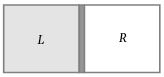
- A
$\sqrt {\frac{3}{2}} $
- B
$\sqrt {\pi /4} $
- C
$\sqrt {2/3} $
- ✓
$3\pi /8$
AnswerCorrect option: D. $3\pi /8$
d
The left side of the container has a gas, let having molecular wt. $M_{1}$ Right part has Mol. wt $=M_{2}$
Temperature of both left and right chambers are equal as the separating wall is diathermic
$\sqrt{\frac{3 R T}{M_{1}}}=\sqrt{\frac{8 R T}{\pi M_{2}}} \Rightarrow \frac{3 R T}{M_{1}}=\frac{8 R T}{\pi M_{2}} \Rightarrow \frac{M_{1}}{\pi M_{2}}$
$= \frac{3}{8} \Rightarrow \frac{M_{1}}{ M _{2}}=\frac{3 \pi}{8}=1.1775 \approx 1.18$
View full question & answer→MCQ 2201 Mark
The temperature at which the $r.m.s.$ speed of hydrogen molecules is equal to escape velocity on earth surface, will be ...... $K$
- A
$1060$
- B
$5030$
- C
$8270$
- ✓
$10063$
AnswerCorrect option: D. $10063$
d
Escape velocity from the earth's surface $11.2\, km/sec$ है
${v_{rms}} = v_{(escape)}$ $= \sqrt {\frac{{3RT}}{M}} $
$\Rightarrow$ $T = \frac{{{{({v_{escape}})}^2} \times M}}{{3R}}$
$ = \frac{{{{(11.2 \times {{10}^3})}^2} \times (2 \times {{10}^{ - 3}})}}{{3 \times 8.31}} = 10063\; K$
View full question & answer→MCQ 2211 Mark
In a vessel, the gas is at pressure $P_0$. If the mass of all the molecules is halved and their speed is doubled, then the resultant pressure will be
- A
$4{P_0}$
- ✓
$2{P_0}$
- C
${P_0}$
- D
$\frac{{{P_0}}}{2}$
AnswerCorrect option: B. $2{P_0}$
b
$P = \frac{1}{3}\frac{{mN}}{V}v_{rms}^2$ $P \propto m\,v_{rms}^2$so $\frac{{{P_2}}}{{{P_1}}} = \frac{{{m_2}}}{{{m_1}}} \times {\left( {\frac{{{v_2}}}{{{v_1}}}} \right)^2} = \frac{{{m_1}/\,2}}{{{m_1}}}{\left( {\frac{{2\,{v_1}}}{{{v_1}}}} \right)^2} = 2$ ==> ${P_2} = 2{P_1} = 2{P_0}$
View full question & answer→MCQ 2221 Mark
When the temperature of a gas is raised from $27^o C$ to $90^o C$, the percentage increase in the $r.m.s.$ velocity of the molecules will be ..... $\%$
Answera
(a) ${v_{rms}} = \sqrt {\frac{{3RT}}{M}} $==>$\frac{{{v_2}}}{{{v_1}}} = \sqrt {\frac{{{T_2}}}{{{T_1}}}} = \sqrt {\frac{{(273 + 90)}}{{(273 + 30)}}} = 1.1$
$\%$ increase $ = \left( {\frac{{{v_2}}}{{{v_1}}} - 1} \right) \times 100 = 0.1 \times 100 = 10\% $
View full question & answer→MCQ 2231 Mark
The r.m.s. velocity of a gas at a certain temperature is $\sqrt 2 $ times than that of the oxygen molecules at that temperature. The gas can be
- A
${H_2}$
- B
$He$
- ✓
$C{H_4}$
- D
$S{O_2}$
AnswerCorrect option: C. $C{H_4}$
c
(c) ${v_{rms}} \propto \frac{1}{{\sqrt M }}$==> $\frac{{{v_1}}}{{{v_2}}} = \sqrt {\frac{{{M_2}}}{{{M_1}}}} $
$\therefore \,\frac{1}{{\sqrt 2 }} = \sqrt {\frac{{{M_2}}}{{32}}} \Rightarrow {M_2} = 16.$ Hence the gas is $C{H_4}.$
View full question & answer→MCQ 2241 Mark
If the $r.m.s.$ velocity of a gas at a given temperature (Kelvin scale) is $300\, m/sec$. What will be the $r.m.s.$ velocity of a gas having twice the molecular weight and half the temperature on Kelvin scale ....... $m/sec$
Answerd
(d) ${v_{rms}} = \sqrt {\frac{{3RT}}{M}} \, \Rightarrow \,\,{v_{rms}}\, \propto \sqrt {\frac{T}{M}} $
$\frac{{{v_2}}}{{{v_1}}} = \sqrt {\frac{{{M_1}}}{{{M_2}}} \times \frac{{{T_2}}}{{{T_1}}}} $$ = \sqrt {\frac{1}{2} \times \frac{1}{2}} $==> ${v_2} = \frac{{{v_1}}}{2} = \frac{{300}}{2}$ $=150m/sec$
View full question & answer→MCQ 2251 Mark
An ideal gas $(\gamma = 1.5)$ is expanded adiabatically. How many times has the gas to be expanded to reduce the root mean square velocity of molecules $2.0$ times
Answerb
(b) ${v_{rms}} = \sqrt {\frac{{3RT}}{M}} $ ==> $\,{v_{rms}} \propto \sqrt T $
${v_{rms}}$ is to reduce two times i.e. temperature of the gas will have to reduce four times or $\frac{{T'}}{T} = \frac{1}{4}$
During adiabatic process $T{V^{\gamma - 1}} = T'\,V'{\,^{\gamma - 1}}$
==> $\frac{{V'}}{V} = {\left( {\frac{T}{{T'}}} \right)^{\frac{1}{{\gamma - 1}}}}$$ = {(4)^{\frac{1}{{1.5 - 1}}}} = {(4)^2} = 16$ ==> $V' = 16\,V$
View full question & answer→MCQ 2261 Mark
The temperature of a gas is doubled $(i)$ on absolute scale $(ii)$ on centigrade scale. The increase in root mean square velocity of gas will be
- ✓
More in case $(i)$
- B
More in case $(ii)$
- C
- D
Information not sufficient
AnswerCorrect option: A. More in case $(i)$
a
$\mathrm{T}=$ Temperature in centigrade scale
$\mathrm{K}=$ temperature in absolute scale
$\mathrm{T}=\mathrm{k}-273 \rightarrow 2 \mathrm{T}=2 \mathrm{K}-273 \times 2$
so final temperature in caswe $I=2 K$
So final temper IN case $=2 \mathrm{K}-273$
Hence more in case $I$
View full question & answer→MCQ 2271 Mark
Five particles have speeds $1, 2, 3, 4, 5 \,\,m/s$. the average velocity of the particles is (in $m/s$)
Answerd
Speed is given in the question whereas we require velocities of each particles to calculate the average velocities.
View full question & answer→MCQ 2281 Mark
What is/are the same for $O_2$ and $NH_3$ in gaseous state
- A
- ✓
- C
maximum no. of vibrational degree of freedom
- D
View full question & answer→MCQ 2291 Mark
A piston is slowly pushed into a metal cylinder containing an ideal gas. Which of the following statements is/are incorrect?
- A
The pressure of the gas increases
- B
The number of the molecules per unit volume increases
- ✓
The average speed of gas molecules increases
- D
The frequency of collision of the gas molecules with the piston increases.
AnswerCorrect option: C. The average speed of gas molecules increases
c
When we slowly push the piston both temperature and pressure inside the cylinder will increased. Hence we can define it by Root mean square velocity which is given as rms relocity $=\sqrt{\frac{3 R T}{m}}$ So not option $A$ is also correct but we have to focus on exact answer.
View full question & answer→MCQ 2301 Mark
Which of the following statements is/are not an assumption of the kinetic theory for an ideal gas?
- A
The duration of a collision is negligible as compared to the time between successive collisions
- B
The molecules have negligible attraction for each other
- ✓
The molecules have negligible momentum change on collision with the container walls
- D
There is no total kinetic energy change of the molecules on colliding with each other or with the walls of the container.
AnswerCorrect option: C. The molecules have negligible momentum change on collision with the container walls
c
All other options except $C$ are correct with respect to kinetic theory of gases. $C$ is incorrect because there is finite momentum change when molecule collides with the container walls.
View full question & answer→MCQ 2311 Mark
Select the incorrect statement about ideal gas.
AnswerCorrect option: B. The gas is not isotropic and the constant $(1/3)$ in equation $P = (1/3)\rho v^2_{rms}$ is result of this property
b
$B)$ incorrect Isotropic property says that the various properties of a material are independent of direction hence the constant $\left(\frac{1}{3}\right)$ is the result of the assumption that the velocity of molecule is same in all three axis $x, y, z$
View full question & answer→MCQ 2321 Mark
Select the incorrect statement$(s)$
- A
$RMS$ speed of $8\,\, gm$ oxygen gas in container at $27\,\,^o C$ is approximately $484 \,\,m/s$
- ✓
$RMS$ speed of $8\,\,gm$ oxygen in container at $27\,^o C$ is approximately $968 \,\,m/s$
- C
For number of molecules greater than one, $RMS$ speed is greater than average speed
- D
A gas behaves more closely as an ideal gas at low pressures and high temperatures
AnswerCorrect option: B. $RMS$ speed of $8\,\,gm$ oxygen in container at $27\,^o C$ is approximately $968 \,\,m/s$
View full question & answer→MCQ 2331 Mark
Hydrogen gas and oxygen gas have volume $1 \,\,cm^3$ each at $N.T.P$.
- A
Number of molecules is same in both the gases.
- B
The average velocity of molecules of each gas is the same.
- C
The internal energy of each gases is the same
- ✓
Answerd
Number of molecules is same in both the gases The number of molecules is directly proportional to volume.
The internal energy of each gas is the same as it depends on temperature.
The average velocity of molecules of each gas is different as it is inversely proportional to the square root of molar mass.
View full question & answer→MCQ 2341 Mark
Five molecules of a gas are having speeds $1,2,4,8$ and $16\,m/s$ at some instant. The root mean square velocity of the gas molecules is ..... $m/s$
Answerb
Given, Five molecules of a gas have speeds $1,2,4,8$ and $16 m / s$ at some instant.
To find, RMs velocity.
we know,
$V_{R M S}=\sqrt{\frac{V_A^2+V_B^2+V_e^2+V_D^2+V_E^2}{5}}$
$\Rightarrow V_{R M S} =\sqrt{\frac{1^2+2^2+4^2+8^2+16^2}{5}}$
$\Rightarrow V_{R M S} =\sqrt{\frac{1+4+16+64+256}{5}}$
$\Rightarrow V_{R M S} =8.2\,m / s$
View full question & answer→MCQ 2351 Mark
Four molecules of a gas have speeds $1, 2, 3$ and $4\, km/sec$. The value of root mean square speed of the gas molecules is
- A
$\frac{{\sqrt {15} }}{2}$
- B
$\sqrt {15}$
- ✓
$\sqrt {\frac{{15}}{2}} $
- D
$\sqrt {\frac{{30}}{2}} $
AnswerCorrect option: C. $\sqrt {\frac{{15}}{2}} $
c
$V_{rms }=\sqrt{\frac{v_{1}^{2}+v_{2}^{2}+v_{3}^{2}+v_{4}^{4}}{4}}$
$V_{rms }=\sqrt{\frac{1+4+9+16}{4}}=\sqrt{\frac{30}{4}}=\sqrt{\frac{15}{2}}$
View full question & answer→MCQ 2361 Mark
The temperature at which root mean square speed of a gas will be half of its value at $0\,^oC$ is ....... $^oC$
- A
$-\,86.4$
- ✓
$-\,204.75$
- C
$-\,104.75$
- D
$-\,68.25$
AnswerCorrect option: B. $-\,204.75$
b
$\mathrm{v}_{\mathrm{rms}} \propto \sqrt{\mathrm{T}}$
rms speed will becomes half, its temperature will becomes one$-$fourth.
$\left(\frac{273}{4}-273\right)^{\circ} \mathrm{C}=-204.75^{\circ} \mathrm{C}$
View full question & answer→MCQ 2371 Mark
At ..... $K$ temperature average speed of $O_2$ will be ${\left( {\frac{7}{4}} \right)^{th}}$ of rms speed of $N_2$ at $47\,^oC$
- ✓
$1320$
- B
$1500$
- C
$273$
- D
$1000$
AnswerCorrect option: A. $1320$
a
${\left( {{{\rm{V}}_{{{\rm{O}}_2}}}} \right)_{{\rm{av}}}} = \frac{7}{4}{\left( {{{\rm{V}}_{{{\rm{r}}_\pi }}}} \right)_{{{\rm{N}}_2}}}\quad \sqrt {\frac{{8{\rm{R}}{{\rm{T}}_1}}}{{\pi {{\rm{M}}_{\rm{w}}}}}} = \frac{7}{4}\sqrt {\frac{{3{\rm{R}}{{\rm{T}}_2}}}{{{{\rm{M}}_{{w_2}}}}}} $
$\frac{8 \mathrm{RT}_{1}}{32}=\frac{49 \times 3 \mathrm{R} \times 320}{16 \times 28} \quad \mathrm{T}_{1}=1320 \mathrm{K}$
View full question & answer→MCQ 2381 Mark
Let $\bar v , \bar v_{rms}$ and $v_p$ respectively denote the mean speed, root mean square speed and most probable speed of the molecules in an ideal monoatomic gas at absolute temperature $T$. The mass of the molecule is $m$. Then
- A
no molecule can have a speed greater than $(\sqrt 2 v_{rms})$
- B
no molecule can have a speed less than $\frac{{{v_p}}}{{\left( {\sqrt 2 } \right)}}$
- C
$\bar v < v_p < v_{rms}$
- ✓
the average kinetic energy of the molecules is $\frac{3}{4}\left( {mv_p^2} \right)$
AnswerCorrect option: D. the average kinetic energy of the molecules is $\frac{3}{4}\left( {mv_p^2} \right)$
d
$v_{r m s}=\sqrt{\frac{3 R T}{m}}$
$\bar{v}=\sqrt{\frac{8 R T}{\pi m}}=\sqrt{\frac{2.5 R T}{m}}$
and $v_{p}=\sqrt{\frac{2 R T}{m}}$
From these expressions, we can see that
$v_{p}<\bar{v}$
Again, $v_{r m s}=v_{p} \frac{\sqrt{3}}{2}$
and average kinetic energy of a gas molecule
$E_{k}=\frac{1}{2} m v_{rm s}^{2}$
$E_{k}=\frac{1}{2} m\left(\sqrt{\frac{3}{2}} v_{y}\right)^{2}=\frac{1}{2} m \times \frac{3}{2} v_{p}^{2}=\frac{3}{4} m v_{p}^{2}$
View full question & answer→MCQ 2391 Mark
If the root mean square velocity of the molecules of hydrogen at $NTP$ is $1.84\, km/s$. Calculate the root mean square velocity of oxygen molecule at $NTP$, molecular weight of hydrogen and oxygen are $2$ and $32$ respectively ....... $km/sec$
- A
$1.47$
- B
$0.94$
- C
$1.84$
- ✓
$0.47$
AnswerCorrect option: D. $0.47$
d
$\left(\mathrm{c}_{\mathrm{ms}}\right)_{\mathrm{H}_{2}}=1.84 \mathrm{km} / \mathrm{s},\left(\mathrm{c}_{\mathrm{ms}}\right)_{\mathrm{O}_{2}}=?$
$\mathrm{M}_{\mathrm{H}_{2}}=2, \mathrm{M}_{\mathrm{O}_{2}}=32$
$\Rightarrow \quad$ Rms velocity
$c_{\mathrm{rms}}=\sqrt{\frac{3 \mathrm{RT}}{\mathrm{M}}}$
$\therefore \quad \frac{c_{\mathrm{H}_{2}}}{c_{\mathrm{O}_{2}}}=\sqrt{\frac{\mathrm{M}_{\mathrm{O}_{2}}}{\mathrm{M}_{\mathrm{H}_{2}}}}$
$\Rightarrow \quad \frac{1.84}{C_{O_{2}}}=\sqrt{\frac{32}{2}}=4$
$\Rightarrow \quad C_{O_{2}}=\frac{1.84}{4}=0.46 \mathrm{km} / \mathrm{s}$
View full question & answer→MCQ 2401 Mark
The effect of temperature on Maxwell's speed distribution is correctly shown by
Answera
(a)
The Maxwell's distribution curve heats at the most probable speed, which depends on temperature.
$V_{\text {probable }} \propto \sqrt{T}$
Hence $T_1 > T_2$ is correctly shown in option $(1)$ as it shows with peaks of the curve at higher temperature, furthers along the $x$-axis.
View full question & answer→MCQ 2411 Mark
When pressure remaining constant, at what temperature will the $r.m.s.$ speed of a gas molecules increase by $10 \%$ of the r.m.s. speed at $STP$?
- A
$57.3 K$
- ✓
$57.3^{\circ} C$
- C
$557.3 K$
- D
$-57.3^{\circ} C$
AnswerCorrect option: B. $57.3^{\circ} C$
b
(b)
$V=\sqrt{\frac{3 R T}{M}} \text { or } V=K \sqrt{T}$
$\text { Let } \frac{V \times 110}{100}=K \sqrt{T_2}$
$\frac{V}{1.1} V=\sqrt{\frac{T}{T_2}}$
$T_2=1.21 T$
$\text { Putting } T=273 \,K$
$T_2=57.33^{\circ} C$
View full question & answer→MCQ 2421 Mark
Five gas molecules chosen at random are found to have speeds of $500,600,700,800$ and $900 m / s$. Then which of the following statements is correct?
- A
The root mean square speed and the average speed are the same.
- ✓
The root mean square speed is $14 m / s$ higher than the average speed.
- C
The root mean square speed is $14 m / s$ lower than the average speed.
- D
The root mean square speed is $\sqrt{14} m / s$ higher than the average speed.The molecules of a given mass of a gas have
AnswerCorrect option: B. The root mean square speed is $14 m / s$ higher than the average speed.
b
(b)
$v_{a v}=\left[\frac{500+600+700+800+900}{5}\right]=700\,m / s$
and
$v_{r m s}=\sqrt{\frac{500^2+600^2+700^2+800^2+900^2}{5}}=714\,m / s$
Thus $v_{r m s}$ is greater than average speed by $14\,m / s$
View full question & answer→MCQ 2431 Mark
The temperature of argon, kept in a vessel, is raised by $1^\circ C$ at a constant volume. The total heat supplied to the gas is a combination of translational and rotational energies. Their respective shares are
- A
$60\%$ and $40\%$
- B
$40\%$ and $60\%$
- C
$50\%$ and $50\%$
- ✓
$100\%$ and $0\%$
AnswerCorrect option: D. $100\%$ and $0\%$
d
Argon is a monoatomic gas, so it has only transferable energy.
View full question & answer→MCQ 2441 Mark
What is the value of $\frac{R}{{{C_P}}}$ for diatomic gas
Answerc
$\frac{R}{{{C_P}}} = \frac{R}{{7/2\,R}}$$ = \frac{2}{7}$ $\left( {\because {C_P} = \frac{7}{2}R} \right)$
View full question & answer→MCQ 2451 Mark
$PV$ versus $T$ graph of equal masses of ${H_2}$, $He$ and ${O_2}$ is shown in fig. Choose the correct alternative
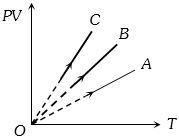
- ✓
$C$ corresponds to ${H_2}$, $B$ to $He$ and $A$ to ${O_2}$
- B
$B$ corresponds to $He,$ $A$ to ${H_2}$ and $C$ to ${O_2}$
- C
$A$ corresponds to $He, B$ to ${H_2}$ and $C$ to ${O_2}$
- D
$A$ corresponds to ${O_2}$,$ B$ to ${H_2}$ and $C$ to ${H_2}$
AnswerCorrect option: A. $C$ corresponds to ${H_2}$, $B$ to $He$ and $A$ to ${O_2}$
a
$PV = \mu RT = \frac{m}{M}RT$
$\Rightarrow$ $\frac{{PV}}{T} \propto \frac{1}{M}$ ($\because$ $M =$ Atomic weight)
from graph, ${\left( {\frac{{PV}}{T}} \right)_A} < {\left( {\frac{{PV}}{T}} \right)_B} < {\left( {\frac{{PV}}{T}} \right)_C}$
$\Rightarrow$ ${M_A} > {M_B} > {M_C}$
View full question & answer→MCQ 2461 Mark
The ratio of specific heats of a gas is $\frac{9}{7}$, then the number of degrees of freedom of the gas molecules for translational motion is :
Answerb
The ratio of a specific heats of a gas is $9 / 7$, then the number of degrees of freedom of the gas molecules for translation motion is $3.$ We will use the standard formula $\frac{(f+2)}{f}=\gamma .$ On cross multi plication and solving we get $f=7,$ but total translational will be $3$ only.
View full question & answer→MCQ 2471 Mark
When $x$ amount of heat is given to a gas at constant pressure, it performs $x/3$ amount of work. The average number of degrees of freedom per molecule is
Answerb
$\frac{W}{Q}=\frac{R \Delta T}{C_{P} \Delta T}=\frac{x / 3}{x}$
$\frac{f+2}{2}=3 \Rightarrow f=4$
View full question & answer→MCQ 2481 Mark
Relation between $U, P$ and $V$ for ideal gas is $U= 2+2PV$ then gas is
- A
- B
- C
- ✓
mixture of monoatomic and diatomic
AnswerCorrect option: D. mixture of monoatomic and diatomic
d
$\mathrm{U}=\mathrm{U}_{0}+2 \mathrm{PV}=\mathrm{U}_{0}+2 \mathrm{nRT}$
$\mathrm{So}, \mathrm{dU}=2 \mathrm{nRdT}=\mathrm{nC}_{\mathrm{v}} \mathrm{dT}$
$\Rightarrow \mathrm{Cv}=2 \mathrm{R}\{\text { mixture of } \quad$ monoatomic
$\mathrm{Cv}=3 \mathrm{R} / 2 \& \text { diatomic } \mathrm{Cv}=5 \mathrm{R} / 2\}$
View full question & answer→MCQ 2491 Mark
Maxwell distribution function is shown in figure for different gases, which of the following is correct matching?
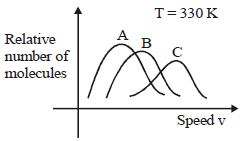
- A
$A \to Ne,\,B \to O_2, C\to He$
- B
$A \to Ne,\,B \to He, C\to O_2$
- C
$A \to O_2,\,B \to He, C\to Ne$
- ✓
$A \to O_2,\,B \to Ne, C\to He$
AnswerCorrect option: D. $A \to O_2,\,B \to Ne, C\to He$
d
$\mathrm{v}=\sqrt{\frac{2 \mathrm{RT}}{\mathrm{M}}} \quad \therefore$ more $\mathrm{v} \Rightarrow$ less $\mathrm{M}$
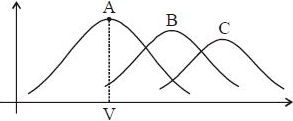
View full question & answer→MCQ 2501 Mark
If hydrogen gas is heated to a very high temperature, then the fraction of energy possessed by gas molecules correspond to rotational motion ...........
- A
$\frac{3}{5}$
- ✓
$\frac{2}{7}$
- C
$\frac{3}{7}$
- D
$\frac{2}{5}$
AnswerCorrect option: B. $\frac{2}{7}$
b
(b)
Hydrogen is a diatomic molecules and if vibrational degrees of freedom are increased the degrees of freedom will be $3$ translation $2$ rotational and two vibrational.
$\therefore$ So total $7$ degree of freedom.
Fraction of energy possessed due to rotational motion : Degree of freedom due to rotation total degree of freedom $=\frac{2}{7}$
View full question & answer→MCQ 2511 Mark
The specific heat of a gas at constant volume is $21.2\, J/mole/°C.$ If the temperature is increased by $1°C$ keeping the volume constant, the change in its internal energy will be ...... $J$
- A
$0$
- ✓
$21.2 $
- C
$42.2 $
- D
$10.6 $
AnswerCorrect option: B. $21.2 $
b
$\Delta U = \mu \,{C_V}\Delta T = 1 \times 21.2 \times 1 = 21.2\,J$
View full question & answer→MCQ 2521 Mark
Molar specific heat at constant volume is ${C_v}$ for a monoatomic gas is
- ✓
$\frac{3}{2}R$
- B
$\frac{5}{2}R$
- C
$3R$
- D
$2R$
AnswerCorrect option: A. $\frac{3}{2}R$
a
${C_V} = \frac{f}{2}R$ for monoatomic gas $f = 3$
View full question & answer→MCQ 2531 Mark
The specific heat at constant volume for the monoatomic argon is $0.075\, kcal/kg-K,$ whereas its gram molecular specific heat ${C_V}$ $= 2.98\, cal/mole/K.$ The mass of the argon atom is
$(Avogadro’s \,number = 6.02 \times {10^{23}}\,molecules/mole)$
- ✓
$6.60 \times {10^{ - 23}}gm$
- B
$3.30 \times {10^{ - 23}}gm$
- C
$2.20 \times {10^{ - 23}}gm$
- D
$13.20 \times {10^{ - 23}}gm$
AnswerCorrect option: A. $6.60 \times {10^{ - 23}}gm$
a
${C_V} = M\,{c_V}$
$\Rightarrow$ $M = \frac{{C_V}}{{c_V}}$
$\Rightarrow$ $M = \frac{{2.98}}{{0.075}} = 39.7\,gm$
$\Rightarrow$ mass of argon atom
$ = \frac{{39.7}}{{6.02 \times {{10}^{23}}}} = 6.6 \times {10^{ - 23}}gm$
View full question & answer→MCQ 2541 Mark
Supposing the distance between the atoms of a diatomic gas to be constant, its specific heat at constant volume per mole (gram mole) is
- ✓
$\frac{5}{2}R$
- B
$\frac{3}{2}R$
- C
$R$
- D
$\frac{1}{2}R$
AnswerCorrect option: A. $\frac{5}{2}R$
a
${C_V} = \frac{f}{2}R$; for diatomic gas $f = 5$ $\Rightarrow$ ${C_V} = \frac{5}{2}R$
View full question & answer→MCQ 2551 Mark
The molar specific heat at constant pressure for a monoatomic gas is
- A
$\frac{3}{2}R$
- ✓
$\frac{5}{2}R$
- C
$\frac{7}{2}R$
- D
$4 \,R$
AnswerCorrect option: B. $\frac{5}{2}R$
b
${C_P} - {C_V} = R$
$\Rightarrow$ ${C_P} = R + {C_V} = R + \frac{f}{2}R = R + \frac{3}{2}R = \frac{5}{2}R$
View full question & answer→MCQ 2561 Mark
For a gas if $\gamma = 1.4$, then atomicity, ${C_p}$ and ${C_v}$ of the gas are respectively
- A
Monoatomic, $\frac{5}{2}R,\;\frac{3}{2}R$
- B
Monoatomic, $\frac{7}{2}R,\;\frac{5}{2}R$
- ✓
Diatomic, $\frac{7}{2}R,\;\frac{5}{2}R$
- D
Triatomic, $\frac{7}{2}R,\;\frac{5}{2}R$
AnswerCorrect option: C. Diatomic, $\frac{7}{2}R,\;\frac{5}{2}R$
c
$\gamma = 1 + \frac{2}{f} \Rightarrow 1.4 = 1 + \frac{2}{f}$
$\Rightarrow$ degree of freedom $f = 5$
${C_P} = \frac{7}{2}R$ and ${C_V} = \frac{5}{2}R$
View full question & answer→MCQ 2571 Mark
Which of the following formulae is wrong
AnswerCorrect option: D. ${C_P} - {C_V} = 2R$
d
The difference between $C_P$ and $C_V$ is $R$, not $2R$.
View full question & answer→MCQ 2581 Mark
For a gas the difference between the two specific heats is $4150\, J/kg\, K.$ What is the specific heats at constant volume of gas if the ratio of specific heat is $1.4$
- A
$8475\,J/kg\,K$
- B
$5186\,J/kg\,K$
- C
$1660\,J/kg\,K$
- ✓
$10375\,J/kg\,K$
AnswerCorrect option: D. $10375\,J/kg\,K$
d
${C_P} - {C_V} = R = 4150\frac{J}{{kg{\rm{ - }}K}}$ and $\frac{{{C_P}}}{{{C_V}}} = \gamma = 1.4$
$\Rightarrow$ ${C_V} = \frac{R}{{(\gamma - 1)}} = \frac{{4150}}{{(1.4 - 1)}} = 10375\,J/kg{\rm{ - }}K$
View full question & answer→MCQ 2591 Mark
The quantity of heat required to raise one mole through one degree Kelvin for a monoatomic gas at constant volume is
- ✓
$\frac{3}{2}R$
- B
$\frac{5}{2}R$
- C
$\frac{7}{2}R$
- D
$4R$
AnswerCorrect option: A. $\frac{3}{2}R$
a
${(\Delta Q)_V} = 1 \times {C_V} \times 1 = {C_V}$
for an atomic gas ${C_V} = \frac{3}{2}R$
$\Rightarrow$ ${(\Delta Q)_V} = \frac{3}{2}R$
View full question & answer→MCQ 2601 Mark
The value of the gas constant $(R)$ calculated from the perfect gas equation is $8.32\, joules/gm \,mole\, K,$ whereas its value calculated from the knowledge of ${C_P}$ and ${C_V}$ of the gas is $1.98\, cal/gm\, mole\, K.$ From this data, the value of $J$ is ......... $J/cal$
- A
$4.16$
- B
$4.18$
- ✓
$4.20$
- D
$4.22$
AnswerCorrect option: C. $4.20$
c
As we know, ${C_P} - {C_V} = \frac{R}{J}$ $\Rightarrow$ $J = \frac{R}{{{C_P} - {C_V}}}$
${C_P} - {C_V} = 1.98\;\frac{{cal}}{{gm - mol - K}}$,
$R = 8.32\frac{J}{{gm - mol - K}}$
$\therefore \;J = \frac{{8.32}}{{1.98}} = 4.20\;J/cal$
View full question & answer→MCQ 2611 Mark
$5$ moles of oxygen is heated at constant volume from $10°C$ to $20°C.$ The change in the internal energy of the gas is (the gram molecular specific heat of oxygen at constant pressure...... $cal$ ${C_p} = 8$ $cal/mole \,°C$ and $R = 8.3 cal/mole\, °C)$
Answerb
$\Delta U = n{C_V}\Delta T = n({C_P} - R)\Delta T$
$ = 5 \times \left( {8 - \frac{{8.36}}{{4.18}}} \right) \times 10$$ = 5 \times 6 \times 10 = 300\,cal$
View full question & answer→MCQ 2621 Mark
Find the ratio of specific heat at constant pressure to the specific heat constant volume for $N{H_3}$
- A
$1.33$
- B
$1.44$
- ✓
$1.28$
- D
$1.67$
AnswerCorrect option: C. $1.28$
c
Observing the options, we know that $C_{p} \mid C_{V}=y$
And For, a polyatomic gas ranio of $\angle P / C$ is $(y<1.33$ )
Hence, $1.28$
View full question & answer→MCQ 2631 Mark
$P-V$ diagram of a diatomic gas is a straight line passing through origin. The molar heat capacity of the gas in the process will be
- A
$4 R$
- B
$2.5 R$
- ✓
$3 R$
- D
$\frac{{4R}}{3}$
Answerc
(c) $P-V$ diagram of the gas is a straight line passing through origin.
Hence $P \propto V$ or $P{V^{ - 1}} = $ constant
Molar heat capacity in the process $P{V^x} = {\rm{constant is }}$
$C = \frac{R}{{\gamma - 1}} + \frac{R}{{1 - x}}$; Here $\gamma = 1.4$ (For diatomic gas)
$\Rightarrow C = \frac{R}{{1.4 - 1}} + \frac{R}{{1 + 1}} \Rightarrow C = 3R$
View full question & answer→MCQ 2641 Mark
A diatomic gas follows equation $PV^m =$ constant, during a process. What should be the value of $m$ such that its molar heat capacity during process $= R$
Answerd
$\rightarrow$ Given, $C=$ Molar Heat Capacity $=R$ $C_v$ for diatomic gas $=\frac{5}{2} R$
$P V^m=\text { constant }$
Molar Heat capacity is given by,
$C =C_V+\frac{R}{1-x} \quad\left(P V^x=\text { Const }\right)$
$R =\frac{S}{2} R+\frac{R}{1-m}$
$\frac{R}{1-m} =R-\frac{S}{2} R$
$\therefore \quad \frac{R}{m-1} =\frac{3}{2} R$
$2 =3(m-1) \quad \Rightarrow \quad \frac{2}{3}+1=m$
$\therefore m =\frac{5}{3}$
$\therefore$ The value of $m$ is $\frac{5}{3}$
View full question & answer→MCQ 2651 Mark
For two different gases $X$ and $Y,$ having degrees of freedom $f_1$ and $f_2$ and molar heat capacities at constant volume $C_{v_1}$ and $C_{v_2}$ respectively, for adiabatic process , the $\ln P$ versus $\ln V$ graph is plotted as shown :-
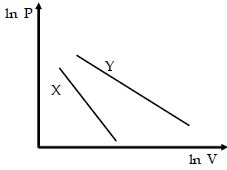
- A
$f_1 > f_2$
- ✓
$f_2 > f_1$
- C
$C_{v_2} = C_{v_1}$
- D
$C_{v_1} > C_{v_2}$
AnswerCorrect option: B. $f_2 > f_1$
b
$\mathrm{PV}^{\gamma}=$ constant $\Rightarrow \ln \mathrm{P}=\ln \mathrm{C}-\gamma \ln \mathrm{V}$
$\Rightarrow \gamma_{\mathrm{x}}>\gamma_{\mathrm{y}} \Rightarrow \mathrm{f}_{1}<\mathrm{f}_{2}$
View full question & answer→MCQ 2661 Mark
$P-V$ diagram of a diatomic gas is a straight line passing through origin. The molar heat capacity of the gas in the process will be
- A
$4\ R$
- B
$25\ R$
- ✓
$3\ R$
- D
$\frac{{4R}}{3}$
AnswerCorrect option: C. $3\ R$
c
$\mathrm{P}-\mathrm{V}$ diagram of the gas is a straight line passing though origin. Hence,
$\mathrm{P} \propto \mathrm{V}$
or $\mathrm{PV}^{-1}=$ constant
Molar heat capacity in the process
$\mathrm{PV}^{x}=$ constant
$C=\frac{R}{\gamma-1}+\frac{R}{1-x}$
Here, $\gamma=1.4 \quad$ (for diatomic gas)
$\therefore \quad \mathrm{C}=\frac{\mathrm{R}}{1.4-1}+\frac{\mathrm{R}}{1+1}$
or $\mathrm{C}=3 \mathrm{R}$
View full question & answer→MCQ 2671 Mark
Specific heats of monoatomic and diatomic gas is same than which relation is valid
- A
$C_P(mono) = C_P(dia)$
- ✓
$C_P(mono) = C_V(dia)$
- C
$C_V(mono) = C_V(dia)$
- D
$C_V(mono) = C_P(dia)$
AnswerCorrect option: B. $C_P(mono) = C_V(dia)$
b
For monoatomic gas $f=3$
Dia. gas $f=5$
$C_{P}=\left(\frac{f+2}{2}\right) R$
$C_{v}=\frac{f R}{2}$
View full question & answer→MCQ 2681 Mark
For a gas, the difference between the two specific heats is $4150\, J\, kg^{-1}\, K^{-1}$ and the ratio of the two specific heats is $1.4$. What is the specific heat of the gas at constant volume in units of $J\, kg^{-1}\, K^{-1}$ ?
- A
$8475$
- B
$5186$
- C
$1660$
- ✓
$10375$
AnswerCorrect option: D. $10375$
d
$\mathrm{By} \frac{\mathrm{C}_{\mathrm{p}}}{\mathrm{C}_{\mathrm{v}}}=1.4$ and $\mathrm{C}_{\mathrm{p}}-\mathrm{C}_{\mathrm{v}}=4150$
$\Rightarrow \mathrm{C}_{\mathrm{v}}=10375 \mathrm{Jkg}^{-1} \mathrm{k}^{-1}$
View full question & answer→MCQ 2691 Mark
Ideal monoatomic gas is taken through a process $dQ = 2dU.$ The molar heat capacity for the process
- A
$2.5\,\,R$
- ✓
$3\,\,R$
- C
$R$
- D
$2\,\,R$
AnswerCorrect option: B. $3\,\,R$
b
$\mathrm{dQ}=2 \mathrm{d} \mathrm{U}$
$\mu C \Delta T=2\left(\mu C_{v} \Delta T\right)$
$\mathrm{C}=2 \mathrm{C}_{\mathrm{v}} ; \mathrm{C}_{\mathrm{v}}=2 \times\left(\frac{3 \mathrm{R}}{2}\right)=3 \mathrm{R}$
$(\mathrm{C}=3 \mathrm{R})$
View full question & answer→MCQ 2701 Mark
Ideal mono-atomic gas is taken through process such that $dQ= 3dU.$ The molar heat capacity for this process is
- A
$3\,R$
- ✓
$4.5\,R$
- C
$4\,R$
- D
$2\,R$
AnswerCorrect option: B. $4.5\,R$
b
$\mathrm{dQ}=3 \mathrm{dU}$
$\Rightarrow \mathrm{dQ}=3 \mathrm{nC}_{\mathrm{v}} \mathrm{dT}$
or $\quad \mathrm{C}=\frac{\mathrm{d} \theta}{\mathrm{ndT}}=3 \mathrm{C}_{\mathrm{v}}=9 \mathrm{R} / 2$
View full question & answer→MCQ 2711 Mark
The equation of a certain gas can be written as: ${\left( {\frac{{{T^7}}}{{{P^2}}}} \right)^{1/5}} = $ constant. The specific heat at constant volume of this gas is in $\left( {in\frac{J}{{mol\,K}}} \right)$
- A
$0.5\, R$
- B
$1.5\, R$
- C
$2\, R$
- ✓
$2.5\, R$
AnswerCorrect option: D. $2.5\, R$
d
Rewriting the given equation as $\mathrm{T}^{7 / 5} \mathrm{P}^{-2 / 5}$ and
comparing this with the standard from of the adiabatic equation $\mathrm{T}^{\gamma} \mathrm{P}^{1-\gamma}=$ constant, we find
$\gamma=\frac{7}{5} .$ Hence, the gas is diatomic and
$C_{v}=\frac{R}{\gamma-1}=\frac{5}{2} R$
View full question & answer→MCQ 2721 Mark
The ratio of specific heats $(\gamma )$ of a ideal gas is given by
- A
$\frac{1}{{1 - \frac{R}{{{C_P}}}}}$
- B
${1 + \frac{R}{{{C_V}}}}$
- C
$\frac{{{C_P}}}{{{C_P} - R}}$
- ✓
Answerd
$\gamma=\frac{C_{\mathrm{P}}}{\mathrm{C}_{\mathrm{V}}}$
and $C_{P}-C_{V}=R$
View full question & answer→MCQ 2731 Mark
When water is heated from $0$ to $4\,^oC$
- A
${C_p}\, = \,{C_v}$
- B
${C_p}\, > \,{C_v}$
- ✓
${C_p}\, < \,{C_v}$
- D
${C_p}\, - \,{C_v}=R$
AnswerCorrect option: C. ${C_p}\, < \,{C_v}$
c
Water has highest density at $4^{\circ} C$. This changes its properties from other simple fluids.
When water is heated from $0^{\circ} C$ to $4^{\circ} C$, the volume of liquid decreases.
Thus for this transition, $P \Delta V$ is negative.
$\int C_p d T=\int C_V d T+P \Delta V$
$\Rightarrow C_P < C_V$
View full question & answer→MCQ 2741 Mark
For a certain process, pressure of diatomic gas varies according to the relation $P = aV^2$, where $a$ is constant. What is the molar heat capacity of the gas for this process?
- ✓
$\frac{{17R}}{6}$
- B
$\frac{{6R}}{{17}}$
- C
$\frac{{13R}}{6}$
- D
$\frac{{16R}}{7}$
AnswerCorrect option: A. $\frac{{17R}}{6}$
a
$\mathrm{PV}^{-2}=\mathrm{a} \quad \mathrm{x}=-2$
$C=\frac{R}{\eta-1}+\frac{R}{1-x}$
$C=\frac{R}{7 / 5-1}+\frac{R}{1+2}=\frac{5 R}{2}+\frac{R}{3}=\frac{17 R}{6}$
View full question & answer→MCQ 2751 Mark
The specific heat of a gas in a polytropic process is given by
- A
$\frac{R}{\gamma-1}+\frac{R}{N-1}$
- B
$\frac{R}{1-\gamma}+\frac{R}{1-N}$
- ✓
$\frac{R}{\gamma-1}-\frac{R}{N-1}$
- D
$\frac{R}{1-\gamma}-\frac{R}{1-N}$
AnswerCorrect option: C. $\frac{R}{\gamma-1}-\frac{R}{N-1}$
c
(c)
$\because C=C_V+\frac{R}{1-N}=\frac{R}{\gamma-1}-\frac{R}{N-1}$
View full question & answer→MCQ 2761 Mark
The variation of pressure $P$ with volume $V$ for an ideal diatomic gas is parabolic as shown in the figure. The molar specific heat of the gas during this process is
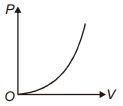
- A
$\frac{9 R}{5}$
- ✓
$\frac{17 R}{6}$
- C
$\frac{3 R}{4}$
- D
$\frac{8 R}{5}$
AnswerCorrect option: B. $\frac{17 R}{6}$
b
(b)
$P=a V^{-2} \quad \text { So, } P V^2=\text { constant then } N=2$
$C=\frac{R}{\gamma-1}-\frac{R}{1-N} \quad \because \gamma=1.4$
$C=\frac{17 R}{6}$
View full question & answer→MCQ 2771 Mark
The pressure $P$ of an ideal diatomic gas varies with its absolute temperature $T$ as shown in figure. The molar heat capacity of gas during this process is ........... $R$ [$R$ is gas constant]
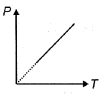
- A
$1.7$
- B
$3.25$
- ✓
$2.5$
- D
$4.2$
Answerc
(c)
$C_V$ of diatomic $=\frac{5}{2} R$
View full question & answer→MCQ 2781 Mark
An ideal gas with adiabatic exponent $(\gamma=1.5)$ undergoes a process in which work done by the gas is same as increase in internal energy of the gas. The molar heat capacity of gas for the process is -
- ✓
$C =4 R$
- B
$C =0$
- C
$C =2 R$
- D
$C = R$
AnswerCorrect option: A. $C =4 R$
a
(a)
$\Rightarrow \Delta Q =\Delta U+\Delta W$
$\Delta U=\Delta W$
$\Rightarrow \Delta Q =2\Delta U$
$\Rightarrow nC\Delta T =2 nC _{ v } \Delta t $
$\Rightarrow C =2 C _{ v }=\frac{2 R }{\gamma-1}$
$\Rightarrow C =\frac{2 R }{1.5-1}=4 R$
View full question & answer→MCQ 2791 Mark
A gaseous mixture contains equal number of hydrogen and nitrogen molecules. Specific heat measurements on this mixture at temperatures below $100\, K$ would indicate that the value of $\gamma $ (ratio of specific heats) for this mixture is
Answerc
Sperific heat capacily of the mixture, $\left(C_{V}\right)_{\text {mix }}$ is given by
$\left(C_{v}\right)_{\text {mix }} =\frac{n_{1} c_{v_{1}}+n_{2} C_{v_{2}}}{n_{1}+n_{2}}\left[\begin{array}{c} \text { In this question, } n_{1}=n_{2}=n \\ c_{v_{1}}=\frac{5 R}{2}, c_{v_{2}}=5 R / 2 \end{array}\right]$
$=\frac{n\left(\frac{5 R}{2}\right)+n \cdot\left(\frac{5 R}{2}\right)}{2 n}=\frac{5 R}{2}:$
$\left(C_{P}\right)_{\text {mix }} =\frac{5 R}{2}+R=\frac{5 R+2 R}{2}=\frac{7 R}{2}$
$\therefore Ratio=7 / 5$
$\text { Correct choice }$
View full question & answer→MCQ 2801 Mark
The ratio of specific heat of a mixture of one mole of helium and one mole of hydrogen gas will be
Answerb
${\gamma_{mix}} = \frac{{{n_1}{\gamma _1}({\gamma _2} - 1) + {n_2}{\gamma _2}({\gamma _1} - 1)}}{{{n_1}({\gamma _2} - 1) + {n_2}({\gamma _1} - 1)}}$
$ = \frac{{\frac{5}{3}\left( {\frac{7}{5} - 1} \right) + \frac{7}{5}\left( {\frac{5}{3} - 1} \right)}}{{\left( {\frac{7}{5} - 1} \right) + \left( {\frac{5}{3} - 1} \right)}} = 1.5$
View full question & answer→MCQ 2811 Mark
The temperature of the mixture of one mole of helium and one mole of hydrogen is increased from ${0^o}C$ to ${100^o}C$ at constant pressure. The amount of heat delivered will be ...... $cal$
- A
$600$
- ✓
$1200$
- C
$1800$
- D
$3600$
AnswerCorrect option: B. $1200$
b
${({C_P})_{mix}} = \frac{{{\mu _1}{C_{{P_1}}} + {\mu _2}{C_{{P_2}}}}}{{{\mu _1} + {\mu _2}}}$(${C_{{P_1}}}(He) = \frac{5}{2}R$ and ${C_{{P_2}}}({H_2}) = \frac{7}{2}R$)
$ = \frac{{1 \times \frac{5}{2}R + 1 \times \frac{7}{2}R}}{{1 + 1}}$= 3R$ = 3 \times 2 = 6\,cal/mol.^\circ C$
Heat required to raise the temperature from $0^{o}C$ to $100^{o}C$
${(\Delta Q)_P} = \mu {C_P}\Delta T = 2 \times 6 \times 100 = 1200\,cal$
View full question & answer→MCQ 2821 Mark
One mole of a monoatomic ideal gas is mixed with one mole of a diatomic ideal gas. The molar specific heat of the mixture at constant volume is
- A
$8$
- B
$\frac{3}{2}R$
- ✓
$2R$
- D
$2.5 R$
Answerc
(c) ${({C_V})_{mix}} = \frac{{{\mu _1}{C_{{V_1}}} + {\mu _2}{C_{{V_2}}}}}{{{\mu _1} + {\mu _2}}}$$ = \frac{{1 \times \frac{3}{2}R + 1 \times \frac{5}{2}R}}{{1 + 1}} = 2R$
$\left( {{{({C_V})}_{mono}} = \frac{3}{2}R,\;\;{{({C_V})}_{di}} = \frac{5}{2}R} \right)$
View full question & answer→MCQ 2831 Mark
Considering the gases to be ideal, the value of $\gamma = \frac{{{C_P}}}{{{C_V}}}$ for a gaseous mixture consisting of $= 3$ moles of carbon dioxide and $2$ moles of oxygen will be $({\gamma _{{O_2}}} = 1.4,\,\,{\gamma _{C{O_2}}} = 1.3)$
- A
$1.37$
- ✓
$1.34$
- C
$1.55$
- D
$1.63$
AnswerCorrect option: B. $1.34$
b
(b) ${\gamma _{{\rm{mix}}}} = \frac{{\frac{{{\mu _1}{\gamma _1}}}{{{\gamma _1} - 1}} + \frac{{{\mu _2}{\gamma _2}}}{{{\gamma _2} - 1}}}}{{\frac{{{\mu _1}}}{{{\gamma _1} - 1}} + \frac{{{\mu _2}}}{{{\gamma _2} - 1}}}} = \frac{{\frac{{3 \times 1.3}}{{(1.3 - 1)}} + \frac{{2 \times 1.4}}{{(1.4 - 1)}}}}{{\frac{3}{{(1.3 - 1)}} + \frac{2}{{(1.4 - 1)}}}} = 1.33$
View full question & answer→MCQ 2841 Mark
Five moles of helium are mixed with two moles of hydrogen to form a mixture. Take molar mass of helium $M_1=4\ g$ and that of hydrogen $M_2=2\ g$ The equivalent molar mass of the mixture is
- A
$6\,g$
- B
$\frac{{13g}}{7}$
- C
$\frac{{18g}}{7}$
- ✓
Answerd
Equivalent molar mass $=\frac{\sum n _{m_1}}{\sum n _{ i }}=\frac{\sum 5 \times 4+2 \times 2}{\sum+2}=\frac{24}{7}$.
View full question & answer→MCQ 2851 Mark
Five moles of helium are mixed with two moles of hydrogen to form a mixture. Take molar mass of helium $M_1=4\ g$ and that of hydrogen $M_2=2\ g$ The equivalent degree of freedom $f$ of the mixture is
AnswerCorrect option: A. $3.57$
View full question & answer→MCQ 2861 Mark
Five moles of helium are mixed with two moles of hydrogen to form a mixture. Take molar mass of helium $M_1=4\ g$ and that of hydrogen $M_2=2\ g$ The equivalent value of $\gamma$ is
AnswerCorrect option: C. $1.56$
c
$=C_{V_{\operatorname{mtx}}}=\frac{\frac{5}{2} \times 2 R+\frac{3}{2} \times 5 R}{7}, C_{P_ {mtx} }=\frac{\frac{7}{2} \times 2 R+\frac{5}{2} \times 5 R}{7} \gamma_{\operatorname{mtx}}=\frac{C_{P mtx }}{C_{V mtx }}=1.56$
View full question & answer→MCQ 2871 Mark
$2$ mole of $N_2$ gas at $27\,^oC$ is mixed with $1$ mole $He$ gas at $-73\,^oC$. Find $T_{mix}$ of the mixture
- A
$277\,^oC$
- ✓
$277\,K$
- C
$5\,^oK$
- D
$50\,^oC$
AnswerCorrect option: B. $277\,K$
b
$\mathrm{T}_{\operatorname{mix}}=\frac{\mathrm{n}_{1} \mathrm{C}_{\mathrm{v}_{1}} \mathrm{T}_{1}+\mathrm{n}_{2} \mathrm{C}_{\mathrm{V}_{2}} \mathrm{T}_{2}}{\mathrm{n}_{1} \mathrm{C}_{\mathrm{V}_{1}}+\mathrm{n}_{2} \mathrm{C}_{\mathrm{V}_{2}}}$
$=\frac{2 \times \frac{5}{2} \mathrm{R} \times 300+1 \times \frac{3 \mathrm{R}}{2} \times 200}{2 \times \frac{5 \mathrm{R}}{2}+1 \times \frac{3 \mathrm{R}}{2}}=277 \mathrm{K}$
View full question & answer→MCQ 2881 Mark
The molar specific heat of mixture at constant volume, if one mole of $He$ gas is mixed with three moles of $O_2$ gas is
- A
$3.33\,R$
- ✓
$2.25\,R$
- C
$1.15\,R$
- D
$6.72\,R$
AnswerCorrect option: B. $2.25\,R$
b
$\left(\mathrm{C}_{\mathrm{V}}\right)_{\mathrm{mol}}=\frac{1 \times \frac{3}{2} \mathrm{R}+3 \times \frac{5}{2} \mathrm{R}}{1 \times 3}$
$\Rightarrow 2.25 \mathrm{R}$
View full question & answer→MCQ 2891 Mark
One grams of $H_2$ at $27\,^oC$ is mixed with $16\, g$ of $O_2$ at $37\,^oC$. The temperature of the mixture is about ....... $^oC$
Answera
$\mathrm{T}=\frac{\mathrm{n}_{1} \mathrm{T}_{1}+\mathrm{n}_{2} \mathrm{T}_{2}}{\mathrm{n}_{1}+\mathrm{n}_{2}}$
$=\frac{0.5 \times 300+0.5 \times 310}{0.5+0.5}=305 \mathrm{K}=32^{\circ} \mathrm{C}$
View full question & answer→MCQ 2901 Mark
When one mole of monatomic gas is mixed with one mole of a diatomic gas, then the equivalent value of $\gamma$ for the mixture will be (vibration mode neglected)
- A
$1.33$
- B
$1.40$
- ✓
$1.50$
- D
$1.6$
AnswerCorrect option: C. $1.50$
c
(c)
$Y$ for monatomic gas $=1+\frac{2}{3}=\frac{5}{3}=\gamma_1$
$\frac{n}{\gamma-1}=\frac{n_1}{\gamma_1-1}+\frac{n_2}{\gamma_2-1}$
$Y$ for diatomic gas $=1+\frac{2}{5}=\frac{7}{5}=\gamma_2$
$\frac{2}{\gamma-1}=\frac{1}{\frac{5}{3}-1}+\frac{1}{\frac{7}{5}-1}$
Solving, we get $\gamma=3 / 2$
View full question & answer→MCQ 2911 Mark
One mole of monatomic gas and three moles of diatomic gas are put together in a container. The molar specific heat (in $JK ^{-1} mol ^{-1}$ ) at constant volume is (Let $R=8 \,JK ^{-1} mol ^{-1}$ )
Answera
(a)
$n_1=1 \text { mole } \quad f_1=3$
$n_2=3 \text { moles } \quad f_2=5$
$R=8 \,JK ^{-1} mol ^{-1}$
Molar specific heat are given by the weighted means of the gases.
$C_{v_f}=\frac{n_1 \times C_{v_1}+n_2 \times C_{v_2}}{n_1+n_2}$
$C_{v_f}=\frac{1 \times \frac{3}{2} R+3 \times \frac{5}{2} R}{4}$
$=\frac{3}{8} R+\frac{15}{8} R$
$=\frac{18}{8} R$
$C_{v_f}=18$
View full question & answer→MCQ 2921 Mark
If $\alpha$ moles of a monoatomic gas are mixed with $\beta$ moles of a polyatomic gas and mixture behaves like diatomic gas, then [neglect the vibrational mode of freedom]
- ✓
$2 \alpha=\beta$
- B
$\alpha=2 \beta$
- C
$\alpha=-3 \beta$
- D
$3 \alpha=-\beta$
AnswerCorrect option: A. $2 \alpha=\beta$
a
(a)
Given: Moles of monoatomic gas $=\alpha$, moles of diatomic gas is $\beta$.
Solution:
The mixture is behaving as diatomic gas. If we neglect the vibrational mode of freedom then degree of freedom ( $\left.f_{\text {mix }}\right)$ of mixture is $3$ (for translational) $+2$ (for rotational $=5$.
We know that,
$f _{\text {mix }}=\frac{ f _1 n _1+ f _2 n _2}{ n _1+ n _2}$
$\Rightarrow 5=\frac{3 \alpha+6 \beta}{\alpha+\beta}$
$\Rightarrow 5 \alpha+5 \beta=3 \alpha+6 \beta$
$\therefore 2 \alpha=\beta$
View full question & answer→MCQ 2931 Mark
Four mole of hydrogen, two mole of helium and one mole of water vapour form an ideal gas mixture. What is the molar specific heat at constant pressure of mixture?
- A
$\frac{16}{7} R$
- B
$\frac{7}{16} R$
- C
$R$
- ✓
$\frac{23}{7} R$
AnswerCorrect option: D. $\frac{23}{7} R$
d
(d)
$C _{ v } \text { for hydrogen }=\frac{5}{2} R$
$C _{ v } \text { for helium }=\frac{3 R }{2}$
$C _{ v } \text { for water vapour }=\frac{6 R }{2}=3 R$
$\therefore \quad\left( C _{ v }\right)_{\text {mix }}$
$\quad=\frac{4 \times \frac{5}{2} R +2 \times \frac{3}{2} R +1 \times 3 R }{4+2+1}=\frac{16}{7} R$
$\therefore C _{ p }= C _{ v }+ R$
$C _{ p }=\frac{16}{7} R + R \text { or } \quad C _{ p }=\frac{23}{7} R$
View full question & answer→MCQ 2941 Mark
In Vander Waal's equation $\left[ {P + \frac{a}{{{V^2}}}} \right]\,(V - b) = RT,$ the dimensions of $a$ are
- ✓
${M^1}{L^5}{T^{ - 2}}$
- B
${M^0}{L^2}{T^{ - 3}}$
- C
${M^1}{L^3}{T^{ - 2}}$
- D
${M^1}{L^1}{T^{ - 2}}$
AnswerCorrect option: A. ${M^1}{L^5}{T^{ - 2}}$
a
Vander Wall's equation is given as,
$\left( P +\frac{ a }{ V ^{2}}\right)( V - b )= RT$
The dimension of a is given as,
$a = PV ^{2}$
$=\left[ ML ^{-1} T ^{-2}\right]\left[ L ^{3}\right]^{2}$
$=\left[ ML ^{5} T ^{-2}\right]$
The dimension of b is given as,
$b = V$
$=\left[ L ^{3}\right]$
Thus, the dimension of a is $\left[ ML ^{5} T ^{-2}\right]$ and the dimension of $b$ is $\left[ L ^{3}\right]$.
View full question & answer→MCQ 2951 Mark
The value of critical temperature in terms of Vander Waal’s constant $a$ and $b$ is
- ✓
${T_c} = \frac{{8a}}{{27Rb}}$
- B
${T_c} = \frac{a}{{2Rb}}$
- C
${T_c} = \frac{8}{{27Rb}}$
- D
${T_c} = \frac{{27a}}{{8Rb}}$
AnswerCorrect option: A. ${T_c} = \frac{{8a}}{{27Rb}}$
a
A Vander Waals equation is given by$:$
$\left(P+\frac{a}{V^{2}}\right)(V-b)=R T$
Where, $a$ and $b$ are constant Solving above equation, $P=\frac{R T}{V-b}-\frac{a}{V^{2}}$
Taking derivative of $P$ $w.r.t$ volume
$\frac{\partial P}{\partial V}=0$
$\frac{\partial^{2} P}{\partial V^{2}}=0$
So, $P$ becomes$:$
$\frac{\partial P}{\partial V}=-\frac{R T}{(V-b)^{2}}+\frac{2 a}{V^{3}}=0$
$\frac{2 a}{V^{3}}=\frac{R T}{(V-b)^{2}}$$.....(1)$
$\frac{a}{V^{4}}=\frac{R T}{2 V(V-b)^{2}}$$.....(2)$
Taking double derivative again,
$\frac{\partial^{2} P}{\partial V^{2}}=\frac{2 R T}{(V-b)^{3}}-\frac{6 a}{V^{4}}=0$
or
$\frac{R T}{(V-b)^{3}}=\frac{3 a}{V^{4}}$
Put equation $( 2 )$ in above equation
$\frac{R T}{(V-b)^{3}}=\frac{3 R T}{2 V(V-b)^{2}}$
On rearranging,
$3 V-3 b=2 V$
$V_{c}=3 b$
$\mathrm{V}_{\mathrm{C}}$ is critical volume
Use this value in equation $(1)$
$\frac{R T}{4 b^{2}}=\frac{2 a}{27 b^{3}}$
$T_{c}=\frac{8 a}{27 R b}$
$\mathrm{T}_{\mathrm{C}}$ is critical temperature.
View full question & answer→MCQ 2961 Mark
If two moles of diatomic gas and one mole of mono atomic gas are mixed then the ratio of specific heats is
- A
$\frac{7}{3}$
- B
$\frac{5}{4}$
- ✓
$\frac{{19}}{{13}}$
- D
$\frac{{15}}{{19}}$
AnswerCorrect option: C. $\frac{{19}}{{13}}$
c
$C _{ peq }=\frac{ n _{1} C _{ p 1}+ n _{2} C _{ p _{2}}}{ n _{1}+ n _{2}} C _{ veq}$
$=\frac{ n _{1} C _{ v _{1}}+ n _{2} C _{ v _{2}}}{ n _{1}+ n _{2}}$
$r _{ eq }=\frac{ C _{ P _{ eq }}}{ C _{ Veq }}=\frac{2 \times \frac{7}{2}+1 \times \frac{5}{2}}{2 \times \frac{5}{2}+1 \times \frac{3}{2}}$
$=\frac{19}{13}$
View full question & answer→MCQ 2971 Mark
One mole of monoatomic gas and three moles of diatomic gas are put together in a container. The molar specific heat (in $J\,{K^{ - 1}}\,mo{l^{ - 1}})$ at constant volume is $(R = 8.3\,J\,{K^{ - 1}}\,mo{l^{ - 1}})$
AnswerCorrect option: A. $18.7$
a
${C_{{V_{mix}}}} = \frac{{{\mu _1}{C_{{V_1}}} + {\mu _2}{C_{{V_2}}}}}{{{\mu _1} + {\mu _2}}} = \frac{{1 \times \frac{3}{2}R + 3 \times \frac{5}{2}R}}{{1 + 3}}$
$ = \frac{3}{4}R = \frac{3}{4} \times 8.3 = 18.7$
View full question & answer→MCQ 2981 Mark
The diameter of oxygen molecule is $2.94 \times {10^{ - 10}}m.$ The Vander Waal’s gas constant ‘$b’$ in ${m^3}/mol$ will be
- A
$3.2$
- B
$16$
- C
$32 \times {10^{ - 4}}$
- ✓
$32 \times {10^{ - 6}}$
AnswerCorrect option: D. $32 \times {10^{ - 6}}$
d
$b =4 N \times \frac{4}{3} \pi \frac{ d ^{3}}{8}$ (standard definition of boyles constant)
$=\frac{4 \times 6.02 \times 10^{23} \times 3.14 \times 2.94^{3} \times 10^{-30}}{3 \times 8}$
$=32 \times 10^{-6}$
View full question & answer→MCQ 2991 Mark
If pressure of $C{O_2}$ (real gas) in a container is given by $P = \frac{{RT}}{{2V - b}} - \frac{a}{{4{b^2}}}$ then mass of the gas in container is ...... $gm$
Answerb
(b) Vander wall's gas equation for ? mole of real gas
$\left( {P + \frac{{{\mu ^2}a}}{{{V^2}}}} \right)\left( {V - \mu b} \right) = \mu RT$==> $P = \frac{{\mu RT}}{{V - \mu b}} - \frac{{{\mu ^2}a}}{{{V^2}}}$
on comparing the given equation with this standard equation we get $\mu = \frac{1}{2}$. Hence $\mu = \frac{m}{M}$==> mass of gas $m = \mu m = \frac{1}{2} \times 44 = 22gm.$
View full question & answer→MCQ 3001 Mark
Consider a gas for which diameter of molecules is $\sigma $ , the gas is at a pressure $P$ and temperature $T$ and $N_a =$ avagodro’s number. The mean free path along $x$ axis is
- A
$\frac{{RT}}{{\sqrt 2 P{N_a}\pi {\sigma ^2}}}$
- B
$\frac{{RT}}{{\sqrt 3 P{N_a}\pi {\sigma ^2}}}$
- ✓
$\frac{{RT}}{{\sqrt 6 P{N_a}\pi {\sigma ^2}}}$
- D
$\frac{{RT}}{{P{N_a}\pi {\sigma ^2}}}$
AnswerCorrect option: C. $\frac{{RT}}{{\sqrt 6 P{N_a}\pi {\sigma ^2}}}$
c
$\lambda=\frac{1}{\sqrt{2} \pi \sigma^{2} n *}$
$\lambda^{2}=\lambda_{\mathrm{x}}^{2}+\lambda_{\mathrm{y}}^{2}+\lambda_{\mathrm{z}}^{2}$
$\lambda_{\mathrm{x}}=\frac{\lambda}{\sqrt{3}}$
View full question & answer→MCQ 3011 Mark
According to $C.E.$ van der Waal, the interatomic potential varies with the average interatomic distance $(R)$ as
- A
$R^{-1}$
- B
$R^{-2}$
- C
$R^{-4}$
- ✓
$R^{-6}$
AnswerCorrect option: D. $R^{-6}$
d
(d)
Interatomic potential varies with average interatomic distance as $R^{-6}$ which is a fact.
View full question & answer→MCQ 3021 Mark
When an air bubble of radius $‘r’$ rises from the bottom to the surface of a lake, its radius becomes $5r/4$ (the pressure of the atmosphere is equal to the $10 \,m$ height of water column). If the temperature is constant and the surface tension is neglected, the depth of the lake is .... $m$
- A
$3.53$
- B
$6.53$
- ✓
$9.53$
- D
$12.53$
AnswerCorrect option: C. $9.53$
c
In this case, $(4 / 3) \pi r^{3}\left(p_{0}+p_{1}\right)=(4 / 3) \pi r^{3}\left(5^{3} / 4^{3}\right) P _{0}$
where, $P_{0}=$ atm pressure, $P_{1}=$ water pressure
Rearranging, we get, $P_{1}=\left[\left(5^{3} / 4^{3}\right)-1\right] P_{0}$
Or, $\rho gH =(\frac{61}{64}) P _{0}$
Or, $H =\frac{(\frac{61}{64}) P _{0}}{\rho g}$
$P_{0}=10 g$ and $\rho$ of water $=1$
Putting these values we get, $H =9.53 \; m$
View full question & answer→MCQ 3031 Mark
A vessel contains $14 \,gm \,(7 $ moles) of hydrogen and $96\, gm$ ($9$ moles) of oxygen at $STP.$ Chemical reaction is induced by passing electric spark in the vessel till one of the gases is consumed. The temperature is brought back to it's starting value $273 K.$ The pressure in the vessel is ...... $atm$
Answera
given that,
mass of hydrogen $=14\; g$
Molar mass of $H_{2}=2\; g m mol ^{-1}$
No. of moles, $n_{H_{2}}=\frac{14}{2}=7 \;moles$
mass of oxygen $=96 \;gm$
Molar mass of $O _{2}=32 \;gmol ^{-1}$
No. of moles, $n_{0_{2}}=\frac{96}{32}=3 \;moles$
Total no. of moles in the vessel, $n=n_{H_{2}}+n_{O_2}$
$n=(7+3)=10 \text { moles }$
Let STP $P =1 atm =10^{5} Pa$
$T=273\; K$
We knows by ideal gas equation, $P V=n R T$
where $P=$ pressure of gas
$V=$ volume of gas
$n=$ amount of substance
$R=$ universal gas coustant
$T=$ absolute temperature
To find $V$, puts all values of $P, n, R, T$ :
$V=\frac{n R T}{P}=\frac{10 \times 8.3 \times 273}{10^{5}} \quad[R=8.3$
$V=0.23 m ^{2}$
chemical reaction is induced bypassing elictric spark in the vessel till one of the gas is consumed. When electric spark is passed. The reaction is
$2 H _{2}+ O _{2} \rightarrow 2 H _{2} O$
Each $1 gm$ of $H _{2}$ reacts with $8 gm ^{ m }$ of $O _{2}$
$\therefore 96 gm$ of oxygen $\rightarrow 12 g$ of $H _{2}$
After consumption:
orygen left $=0$
Hydrogen left $=14-12=2 gm$
No. of moles of $2\; gm$ of $H _{2} \Rightarrow n^{\prime}=\frac{2}{2}=1 \;mol$
$\therefore$ New ideal gas eq.: $P^{\prime} V=n^{\prime} R T$ $\dots (2)$
Dividing eq. $(1)$ and $(2)$:
$\frac{p^{\prime}}{p}=\frac{n^{\prime}}{n} \Rightarrow p^{\prime}=\frac{n^{\prime} p}{n}=\frac{1 \times 10^{5}}{10}=10^{4}$
$p^{\prime}=0.1 \; atm$
The presoure in the vessel is $0.1 \; atm$
View full question & answer→MCQ 3041 Mark
The expansion of an ideal gas of mass $m$ at a constant pressure $P$ is given by the straight line $D$. Then the expansion of the same ideal gas of mass $2m$ at a pressure $P/ 2 $ is given by the straight line
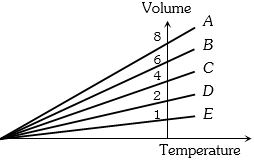
Answerd
ideal gas equation
$PV = nRT$
$n =\frac{ m }{ M }$
where
$m =$ weight in grams
$M =$ molecular weight
$PV =\frac{ m }{ M } RT$
$V =\left(\frac{ m }{ P }\right) \frac{ R }{ M } T$
slope of expansion curve is determined by $\left(\frac{m}{P}\right) \frac{R}{M}$
for mass $m$ and pressure $P$ slope
$S _{1}=\left(\frac{ m }{ P }\right) \frac{ R }{ M } \quad$ eq(1)
for mass $2 m$ and pressure $\frac{P}{2}$ slope
$S _{2}=\left(\frac{2 m }{\frac{ p }{2}}\right) \frac{ R }{ M }$
$S _{2}=4\left(\frac{ m }{ P }\right) \frac{ R }{ M } \quad eq (2)$
$\frac{e q(2)}{e q(1)}$
$S _{2}=4 S _{1}$
According to question given
$S _{1}=2$
$SO _{2}=8$
View full question & answer→MCQ 3051 Mark
An experiment is carried on a fixed amount of gas at different temperatures and at high pressure such that it deviates from the ideal gas behaviour. The variation of $\frac{{PV}}{{RT}}$ with $P$ is shown in the diagram. The correct variation will correspond to
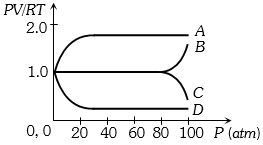
- A
Curve $A$
- ✓
Curve $B$
- C
Curve $C$
- D
Curve $D$
AnswerCorrect option: B. Curve $B$
b
At low pressure, the gas will show ideal behaviour and hence $\frac{ PV }{ RT }=$ number of moles which will remain constant.
But as pressure increases, there will be dominant interatomic forces and actual volume will be less due to finite size. Hence, B curve will be followed.
View full question & answer→MCQ 3061 Mark
A fix amount of nitrogen gas ($1$ mole) is taken and is subjected to pressure and temperature variation. The experiment is performed at high pressure as well as high temperatures. The results obtained are shown in the figures. The correct variation of $PV/RT$ with $P$ will be exhibited by
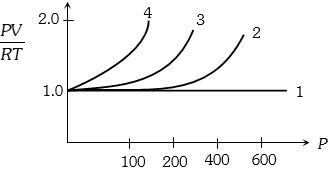
Answerb
At high pressure the gas deviates from its ideal behavior.
View full question & answer→MCQ 3071 Mark
Two spherical vessel of equal volume, are connected by a n arrow tube. The apparatus contains an ideal gas at one atmosphere and $300K$. Now if one vessel is immersed in a bath of constant temperature $600K$ and the other in a bath of constant temperature $300K$. Then the common pressure will be ...... $atm$
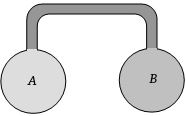
AnswerCorrect option: C. $1.33$
c
(c) $\mu = {\mu _1} + {\mu _2}$
$\frac{{P(2V)}}{{R\,{T_1}}} = \frac{{P'v}}{{R\,{T_1}}} + \frac{{P'V}}{{R\,{T_2}}}$==> $\frac{{2P}}{{R\,{T_1}}} = \frac{{P'}}{R}\left[ {\frac{{{T_2} + {T_1}}}{{{T_1}\;{T_2}}}} \right]$
$P' = \frac{{2P\,{T_2}}}{{({T_1} + {T_2})}} = \frac{{2 \times 1 \times 600}}{{(300 + 600)}} = \frac{4}{3}atm$
View full question & answer→MCQ 3081 Mark
An air bubble doubles its radius on raising from the bottom of water reservoir to be the surface of water in it. If the atmospheric pressure is equal to $10\, m$ of water, the height of water in the reservoir is ..... $m$
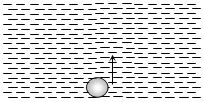
Answerc
(c) According to Boyle’s law ${({P_1}{V_1})_{{\rm{bottom}}}} = {({P_2}{V_2})_{{\rm{top}}}}$
$(10 + h) \times \frac{4}{3}\pi r_1^3 = 10 \times \frac{4}{3}\pi r_2^3$ but ${r_2} = 2{r_1}$
$\therefore$ $(10 + h)r_1^3 = 10 \times 8r_1^3$==> $10 + h = 80$ $\therefore h = 70m$
View full question & answer→MCQ 3091 Mark
A resistance coil connected to an external battery is placed inside an adiabatic cylinder fitted with a frictionless pistn and containing an ideal gas. A current $i$ flows through the coil which has a resistance $R$. At what speed must the piston move upward in order that the temperature of the gas remains uchanged? Neglect atmospheric pressure.
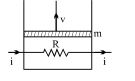
- A
$\frac{{{i^2}m}}{{Rg}}$
- B
$\frac{{Rmg}}{{{i^2}}}$
- C
$\frac{{mg}}{{{i^2}}}$
- ✓
$\frac{{{i^2}R}}{{mg}}$
AnswerCorrect option: D. $\frac{{{i^2}R}}{{mg}}$
d
Applying $C O E$
$i^{2} R t=m g x$
$\Rightarrow \frac{d x}{d t}=\frac{i^{2} R}{m g}$
View full question & answer→MCQ 3101 Mark
One gram mole of an ideal gas $A$ with the ratio of constant pressure and constant volume specific heats $\gamma_{A}=5 / 3$ is mixed with $n$ gram moles of another ideal gas $B$ with $\gamma_{B}=7 / 5$. If the $\gamma$ for the mixture is $19 / 13$, then what will be the value of $n$ ?
Answerb
$(b)$ By using formula,
$\gamma_{\text {mixture }}=\frac{\left(\frac{\mu_{1} C p_{1}+\mu_{2} C p_{2}}{\mu_{1}+\mu_{2}}\right)}{\left(\frac{\mu_{1} C v_{1}+\mu_{2} C v_{2}}{\mu_{1}+\mu_{2}}\right)}$
$\gamma_{\text {mixture }}=\frac{\mu_{1} C p_{1}+\mu_{2} C p_{2}}{\mu_{1} C v_{1}+\mu_{2} C v_{2}}$
$=\frac{\mu_{1}\left(\frac{\gamma_{1}}{\gamma_{1}-1}\right) R+\mu_{2}\left(\frac{\gamma_{2}}{\gamma_{2}-1}\right) R}{\mu_{1}\left(\frac{R}{\gamma_{1}-1}\right)+\mu_{2}\left(\frac{R}{\gamma_{2}-1}\right)}$
or $\gamma_{\text {mixture }}=\frac{\mu_{1} \gamma_{1}\left(\gamma_{2}-1\right)+\mu_{2} \gamma_{2}\left(\gamma_{1}-1\right)}{\mu_{1}\left(\gamma_{2}-1\right)+\mu_{2}\left(\gamma_{1}-1\right)}$
It is given, $\gamma_{\text {mixture }}=\frac{19}{13}$
$\gamma_{1}=\frac{5}{3}, \gamma_{2}=\frac{7}{5}$
$n_{1}=1, n_{2}=n$
Substituting values, we have
$\frac{19}{13}-\frac{\frac{5}{3}\left(\frac{7}{5}-1\right)+n \frac{7}{5}\left(\frac{5}{3}-1\right)}{\left(\frac{7}{5}-1\right)+n\left(\frac{5}{3}-1\right)}$
$\Rightarrow \quad \frac{19}{13} =\frac{\frac{5}{3} \times \frac{2}{5}+n \frac{7}{5} \times \frac{2}{3}}{\frac{2}{5}+n \frac{2}{3}}$
$\Rightarrow 19\left(\frac{2}{5}+n \frac{2}{3}\right) =13\left(\frac{2}{3}+n \frac{14}{15}\right)$
$\Rightarrow \quad n =2$
View full question & answer→MCQ 3111 Mark
Which one of the following schematic graphs best represents the variation of $p V$ (in Joules) versus $T$ (in Kelvin) of one mole of an ideal gas? (The dotted line represents $p V=T$ )
Answera
(a) From gas equation,
$p V=n R T$
Here, $n=1$ mole
So, $p V=R T \dots(i)$
Substituting the value of $R$ in Eq. $(i)$, we get
$p V=8.3 T$
Clearly, slope of $p V$ versus $T$ line is $8.3$, which is greater than one. Hence, following graph is correct.
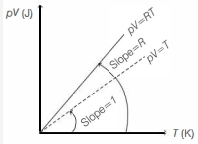
View full question & answer→MCQ 3121 Mark
Two containers $C_{1}$ and $C_{2}$ of volumes $V$ and $4 \,V$ respectively, hold the same ideal gas and are connected by a thin horizontal tube of negligible volume with a valve which is initially closed. The initial pressures of the gas in $C_{1}$ and $C_{2}$ are $p$ and $5 p$, respectively. Heat baths are employed to maintain the temperatures in the containers at $300 \,K$ and $400 \,K$, respectively. The valve is now opened. Select the correct statement.
AnswerCorrect option: D. A long time af ter the valve is opened, number of moles of gas in the hot container will be thrice that of the cold one.
d
$(d)$ Let $n_{1}$ and $n_{2}$ are number of moles of gas present in container $C_{1}$ and $C_{2}$ respectively, before the value is opened.
Then, using $p V=n R T$.
$\text { and }$
$n_{1} =\frac{p V}{R(300)}$
$n_{2} =\frac{5 p(4 V)}{R(400)}$
When value is opened gas flows from $C_{2}$ to $C_{1}$ till pressure in $C_{1}$ and $C_{2}$ is equal. Let after equalisation of pressure in both $C_{1}$ and $C_{2}$, its value is $p_{0}$,
Then, using $p V=n R^{\prime} T$.
$p_{0} V=n_{1}^{\prime} R(300)\left(\right.$ Container $\left.C_{1}\right)$
and $p_{0} 4 V=n_{2}{ }^{\prime} R(400)$ (Container $C_{2}$ )
So, $\quad n_{1}^{\prime}=\frac{p_{0} V}{R(300)}$
and $\quad n_{2}^{\prime}=\frac{p_{0}(4 V)}{R(400)}$
As no gas is leaked from containers,
$n_{1}+n_{2}=n_{1}{ }^{\prime}: n_{2}{ }^{\prime}$
$\Rightarrow \quad \frac{p V}{R(300)}+\frac{20 p V}{R(400)}$ = $\quad \frac{p_{0} V}{R(300)}+\frac{4 p_{0} V}{R(400)}$
So, $p\left(\frac{1}{300}+\right.\left.\frac{20}{400}\right)$ $=p_{0}\left(\frac{1}{300}+\frac{4}{400}\right)$
$\Rightarrow \quad 4 p=p_{0}$
$\text { Now, } \frac{n_{2}{ }^{\prime}}{n_{1}{ }^{\prime}}=\frac{\frac{4 p_{0} V}{R(400)}}{\frac{p_{0} V}{R(300)}}=3$
Finally number of moles of $C_{2}$ is thrice of $C_{1}$.
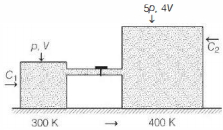
View full question & answer→MCQ 3131 Mark
A hot air balloon with a payload rises in the air. Assume that the balloon is spherical in shape with diameter of $11.7 \,m$ and the mass of the balloon and the payload (without the hot air inside) is $210 \,kg$. Temperature and pressure of outside air are $27^{\circ} C$ and $1 atm =10^5 \,N / m ^2$, respectively. Molar mass of dry air is $30 \,g$. The temperature of the hot air inside is close to .......... $^{\circ} C$ [The gas constant, $R=8.31 \,JK ^{-1} mol ^{-1}$ ]
Answerc
(c)
Hot air balloon will rise in the atmosphere when upthrust of buoyant force is greater than weight of balloon and its payload.
Upthrust $=$ Weight of atmospheric air displaced by balloon
So, upthrust $\geq$ weight of balloon and its payload
$\Rightarrow$ (Volume of air displaced $\times$ density of atmospheric air $\times$ Acceleration due to gravity) $\geq$ (Volume of air of inside balloon $\times$ density of air inside balloon $x$ acceleration due to gravity) $+$ (Weight of payload of balloon)
$\Rightarrow V \cdot \rho_o \cdot g \geq V \cdot \rho_i \cdot g+210 \times g$
where $\rho_0=$ density of outside air and $\rho_i=$ density of inside air.
$\Rightarrow \quad V\left(\rho_o-\rho_i\right)=210$
$\Rightarrow \quad \rho_0-\rho_i=\frac{210 \times 3}{4 \pi r^3}\left(\because V=\frac{4}{3} \pi r^3\right)$
$\Rightarrow \frac{P M}{R T_o}-\frac{P M}{R T_i}=\frac{210 \times 3}{4 \times \pi \times\left(\frac{11.7}{2}\right)^3} \Rightarrow \frac{1}{T_o}-\frac{1}{T_i}$
$=\frac{680\times 8 \times 8.31}{4\times \pi \times(1.7)^3 \times 10^5 \times 30 \times 10^{-3}}$
$\Rightarrow \frac{T_i-T_o}{T_o T_i}=\frac{1}{1387}$
$\Rightarrow T_o T_i=1387\left(T_i-T_o\right)$
$\Rightarrow 300 T_i=1387 T_i-300 \times 1387$ (as, $T_o=27^{\circ} C =300 K$ )
So, $T_i=\frac{300 \times 1387}{1087} \approx 383\, K$
$\therefore T_i=383-273=110^{\circ} C$
So, temperature of hot air is near to $105^{\circ} C$.
View full question & answer→MCQ 3141 Mark
A thermally insulated rigid container of $1 \,L$ volume contains a diatomic ideal gas at room temperature. A small paddle installed inside the container is rotated from the outside, such that the pressure rises by $10^{5} \,Pa$. The change in internal energy is close to ............... $J$
Answerd
$(d)$ Change in internal energy of $n$ moles of an ideal gas, when temperature changes by $\Delta T$ is
$\Delta U=n \cdot \frac{f}{2} \cdot R \cdot \Delta T$
$=\frac{f}{2}(n R \Delta T)=\frac{f}{2}(\Delta p \cdot V)$
$\left[\therefore\right.$ for ideal gas $\left.p V=n R^{\prime} T\right]$
Here, $f=5$ (gas is diatomic)
$\Delta p=10^{5} \,Pa , V=1 \,L =10^{-3} \,m ^{3}$
So, $\Delta U=\frac{5}{2} \times 10^{5} \times 10^{-3}=250 \,J$
View full question & answer→MCQ 3151 Mark
Consider the following statements for air molecules in an air tight container :
$(I)$ The average speed of molecules is larger than root mean square speed.
$(II)$ Mean free path of molecules is larger than the mean distance between molecules.
$(III)$ Mean free path of molecules increases with temperature.
$(IV)$ The rms speed of nitrogen is smaller than oxygen molecule.
Which of the above statements are correct?
- ✓
Only statement $II$ is correct
- B
Statements $II$ and $III$ are correct
- C
Statements $II$ and $IV$ are correct
- D
Statements $I, II$ and $IV$ are correct
AnswerCorrect option: A. Only statement $II$ is correct
a
$(a)$ Average speed is related to the rms speed as
$\bar{c}=\sqrt{\frac{8}{3 \pi}} \cdot c_{ rms }$
$\Rightarrow \bar{c} < c_{ rms }$
So, statement $1$ is incorrect.
Mean free path of molecules is larger than mean distance between molecules.
So, statement $II$ is correct.
Mean free path decreases with temperature as collision frequency increases with temperature. So, statement $III$ is incorrect.
As, $c_{ rms } \propto \frac{1}{\sqrt{M}} \Rightarrow rms$ speed of nitrogen molecule is higher than that of oxygen molecule at same temperature. So, statement $IV$ is incorrect.
View full question & answer→MCQ 3161 Mark
The number of gas molecules striking per second per square metre of the top surface of a table placed in a room at $20^{\circ} C$ and 1 atmospheric pressure is of the order of $\left(k_{B}=1.4 \times 10^{-23} \,JK ^{-1}\right.$ and the average mass of an air molecule is $5 \times 10^{-27} \,kg$ )
- ✓
$10^{27}$
- B
$10^{23}$
- C
$10^{25}$
- D
$10^{29}$
AnswerCorrect option: A. $10^{27}$
a
$(a)$ Using, $v_{ rms }=\sqrt{\frac{3 k T}{m}}$ and $\quad p=N \times 2 m v_{\text {rms }}$
We have,
$N=\frac{p}{2 m} \frac{p}{v_{\text {rms }}}=\frac{p \times \sqrt{m}}{2 m \cdot \sqrt{3 k T}}=\frac{(p / 2)}{\sqrt{3 m k T}}$
$=\frac{101 \times 10^{5}}{2 \times \sqrt{\left(3 \times 5 \times 10^{-27} \times 14 \times 10^{-23} \times 293\right)}}$
$=6.4 \times 10^{27}$
View full question & answer→MCQ 3171 Mark
Which of the following plots represents schematically the dependence of the time period of a pendulum, if measured and plotted as a function of the amplitude of its oscillations? (Note amplitude need not be small)
Answera
$(a)$ Time period of a simple pendulum depends on its amplitude as,
$T=2 \pi \sqrt{\frac{l}{g}} \cdot\left(1+\frac{\theta_{0}^{2}}{16}\right)$
where, $\theta _{0}=$ angular a mplitude from mean position. Clearly, $T$ increases with $\theta$ and its relation is parabolic. Its variation is as shown below in the figgure.
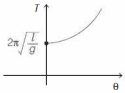
View full question & answer→MCQ 3181 Mark
A gas obeying the equation of state $p V=R T$ undergoes a hypothetical reversible process described by the equation, $p V^{5 / 3} \exp \left(-\frac{p V}{E_{0}}\right)=C_{1}$, where $C_{1}$ and $E_{0}$ are dimensioned constants. Then, for this process, the thermal compressibility at high temperature
AnswerCorrect option: A. approaches a constant value
a
$(a)$ Process equation is
$p V^{\frac{5}{3}} \cdot\left(e^{\frac{-p V}{E_{0}}}\right)=C_{1}$
$\Rightarrow \quad p V^{\frac{5}{3}}=C_{1} e^{\frac{p V}{E_{0}}}$
Taking $\log$ to $e$ base, we have
$\log (p)+\frac{5}{3} \log (V)=\log \left(C_{1}\right)+\frac{p V}{E_{0}}$
Differentiating with respect to volume, we have
$\frac{1}{p} \cdot \frac{d p}{d V}+\frac{5 l}{3 V}=0+\frac{1}{E_{0}}\left(p+\frac{V d p}{d V}\right)$
$\Rightarrow \frac{d p}{p}+\frac{5}{3} \frac{d V}{V}=\frac{1}{E_{0}}(p d V+V d p)$
$\Rightarrow \frac{-d V}{d p}=\frac{\left(\frac{1}{p}-\frac{V}{E_{0}}\right)}{\left(\frac{p}{E_{0}}-\frac{5}{3 V}\right)}$
$\text { As, } p V=R T$
$\Rightarrow \quad-\frac{d V}{d p}=\left(\frac{R T}{\frac{R}{E_{0}}-\frac{5 p}{E_{0}}}\right)$
$\Rightarrow \quad-\frac{1}{V} \frac{d V}{d p} =\frac{(R T}{p\left(\frac{1}{E_{0}}-\frac{5}{3 R T}\right)}$
But this is compressibility of gas, so compressibility,
$k=-\frac{1}{V} \frac{d V}{d p}$
$=\frac{\left(\frac{1}{RT}-\frac{1}{E_{0}}\right)}{p\left(\frac{1}{E_{0}}-\frac{5}{3 R T}\right)}$
As $T \rightarrow \infty, \frac{1}{R T} \rightarrow 0$
So, $k$ approaches a constant value at higher temperatures.
View full question & answer→MCQ 3191 Mark
A container is divided into two equal parts $I$ and $II$ by a partition with a small hole of diameter $d$. The two partitions are filled with same ideal gas, but held at temperatures $T_{ I }=150 \,K$ and $T_{ II }=300 \,K$ by connecting to heat reservoirs. Let $\lambda_{1}$ and $\lambda_{1 I}$ be the mean free paths of the gas particles in the two parts, such that $d >> \lambda_{ I }$ and $d >> \lambda_{ II }$. Then, the $\lambda_{ I } / \lambda_{ II }$ is close to
- A
$0.25$
- B
$0.5$
- ✓
$0.7$
- D
$1.0$
Answerc
$(c)$ In steady state, rate of diffusion of gases must be same from both sides.
$\Rightarrow r_{1}=r_{2}$
$\Rightarrow \frac{P_{ I }}{\sqrt{T_{ I }}}=\frac{P_{ II }}{\sqrt{T_{ II }}}$
Now, mean free path of a gas molecule is
or $\quad \lambda \propto \frac{T}{P}$
So, $\quad \frac{\lambda_{ I }}{\lambda_{ II }}=\frac{T_{ I } / P_{ I }}{T_{ II } / P_{ II }}$
$=\frac{T_{ I }}{T_{ II }} \times \frac{P_{ II }}{P_{ I }}=\frac{T_{ I }}{T_{ II }} \times \frac{\sqrt{T_{ II }}}{\sqrt{T_{ I }}}$
$\Rightarrow \quad \frac{\lambda_{ I }}{\lambda_{\text {II }}}=\frac{\sqrt{T_{ I }}}{\sqrt{T_{ II }}}=\sqrt{\frac{150}{300}}$
$\Rightarrow \quad \frac{\lambda_{ I }}{\lambda_{ II }}=0.7$
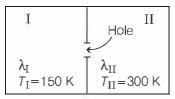
View full question & answer→MCQ 3201 Mark
One mole of a monoatomic ideal gas is expanded by a process described by $p V^3=C$, where $C$ is a constant. The heat capacity of the gas during the process is given by ( $R$ is the gas constant)
- A
$2 R$
- B
$\frac{5}{2} R$
- C
$\frac{3}{2} R$
- ✓
$R$
Answerd
94. (d) For an ideal gas in process, $p V^3=C$ (a constant)
Work done in the process is
$W =\int p d V$
$=\int \frac{C}{V^3} d V=\frac{C V^{-2}}{-2}$
$=\frac{p V^3 \cdot V^{-2}}{-2}=\frac{p V}{-2}$
$\Rightarrow \Delta W=-\frac{n R \Delta T}{2}$
Also, for ideal gas,
$\Delta U=n C_V \Delta T$
So, by first law of thermodynamics, we have
$\Delta Q=\Delta U+\Delta W$
$\Rightarrow \quad n C \Delta T=n C_V \Delta T-\frac{n R \Delta T}{2}$
$\Rightarrow \quad C=C_V-\frac{R}{2} \Rightarrow C=\frac{3}{2} R-\frac{R}{2}=R$
${\left[\therefore \text { for monoatomic ideal gas, } C_V=\frac{3}{2} R\right]}$
$\therefore$ Heat capacity for given process is
$C=R$
View full question & answer→MCQ 3211 Mark
The average distance between molecules of an ideal gas at $STP$ is approximately of the order of
- ✓
$1 \,nm$
- B
$100 \,nm$
- C
$100 \,cm$
- D
$1 \,\mu m$
AnswerCorrect option: A. $1 \,nm$
a
(a)
$1$ mole of an ideal gas has $\sim 10^{24}$ molecules and it occupies $22 L$ or $\sim 22 \times 10^{-3} m ^3$ of space.
So, average spacingbetween molecules is
$\text { nearly } d =\left(\frac{V}{N}\right)^{\frac{1}{3}}=\left(\frac{22 \times 10^{-3}}{10^{24}}\right)^{\frac{1}{3}}$
$\approx 3 \times 10^{-9} \,m$
$\text { or } d=3 \,nm$
So, order will be $1 \,nm$.
View full question & answer→MCQ 3221 Mark
An ideal gas filled in a cylinder occupies volume $V$. The gas is compressed isothermally to the volume $V/3$. Now, the cylinder valve is opened and the gas is allowed to leak keeping temperature same. What percentage of the number of molecules should escape to bring the pressure in the cylinder back to its original value?
- ✓
$66 \%$
- B
$33 \%$
- C
$0.33 \%$
- D
$0.66 \%$
AnswerCorrect option: A. $66 \%$
a
(a)
Initially let pressure is $p$, then
$p V=n_1 R T$
Finally pressure is $p$ and volume is $\frac{V}{3}$.
Let number of moles of gas left is $n_2$, then
$p \frac{V}{3}=n_2 R T$
Dividing both equations, we get
$\frac{n_2}{n_1}=\frac{1}{3} \text { or } 1-\frac{n_2}{n_1}=1-\frac{1}{3} \text { or } n_1-n_2=\frac{2}{3}$
Hence, $\frac{n_1-n_2}{n_1} \times 100=\frac{2}{3} \times 100=66 \%$ or percentage of number of molecules escaped $=66 \%$.
View full question & answer→MCQ 3231 Mark
The equation of state of $n$ moles of a non-ideal gas can be approximated by the equation $\left(p+\frac{n^2 \alpha }{V^2}\right)(V-n b)=n R T$ where $a$ and $b$ are constant characteristics of the gas. Which of the following can represent the equation of a quasistatic adiabat for this gas (assume that, $C_V$ is the molar heat capacity at constant volume is independent of temperature)?
- ✓
$T(V-n b)^{R / C_V}=$ constant
- B
$T(V-n b)^{C_V / R}=$ constant
- C
$\left(T+\frac{a b}{V^2 R}\right)(V-n b)^{R / C_V}=$ constant
- D
$\left(T+\frac{n^2 a b}{V^2 R}\right)(V-n b)^{C_V / R}=$ constant
AnswerCorrect option: A. $T(V-n b)^{R / C_V}=$ constant
a
(a)
Given a van der Waal's gas with state equation, $\left(p+\frac{n^2 a}{V^2}\right)(V-n b)=n R T$
For adiabatic process, $d W=0$
So, from first law of thermodynamics, we have
$d U=d Q+d W$
$\Rightarrow \quad d U-d W=0$
$\Rightarrow d U+p d V=0$
$\Rightarrow\left(\frac{\partial U}{\partial T}\right)_V d T+\left(\frac{\partial U}{\partial V}\right)_T$
$d V+\left(p+\frac{n^2 a}{V^2}\right) d V=0$
$\Rightarrow \quad C_V d T+\left(\frac{n k T}{V-n b}\right) d V=0$
$\Rightarrow \quad C_V \frac{d T}{T}+\left(\frac{n k}{V-n b}\right) d V=0$
Integrating above equation, we get
$\Rightarrow \quad C_V \int \frac{d T}{T}+n k \int \frac{d V}{V-n b}=\text { constant }$
$\Rightarrow \quad \log T^{C_V}+\log (V-n b)^{n k}=C$
$\Rightarrow \quad(V-n b)^R \cdot T^{C_V}=e^C$
$\Rightarrow \quad(V-n b)^{R / C_V \cdot T}=e^{C / C_V}=\text { constant }$
$\therefore \text { Equation for quasistatic adiabatic }$
$\text { process is }(V-n b)^{R / C_V \cdot T}=\text { constant. }$
View full question & answer→MCQ 3241 Mark
The number of air molecules in a $(5 \,m \times 5 \,m \times 4 \,m )$ room at standard temperature and pressure is of the order of
- A
$6 \times 10^{23}$
- B
$3 \times 10^{24}$
- ✓
$3 \times 10^{27}$
- D
$6 \times 10^{30}$
AnswerCorrect option: C. $3 \times 10^{27}$
c
(c)
From ideal gas equation, $p V=n R T \Rightarrow p V=N k_B T$ or $N=\frac{p V}{k_B T}$
Substituting given values, we get
$\Rightarrow N=\frac{10^5 \times 100}{138 \times 10^{-23} \times 273}$
$\Rightarrow N=3 \times 10^{27} \text { molecules }$
View full question & answer→MCQ 3251 Mark
We sit in the room with windows open. Then,
- A
air pressure on the floor of the room equals the atmospheric pressure but the air pressure on the ceiling is negligible
- ✓
air pressure is nearly the same on the floor, the walls and the ceiling
- C
air pressure on the floor equals the weight of the air column inside the room (from floor to ceiling) per unit area
- D
air pressure on the walls is zero, since the weight of air acts downward
AnswerCorrect option: B. air pressure is nearly the same on the floor, the walls and the ceiling
b
(b)
Gas molecules move randomly and effect of gravity on them is insignificantly low. So, pressure exerted by gas molecules is same everywhere.
View full question & answer→MCQ 3261 Mark
Two bulbs of identical volumes connected by a small capillary are initially filled with an ideal gas at temperature $T$. Bulb $2$ is heated to maintain a temperature $2 T$, while bulb $1$ remains at temperature $T$. Assume throughout that the heat conduction by the capillary is negligible. Then, the ratio of final mass of the gas in bulb $2$ to the initial mass of the gas in the same bulb is close to
- A
$1 / 2$
- ✓
$2 / 3$
- C
$1 / 3$
- D
$1$
AnswerCorrect option: B. $2 / 3$
b
(b)
Let $n=$ number of moles of gas in both of the bulbs and capillary.
When bulbs are maintained at different temperatures, let number of moles are $n_1$ and $n_2$ in bulbs at temperatures $T$ and $2 T$, respectively.
As gas is ideal,
$n_1=\frac{p V}{R T} \text { and } n_2=\frac{p V}{R(2 T)} \Rightarrow \frac{n_1}{n_2}=\frac{2}{1}$
Also, $\quad n_1+n_2=n$
$\Rightarrow \quad n_1=\frac{2 n}{3} \text { and } n_2=\frac{n}{3}$
Now, ratio of final mass of gas in bulb $2$ to the initial mass of gas in same bulb is
$=\frac{\text { Mass of gas finally in bulb } 2}{\text { Mass of gas initially in bulb } 2}$
$=\frac{\text { Number of moles finally present in bulb } 2}{\text { Number of moles initially present in bulb } 2}$
$=\frac{n / 3}{n / 2}=\frac{2}{3}$
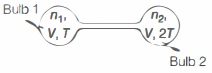
View full question & answer→MCQ 3271 Mark
A container with rigid walls is covered with perfectly insulating material. The container is divided into two parts by a partition. One part contains a gas while the other is fully evacuated (vacuum). The partition is suddenly removed. The gas rushes to fill the entire volume and comes to equilibrium after a little time. If the gas is not ideal, then
- ✓
the initial internal energy of the gas equals its final internal energy
- B
the initial temperature of the gas equals its final temperature
- C
the initial pressure of the gas equals its final pressure
- D
the initial entropy of the gas equals its final entropy
AnswerCorrect option: A. the initial internal energy of the gas equals its final internal energy
a
(a)
Expansion is in vacuum, so work done by expanding gas is $\Delta W=0$.
Container is insulated, so heat exchanged with surroundings is $\Delta Q=0$.
Now, from first law of thermodynamics, we have
$\Rightarrow \Delta Q=\Delta U+\Delta W$
$\Rightarrow \Delta U=0$
$\Rightarrow U_i=U_f$
Hence, initial and final internal energies of gas are equal.
As, the gas is not ideal expansion results in reduction of pressure, so intermolecular potential energy increases. This results in reduction of kinetic energy, so temperature reduces.
View full question & answer→MCQ 3281 Mark
In a thermally isolated system, two boxes filled with an ideal gas are connected by a valve. When the valve is in closed position, states of the box $1$ and $2$ respectively, are ( $1 \,atm , V, T)$ and $(0.5 \,atm , 4 V, T)$. When the valve is opened, then the final pressure of the system is approximately ............... $atm$
- A
$0.5$
- ✓
$0.6$
- C
$0.75$
- D
$1.0$
Answerb
(b)
Given situation is
Let final temperature after opening the valve is $T_f$, then $\Delta W_{\text {ext }}=0$ and $\Delta Q_{\text {ext }}=0$ So, from first law of thermodynamics,
$\Delta U=0$
$\Rightarrow n_1 C_V T+n_2 C_V T=\left(n_1+n_2\right) C_V T_f$
$\Rightarrow T_f=T$
Now, by gas equation, we have
$\text { As, } n_1+n_2=n$
$\Rightarrow \frac{V}{R T}+\frac{4 V \times 0.5}{R T} =\frac{5 V \times p_1}{R T}$
$\Rightarrow p =0.6 \,atm$
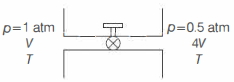
View full question & answer→MCQ 3291 Mark
Velocity of sound measured at a given temperature in oxygen and hydrogen is in the ratio
- ✓
$1: 4$
- B
$4: 1$
- C
$1: 1$
- D
$32: 1$
AnswerCorrect option: A. $1: 4$
a
(a)
Velocity of sound in a gascous medium is
$\quad v=\sqrt{\frac{\gamma R T}{M}}$
$\Rightarrow \quad v \propto \frac{1}{\sqrt{M}}$
$\text { So, } \quad \frac{v_{\text {Oxygen }}}{v_{\text {Hydrogen }}}=\sqrt{\frac{M_{ H }}{M_0}}=\sqrt{\frac{2}{32}}$
$\Rightarrow \quad \frac{v_{\text {Oxygen }}}{v_{\text {Hydrogen }}}=\frac{1}{4}$
View full question & answer→MCQ 3301 Mark
An ideal gas with heat capacity at constant volume $C_V$ undergoes a quasistatic process described by $p V^{\alpha}$ in a $p-V$ diagram, where $\alpha$ is a constant. The heat capacity of the gas during this process is given by
AnswerCorrect option: C. $C_V+\frac{n R}{1-\alpha}$
c
(c)
Process equation is
$p V^\alpha=\text { constant }(k) \Rightarrow p=\frac{k}{V^\alpha}$
Work done by the gas in given process is
$\Delta W=\int \limits_{V_i}^{V_f} p d V$
$=\int \limits_{V_i}^{V_f} k d V$
$\left.=\left[\frac{p V}{1-\alpha}\right]_{V_i}^{V_f}=\frac{p\left(V^{1-\alpha}\right.}{1-\alpha}\right]_{V_i}^{V_f}$
$=\frac{p \Delta V}{1-\alpha}=\frac{n R \Delta T}{1-\alpha}$
The change of internal energy of gas in this process will be
$\Delta U=C_V \Delta T$
And if $\Delta Q$ is heat supplied to the gas then,
$\Delta Q=C \Delta T$
Now, by first law of thermodynamics, we have
$\Delta Q=\Delta U+\Delta W$
$\Rightarrow \quad C \Delta T=C_V \Delta T+\frac{n R \Delta T}{1-\alpha}$
Heat capacity of the gas is
$\Rightarrow \quad C=C_V+\frac{n R}{1-\alpha}$
View full question & answer→MCQ 3311 Mark
The molecules of air in the room that you are sitting are all experiencing the force of gravity tending to bring them down. The molecules are also frequently and randomly undergoing collisions, which tend to oppose the effect of fall under gravity. The density of air is nearly uniform throughout the room because
- A
the mass of the molecules is very small
- ✓
the gravitational potential energy $m g h$ is much lesser than the average thermal energy $k T$
- C
the gravitational potential energy $m g h$ is much greater than the average thermal energy $k T$
- D
$m g h$ is nearly of the same magnitude as $k T$, which results in the cancellation of the two opposing factors
AnswerCorrect option: B. the gravitational potential energy $m g h$ is much lesser than the average thermal energy $k T$
b
(b)
Gas molecules does not settle in room because they have too much kinetic encrgy $\left(k_B T > m g h\right)$.
If heat energy is dissipated or extracted from that room, gas molecules does settle down. For example, earth's atmosphere is more denser near the surface. So, correct option is (b).
View full question & answer→MCQ 3321 Mark
The relation $C_p-C_V=R\left(C_p\right.$ and $C_V$ are the molar specific heats at constant pressure and volume) is exactly true for
- A
- ✓
any ideal gas, whether monoatomic, diatomic or polyatomic
- C
any real gas above its critical temperature
- D
AnswerCorrect option: B. any ideal gas, whether monoatomic, diatomic or polyatomic
b
(b)
Mayer's relation,
$C_p-C_V=R$ is true only for ideal gases whether they are monoatomic, diatomic or polyatomic as for real gases.
$C_p-C_V=T V \beta^2 k$
where, $k=$ isothermal compressibility and $\beta=$ isobaric thermal expansion coefficient.
So, correct option is $(b)$.
View full question & answer→MCQ 3331 Mark
The temperature of a gas having $2.0 \times 10^{25}$ molecules per cubic meter at $1.38 \mathrm{~atm}$ (Given, $\mathrm{k}=$ $\left.1.38 \times 10^{-23} \mathrm{JK}^{-1}\right)$ is :
- ✓
$500 \mathrm{~K}$
- B
$200 \mathrm{~K}$
- C
$100 \mathrm{~K}$
- D
$300 \mathrm{~K}$
AnswerCorrect option: A. $500 \mathrm{~K}$
a
$ \mathrm{PV}=\mathrm{nRT} $
$ \mathrm{PV}=\frac{\mathrm{N}}{\mathrm{N}_{\mathrm{A}}} \mathrm{RT}$
$\mathrm{N}=$ Total no. of molecules
$\mathrm{P}=\frac{\mathrm{N}}{\mathrm{V}} \mathrm{kT}$
$1.38 \times 1.01 \times 10^5=2 \times 10^{25} \times 1.38 \times 10^{-23} \times \mathrm{T}$
$1.01 \times 10^5=2 \times 10^2 \times \mathrm{T}$
$\mathrm{T}=\frac{1.01 \times 10^3}{2} \approx 500 \mathrm{~K}$
View full question & answer→MCQ 3341 Mark
$P-T$ diagram of an ideal gas having three different densities $\rho_1, \rho_2, \rho_3$ (in three different cases) is shown in the figure. Which of the following is correct :
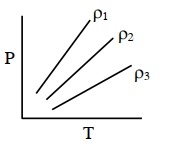
- A
$\rho_2<\rho_3$
- ✓
$\rho_1>\rho_2$
- C
$\rho_1<\rho_2$
- D
$\rho_1=\rho_2=\rho_3$
AnswerCorrect option: B. $\rho_1>\rho_2$
b
For ideal gas
$P V=n R T$
$P V=\frac{m}{M} R T$
$P=\left(\frac{M}{V}\right) \frac{R T}{M}$
$P=\frac{\rho R T}{M}$
(Where $\mathrm{m}$ is mass of gas and $\mathrm{M}$ is molecular mass of gas)
for same temperature $\mathrm{P}_1>\mathrm{P}_2>\mathrm{P}_3$
So $\rho_1>\rho_2>\rho_3$
So correct answer is $(2)$
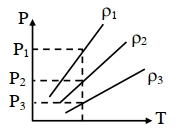
View full question & answer→MCQ 3351 Mark
The average kinetic energy of a monatomic molecule is $0.414 \mathrm{eV}$ at temperature :
(Use $\mathrm{K}_{\mathrm{B}}=1.38 \times 10^{-23} \mathrm{~J} / \mathrm{mol}-\mathrm{K}$ )
- A
$3000 \mathrm{~K}$
- ✓
$3200 \mathrm{~K}$
- C
$1600 \mathrm{~K}$
- D
$1500 \mathrm{~K}$
AnswerCorrect option: B. $3200 \mathrm{~K}$
b
For monoatomic molecule degree of freedom $=3$.
$ \therefore \mathrm{K}_{v-\mathrm{g}}=\frac{3}{2} \mathrm{~K}_{\mathrm{B}} \mathrm{T} $
$ \mathrm{T}=\frac{0.414 \times 1.6 \times 10^{-19} \times 2}{3 \times 1.38 \times 10^{-23}} $
$ =3200 \mathrm{~K}$
View full question & answer→MCQ 3361 Mark
The total kinetic energy of $1$ mole of oxygen at $27^{\circ} \mathrm{C}$ is :
[Use universal gas constant $(R)=8.31 \mathrm{~J} / \mathrm{mole} \mathrm{K}$ ]
- A
$6845.5 \mathrm{~J}$
- B
$5942.0 \mathrm{~J}$
- ✓
$6232.5 \mathrm{~J}$
- D
$5670.5 \mathrm{~J}$
AnswerCorrect option: C. $6232.5 \mathrm{~J}$
c
$ \text { Kinetic energy }=\frac{f}{2} \mathrm{nRT} $
$ =\frac{5}{2} \times 1 \times 8.31 \times 300 \mathrm{~J} $
$ =6232.5 \mathrm{~J}$
View full question & answer→MCQ 3371 Mark
An object is placed in a medium of refractive index $3$. An electromagnetic wave of intensity $6 \times 10^8 \mathrm{~W} / \mathrm{m}^2$ falls normally on the object and it is absorbed completely. The radiation pressure on the object would be (speed of light in free space $=3 \times 10^8 \mathrm{~m} / \mathrm{s}$ ):
- A
$36\ \mathrm{Nm}^{-2}$
- B
$18\ \mathrm{Nm}^{-2}$
- ✓
$6 \ \mathrm{Nm}^{-2}$
- D
$2\ \mathrm{Nm}^{-2}$
AnswerCorrect option: C. $6 \ \mathrm{Nm}^{-2}$
c
$ \text { Radiation pressure }=\frac{I}{V} $
$ =\frac{I \cdot \mu}{c} $
$ =\frac{6 \times 10^8 \times 3}{3 \times 10^8} $
$ =6 \mathrm{~N} / \mathrm{m}^2$
View full question & answer→MCQ 3381 Mark
Two vessels $A$ and $B$ are of the same size and are at same temperature. A contains $1 \mathrm{~g}$ of hydrogen and $B$ contains $1 \mathrm{~g}$ of oxygen. $\mathrm{P}_{\mathrm{A}}$ and $\mathrm{P}_{\mathrm{B}}$ are the pressures of the gases in $A$ and $\mathrm{B}$ respectively, then $\frac{\mathrm{P}_{\mathrm{A}}}{\mathrm{P}_{\mathrm{B}}}$ is:
Answera
$\frac{\mathrm{P}_{\mathrm{A}} \mathrm{V}_{\mathrm{A}}}{\mathrm{P}_{\mathrm{B}} \mathrm{V}_{\mathrm{B}}}=\frac{\mathrm{n}_{\mathrm{A}} R \mathrm{RT}_{\mathrm{A}}}{\mathrm{n}_{\mathrm{B}} \mathrm{RT}_{\mathrm{B}}}$
Given $V_A=V_B$
And $T_{\mathrm{A}}=T_{\mathrm{B}}$
$\frac{\mathrm{P}_{\mathrm{A}}}{\mathrm{P}_{\mathrm{B}}}=\frac{\mathrm{n}_{\mathrm{A}}}{\mathrm{n}_{\mathrm{B}}}$
$\frac{\mathrm{P}_{\mathrm{A}}}{\mathrm{P}_{\mathrm{B}}}=\frac{1 / 2}{1 / 32}=16$
View full question & answer→MCQ 3391 Mark
The parameter that remains the same for molecules of all gases at a given temperature is :
Answera
$\mathrm{KE}=\frac{\mathrm{f}}{2} \mathrm{kT}$
Conceptual
View full question & answer→MCQ 3401 Mark
Energy of $10$ non rigid diatomic molecules at temperature $\mathrm{T}$ is :
- A
$\frac{7}{2} \mathrm{RT}$
- B
$70 \mathrm{~K}_{\mathrm{B}} \mathrm{T}$
- C
$35 \mathrm{RT}$
- ✓
$35 \mathrm{~K}_{\mathrm{B}} \mathrm{T}$
AnswerCorrect option: D. $35 \mathrm{~K}_{\mathrm{B}} \mathrm{T}$
d
$\text { Degree of freedom }(f)=5+2(3 N-5)$
$\qquad f=5+2(3 \times 2-1)=7$
$\text { energy of one molecule }=\frac{f}{2} K_B T$
energy of 10 molecules
$=10\left(\frac{\mathrm{f}}{2} \mathrm{~K}_{\mathrm{B}} \mathrm{T}\right)=10\left(\frac{7}{2} \mathrm{~K}_{\mathrm{B}} \mathrm{T}\right)=35 \mathrm{~K}_{\mathrm{B}} \mathrm{T}$
View full question & answer→MCQ 3411 Mark
The temperature of a gas is $-78^{\circ} \mathrm{C}$ and the average translational kinetic energy of its molecules is $\mathrm{K}$. The temperature at which the average translational kinetic energy of the molecules of the same gas becomes $2 \mathrm{~K}$ is :
- A
$-39^{\circ} \mathrm{C}$
- ✓
$117^{\circ} \mathrm{C}$
- C
$127^{\circ} \mathrm{C}$
- D
$-78^{\circ} \mathrm{C}$
AnswerCorrect option: B. $117^{\circ} \mathrm{C}$
b
$\mathrm{K} . \mathrm{E}=\frac{\mathrm{nf}_1 \mathrm{RT}}{2}$
$\mathrm{~T}_{\mathrm{i}}=-78^{\circ} \mathrm{C} \rightarrow 273+\left[-78^{\circ} \mathrm{C}\right]=195 \mathrm{~K}$
$\mathrm{~K} . \mathrm{E} \alpha \mathrm{T}$
To double the $K.E$ energy temp also
$\text { become double }$
$\mathrm{T}_{\mathrm{f}}=390 \mathrm{~K}$
$\mathrm{~T}_{\mathrm{f}}=117^{\circ} \mathrm{C}$
View full question & answer→MCQ 3421 Mark
At which temperature the r.m.s. velocity of a hydrogen molecule equal to that of an oxygen molecule at $47^{\circ} \mathrm{C}$ ?
- A
$80 \mathrm{~K}$
- B
$-73 \mathrm{~K}$
- C
$4 \mathrm{~K}$
- ✓
$20 \mathrm{~K}$
AnswerCorrect option: D. $20 \mathrm{~K}$
d
$ \sqrt{\frac{3 R T}{2}}=\sqrt{\frac{3 R(320)}{32}} $
$ T=\frac{320}{16}=20 \mathrm{~K}$
View full question & answer→MCQ 3431 Mark
If the root mean square velocity of hydrogen molecule at a given temperature and pressure is $2 \mathrm{~km} / \mathrm{s}$, the root mean square velocity of oxygen at the same condition in $\mathrm{km} / \mathrm{s}$ is :
- A
$2.0$
- ✓
$0.5$
- C
$1.5$
- D
$1.0$
Answerb
$V_{1 \mathrm{~ms}}=\sqrt{\frac{3 \mathrm{RT}}{\mathrm{M}}}$
$\frac{\mathrm{V}_1}{\mathrm{~V}_2}=\sqrt{\frac{\mathrm{M}_2}{\mathrm{M}_1}} \Rightarrow \frac{2}{\mathrm{~V}_2}=\sqrt{\frac{32}{2}}$
$\mathrm{~V}_2=0.5 \mathrm{~km} / \mathrm{s}$
View full question & answer→MCQ 3441 Mark
A sample contains mixture of helium and oxygen gas. The ratio of root mean square speed of helium and oxygen in the sample, is:
- A
$\frac{1}{32}$
- ✓
$\frac{2 \sqrt{2}}{1}$
- C
$\frac{1}{4}$
- D
$\frac{1}{2 \sqrt{2}}$
AnswerCorrect option: B. $\frac{2 \sqrt{2}}{1}$
b
$\mathrm{V}_{\mathrm{rms}} =\sqrt{\frac{3 \mathrm{RT}}{\mathrm{M}_{\mathrm{w}}}}$
$\Rightarrow \frac{\mathrm{V}_{\mathrm{O}_2}}{\mathrm{~V}_{\mathrm{He}}}$ $=\sqrt{\frac{\mathrm{M}_{\mathrm{w}, \mathrm{He}}}{\mathrm{M}_{\mathrm{w}, \mathrm{O}_2}}}$
$=\sqrt{\frac{4}{32}}=\frac{1}{2 \sqrt{2}}$
$\frac{\mathrm{V}_{\mathrm{He}}}{\mathrm{V}_{\mathrm{O}_2}} =\frac{2 \sqrt{2}}{1}$
View full question & answer→MCQ 3451 Mark
The translational degrees of freedom $(f)$ and rotational degrees of freedom $(f)$ of $\mathrm{CH}_4$ molecule are:
- A
$f=2$ and $f=2$
- ✓
$f_t=3$ and $f=3$
- C
$f=3$ and $f=2$
- D
$f=2$ and $f=3$
AnswerCorrect option: B. $f_t=3$ and $f=3$
b
$\text { Since } \mathrm{CH}_4 \text { is polyatomic Non-Linear }$
$\text { D.O.F of } \mathrm{CH}_4$
$\text { T. DOF }=3$
$\text { R DOF }=3$
View full question & answer→MCQ 3461 Mark
During an adiabatic process, the pressure of a gas is found to be proportional to the cube of its absolute temperature. The ratio of $\frac{C_p}{C_v}$ for the gas is:
- A
$\frac{5}{3}$
- ✓
$\frac{3}{2}$
- C
$\frac{7}{5}$
- D
$\frac{9}{7}$
AnswerCorrect option: B. $\frac{3}{2}$
b
$ \mathrm{P} \propto \mathrm{T}^3 \Rightarrow \mathrm{PT}^{-3}=\text { constant } $
$ \mathrm{PV}^\gamma=\text { const } $
$ \mathrm{P}\left(\frac{\mathrm{nRT}}{\mathrm{P}}\right)^\gamma=\text { const } $
$ \mathrm{P}^{1-\gamma} \mathrm{T}^\gamma=\text { const }$
$ \mathrm{PT}^{\frac{\gamma}{1-\gamma}}=\text { const } $
$ \frac{\gamma}{1-\gamma}=-3 $
$ \gamma=-3+3 \gamma $
$ 3=2 \gamma $
$ \gamma=\frac{3}{2}$
View full question & answer→MCQ 3471 Mark
Two thermodynamical process are shown in the figure. The molar heat capacity for process $A$ and $B$ are $C_A$ and $C_B$. The molar heat capacity at constant pressure and constant volume are represented by $C_P$ and $C_V$, respectively. Choose the correct statement.
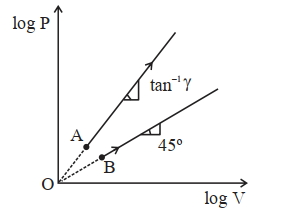
- A
$C_B=\infty, C_A=0$
- B
$C_A=0$ and $C_B=\infty$
- ✓
$C_P>C_B>C_A>C_v$
- D
$C_A>C_P>C_V$
AnswerCorrect option: C. $C_P>C_B>C_A>C_v$
c
For process $\mathrm{A}$
$ \log P=\gamma \log \mathrm{V} \Rightarrow \mathrm{P}=\mathrm{V}^\gamma,(\gamma>1) $
$ P V^{-\gamma}=\text { Constant } $
$ C_A=C_V+\frac{R}{1+\gamma} \ldots . \text { (i) }$
Likewise for process $\mathrm{B} \rightarrow P V^{-1}=$ $Cons$ $\tan t$
$C_B$ $ =C_v+\frac{R}{1+1} $
$C_B$ $ =C_v+\frac{R}{2} $ $.............(ii)$
$C_P$ $=C_v+R$ $...........(iii)$
By $(i)$, $(ii)$ & $(iii)$ $C_P>C_B>C_A>C_v$ [No answer matching]
View full question & answer→MCQ 3481 Mark
A mixture of one mole of monoatomic gas and one mole of a diatomic gas (rigid) are kept at room temperature $\left(27^{\circ} \mathrm{C}\right)$. The ratio of specific heat of gases at constant volume respectively is:
- A
$\frac{7}{5}$
- B
$\frac{3}{2}$
- ✓
$\frac{3}{5}$
- D
$\frac{5}{3}$
AnswerCorrect option: C. $\frac{3}{5}$
c
$\frac{\left(\mathrm{C}_{\mathrm{v}}\right)_{\text {mono }}}{\left(\mathrm{C}_{\mathrm{v}}\right)_{\text {dia }}}=\frac{\frac{3}{2} \mathrm{R}}{\frac{5}{2} \mathrm{R}}=\frac{3}{5}$
View full question & answer→MCQ 3491 Mark
A diatomic gas $(\gamma=1.4)$ does $100 \mathrm{~J}$ of work in an isobaric expansion. The heat given to the gas is :
- ✓
$350 \mathrm{~J}$
- B
$490 \mathrm{~J}$
- C
$150 \mathrm{~J}$
- D
$250 \mathrm{~J}$
AnswerCorrect option: A. $350 \mathrm{~J}$
a
For Isobaric process
$\mathrm{w}=\mathrm{P} \Delta \mathrm{v}=\mathrm{nR} \Delta \mathrm{T}=100 \mathrm{~J}$
$\mathrm{Q}=\Delta \mathrm{u}+\mathrm{w}$
$\Delta \mathrm{Q}=\frac{\mathrm{F}}{2} \mathrm{nR} \Delta \mathrm{T}+\mathrm{nR} \Delta \mathrm{T}$
$\left(\frac{\mathrm{f}}{2}+1\right) \mathrm{nR} \Delta \mathrm{T}$
$\left(\frac{5}{2}+1\right) 100=350 \mathrm{~J}$
View full question & answer→MCQ 3501 Mark
$\mathrm{N}$ moles of a polyatomic gas $(f=6)$ must be mixed with two moles of a monoatomic gas so that the mixture behaves as a diatomic gas. The value of $\mathrm{N}$ is:
Answerc
$\mathrm{f}_{\mathrm{eq}}=\frac{\mathrm{n}_1 \mathrm{f}_1+\mathrm{n}_2 \mathrm{f}_2}{\mathrm{n}_1+\mathrm{n}_2}$
For diatomic gas $\mathrm{f}_{\mathrm{eq}}=5$
$ 5=\frac{(N)(6)+(2)(3)}{N+2} $
$ 5 N+10=6 N+6 $
$ N=4$
View full question & answer→MCQ 3511 Mark
If three moles of monoatomic gas $\left(\gamma=\frac{5}{3}\right)$ is mixed with two moles of a diatomic gas $\left(\gamma=\frac{7}{5}\right)$, the value of adiabatic exponent $\gamma$ for the mixture is:
- A
$1.75$
- B
$1.40$
- ✓
$1.52$
- D
$1.35$
AnswerCorrect option: C. $1.52$
c
$\mathrm{f}_1=3, \quad \mathrm{f}_2=5$
$\mathrm{n}_1=3, \quad \mathrm{n}_2=2$
$\mathrm{f}_{\text {mixture }}=\frac{\mathrm{n}_1 \mathrm{f}_1+\mathrm{n}_2 \mathrm{f}_2}{\mathrm{n}_1+\mathrm{n}_2}=\frac{9+10}{\mathrm{f}}=\frac{19}{5}$
$\gamma_{\text {mixture }}=1+\frac{2 \times 5}{19}=\frac{29}{19}=1.52$
View full question & answer→MCQ 3521 Mark
Two moles a monoatomic gas is mixed with six moles of a diatomic gas. The molar specific heat of the mixture at constant volume is:
- ✓
$\frac{9}{4} R$
- B
$\frac{7}{4} R$
- C
$\frac{3}{2} R$
- D
$\frac{5}{2} R$
AnswerCorrect option: A. $\frac{9}{4} R$
a
$ \mathrm{C}_{\mathrm{V}} $$ =\frac{\mathrm{n}_1 \mathrm{C}_{\mathrm{r}_1}+\mathrm{n}_2 \mathrm{C}_{\mathrm{r}_2}}{\mathrm{n}_1+\mathrm{n}_2} $
$ =\frac{2 \times \frac{3}{2} \mathrm{R}+6 \times \frac{5}{2} \mathrm{R}}{2+6} $
$ =\frac{9}{4} \mathrm{R}$
View full question & answer→MCQ 3531 Mark
If the collision frequency of hydrogen molecules in a closed chamber at $27^{\circ} \mathrm{C}$ is $\mathrm{Z}$, then the collision frequency of the same system at $127^{\circ} \mathrm{C}$ is :
AnswerCorrect option: C. $\frac{2}{\sqrt{3}} \mathrm{Z}$
c
Assuming mean free path constant.
$\mathrm{f} \propto \mathrm{v} \propto \sqrt{\mathrm{T}}$
$\frac{\mathrm{f}_1}{\mathrm{f}_2}=\sqrt{\frac{\mathrm{T}_1}{\mathrm{~T}_2}}=\sqrt{\frac{300}{400}}$
$\mathrm{f}_2=\sqrt{\frac{4}{3}}=\mathrm{f}_1=\frac{2}{\sqrt{3}} \mathrm{Z}$
View full question & answer→MCQ 3541 Mark
If $\mathrm{n}$ is the number density and $\mathrm{d}$ is the diameter of the molecule, then the average distance covered by a molecule between two successive collisions (i.e. mean free path) is represented by :
- A
$\frac{1}{\sqrt{2 n \pi d^2}}$
- B
$\sqrt{2} \mathrm{n} \pi \mathrm{d}^2$
- ✓
$\frac{1}{\sqrt{2} \mathrm{n} \pi \mathrm{d}^2}$
- D
$\frac{1}{\sqrt{2} n^2 \pi^2 d^2}$
AnswerCorrect option: C. $\frac{1}{\sqrt{2} \mathrm{n} \pi \mathrm{d}^2}$
c
$\mathrm{n}=$ number of molecule per unit volume
$\mathrm{d}=$ diameter of the molecule
$\lambda=\frac{1}{\sqrt{2} \pi \mathrm{d}^2 \mathrm{n}}$ (By Theory)
View full question & answer→MCQ 3551 Mark
Given below are two statements :
Statement $(I)$ : The mean free path of gas molecules is inversely proportional to square of molecular diameter.
Statement $(II)$ : Average kinetic energy of gas molecules is directly proportional to absolute temperature of gas.
In the light of the above statements, choose the correct answer from the option given below:
- A
Statement $I$ is false but Statement $II$ is true.
- ✓
Statement $I$ is true but Statement $II$ is false.
- C
Both Statement $I$ and Statement $II$ are false
- D
Both Statement $I$ and Statement $II$ are true.
AnswerCorrect option: B. Statement $I$ is true but Statement $II$ is false.
b
$\lambda=\frac{\mathrm{RT}}{\sqrt{2} \pi \mathrm{d}^2 \mathrm{~N}_{\mathrm{A}} \mathrm{P}}$
$\mathrm{KE}=\frac{\mathrm{f}}{2} \mathrm{nRT}$
View full question & answer→MCQ 3561 Mark
For three low density gases $A, B, C$ pressure versus temperature graphs are plotted while keeping them at constant volume, as shown in the figure.
The temperature corresponding to the point ' $K$ ' is $...........\,{}^{\circ}\,C$
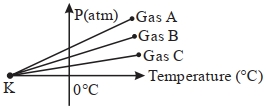
- ✓
$-273$
- B
$-100$
- C
$-373$
- D
$-40$
AnswerCorrect option: A. $-273$
a
For isochoric process
$\frac{ P }{ T }= n \frac{ R }{ V }= constan t$
$P =\frac{ nR }{ V }( t +273)$
If $P =0 \Rightarrow t =-273^{\circ}\,C$
View full question & answer→MCQ 3571 Mark
Given below are two statements:
Statements $I:$ The temperature of a gas is $-73^{\circ}\,C$. When the gas is heated to $527^{\circ}\,C$, the root mean square speed of the molecules is doubled.
Statement $II:$ The product of pressure and volume of an ideal gas will be equal to translational kinetic energy of the molecules.
In the light of the above statements, choose the correct answer from the options given below :
- A
Both statement $I$ and Statement $II$ are true
- ✓
Statement $I$ is true but Statement $II$ is false
- C
Both Statement $I$ and Statement $II$ are false
- D
Statement $I$ is false but Statement $II$ is true
AnswerCorrect option: B. Statement $I$ is true but Statement $II$ is false
b
Statement$-I$
$T _1=-73^{\circ}\,C =200\,K$
$T _2=527^{\circ}\,C =800\,K$
$\frac{ V _1}{ V _2}=\frac{\sqrt{\frac{3 RT _1}{ M }}}{\sqrt{\frac{3 RT _2}{ M }}}=\sqrt{\frac{ T _1}{ T _2}}$
$=\sqrt{\frac{200}{800}}=\frac{1}{2}$
$V _2=2 V _1 \text { (True) }$
Statement$-II$
$PV = nRT$
Translational $KE =\frac{3}{2} nRT$ (False)
View full question & answer→MCQ 3581 Mark
A flask contains Hydrogen and Argon in the ratio $2: 1$ by mass. The temperature of the mixture is $30^{\circ} C$. The ratio of average kinetic energy per molecule of the two gases ( $K$ argon/ $K$ hydrogen) is: (Given: Atomic Weight of $Ar = 39.9$)
- ✓
$1$
- B
$2$
- C
$\frac{39.9}{2}$
- D
$39.9$
Answera
Average $KE$ per molecule $=\frac{3}{2} kT$
$\frac{ K _{ AS }}{ K _{ H }}=\frac{1}{1}$
View full question & answer→MCQ 3591 Mark
At $300\,K$, the rms speed of oxygen molecules is $\sqrt{\frac{\alpha+5}{\alpha}}$ times to that of its average speed in the gas. Then, the value of $\alpha$ will be (used $\pi=\frac{22}{7}$ )
Answerb
$\sqrt{\frac{3 RT }{ M }}=\sqrt{\frac{\alpha+5}{\alpha}} \sqrt{\frac{8}{\pi} \frac{ RT }{ M }}$
$3=\frac{\alpha+5}{\alpha} \frac{8}{\pi}$
$\alpha=28$
View full question & answer→MCQ 3601 Mark
The number of air molecules per $\mathrm{cm}^3$ increased from $3 \times 10^{19}$ to $12 \times 10^{19}$. The ratio of collision frequency of air molecules before and after the increase in number respectively is $.........$
- A
$1.25$
- ✓
$0.25$
- C
$0.75$
- D
$0.50$
AnswerCorrect option: B. $0.25$
b
Collision frequency,
$\mathrm{f}=\frac{\mathrm{V}}{\lambda}=\frac{\mathrm{V}}{\left(\frac{1}{\sqrt{2} \pi \mathrm{d}^2 \mathrm{n}_\psi}\right)}=\sqrt{2} \pi \mathrm{d}^2 \mathrm{vn}_v$
$\therefore \mathrm{f} \propto \mathrm{n}_{\mathrm{v}}, \mathrm{n}_{\mathrm{v}}$ is number density
$\frac{\mathrm{f}_1}{\mathrm{f}_2}=\frac{\mathrm{n}_{\mathrm{r}_1}}{\mathrm{n}_{r_2}}=\frac{3 \times 10^{19}}{12 \times 10^{-19}}=0.25$
View full question & answer→MCQ 3611 Mark
Three vessels of equal volume contain gases at the same temperature and pressure. The first vessel contains neon (monoatomic), the second contains chlorine (diatomic) and third contains uranium hexafloride (polyatomic). Arrange these on the basis of their root mean square speed $\left(v_{ ms }\right)$ and choose the correct answer from the options given below:
- A
$v _{ rms }($ mono $)= v _{ rms }($ dia $)= v _{rms}($ poly $)$
- ✓
$v _{rms}($ mono $) > v _{rms}($ dia $) > v _{rms}$ (poly)
- C
$v _{rms}($ dia $) < v _{rms}($ poly $) < v _{rms}($ mono $)$
- D
$v _{ rms }( mono ) < v _{rms}( dia ) < v _{ rms }$ (poly $)$
AnswerCorrect option: B. $v _{rms}($ mono $) > v _{rms}($ dia $) > v _{rms}$ (poly)
b
$v _{ rms }(\text { mono })=\sqrt{\frac{3 RT }{4 \times 10^{-3}}}$
$v _{ rms }(\text { dia })=\sqrt{\frac{3 RT }{71 \times 10^{-3}}}$
$v _{ rms }( ply )=\sqrt{\frac{3 RT }{146 \times 10^{-3}}}$
So correct relation is
$v _{ rms }(\text { mono }) > v _{ rms }(\text { dia }) > v _{ rms }(\text { poly })$
View full question & answer→MCQ 3621 Mark
The rms speed of oxygen molecule in a vessel at particular temperature is $\left(1+\frac{5}{x}\right)^{\frac{1}{2}} v$, where $v$ is the average speed of the molecule. The value of $x$ will be:(Take $\pi=\frac{22}{7}$ )
Answera
$\sqrt{\frac{3 RT }{ M }}=\left(1+\frac{5}{ x }\right)^{\frac{1}{2}} \sqrt{\frac{8 RT }{\pi M }}$
$\Rightarrow \frac{3 \times 22}{7 \times 8}=1+\frac{5}{ x }$
$\Rightarrow x =28$
View full question & answer→MCQ 3631 Mark
Let $\gamma_1$ be the ratio of molar specific heat at constant pressure and molar specific heat at constant volume of a monoatomic gas and $\gamma_2$ be the similar ratio of diatomic gas. Considering the diatomic gas molecule as a rigid rotator, the ratio, $\frac{\gamma_1}{\gamma_2}$ is
- A
$\frac{27}{35}$
- B
$\frac{35}{27}$
- ✓
$\frac{25}{21}$
- D
$\frac{21}{25}$
AnswerCorrect option: C. $\frac{25}{21}$
c
For monoatomic gas
$\gamma_1=\frac{5}{3}$
For diatomic gas at low temperatures
$\gamma _2=\frac{7}{5}$
$\therefore \frac{\gamma_1}{\gamma_2}=\frac{\frac{5}{3}}{\frac{7}{5}}=\frac{25}{21}$
View full question & answer→MCQ 3641 Mark
The correct relation between $\gamma=\frac{ C _p}{ c _v}$ and temperature $T$ is :
- A
$\gamma \propto \frac{1}{\sqrt{ T }}$
- ✓
$\gamma \propto T ^{\circ}$
- C
$\gamma \propto \frac{1}{T}$
- D
$\gamma \propto T$
AnswerCorrect option: B. $\gamma \propto T ^{\circ}$
b
$\gamma$ is independent of temperature
View full question & answer→MCQ 3651 Mark
Match List$-I$ with List$-II:$
| List$-I$ |
List$-II$ |
| $(A)$ $3$ Translational degrees of freedom |
$(I)$ Monoatomic gases |
| $(B)$ $3$ Translational,$2$ rotational degrees of freedoms |
$(II)$ Polyatomic gases |
| $(C)$ $3$ Translational,$2$ rotational and $1$ vibrational degrees of freedom |
$(III)$ Rigid diatomic gases |
| $(D)$ $3$ Translational,$3$ rotational and more than one vibrational degrees of freedom |
$(IV)$ Nonrigid diatomic gases |
Choose the correct answer from the options given below:
- A
$(A) - (IV), (B) - (III), (C) - (II), (D) - (I)$
- B
$(A) - (IV), (B) - (II), (C) - (I), (D) - (III)$
- ✓
$(A) - (I), (B) - (III), (C) - (IV), (D) - (II)$
- D
$(A) - (I), (B) - (IV), (C) - (III), (D) - (II)$
AnswerCorrect option: C. $(A) - (I), (B) - (III), (C) - (IV), (D) - (II)$
View full question & answer→MCQ 3661 Mark
A gas mixture consists of $2$ moles of oxygen and 4 moles of neon at temperature $T$. Neglecting all vibrational modes, the total internal energy of the system will be $...........\,RT$
Answerd
$\left( C _{ v }\right)_{\operatorname{mix}}=\frac{ n _1 Cv _1+ n _2 Cv _2}{ n _1+ n _2}$
$\left( C _{ v }\right)_{\operatorname{mix}}=\frac{2 \times \frac{5}{2} R +4 \times \frac{3}{2} R }{2+4}=\frac{11 R }{6}$
$\Delta U = n \left( C _{ v }\right)_{\operatorname{mix}} RT =6 \frac{11 R }{6} \times RT =11 R$
View full question & answer→MCQ 3671 Mark
The mean free path of molecules of a certain gas at $STP$ is $1500\,d$, where $d$ is the diameter of the gas molecules. While maintaining the standard pressure, the mean free path of the molecules at $373\,K$ is approximately $..........\,d$
- A
$1098$
- ✓
$2049$
- C
$750$
- D
$1500$
AnswerCorrect option: B. $2049$
b
Mean free path
$\lambda=\frac{ RT }{\sqrt{2} \pi d ^2 N _{ A } P }$
$\lambda \propto T$
$\frac{1500 d }{\lambda}=\frac{273}{373}$
$\lambda=2049\,d$
View full question & answer→MCQ 3681 Mark
A flask contains hydrogen and oxygen in the ratio of $2: 1$ by mass at temperature $27^{\circ} C$. The ratio of average kinetic energy per molecule of hydrogen and oxygen respectively is :
- A
$2: 1$
- ✓
$1: 1$
- C
$1: 4$
- D
$4: 1$
AnswerCorrect option: B. $1: 1$
b
$K _{ av }=\frac{5}{2} kT$
Ratio $=1: 1$
View full question & answer→MCQ 3691 Mark
The average kinetic energy of a molecule of the gas is
- ✓
proportional to absolute temperature
- B
- C
- D
dependent on the nature of the gas
AnswerCorrect option: A. proportional to absolute temperature
a
Basic theory
Translational $K . E$ on average of a molecule is $\frac{3}{2}$
$KT$ which is independent of nature, pressure and volume.
View full question & answer→MCQ 3701 Mark
The temperature at which the kinetic energy of oxygen molecules becomes double than its value at $27^{\circ}\,C$ is $............^{\circ}\,C$
- A
$1227$
- B
$927$
- ✓
$327$
- D
$627$
Answerc
Kinetic energy $=\frac{f}{2} kT , T$ is absolute temperature.
If $K _1$ is kinetic energy at $27^{\circ} C$.
$K _2$ is kinetic energy at new temperature $T$.
$\frac{ K _1}{ K _2}=\frac{ T _1}{ T _2} \Rightarrow \frac{1}{2}=\frac{300}{ T }$
$T =600\,K$
$T =327^{\circ}\,C$
View full question & answer→MCQ 3711 Mark
The root mean square velocity of molecules of gas is
- A
Proportional to square of temperature $\left( T ^2\right)$.
- B
Inversely proportional to square root of temperature $\sqrt{\frac{1}{ T }}$.
- ✓
Proportional to square root of temperature $\sqrt{T}$.
- D
Proportional to temperature $(T)$.
AnswerCorrect option: C. Proportional to square root of temperature $\sqrt{T}$.
c
The rms speed of a gas molecule is
$V _{ RMS }=\sqrt{\frac{3 RT }{ M }}$
$V _{ RMS } \alpha \sqrt{ T }$
View full question & answer→MCQ 3721 Mark
The temperature of an ideal gas is increased from $200\,K$ to $800\,K$. If r.m.s. speed of gas at $200\,K$ is $v_0$. Then, r.m.s. speed of the gas at $800\,K$ will be:
- A
$v _0$
- B
$4 v_0$
- C
$\frac{v_0}{4}$
- ✓
$2 v _0$
AnswerCorrect option: D. $2 v _0$
d
$V _{ rms }=\sqrt{\frac{3 RT }{ M }}$
$\Rightarrow V _{ rms } \alpha \sqrt{ T }$
Increasing temperature $4$ times, rms speed gets doubled.
View full question & answer→MCQ 3731 Mark
The root mean square speed of molecules of nitrogen gas at $27^{\circ} C$ is approximately$.......m/s$(Given mass of a nitrogen molecule $=4.6 \times 10^{-26}\,kg$ and take Boltzmann constant $k _{ B }=1.4 \times 10^{-23}\,JK ^{-1}$ )
- ✓
$523$
- B
$1260$
- C
$91$
- D
$27.4$
Answera
$V _{ rms }=\sqrt{\frac{3 k _{ B } T }{ m }}=\sqrt{\frac{3 \times 1.4 \times 10^{-23} \times 300}{4.6 \times 10^{-26}}}=523\,m / s$
View full question & answer→MCQ 3741 Mark
If the r.m.s. speed of chlorine molecule is $490\,m / s$ at $27^{\circ}\,C$, the r.m.s. speed of argon molecules at the same temperature will be $......\,m/s$ (Atomic mass of argon $=39.9\,u$, molecular mass of chlorine $=70.9\,u )$
- A
$751.7$
- B
$451.7$
- ✓
$651.7$
- D
$551.7$
AnswerCorrect option: C. $651.7$
c
$V _{ rms }=\sqrt{\frac{3 RT }{ M }} \quad \frac{ v _{ Ar }}{ v _{ Cl }}=\sqrt{\frac{ M _{ Cl }}{ M _{ Ar }}}$
$\Rightarrow v _{ Ar }=1.33 \times 490=651.7\,m / s$
View full question & answer→MCQ 3751 Mark
According to law of equipartition of energy the molar specific heat of a diatomic gas at constant volume where the molecule has one additional vibrational mode is :-
- A
$\frac{9}{2} R$
- B
$\frac{5}{2} R$
- C
$\frac{3}{2} R$
- ✓
$\frac{7}{2} R$
AnswerCorrect option: D. $\frac{7}{2} R$
d
Diatomic gas molecules have three translational degree of freedom, two rotational degree of freedom and it is given that it has one vibrational mode so there are two additional degree of freedom corresponding to one vibrational mode, so total degree of freedom $=7$
$C _{ V }=\frac{ fR }{2}=\frac{7 R }{2}$
View full question & answer→MCQ 3761 Mark
When a gas filled in a closed vessel is heated by raising the temperature by $1^{\circ} C$, its pressure increase by $0.4 \%$. The initial temperature of the gas is ..........$K$
Answerc
$pV = nRT$
$\Delta P . V = nR \Delta T$
$\Rightarrow \frac{\Delta P }{ P }=\frac{\Delta T }{ T }=\frac{0.4}{100}$
$\Rightarrow T =\frac{100 \times 1}{0.4}=250 K$
View full question & answer→MCQ 3771 Mark
A mixture of hydrogen and oxygen has volume $2000 \; cm ^{3}$, temperature $300 \; K$, pressure $100 \; kPa$ and mass $0.76 \; g$ The ratio of number of moles of hydrogen to number of moles of oxygen in the mixture will be
- A
$\frac{1}{3}$
- ✓
$\frac{3}{1}$
- C
$\frac{1}{16}$
- D
$\frac{16}{1}$
AnswerCorrect option: B. $\frac{3}{1}$
b
$PV = nRT$
$n=\frac{100 \times 10^{3} \times 2000 \times 10^{-6}}{\frac{25}{3} \times 300}$
$n=80 \times 10^{-3}$
$n_{1}+n_{2}=0.08$
$n_{1} \times 2+n_{2} \times 32=0.76$
$\left(0.08-n_{2}\right) 2+n_{2}(32)=0.76$
$n_{2}=0.02$
$n_{1}=0.06$
$\frac{n_{1}}{n_{2}}=\frac{3}{1}$
View full question & answer→MCQ 3781 Mark
A vessel contains $16 \,g$ of hydrogen and $128 \,g$ of oxygen at standard temperature and pressure. The volume of the vessel in $cm ^{3}$ is
- A
$72 \times 10^{5}$
- B
$32 \times 10^{5}$
- ✓
$27 \times 10^{4}$
- D
$54 \times 10^{4}$
AnswerCorrect option: C. $27 \times 10^{4}$
c
No of $moles$ of $H _{2}=8 \,moles$
No of $moles$ of $O _{2}=4 \,moles$
Total $moles$ $=12 \,moles$
At $STP \,1 \,mole$ occupy $=22.4 \ell=22.4 \times 10^{3} \,cm ^{3}$
$12 \,moles$ will occupy $=12 \times 22.4 \times 10^{3} cm ^{3}$ $\approx 26.8 \times 10^{4} \,cm ^{3}$
View full question & answer→MCQ 3791 Mark
A monoatomic gas performs a work of $\frac{Q}{4}$ where $Q$ is the heat supplied to it. The molar heat capaticy of the gas will be $R$ during this transformation. Where $R$ is the gas constant.
Answerc
$\Delta Q =\Delta E + WD \Rightarrow Q =\Delta E +\frac{ Q }{4}$
$\Rightarrow n \frac{3\, R }{2} \Delta T =\Delta E =\frac{3\, Q }{4}$
$\therefore n \Delta T =\frac{ Q }{2\, R }$
$\therefore C =2$
View full question & answer→MCQ 3801 Mark
$0.056 \,kg$ of Nitrogen is enclosed in a vessel at a temperature of $127\,^{\circ} C$. The amount of heat required to double the speed of its molecules is k cal. (Take $R =2$ $cal \,mole$ $^{-1} K ^{-1}$ )
Answera
$0.056 \,kg N N _{2}=56\, gm$ of $N _{2}=2\, mole$ of $N _{2}$
$T _{1}=400\, K , v \alpha \sqrt{ T }$ so $T _{2}=4 T _{1}=1600\, K$
$Q =\frac{ f }{2} nR \Delta T$
$f=5$
$Q =12 \,k \,cal$
View full question & answer→MCQ 3811 Mark
A flask contains argon and oxygen in the ratio of $3: 2$ in mass and the mixture is kept at $27^{\circ} C$. The ratio of their average kinetic energy per molecule respectively will be ...........
- A
$3: 2$
- B
$9: 4$
- C
$2: 3$
- ✓
$3:5$
Answerd
Average $K.E./molecule=\frac{f}{2} k T$
So, $\frac{K_{A r}}{K_{O_{2}}}=\frac{\frac{3}{2} k T}{\frac{5}{2} k T}=\frac{3}{5}$
View full question & answer→MCQ 3821 Mark
A thermally insulated vessel contains an ideal gas of molecular mass $M$ and ratio of specific heats $1.4$. Vessel is moving with speed $v$ and is suddenly brought to rest. Assuming no heat is lost to the surrounding and vessel temperature of the gas increases by ... ( $R =$ universal gas constant )
AnswerCorrect option: B. $\frac{ Mv ^{2}}{5 R }$
b
$\frac{ C _{ P }}{ C _{ v }}=1+\frac{2}{ F }=1.4 \Rightarrow F =5$
By conservation of energy
$\frac{ F }{2} nR \Delta T =\frac{1}{2}[ nm ] v ^{2}$
$\Delta T =\frac{ mv ^{2}}{ FR }=\frac{ Mv ^{2}}{5 R }$
View full question & answer→MCQ 3831 Mark
A cylinder of fixed capacity of $44.8 \,litres$ contains helium gas at standard temperature and pressure. The amount of heat needed to raise the temperature of gas in the cylinder by $20.0^{\circ} C$ will be .............. $J$(Given gas constant $R =8.3 \,JK ^{-1}- moI ^{-1}$ )
Answerc
No of moles $=\frac{44.8}{22.4}=2$
Gas is mono atomic so $C _{ V }=\frac{3}{2} R$
$\Delta Q = nC _{ v } \Delta T$
$=2 \times \frac{3}{2} R (20)$
$=60 R$
$=60 \times 8.3$
$=498 \,J$
View full question & answer→MCQ 3841 Mark
Following statements are given :
$(1)$ The average kinetic energy of a gas molecule decreases when the temperature is reduced.
$(2)$ The average kinetic energy of a gas molecule increases with increase in pressure at constant temperature.
$(3)$ The average kinetic energy of a gas molecule decreases with increases in volume.
$(4)$ Pressure of a gas increases with increase in temperature at constant pressure.
$(5)$ The volume of gas decreases with increase in temperature.
Choose the correct answer from the options given below:
AnswerCorrect option: A. $(1)$ and $(4)$ only
a
$KE _{\text {avg }}=\frac{3}{2} KT$
$P =\frac{1}{3} \rho V _{\text {rus }}^{2}$
Note : Statement $(4)$ is correct only if we consider it at constant volume and not constant pressure. Ideally, this question must be bonus but most appropriate answer is option $(A)$.
View full question & answer→MCQ 3851 Mark
$7$ mole of certain monoatomic ideal gas undergoes a temperature increase of $40 K$ at constant pressure. The increase in the internal energy of the gas in this process is$....J$ (Given $R =8.3 JK ^{-1} mol ^{-1}$ )
- A
$5810$
- ✓
$3486$
- C
$11620$
- D
$6972$
AnswerCorrect option: B. $3486$
b
For a quasi-static process the change in internal energy of an ideal gas is
$\Delta U = nC _{ V } \Delta T$
$= n \times \frac{3 R }{2} \times \Delta T$
[molar heat capacity at constant volume for mono atomic gas $=\frac{3 R}{2}$ ]
$\Delta U =7 \times \frac{3}{2} \times 8.3 \times 40=3486\,J$
View full question & answer→MCQ 3861 Mark
A vessel contains $14\,g$ of nitrogen gas at a temperature of $27^{\circ}\,C$. The amount of heat to be transferred to the gap to double the r.m.s. speed of its molecules will be $......J$ $\left(\right.$ Take $R =8.32\,J\,mol ^{-1} k ^{-1}$ )
- A
$2229$
- B
$5616$
- ✓
$9360$
- D
$13104$
AnswerCorrect option: C. $9360$
c
$v _{ rms } \propto \sqrt{ T }$
$v _{ rms } \propto \sqrt{300\,K }, v _{ rms _{ f }}=2 v _{ rms _{ i }}$
$v _{ rms _{ f }} \propto \sqrt{1200\,K }$
$T _{ f }=1200\,K , T _{ i }=300 K , n =\frac{14}{28}=\frac{1}{2}$
$Q = nC _{ v } \Delta T =\frac{1}{2} \times \frac{5 R }{2} \times 900$
$Q =9360\,J$
View full question & answer→MCQ 3871 Mark
The relation between root mean square speed $\left( v _{ rms }\right)$ and most probable speed $\left( v _{ p }\right)$ for the molar mass $M$ of oxygen gas molecule at the temperature of $300\, K$ will be
- A
$v _{ rms }=\sqrt{\frac{2}{3}} v _{ p }$
- ✓
$v _{ rms }=\sqrt{\frac{3}{2}} v _{ p }$
- C
$v _{ rms }= v _{ p }$
- D
$v _{ rms }=\sqrt{\frac{1}{3}} v _{ p }$
AnswerCorrect option: B. $v _{ rms }=\sqrt{\frac{3}{2}} v _{ p }$
b
$v _{ rms }=\sqrt{\frac{3 RT }{ M }} \text { and } v _{ mp }=\sqrt{\frac{2 RT }{ M }}$
Thus $v _{ rms }=\sqrt{\frac{3}{2}} v _{ mp }$
View full question & answer→MCQ 3881 Mark
What will be the effect on the root mean square velocity of oxygen molecules if the temperature is doubled and oxygen molecule dissociates into atomic oxygen?
- A
The velocity of atomic oxygen remains same
- ✓
The velocity of atomic oxygen doubles
- C
The velocity of atomic oxygen becomes half
- D
The velocity of atomic oxygen becomes four times
AnswerCorrect option: B. The velocity of atomic oxygen doubles
b
$V _{ mms }=\sqrt{\frac{3 RT }{ M }}$
$T \rightarrow 2 T$
$M \rightarrow \frac{ M }{2}$
$V _{ rms } \propto \sqrt{\frac{ T }{ M }}$
$\Rightarrow\left(V_{\text {rms }}\right)_{\text {atomic }}=\left(V_{\text {rms }}\right)_{\text {molecular }} \times \sqrt{\frac{2}{1 / 2}}=2\left(V_{\text {ms }}\right)_{\text {molecular }}$
View full question & answer→MCQ 3891 Mark
Same gas is filled in two vessels of the same volume at the same temperature. If the ratio of the number of molecules is $1: 4$, then
$A.$ The $r.m.s$. velocity of gas molecules in two vessels will be the same.
$B.$ The ratio of pressure in these vessels will be $1: 4$
$C.$ The ratio of pressure will be $1: 1$
$D.$ The $r.m.s.$ velocity of gas molecules in two vessels will be in the ratio of $1: 4$
- A
$A$ and $C$ only
- B
$B$ and $D$ only
- ✓
$A$ and $B$ only
- D
$C$ and $D$ only
AnswerCorrect option: C. $A$ and $B$ only
c
$KTG$
A. $V_{R m s}=\sqrt{\frac{3 R T}{M_{m}}} \Rightarrow V_{R m s}$ is same
B. $\frac{ P _{1}}{ P _{2}}=\frac{ N _{1}}{ N _{2}} \Rightarrow B$ is correct
Ans $[A \& B$ only are correct]
View full question & answer→MCQ 3901 Mark
The root mean square speed of smoke particles of mass $5 \times 10^{-17}\,kg$ in their Brownian motion in air at NTP is approximately $.......\,mm\,s ^{-1}$ [Given $k =1.38 \times 10^{-23}\,J\,K ^{-1}$ ]
Answerc
$V _{\text {rms}}=\sqrt{\frac{3 kT }{ m }}=\sqrt{\frac{3 \times 1.38 \times 10^{-23} \times 293}{5 \times 10^{-17}}}$
$\approx 15\,mm / s$
View full question & answer→MCQ 3911 Mark
A gas has $n$ degrees of freedom. The ratio of specific heat of gas at constant volume to the specific heat of gas at constant pressure will be.
- ✓
$\frac{n}{n+2}$
- B
$\frac{ n +2}{ n }$
- C
$\frac{n}{2 n+2}$
- D
$\frac{ n }{ n -2}$
AnswerCorrect option: A. $\frac{n}{n+2}$
a
$C _{ v }=\frac{ nR }{2} \quad C _{ p }=\frac{( n +2) R }{2}$
$\frac{ C _{v}}{ C _{ p }}=\frac{ n }{ n +2}$
View full question & answer→MCQ 3921 Mark
One mole of a monoatomic gas is mixed with three moles of a diatomic gas. The molecular specific heat of mixture at constant volume is $\frac{\alpha^{2}}{4} R J / mol\,K$; then the value of $\alpha$ will be $.......$ (Assume that the given diatomic gas has no vibrational mode.)
Answerd
$C _{ V_{mix }} =\frac{ n _{1} Cv _{1}+ n _{2} Cv _{2}}{ n _{1}+ n _{2}}$
$=\frac{1 \cdot \frac{3 R }{2}+3 \cdot \frac{5 R }{2}}{1+3}$
$=\frac{9 R }{4}=\frac{\alpha^{2}}{4} R$
$\alpha=3$
View full question & answer→MCQ 3931 Mark
According to kinetic theory of gases,
$A$. The motion of the gas molecules freezes at $0^{\circ} C$
$B$. The mean free path of gas molecules decreases if the density of molecules is increased.
$C$. The mean free path of gas molecules increases if temperature is increased keeping pressure constant.
$D$. Average kinetic energy per molecule per degree of freedom is $\frac{3}{2} k_{B} T$ (for monoatomic gases)
Choose the most appropriate answer from the options given below
- A
$A$ and $C$ only
- ✓
$B$ and $C$ only
- C
$A$ and $B$ only
- D
$C$ and $D$ only
AnswerCorrect option: B. $B$ and $C$ only
b
$\lambda=\frac{ kT }{\sqrt{2} \pi d ^{2} P }$
View full question & answer→MCQ 3941 Mark
The total internal energy of two mole monoatomic ideal gas at temperature $T=300\,K$ will be ...........$J$.
$\text { (Given } R =8.31\,J / mol.K )$
- A
$7567$
- B
$7771$
- ✓
$7479$
- D
$8976$
AnswerCorrect option: C. $7479$
c
$U = nC _{ v } T$
$=2 \times \frac{3}{2} R \times 300$
$=900 R =900 \times 8 \cdot 31=7479\,J$
View full question & answer→MCQ 3951 Mark
Sound travels in a mixture of two moles of helium and n moles of hydrogen. If rms speed of gas molecules in the mixture is $\sqrt{2}$ times the speed of sound, then the value of $n$ will be
Answerb
$v _{ s }=\sqrt{\frac{\gamma RT }{ M }}$
$v _{ mms }=\sqrt{\frac{3 RT }{ M }}$
$\frac{ v _{ s }}{ v _{ rms }}=\sqrt{\frac{\gamma}{3}}=\frac{1}{\sqrt{2}} \Rightarrow \frac{\gamma}{3}=\frac{1}{2} \Rightarrow \gamma=\frac{3}{2}$
$\gamma=1+\frac{2}{ f _{\operatorname{mix}}}$
$f _{\operatorname{mix}}=\frac{2 \times 3+ n \times 5}{ n +2}=\frac{6+ n \times 5}{( n +2)}$
$\gamma=1+\frac{2( n +2)}{6+ n \times 5}=\frac{6+5 n +2 n +4}{6+5 n }$
$\gamma=\frac{7 n +10}{6+5 n }=\frac{3}{2}$
$14 n +20=18+15 n$
$n =2$
View full question & answer→MCQ 3961 Mark
Which statements are correct about degrees of freedom?
$A.$ $A$ molecule with $n$ degrees of freedom has $n^{2}$ different ways of storing energy.
$B.$ Each degree of freedom is associated with $\frac{1}{2} RT$ average energy per mole.
$C.$ $A$ monoatomic gas molecule has $1$ rotational degree of freedom where as diatomic molecule has $2$ rotational degrees of freedom
$D$ $CH _{4}$ has a total to $6$ degrees of freedom Choose the correct answer from the option given below:
- A
$B$ and $C$ only
- ✓
$B$ and $D$ only
- C
$A$ and $B$ only
- D
$C$ and $D$ only
AnswerCorrect option: B. $B$ and $D$ only
b
Methane molecule is tetrahedron
Degree of freedom due to rotation $=3$
Degree of freedom due to translation $=3$
View full question & answer→MCQ 3971 Mark
A cylindrical container of volume $4.0 \times 10^{-3} \,{m}^{3}$ contains one mole of hydrogen and two moles of carbon dioxide. Assume the temperature of the mixture is $400 \,{K}$ The pressure of the mixture of gases is:
[Take gas constant as $8.3\, {J} {mol}^{-1} {K}^{-1}$]
- A
$249 \, \times 10^{1} {Pa}$
- B
$24.9 \, \times 10^{3} {Pa}$
- ✓
$24.9 \, \times 10^{5} {Pa}$
- D
$24.9 \,{Pa}$
AnswerCorrect option: C. $24.9 \, \times 10^{5} {Pa}$
c
${V}=4 \times 10^{-3} \,{m}^{3}$
${n}=3$ $moles$
${T}=400\, {K}$
${PV}={nRT} \Rightarrow {P}=\frac{{nRT}}{{V}}$
${P}=\frac{3 \times 8.3 \times 400}{4 \times 10^{-3}}$
$=24.9 \times 10^{5} \,{Pa}$
View full question & answer→MCQ 3981 Mark
The volume $V$ of an enclosure contains a mixture of three gases, $16\, g$ of oxygen, $28\, g$ of nitrogen and $44\, g$ of carbon dioxide at absolute temperature $T$. Consider $R$ as universal gas constant. The pressure of the mixture of gases is
AnswerCorrect option: C. $\frac{5}{2} \frac{ RT }{ V }$
c
$PV =\left( n _{1}+ n _{2}+ n _{3}\right) RT$
$P \times V =\left[\frac{16}{32}+\frac{28}{28}+\frac{44}{44}\right] RT$
$PV =\left[\frac{1}{2}+1+1\right] RT$
$P =\frac{5}{2} \frac{ RT }{ V }$
View full question & answer→MCQ 3991 Mark
What will be the average value of energy along one degree of freedom for an ideal gas in thermal equilibrium at a temperature $T \,?\left( k _{ B }\right.$ is Boltzmann constant)
- ✓
$\frac{1}{2} k _{ B } T$
- B
$\frac{2}{3} k _{ B } T$
- C
$\frac{3}{2} k _{ B } T$
- D
$k _{ B } T$
AnswerCorrect option: A. $\frac{1}{2} k _{ B } T$
a
Energy associated with each degree of freedom per $=\frac{1}{2} k _{ B } T$
View full question & answer→MCQ 4001 Mark
On the basis of kinetic theory of gases, the gas exerts pressure because its molecules:
- A
continuously lose their energy till it reaches wall.
- B
are attracted by the walls of container.
- C
continuously stick to the walls of container.
- ✓
suffer change in momentum when impinge on the walls of container.
AnswerCorrect option: D. suffer change in momentum when impinge on the walls of container.
d
From the assumption of $KTG ,$ the molecules of gas collide with the walls and suffers momentum change which results in force on the wall and hence pressure.
View full question & answer→MCQ 4011 Mark
The average translational kinetic energy of ${N}_{2}$ gas molecules at $\ldots \ldots \ldots . .{ }^{\circ} {C}$ becomes equal to the ${K} . {E}$. of an electron accelerated from rest through a potential difference of $0.1$ $volt.$
$\left(\right.$ Given $\left.{k}_{{B}}=1.38 \times 10^{-23} \, {J} / {K}\right)$
(Fill the nearest integer).
Answera
Given
Translation K.E. of ${N}_{2}={KE}$. of electron
$\frac{3}{2} {kT}={eV}$
$\frac{3}{2} \times 1.38 \times 10^{-23} {T}=1.6 \times 10^{-19} \times 0.1$
$\Rightarrow {T}=773 {k}$
${T}=773-273=500^{\circ} {C}$
View full question & answer→MCQ 4021 Mark
The number of molecules in one litre of an ideal gas at $300 \,{K}$ and $2$ atmospheric pressure with mean kinetic energy $2 \times 10^{-9}\, {J}$ per molecules is $....\, \times 10^{11}$
Answerc
$KE =\frac{3}{2} kT$
$PV =\frac{ N }{ N _{ A }} RT$
$N =\frac{ PV }{ kT }$
$= N =1.5 \times 10^{11}$
View full question & answer→MCQ 4031 Mark
Consider a sample of oxygen behaving like an ideal gas. At $300 \,K ,$ the ratio of root mean square (rms) velocity to the average velocity of gas molecule would be :
(Molecular weight of oxygen is $32 \,g / mol$ $\left. R =8.3 \,J K ^{-1} mol ^{-1}\right)$
- A
$\sqrt{\frac{3}{8}}$
- B
$\sqrt{\frac{8}{3}}$
- ✓
$\sqrt{\frac{3 \pi}{8}}$
- D
$\sqrt{\frac{8 \pi}{3}}$
AnswerCorrect option: C. $\sqrt{\frac{3 \pi}{8}}$
c
$v _{vms }=\sqrt{\frac{3 RT }{ M }}$
$v _{ avg }=\sqrt{\frac{8 RT }{\pi} \frac{ RT }{ M }}$
$\frac{ v _{ rms }}{ v _{ avg }}=\sqrt{\frac{3 \pi}{8}}$
View full question & answer→MCQ 4041 Mark
The $rms$ speeds of the molecules of Hydrogen, Oxygen and Carbondioxide at the same temperature are ${V}_{{H}}, {V}_{0}$ and ${V}_{{C}}$ respectively then
- ✓
${V}_{{H}}>{V}_{0}>{V}_{{C}}$
- B
${V}_{{C}}>{V}_{0}>{V}_{{H}}$
- C
${V}_{{H}}={V}_{0}>{V}_{{C}}$
- D
${V}_{{H}}={V}_{{O}}={V}_{{C}}$
AnswerCorrect option: A. ${V}_{{H}}>{V}_{0}>{V}_{{C}}$
a
${V}_{{RMS}}=\sqrt{\frac{3 {RT}}{{M}_{{W}}}}$
At the same temperature ${V}_{{RMS}} \propto \frac{1}{\sqrt{{M}_{{w}}}}$
$\Rightarrow {V}_{{H}}>{V}_{0}>{V}_{{C}}$
View full question & answer→MCQ 4051 Mark
If the $rms$ speed of oxygen molecules at $0^{\circ} {C}$ is $160\; {m} / {s}$, find the rms speed of hydrogen molecules at $0^{\circ} {C}$. (In ${m}/{s}$)
Answera
${V}_{{rms}}=\sqrt{\frac{3 {KT}}{{M}}}$
$\frac{\left({V}_{{ms}}\right)_{{O}_{2}}}{\left({V}_{{mms}}\right)_{{H}_{2}}}=\sqrt{\frac{{M}_{{H}_{2}}}{{M}_{{O}_{2}}}}=\sqrt{\frac{2}{32}}$
$\left({V}_{{rms}}\right)_{{H}_{2}}=4 \times\left({V}_{{rms}}\right)_{{O}_{2}}$
$=4 \times 160$
$=640\, {m} / {s}$
View full question & answer→MCQ 4061 Mark
Consider a mixture of gas molecule of types $A, B$ and $C$ having masses $m_{A}\,<\,m_{B}\,<\,m_{C}$ ratio of their root mean square speeds at normal temperature and pressure is :
- A
${v}_{A}={v}_{{B}} \neq {v_C}$
- B
$\frac{1}{v_{A}}\,>\,\frac{1}{v_{B}}\,>\,\frac{1}{v_{c}}$
- C
${v}_{{A}}={v}_{{B}}={v_C}=0$
- ✓
$\frac{1}{v_{A}}\,<\,\frac{1}{v_{B}}\,<\,\frac{1}{v_{C}}$
AnswerCorrect option: D. $\frac{1}{v_{A}}\,<\,\frac{1}{v_{B}}\,<\,\frac{1}{v_{C}}$
d
$V_{\text {RMS }}=\sqrt{\frac{3 R T}{M}}$
$m_{A}\,<\,m_{B}\,<\,m_{c}$
$\Rightarrow V_{A}\,>\,V_{B}\,>\,V_{c}$
$\Rightarrow \frac{1}{V_{A}}\,<\,\frac{1}{V_{B}}\,<\,\frac{1}{V_{c}}$
View full question & answer→MCQ 4071 Mark
Given below are two statements:
Statement $I :$ In a diatomic molecule, the rotational energy at a given temperature obeys Maxwell's distribution.
Statement $II :$ In a diatomic molecule, the rotational energy at a given temperature equals the translational kinetic energy for each molecule.
In the light of the above statements, choose the correct answer from the options given below:
- A
Statement $I$ is false but Statement $II$ is true.
- B
Both Statement $I$ and Statement $II$ are false.
- C
Both Statement $I$ and Statement $II$ are true.
- ✓
Statement $I$ is true but Statement $II$ is false.
AnswerCorrect option: D. Statement $I$ is true but Statement $II$ is false.
d
Translational degree of freedom $=3$
Rotational degree of freedom $=2$
View full question & answer→MCQ 4081 Mark
For $a$ gas $C_{p}-C_{V}=R$ in a state $P$ and $C_{p}-C_{V}=1.10 R$ in a state $Q, T_{p}$ and $T_{Q}$ are the temperatures in two different states $P$ and $Q$ respectively. Then
AnswerCorrect option: D. ${T}_{{p}}\,>\,{T}_{{Q}}$
d
$C_{p}-C_{V}=R$ for ideal gas and gas behaves as ideal gas at high temperature
$T_{P}>T_{Q}$
View full question & answer→MCQ 4091 Mark
A system consists of two types of gas molecules $A$ and $B$ having same number density $2 \times$ $10^{25}\, / {m}^{3}$. The diameter of ${A}$ and ${B}$ are $10\, \stackrel{\circ}{{A}}$ and $5\, \stackrel{\circ}{{A}}$ respectively. They suffer collision at room temperature. The ratio of average distance covererd by the molecule $A$ to that of $B$ between two successive collision is $.....\,\times 10^{-2}$
Answerb
$\lambda=\frac{1}{\sqrt{2} \pi d ^{2} n }$
$\frac{\lambda_{1}}{\lambda_{2}}=\frac{ d _{2}^{2} n _{2}}{ d _{1}^{2} n _{1}}$
$=\left(\frac{5}{10}\right)^{2}=0.25=25 \times 10^{-2}$
View full question & answer→MCQ 4101 Mark
Which of the following graphs represent the behavior of an ideal gas ? Symbols have their usual meaning.
Answerc
$P V=n R T$
$P V \propto T$
View full question & answer→MCQ 4111 Mark
A balloon carries a total load of $185\; {kg}$ at normal pressure and temperature of $27^{\circ} {C}$. What load will the balloon carry on rising to a height at which the barometric pressure is $45\; {cm}$ of ${Hg}$ and the temperature is $-7^{\circ} {C}$. Assuming the volume constant? (in ${kg}$)
- A
$181.46$
- B
$214.15$
- C
$219.07$
- ✓
$123.54$
AnswerCorrect option: D. $123.54$
d
$P{m}=\rho R T$
$\therefore \frac{P_{1}}{P_{2}}=\frac{\rho_{1} T_{1}}{\rho_{2} T_{2}}$
$\frac{\rho_{1}}{\rho_{2}} \Rightarrow \frac{P_{1} T_{2}}{P_{2} T_{1}}=\left(\frac{76}{45}\right) \times \frac{266}{300}$
$\frac{\rho_{1}}{\rho_{2}} \Rightarrow \frac{M_{1}}{M_{2}}=\frac{76 \times 266}{45 \times 300}$
$\therefore M_{2} \Rightarrow \frac{45 \times 300 \times 185}{76 \times 266}=123.54 \,{kg}$
View full question & answer→MCQ 4121 Mark
A mixture of hydrogen and oxygen has volume $500\, {cm}^{3}$, temperature $300\, {K}$, pressure $400\, {kPa}$ and mass $0.76\, {g}$. The ratio of masses of oxygen to hydrogen will be :-
- A
$3: 8$
- B
$3: 16$
- ✓
$16: 3$
- D
$8: 3$
AnswerCorrect option: C. $16: 3$
c
${PV}={nRT}$
$400 \times 10^{3} \times 500 \times 10^{-6}={n}\left(\frac{25}{3}\right)(300)$
${n}=\frac{2}{25}$
${n}={n}_{1}+{n}_{2}$
$\frac{2}{25}=\frac{{M}_{1}}{2}+\frac{{M}_{2}}{32}$
Also ${M}_{1}+{M}_{2}=0.76\, {gm}$
$\frac{{M}_{2}}{{M}_{1}}=\frac{16}{3}$
View full question & answer→MCQ 4131 Mark
Two ideal polyatomic gases at temperatures $T _{1}$ and $T _{2}$ are mixed so that there is no loss of energy. If $F _{1}$ and $F _{2}, m _{1}$ and $m _{2}, n _{1}$ and $n _{2}$ be the degrees of freedom, masses, number of molecules of the first and second gas respectively, the temperature of mixture of these two gases is
- A
$\frac{ n _{1} T _{1}+ n _{2} T _{2}}{ n _{1}+ n _{2}}$
- ✓
$\frac{ n _{1} F _{1} T _{1}+ n _{2} F _{2} T _{2}}{ n _{1} F _{1}+ n _{2} F _{2}}$
- C
$\frac{ n _{1} F _{1} T _{1}+ n _{2} F _{2} T _{2}}{ F _{1}+ F _{2}}$
- D
$\frac{ n _{1} F _{1} T _{1}+ n _{2} F _{2} T _{2}}{ n _{1}+ n _{2}}$
AnswerCorrect option: B. $\frac{ n _{1} F _{1} T _{1}+ n _{2} F _{2} T _{2}}{ n _{1} F _{1}+ n _{2} F _{2}}$
b
Let the final temperature of the mixture be $T$. Since, there is no loss in energy.
$\Delta U =0$
$\Rightarrow \frac{ F _{1}}{2} n _{1} R \Delta T +\frac{ F _{2}}{2} n _{2} R \Delta T =0$
$\Rightarrow \frac{ F _{1}}{2} n _{1} R \left( T _{1}- T \right)+\frac{ F _{2}}{2} n _{2} R \left( T _{2}- T \right)=0$
$\Rightarrow T =\frac{ F _{1} n _{1} RT _{1}+ F _{2} n _{2} RT _{2}}{ F _{1} n _{1} R + F _{2} n _{2} R } \Rightarrow \frac{ F _{1} n _{1} T _{1}+ F _{2} n _{2} T _{2}}{ F _{1} n _{1}+ F _{2} n _{2}}$
View full question & answer→MCQ 4141 Mark
A monoatomic gas of mass $4.0\, u$ is kept in an insulated container. Container is moving with velocity $30 \,m / s$. If container is suddenly stopped then change in temperature of the gas $\left( R =\right.$ gas constant) is $\frac{ x }{3 R } .$ Value of $x$ is ..........
- A
$2500$
- ✓
$3600$
- C
$4900$
- D
$4200$
AnswerCorrect option: B. $3600$
b
Given that mass of gas is $4 u$ hence its molar
mass $M$ is $4 g / mol$
$\therefore \frac{1}{2} mv ^{2}= n C _{ v } \Delta T$
$\frac{1}{2} m \times(30)^{2}=\frac{ m }{ M } \times \frac{3 R }{2} \times \Delta T$
$\therefore \Delta T =\frac{3600}{3 R }$
View full question & answer→MCQ 4151 Mark
A container is divided into two chambers by a partition. The volume of first chamber is $4.5$ litre and second chamber is $5.5$ litre. The first chamber contain $3.0$ moles of gas at pressure $2.0\, atm$ and second chamber contain $4.0$ moles of gas at pressure $3.0\, atm$ .After the partition is removed and the mixture attains equilibrium, then, the common equilibrium pressure existing in the mixture is $x \times 10^{-1} atm$. Value of $x$ is.........
- A
$22.5$
- B
$28.5$
- ✓
$25.5$
- D
$32.5$
AnswerCorrect option: C. $25.5$
c
Let common equilibrium pressure of mixture is $P$ atmp. then
$U _{1}+ U _{2}= U _{\text {mixutre }}$
$\frac{ f }{2} P _{1} V _{1}+\frac{ f }{2} P _{2} V _{2}=\frac{ f }{2} P \left( V _{1}+ V _{2}\right)$
$\frac{ f }{2}(2)(4.5)+\frac{ f }{2}(3)(5.5)=\frac{ f }{2} P (4.5+5.5)$
$\Rightarrow P =2.55= x \times 10^{-1} atmp$
So $x =25.5 \approx 26$ (Nearest integer)
View full question & answer→MCQ 4161 Mark
For an ideal gas the instantaneous change in pressure $'{p} '$ with volume $'v'$ is given by the equation $\frac{{dp}}{{dv}}=-{ap} .$ If ${p}={p}_{0}$ at ${v}=0$ is the given boundary condition, then the maximum temperature one mole of gas can attain is :
(Here ${R}$ is the gas constant)
- ✓
$\frac{{p}_{0}}{{aeR}}$
- B
$\frac{a p_{0}}{e R}$
- C
$infinity$
- D
$0^{\circ} {C}$
AnswerCorrect option: A. $\frac{{p}_{0}}{{aeR}}$
a
$\int_{p_{0}}^{p} \frac{d p}{P}=-a \int_{0}^{v} d v$
$\ell n\left(\frac{p}{p_{0}}\right)=-a v$
$p=p_{0} e^{-a v}$
For temperature maximum p-v product should be maximum
${T}=\frac{{pv}}{{n} {R}}=\frac{{p}_{0} {ve}^{-{av}}}{{R}}$
$\frac{{dT}}{{d} {v}}=0 \Rightarrow \frac{{p}_{0}}{{R}}\left\{{e}^{-{av}}+{ve}^{-{dv}}(-{a})\right\}$
$\frac{{p}_{0} {e}^{-{dv}}}{{R}}\{1-{av}\}=0$
${v}=\frac{1}{{a}}, \infty$
${T}=\frac{{p}_{0} 1}{{Rae}}=\frac{{p}_{0}}{{Rae}}$
$\text { at } {v}=\infty$
${T}=0$
View full question & answer→MCQ 4171 Mark
The root mean square speed of molecules of a given mass of a gas at $27^{\circ} C$ and $1$ atmosphere pressure is $200\, ms ^{-1}$. The root mean square speed of molecules of the gas at $127^{\circ} C$ and $2$ atmosphere pressure is $\frac{ x }{\sqrt{3}}\, ms ^{-1} .$ The value of $x$ will be ......$ms ^{-1} .$
Answerc
$v _{ rms }=\sqrt{\frac{3 RT }{ M }}$
$v _{ rms } \propto \sqrt{ T }$
$\frac{\left( v _{ rms }\right)_{2}}{\left( v _{ rms }\right)_{1}}=\sqrt{\frac{ T _{2}}{ T _{1}}}$
$=\sqrt{\frac{400}{300}}$
$=\frac{2}{\sqrt{3}}$
$\left( v _{ rms }\right)_{2}=\frac{2}{\sqrt{3}}\left( v _{ rms }\right)_{1}$
$=\frac{2}{\sqrt{3}} \times 200$
$\left( v _{ rms }\right)_{2}=\frac{400}{\sqrt{3}} m / s$
$=400$
View full question & answer→MCQ 4181 Mark
A polyatomic ideal gas has $24$ vibrational modes. What is the value of $\gamma$ ?
- ✓
$1.03$
- B
$1.30$
- C
$1.37$
- D
$10.3$
AnswerCorrect option: A. $1.03$
a
Since each vibrational mode has 2 degrees of
freedom hence total vibrational degrees of
freedom $=48$
$f=3+3+48=54$
$\gamma=1+\frac{2}{ f }=\frac{28}{27}=1.03$
View full question & answer→MCQ 4191 Mark
The internal energy $(U),$ pressure $(P)$ and volume $( V )$ of an ideal gas are related as $U =$ $3 P V+4$. The gas is :-
- A
- ✓
- C
Either monoatomic or diatomic
- D
Answerb
$U =3 PV +4$
$\frac{ nf }{2} RT =3 PV +4$
$\frac{ f }{2} PV =3 PV +4$
$f =6+\frac{8}{ PV }$
Since degree of freedom is more than $6$ therefore gas is polyatomic.
View full question & answer→MCQ 4201 Mark
If one mole of the polyatomic gas is having two vibrational modes and $\beta$ is the ratio of molar specific heats for polyatomic gas $\left(\beta=\frac{ C _{ P }}{ C _{ v }}\right)$ then the value of $\beta$ is:
- A
$1.02$
- ✓
$1.2$
- C
$1.25$
- D
$1.35$
Answerb
$f=4+3+3=10$
assuming non linear
$\beta=\frac{C_{p}}{C_{v}}=1+\frac{2}{f}=\frac{12}{10}=1.2$
View full question & answer→MCQ 4211 Mark
$1$ mole of rigid diatomic gas performs a work of $Q / 5$ when heat $Q$ is supplied to it. The molar heat capacity of the gas during this transformation is $\frac{ x R }{8},$ The value of $x$ is $\ldots \ldots \ldots .$ $[ K =$ universal gas constant $]$
Answerb
$Q =\Delta U + W$
$Q =\Delta U +\frac{ Q }{5}$
$\Delta U =\frac{4 Q }{5}$
$nC _{ v } \Delta T =\frac{4}{5} nC \Delta T$
$\frac{5}{4} C_{v}=C$
$C=\frac{5}{4}\left(\frac{f}{2}\right) R=\frac{5}{4}\left(\frac{5}{2}\right) R$
$C =\frac{25}{8} R$
$x =25$
View full question & answer→MCQ 4221 Mark
Calculate the value of mean free path $(\lambda)$ for oxygen molecules at temperature $27^{\circ}\, C$ and pressure $1.01 \times 10^{5} \,Pa$. Assume the molecular diameter $0.3 \,nm$ and the gas is ideal. $\left( k =1.38 \times 10^{-23}\, J\,K ^{-1}\right)$ (in $nm$)
Answerd
$\lambda=\frac{ RT }{\sqrt{2} \pi d ^{2} N _{ A } P }$
$\lambda=102\, nm$
View full question & answer→MCQ 4231 Mark
A gas mixture consists of $3$ moles of oxygen and $5$ moles of argon at temperature $T$. Assuming the gases to be ideal and the oxygen bond to be rigid, the total internal energy (in units of $RT$ ) of the mixture is
Answerb
$u =\frac{ f _{1} n _{1} RT }{2}+\frac{ f _{2} n _{2} RT }{2}$
$u =\frac{5}{2} \times 3 RT +\frac{3 \times 5 RT }{2}=15 RT$
View full question & answer→MCQ 4241 Mark
Consider a gas of triatomic molecules. The molecules are assumed to the triangular and made of massless rigid rods whose vertices are occupied by atoms. The internal energy of a mole of the gas at temperature $T$ is $......RT$
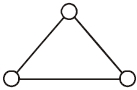
Answerd
$DOF =3+3=6$
$U =\frac{ f }{2} nRT =3 RT$
View full question & answer→MCQ 4251 Mark
Number of molecules in a volume of $4\, cm ^{3}$ of a perfect monoatomic gas at some temperature $T$ and at a pressure of $2\, cm$ of mercury is close to $?$
(Given, mean kinetic energy of a molecule (at $T$ ) is $4 \times 10^{-14}$ erg, $g=980\, cm / s ^{2}$, density of mercury $=13.6\, g / cm ^{3}$)
- A
$5.8 \times 10^{18}$
- B
$5.8 \times 10^{16}$
- ✓
$4.0 \times 10^{18}$
- D
$4.0 \times 10^{16}$
AnswerCorrect option: C. $4.0 \times 10^{18}$
c
$n =\frac{ PV }{ RT }, \frac{3}{2} kT =4 \times 10^{-14}$
$N =\frac{ PV }{ RT } \times Na$
$=\frac{2 \times 13.6 \times 980 \times 4}{\frac{8}{3} \times 10^{-14}}=3.99 \times 10^{18}$
View full question & answer→MCQ 4261 Mark
Molecules of an ideal gas are known to have three translational degrees of freedom and two rotational degrees of freedom. The gas is maintained at a temperature of $T$. The total internal energy, $U$ of a mole of this gas, and the value of $\gamma\left(=\frac{ C _{ P }}{ C _{ v }}\right)$ given, respectively, by
- A
$U =\frac{5}{2} RT$ and $\gamma=\frac{6}{5}$
- B
$U =5 RT$ and $\gamma=\frac{7}{5}$
- C
$U =5 RT$ and $\gamma=\frac{6}{5}$
- ✓
$U =\frac{5}{2} RT$ and $\gamma=\frac{7}{5}$
AnswerCorrect option: D. $U =\frac{5}{2} RT$ and $\gamma=\frac{7}{5}$
d
Total degree of freedom $=3+2=5$
$U =\frac{ nfRT }{2} \Rightarrow \frac{5 RT }{2}$
$\gamma \Rightarrow \frac{ C _{ P }}{ C _{ V }} \Rightarrow 1+\frac{2}{ f } \Rightarrow 1+\frac{2}{5} \Rightarrow \frac{7}{5}$
View full question & answer→MCQ 4271 Mark
Initially a gas of diatomic molecules is contained in a cylinder of volume $V _{1}$ at a pressure $P_{1}$ and temperature $250\, K$. Assuming that $25 \%$ of the molecules get dissociated causing a change in number of moles. The pressure of the resulting gas at temperature $2000\, K ,$ when contained in a volume $2 V _{1}$ is given by $P _{2}$. The ratio $\frac{P _{2}}{ P _{1}}$ is.
Answera
$P V = n R T$
$P _{1} V _{1}= nR\times 250$
$P _{2}\left(2 V _{1}\right)=\frac{5 n }{4} R \times 2000$
Divide
$\frac{ P _{1}}{2 P _{2}}=\frac{4 \times 250}{5 \times 2000}$
$\frac{P_{1}}{P_{2}}=\frac{1}{5}$
$\frac{P_{2}}{P_{1}}=5$
View full question & answer→MCQ 4281 Mark
Nitrogen gas is at $300^{\circ} C$ temperature. The temperature (in $K$) at which the $rms$ speed of a $H _{2}$, molecule would be equal to the $rms$ speed of a nitrogen molecule, is........
(Molar mass of $N _{2}$ gas $28\, g$ )
Answerb
$V _{ rms }=\sqrt{\frac{3 RT }{ M }}$
$V _{ N _{2}}= V _{ H _{2}}$
$\sqrt{\frac{3 RT _{ N _{2}}}{ M _{ N _{2}}}}=\sqrt{\frac{3 RT _{ H _{2}}}{ M _{ H _{2}}}}$
$\frac{573}{28}=\frac{ T _{ H _{2}}}{2} \Rightarrow T _{ H _{2}}=40.928$
View full question & answer→MCQ 4291 Mark
Consider two ideal diatomic gases $\mathrm{A}$ and $\mathrm{B}$ at some temperature $T$. Molecules of the gas $A$ are rigid, and have a mass $m$. Molecules of the gas $\mathrm{B}$ have an additional vibrational mode, and have a mass $\frac{\mathrm{m}}{4} .$ The ratio of the specific heats $(\mathrm{C}_{\mathrm{v}}^{\mathrm{A}}$ and $\mathrm{C}_{\mathrm{v}}^{\mathrm{B}})$ of gas $\mathrm{A}$ and $\mathrm{B}$, respectively is
Answerb
Degree of freedom of a diatomic molecule if vibration is absent $=5$
Degree of freedom of a diatomic molecule if vibration is present $=7$
$\therefore C_{v}^{A}=\frac{f_{A}}{2} R=\frac{5}{2} R$ and $C_{v}^{B}=\frac{f_{B}}{2} R=\frac{7}{2} R$
$\therefore \quad \frac{C_{\mathrm{v}}^{\mathrm{A}}}{C_{\mathrm{v}}^{\mathrm{B}}}=\frac{5}{7}$
View full question & answer→MCQ 4301 Mark
To raise the temperature of a certain mass of gas by $50^{\circ} C$ at a constant pressure, $160$ calories of heat is required. When the same mass of gas is cooled by $100^{\circ} C$ at constant volume, $240$ calories of heat is released. How many degrees of freedom does each molecule of this gas have (assume gas to be ideal) $?$
Answerc
$nC _{ P }(50)=160$
$nC _{ v }(100)=240$
$\Rightarrow \frac{ C _{ p }}{2 C _{ v }}=\frac{160}{240}=\frac{\gamma}{2}$
$\therefore \gamma=\frac{4}{3}$ and $f =\frac{2}{\gamma-1}=6$
View full question & answer→MCQ 4311 Mark
Match the $\frac{C _{ P }}{ C _{ v }}$ ratio for ideal gases with different type of molecules
| Moleculae type |
$\frac{C _{ P }}{ C _{ v }}$ |
| $(A)$ Monoatomic |
$(I)$ $\frac{7}{ 5}$ |
| $(B)$ Diatomic rigid molecules |
$(II)$ $\frac{9}{7}$ |
| $(C)$ Diatomic non-rigid molecules |
$(III)$ $\frac{4}{3}$ |
| $(D)$ Triatomic rigid molecules |
$(IV)$ $\frac{5}{3}$ |
- ✓
$A-IV, B-I, C-II, D-III$
- B
$A-IV, B-II, C-I, D-III$
- C
$A-III, B-IV, C-II, D-I$
- D
$A-II, B-III, C-I, D-IV$
AnswerCorrect option: A. $A-IV, B-I, C-II, D-III$
a
$\gamma=\frac{ C _{ p }}{ C _{ v }}=1+\frac{2}{ f }$
where $'f'$ is degree of freedom
$(A)$ Monoatomic $f=3, \gamma=1+\frac{2}{3}=\frac{5}{3}$
$(B)$ Diatomic rigid molecules,
$f=5, \gamma=1+\frac{2}{3}=\frac{7}{5}$
$(C)$ Diatomic non-rigid molecules
$f=7, \gamma=1+\frac{2}{7}=\frac{9}{7}$
$(D)$ Triatomic rigid molecules
$f=6, \gamma=1+\frac{2}{6}=\frac{4}{3}$
View full question & answer→MCQ 4321 Mark
Consider a mixture of $n$ moles of helium gas and $2 n$ moles of oxygen gas (molecules taken to be rigid) as an ideal gas. Its $\frac{\mathrm{C}_{\mathrm{P}}}{\mathrm{C}_{\mathrm{V}}}$ value will be
- A
$\frac{67}{45}$
- ✓
$\frac{19}{13}$
- C
$\frac{23}{15}$
- D
$\frac{40}{27}$
AnswerCorrect option: B. $\frac{19}{13}$
b
$\frac{C_{P}}{C_{V}} \operatorname{mix}=\frac{n_{1} C_{P_{1}}+n_{2} C_{P_{2}}}{n_{1} C_{V_{1}}+n_{2} C_{V_{2}}}$
$\frac{C_{P}}{C_{V}} \operatorname{mix}=\frac{n \times\left(\frac{5 R}{2}\right)+2 n\left(\frac{7 R}{2}\right)}{n \times \frac{3 R}{2}+2 n\left(\frac{5 R}{2}\right)}$
$\frac{C_{P}}{C_{V}}=\frac{19}{13}$
View full question & answer→MCQ 4331 Mark
The plot that depicts the behavior of the mean free time $t$ (time between two successive collisions) for the molecules of an ideal gas, as a function of temperature $(T)$, qualitatively, is (Graphs are schematic and not drawn to scale)
Answerd
Mean free time $=\frac{\text { Mean free path }}{\text { Average speed }}$
$=\frac{\frac{1}{\sqrt{2} \pi \mathrm{D}^{2} \mathrm{n}}}{\sqrt{\frac{8 \mathrm{RT}}{\pi \mathrm{M}_{\mathrm{w}}}}}$
$\mathrm{t} \propto \frac{1}{\sqrt{\mathrm{T}}}$
View full question & answer→MCQ 4341 Mark
Two gases-argon (atomic radius $0.07 \;\mathrm{nm}$,atomic weight $40$ ) and xenon (atomic radius $0.1\; \mathrm{nm},$ atomic weight $140$ ) have the same number density and are at the same temperature. The raito of their respective mean free times is closest to
- ✓
$1.09$
- B
$4.67$
- C
$1.83$
- D
$2.3$
AnswerCorrect option: A. $1.09$
a
$\lambda=\frac{1}{\sqrt{2} \pi \mathrm{n}_{\mathrm{v}} \mathrm{d}^{2}}$
$\tau=\frac{\lambda}{\mathrm{v}}=\frac{1}{\sqrt{2} \pi \mathrm{n}_{\mathrm{v}} \mathrm{d}^{2} \mathrm{v}}=\frac{1}{\sqrt{2} \pi \mathrm{n}_{\mathrm{v}} \mathrm{d}^{2}} \sqrt{\frac{\mathrm{M}}{3 \mathrm{RT}}}$
$\frac{\tau_{1}}{\tau_{2}}=\sqrt{\frac{M_{1}}{M_{2}}} \frac{d_{2}^{2}}{d_{1}^{2}}$
$=\sqrt{\frac{40}{140}} \frac{(0.1)^{2}}{(0.07)^{2}}$
$=1.09$
View full question & answer→MCQ 4351 Mark
An ideal gas in a closed container is slowly heated. As its temperature increases, which of the following statements are true$?$
$(A)$ the mean free path of the molecules decreases.
$(B)$ the mean collision time between the molecules decreases.
$(C)$ the mean free path remains unchanged.
$(D)$ the mean collision time remains unchanged.
- A
$(C)$ and $(D)$
- B
$(A)$ and $(B)$
- C
$(A)$ and $(D)$
- ✓
$(B)$ and $(C)$
AnswerCorrect option: D. $(B)$ and $(C)$
d
The mean free path of molecules of an ideal gas is given as
$\lambda=\frac{ V }{\sqrt{2} \pi d ^{2} N }$
$V =$ Volume of container
where: $N =$ No of molecules
Hence with increasing temp since volume of container does not change (closed container), so mean free path is unchanged.
Average collision time
$=\frac{\text { mean free path }}{V_{ av }}=\frac{\lambda}{(\text { avg speed of molecules })}$
$\because$ avg speed $\alpha \sqrt{ T }$
$\therefore$ Avg coll. time $\alpha \frac{1}{\sqrt{ T }}$
Hence with increase in temperature the average collision time decreases.
View full question & answer→MCQ 4361 Mark
In a dilute gas at pressure $P$ and temperature $T$, the mean time between successive collisions of a molecule varies with $T$ as
- A
$\sqrt{ T }$
- B
$\frac{1}{ T }$
- ✓
$\frac{1}{\sqrt{ T }}$
- D
$T$
AnswerCorrect option: C. $\frac{1}{\sqrt{ T }}$
c
$v _{ avg } \propto \sqrt{ T }$
$t _{0}:$ mean time
$\lambda:$ mean free path
$t _{0}=\frac{\lambda}{ v _{avg }} \times \frac{1}{\sqrt{ T }}$
View full question & answer→MCQ 4371 Mark
The change in the magnitude of the volume of an ideal gas when a small additional pressure $\Delta P$ is applied at a constant temperature, is the same as the change when the temperature is reduced by a small quantity $\Delta T$ at constant pressure. The initial temperature and pressure of the gas were $300\, K$ and $2\; atm$ respectively. If $|\Delta T|=C|\Delta P|$ then value of $C$ in $(K / a t m)$ is......
Answera
$PV = nRT$
$P \Delta V + V \Delta P =0 \quad($ for constant temp. $)$
$P \Delta V = n R \Delta T \quad($ for constant pressure)
$\Delta T =\frac{ P \Delta V }{ nR }$
$\Delta P =-\frac{ P \Delta V }{ V } \quad(\Delta V$ is same in both cases $)$
$\frac{\Delta T }{\Delta P }=\frac{ P \Delta V }{ nR } \frac{ V }{- P \Delta V }=\frac{- V }{ nR }=-\frac{ T }{ P }$
$( PV = nRT )$
$\left(\frac{ V }{ nR }=\frac{ T }{ P }\right) \quad\left|\frac{\Delta T }{\Delta P }\right|=\left|\frac{-300}{2}\right|=150$
View full question & answer→MCQ 4381 Mark
Two moles of an ideal gas with $\frac{\mathrm{C}_{\mathrm{P}}}{\mathrm{C}_{\mathrm{V}}}=\frac{5}{3}$ are mixed with $3$ moles of another ideal gas with $\frac{\mathrm{C}_{\mathrm{P}}}{\mathrm{C}_{\mathrm{V}}}=\frac{4}{3} .$ The value of $\frac{\mathrm{C}_{\mathrm{P}}}{\mathrm{C}_{\mathrm{V}}}$ for the mixture is
- A
$1.50$
- ✓
$1.42$
- C
$1.45$
- D
$1.47$
AnswerCorrect option: B. $1.42$
b
For $1^{\text {st }}$ gas $\frac{C_{P_{1}}}{C_{V_{1}}}=\frac{5}{3} \Rightarrow C_{P_{1}}=5 x$ and $C_{V_{1}}=3 x$
For $2^{\text {nd }}$ gas $\frac{C_{P_{2}}}{C_{V_{2}}}=\frac{4}{3} \Rightarrow C_{P_{2}}=4 x$ and $C_{V_{2}}=3 x$
Now for mixture $\mathrm{C}_{\mathrm{P}}=\frac{\mathrm{n}_{1} \mathrm{C}_{\mathrm{P}}+\mathrm{n}_{2} \mathrm{C}_{\mathrm{B}_{2}}}{\mathrm{n}_{1}+\mathrm{n}_{2}}=\frac{17 \mathrm{R}}{5}$
$C_{V}=\frac{n_{1} C_{V_{1}}+n_{2} C_{V_{3}}}{n_{1}+n_{2}}=\frac{12 R}{5}$
$\Rightarrow \frac{C_{p}}{C_{v}}=\frac{2(5 x)+3(4 x)}{2(3 x)+3(3 x)}=\frac{17}{12}$
$\Rightarrow \frac{C_{P}}{C_{V}} \approx 1.42$
View full question & answer→MCQ 4391 Mark
Under an adiabatic process, the volume of an ideal gas gets doubled. Consequently the mean collision time between the gas molecule changes from $\tau_{1}$ to $\tau_{2} .$ If $\frac{C_{p}}{C_{v}}=\gamma$ for this gas then a good estimate for $\frac{\tau_{2}}{\tau_{1}}$ is given by :
AnswerCorrect option: A. $\left(\frac{1}{2}\right)^{\frac{\gamma+1}{2}}$
a
${\lambda \propto V}$
The average time between the collisions of the gas molecules is nothing but the mean free path divided by the root mean square speed of the gas molecules.
$\mathrm{So}$
$\Longrightarrow\left[\text { Time }=t=\frac{\lambda}{v_{R M S}}\right]$
Now we also know that :-
$v_{R M S} \propto \sqrt{P V}$
Using the above we get :-
$\Longrightarrow t \propto V \times \sqrt{\frac{1}{P V}}$
$\Longrightarrow t \propto \sqrt{\frac{V^{2}}{P V}}$
$\Longrightarrow t \propto \sqrt{\frac{V}{P}}$
adiabatic process then $PV^{\gamma}=constant$
then $t \propto V^{\frac{\gamma+1}{2}}$
View full question & answer→MCQ 4401 Mark
A $15\,g$ mass of nitrogen gas is enclosed in a vessel at a temperature $27\,^oC.$ Amount of heat transferred to the gas, so that rms velocity of molecules is doubled, is about ...... $kJ$ [Take $R = 8.3\,J/K\,mole$ ]
Answerc
$\Delta Q = \frac{f}{2}nR\Delta T$
$ = \frac{5}{2}\left( {\frac{{15}}{{28}}} \right)(8.3)(1200 - 300) = 10000\,J$
View full question & answer→MCQ 4411 Mark
$2\, kg$ of a monoatomic gas is at a pressure of $4\times10^4\, N/m^2$. The density of the gas is $8\, kg/m^3$. What is the order of energy of the gas due to its thermal motion ?
- A
$10^3\, J$
- B
$10^5\, J$
- ✓
$10^4\, J$
- D
$10^6\, J$
AnswerCorrect option: C. $10^4\, J$
c
$\mathrm{E} =\frac{1}{2} \mathrm{M} \mathrm{V}_{m}^{2} $
$=\frac{1}{2} \times 2 \times\left(\frac{3 \mathrm{P}}{\rho}\right) $
$=\frac{3 \times 4 \times 10^{4}}{8}=1.5 \times 10^{4} \mathrm{J}$
View full question & answer→MCQ 4421 Mark
A gas mixture consists of $3\,moles$ of oxygen and $5\,moles$ or argon at temperature $T.$ Considering only translational and rotational modes, the total internal energy of the system is
- ✓
$15\,RT$
- B
$12\,RT$
- C
$4\,RT$
- D
$20\,RT$
AnswerCorrect option: A. $15\,RT$
a
$U_{\text {total }} =U_{O_{2}}+U_{A r}$
$=\frac{3 \times 5 \times R T}{2}+\frac{5 \times 3 \times R T}{2}$
$=15 \mathrm{RT}$
View full question & answer→MCQ 4431 Mark
An ideal gas occupies a volume of $2\, m^3$ at a pressure of $3\times10^6\, Pa$. The energy of the gas is
- A
$9\times10^6\,J$
- B
$6\times10^4\,J$
- C
$10^8\,J$
- ✓
Answerd
Cannot determine, degree of freedom must be given
View full question & answer→MCQ 4441 Mark
If $10^{22}$ gas molecules each of mass $10^{-26}\, kg$ collide with a surface (perpendicular to it)elastically per second over an area $1\, m^2$ with a speed $10^4\,m/s$, the pressure exerted by the gas molecules will be of the order of
- A
${10^8}\,\frac{N}{{{m^2}}}$
- B
${10^3}\,\frac{N}{{{m^2}}}$
- C
${10^4}\,\frac{N}{{{m^2}}}$
- ✓
Answerd
Pressure is defined as normal force per unit area.
Force is calculated as change in $ momentum/time.$
By this answer is $2 \mathrm{N} / \mathrm{m}^{2}$
None of the option matches so this question must be Bonus.
Detailed solution is as following:
$Magnitude\, of\, change\, in\, momentum \,per\, collision$ $=2$ $mv$
Pressure $=\frac{\text { Force }}{\text { Area }}=\frac{N(2 m v)}{1}$
${=\frac{10^{22} \times 2 \times 10^{-26} \times 10^{4}}{1}} $
${=2 \mathrm{N} / \mathrm{m}^{2}}$
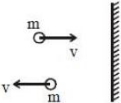
View full question & answer→MCQ 4451 Mark
An $HCl$ molecule has rotational, translational and vibrational motions. If the $rms$ velocity of $HCl$ molecules in its gaseous phase is $\bar v ,\,m$ is its mass and $k_B$ is Boltzmann constant, then its temperature will be
- ✓
$\frac{{m{\bar v ^{ 2}}}}{{3{k_B}}}$
- B
$\frac{{m{\bar v ^{ 2}}}}{{7{k_B}}}$
- C
$\frac{{m{\bar v ^{ 2}}}}{{5{k_B}}}$
- D
$\frac{{m{\bar v ^{ 2}}}}{{6{k_B}}}$
AnswerCorrect option: A. $\frac{{m{\bar v ^{ 2}}}}{{3{k_B}}}$
a
According to equipartion energy theorem
$\frac{1}{2} m\left(v_{m s}^{2}\right)=3 \times \frac{1}{2} k_{b} T$
$T=\frac{m \bar{V}_{r m s}^{-2}}{3 k}$
View full question & answer→MCQ 4461 Mark
A cylinder with fixed capacity of $67.2\, lit$ contains helium gas at $STP$. The amount of heat needed to raise the temperature of the gas by $20\,^oC$ is ..... $J$ [Given that $R = 8.31\, J\, mol^{-1}\, K^{-1}$]
Answerc
$\Delta \mathrm{Q}=\mathrm{nC}_{\mathrm{v}} \Delta \mathrm{T}=\mathrm{n} \frac{\mathrm{3}}{2} \mathrm{R} \Delta \mathrm{T}$
$=\left(\frac{67.2}{22.4}\right)\left(\frac{3}{2} \times 8.31\right)(20)$
$ \approx 748 \mathrm{J}$
View full question & answer→MCQ 4471 Mark
When heat $Q$ is supplied to a diatomic gas of rigid molecules at constant volume its temperature increases by $\Delta T.$ The heat required to produce the same change in temperature, at constant pressure is
- A
$\frac {3}{2}\,Q$
- B
$\frac {5}{3}\,Q$
- ✓
$\frac {7}{5}\,Q$
- D
$\frac {2}{3}\,Q$
AnswerCorrect option: C. $\frac {7}{5}\,Q$
c
$Q=C v \Delta T$
$Q^{\prime}=C_{P} \Delta T$
$Q^{\prime}=\frac{C_{P}}{C_{V}} Q=\left(1+\frac{2}{5}\right) Q=\frac{7}{5} Q$
View full question & answer→MCQ 4481 Mark
A mixture of $2\, moles$ of helium gas (atomic mass $= 4\, u$), and $1\, mole$ of argon gas (atomic mass $= 40\, u$) is kept at $300\, K$ in a container. The ratio of their rms speeds $\left[ {\frac{{{V_{rms}}{\rm{(helium)}}}}{{{V_{rms}}{\rm{(argon)}}}}} \right]$, is close to
- ✓
$3.16$
- B
$0.32$
- C
$0.45$
- D
$2.24$
AnswerCorrect option: A. $3.16$
a
$\frac{\left(\mathrm{V}_{\mathrm{RMS}}\right)_{\mathrm{He}}}{\left(\mathrm{V}_{\mathrm{RMS}}\right)_{\mathrm{Ar}}} =\sqrt{\frac{\mathrm{M}_{\mathrm{Ar}}}{\mathrm{M}_{\mathrm{He}}}} $
$=\sqrt{\frac{40}{4}}=\sqrt{10}=3.16$
View full question & answer→MCQ 4491 Mark
The temperature, at which the root mean square velocity of hydrogen molecules equals their escape velocity from the earth is closest to : [Boltzmans Constant $k_B = 1.38\times10^{-23}\, J / K$ Avogadro number $N_A = 6.02\times10^{26}\, / kg$ Radius of Earth $: 6.4\times10^6\, m$ Gravitation acceleration on Earth $= 10\, ms^{-2}$]
- A
$800\,K$
- ✓
$10^4\,K$
- C
$3\times10^5\,K$
- D
$650\,K$
AnswerCorrect option: B. $10^4\,K$
b
$v_{m s}=\sqrt{\frac{3 R T}{m}} \quad v_{\text {escape }}=\sqrt{2 g R_{e}}$
$\mathrm{v}_{\mathrm{rms}}=\mathrm{v}_{\text {escape }}$
$\frac{3 \mathrm{RT}}{\mathrm{m}}=2 \mathrm{gR}_{\mathrm{e}}$
$\frac{3 \times 1.38 \times 10^{-23} \times 6.02 \times 10^{26}}{2} \times 10 \times 10^{3}=10^{4} \mathrm{k}$
View full question & answer→MCQ 4501 Mark
For a given gas at $1\,atm$ pressure, $rms$ speed of the molecules is $200\,m/s$ at $127\,^oC.$ At $2\,atm$ pressure and at $227\,^oC,$ the $rms$ speed of the molecules will be
- A
$80\,m/s$
- ✓
$100\sqrt {5}\,m/s$
- C
$100\,m/s$
- D
$80\sqrt {5}\,m/s$
AnswerCorrect option: B. $100\sqrt {5}\,m/s$
b
$V_{r m s}=\sqrt{\frac{3 R T}{M_{w}}}$
$\Rightarrow v_{m s} \propto \sqrt{T}$
$\text { Now, } \frac{v}{200}=\sqrt{\frac{500}{400}} \Rightarrow \frac{v}{200}=\frac{\sqrt{5}}{2}$
$\Rightarrow \mathrm{v}=100 \sqrt{5} \mathrm{m} / \mathrm{s}$
View full question & answer→MCQ 4511 Mark
The number density of molecules of a gas depends on their distance $r$ from the origin as, $n\left( r \right) = {n_0}{e^{ - \alpha {r^4}}}$. Then the total number of molecules is proportional to
AnswerCorrect option: A. ${n_0}{\alpha ^{ - 3/4}}$
a
Given number density of molecules of gas as a function of $r$ is
$n(r)=n_{0} e^{-a r^{4}}$
Total number of molecule $=\int_{0}^{\infty} n(r) \mathrm{d} V=\int_{0}^{\infty} n_{0} e^{-\alpha x^{4}} 4 \pi r^{2} d r$
Number of molecules is proportional to $\mathrm{n}_{0} \alpha^{-3 / 4}$
View full question & answer→MCQ 4521 Mark
A vertical closed cylinder is separated into two parts by a frictionless piston of mass $m$ and of negligible thickness. The piston is free to move along the length of the cylinder .The length of the cylinder above the piston is $l_1,$ and that below the piston is $l_2,$ such that $l_1 > l_2.$ Each part of the cylinder contains $n$ moles of an ideal gas at equal temperature $T.$ If the piston is stationary, its mass, $m,$ will be given by: ( $R$ is universal gas constant and $g$ is the acceleration due to gravity)
- A
$\frac{{RT}}{{ng}}\left[ {\frac{{{l_1} - 3{l_2}}}{{{l_1}{l_2}}}} \right]$
- B
$\frac{{RT}}{g}\left[ {\frac{{2{l_1} + {l_2}}}{{{l_1}{l_2}}}} \right]$
- C
$\frac{{nRT}}{{ng}}\left[ {\frac{1}{{{l_2}}} + \frac{1}{{{l_1}}}} \right]$
- ✓
$\frac{{nRT}}{g}\left[ {\frac{{{l_1} - {l_2}}}{{{l_1}{l_2}}}} \right]$
AnswerCorrect option: D. $\frac{{nRT}}{g}\left[ {\frac{{{l_1} - {l_2}}}{{{l_1}{l_2}}}} \right]$
d
$\mathrm{P}_{2} \mathrm{A}-\mathrm{P}_{1} \mathrm{A}=\mathrm{mg}$
$m=\frac{1}{g}\left(\frac{P_{1} A \ell_{1}}{\ell_{1}}-\frac{P_{2} A \ell_{2}}{\ell_{2}}\right)$
$\mathrm{m}=\frac{1}{\mathrm{g}}\left(\frac{\mathrm{nRT}}{\ell_{1}}-\frac{\mathrm{nRT}}{\ell_{2}}\right)$
$m=\frac{n R T}{g}\left(\frac{1}{\ell_{1}}-\frac{1}{\ell_{2}}\right)$
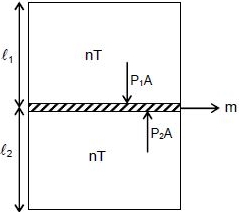
View full question & answer→MCQ 4531 Mark
One mole of an ideal gas passes through a process where pressure and volume obey the relation $P\, = {P_0}\,\left[ {1 - \frac{1}{2}{{\left( {\frac{{{V_0}}}{V}} \right)}^2}} \right]$. Here $P_0$ and $V_0$ are constants. Calculate the change in the temperature of the gas if its volume change from $V_0$ to $2V_0$
- A
$\frac{1}{4}\frac{{{P_0}{V_0}}}{R}$
- B
$\frac{1}{2}\frac{{{P_0}{V_0}}}{R}$
- C
$\frac{5}{4}\frac{{{P_0}{V_0}}}{R}$
- ✓
$\frac{3}{4}\frac{{{P_0}{V_0}}}{R}$
AnswerCorrect option: D. $\frac{3}{4}\frac{{{P_0}{V_0}}}{R}$
d
$n=1$ mole
$P=P_{0}\left\{1-\frac{1}{2}\left(\frac{V_{0}}{V}\right)^{2}\right\} \quad ; \quad P V=n R T=R T$
$P=\frac{R T}{V}$
$\frac{R T}{V}=P_{0}\left\{1-\frac{V_{0}^{2}}{2 V^{2}}\right\}$
$T=\frac{P_{0} V}{R}\left\{1-\frac{V^{2}}{2 V^{2}}\right\}=\frac{P_{0}}{R}\left\{V-\frac{V_{0}^{2}}{2 V}\right\}$
$\Delta T $$=\frac{P_{0}}{R}\left\{\left(2 V_{0}-V_{0}\right)-\frac{V_{0}^{2}}{2}\left(\frac{1}{2 V_{0}}-\frac{1}{V_{0}}\right)\right\}$
$=\frac{P_{0}}{R}\left\{V_{0}-\frac{V_{0}^{2}}{2}\right\} $
$ \Delta T $$=\frac{P_{0}}{R}\left\{\left(2 V_{0}-V_{0}\right)-\frac{V_{0}^{2}}{2}\left(\frac{1}{2 V_{0}}-\frac{1}{V_{0}}\right)\right\} $
$=\frac{P_{0}}{R}\left\{V_{0}-\frac{V_{0}^{2}(1-2)}{2 \times 2 V_{0}}\right\} $
$=\frac{P_{0}}{R}\left\{V_{0}-\frac{V_{0}}{4}\right\}=\frac{3}{4} \frac{P_{0} V_{0}}{R}$
View full question & answer→MCQ 4541 Mark
A $25\times10^{-3}\, m^3$ volume cylinder is filled with $1\, mol$ of $O_2$ gas at room temperature $(300\, K)$. The molecular diameter of $O_2$, and its root mean square speed, are found to be $0.3\, nm$ and $200\, m/s$, respectively. What is the average collision rate (per second) for an $O_2$ molecule?
- ✓
$\sim 10^{10}$
- B
$\sim 10^{11}$
- C
$\sim 10^{12}$
- D
$\sim 10^{13}$
AnswerCorrect option: A. $\sim 10^{10}$
a
$v=\frac{V_{a v}}{\lambda}$
$\lambda=\frac{\mathrm{RT}}{\sqrt{2} \pi \sigma^{2} \mathrm{N}_{\mathrm{A}} \mathrm{P}}$
$\sigma=2 \times 0.3 \times 10^{-9}$
$P=\frac{R T}{V}$
$\Rightarrow \quad=\frac{V}{\sqrt{2} \pi \sigma^{2} N_{A}}$
$V_{\mathrm{av}}=\sqrt{\frac{8}{3 \pi}} \times V_{\mathrm{rms}}$
$\begin{aligned} \therefore \quad \mathrm{v} =\frac{200 \times \sqrt{2} \pi \times \sigma^{2} \mathrm{N}_{\mathrm{A}}}{25 \times 10^{-3}} \times \sqrt{\frac{8}{3 \pi}} \\ =17.68 \times 10^{8} / \mathrm{sec} \\ =0.1768 \times 10^{10} / \mathrm{sec}-10^{10} \end{aligned}$
View full question & answer→MCQ 4551 Mark
The specific heats, $C_P$ and $C_V$ of a gas of diatomic molecules, $A$, are given (in units of $J\, mol^{-1}\, K^{-1}$) by $29$ and $22$, respectively. Another gas of diatomic molecules $B$, has the corresponding values $30$ and $21$. If they are treated as ideal gases, then
- A
$A$ has one vibrational mode and $B$ has two
- B
Both $A$ and $B$ have a vibrational mode each
- C
$A$ is rigid but $B$ has a vibrational mode
- ✓
$A$ has a vibrational mode but $B$ has none
AnswerCorrect option: D. $A$ has a vibrational mode but $B$ has none
d
For $A:$
$\frac{C_{p}}{C_{v}}=\gamma=1+\frac{2}{f}=\frac{29}{22}$
It gives $f=6.3 \approx 6 \quad(3 \text { translational, } 2 \text { rotational and } 1$ vibrational)
For $B:$
$\frac{C_{p}}{C_{v}}=\gamma=1+\frac{2}{f}=\frac{30}{21}$
$\Rightarrow \mathrm{f}=4.67$
$\Rightarrow \quad \approx 5 \quad(3 \text { translational, } 2$ rotational, no vibrational)
View full question & answer→MCQ 4561 Mark
$2\, moles$ of helium gas is mixed with $3\, moles$ of hydrogen molecules (taken to be rigid). What is the molar specific heat of mixture at constant volume ....... $J/mol\, K$ ? $(R = 8.3\, J/mol\, K)$
- ✓
$17.4$
- B
$15.7$
- C
$19.7$
- D
$21.6$
AnswerCorrect option: A. $17.4$
a
$f_{\operatorname{mix}}=\frac{n_{1} f_{1}+n_{2} f_{2}}{n_{1}+n_{2}}=\frac{2 \times 3+3 \times 5}{5}=\frac{21}{5}$
$C_{v}=\frac{f R}{5}=\frac{21}{5} \times \frac{R}{2}=17.4 \mathrm{J} / \mathrm{mol} \mathrm{K}$
View full question & answer→MCQ 4571 Mark
An ideal gas is enclosed in a cylinder at pressure of $2\,atm$ and temperature, $300\,K.$ The mean time between two successive collisions is $6 \times 10^{-8}\, s.$ If the pressure is doubled and temperature is increased to $500\,K,$ the mean time between two successive collisions will be close to
- A
$2\times 10^{-7}\,s$
- ✓
$4\times 10^{-8}\,s$
- C
$0.5\times 10^{-8}\,s$
- D
$3\times 10^{-6}\,s$
AnswerCorrect option: B. $4\times 10^{-8}\,s$
b
${\text { The mean time between two collision } \propto \frac{P}{\sqrt{T}}} $
${\qquad \frac{\Delta t_{1}}{\Delta t_{2}}=\frac{P_{1}}{P_{2}} \times \frac{\sqrt{T_{2}}}{\sqrt{T_{1}}}} $
${\Rightarrow \quad \frac{6 \times 10^{-8}}{\Delta t_{2}}=(\sqrt{\frac{3}{5}}) \times 2} $
${\Rightarrow \quad \Delta t_{2}=6 \times 10^{-8} \times \frac{1}{2} \sqrt{\frac{5}{3}} \approx 4 \times 10^{-8} \text { sec }}$
View full question & answer→MCQ 4581 Mark
The value closest to the thermal velocity of a Helium atom at room temperature $(300\,K)$in $ms^{-1}$ is $[k_B\, = 1 .4\times10^{-23}\,J/K;\, m_{He}\, = 7\times10^{-27}\,kg]$
- A
$1.3\times10^4$
- B
$1.3\times10^5$
- C
$1.3\times10^2$
- ✓
$1.3\times10^3$
AnswerCorrect option: D. $1.3\times10^3$
d
$v = \sqrt {3{k_B}T/{m_{He}}} = \sqrt {\frac{{3 \times 1.4 \times {{10}^{ - 23}} \times 300}}{{7 \times {{10}^{ - 27}}}}} = 1.34 \times {10^3}\,m/s$
View full question & answer→MCQ 4591 Mark
Two moles of helium are mixed with $n$ with moles of hydrogen. If $\frac{{{C_P}}}{{{C_V}}}\, = \,\frac{3}{2}$ for the mixture, then the value of $n$ is
Answerb
Using formula,
${\gamma _{mixture}} = {\left( {\frac{{{C_p}}}{{{C_V}}}} \right)_{mix}} = \frac{{\frac{{{n_1}{\gamma _1}}}{{{\gamma _1} - 1}} + \frac{{{n_2}{\gamma _2}}}{{{\gamma _2} - 1}}}}{{\frac{{{n_1}}}{{{\gamma _1} - 1}} + \frac{{{n_2}}}{{{\gamma _2} - 1}}}}$
Putting the value of ${n_1} = 2,{n_2} = n.$
${\left( {\frac{{{C_p}}}{{{C_v}}}} \right)_{mix }} = \frac{3}{2}$
${\gamma _1} = \frac{5}{3},{\gamma _2} = \frac{7}{5}$ and solving we get, $n=2$
View full question & answer→MCQ 4601 Mark
The temperature of an open room of volume $30\ m^3$ increases from $17^o C$ to $27vC$ due to sunshine. The atmospheric pressure in the room remains $1 \times 10^5\ Pa$. Ifni and nr are the number of molecules in the room before and after heating, then $n_f-n_i$ will be :
- A
$-1.61 \times 10^{23}$
- B
$1.38 \times 10^{23}$
- C
$2.5 \times 10^{23}$
- ✓
$-2.5 \times 10^{25}$
AnswerCorrect option: D. $-2.5 \times 10^{25}$
d
$\text { Given: Temperature } T_{i}=17+273=290 \mathrm{K}$
Temperature $T_{f}=27+273=300 K$
Atmospheric pressure, $P_{0}=1 \times 10^{5} P a$
$ Volume\, of\, room,$ $V_{0}=30 \mathrm{m}^{3}$
$ Difference \,in\, number\, of\, molecules,$ $N_{f}-N_{i}=?$
The number of molecules
$\Rightarrow \quad N=\frac{P V}{R T}\left(\mathrm{N}_{0}\right)$
$\begin{aligned} \therefore \quad N_{f}-N_{i} =\frac{P_{0} V_{0}}{R}\left(\frac{1}{T_{f}}-\frac{1}{T_{i}}\right) \mathrm{N}_{0} \\ =\frac{1 \times 10^{5} \times 30}{8.314} \times 6.023 \times 10^{23}\left(\frac{1}{300}-\frac{1}{290}\right) \\ =-2.5 \times 10^{25} \end{aligned}$
View full question & answer→MCQ 4611 Mark
$N\,moles$ of a diatomic gas in a cylinder are at a temperature $T$. Heat is supplied to the cylinder such that the temperature remains constant but $n\,moles$ of the diatomic gas get converted into monoatomic gas. What is the change in the total kinetic energy of the gas ?
- ✓
$\frac{1}{2}nRT$
- B
$0$
- C
$\frac{3}{2}nRT$
- D
$\frac{5}{2}nRT$
AnswerCorrect option: A. $\frac{1}{2}nRT$
a
Energyassociated with $N$ moles of diatomic
gas,
$\mathrm{U}_{\mathrm{i}}=\mathrm{N} \frac{5}{2} \mathrm{RT}$
Energy associated with $n$ moles of monoatomic gas
$=n \frac{3}{2} R T$
Total energy when $n$ moles of diatomic gas converted into monoatomic
$\left(U_{f}\right)=2 n \frac{3}{2} R T+(N-n) \frac{5}{2} R T$
$=\frac{1}{2} n R T+\frac{5}{2} N R T$
Now, change in total kinetic energy of the
gas
$\Delta \mathrm{U}=\mathrm{Q}=\frac{1}{2} \mathrm{nRT}$
View full question & answer→MCQ 4621 Mark
$c_P$ and $c_V$ are specific heats at constant pressure and constant volume respectively. It is observed that
$c_P - c_V = a$ for hydrogen gas
$c_P - c_V = b$ for nitrogen gas
The correct relation between $a$ and $b$ is
- A
$a = \frac{1}{{14}}b$
- B
$a=b$
- ✓
$a=14b$
- D
$a=28b$
AnswerCorrect option: C. $a=14b$
c
As we know, $C_P-C_v=E$ where $C_p$ and $C_v$ are molar specific heat capacities
or, ${C_P} - {C_v} = \frac{R}{M}$
For hydrogen $(M = 2){C_p} - {C_v} = a = \frac{R}{2}$
$For\,nitrogen\left( {M = 28} \right){C_p} - {C_v} = b = \frac{R}{{28}}$
$\therefore \,\frac{a}{b} = 14\,\,or,\,\,a = 14b$
View full question & answer→MCQ 4631 Mark
For the $P-V$ diagram given for an ideal gas, out of the following which one correctly represents the $T-P$ diagram ?
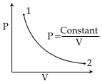
Answerc
From $P-V$ graph
$P \propto \frac{1}{V}$ , $T\, =$ constant
and Pressure is increasing from $2$ to $1$ so option $(c)$ represents correct $T-P$ graph
View full question & answer→MCQ 4641 Mark
An ideal gas has molecules with $5\,$ degrees of freedom. The ratio of specific heats at constant pressure $(C_p)$ and at constant volume $(C_v)$ is
Answerd
The ratio of specific heats at constant pressure $\left(\mathrm{C}_{\mathrm{p}}\right)$ and constant volume $\left(\mathrm{C}_{\mathrm{v}}\right)$
$\frac{C_{p}}{C_{v}}=\gamma=\left(1+\frac{2}{f}\right)$
where fis degree of freedom
$\frac{C_{p}}{C_{v}}=\left(1+\frac{2}{5}\right)=\frac{7}{5}$
View full question & answer→MCQ 4651 Mark
Which of the following shows the correct relationship between the pressure $'P'$ and density $\rho $ of an ideal gas at constant temperature ?
Answerd
As we know for an ideal gas at constant
temperature, pressure $\mathrm{P}=\frac{\rho \mathrm{RT}}{\mathrm{M}}$
$\mathrm{P} \propto \rho$
$\therefore \mathrm{R}, \mathrm{T} \& \mathrm{M}$ are constant, so pressure $(P)$varies linearlywith density $(\rho)$.
View full question & answer→MCQ 4661 Mark
An ideal gas undergoes a quasi static, reversible process in which its molar heat capacity $C$ remains constant. If during this process the relation of pressure $P$ and volume $V$ is given by $PV^n =$ constant, then n is given by (Here $C_p$ and $C_v$ are molar specific heat at constant pressure and constant volume, respectively) :
- A
$n = \frac{{{C_p} - C}}{{C - {C_V}}}\;\;\;\;\;\;\;\;\;\;\;\;\;\;$
- B
$\;n = \frac{{C - {C_V}}}{{C - {C_p}}}$
- C
$\;n = \frac{{{C_p}}}{{{C_V}}}$
- ✓
$\;n = \frac{{C - {C_p}}}{{C - {C_V}}}$
AnswerCorrect option: D. $\;n = \frac{{C - {C_p}}}{{C - {C_V}}}$
d
For a polytropic process
$C = {C_V} + \frac{R}{{1 - n}}$ $\therefore C - {C_V} = \frac{R}{{1 - n}}$
$\therefore 1 - n = \frac{R}{{C - {C_V}}}$ $\therefore 1 - \frac{R}{{C - {C_V}}} = n$
$\therefore n = \frac{{C - {C_V} - R}}{{C - {C_V}}} = \frac{{C - {C_V} - {C_P} + {C_V}}}{{C - {C_V}}}$
$ = \frac{{C - {C_P}}}{{C - {C_V}}}\left( {{C_P} - {C_{V = R}}} \right)$
View full question & answer→MCQ 4671 Mark
In an ideal gas at temperature $T,$ the average force that a molecule applies on the walls of a closed container depends on $T$ as $T^q$ . A good estimate for $q$ is
- A
$\frac {1}{2}$
- B
$2$
- C
$\frac {1}{4}$
- ✓
$1$
Answerd
Pressure, $P=\frac{1}{3} \frac{m N}{V} V_{r m s}^{2}$
or, $\quad P=\frac{(m N) T}{V}$
If the gas mass and temperature are constant then
$P \propto\left(V_{\max }\right)^{2} \propto T$
So, force $\propto\left(V_{\text {rns }}\right)^{2} \propto T$
i.e., Value of $q=1$
View full question & answer→MCQ 4681 Mark
Using equipartition of energy, the specific heat (in $J\, kg^{-1}\, K^{-1}$ ) of aluminium at room temperature can be estimated to be ( atomic weight of aluminium $= 27$)
Answerd
Using equipartition of energy, we have
$\frac{6}{2} K T=m C T$
$C=\frac{3 \times 1.38 \times 10^{-23} \times 6.02 \times 10^{23}}{27 \times 10^{-3}}$
$\therefore \mathrm{C}=925 \mathrm{J} / \mathrm{kgK}$
View full question & answer→MCQ 4691 Mark
Consider an ideal gas confined in an isolated closed chamber. As the gas undergoes an adiabatic expansion, the average time of collision between molecules increases as $V ^q$, where $V$ is the volume of the gas. The value of $q$ is $\left( {\gamma = \frac{{{C_P}}}{{{C_V}}}} \right)$
- A
$\frac{{3\gamma - 5}}{6}\;\;\;\;\;\;\;\;\;\;\;\;\;\;\;\;$
- ✓
$\;\frac{{\gamma + 1}}{2}$
- C
$\;\frac{{\gamma - 1}}{2}$
- D
$\;\frac{{3\gamma + 5}}{6}$
AnswerCorrect option: B. $\;\frac{{\gamma + 1}}{2}$
b
$\tau = \frac{1}{{\sqrt 2 \pi {d^2}\left( {\frac{N}{V}} \right)\sqrt {\frac{{3RT}}{M}} }}$
$\tau \propto \frac{V}{{\sqrt T }}$
$As,\,T{V^{\gamma - 1}} = K$
$So,\,\tau \propto {V^{\gamma + 1/2}}$
$Therefore,\,q = \frac{{\gamma + 1}}{2}$
View full question & answer→MCQ 4701 Mark
A gas molecule of mass $M$ at the surface of the Earth has kinetic energy equivalent to $0\,^oC$. If it were to go up straight without colliding with any other molecules, how high it would rise? Assume that the height attained is much less than radius of the earth. ($k_B$ is Boltzmann constant)
- A
$0$
- B
$\frac{{273{k_B}}}{{2Mg}}$
- C
$\frac{{546{k_B}}}{{3Mg}}$
- ✓
$\frac{{819{k_B}}}{{2Mg}}$
AnswerCorrect option: D. $\frac{{819{k_B}}}{{2Mg}}$
d
Kinetic energy of each molecule,
$\mathrm{K} \mathrm{E}=\frac{3}{2} \mathrm{K}_{\mathrm{B}} \mathrm{T}$
In the given problem,
Temperature, $\mathrm{T}=0^{\circ} \mathrm{C}=273 \mathrm{K}$
Height attained by the gas molecule, $h=?$
$\mathrm{KE}=\frac{3}{2} \mathrm{K}_{\mathrm{B}}(273)=\frac{819 \mathrm{K}_{\mathrm{B}}}{2}$
$\mathrm{K.E}=\mathrm{PE}$
$ \Rightarrow \frac{{819{K_B}}}{2} = Mgh$
$h=\frac{{819{k_B}}}{{2Mg}}$
View full question & answer→MCQ 4711 Mark
At room temperature a diatomic gas is found to have an $r.m.s.$ speed of $1930\,ms^{-1}$. The gas is
- ✓
$H_2$
- B
$Cl_2$
- C
$O_2$
- D
$F_2$
Answera
$\because \quad \mathrm{C}=\sqrt{\frac{3 \mathrm{RT}}{\mathrm{M}}}$
$(1930^2)=\frac{3 \times 8.314 \times 300}{M}$
$\mathrm{M}=\frac{3 \times 8.314 \times 300}{1930 \times 1930} \approx 2 \times 10^{-3} \mathrm{kg}$
The gas is $\mathrm{H}_{2}$
View full question & answer→MCQ 4721 Mark
Modern vacuum pumps can evacuate a vessel down to a pressure of $4.0 \times {10^{ - 15}}\, atm$ at room temperature $(300\, K)$. Taking $R = 8.0\, JK^{-1}\, mole^{-1}$ , $1\, atm = 10^5\, Pa$ and $N_ {Avogadro} = 6 \times 10^{23}\, mole^{-1}$ , the mean distance between molecules of gas in an evacuated vessel will be of the order of
- A
$0.2\,\mu m$
- ✓
$0.2\,mm$
- C
$0.2\,cm$
- D
$0.2\,nm$
AnswerCorrect option: B. $0.2\,mm$
b
Formula for mean free path-
$Y=\frac{K T}{\sqrt{2} \pi \sigma^{2} p}$
-wherein
$\sigma=$ Diameter of the molecule
$p=$ pressure of the gas
$T=$ temperature
$K=$ Boltzmann's Constant
Let intermolecular distance be $D$ then in a volume $\frac{4 \pi}{3} D^{3}$ there is only one
$\frac{4 \pi}{3} D^{3} P=\frac{1}{N_{A}}=R_{T} \quad$ or $\quad D=\left(\frac{3 R T}{4 \pi N_{A} P}\right)^{1 / 3}$
$\begin{aligned} \text { Put } P=& 4 \times 10^{-10} P a, R=83, N_{A}=6 \times 10^{23} \\ T=& 300 \mathrm{K} \end{aligned}$
$D=0.2 \mathrm{mm}$
View full question & answer→MCQ 4731 Mark
An ideal monoatomic gas is confined in a cylinder by a spring loaded piston of cross section $8.0\times10^{-3}\, m^2$ . Initially the gas is at $300\, K$ and occupies a volume of $2.4\times10^{-3}\, m^3$ and the spring is in its relaxed state as shown in figure. The gas is heated by a small heater until the piston moves out slowly by $0.1\, m$. The force constant of the spring is $8000\, N/m$ and the atmospheric pressure is $1.0\times10^5\, N/m^2$ . The cylinder and the piston are thermally insulated. The piston and the spring are massless and there is no friction between the piston and the cylinder. The final temperature of the gas will be: (Neglect the heat loss through the lead wires of the heater . The heat capacity of the heater coil is also negligible)
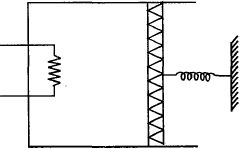
- A
$300$
- B
$500$
- ✓
$800$
- D
$1000$
Answerc
$A=8 \times 10^{-3} \mathrm{m}^{2}$
$\mathrm{T}_{1}=300 \mathrm{K}$
$\mathrm{V}_{1}=2.4 \times 10^{-3} \mathrm{m}^{3}$
$\mathrm{V}_{2}=\mathrm{V}_{1}+\mathrm{A} \Delta \mathrm{x}$
$=2.4 \times 10^{-3} \times 8 \times 10^{-3} \times 0.1$
$=3.2 \times 10^{-3} \mathrm{m}^{3}$
$K=8000 \mathrm{N} / \mathrm{m}$
$T_{2}=?$
$P_{1}=10^{5} N / \mathrm{m}^{2}$
${\mathrm{P}_{2}=\mathrm{P}_{0}+\frac{\mathrm{kx}}{\mathrm{A}}=10^{5}+\frac{8000 \times 0.1}{8 \times 10^{-3}}} $
${=2 \times 10^{5} \mathrm{N} / \mathrm{m}^{2}}$
$\frac{P_{1} V_{1}}{T_{1}}=\frac{P_{2} V_{2}}{T_{2}}$
$\frac{10^{5} \times 2.4 \times 10^{-3}}{300}=\frac{2 \times 10^{5} \times 3.2 \times 10^{-3}}{\mathrm{T}_{2}}$
$\mathrm{T}_{2}=\frac{3.2 \times 300}{1.2}=800 \mathrm{K}$
View full question & answer→MCQ 4741 Mark
There are two identical chambers, completely thermally insulated from surroundings. Both chambers have a partition wall dividing the chambers in two compartments. Compartment $1$ is filled with an ideal gas and Compartment $3$ is filled with a real gas. Compartments $2$ and $4$ are vacuum . A small hole (orifice) is made in the partition walls and the gases are allowed to expand in vacuum
Statement $-1$ : No change in the temperature of the gas takes place when ideal gas expands in vacuum. However, the temperature of real gas goes down (cooling) when it expands in vacuum
Statement $-2$ : The internal energy of an ideal gas is only kinetic. The internal energy of a real gas is kinetic as well as potential
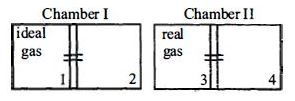
- ✓
Statement $-1$ is false and Statement $-2$ is true
- B
Statement $-1$ and Statement $-2$ both are true. Statement $-2$ is the correct explanation of Statement $-1$
- C
Statement $-1$ is true and Statemcnt $-2$ is false
- D
Statement $-1$ and Statement $-2$ both are true. Statement $-2$ is not correct explanation of Statement $- 1$
AnswerCorrect option: A. Statement $-1$ is false and Statement $-2$ is true
a
In ideal gases the molecules are considered as point particles and for point particles, there is no internal excitation, no vibration and no rotation. For an ideal gas the internal energy can only be translational kinetic energy and for real gas both kinetic as well as potential energy
View full question & answer→MCQ 4751 Mark
In the isothermal expansion of $10\,g$ of gas from volume $V$ to $2V$ the work done by the gas is $575\,J$. What is the root mean square speed of the molecules of the gas at that temperature ..... $m/s$?
Answerc
${v_{rms}} = \sqrt {\frac{{3PV}}{{{\rm{mass\, of\, the\, gas}}}}} $
View full question & answer→MCQ 4761 Mark
Figure shows the variation in temperature $\left( {\Delta T} \right)$ with the amount of heat supplied $(Q)$ in an isobaric process corresponding to a monoatomic $(M)$, diatomic $(D)$ and a polyatomic $(P)$ gas. The initial state of all the gases are the same and the scales for the two axes coincide. Ignoring vibrational degrees of freedom, the lines $a, b$ and $c$ respectively correspond to
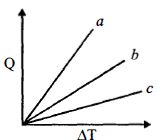
- A
$P, M$ and $D$
- ✓
$M, D$ and $P$
- C
$P, D$ and $M$
- D
$D, M$ and $P$
AnswerCorrect option: B. $M, D$ and $P$
b
On giving same amount of heat at constant pressure, there is no change in temperature for mono, dia and polyatomic.
$(\Delta \mathrm{Q})_{\mathrm{P}}=\mu \mathrm{C}_{\mathrm{p}} \Delta \mathrm{T}\left(\mu=\begin{array}{l}{\text { No. of molecules }} \\ {\text { Avogedro's na }}\end{array}\right)$
or $\quad \Delta \mathrm{T} \propto \frac{1}{\text { no of molecules }}$
View full question & answer→MCQ 4771 Mark
This question has Statement $- 1$ and Statement $-2$. Of the four choices given after the Statements, choose the one that best describes the two Statements.
Statement $1$ : The internal energy of a perfect gas is entirely kinetic and depends only on absolute temperature of the gas and not on its pressure or volume.
Statement $2$ : A perfect gas is heated keeping pressure constant and later at constant volume. For the same amount of heat the temperature of the gas at constant pressure is lower than that at constant volume.
- A
Statement $- 1$ is true, Statement $-2$ is true and
Statement $-2$ is the correct explanation of Statement $-1$
- B
Statement $-1$ is true, Statement $-2$ is false.
- ✓
Statement $-1$ is true, Statement $-2$ is true but
Statement $-2$ is not the correct explanation of Statement $-1$
- D
Statement $-1$ is false, Statement $-2$ is true
AnswerCorrect option: C. Statement $-1$ is true, Statement $-2$ is true but
Statement $-2$ is not the correct explanation of Statement $-1$
c
Internal energy of a system is the energy possessed by the system due to molecular motion and molecular configuration.
Internal energy $u=u_{k}+u_{p}$
For an ideal gas there is no molecular attraction $u_{p}=0$
$\therefore$ Internal energy $\mathrm{u}=\mathrm{u}_{\mathrm{k}}$
$(i.e.,\, internal\, kinetic\, energy)$
and $u=u_{k}=\frac{3}{2} \mu R T$
At constant pressure $(\Delta \mathrm{Q})_{\mathrm{P}}=\mu \mathrm{C}_{\mathrm{p}} \Delta \mathrm{T}$
At constant volume $(\Delta \mathrm{Q})_{\mathrm{v}}=\mu \mathrm{C}_{\mathrm{v}} \Delta \mathrm{T}$
$\mathrm{AsC}_{\mathrm{P}}>\mathrm{C}_{\mathrm{V}} \quad \therefore \quad(\Delta \mathrm{T})_{\mathrm{P}}<(\Delta \mathrm{T})_{\mathrm{V}}$
View full question & answer→MCQ 4781 Mark
A closed vessel contains $10 g$ of an ideal gas $X$ at $300 \ K$, which exerts $2$ atm pressure. At the same temperature, $80 g$ of another ideal gas $Y$ is added to it and the pressure becomes $6 atm$. The ratio of root mean square velocities of $X$ and $Y$ at $300 \ K$ is
- A
$2 \sqrt{2}: \sqrt{3}$
- B
$2 \sqrt{2}: 1$
- C
$1: 2$
- ✓
$2: 1$
AnswerCorrect option: D. $2: 1$
d
For Ideal Gas
$PV = nRT$
$\therefore n \propto P \text { at constant } T \& V.$
$\because \quad \text { mole }=\frac{\text { Mass }}{\text { Molar mass }}$
$\text { For gas } X : \frac{10}{ M _{ X }} \propto 2 atm$ $. . . . (1)$
For gas $X \& Y : \frac{10}{ M _{ X }}+\frac{80}{ M _{ Y }} \propto 6 atm$ $. . . . (2)$
From $(2)$ - $(1)$
$\frac{80}{ M _y} \propto 4$ $. . . . (3)$
On dividing $(1)$ by $(3)$
$\frac{M_{ Y }}{8 M _{ X }}=\frac{1}{2}$
$\therefore \quad \frac{ M _{ Y }}{ M _{ X }}=4$ $. . . . (4)$
$\because \quad V _{ rms }=\sqrt{\frac{3 R T}{M}} \Rightarrow V _{ rms } \propto \frac{1}{\sqrt{ M }}$
$\therefore \frac{\left( V _{ rms }\right)_{ X }}{\left( V _{ rms }\right)_{ Y }}=\sqrt{\frac{ M _{ Y }}{ M _{ X }}}=\sqrt{\frac{4}{1}}=\frac{2}{1}$
View full question & answer→MCQ 4791 Mark
A spherical soap bubble inside an air chamber at pressure $P_0=10^5 Pa$ has a certain radius so that the excess pressure inside the bubble is $\Delta P=144 Pa$. Now, the chamber pressure is reduced to $8 P_0 / 27$ so that the bubble radius and its excess pressure change. In this process, all the temperatures remain unchanged. Assume air to be an ideal gas and the excess pressure $\Delta P$ in both the cases to be much smaller than the chamber pressure. The new excess pressure $\Delta P$ in $Pa$ is
Answerc
(image)
$P - P _0=\Delta P =\frac{4 T }{ R }$
$P =\left( P _0+\frac{4 T }{ R }\right)$
Case-$2$
(image)
$P _1-\frac{8 P _0}{27}=\Delta P _1=\frac{4 T }{ R _1}$
$P _1=\frac{4 T }{ R _1}+\frac{8 P _0}{27}$
Constant temperature process
$PV = P _1 V_1$
$\left( P _0+\frac{4 T }{ R }\right) \frac{4}{3} \pi R ^3=\left(\frac{4 T }{ R _1}+\frac{8 P _0}{27}\right) \frac{4}{3} \pi R _1^3 ;\left(\frac{4 T }{ R }\right),\left(\frac{4 T }{ R _1}\right) \rightarrow \text { (Neglected) }$
$R =\frac{2}{3} R _1 \Rightarrow R _1=\frac{3}{2} R$
$\Delta P _1=\frac{4 T }{ R _1}=\frac{4 T }{3 R } \times 2=\frac{2}{3} \times(144)=96 Pa$
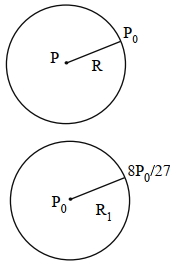
View full question & answer→MCQ 4801 Mark
A spherical bubble inside water has radius $R$. Take the pressure inside the bubble and the water pressure to be $p_0$. The bubble now gets compressed radially in an adiabatic manner so that its radius becomes $(R-a)$. For $a \ll R$ the magnitude of the work done in the process is given by $\left(4 \pi p_0 R a^2\right) X$, where $X$ is a constant and $\gamma=C_p / C_V=41 / 30$. The value of $X$ is. . . . . .
- A
$2.02$
- B
$2.04$
- ✓
$2.05$
- D
$2.06$
AnswerCorrect option: C. $2.05$
c
$W =(\Delta P )_{ arg } \times 4 \pi R ^2 a$
$\simeq\left|\frac{ dP }{2} \cdot 4 \pi R ^2 a \right|$
$\text { \{for small change } \left.(\Delta P )_{ avg }< P >\text { arithmetic mean }\right\}$
$= PV = c \Rightarrow dP =-\gamma \frac{ P }{ V } dV =-\frac{\gamma P _0}{ V } 4 \pi R ^2 a$
$=\frac{\gamma P _0}{2 V } \times 4 \pi R ^2 a \times 4 \pi R ^2 a$
$=\frac{\gamma P _0}{2 \times 4 \pi R ^3} 4 \pi R ^2 a \times 4 \pi R ^2 a$
$=\left(4 pRP \times a ^2\right) \frac{3 \gamma}{2}$
$\therefore x =2.05$
View full question & answer→MCQ 4811 Mark
A flat plate is moving normal to its plane through a gas under the action of constant force $F$. The gas is kept at a very low pressure. The speed of the plate $v$ is much less than the average speed $u$ of the gas molecules. Which of the following options is/are true?
[$A$] The resistive force experienced by the plate is proportional to $\mathrm{v}$
[$B$] The pressure difference between the leading and trailing faces of the plate is proportional to uv
[$C$] The plate will continue to move with constant non-zero acceleration, at all times
[$D$] At a later time the external force $F$ balances the resistive force.
- A
$A,C,D$
- B
$A,C,B$
- ✓
$A,B,D$
- D
$A,C$
AnswerCorrect option: C. $A,B,D$
View full question & answer→MCQ 4821 Mark
A container of fixed volume has a mixture of one mole of hydrogen and one mole of helium in equilibrium at temperature $T$. Assuming the gases are ideal, the correct statement$(s)$ is(are)
$(A)$ The average energy per mole of the gas mixture is $2RT$.
$(B)$ The ratio of speed of sound in the gas mixture to that in helium gas is $\sqrt{6 / 5}$.
$(C)$ The ratio of the rms speed of helium atoms to that of hydrogen molecules is $1 / 2$.
$(D)$ The ratio of the rms speed of helium atoms to that of hydrogen molecules is $1 / \sqrt{2}$.
- A
$(B,C,D)$
- B
$(A,C,D)$
- ✓
$(A,B,D)$
- D
$(A,B,C)$
AnswerCorrect option: C. $(A,B,D)$
c
$U = nC _{ v _1} T + nC _{ V _2} T$
$=1 \times \frac{5}{2} RT +1 \times \frac{3}{2} RT =4 RT$
$\Rightarrow \quad 2 C _{ V _{\text {mix }}} T =4 RT$
Average energy per mole $=2 RT \Rightarrow C _{ V _{\text {mix }}}=2 R$
$\frac{ C _{\operatorname{mix}}}{ C _{ H 0}}=\sqrt{\left(\frac{\gamma_{\operatorname{mix}}}{\gamma_{ Ho }}\right)\left(\frac{ M _{ H _0}}{ M _{\text {mix }}}\right)}=\sqrt{\frac{3}{2} \times \frac{3}{5} \times \frac{4}{3}}=\sqrt{\frac{6}{5}}$
$\frac{ V _{\text {rms }} H _0}{ V _{ rms H }}=\sqrt{\frac{ M _{ H _2}}{ M _{ H 0}}}=\frac{1}{\sqrt{2}}$
View full question & answer→MCQ 4831 Mark
Two non-reactive monoatomic ideal gases have their atomic masses in the ratio $2: 3$. The ratio of their partial pressures, when enclosed in a vessel kept at a constant temperature, is $4: 3$. The ratio of their densities is:
- A
$1: 4$
- B
$1: 2$
- C
$6: 9$
- ✓
$8: 9$
AnswerCorrect option: D. $8: 9$
d
$P_1=\frac{\rho_1 R T}{M_1}$
$P_2=\frac{\rho_2 R T}{M_2}$
by $(i)$ and $(ii)$
$\frac{\rho_1}{\rho_2}=\frac{8}{9}$
View full question & answer→MCQ 4841 Mark
A mixture of $2$ moles of helium gas (atomic mass $=4 \ amu$ ), and $1$ mole of argon gas (atomic mass $=40 \ amu$ ) is kept at $300 \ K$ in a container. The ratio of the rms speeds $\left(\frac{\left. v _{ mms } \text { (helium }\right)}{ v _{\text {rms }} \text { (argon) }}\right)$ is :
- A
$0.32$
- B
$0.45$
- C
$2.24$
- ✓
$3.16$
AnswerCorrect option: D. $3.16$
d
$\frac{v_{R_{m s_{\text {T }}}}}{v_{R_{m m s_{A r}}}}=\frac{\sqrt{\frac{3 R T}{m_{H e}}}}{\sqrt{\frac{3 R T}{m_{A r}}}}=\sqrt{\frac{m_{A r}}{m_{H e}}}=\sqrt{\frac{40}{4}}=\sqrt{10} \approx 3.16$
View full question & answer→MCQ 4851 Mark
A real gas behaves like an ideal gas if its
- A
pressure and temperature are both high
- B
pressure and temperature are both low
- C
pressure is high and temperature is low
- ✓
pressure is low and temperature is high
AnswerCorrect option: D. pressure is low and temperature is high
d
Real gas obeys vanderwaals equation
$\left( p +\frac{ n ^2 a }{ V ^2}\right)( V - nb )= nRT$
at high temperature and low pressure
Van der waal equation becomes approximately $PV$ $= nRT$
Hence gases behave ideally at high temperature and low pressure.
View full question & answer→MCQ 4861 Mark
$STATEMENT- 1$ The total translational kinetic energy of all the molecules of a given mass of an ideal gas is $1.5$ times the product of its pressure and its volume. because
$STATEMENT-2$ The molecules of a gas collide with each other and the velocities of the molecules change due to the collision.
- A
Statement -$1$ is True, Statement-$2$ is True; Statement -$2$ is a correct explanation for Statement-$1$.
- ✓
Statement -$1$ is True, Statement-$2$ is True; Statement -$2$ is $NOT$ a correct explanation for Statement-$1$.
- C
Statement -$1$ is True, Statement- $2$ is False.
- D
Statement -$1$ is False, Statement-$2$ is True.
AnswerCorrect option: B. Statement -$1$ is True, Statement-$2$ is True; Statement -$2$ is $NOT$ a correct explanation for Statement-$1$.
View full question & answer→MCQ 4871 Mark
A monatomic ideal gas undergoes a process in which the ratio of $\mathrm{P}$ to $\mathrm{V}$ at any instant is constant and equals to $1$. What is the molar heat capacity of the gas?
- ✓
$\frac{4 \mathrm{R}}{2}$
- B
$\frac{3 R}{2}$
- C
$5 R / 2$
- D
$0$
AnswerCorrect option: A. $\frac{4 \mathrm{R}}{2}$
View full question & answer→MCQ 4881 Mark
An ideal gas is initially at temperature $T$ and volume $V.$ Its volume is increased by $\Delta V$ due to an increase in temperature $\Delta T,$ pressure remaining constant. The quantity $\delta = \Delta V/(V\Delta T)$ varies with temperature as
Answerc
We know that $V / T =$ constant
$\frac{ V +\Delta V }{ T +\Delta T }=\frac{ V }{ T } \text { or } VT + T \Delta V = VT + V \Delta T$
$\text { or } T \Delta V = V \Delta T \text { or } \frac{\Delta V }{ V \Delta T }=\frac{1}{ T }$
View full question & answer→MCQ 4891 Mark
A gas mixture consists of $2$ moles of $O_2$ and $4$ moles of $Ar$ at temperature $T$. Neglecting all vibrational modes, the total internal energy of the system is
- A
$4 RT$
- B
$15 RT$
- C
$9 RT$
- ✓
$11 RT$
AnswerCorrect option: D. $11 RT$
d
Total Energy $ = {U_{oxygen}} + {U_{argon}} = {\mu _1}\frac{{{f_1}}}{2}RT + {\mu _2}\frac{{{f_2}}}{2}RT$
$[f_1 = 5 (Oxygen)$ , $f_2 = 3 (Argon)]$
$ = 2\frac{5}{2}RT + 4\frac{3}{2}RT = 5\,RT + 6\,RT = 11\,RT$
View full question & answer→MCQ 4901 Mark
A closed compartment containing gas is moving with some acceleration in horizontal direction. Neglect effect of gravity. Then the pressure in the compartment is
Answerb
The pressure in the front part of the closed compartment will be less because in the accelerated frame the pseudo force will act on the molecules backwards and the density of the gas will be more backwards
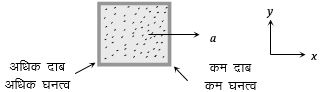
View full question & answer→MCQ 4911 Mark
A vessel contains a mixture of one mole of oxygen and two moles of nitrogen at $300 K$. The ratio of the average rotational kinetic energy per ${O_2}$ molecule to that per ${N_2}$ molecule is
- ✓
$1:1$
- B
$1:2$
- C
$2:1$
- D
Depends on the moments of inertia of the two molecules
Answera
A diatomic gas has $2$ degrees of freedom associated with rotational motion. Law of equipartition of energy states that the rotational kinetic energy per degree of freedom is $\frac{1}{2} KT$. Since two gases are at same temperature their rotational kinetic energies will be equal.
View full question & answer→MCQ 4921 Mark
Let $\bar v,\;{v_{rms}}$ and ${v_p}$ respectively denote the mean speed, root mean square speed and most probable speed of the molecules in an ideal monoatomic gas at absolute temperature $T.$ The mass of a molecule is $m.$ Then
- A
No molecule can have speed less than ${v_p}/\sqrt 2 $
- B
The average kinetic energy of a molecule is $\frac{3}{4}mv_p^2$
- C
${v_p} < \bar v < {v_{rms}}$
- ✓
Both $(b)$ and $(c)$
AnswerCorrect option: D. Both $(b)$ and $(c)$
d
${v_{rms}} = \sqrt {\frac{{3RT}}{M}} ,$ ${v_P} = \sqrt {\frac{{2RT}}{M}} = 0.816{v_{rms}}$
$\bar v = \sqrt {\frac{{8RT}}{{\pi M}}} = 0.92{v_{rms}}$ $ \Rightarrow \,\,{v_P} < \bar v < {v_{rms}}$
and ${E_{av}} = \frac{1}{2}mv_{rms}^2 = \frac{1}{2}m\frac{3}{2}v_P^2 = \frac{3}{4}mv_P^2$
View full question & answer→MCQ 4931 Mark
A vessel contains $1$ mole of ${O_2}$ gas (molar mass $32)$ at a temperature $T.$ The pressure of the gas is $P. $ An identical vessel containing one mole of $He$ gas (molar mass $4)$ at temperature $2T$ has a pressure of
Answerc
$PV = \mu RT$
$P \propto \mu T$ $ ( \because$ $V$ व $R =$ नियत$)$
$\frac{{{P_2}}}{{{P_1}}} = \frac{{{\mu _2}}}{{{\mu _1}}} \times \frac{{{T_2}}}{{{T_1}}}$
$\frac{{{P_{He}}}}{P} = \frac{1}{1} \times \frac{{2T}}{T}$
${P_{He}} = 2P$
View full question & answer→MCQ 4941 Mark
The average translational energy and the $r.m.s.$ speed of molecules in a sample of oxygen gas at $300 K$ are $6.21 \times {10^{ - 21}}\,J$ and $484\, m/s$ respectively. The corresponding values at $600 K$ are nearly (assuming ideal gas behaviour)
- A
$12.42 \times {10^{-21}}\,J,\;968\,m/s$
- B
$8.78 \times {10^{-21}}J,\;684\,m/s$
- C
$6.21 \times {10^{-21}}\,J,\,968\,m/s$
- ✓
$12.42 \times {10^{-21}}\,J,\;684\,m/s$
AnswerCorrect option: D. $12.42 \times {10^{-21}}\,J,\;684\,m/s$
d
$E \propto T$
$\therefore \frac{{{E_2}}}{{{E_1}}} = \frac{{{T_2}}}{{{T_1}}} = \frac{{600}}{{300}} = 2$
$\therefore \,\,{E_2} = 2{E_1}\,\,\,$
$\therefore \,\,\,{E_2} = 2 \times 6.21 \times {10^{ - 21}}\,\, = 12.42 \times {10^{ - 21}}\,J$
${\upsilon _{rms}} \propto \sqrt T $ પરથી $\frac{{{{({\upsilon _{rms}})}_2}}}{{{{({\upsilon _{rms}})}_1}}} = \sqrt {\frac{{{T_2}}}{{{T_1}}}} = \,\sqrt {\frac{{600}}{{300}}} \, = \,\sqrt 2 \,\,$
$\therefore {({\upsilon _{rms}})_2}\, = \,\sqrt 2 {({\upsilon _{rms}})_1}$
$\therefore {({\upsilon _{rms}})_2}\,\, = \,\sqrt 2 \times 325\,\, = \,459.6\,m/s$
View full question & answer→MCQ 4951 Mark
The average translational kinetic energy of ${O_2}$ (molar mass $32$) molecules at a particular temperature is $ 0.048\, eV.$ The translational kinetic energy of ${N_2}$ (molar mass $28$) molecules in $eV$ at the same temperature is
- A
$0.0015$
- B
$0.003$
- ✓
$0.048$
- D
$0.768$
AnswerCorrect option: C. $0.048$
c
Given,
$E _{ O _{2}}=0.048 \; eV$
We know that,
Translational kinetic energy,
$E =\frac{3}{2} KT$
where, $k =$ Boltzmann constant
$T =$ Temperature
$\therefore E \propto T$
Since, the temperature is same for both oxygen and nitrogen therefore, $E _{ O _{2}}= E _{ N _{2}}$
$\therefore E _{ N _{2}}=0.048 \; eV$
View full question & answer→MCQ 4961 Mark
The temperature of an ideal gas is increased from $120\, K$ to $480\, K.$ If at $120\, K,$ the root mean square velocity of the gas molecules is $v,$ at $480\, K$ it becomes
Answerb
${v_{rms}} \propto \sqrt T $
$\Rightarrow$ $\frac{{{v_1}}}{{{v_2}}} = \sqrt {\frac{{{T_1}}}{{{T_2}}}} = \sqrt {\frac{{120}}{{480}}} = \frac{1}{2}$
$ \Rightarrow \,\,{v_2} = 2{v_1}$
View full question & answer→MCQ 4971 Mark
From the following statements, concerning ideal gas at any given temperature $T,$ select the correct one(s)
- A
The coefficient of volume expansion at constant pressure is same for all ideal gases
- B
The mean free path of molecules increases with the decrease in pressure
- C
In a gaseous mixture, the average translational kinetic energy of the molecules of each component is same
- ✓
Answerd
For $1$ mole of an ideal gas
$pV = RT \text {...(i) }$
at constant pressure:
$PdV = RdT \text {....(ii) }$
From Eqs. $(i)$ and $(ii)$, we get
$\frac{d V}{V}=\frac{d T}{T}$
The coefficient of volume expansion at constant pressure is given by $\frac{ dV }{ VdT }=\frac{1}{ T }$
same for all gases at same temperature.
The average translational kinetic energy per molecule is $(3 / 2) kT$ and not $3 kT$. With decrease in pressure, volume of the gas increase so its mean free path increases.
The average translational kinetic energy of the molecules is independent of their nature, so each component of the gaseous mixture will have the same value of average translational kinetic energy.
View full question & answer→MCQ 4981 Mark
Three closed vessels $A, B$ and $C$ are at the same temperature $T$ and contain gases which obey the Maxwellian distribution of velocities. Vessel $A$ contains only ${O_2},\,B$ only ${N_2}$ and $C$ a mixture of equal quantities of ${O_2}$ and ${N_2}$. If the average speed of the ${O_2}$ molecules in vessel A is ${V_1}$, that of the ${N_2}$ molecules in vessel B is ${V_2}$, the average speed of the ${O_2}$ molecules in vessel $C$ is
- A
$({V_1} + {V_2})/2$
- ✓
${V_1}$
- C
${({V_1}{V_2})^{1/2}}$
- D
$\sqrt {3kT/M} $
AnswerCorrect option: B. ${V_1}$
b
Both $O _{2}$ and $N _{2}$ gases in vessel $C$ will behave independently since, $V _{ av }=$ $\sqrt{\frac{8 RT }{\pi M }}$ depends only on the temperature and mass of the gas molecule, there is no difference between the $V _{\text {av }}$ of $O _{2}$ in vessel $A$ and $C$ is $V _{1}$
View full question & answer→MCQ 4991 Mark
$70$ calories of heat are required to raise the temperature of $2$ moles of an ideal gas at constant pressure from $30°C$ to $35°C.$ The amount of heat required to raise the temperature of same gas through the same range $(30°C$ to $35°C)$ at constant volume ..... $cal$ $(R = 2 \,cal/mol/K)$
Answerb
${(\Delta Q)_P} = \mu {C_P}\Delta T$
$\Rightarrow$ $2 \times {C_P} \times (35 - 30)$
$\Rightarrow$ ${C_P} = 7\frac{{cal}}{{mole{\rm{ - }}K}}$
$\because$ ${C_P} - {C_V} = R$
$\Rightarrow$ ${C_V} = {C_P} - R = 7 - 2 = 5\frac{{cal}}{{mole{\rm{ - }}kevin}}$
$\therefore$ ${(\Delta Q)_V} = \mu {C_V}\Delta T = 2 \times 5 \times (35 - 30) = 50\,cal.$
View full question & answer→MCQ 5001 Mark
At room temperature, the $r.m.s.$ speed of the molecules of certain diatomic gas is found to be $1920\, m/s$. The gas is
- ✓
${H_2}$
- B
${F_2}$
- C
${O_2}$
- D
$C{l_2}$
AnswerCorrect option: A. ${H_2}$
a
${v_{rms}} = \sqrt {\frac{{3RT}}{M}} $
$\Rightarrow$ $M = \frac{{3RT}}{{v_{rms}^2}}$
$\therefore$ $M = \frac{{3 \times 8.3 \times 300}}{{{{(1920)}^2}}}$
$ = 2 \times {10^{ - 3}}kg = 2\,gm$
$\Rightarrow$ Hydrogen
View full question & answer→