Question types

13. oscillations question types

941 questions across 1 question group — pick any mix to generate a Physics paper with step-by-step answer keys.

941
Questions
1
Question groups
5
Question types
Sample Questions

13. oscillations questions

One sample from each question group in this chapter. Select any group above to see the full set with answer keys.

If $x=5 \sin \left(\pi t+\frac{\pi}{3}\right) \mathrm{m}$ represents the motion of a particle executing simple harmonic motion, the amplitude and time period of motion, respectively, are
  • $5 \mathrm{~m}, 2 \mathrm{~s}$
  • B
    $5 \mathrm{~cm}, 1 \mathrm{~s}$
  • C
    $5 \mathrm{~m}, 1 \mathrm{~s}$
  • D
    $5 \mathrm{~cm}, 2 \mathrm{~s}$

Answer: A.

View full solution
If the mass of the bob in a simple pendulum is increased to thrice its original mass and its length is made half its original length, then the new time period of oscillation is $\frac{x}{2}$ times its original time period. Then the value of $x$ is:
  • $\sqrt{2}$
  • B
    $2 \sqrt{3}$
  • C
    $4$
  • D
    $\sqrt{3}$

Answer: A.

View full solution
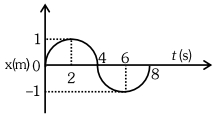
The $x-t$ graph of a particle performing simple harmonic motion is shown in the figure. The acceleration of the particle at $t=2 s$ is :
  • $-\frac{\pi^2}{16}\,ms ^{-2}$
  • B
    $\frac{\pi^2}{8}\,ms ^{-2}$
  • C
    $-\frac{\pi^2}{8}\,ms ^{-2}$
  • D
    $\frac{\pi^2}{16}\,ms ^{-2}$


Answer: A.

View full solution
Two pendulums of length $121\,cm$ and $100\,cm$ start vibrating in phase. At some instant, the two are at their mean position in the same phase. The minimum number of vibrations of the shorter pendulum after which the two are again in phase at the mean position is :
  • A
    $9$
  • B
    $10$
  • C
    $8$
  • $11$

Answer: D.

View full solution
Match $List - I$ with $List - II$

Choose the correct answer from the options given below

  • A
    $(a) - (iv), (b) - (ii), (c) - (iii), (d) - (i)$
  • $(a) - (iv), (b) - (iii), (c) - (ii), (d) - (i)$
  • C
    $(a) - (i), (b) - (iv), (c) - (iii), (d) - (ii)$
  • D
    $(a) - (iii), (b) - (ii), (c) - (i), (d) - (iv)$

Answer: B.

View full solution

Generate a 13. oscillations paper free

Pick question groups from the list above, set marks and difficulty, and export a branded PDF with step-by-step answer keys. First 3 chapters free — no signup.

Download App