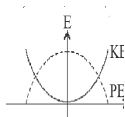
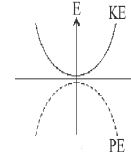
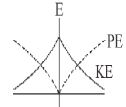
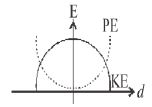
MCQ 11 Mark
If $x=5 \sin \left(\pi t+\frac{\pi}{3}\right) \mathrm{m}$ represents the motion of a particle executing simple harmonic motion, the amplitude and time period of motion, respectively, are
- ✓
$5 \mathrm{~m}, 2 \mathrm{~s}$
- B
$5 \mathrm{~cm}, 1 \mathrm{~s}$
- C
$5 \mathrm{~m}, 1 \mathrm{~s}$
- D
$5 \mathrm{~cm}, 2 \mathrm{~s}$
AnswerCorrect option: A. $5 \mathrm{~m}, 2 \mathrm{~s}$
a
$x=5 \sin \left(\pi t+\frac{\pi}{3}\right) \mathrm{m}$
Amplitude $=5 \mathrm{~m}$
$\omega=\pi=\frac{2 \pi}{T}$
$T=\frac{2 \pi}{\pi}=2 \mathrm{~s}$
View full question & answer→MCQ 21 Mark
If the mass of the bob in a simple pendulum is increased to thrice its original mass and its length is made half its original length, then the new time period of oscillation is $\frac{x}{2}$ times its original time period. Then the value of $x$ is:
- ✓
$\sqrt{2}$
- B
$2 \sqrt{3}$
- C
$4$
- D
$\sqrt{3}$
AnswerCorrect option: A. $\sqrt{2}$
a
$T^{\prime}=2 \pi \sqrt{\frac{\ell^{\prime}}{g}} \text { where } \ell^{\prime}=\frac{\ell}{2}$
$T=2 \pi \sqrt{\frac{\ell}{g}}$
$T^{\prime}=\frac{x}{2} T$
$2 \pi \sqrt{\frac{\ell}{2 g}}=\frac{x}{2} 2 \pi \sqrt{\frac{\ell}{g}}$
$\frac{1}{\sqrt{2}}=\frac{x}{2} \Rightarrow x=\sqrt{2}$
View full question & answer→MCQ 31 Mark
The $x-t$ graph of a particle performing simple harmonic motion is shown in the figure. The acceleration of the particle at $t=2 s$ is :
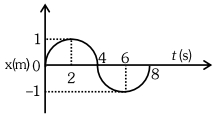
- ✓
$-\frac{\pi^2}{16}\,ms ^{-2}$
- B
$\frac{\pi^2}{8}\,ms ^{-2}$
- C
$-\frac{\pi^2}{8}\,ms ^{-2}$
- D
$\frac{\pi^2}{16}\,ms ^{-2}$
AnswerCorrect option: A. $-\frac{\pi^2}{16}\,ms ^{-2}$
a
$x = A \sin (\omega t )$
$\frac{ dx }{ dt }= v = A \omega \cos (\omega t )$
$\frac{ dv }{ dt }= a =-\omega^2 A \sin (\omega t )$
$a =-\left(\frac{2 \pi}{8}\right)^2 \times 1 \sin \left(\frac{2 \pi}{8} \times 2\right)$
$\Rightarrow a =-\frac{\pi^2}{16} \times \sin \left(\frac{\pi}{2}\right)$
$\therefore a =\frac{-\pi^2}{16}\,m / s ^2$
View full question & answer→MCQ 41 Mark
Two pendulums of length $121\,cm$ and $100\,cm$ start vibrating in phase. At some instant, the two are at their mean position in the same phase. The minimum number of vibrations of the shorter pendulum after which the two are again in phase at the mean position is :
Answerd
$( n ) T _{\ell}=( n +1) T _{ s }$
$( n ) 2 \pi \sqrt{\frac{1.21}{ g }}=( n +1) 2 \pi \sqrt{\frac{1}{ g }}$
$( n )(1.1)=( n +1)$
$0.1( n )=1$
$n =10$
No. of oscillation of smaller one
$= n +1$
$=10+1$
$=11$
View full question & answer→MCQ 51 Mark
Match $List - I$ with $List - II$
Choose the correct answer from the options given below

- A
$(a) - (iv), (b) - (ii), (c) - (iii), (d) - (i)$
- ✓
$(a) - (iv), (b) - (iii), (c) - (ii), (d) - (i)$
- C
$(a) - (i), (b) - (iv), (c) - (iii), (d) - (ii)$
- D
$(a) - (iii), (b) - (ii), (c) - (i), (d) - (iv)$
AnswerCorrect option: B. $(a) - (iv), (b) - (iii), (c) - (ii), (d) - (i)$
b
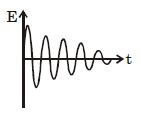
$(a) \rightarrow (iv)$ Amplitude is continuously decreasing
$(b) \rightarrow (iii)$ $\quad F \propto- x$
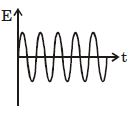
$(c) \rightarrow (ii)$ Amplitude is constant
$(d) \rightarrow (i)$ $\quad$ K.E. $+$ P.E. $=$ M.E. $=$ constant
View full question & answer→MCQ 61 Mark
Identify the function which represents a nonperiodic motion.
AnswerCorrect option: A. $e^{-\omega t}$
a
$e^{-\omega t}$ represents non-periodic motion.
View full question & answer→MCQ 71 Mark
A body is executing simple harmonic motion with frequency $'n',$ the frequency of its potential energy is :
- A
$\mathrm{n}$
- B
$3 \mathrm{n}$
- ✓
$2 \mathrm{n}$
- D
$4 \mathrm{n}$
AnswerCorrect option: C. $2 \mathrm{n}$
c
Displacement equation of $SHM$ of frequency $'n'$
$\mathrm{x}=\mathrm{A} \sin (\omega \mathrm{t})=\mathrm{A} \sin (2 \pi \mathrm{nt})$
Now,
Potential energy
$U=\frac{1}{2} k x^{2}=\frac{1}{2} K A^{2} \,\sin ^{2}(2 \pi n t)$
$=\frac{1}{2} k A^{2}\left[\frac{1-\cos (2 \pi(2 n) t)}{2}\right]$
So frequency of potential energy $=2 \mathrm{n}$
View full question & answer→MCQ 81 Mark
A spring is stretched by $5 \,\mathrm{~cm}$ by a force $10 \,\mathrm{~N}$. The time period of the oscillations when a mass of $2 \,\mathrm{~kg}$ is suspended by it is :(in $s$)
- A
$0.0628$
- B
$6.28$
- C
$3.14$
- ✓
$0.628$
AnswerCorrect option: D. $0.628$
d
$\mathrm{F}=\mathrm{K} \mathrm{x}$
$10=\mathrm{K} \times 0.05$
$\mathrm{~K}=\frac{1000}{5}=200$
$\mathrm{~T}=2 \pi \sqrt{\frac{\mathrm{m}}{\mathrm{k}}}=2 \pi \sqrt{\frac{2}{200}}$
$=\frac{2 \pi}{10}=\frac{6.28}{10}$
$=.628\, \mathrm{~s}$
View full question & answer→MCQ 91 Mark
Identify the function which represents a periodic motion.
AnswerCorrect option: D. $\sin \omega t+\cos \omega t$
d
For periodic function
$f(t)=f(t+T)$
where $T$ is time period of function
$\sin (\omega t+2 \pi)+\cos (\omega t+2 \pi)$
$=\sin \omega t+\cos \omega t$
View full question & answer→MCQ 101 Mark
The phase difference between displacement and acceleration of a particle in a simple harmonic motlon is
- A
- ✓
$\pi\; rad$
- C
$\frac{3 \pi}{2}\; rad$
- D
$\frac{\pi}{2}\; rad$
AnswerCorrect option: B. $\pi\; rad$
b
Displacement $(x)$ equation of $SHM$
$x = A \sin (\omega t +\phi)$ $....(1)$
$\frac{ dx }{ dt }= A \omega \cos (\omega t +\phi)$
acceleration $(a)=\frac{d^{2} x}{d t^{2}}$
$a=-\omega^{2} A \sin (\omega t+\phi)$
$a =\omega^{2} A \sin (\omega t +\phi+\pi)$$.....(2)$
from $(1) \;and\;(2),$ phase difference between displacement and acceleration is $\pi .$
View full question & answer→MCQ 111 Mark
The displacement of a particle executing simple harmonic motion is given by
$\mathrm{y}=\mathrm{A}_{0}+\mathrm{A} \sin \omega \mathrm{t}+\mathrm{B} \cos \omega \mathrm{t}$
Then the amplitude of its oscillation is given by
- A
$\mathrm{A}_{0}+\sqrt{\mathrm{A}^{2}+\mathrm{B}^{2}}$
- ✓
$\sqrt{\mathrm{A}^{2}+\mathrm{B}^{2}}$
- C
$\sqrt{\mathrm{A}_{0}^{2}+(\mathrm{A}+\mathrm{B})^{2}}$
- D
$\mathrm{A}+\mathrm{B}$
AnswerCorrect option: B. $\sqrt{\mathrm{A}^{2}+\mathrm{B}^{2}}$
b
$y=A_{0}+A \sin \omega t+B \cos \omega t$
$y=A_{0}+\sqrt{A^{2}+B^{2}} \sin (\omega t+\phi)$
$\mathrm{A}_{0}$ is mean position, and $\sqrt{\mathrm{A}^{2}+\mathrm{B}^{2}}$ is amplitude
View full question & answer→MCQ 121 Mark
The distance covered by a particle undergoing $SHM$ in one time period is (amplitude $= A$)
Answerd
Distance in one oscillation $= 4A$
View full question & answer→MCQ 131 Mark
Average velocity of a particle executing $SHM$ in one complete vibration is
Answerd
Displacement $=$ zero in one complete oscillation
$\Rightarrow$ Average velocity $=\frac{\text { Dtsplacement }}{\mathrm{T}}=0$
View full question & answer→MCQ 141 Mark
A pendulum is hung from the roof of a sufficiently high building and is moving freely to and fro like a simple harmonic oscillator. The acceleration of the bob of the pendulum is $20\; m/s^2$ at a distance of $5\; m$ from the mean position. The time period of oscillation is
- A
$2\pi\;s$
- ✓
$\pi\;s$
- C
$1\;s$
- D
$2\;s$
AnswerCorrect option: B. $\pi\;s$
b
Magnitude of acceleration of a particle moving in a $SHM$ is, $|a|=\omega^{2} y ;$ where $y$ is amplitude.
$\Rightarrow \quad 20=\omega^{2}(5) \Rightarrow \omega=2 \mathrm{rad} \mathrm{s}^{-1}$
$\therefore \quad$ Time period of oscillation, $T=\frac{2 \pi}{\omega}=\frac{2 \pi}{2}=\pi \mathrm{s}$
View full question & answer→MCQ 151 Mark
A spring of force constant $k$ is cut into lengths of ratio $1:2:3$ . They are connected in series and the new force constant is $k'$ . Then they are connected in parallel and force constant is $k''$ . Then $k':k''$ is
- ✓
$1:11$
- B
$1:14$
- C
$1:16$
- D
$1:9$
AnswerCorrect option: A. $1:11$
a
Let us assume, the length of spring be $l$.
When we cut the spring into ratio of length $1: 2: 3,$ we
get three springs of lengths $\frac{l}{6}, \frac{2 l}{6}$ and $\frac{3 l}{6}$ with force
constant,
$\therefore k_{1}=\frac{k l}{l_{1}}=\frac{k l}{l / 6}=6 k$
${k_{2}=\frac{k l}{l_{2}}=\frac{k l}{2 l / 6}=3 k}$
${k_{3}=\frac{k l}{l_{3}}=\frac{k l}{3 l / 6}=2 k}$
When connected in series,
$\frac{1}{k^{\prime}}=\frac{1}{6 k}+\frac{1}{3 k}+\frac{1}{2 k}=\frac{1+2+3}{6 k}=\frac{1}{k}$
$\therefore \quad \overline{k^{\prime}}=k$
When connected in parallel,
${k^{\prime \prime}=6 k+3 k+2 k=11 k}$
${\frac{k^{\prime}}{k^{\prime \prime}}=\frac{k}{11 k}=\frac{1}{11}}$
View full question & answer→MCQ 161 Mark
A particle executes linear simple harmonic motion with an ampilitude of $3\,cm$ . When the particle is at $2\,cm$ from the mean position , the magnitude of its velocity is equal to that of its acceleration. Then its time period in seconds is
- ✓
$\frac{{4\pi }}{{\sqrt 5 }}$
- B
$\frac{{2\pi }}{{\sqrt 5 }}$
- C
$\;\frac{{\sqrt 5 }}{\pi }$
- D
$\frac{{\sqrt 5 }}{{2\pi }}$
AnswerCorrect option: A. $\frac{{4\pi }}{{\sqrt 5 }}$
a
$\text { Given, } A=3 \mathrm{cm}, x=2 \mathrm{cm}$
The velocity of a particle in simple harmonic motion is given as
$v=\omega \sqrt{A^{2}-x^{2}}$
and magnitude of its acceleration is
$a=\omega^{2} x$
Given $|v|=|a|$
$\therefore \omega \sqrt{A^{2}-x^{2}}-\omega^{2} x$
${\omega x=\sqrt{A^{2}-x^{2}} \text { or } \omega^{2} x^{2}=A^{2}-x^{2}}$
${\omega^{2}=\frac{A^{2}-x^{2}}{x^{2}}=\frac{9-4}{4}=\frac{5}{4}}$
${\omega=\frac{\sqrt{5}}{2}}$
Time period, $T=\frac{2 \pi}{\omega}=2 \pi \cdot \frac{2}{\sqrt{5}}=\frac{4 \pi}{\sqrt{5}} \mathrm{s}$
View full question & answer→MCQ 171 Mark
A body of mass $m $ is attached to the lower end of a spring whose upper end is fixed. The spring has negligible mass. When the mass $m$ is slightly pulled down and released , it oscillates with a time period of $3\,s$ . When the mass $m$ is increased by $1\,kg$ , the time period of oscillations becomes $5\,s$ . The value of $m$ in $kg$ is
- A
$\frac{16}{9}$
- ✓
$\frac{9}{16}$
- C
$\frac{3}{4}$
- D
$\frac{4}{3}$
AnswerCorrect option: B. $\frac{9}{16}$
b
$Time\, period\, of\, spring - block \,system,$
$T=2 \pi \sqrt{\frac{m}{k}}$
For given spring, $T \propto \sqrt{m}$
$\frac{T_{1}}{T_{2}} =\sqrt{\frac{m_{1}}{m_{2}}}$
$\text { Here, } T_{1} =3 \mathrm{s}, m_{1}=m, T_{2}=5 \mathrm{s}, m_{2}=m+1, m=?$
$ \frac{3}{5}=\sqrt{\frac{m}{m+1}} \text { or } \frac{9}{25}=\frac{m}{m+1}$
$25 m=9 m+9 \Rightarrow 16 m=9$
$\therefore m=\frac{9}{16} \mathrm{kg}$
View full question & answer→MCQ 181 Mark
A particle of mass m is under the influence of a force $F$ which varies with the displacement $x$ according to the relation $F = - kx + {F_0}$ in which $k$ and ${F_0}$ are constants. The particle when disturbed will oscillate
- A
about $x = 0,\,{\rm{with }}\,\omega \ne \sqrt {k/m} $
- B
about $x = 0,\,{\rm{with }}\,\omega = \sqrt {k/m} $
- ✓
about $x = {F_0}/k\,\,{\rm{with }}\,\omega = \sqrt {k/m} $
- D
about $x = {F_0}{\rm{/}}k\,{\rm{with }}\,\omega \ne \sqrt {k/m} $
AnswerCorrect option: C. about $x = {F_0}/k\,\,{\rm{with }}\,\omega = \sqrt {k/m} $
c
(c) Restoring force is zero at mean position
$F = - Kx + {F_0}$$\Rightarrow$ $0 = - Kx + {F_0}$$\Rightarrow$ $x = \frac{{{F_0}}}{K}$
i.e. the particle will oscillate about $x = \frac{{{F_0}}}{K}$
View full question & answer→MCQ 191 Mark
The displacement of a particle from its mean position (in metre) is given by $y = 0.2\sin (10\pi t + 1.5\pi )\cos (10\pi t + 1.5\pi )$. The motion of particle is
- A
Periodic but not $S.H.M.$
- B
- ✓
Simple harmonic motion with period $0.1 s$
- D
Simple harmonic motion with period $0.2 s$
AnswerCorrect option: C. Simple harmonic motion with period $0.1 s$
c
(c) $y = 0.2\sin (10\pi t + 1.5\pi )$$\cos (10\pi t + 1.5\pi )$
$ = 0.1\sin 2(10\pi \,t + 1.5\pi )$
$ = 0.1\sin (20\pi t + 3.0\pi )$
$\therefore$ Time period, $T = \frac{{2\pi }}{\omega } = \frac{{2\pi }}{{20\pi }} = \frac{1}{{10}} = 0.1sec$
View full question & answer→MCQ 201 Mark
The angular frequency of motion whose equation is $4\frac{{{d^2}y}}{{d{t^2}}} + 9y = 0$ is ($y =$ displacement and $t =$ time)
- A
$2.25$
- B
$0.44$
- ✓
$1.5$
- D
$0.67$
Answerc
$4 \frac{d^{2} y}{d t^{2}}+9 y=0$
or $\frac{d^{2} y}{d t^{2}}=\frac{-9}{4} y$
Comparing with $SHM$ equation
$\frac{\mathrm{d}^{2} \mathrm{y}}{\mathrm{dt}^{2}}=-\omega^{2} \mathrm{y}$
$\therefore \omega^{2}=\frac{9}{4}$
$\therefore \omega=\frac{3}{2}$
View full question & answer→MCQ 211 Mark
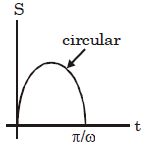
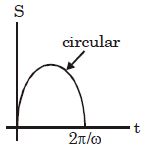
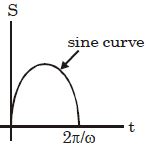
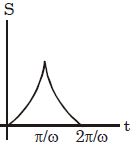
A particle moves along a circle with a constant angular speed $\omega$ Its displacement,with respect to this position of the particle at time $t = 0$ is plotted against time. The graph would look like
Answerc
$S = 2Rsin (\frac{\omega t}{2})$
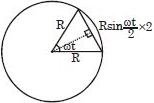
View full question & answer→MCQ 221 Mark
The equation of motion of a particle is $x = a\,cos (\alpha\, t)$ . The motion is
- A
Periodic but not oscillatory
- ✓
- C
Oscillatory but not periodic
- D
Neither periodic nor oscillatory
View full question & answer→MCQ 231 Mark
The displacement of a particle is represented by the equation $y = sin^3\,\,\,\omega t$ . The motion is
AnswerCorrect option: B. periodic but not simple harmonic
b
Given, $y=\sin ^{3} \omega t=\frac{1}{4}[3 \sin \omega t-\sin 3 \omega t]$
As this motion is not represented by single harmonic function, hence it is not $SHM.$ As this motion involves sine and cosine functions, hence it is periodic motion.
View full question & answer→MCQ 241 Mark
A particle moves on $x-$ axis according to the equation $x = x_0\,\,sin^2\,\omega t,$ the motion is simple harmonic
AnswerCorrect option: D. With time period $(\pi /\omega )$
d
$\mathrm{x}=\mathrm{x}_{0} \sin ^{2} \omega \mathrm{t}$
$x=x_{0}\left[\frac{1-\cos 2 \omega t}{2}\right]=\frac{x_{0}}{2}-\frac{x_{0} \cos 2 \omega t}{2}$
Angular Frequency $=2 \omega$
$\frac{2 \pi}{\mathrm{T}}=2 \omega$
$\mathrm{T}=\frac{\pi}{\omega}$
View full question & answer→MCQ 251 Mark
A simple pendulum having length $\ell $ is having speed $\sqrt {2g\ell }$ at bottom most point of its trajectory. Its motion will be
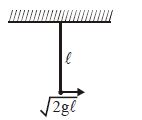
AnswerCorrect option: A. Periodic but not $SHM$
a
Particle will just complete half of the circle, so periodic but not $S.H.M.$
View full question & answer→MCQ 261 Mark
A particle is performing simple harmonic motion along $x$ -axis with amplitude $4\, cm$ and time period $1.2\, sec$. The minimum time taken by the particle to move from $x = 2\, cm$ to $x =+ 4 \,cm$ and back again is given by .... $s$
Answerb
minimum time taken by particle $=\frac{T}{6}+\frac{T}{6}$
$=\frac{T}{3}$
$=0.4 \mathrm{s}$
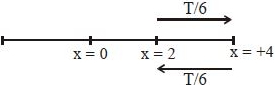
View full question & answer→MCQ 271 Mark
A particle is performing $SHM$ according to the equation $x = (3\, cm)$ $\sin \,\left( {\frac{{2\pi t}}{{18}} + \frac{\pi }{6}} \right)$ where $t$ is in seconds. The distance travelled by the particle in $36\, s$ is ..... $cm$
Answera
$\omega t=\frac{2 \pi}{18} t \Rightarrow \omega=\frac{2 \pi}{18} \quad$ also $\quad \omega=\frac{2 \pi}{\mathrm{T}}$
$\because T=18 s$
So distance travelled in $36 \mathrm{sec}=8 \mathrm{A}$
$=8 \times 3=24 \mathrm{cm}$
View full question & answer→MCQ 281 Mark
The equation of motion of a particle of mass $1\,g$ is $\frac{{{d^2}x}}{{d{t^2}}} + {\pi ^2}x = 0$ where $x$ is displacement (in $m$ ) from mean position. The frequency of oscillation is .... $s$ (in $Hz$ )
- ✓
$0.5$
- B
$2$
- C
$5\sqrt {10}$
- D
$\frac {1}{5\sqrt {10}}$
Answera
${\omega ^2} = {\pi ^2} \Rightarrow \omega = \pi \Rightarrow f = \frac{\omega }{{2\pi }} = \frac{\pi }{{2\pi }} = \frac{1}{2}Hz$
View full question & answer→MCQ 291 Mark
The function $(sin\,\omega t -cos\,\omega t)$ represents
- A
a simple harmonic motion with a period $\frac{\pi }{\omega }$
- ✓
a simple harmonic motion with a period $\frac{2\pi }{\omega }$
- C
a periodic but not simple harmonic motion with a period $\frac{\pi }{\omega }$
- D
a periodic but not simple harmonic motion with a periodic $\frac{2\pi }{\omega }$
AnswerCorrect option: B. a simple harmonic motion with a period $\frac{2\pi }{\omega }$
b
$x=\sin \omega t-\cos \omega t$
$\Longrightarrow x=2 \cos \omega t=2 \sin \left(\omega t+\frac{\pi}{2}\right) \quad\left[\sin C-\sin D=2 \cos \left(\frac{C+D}{2}\right) \sin \left(\frac{C-D}{2}\right)\right]$
On comparing this with equation of $S H M: x=A \sin (\omega t+\phi)$
$\Longrightarrow A=2$ $\omega(\text { Angular frequency })$
$\Longrightarrow T=\frac{2 \pi}{\omega}$
View full question & answer→MCQ 301 Mark
The amplitude and the periodic time of a $S.H.M.$ are $ 5\,cm$ and $6\,sec$ respectively. At a distance of $2.5\,cm$ away from the mean position, the phase will be
- A
$5\pi /12$
- B
$\pi /4$
- C
$\pi /3$
- ✓
$\pi /6$
AnswerCorrect option: D. $\pi /6$
d
The equation of motion is given as $y=5 \sin \frac{2 \pi t}{6}$
Here, $y=2.5 cm$
$\therefore 2.5=5 \sin \frac{2 \pi t}{6}$
$\Rightarrow \frac{\pi}{6}=\frac{2 \pi t}{6} \Rightarrow t=\frac{1}{2} s$
$\therefore$ The phase $=\frac{2 \pi t}{6}=\frac{2 \pi}{6} \times \frac{1}{2}=\frac{\pi}{6}$
View full question & answer→MCQ 311 Mark
A particle is oscillating according to the equation $X = 7\cos 0.5\pi t$, where $t$ is in second. The point moves from the position of equilibrium to maximum displacement in time ..... $\sec$
Answerc
(c) From given equation$\omega = \frac{{2\pi }}{T} = 0.5\pi ⇒ T = 4\,sec$
Time taken from mean position to the maximum displacement $ = \frac{1}{4}T = 1\,sec.$
View full question & answer→MCQ 321 Mark
A particle is executing simple harmonic motion with a period of $T$ seconds and amplitude a metre. The shortest time it takes to reach a point $\frac{a}{{\sqrt 2 }}\,m$ from its mean position in seconds is
Answerc
(c) $y = a\sin \frac{{2\pi }}{T}t$
==> $\frac{a}{{\sqrt 2 }} = a\sin \frac{{2\pi }}{T} \cdot t$
==> $\sin \frac{{2\pi }}{T}t = \frac{1}{{\sqrt 2 }} = \sin \frac{\pi }{4}$
==> $\frac{{2\pi }}{T}t = \frac{\pi }{4}$
==> $t = \frac{T}{8}$
View full question & answer→MCQ 331 Mark
A particle executes a simple harmonic motion of time period $T$. Find the time taken by the particle to go directly from its mean position to half the amplitude
- A
$T / 2$
- B
$T / 4$
- C
$T / 8$
- ✓
$T / 12$
AnswerCorrect option: D. $T / 12$
d
(d) $y = A\sin \omega t = \frac{{A\sin 2\pi }}{T}t$
==> $\frac{A}{2} = A\sin \frac{{2\pi t}}{T}$
==> $t = \frac{T}{{12}}$.
View full question & answer→MCQ 341 Mark
A particle executing $S.H.M.$ of amplitude 4 cm and $T = 4 \,sec.$ The time taken by it to move from positive extreme position to half the amplitude is ..... $\sec$
- A
$1$
- B
$0.33$
- ✓
$0.67$
- D
$1.22$
AnswerCorrect option: C. $0.67$
c
(c) Equation of motion $y = a\cos \omega t$
$\frac{a}{2} = a\cos \omega t$
$\Rightarrow \cos \omega t = \frac{1}{2}$
$\Rightarrow \omega t = \frac{\pi }{3}$
$ \Rightarrow \frac{{2\pi t}}{T} = \frac{\pi }{3}$
$\Rightarrow t = \frac{{\frac{\pi }{3} \times T}}{{2\pi }} = \frac{4}{{3 \times 2}} = \frac{2}{3}\sec $
View full question & answer→MCQ 351 Mark
The periodic time of a body executing simple harmonic motion is $3\, sec$. After how much interval from time $t = 0$, its displacement will be half of its amplitude ..... $\sec$
- A
$0.13$
- B
$0.17$
- ✓
$0.25$
- D
$0.33$
AnswerCorrect option: C. $0.25$
c
(c) $y = a\sin \frac{{2\pi }}{T}t$
==> $\frac{a}{2} = a\sin \frac{{2\pi t}}{3}$
==> $\frac{1}{2} = \sin \frac{{2\pi t}}{3}$
==> sin$\frac{{2\pi t}}{3} = \sin \frac{\pi }{6}$
==> $\frac{{2\pi t}}{3} = \frac{\pi }{6}$
==> $t = \frac{1}{4}\sec $
View full question & answer→MCQ 361 Mark
If $x = a\sin \left( {\omega t + \frac{\pi }{6}} \right)$ and $x' = a\cos \omega t$, then what is the phase difference between the two waves
- ✓
$ \pi/ 3$
- B
$ \pi/ 6$
- C
$ \pi/ 2$
- D
$ \pi$
AnswerCorrect option: A. $ \pi/ 3$
a
(a) $x = a\sin \left( {\omega t + \frac{\pi }{6}} \right)$ and $x' = a\cos \omega t = a\sin \,\left( {\omega \,t + \frac{\pi }{2}} \right)$
$\therefore \Delta \phi = \left( {\omega t + \frac{\pi }{2}} \right) - \left( {\omega t + \frac{\pi }{6}} \right) = \frac{\pi }{3}$
View full question & answer→MCQ 371 Mark
A particle doing simple harmonic motion, amplitude $= 4\, cm$, time period $= 12\, sec$. The ratio between time taken by it in going from its mean position to $2 \,cm$ and from $2\, cm$ to extreme position is
Answerd
(d) $\omega = \frac{{2\pi }}{T} = \frac{{2\pi }}{{12}} = \frac{\pi }{6}\frac{{rad}}{{sec}}$ (For $y = 2 \,cm$) $2 = 4\left( {\sin \frac{\pi }{6}{t_1}} \right)$
By solving ${t_1} = 1$sec (For $y = 4 \,cm$) ${t_2} = 3sec$
So time taken by particle in going from 2 cm to extreme position is ${t_2} - {t_1} = 2sec$.
Hence required ratio will be $\frac{1}{2}$.
View full question & answer→MCQ 381 Mark
A simple harmonic motion having an amplitude $A$ and time period $T$ is represented by the equation : $y = 5 \sin \pi (t + 4) m$
Then the values of $A$ (in $m$) and $T$ (in $sec$) are :
- ✓
$A = 5; T = 2$
- B
$A = 10 ; T = 1$
- C
$A = 5 ; T = 1$
- D
$A = 10 ; T = 2$
AnswerCorrect option: A. $A = 5; T = 2$
a
Standard equation S.H.M: $y=a \sin 2 \pi(t+T)$
Given equation of SHM: $y=a \sin \pi(t+4)$
We will the above equations$:$
hence it will be written as after multiplying by $2$ at $R.H.S$
$y=a \sin 2 \pi\left(\frac{t}{2}+\frac{4}{2}\right)$
$T=2 ; A=5$
View full question & answer→MCQ 391 Mark
The graphs in figure show that a quantity $y$ varies with displacement $d$ in a system undergoing simple harmonic motion. Which graphs best represents the relationship obtained when $y$ is The time

Answerd
Distance versus time curve is like the rotated curve $IV$ for an $SHM$ since distance follows a $wave-lke$ path about the mean position. Thus $time-displacement$ curve will be it's rotated version, or curve $IV$
View full question & answer→MCQ 401 Mark
A small mass executes linear $SHM$ about $O$ with amplitude $a$ and period $T.$ Its displacement from $O$ at time $T/8$ after passing through $O$ is :
- A
$a/8$
- B
$a/2\sqrt{2}$
- C
$a/2$
- ✓
$a / \sqrt{2}$
AnswerCorrect option: D. $a / \sqrt{2}$
d
This SHM can be represented by
$\boldsymbol{x}=\boldsymbol{a} \sin \omega t$
$\Rightarrow x=a \sin \frac{2 \pi t}{T}$
$\Rightarrow x\left(t=\frac{T}{8}\right)=a \sin \left(\frac{2 \pi}{T} \times \frac{T}{8}\right)=a \sin \left(\frac{\pi}{4}\right)=\frac{a}{\sqrt{2}}$
View full question & answer→MCQ 411 Mark
A particle executes $SHM$ of period $1.2\, sec$ and amplitude $8\, cm.$ Find the time it takes to travel $3\,cm$ from the positive extremity of its oscillation. ..... $\sec$
- A
$0.28$
- B
$0.32$
- ✓
$0.17$
- D
$0.42$
AnswerCorrect option: C. $0.17$
c
$x=A \cos \omega t$
$\Rightarrow \quad 5 \mathrm{cm}=8 \cos \omega t$
$\Rightarrow \quad \omega t=0.9$
$\frac{2 \pi}{1.2} t=0.9$
$\Rightarrow \quad t=\frac{1.08}{2 \pi} \mathrm{s}=0.17 \mathrm{s}$
View full question & answer→MCQ 421 Mark
Astone is swinging in a horizontal circle $0.8\, m$ in diameter at $30 \,rev / min.$ Adistant horizontal light beam causes a shadow of the stone to be formed on a nearly vertical wall. The amplitude and period of the simple harmonic motion for the shadow of the stone are
- A
$0.4\ m, 4\ s$
- B
$0.2\ m. 2\ s$
- ✓
$0.4\ m, 2\ s$
- D
$0.8\ m, 2\ s$
AnswerCorrect option: C. $0.4\ m, 2\ s$
c
$A=\frac{d}{2}=\frac{0.8}{2}=0.4 \mathrm{m}$
$\omega=\frac{30 \times 2 \pi}{60}=\pi$
or $\frac{2 \pi}{\mathrm{T}}=\pi$
$\therefore \mathrm{T}=2 \mathrm{sec}$
View full question & answer→MCQ 431 Mark
A particle moves in $xy$ plane according to the law $x = a \sin \omega t$ and $y = a(1-\cos \omega t)$ where $a$ and $\omega$ are constants. The particle traces
AnswerCorrect option: D. $(A)$ and $(C)$ both
d
A particle moves in $x y$ plane according to the law
$x=a \sin (\omega t)$ and $y=a(1-\cos (\omega t))$ where $a$ and $\omega$ are constants.
$\Rightarrow \sin ^2(\omega t)=\frac{x^2}{a^2}$
$\Rightarrow \cos ^2(\omega t)=\left(1-\frac{y}{a}\right)^2$
$\Rightarrow \frac{x^2}{a^2}+\left(1-\frac{y}{a}\right)^2=1$
$\Rightarrow x^2+(y-a)^2=a^2$
The given equation is the equation of circle with centre $(0, a)$, the radius a also the angular velocity is $\omega$ so distance covered $=a c o t$
View full question & answer→MCQ 441 Mark
The motion of a particle as per $x=Asin \omega t + Bcos\omega t$ is :-
- A
Periodic but not-$SHM$
- B
$SHM$ with amplitude $A + B$
- ✓
$SHM$ with amplitude $\sqrt {{A^2} + {B^2}} $
- D
$SHM$ with amplitude $\frac{A+B}{2}$
AnswerCorrect option: C. $SHM$ with amplitude $\sqrt {{A^2} + {B^2}} $
c
$\mathrm{x}=\mathrm{A} \sin \omega \mathrm{t}+\mathrm{B} \cos \omega \mathrm{t}$
$x=\sqrt{A^{2}+B}\left[\frac{A}{A^{2}+B^{2}} \sin \omega t+\frac{B}{\sqrt{A^{2}+B^{2}}} \cos \omega t\right]$
$\mathrm{x}=\sqrt{\mathrm{A}^{2}+\mathrm{B}^{2}}[\cos \phi \sin \omega \mathrm{t}+\sin \phi \cos \omega \mathrm{t}]$
$\mathrm{x}=\sqrt{\mathrm{A}^{2}+\mathrm{B}^{2}} \sin (\omega \mathrm{t}+\phi)$
View full question & answer→MCQ 451 Mark
The motion of a particle represented by $y\ =$ $\sin \omega t - \cos \omega t$ is
- A
NOT $S.H.M.$
- ✓
$S.H.M.$ with period $\frac{{2\pi }}{\omega }$,amplitude $\sqrt 2$
- C
$S.H.M.$ with complicated period, amplitude $1$
- D
$S.H.M.$ with period $\frac{{\sqrt {2\pi } }}{\omega }$, amplitude $\sqrt 2$
AnswerCorrect option: B. $S.H.M.$ with period $\frac{{2\pi }}{\omega }$,amplitude $\sqrt 2$
b
$y=\sqrt{2} \sin \left(\omega t-\frac{\pi}{4}\right)$
amplitude $\sqrt{2}$
$\mathrm{T}=\frac{2 \pi}{\omega}$
View full question & answer→MCQ 461 Mark
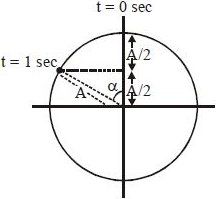
At time $t = 0$, a simple harmonic oscillator is at its extreme position. If it covers half of the amplitude distance in $1\, second$, then the time period of oscillation is ..... $s$
Answerc
$\cos \alpha=\frac{A / 2}{A}=\frac{1}{2}$
$\alpha=60^{\circ}$
$60^{\circ}$ angle travelled in $1\, sec.$
$360^{\circ}$ angle travelled in $1\, sec.$ $\frac{360}{60} \times 1=6$ sec.
View full question & answer→MCQ 471 Mark
Two $SHM$ are represented by equations, $y_1 = 6\cos \left( {6\pi t + \frac{\pi }{6}} \right)\,,{y_2} = 3\left( {\sqrt 3 \sin 3\pi t + \cos 3\pi t} \right)$
- ✓
ratio of their amplitudes is $1$
- B
ratio of their time periods is $1$
- C
ratio of their maximum velocities is $1$
- D
ratio of their maximum acceleration is $1$
AnswerCorrect option: A. ratio of their amplitudes is $1$
a
$y_{1}=6 \cos \left(6 \pi t+\frac{\pi}{6}\right)$
$y_{2}=3(\sqrt{2} \sin 3 \pi t+\cos 3 \pi t)$
$=6\left[\frac{\sqrt{3}}{2} \sin 3 \pi t+\frac{1}{2} \cos 3 \pi t\right]$
$6\left[\sin \left(3 \pi t+\frac{\pi}{3}\right)\right]$
$=6 \sin \left(3 \pi t+\frac{\pi}{3}\right)$
ratio of their amplitude is $1 .$
Hence,
Option $A$ is correct answer.
View full question & answer→MCQ 481 Mark
The phase difference between two $SHM\,\,$ ${y_1}\, = \,10\,\sin \,\left( {10\pi t\, + \,\frac{\pi }{3}} \right)$ and ${y_2}\, = \,12\,\sin \,\left( {8\pi t\, + \,\frac{\pi }{4}} \right)$ at $t = 0.5\,s$ it
- A
$\frac {11 \pi}{12}$
- ✓
$\frac {13 \pi}{12}$
- C
$\pi $
- D
$\frac {17 \pi}{12}$
AnswerCorrect option: B. $\frac {13 \pi}{12}$
b
Phase for $1\, st$ $\mathrm{SHM}: \phi_{1}=10 \pi \mathrm{t}+\frac{\pi}{3}$
Phase for $2 \,nd$ $\mathrm{SHM}: \phi_{2}=8 \pi \mathrm{t}+\frac{\pi}{4}$
Phase difference : $\Delta \phi=\phi_{1}-\phi_{2}=2 \pi t+\frac{\pi}{12}$
Put $t=0.5 \mathrm{s}$
$\Delta \phi=2 \pi(0.5)+\frac{\pi}{12}=\frac{13 \pi}{12}$
View full question & answer→MCQ 491 Mark
Two simple harmonic motions are represented by equations ${y_1} = 4\,\sin \,\left( {10t + \phi } \right)$ and ${y_2} = 5\,\cos \,10\,t$ What is the phase difference between their velocities?
AnswerCorrect option: D. $\left( {\phi - \frac{\pi }{2}} \right)$
d
$y_{1}=4 \sin (10 t+\phi)$
$y_{2}=5 \cos 10 t$
$\Rightarrow \mathrm{y}_{2}=5 \sin \left(10 \mathrm{t}+\frac{\pi}{2}\right)$
phase difference $\frac{\pi}{2}-\phi$
View full question & answer→MCQ 501 Mark
In an angular $SHM$ angular amplitude of oscillation is $\pi $ $rad$ and time period is $0.4\,sec$ then calculate its angular velocity at angular displacement $ \pi/2 \,rad$. ..... $rad/sec$
- A
$34.3$
- ✓
$42.7$
- C
$22.3$
- D
$50.3$
AnswerCorrect option: B. $42.7$
b
$\omega=\frac{2 \pi}{\mathrm{T}}=\frac{2 \pi}{0.4}=5 \pi$
$\Omega=\omega \sqrt{\theta_{0}^{2}-\theta^{2}}$
$\Omega=5 \pi \sqrt{\pi^{2}-\frac{\pi^{2}}{4}} \Omega=5 \pi \sqrt{\pi^{2}-\frac{\pi^{2}}{4}}$
$=\frac{5 \pi^{2} \sqrt{3}}{2}=42.7 \mathrm{rad} / \mathrm{s}$
View full question & answer→MCQ 511 Mark
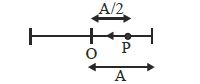
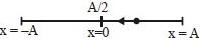
A particle starts from a point $P$ at a distance of $A/2$ from the mean position $O$ and travels towards left as shown in the figure. If the time period of $SHM$ , executed about $O$ is $T$ and amplitude $A$ then the equation of motion of particle is
- A
$x = A\,\sin \left( {\frac{{2\pi }}{T}t + \frac{\pi }{6}} \right)$
- ✓
$x = A\,\sin \left( {\frac{{2\pi }}{T}t + \frac{{5\pi }}{6}} \right)$
- C
$x = A\,\cos \left( {\frac{{2\pi }}{T}t + \frac{\pi }{6}} \right)$
- D
$x = A\,\cos \left( {\frac{{2\pi }}{T}t + \frac{\pi }{4}} \right)$
AnswerCorrect option: B. $x = A\,\sin \left( {\frac{{2\pi }}{T}t + \frac{{5\pi }}{6}} \right)$
b
$\mathrm{x}=\mathrm{A} \sin \left(\omega \mathrm{t}+\frac{\pi}{2}+\frac{\pi}{3}\right)$
$\mathrm{x}=\mathrm{A} \sin \left(\omega \mathrm{t}+\frac{5 \pi}{6}\right)=\mathrm{A} \sin \left(\frac{2 \mathrm{n}}{\mathrm{T}} \mathrm{t}+\frac{5 \mathrm{n}}{6}\right)$
View full question & answer→MCQ 521 Mark
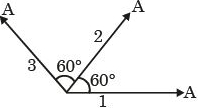
Three simple harmonic motions of equal amplitudes $A$ and equal time periods in the same direction combine. The phase of the second motion is $60^o$ ahead of the first and the phase of the third motion is $60^o$ ahead of the second. Find the amplitude of the resultant motion
- A
$A$
- ✓
$2\,A$
- C
$3\,A$
- D
$4\,A$
AnswerCorrect option: B. $2\,A$
b
Resultant of $1 \& 3$ is also $\mathrm{A}$ in the direction of $2.$
$\Delta \phi=120^{\circ}$ between $1 \& 3$
$A_{\text {net }}=A+A=2 A$
View full question & answer→MCQ 531 Mark
A body executes $SHM$ under the influence of one force and has a period $T_1\, second$ and the same body executes $SHM$ with period $T_2\, second$ when under the influence of another force. When bothforces act simultaneously and in the same direction, then the time period of the same body is
- A
$\left( {{T_1} + {T_2}} \right)\,\sec $
- B
$\sqrt {T_1^2 + T_2^2} \,\sec $
- C
$\frac{{\sqrt {T_1^2 + T_2^2} }}{{{T_1}{T_2}}}\,\sec $
- ✓
$\frac{{{T_1}{T_2}}}{{\sqrt {\left( {T_1^2 + T_2^2} \right)} }}\,\sec $
AnswerCorrect option: D. $\frac{{{T_1}{T_2}}}{{\sqrt {\left( {T_1^2 + T_2^2} \right)} }}\,\sec $
d
Under the force $F_{1}$ time oscillation of the body $T_{1}$
$F_{1}=M\left(\frac{2 \pi}{T_{1}}\right)^{2} V ; \quad$ where $\quad M \quad$ is the mass and
$v$ is the velocity and $F_{2}=M\left(\frac{2 \pi}{T_{2}}\right)^{2} V$
$F_{N e t}=F_{1}+F_{2}$
$M\left(\frac{2 \pi}{T}\right)^{2}=M\left(\frac{2 \pi}{T_{1}}\right)^{2}+M\left(\frac{2 \pi}{T_{2}}\right)^{2}$
$\frac{1}{T^{2}}=\frac{1}{T_{1}^{2}}+\frac{1}{T_{2}^{2}}=\frac{T_{1}^{2}+T_{2}^{2}}{T_{1}^{2} T_{2}^{2}}=\frac{T_{1} T_{2}}{\sqrt{T_{1}^{2}+T_{2}^{2}}}$
View full question & answer→MCQ 541 Mark
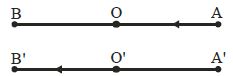
Two particles undergo $SHM$ along parallel lines with the same time period $(T)$ and equal amplitudes. At a particular instant, one particle is at its extreme position while the other is at its mean position. They move in the same direction. They will cross each other after a further time
- A
$T/8$
- ✓
$3T/8$
- C
$T/6$
- D
$4T/3$
AnswerCorrect option: B. $3T/8$
b
$\mathrm{x}_{1}=\mathrm{A} \cos \omega \mathrm{t}$
$\mathrm{x}_{2}=-\mathrm{A} \sin \omega \mathrm{t}$
if they will cross each other
$X_{1}=X_{2}$
for crossing first time
time $=\frac{3 \mathrm{T}}{8}$
View full question & answer→MCQ 551 Mark
The displacement time equation of a particle executing $SHM$ is : $x = A \,sin\,(\omega t + \phi )$. At time $t = 0$ position of the particle is $x = A/2$ and it is moving along negative $x-$ direction. Then the angle $\phi $ can be
- A
$\pi /6$
- B
$\pi /3$
- C
$2\pi /3$
- ✓
$5\pi /6$
AnswerCorrect option: D. $5\pi /6$
d
$\phi=150^{\circ}$
$\mathrm{x}=\mathrm{A} \sin (\omega \mathrm{t}+5 \pi / 6)$
View full question & answer→MCQ 561 Mark
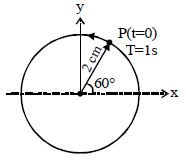
Figure shows the circular motion of a particle. The radius of the circle, the period, sense of revolution and the initial position are indicated in the figure. The simple harmonic motion of the $x-$ projection of the radius vector of the rotating particle $P$ is
- A
$x = 2\,\cos \,\left( {2\pi t + \frac{\pi }{6}} \right)$
- B
$x = 2\,\sin \,\left( {2\pi t + \frac{\pi }{3}} \right)$
- C
$x = 2\,\sin \,\left( {2\pi t - \frac{\pi }{6}} \right)$
- ✓
$x = 2\,\cos \,\left( {2\pi t + \frac{\pi }{3}} \right)$
AnswerCorrect option: D. $x = 2\,\cos \,\left( {2\pi t + \frac{\pi }{3}} \right)$
View full question & answer→MCQ 571 Mark
Two particles executing $S.H.M.$ of same frequency, meet at $x=+A / 2$, while moving in opposite directions. Phase difference between the particles is .........
- A
$\frac{\pi}{6}$
- B
$\frac{\pi}{3}$
- C
$\frac{5 \pi}{6}$
- ✓
$\frac{2 \pi}{3}$
AnswerCorrect option: D. $\frac{2 \pi}{3}$
d
(d)
$x=A \sin \omega t$
When displacement
$x=\frac{A}{2}$
$\frac{A}{2}=A \sin (\omega t+\phi)$
$\sin ^{-1} \frac{1}{2}=\omega t+\phi$
$\omega t+\phi=30^{\circ} \text { or } 150^{\circ}$
When particles are in opposite direction at one lime phase is $30^{\circ}$ and at the other $150^{\circ}$. So phase difference is $120^{\circ}$.
View full question & answer→MCQ 581 Mark
The time period of a particle executing $S.H.M.$ is $8 \,s$. At $t=0$ it is at the mean position. The ratio of distance covered by the particle in $1^{\text {st }}$ second to the $2^{\text {nd }}$ second is .............. $s$
- A
$(\sqrt{2}-1)$
- B
$\sqrt{2}$
- ✓
$(\sqrt{2}+1)$
- D
$\frac{1}{\sqrt{2}}$
AnswerCorrect option: C. $(\sqrt{2}+1)$
c
(c)
$T=8 \,s$
$ \omega=\frac{2 \pi}{8}=\frac{\pi}{4}$
$x_1=A \sin \frac{\pi}{4}=\frac{A}{\sqrt{2}}$
$x_2=A \sin \frac{\pi}{4} \times 2-A \sin \frac{\pi}{4}=A-\frac{A}{\sqrt{2}}=\frac{A}{\sqrt{2}}(\sqrt{2}-1)$
$\frac{x_1}{x_2}=\frac{1}{\sqrt{2}-1} \times \frac{\sqrt{2}+1}{\sqrt{2}+1}=\sqrt{2}+1$
View full question & answer→MCQ 591 Mark
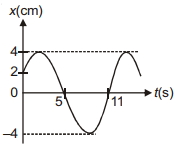
Figure shows the position-time graph of an object in $S.H.M.$ The correct equation representing this motion is ..........
- A
$2 \sin \left(\frac{2 \pi}{5} t+\frac{\pi}{6}\right)$
- B
$4 \sin \left(\frac{\pi}{5} t+\frac{\pi}{6}\right)$
- C
$4 \sin \left(\frac{\pi}{6} t+\frac{\pi}{3}\right)$
- ✓
$4 \sin \left(\frac{\pi}{6} t+\frac{\pi}{6}\right)$
AnswerCorrect option: D. $4 \sin \left(\frac{\pi}{6} t+\frac{\pi}{6}\right)$
d
(d)
Time period is $12 \,s$ from diagram.
$\omega=\frac{2 \pi}{12}=\frac{\pi}{6}$
Amplitude $A=4$
Initial phase is determined by putting known values in the equation.
$2=4 \sin \left(\frac{\pi}{6} t+\phi\right)$
$\sin ^{-1} \frac{1}{2}=\phi[t=0]$
$\frac{\pi}{6}=\phi$
Hence equation is $x=\left(\frac{\pi}{6} t+\frac{\pi}{6}\right)$
View full question & answer→MCQ 601 Mark
Two particle executing $S.H.M.$ of same amplitude of $20 \,cm$ with same period along the same line about same equilibrium position. The maximum distance between the two is $20 \,cm$. Their phase difference in radian is equal to
- ✓
$\frac{\pi}{3}$
- B
$\frac{\pi}{2}$
- C
$\frac{2 \pi}{3}$
- D
$\frac{4 \pi}{5}$
AnswerCorrect option: A. $\frac{\pi}{3}$
a
(a)
$x_1=A \sin \left(\omega t+\phi_1\right)$
$x_2=A \sin \left(\omega t+\phi_2\right)$
$x_1-x_2=A \sin \left(\omega t+\phi_1\right)-A \sin \left(\omega t+\phi_2\right)$
$20=2 \times 20 \sin \left(\frac{\phi_1-\phi_2}{2}\right) \cdot \cos \left[\omega t+\left(\frac{\phi_1+\phi_2}{2}\right)\right]$
$\frac{1}{2}=\sin \left(\frac{\phi_1-\phi_2}{2}\right) \cdot \cos \left(\omega t+\left(\frac{\phi_1+\phi_2}{2}\right)\right) \text { for maximum value. } \Rightarrow \frac{\phi_1-\phi_2}{2}=\frac{\pi}{6} \Rightarrow \phi_1-\phi_2=\frac{\pi}{3}$
View full question & answer→MCQ 611 Mark
A $1.00 \times {10^{ - 20}}kg$ particle is vibrating with simple harmonic motion with a period of $1.00 \times {10^{ - 5}}sec$ and a maximum speed of $1.00 \times {10^3}m/s$. The maximum displacement of the particle is
- ✓
$1.59 \,mm$
- B
$1.00\, m$
- C
$10 \,m$
- D
AnswerCorrect option: A. $1.59 \,mm$
a
(a) ${v_{\max }} = a\omega = a \times \frac{{2\pi }}{T}$
==> $a = \frac{{{v_{\max }} \times T}}{{2\pi }}$
$A = \frac{{1.00 \times {{10}^3} \times (1 \times {{10}^{ - 5}})}}{{2\pi }} = 1.59\,mm$
View full question & answer→MCQ 621 Mark
A simple pendulum performs simple harmonic motion about $X = 0$ with an amplitude $A$ and time period $T$. The speed of the pendulum at $X = \frac{A}{2}$ will be
AnswerCorrect option: A. $\frac{{\pi A\sqrt 3 }}{T}$
a
(a)Velocity of a particle executing $S.H.M.$ is given by
$v = \omega \sqrt {{a^2} - {x^2}} $
$= \frac{{2\pi }}{T}\sqrt {{A^2} - \frac{{{A^2}}}{4}} $
$= \frac{{2\pi }}{T}\sqrt {\frac{{3{A^2}}}{4}}$
$= \frac{{\pi A\sqrt 3 }}{T}$.
View full question & answer→MCQ 631 Mark
A body of mass $5\, gm$ is executing $S.H.M.$ about a point with amplitude $10 \,cm$. Its maximum velocity is $100\, cm/sec$. Its velocity will be $50\, cm/sec$ at a distance
- A
$5$
- B
$5\sqrt 2 $
- ✓
$5\sqrt 3 $
- D
$10\sqrt 2 $
AnswerCorrect option: C. $5\sqrt 3 $
c
(c) It is given ${v_{\max }} = 100\,cm/sec$, $a = 10\, cm.$
==> ${v_{\max }} = a\omega $
==> $\omega = \frac{{100}}{{10}} = 10\,rad/sec$
Hence $v = \omega \sqrt {{a^2} - {y^2}} $
==>$50 = 10\sqrt {{{(10)}^2} - {y^2}} $
==> $y = 5\sqrt 3 \,cm$
View full question & answer→MCQ 641 Mark
A particle executes simple harmonic motion with an amplitude of $4 \,cm$. At the mean position the velocity of the particle is $10\, cm/s$. The distance of the particle from the mean position when its speed becomes $5 \,cm/s$ is
- A
$\sqrt 3 \,cm$
- B
$\sqrt 5 \,cm$
- ✓
$2(\sqrt 3 )\,cm$
- D
$2(\sqrt 5 )\,cm$
AnswerCorrect option: C. $2(\sqrt 3 )\,cm$
c
(c) ${v_{\max }} = a\omega $
==> $\omega = \frac{{{v_{\max }}}}{a} = \frac{{10}}{4}$
Now, $v = \omega \sqrt {{a^2} - {y^2}} $
==> ${v^2} = {\omega ^2}({a^2} - {y^2})$
==> ${y^2} = {a^2} - \frac{{{v^2}}}{{{\omega ^2}}}$
$y = \sqrt{{a^2} - \frac{{{v^2}}}{{{\omega ^2}}}}$
$= \sqrt{{4^2} - \frac{5^2}{{({\frac{10}{4}})^2}}}$
$ = 2\sqrt 3 \,cm$
View full question & answer→MCQ 651 Mark
The displacement equation of a particle is $x = 3\sin 2t + 4\cos 2t.$ The amplitude and maximum velocity will be respectively
- ✓
$5, 10$
- B
$3, 2$
- C
$4, 2$
- D
$3, 4$
AnswerCorrect option: A. $5, 10$
a
(a) $x = 3\sin 2t + 4\cos 2t.$
From given equation ${a_1} = 3,\;{a_2} = 4,$ and $\phi = \frac{\pi }{2}$
$a = \sqrt {a_1^2 + a_2^2} $$ = \sqrt {{3^2} + {4^2}} = 5$
==> ${v_{\max }} = a\omega = 5 \times 2 = 10$
View full question & answer→MCQ 661 Mark
The instantaneous displacement of a simple pendulum oscillator is given by $x = A\cos \left( {\omega t + \frac{\pi }{4}} \right)$. Its speed will be maximum at time
- ✓
$\frac{\pi }{{4\omega }}$
- B
$\frac{\pi }{{2\omega }}$
- C
$\frac{\pi }{\omega }$
- D
$\frac{{2\pi }}{\omega }$
AnswerCorrect option: A. $\frac{\pi }{{4\omega }}$
a
(a) $x = A\cos \left( {\omega t + \frac{\pi }{4}} \right)$ and
$v = \frac{{dx}}{{dt}} = - A\omega \sin \left( {\omega \,t + \frac{\pi }{4}} \right)$
For maximum speed, $\sin \,\left( {\omega \,t + \frac{\pi }{4}} \right) = 1$
==> $\omega \,t + \frac{\pi }{4} = \frac{\pi }{2}$ or $\omega \,t = \frac{\pi }{2} - \frac{\pi }{4}$
==> $t = \frac{\pi }{{4\omega }}$
View full question & answer→MCQ 671 Mark
A particle executes $SHM $ in a line $4\, cm $ long. Its velocity when passing through the centre of line is $12\, cm/s$. The period will be ..... $s$
- A
$2.047$
- ✓
$1.047$
- C
$3.047 $
- D
$0.047$
AnswerCorrect option: B. $1.047$
b
(b) Length of the line = Distance between extreme positions of oscillation $= 4 \,cm$
So, Amplitude $a = 2\,cm.$
also ${v_{max}} = 12\,cm/s.$
$\because {v_{\max }} = \omega a = \frac{{2\,\pi }}{T}a$
$ \Rightarrow T = \frac{{2\,\pi a}}{{{v_{max}}}}$ $ = \frac{{2 \times 3.14 \times 2}}{{12}}$$ = 1.047\,\sec $
View full question & answer→MCQ 681 Mark
The displacement of a body executing $SHM$ is given by $x = A \sin (2\pi t + \pi /3).$ The first time from $t = 0$ when the velocity is maximum is .... $\sec$
- ✓
$0.33$
- B
$0.16$
- C
$0.25$
- D
$0.5$
AnswerCorrect option: A. $0.33$
a
$x=A \sin \left(2 \pi t+\frac{\pi}{3}\right)$
Velocity is maximum at mean position i.e. $x=0$
$\Rightarrow \sin \left(2 \pi t+\frac{\pi}{3}\right)=0$
$\Rightarrow\left(2 \pi t+\frac{\pi}{3}\right)=0, \pi, 2 \pi, 3 \pi \dots$
if we take $\left(2 \pi t+\frac{\pi}{3}\right)=0,$ time will come negative which is not possible. So we take $\left(2 \pi t+\frac{\pi}{3}\right)=\pi$
$\Rightarrow t=\frac{1}{3} s=0.33 s$
for other solutions, we will get higher values of time. but since it is asking for the first time after $t=0,$ the required solution will be $t=0.33 s$
View full question & answer→MCQ 691 Mark
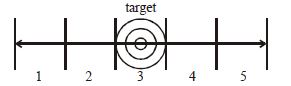
A shooting game involves using a gun that fires by itself at random times. The player can only point the gun in a fixed direction while the target moves from side to side with simple harmonic motion, as shown. At which of the given region should the player aim in order to score the greatest number of hits?
- A
$3$
- ✓
either $1$ or $5$
- C
either $2$ or $4$
- D
any of $1, 2, 3,$ or $5$
AnswerCorrect option: B. either $1$ or $5$
b
During $SHM$ speed will be minimum in $1$ and $5$ region.
Hence probability of greatest number of hit will increase.
View full question & answer→MCQ 701 Mark
If displacement $x$ and velocity $v$ are related as $4v^2 = 16\, -\, x^2$ in a $SHM$ . Then time period of given $SHM$ is (consider $SI\,units$ )
- A
$\pi $
- B
$2\pi $
- ✓
$4\pi $
- D
$6\pi $
AnswerCorrect option: C. $4\pi $
c
$4 v^{2}=16-x^{2} \Rightarrow \frac{x^{2}}{16}+\frac{v^{2}}{4}=1$
relation between displacement and velocity is
$\frac{x^{2}}{A^{2}}+\frac{v^{2}}{(A \omega)^{2}}=1$
$\therefore A \omega=2$ and $A=4$
$\omega=\frac{1}{2} \quad \Rightarrow \mathrm{T}=4 \pi$
View full question & answer→MCQ 711 Mark
If displacement $x$ and velocity $v$ are related as $4v^2 = 25 -x^2$ in a $SHM$. Then time Period of given $SHM$ is (Consider $SI\, units$)
- A
$\pi $
- B
$2\pi $
- ✓
$4\pi $
- D
$6\pi $
AnswerCorrect option: C. $4\pi $
c
$4 v^{2}=25-x^{2} \Rightarrow \frac{x^{2}}{25}+\frac{4 v^{2}}{25}=1$
Comparing with $\frac{\mathrm{x}^{2}}{\mathrm{A}^{2}}+\frac{\mathrm{v}^{2}}{(\mathrm{A} \omega)^{2}}=1$
$A=5, A \omega=\frac{5}{2} \quad \therefore \omega=\frac{1}{2} \Rightarrow T=4 \pi$
View full question & answer→MCQ 721 Mark
A particle is performing simple harmonic motion
$(i)$ its velocity-displacement graph is parabolic in nature
$(ii)$ its velocity-time graph is sinusoidal in nature
$(iii)$ its velocity-acceleration graph is elliptical in nature
Correct answer is
- A
$(i), (ii)$ and $(iii)$
- ✓
$(ii)$ and $(iii)$
- C
$(i)$ and $(ii)$
- D
$(i)$ and $(iii)$
AnswerCorrect option: B. $(ii)$ and $(iii)$
b
$(i)$ $\mathrm{v}=\omega \sqrt{\mathrm{A}^{2}-\mathrm{x}^{2}}$ $(ii)$ $\mathrm{v}=\mathrm{A} \omega \cos \omega \mathrm{t}$
$\mathrm{v}=\mathrm{A} \omega \cos \omega \mathrm{t} ; \mathrm{a}=\mathrm{A} \omega^{2} \sin \omega \mathrm{t}$
$\Rightarrow \frac{v^{2}}{A^{2} \omega^{2}}+\frac{a^{2}}{A^{2} \omega^{4}}=1$
$(ii)$ and $(iii)$ are correct
View full question & answer→MCQ 731 Mark
A point object is kept in front of a plane mirror. The plane mirror is doing $SHM$ of amplitude $2\,cm$. The plane mirror moves along the $x-$ axis and $x-$ axis is normal to the mirror. The amplitude of the mirror is such that the object is always infront of the mirror. The amplitude of $SHM$ of the image is .... $cm$
Answerc
$\frac{\mathrm{V}_{1}+\mathrm{V}_{0}}{2}=\mathrm{V}_{\mathrm{M}}$
$\mathrm{V}_{0}=\mathrm{O} \Rightarrow \mathrm{V}_{\mathrm{I}}=2 \mathrm{V}_{\mathrm{M}}$
$A_{I}=4 \mathrm{cm}$
View full question & answer→MCQ 741 Mark
The piston in the cylinder head of locomotive has a stroke of $6\,m$ (which is twice the amplitude). If the piston executing simple harmonic motion with an angular frequency of $200\, rad\, min^{-1}$, its maximum speed is .... $ms^{-1}$
Answerb
Amplitude $=\frac{6}{2}=3 \mathrm{m}$
$\mathrm{V}_{\max }=\mathrm{A} \omega=3 \times \frac{200}{60}=10 \mathrm{ms}^{-1}$
View full question & answer→MCQ 751 Mark
The instantaneous displacement of a simple pendulum oscillator is given by $x = A\,\cos \,\left( {\omega t + \frac{\pi }{4}} \right)$ . Its speed will be maximum at time
- ✓
$\frac{\pi }{{4\omega }}$
- B
$\frac{\pi }{{2\omega }}$
- C
$\frac{\pi }{{\omega }}$
- D
$\frac{2\pi }{{\omega }}$
AnswerCorrect option: A. $\frac{\pi }{{4\omega }}$
a
$\mathrm{x}=\mathrm{A} \cos \left(\omega \mathrm{t}+\frac{\pi}{4}\right)$ and $v=\frac{\mathrm{dx}}{\mathrm{dt}}$
$=-A \omega \sin \left(\omega t+\frac{\pi}{4}\right)$
For maximum speed,
$\sin \left(\omega t+\frac{\pi}{4}\right)=1 \Rightarrow \omega t+\frac{\pi}{4}=\frac{\pi}{2}$
or $\omega t=\frac{\pi}{2}-\frac{\pi}{4} \Rightarrow t=\frac{\pi}{4 \omega}$
View full question & answer→MCQ 761 Mark
A particle excutes $SHM$ on a straight line path. The amplitude of oscillation is $2\,cm$. When the displacement of the particle from the mean position is $1\,cm$, the numerical value of magnitude of acceleration is equal to the numerical value of magnitude of velocity. The frequency of $SHM$ is (in $second^{-1}$)
- A
$2\pi \sqrt 3 $
- B
$\frac{{2\pi }}{{\sqrt 3 }}$
- ✓
$\frac{{\sqrt 3 }}{{2\pi }}$
- D
$\frac{1}{{2\pi \sqrt 3 }}$
AnswerCorrect option: C. $\frac{{\sqrt 3 }}{{2\pi }}$
c
$\mathrm{V}=\omega \sqrt{\mathrm{a}^{2}-(\mathrm{a} / 2)^{2}}=\frac{\sqrt{3}}{2} \mathrm{a} \omega$
$\operatorname{acc}^{\mathrm{n}} \mathrm{f}=\frac{\omega^{2} \mathrm{a}}{2}$
$\therefore \mathrm{V}=\mathrm{f}$
$\frac{\omega^{2} a}{2}=\frac{\sqrt{3}}{2} a \omega$
$2 \pi n=\sqrt{3}$
$\mathrm{n}=\frac{\sqrt{3}}{2 \pi}$
View full question & answer→MCQ 771 Mark
A particle is executing $SHM$ about $y=0$ along $y$-axis. Its position at an instant is given by $y=(7 \,m )$ sin( $\pi f)$. Its average velocity for a time interval $0$ to $0.5 \,s$ is ........... $m / s$
- ✓
$14$
- B
$7$
- C
$\frac{1}{7}$
- D
$28$
Answera
(a)
Average velocity, $v_{\text {avg }}=\frac{\text { displacement }}{\text { total time }}$
Given, $y=7 \sin (\pi t) m , t=0$ to $0.5$
$y$ at $t=0, x_1=7 \sin \left(0^{\circ}\right)=0$
$y$ at $t=0.5$,
$x_2=7 \sin (\pi / 2)=7$
$\therefore V_{\text {avg }}=\frac{7-0}{0.5-0}=14$
$v_{\text {avg }}=14 m / s$
View full question & answer→MCQ 781 Mark
A body executing $S.H.M.$ along a straightline has a velocity of $3 \,ms ^{-1}$ when it is at a distance of $4 \,m$ from its mean position and $4 \,ms ^{-1}$ when it is at a distance of $3 \,m$ from its mean position. Its angular frequency and amplitude are
- A
$2 \,rad s ^{-1}$ and $5 \,m$
- B
$1 \,rad s ^{-1}$ and $10 \,m$
- C
$2 \,rad s ^{-1}$ and $10 \,m$
- ✓
$1 \,rad s ^{-1}$ and $5 \,m$
AnswerCorrect option: D. $1 \,rad s ^{-1}$ and $5 \,m$
d
(d)
$v=\omega \sqrt{A^2-x^2}$
$v_1=3 \,m / s x_1=4 \,m$
$v_2=4 \,m / s x_2=3 \,m$
$3=\omega \sqrt{A^2-4^2} \ldots(i)$
$4=\omega \sqrt{A^2-3^2} \ldots(ii)$
Solving $(i)$ and $(ii)$, we get
$A=5 \,m$ and $\omega=1 \,rad / s$
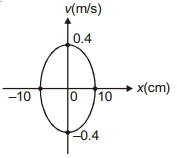
View full question & answer→MCQ 791 Mark
The plot of velocity $(v)$ versus displacement $(x)$ of a particle executing simple harmonic motion is shown in figure. The time period of oscillation of particle is .........
- ✓
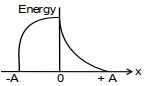
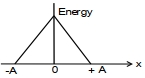
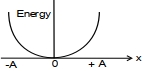
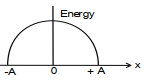
$\frac{\pi}{2} s$
- B
$\pi s$
- C
$2 \pi s$
- D
$3 \pi s$
AnswerCorrect option: A. $\frac{\pi}{2} s$
a
(a)
$A=10 \,cm \quad A \omega=0.4 \,m / s$
$=0.1 \,m$
$\therefore \omega =4 \,rad / s$
$T=\frac{2 \pi}{4}=\frac{\pi}{2} s$
View full question & answer→MCQ 801 Mark
A $1.00 \times 10^{-20} \,kg$ particle is vibrating under simple harmonic motion with a period of $1.00 \times 10^{-5} \,s$ and with a maximum speed of $1.00 \times 10^3 \,m / s$. The maximum displacement of particle from mean position is .......... $mm$
- ✓
$1.59$
- B
$1.00$
- C
$10$
- D
$3.18$
AnswerCorrect option: A. $1.59$
a
(a)
$m=1 \times 10^{-20} \,kg$
$T=1 \times 10^{-5} \,kg$
Maximum speed $=A \omega=1 \times 10^3 \,m / s \quad \dots (i)$
$\omega=\frac{2 \pi}{T}=2 \pi \times 10^5 \,rad / s$
Putting value of $\omega$ in $(i)$
$A \times 2 \pi \times 10^5=1 \times 10^3$
$A=\frac{1}{2 \pi \times 10^2}$
$A=1.59 \,mm$
View full question & answer→MCQ 811 Mark
A particle executes $S.H.M.$ and its position varies with time as $x=A$ sin $\omega t$. Its average speed during its motion from mean position to mid-point of mean and extreme position is
- A
- ✓
$\frac{3 A \omega}{\pi}$
- C
$\frac{A \omega}{2 \pi}$
- D
$\frac{2 A \omega}{\pi}$
AnswerCorrect option: B. $\frac{3 A \omega}{\pi}$
b
(b)
Phase at mean position $=0$
Phase at mid point
$\frac{A}{2}=A \sin \phi$
$\phi=\frac{\pi}{6}$
Time it takes to travel a phase difference of $\phi$
$t=\frac{2 \pi}{\omega} \times \frac{\phi}{2 \pi}$
or $t=\frac{\phi}{\omega}$
or $t=\frac{\pi}{6 \omega}$
Average speed $=\frac{\text { Total distance }}{\text { Time taken }}$
$=\frac{A / 2}{\pi / 6 \omega}$
$=\frac{3 A \omega}{\pi}$
View full question & answer→MCQ 821 Mark
A particle is executing $S.H.M.$ and its velocity $v$ is related to its position $(x)$ as $v^2+a x^2=b$, where $a$ and $b$ are positive constants. The frequency of oscillation of particle is ..........
AnswerCorrect option: B. $\frac{\sqrt{a}}{2 \pi}$
b
(b)
$v^2+a x^2=b$
$v^2=b-a x^2$
$v^2=a\left(\frac{b}{a}-x^2\right)$
Comparing it to equation
$v^2=\omega^2\left(A^2-x^2\right)$
$\omega=\sqrt{a}$
$f=\frac{\omega}{2 \pi}=\frac{\sqrt{a}}{2 \pi}$
View full question & answer→MCQ 831 Mark
A particle executes $S.H.M.$ according to equation $x=10( cm ) \cos \left[2 \pi t+\frac{\pi}{2}\right]$, where $t$ is in second. The magnitude of the velocity of the particle at $t=\frac{1}{6} \,s$ will be .............. $cm / s$
- A
$24.7$
- B
$20.5$
- C
$28.3$
- ✓
$31.4$
AnswerCorrect option: D. $31.4$
d
(D)
$x=10 \cos \left[2 \pi t+\frac{\pi}{2}\right]$
At $t=\frac{1}{6} s$
$x=10 \cos \left[\frac{\pi}{2}+\frac{\pi}{3}\right]$
$x=-10 \sin \frac{\pi}{3}$
$x=-5 \sqrt{3}$
$v=\omega \sqrt{A^2-x^2}$
$v=2 \pi \sqrt{100-75}$
$v=10 \pi$
$v=31.4 \,cm / s$
View full question & answer→MCQ 841 Mark
The phase of a particle executing simple harmonic motion is $\frac{\pi }{2}$ when it has
Answerd
(d) For $S.H.M.$ displacement $y = a\sin \omega \,t$ and acceleration $A = \, - {\omega ^2}y\sin \omega \,t$ these are maximum at $\omega \,t = \frac{\pi }{2}.$
View full question & answer→MCQ 851 Mark
The amplitude of a particle executing $S.H.M.$ with frequency of $60 \,Hz$ is $0.01 \,m$. The maximum value of the acceleration of the particle is
AnswerCorrect option: A. $144{\pi ^2}\,m/se{c^2}$
a
(a) Maximum acceleration $ = a{\omega ^2} = a \times 4{\pi ^2}{n^2}$
$ = 0.01 \times 4 \times {(\pi )^2} \times {(60)^2} = 144{\pi ^2}\,m/\sec $
View full question & answer→MCQ 861 Mark
A small body of mass $0.10\, kg$ is executing $S.H.M.$ of amplitude $1.0 \,m$ and period $0.20\, sec$. The maximum force acting on it is.... $N$
- ✓
$98.596$
- B
$985.96$
- C
$100.2$
- D
$76.23$
AnswerCorrect option: A. $98.596$
a
(a) Maximum acceleration
${A_{\max }} = a{\omega ^2}$
$= \frac{{a \times 4{\pi ^2}}}{{{T^2}}}$
$ = \frac{{1 \times 4 \times {{(3.14)}^2}}}{{0.2 \times 0.2}}$
${F_{\max }} = m \times {A_{\max }}$
$= \frac{{0.1 \times 4 \times {{(3.14)}^2}}}{{0.2 \times 0.2}}$
$= 98.596\;N$
View full question & answer→MCQ 871 Mark
A body executing simple harmonic motion has a maximum acceleration equal to $ 24\,metres/se{c^2} $ and maximum velocity equal to $ 16\;metres/sec $. The amplitude of the simple harmonic motion is
AnswerCorrect option: A. $\frac{{32}}{3}\,metres$
a
(a) Maximum velocity $ = a\omega = 16$
Maximum acceleration $ = {\omega ^2}a = 24$
$ \Rightarrow a = \frac{{{{(a\omega )}^2}}}{{{\omega ^2}a}} = \frac{{16 \times 16}}{{24}} = \frac{{32}}{3}m$
View full question & answer→MCQ 881 Mark
A particle of mass $10$ grams is executing simple harmonic motion with an amplitude of $0.5\, m$ and periodic time of $(\pi /5)$ seconds. The maximum value of the force acting on the particle is ... $N$
Answerd
(d) Maximum force $ = m(a{\omega ^2}) = ma\left( {\frac{{4{\pi ^2}}}{{{T^2}}}} \right)$
$ = 0.5\,\left( {\frac{{4{\pi ^2}}}{{{\pi ^2}/25}}} \right) \times 0.01 = 0.5N$
View full question & answer→MCQ 891 Mark
A body is vibrating in simple harmonic motion with an amplitude of $0.06\, m$ and frequency of $15\, Hz$. The velocity and acceleration of body is
- ✓
$5.65\,m/s$ and $5.32 \times {10^2}m/{s^2}$
- B
$6.82\,m/s$ and $7.62 \times {10^2}\,m/{s^2}$
- C
$8.91\,m/s$ and $8.21 \times {10^2}\,m/{s^2}$
- D
$9.82\,m/s$ and $9.03 \times {10^2}\,m/{s^2}$
AnswerCorrect option: A. $5.65\,m/s$ and $5.32 \times {10^2}m/{s^2}$
a
(a)Velocity $v = a\omega = a \times 2\pi \;n$
$ = 0.06 \times 2\pi \times 15 = 5.65\;m/s$
Acceleration $A = {\omega ^2}a = 4{\pi ^2}{n^2}a = 5.32 \times {10^2}m/{s^2}$
View full question & answer→MCQ 901 Mark
A particle executes linear simple harmonic motion with an amplitude of $2\, cm$. When the particle is at $1\, cm$ from the mean position the magnitude of its velocity is equal to that of its acceleration. Then its time period in seconds is
- A
$\frac{1}{{2\pi \sqrt 3 }}$
- B
$2\pi \sqrt 3 $
- ✓
$\frac{{2\pi }}{{\sqrt 3 }}$
- D
$\frac{{\sqrt 3 }}{{2\pi }}$
AnswerCorrect option: C. $\frac{{2\pi }}{{\sqrt 3 }}$
c
(c) Velocity $v = \omega \sqrt {{A^2} - {x^2}} $ and acceleration $ = {\omega ^2}x$
Now given, ${\omega ^2}x = \omega \sqrt {{A^2} - {x^2}} $
==> ${\omega ^2}.1 = \omega \sqrt {{2^2} - {1^2}} $
==> $\omega = \sqrt 3 $
$T = \frac{{2\pi }}{\omega } = \frac{{2\pi }}{{\sqrt 3 }}$
View full question & answer→MCQ 911 Mark
Values of the acceleration $A$ of a particle moving in simple harmonic motion as a function of its displacement $x$ are given in the table below. The period of the motion is
| $A (mm \,\,s^{-2}$) |
$16$
|
$8$
|
$0$
|
$- 8$
|
$- 16$
|
|
$x\;(mm)$
|
$- 4$
|
$- 2$
|
$0$
|
$2$
|
$4$
|
- A
$\frac{1}{\pi }s$
- B
$\frac{2}{\pi }s$
- C
$\frac{\pi }{2}s$
- ✓
$\pi \,s$
AnswerCorrect option: D. $\pi \,s$
d
(d) $|A| = \omega^2x$ ==> $\frac{{|A|}}{x} = {\omega ^2}$
From the given value $\frac{{|A|}}{x} = {\omega ^2} = 4$ ==> $\omega = 2.$
Also $\omega = \frac{{2\pi }}{T} \Rightarrow 2 = \frac{{2\pi }}{T}\, \Rightarrow T = \pi \,sec$
View full question & answer→MCQ 921 Mark
The maximum acceleration of a particle in $SHM$ is made two times keeping the maximum speed to be constant. It is possible when
- A
amplitude of oscillation is doubled while frequency remains constant
- B
amplitude is doubled while frequency is halved
- ✓
frequency is doubled while amplitude is halved
- D
frequency is doubled while amplitude remains constant
AnswerCorrect option: C. frequency is doubled while amplitude is halved
c
$a_{\max }=A \omega^{2}$
$v_{\max }=\mathrm{A} \omega$
Double $\omega$; half the amplitude
View full question & answer→MCQ 931 Mark
A plank with a small block on top of it is under going vertical $SHM.$ Its period is $2\, sec.$ The minimum amplitude at which the block will separate from plank is :
- ✓
$\frac{10}{\pi ^2}$
- B
$\frac{\pi ^2}{10}$
- C
$\frac{20}{\pi ^2}$
- D
$\frac{\pi}{10}$
AnswerCorrect option: A. $\frac{10}{\pi ^2}$
a
Here $g=A \omega^{2}$
$\mathrm{A}=\frac{\mathrm{g}}{\omega^{2}}=\frac{\mathrm{g}}{\left(\frac{2 \pi}{\mathrm{T}}\right)^{2}}=\frac{\mathrm{gT}^{2}}{4 \pi^{2}}$
$A=\frac{10 \times 4}{4 \pi^{2}}=\frac{10}{\pi^{2}} \mathrm{m}$
View full question & answer→MCQ 941 Mark
In $SHM,$ acceleration versus displacement (from mean position) graph :
Answerd
$a=-\omega^{2}\left(x-x_{o}\right)$
so graph of $a$ vs $x$ is a straight line having slope $-\omega^{2}$
View full question & answer→MCQ 951 Mark
A plank with a small block on top of it is under going vertical $SHM$ . Its period is $2\ sec$ . The minimum amplitude at which the block will separate from plank is
- ✓
$\frac{{10}}{{{\pi ^2}}}$
- B
$\frac{{{\pi ^2}}}{{10}}$
- C
$\frac{{20}}{{{\pi ^2}}}$
- D
$\frac{\pi }{{10}}$
AnswerCorrect option: A. $\frac{{10}}{{{\pi ^2}}}$
a
Here $\mathrm{g}=\mathrm{A} \omega^{2}$
$\therefore \quad A=\frac{g}{\omega^{2}}=\frac{g}{\left(\frac{2 \pi}{T}\right)^{2}}=\frac{g T^{2}}{4 \pi^{2}}$
$\mathrm{A}=\frac{10 \times 4}{4 \pi^{2}}=\frac{10}{\pi^{2}} \mathrm{m}$
View full question & answer→MCQ 961 Mark
This is the position time graph of a mass on spring. What can you say about the velocity and force at the instant indicated by dashed line ? (positive direction is to the right)
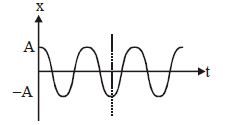
- ✓
Velocity is zero, force is to the right
- B
Velocity is positive, force is to the right
- C
Velocity is negative, force is to the right
- D
Velocity is zero, force is to the left
AnswerCorrect option: A. Velocity is zero, force is to the right
a
Particle is at negative extreme at the instant indicated in figure.
$v = 0$

View full question & answer→MCQ 971 Mark
The acceleration displacement graph of a particle executing $SHM$ is shown in figure. The time period of simple harmonic motion is
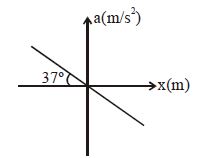
- ✓
$\frac {4\pi }{\sqrt 3}\,s$
- B
$\frac {2\pi }{\sqrt 3}\,s$
- C
The given graph doesn't represent $SHM$
- D
Information is insufficient
AnswerCorrect option: A. $\frac {4\pi }{\sqrt 3}\,s$
a
$a=\omega^{2} x$
$\Rightarrow \frac{a}{x}=\omega^{2}=\tan 37^{\circ}=\frac{3}{4}$
$\Rightarrow \frac{4 \pi^{2}}{\mathrm{T}^{2}}=\frac{3}{4} \Rightarrow \mathrm{T}=\frac{4 \pi}{\sqrt{3}}$ $s$
View full question & answer→MCQ 981 Mark
A particle is excuting a simple harmonic motion. Its maximum acceleration is $\alpha $ and maximum velocity is $\beta $. Then its frequency of vibration will be
- ✓
$\frac{\alpha }{{2\pi \beta }}$
- B
$\frac{{{\alpha ^2}}}{{{\beta ^2}}}$
- C
$\frac{\beta }{\alpha }$
- D
$\frac{\alpha }{{{\beta ^2}}}$
AnswerCorrect option: A. $\frac{\alpha }{{2\pi \beta }}$
a
$a_{\max }=\alpha \Rightarrow \omega^{2} A=\alpha$ $...(1)$
$\mathrm{V}_{\max }=\beta \Rightarrow \omega \mathrm{A}=\beta$ $...(2)$
Dividing
$\omega=\frac{\alpha}{\beta} \Rightarrow n=\frac{\alpha}{2 \pi \beta}$
View full question & answer→MCQ 991 Mark
The maximum velocity of a body undergoing $S.H.M$. is $0.2\,m/s$ and its acceleration at $0.1\,m$ from the mean position is $0.4\,m/s^2$. The amplitude of the $S.H.M.$ is .... $m$
- A
$0.25$
- B
$0.3$
- ✓
$0.1$
- D
$1.05$
Answerc
$\mathrm{V}_{\max }=\omega \mathrm{A}=0.2 \mathrm{m} / \mathrm{s}$
$a=-\omega^{2} x=0.4 \mathrm{m} / \mathrm{s}^{2}$
$\omega^{2}=4 \quad \Rightarrow \quad \omega=2$
$\omega A=0.2$
$2 \times \mathrm{A}=0.2$
$\mathrm{A}=0.1 \mathrm{m}$
View full question & answer→MCQ 1001 Mark
A particle moves in space according to equation
$\vec r = (\sin \,t\,\hat i\, + \,\cos \,t\,\hat j\, + \,t\,\hat k)m$
Find time $'t'$ when position vector and acceleration vector are perpendicular to each other
Answerd
$\overrightarrow{\mathrm{r}}=(\sin t \hat{i}+\cos t \hat{j}+t \hat{k}) m$
$\overrightarrow{\mathrm{v}}=\frac{\mathrm{d} \overrightarrow{\mathrm{r}}}{\mathrm{dt}}=(\cos t \hat{i}-\sin t \hat{j})$
$\overrightarrow{\mathrm{a}}=\frac{\mathrm{d} \overrightarrow{\mathrm{v}}}{\mathrm{dt}}=(-\sin t \hat{\mathrm{i}}-\cos t \hat{\mathrm{j}})$
According to question
$\overrightarrow{r} \cdot \overrightarrow{a}=0$
$\Rightarrow-\sin ^{2} t-\cos ^{2} t=0$
$\Rightarrow 1=0$ which is not possible
View full question & answer→MCQ 1011 Mark
A body is performing simple harmonic motion with amplitude a and time period $T$. Variation of its acceleration $(f)$ with time $(t)$ is shown in figure. If at time $t$, velocity of the body is $v$, which of the following graphs is correct
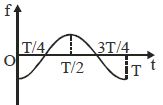
Answera
$a = \frac{{dv}}{{dt}}$
View full question & answer→MCQ 1021 Mark
A particle executes simple harmonic motion according to equation $4 \frac{d^2 x}{d t^2}+320 x=0$. Its time period of oscillation is .........
- A
$\frac{2 \pi}{5 \sqrt{3}} s$
- B
$\frac{\pi}{3 \sqrt{2}} s$
- ✓
$\frac{\pi}{2 \sqrt{5}} s$
- D
$\frac{2 \pi}{\sqrt{3}} s$
AnswerCorrect option: C. $\frac{\pi}{2 \sqrt{5}} s$
c
(c)
$4 \frac{d^2 x}{d t^2}+320 x=0$
$4 a=-320 x$
$a=-80 x$
Since $a=-\omega^2 x$ in $S.H.M.$
$80=\omega^2$
$\sqrt{16 \times 5}=\omega$
or $\omega=4 \sqrt{5}$
$T=\frac{2 \pi}{\omega}=\frac{2 \pi}{4 \sqrt{3}}=\frac{\pi}{2 \sqrt{5}} s$
View full question & answer→MCQ 1031 Mark
A block is resting on a piston which executes simple harmonic motion with a period $2.0 \,s$. The maximum velocity of the piston, at an amplitude just sufficient for the block to separate from the piston is .......... $ms ^{-1}$
- A
$1.57$
- ✓
$3.12$
- C
$2.0$
- D
$6.42$
AnswerCorrect option: B. $3.12$
b
(b)
Period $(T)=2 \,s$
$\omega=\frac{2 \pi}{2}=\pi \,rad / s$
When block just represent from a piston, maximum acceleration must be equal to $g$.
$g=-\omega^2 x$
Acceleration is maximum when $x=A$
$g=-\omega^2 A$
or $A=\frac{9.8}{\pi^2}$
Maximum velocity $=A \omega$
$=\frac{9.8}{\pi^2} \times \pi$
$=\frac{9.8}{\pi} \,m / s$
$=3.119 \,m / s =3.12 \,m / s$
View full question & answer→MCQ 1041 Mark
A body oscillates with $S.H.M.$ according to the equation $x=(5.0 \,m ) \cos \left[\left(2 \pi \,rad s ^{-1}\right) t+\pi / 4\right]$ At $t=1.5 \,s$, its acceleration is ....... $m / s ^2$
- A
$-139.56$
- ✓
$139.56$
- C
$69.78$
- D
$-69.78$
AnswerCorrect option: B. $139.56$
b
(b)
$x=5 \cos (2 \pi t+\pi / 4)$
$t=\frac{3}{2} s$
$x=5 \cos (3 \pi+\pi / 4)$
$x=5 \cos \left(\frac{13 \pi}{4}\right)$
$x=-5 \cos \frac{\pi}{4}$
$x=-\frac{5}{\sqrt{2}}$
Acceleration
$a=-\omega^2 x$
$a=-4 \pi^2 x-\frac{5}{\sqrt{2}}$
$a=139.56 \,m / s ^2$
View full question & answer→MCQ 1051 Mark
A particle execute $S.H.M.$ along a straight line. The amplitude of oscillation is $2 \,cm$. When displacement of particle from the mean position is $1 \,cm$, the magnitude of its acceleration is equal to magnitude of its velocity. The time period of oscillation is ........
- A
$\frac{2 \pi}{\sqrt{2}}$
- B
$\frac{\sqrt{2}}{2 \pi}$
- ✓
$\frac{2 \pi}{\sqrt{3}}$
- D
$\frac{\sqrt{3}}{2 \pi}$
AnswerCorrect option: C. $\frac{2 \pi}{\sqrt{3}}$
c
(c)
$A=2 \,cm =2 \times 10^{-2}$
$a=-\omega^2 x$
and $v=\omega \sqrt{A^2-x^2}$
$\omega^2 \times 1 \times 10^{-2}=\omega \sqrt{(4-1) 10^{-4}}$
$\omega \times 1 \times 10^{-2}=\sqrt{3} \times 10^{-2}$
$\omega=\sqrt{3}$
$T=\frac{2 \pi}{\omega}=\frac{2 \pi}{\sqrt{3}}$
View full question & answer→MCQ 1061 Mark
A flat horizontal board moves up and down under $S.H.M.$ vertically with amplitude $A$. The shortest permissible time period of the vibration such that an object placed on the board may not lose contact with the board is ..........
- A
$2 \pi \sqrt{\frac{g}{A}}$
- ✓
$2 \pi \sqrt{\frac{A}{g}}$
- C
$2 \pi \sqrt{\frac{2 A}{g}}$
- D
$\frac{\pi}{2} \sqrt{\frac{A}{g}}$
AnswerCorrect option: B. $2 \pi \sqrt{\frac{A}{g}}$
b
(b)
Maximum acceleration of the system $\left(a_{\max }\right)=-\omega^2 A$
For a block to escape the board the acceleration must be equal to 9 at the top-most point.
$g=\omega^2 A$
$\omega=\sqrt{\frac{g}{A}}$
Time period $=\frac{2 \pi}{\omega}=\sqrt{\frac{A}{g}}$
View full question & answer→MCQ 1071 Mark
A particle is vibrating in a simple harmonic motion with an amplitude of $4\, cm.$ At what displacement from the equilibrium position, is its energy half potential and half kinetic
- A
$1\, cm$
- B
$\sqrt 2\,cm $
- C
$3 \,cm$
- ✓
$2\sqrt 2\, cm$
AnswerCorrect option: D. $2\sqrt 2\, cm$
d
(d) Let $x$ be the point where $K.E. = P.E.$
Hence $\frac{1}{2}m{\omega ^2}({a^2} - {x^2}) = \frac{1}{2}m{\omega ^2}{x^2}$
==> $2{x^2} = {a^2}$
==> $x = \frac{a}{\sqrt{2}} = \frac{a}{\sqrt{2}} = 2\sqrt{2}\,cm$
View full question & answer→MCQ 1081 Mark
The total energy of the body executing $S.H.M.$ is $E$. Then the kinetic energy when the displacement is half of the amplitude, is
- A
$\frac{E}{2}$
- B
$\frac{E}{4}$
- ✓
$\frac{{3E}}{4}$
- D
$\frac{{\sqrt 3 }}{4}E$
AnswerCorrect option: C. $\frac{{3E}}{4}$
c
(c) Total energy in $SHM $ $E = \frac{1}{2}m{\omega ^2}{a^2}$; (where $a =$ amplitude)
Potential energy $U = \frac{1}{2}m{\omega ^2}({a^2} - {y^2}) $
$= E - \frac{1}{2}m{\omega ^2}{y^2}$
When $y = \frac{a}{2}$
$⇒$ $U = E - \frac{1}{2}m{\omega ^2}\left( {\frac{{{a^2}}}{4}} \right)$
$= E - \frac{E}{4} = \frac{{3E}}{4}$
View full question & answer→MCQ 1091 Mark
The potential energy of a particle executing S.H.M. is $ 2.5\, J$, when its displacement is half of amplitude. The total energy of the particle be .... $J$
Answerb
(b) $\frac{{{\rm{Potential\, energy (}}U{\rm{)}}}}{{{\rm{Total \,energy (}}E{\rm{)}}}} = \frac{{\frac{1}{2}m{\omega ^2}{y^2}}}{{\frac{1}{2}m{\omega ^2}{a^2}}} = \frac{{{y^2}}}{{{a^2}}}$
So $\frac{{2.5}}{E} = \frac{{{{\left( {\frac{a}{2}} \right)}^2}}}{{{a^2}}}$
==> $E = 10J$
View full question & answer→MCQ 1101 Mark
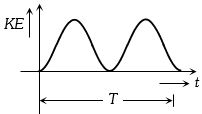
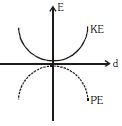
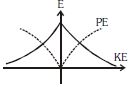
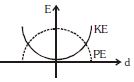
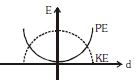
The frequency at which its kinetic energy change into potential energy is
Answerc
(c) In $S.H.M.$, frequency of $K.E.$ and $P.E.$
$= 2 ×$ (Frequency of oscillating particle)
View full question & answer→MCQ 1111 Mark
The total energy of a particle executing $S.H.M.$ is $80 \,J$. What is the potential energy when the particle is at a distance of $\frac{3}{4}$ of amplitude from the mean position..... $J$
Answerd
(d) $\frac{U}{E} = \frac{{\frac{1}{2}m{\omega ^2}{y^2}}}{{\frac{1}{2}m{\omega ^2}{a^2}}} = \frac{{{y^2}}}{{{a^2}}}$
==> $\frac{U}{{80}} = \frac{{{{\left( {\frac{3}{4}a} \right)}^2}}}{{{a^2}}} = \frac{9}{{16}}$
==> $U = 45\,J$
View full question & answer→MCQ 1121 Mark
The kinetic energy of a particle executing $S.H.M.$ is $16\, J$ when it is at its mean position. If the mass of the particle is $0.32 \,kg$, then what is the maximum velocity of the particle ..... $m/s$
Answerc
(c) Kinetic energy at mean position, ${K_{\max }} = \frac{1}{2}mv_{\max }^2.$
$\Rightarrow {v_{\max }} = \sqrt {\frac{{2\,{K_{\max }}}}{m}} $ $ = \sqrt {\frac{{2 \times 16}}{{0.32}}} $
$ = \sqrt {100} $
$ = 10\,m/s.$
View full question & answer→MCQ 1131 Mark
The displacement of a particle varies with time as $x = 12\sin \omega t - 16{\sin ^3}\omega t$ (in $cm$). If its motion is $S.H.M.$, then its maximum acceleration is
AnswerCorrect option: B. $36\,{\omega ^2}$
b
(b) $x = 12\sin \omega \,t - 16\,{\sin ^3}\omega \,t = 4[3\sin \omega \,t - 4{\sin ^3}\omega \,t]$
$ = 4[\sin 3\omega \,t]$ (By using $\sin 3\theta = 3\sin \theta - 4{\sin ^3}\theta )$
$\therefore $ maximum acceleration ${A_{\max }} = {(3\omega )^2} \times 4 = 36{\omega ^2}$
View full question & answer→MCQ 1141 Mark
The graph shows the variation of displacement of a particle executing S.H.M. with time. We infer from this graph that
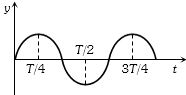
- A
The force is zero at time $3T/4$
- B
The velocity is maximum at time $T/2$
- C
The acceleration is maximum at time T
- ✓
The P.E. is equal to total energy at time $T/2$
AnswerCorrect option: D. The P.E. is equal to total energy at time $T/2$
d
(d)At time $\frac{T}{2};\;v = 0$ $\therefore $Total energy = Potential energy.
View full question & answer→MCQ 1151 Mark
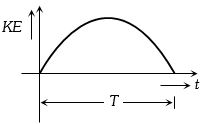
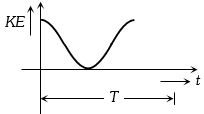
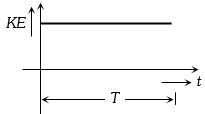
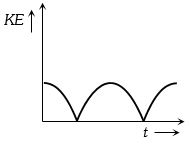
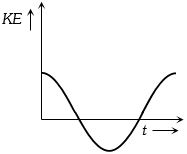
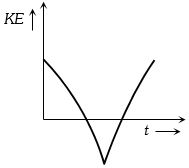
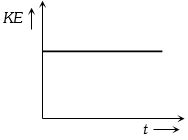
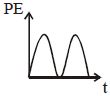
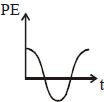
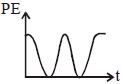
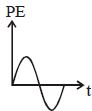
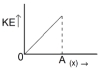
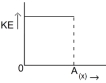
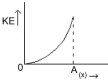
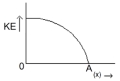
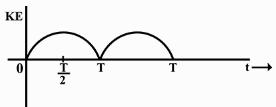
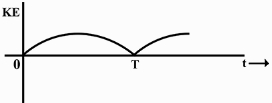
As a body performs $S.H.M.$, its potential energy $U.$ varies with time as indicated in
Answerb
(b) $PE$ varies from zero to maximum. It is always positive sinusoidal function.
View full question & answer→MCQ 1161 Mark
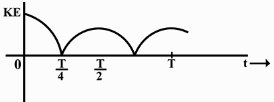
Acceleration $A$ and time period $T$ of a body in $S.H.M.$ is given by a curve shown below. Then corresponding graph, between kinetic energy $(K.E.)$ and time $t$ is correctly represented by
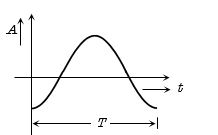
Answera
(a) In $S.H.M.$ when acceleration is negative maximum or positive maximum, the velocity is zero so kinetic energy is also zero.
Similarly for zero acceleration, velocity is maximum so kinetic energy is also maximum.
View full question & answer→MCQ 1171 Mark
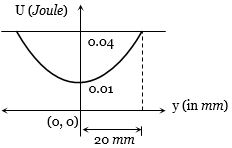
The variation of potential energy of harmonic oscillator is as shown in figure. The spring constant is
- A
$1 \times 10^2 N/m$
- ✓
$150 N/m$
- C
$0.667 \times 10^2 N/m$
- D
$3 \times 10^2 N/m$
AnswerCorrect option: B. $150 N/m$
b
(b)Total potential energy $= 0.04 J$
Resting potential energy $=0.01 J$
Maximum kinetic energy $=(0.04-0.01)$
$ = 0.03J = \frac{1}{2}m\;{\omega ^2}{a^2} = \frac{1}{2}k{a^2}$
$0.03 = \frac{1}{2} \times k \times {\left( {\frac{{20}}{{1000}}} \right)^2}$
$k = 0.06 \times 2500\;N/m = 150\;N/m$.
View full question & answer→MCQ 1181 Mark
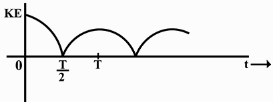
A body performs $S.H.M.$ Its kinetic energy $K$ varies with time $t$ as indicated by graph
Answera
(a) Kinetic energy varies with time but is never negative.
View full question & answer→MCQ 1191 Mark
An object of mass $0.2\, kg$ executes simple harmonic along $X-$ axis with frequency of $\frac{{25}}{\pi }Hz$. At the position $x = 0.04m$, the object has kinetic energy of $0.5 \,J$ and potential energy of $0.4\, J$ amplitude of oscillation in meter is equal to
AnswerCorrect option: B. $0.06$
b
(b) $E = \frac{1}{2}m{\omega ^2}{A^2}$$ \Rightarrow $$E = \frac{1}{2}m\,{(2\pi f)^2}{A^2}$$ \Rightarrow $$A = \frac{1}{{2\pi f}}\sqrt {\frac{{2E}}{m}} $
Putting $E = K + U$ we obtain,
$A = \frac{1}{{2\pi \left( {\frac{{25}}{\pi }} \right)}}\sqrt {\frac{{2 \times (0.5 + 0.4)}}{{0.2}}} $ $ \Rightarrow A = 0.06\,m$
View full question & answer→MCQ 1201 Mark
The kinetic energy and the potential energy of a particle executing $S.H.M.$ are equal. The ratio of its displacement and amplitude will be
- ✓
$\frac{1}{{\sqrt 2 }}$
- B
$\frac{{\sqrt 3 }}{2}$
- C
$\frac{1}{2}$
- D
$\sqrt 2 $
AnswerCorrect option: A. $\frac{1}{{\sqrt 2 }}$
a
(a) Given $K.E. = P.E.$$ \Rightarrow \frac{1}{2}m{v^2} = \frac{1}{2}k{x^2}$
$ \Rightarrow \frac{1}{2}m{\omega ^2}({a^2} - {x^2}) = \frac{1}{2}m{\omega ^2}{x^2}$
$ \Rightarrow {a^2} - {x^2} = {x^2}$$ \Rightarrow {x^2} = \frac{{{a^2}}}{2}$$ \Rightarrow \frac{x}{a} = \frac{1}{{\sqrt 2 }}.$
View full question & answer→MCQ 1211 Mark
Two simple pendulum first of bob mass $M_1$ and length $L_1$ second of bob mass $M_2$ and length $L_2$. $M_1 = M_2$ and $L_1 = 2L_2$. If these vibrational energy of both is same. Then which is correct
AnswerCorrect option: B. Amplitude of $B$ smaller than $A$
b
(b) $n = \frac{1}{{2\pi }}\sqrt {\frac{g}{l}} $==> $n \propto \frac{1}{{\sqrt l }}$==> $\frac{{{n_1}}}{{{n_2}}} = \sqrt {\frac{{{l_2}}}{{{l_1}}}} = \sqrt {\frac{{{L_2}}}{{2{L_2}}}} $
==> $\frac{{{n_1}}}{{{n_2}}} = \frac{1}{{\sqrt 2 }}$==> ${n_2} = \sqrt 2 \,{n_1}$ ==> ${n_2} > {n_1}$
Energy $E = \frac{1}{2}m{\omega ^2}{a^2} = 2{\pi ^2}m{n^2}{a^2}$
==>$\frac{{a_1^2}}{{a_2^2}} = \frac{{{m_2}n_2^2}}{{{m_1}n_1^2}}$ ( $E$ is same)
Given ${n_2} > {n_1}$ and ${m_1} = {m_2}$ ==> ${a_1} > {a_2}$
View full question & answer→MCQ 1221 Mark
The graphs in figure show that a quantity $y$ varies with displacement $d$ in a system undergoing simple harmonic motion. Which graphs best represents the relationship obtained when $y$ is The total energy of the system
Answera
The total energy of $SHM$ always remains constant. Hence, option $A$ is correct.
View full question & answer→MCQ 1231 Mark
A spring mass system preforms $S.H.M.$ If the mass is doubled keeping amplitude same, then the total energy of $S.H.M.$ will become :
Answerc
The total energy of the mass spring system is equal to $\frac{1}{2} k A^{2},$ which is independent of mass. So the total energy will remain unchanged if amplitude is kept the same.
View full question & answer→MCQ 1241 Mark
A particle of mass $m$ performs $SHM$ along a straight line with frequency $f$ and amplitude $A.$
AnswerCorrect option: D. $(B)$ and $(C)$ both
d
if $x=$ $Asinwt$ $\Rightarrow v=$ $Awcoswt$ $\Rightarrow v^{2}=A^{2} \times 4 \pi^{2} f^{2} \cos ^{2} \omega t=4 \pi^{2} f^{2} A^{2}(1+\cos 2 \omega t) / 2=$
$2 \pi^{2} f^{2} A^{2}(1+\cos 2 \omega t)$
The average potential energy is equal to average kinetic energy is equal to average of $m v^{2} / 2=\frac{1}{2} m \times 2 \pi^{2} f^{2} A^{2}(1+\cos 2 \omega t)-(1)$
$\Rightarrow m \pi^{2} f^{2} A^{2}$
From $( 1 ),$ angular frequency of oscillation of kinetic energy is $2$ $\omega$ i.e., frequency of oscillation of kinetic energy is $2 f$
View full question & answer→MCQ 1251 Mark
A spring hangs vertically from the ceiling and a mass is attached to its free end. When the mass is pulled down and released, it oscillates vertically with simple harmonic motion of period $T$ . The variation with time $t$ of its distance from the ceiling is as shown. Which statement gives a correct deduction from this graph?
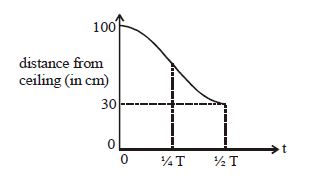
- A
The amplitude of the oscillation is $70\ cm$
- B
The kinetic energy is maximum at $t = \frac {1}{2}\ T$
- C
The restoring force on the mass increases between $t = 0$ and $t = \frac {1}{4}\ T$
- ✓
The speed is maximum at $t = \frac {1}{4}\ T$
AnswerCorrect option: D. The speed is maximum at $t = \frac {1}{4}\ T$
d
Speed is maximum at the mean position
Distance between extreme position $ = 2A$ .
$2A = 70$
$A = 35\ cm$
View full question & answer→MCQ 1261 Mark
Kinetic energy of a particle executing simple harmonic motion in straight line is $pv^2$ and potential energy is $qx^2$, where $v$ is speed at distance $x$ from the mean position. It time period is given by the expression
- A
$2\pi \sqrt {\frac{q}{p}}$
- ✓
$2\pi \sqrt {\frac{p}{q}}$
- C
$2\pi \sqrt {\frac{q}{{p + q}}}$
- D
$2\pi \sqrt {\frac{p}{{p + q}}}$
AnswerCorrect option: B. $2\pi \sqrt {\frac{p}{q}}$
b
$\mathrm{KE}=\mathrm{TE} \propto \mathrm{pA}^{2} \omega^{2}$
$\mathrm{PE}=\mathrm{TE} \propto \mathrm{q} \mathrm{A}^{2}$
$\mathrm{PA}^{2} / \omega^{2}=\mathrm{q} \mathrm{A}^{2}$
$\mathrm{T}=2 \pi \sqrt{\frac{p}{q}}$
View full question & answer→MCQ 1271 Mark
A particle performs $S.H.M.$ of amplitude $A$ with angular frequency $\omega$ along a straight line. Whenit is at a distance $\frac{{\sqrt 3 }}{2}$ $A$ from mean position, its kinetic energy gets increased by an amount $\frac{1}{2}m{\omega ^2}{A^2}$ due to an impulsive force. Then its new amplitude becomes
- A
$\frac{{\sqrt 5 }}{2}A$
- B
$\frac{{\sqrt 3 }}{2}A$
- ✓
$\sqrt 2$ $A$
- D
$\sqrt 5$ $A$
AnswerCorrect option: C. $\sqrt 2$ $A$
c
Due to impulse force, the total energy of the particle becomes
$\frac{1}{2} m \omega^{2} A^{2}+\frac{1}{2} m \omega^{2} A^{2}=m \omega^{2} A^{2}$
Let $A^{\prime}$ be the new amplitude. (apply energy conservation law)
$\frac{1}{2} m_{\omega}^{2}\left(A^{\prime}\right)=m_{\omega}^{2} A^{2}$
${A}^{\prime}=\sqrt{2} A$
View full question & answer→MCQ 1281 Mark
A particle executing a simple harmonic motion of period $2\ s$ . When it is at its extreme displacement from its mean position, it receives an additional energy equal to what it had in its mean position. Due to this , in its subsequent motion,
AnswerCorrect option: A. its amplitude will change and become equal to $\sqrt 2 $ times its previous amplitude
a
Its new amplitude is $\sqrt{2}$ times of previous amplitude.
View full question & answer→MCQ 1291 Mark
The kinetic energy of $SHM$ is $1/n$ time its potential energy. If the amplitude of the $SHM$ be $A$, then what is the displacement of the particle?
AnswerCorrect option: C. $\sqrt {\frac{n}{{n + 1}}} A$
c
$\mathrm{K}=\frac{1}{\mathrm{n}} \mathrm{up} \Rightarrow \frac{1}{2} \mathrm{m} \omega^{2}\left(\mathrm{A}^{2}-\mathrm{x}^{2}\right)=\frac{1}{\mathrm{n}} \frac{1}{2} \mathrm{m} \omega^{2} \mathrm{x}^{2}$
that $A^{2}-x^{2}=\frac{x^{2}}{n} \quad$ or $x^{2}\left(1-\frac{1}{n}\right)=A^{2}$
$x=\sqrt{\frac{n}{n+1}} A$
View full question & answer→MCQ 1301 Mark
A particle executing $S.H.M.$ its potential energy $V/S$ displacement graph is given by The value of restoring force constant is ..... $N/m$
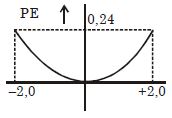
Answera
Here $\frac{1}{2} \mathrm{KA}^{2}=24$
$A=2$
View full question & answer→MCQ 1311 Mark
The $K.E.$ and $P.E.$ of a particle executing $SHM$ with amplitude $A$ will be equal when its displacement is-
- A
$A \sqrt 2$
- B
$A/2$
- ✓
$A/ \sqrt 2$
- D
$A \sqrt {2 / 3}$
AnswerCorrect option: C. $A/ \sqrt 2$
c
$\mathrm{KE}=\mathrm{PE}$
$\frac{1}{2} \mathrm{m} \omega^{2}\left(\mathrm{A}^{2}-\mathrm{y}^{2}\right)=\frac{1}{2} \mathrm{m} \omega^{2} \mathrm{y}^{2}$
$y=\frac{A}{\sqrt{2}}$
View full question & answer→MCQ 1321 Mark
The potential energy of a simple harmonic oscillator at mean position is $2\,joules$. If its mean $K.E.$ is $4\,joules$, its total energy will be .... $J$
Answerc
Total energy $=\frac{1}{2} \mathrm{KA}^{2}+\mathrm{U}_{0}$
$\mathrm{U}_{0}=2 \mathrm{J}(\text { given })$ and $\frac{1}{4} \mathrm{KA}^{2}=4 \mathrm{J}$
So total energy $=8+2=10 \mathrm{J}$
View full question & answer→MCQ 1331 Mark
A vertical mass spring system executes simple harmonic oscillations with a period of $2\,s$. A quantity of this system which exhibits simple harmonic variation with a period of $1\, sec$ is
- A
- ✓
- C
Phase difference between acceleration and displacement
- D
Difference between kinetic energy and potential energy
View full question & answer→MCQ 1341 Mark
Dispacement time graph of a particle executing $SHM$ is as shown in the figure. Corresponding graph between $PE$ and time is
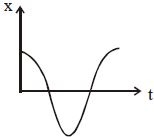
View full question & answer→MCQ 1351 Mark
A particle of mass $10\, gm$ moves in a field where potential energy per unit mas is given by expression $v = 8 \times 10^4\, x^2\, erg/gm$. If the total energy of the particle is $8 \times 10^7\, erg$ then the relation between $x$ and time $t$ is
- ✓
$x = 10\,\sin \,\left( {400\,t + \phi } \right)\,cm$
- B
$x = \,\sin \,\left( {400\,t + \phi } \right)\,m$
- C
$x = 10\,\sin \,\left( {40\,t + \phi } \right)\,cm$
- D
$x = 100\,\sin \,\left( {4\,t + \phi } \right)\,m\,\left[ {\phi = {\rm{constant}}} \right]$
AnswerCorrect option: A. $x = 10\,\sin \,\left( {400\,t + \phi } \right)\,cm$
a
Potential energy per unit mass $=\frac{1}{2} \omega^{2} \mathrm{x}^{2}$
$8 \times 10^{4} x^{2}$ erg. $=\frac{1}{2} \omega^{2} x^{2}$
$\omega=400$
total energy $=\frac{1}{2} \mathrm{m} \omega^{2} \mathrm{A}^{2}$
$\therefore A=10 \mathrm{cm}$
View full question & answer→MCQ 1361 Mark
For a simple pendulum, a graph is plotted between its kinetic energy $(KE)$ and potential energy $(PE)$ against its displacement $d.$ Which one of the following represents these correctly ? (graphs are schematic and not drawn to scale)
View full question & answer→MCQ 1371 Mark
The $K.E.$ and $P.E.$ of a particle executing $SHM$ with amplitude $A$ will be equal when its displacement is
- A
$A\sqrt 2 $
- B
$A/2$
- ✓
$A/\sqrt 2 $
- D
$A\,\sqrt {2/3} $
AnswerCorrect option: C. $A/\sqrt 2 $
c
$\mathrm{KE}=\mathrm{PE}$
$\frac{1}{2} \mathrm{m} \omega^{2}\left(\mathrm{A}^{2}-\mathrm{y}^{2}\right)=\frac{1}{2} \mathrm{m} \omega^{2} \mathrm{y}^{2}$
$\Rightarrow \mathrm{y}=\frac{\mathrm{A}}{\sqrt{2}}$
View full question & answer→MCQ 1381 Mark
The angular velocity and the amplitude of a simple pendulum is $'\omega '$ and $'A'$ respectively. At a displacement $x$ from the mean position its kinetic energy is $'T'$ and potnetial energy is $'V'$. Then the ratio $\frac{V}{T}$ is
- A
$\frac{{{x^2}{\omega ^2}}}{{{A^2} - {x^2}}}$
- B
$\frac{{{A^2} - {x^2}}}{{{x^2}{\omega ^2}}}$
- ✓
$\frac{{{x^2}}}{{{A^2} - {x^2}}}$
- D
$\frac{{{A^2} - {x^2}}}{{{x^2}}}$
AnswerCorrect option: C. $\frac{{{x^2}}}{{{A^2} - {x^2}}}$
c
$\mathrm{V}=\frac{1}{2} \mathrm{Kx}^{2}$
$\mathrm{T}=\frac{1}{2} \mathrm{K}\left(\mathrm{A}^{2}-\mathrm{x}^{2}\right)$
$\frac{V}{T}=\frac{x^{2}}{A^{2}-x^{2}}$
View full question & answer→MCQ 1391 Mark
Two, spring $P$ and $Q$ of force constants $k_p$ and ${k_Q}\left( {{k_Q} = \frac{{{k_p}}}{2}} \right)$ are stretched by applying forces of equal magnitude. If the energy stored in $Q$ is $E$, then the energy stored in $P$ is
Answerc
Here, $k_{Q}=\frac{k_{p}}{2}$
According to Hooke's law
$\therefore \quad \mathrm{F}_{\mathrm{p}}=-k_{\mathrm{p}} x_{\mathrm{p}}$
$F_{\mathrm{Q}}=-k_{\mathrm{Q}} x_{\mathrm{Q}} \Rightarrow \frac{F_{p}}{F_{Q}}=\frac{k_{p}}{k_{Q}} \frac{x_{p}}{x_{Q}}$
$F_{\mathrm{p}}=F_{\mathrm{Q}}[\text { Given }]$
$\therefore \frac{x_{p}}{x_{Q}}=\frac{k_{Q}}{k_{p}}$ $...(i)$
Energy stored in a spring is $\mathrm{U}=\frac{1}{2} k x^{2}$
$\therefore \quad \frac{U_{p}}{U_{Q}}=\frac{k_{p} x_{p}^{2}}{k_{Q} x_{Q}^{2}}=\frac{k_{p}}{k_{Q}} \times \frac{k_{Q}^{2}}{k_{p}^{2}}=\frac{1}{2}\left[\because k_{Q}=\frac{k_{p}}{2}\right]$
$\Rightarrow U_{p}=\frac{U_{Q}}{2}=\frac{E}{2} \quad\left[\therefore U_{Q}=E\right]$
View full question & answer→MCQ 1401 Mark
A particle of mass $4 \,kg$ moves simple harmonically such that its $P E(U)$ varies with position $x$, as shown. The period of oscillations is ............
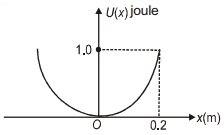
AnswerCorrect option: D. $\frac{2 \pi \sqrt{2}}{5} s$
d
(d)
Mass $=4 \,kg$
Maximum $P.E.$ $=\frac{1}{2} k A^2$
$1=\frac{1}{2} \times k \times(0.2)^2$
$\frac{2}{0.04}=k$
$k=50 \,N / m$
$T=2 \pi \sqrt{\frac{m}{k}}$
$T=2 \pi \sqrt{\frac{4}{50}}$
$=\frac{2 \sqrt{2} \pi}{5} \,s$
View full question & answer→MCQ 1411 Mark
A particle is performing $S.H.M.$ with energy of vibration $90 \,J$ and amplitude $6 \,cm$. When the particle reaches at distance $4 \,cm$ from mean position, it is stopped for a moment and then released. The new energy of vibration will be ........... $J$
Answera
(a)
Energy $=90 \,J \quad$ Amplitude $=6 \,cm$
Maximum energy $=\frac{1}{2} m A^2 \omega^2=90$
$\text { or } m \omega^2=\frac{180}{36 \times 10^{-4}}$
$\therefore m \omega^2=30 \times 10^2$
When particle is stopped the point where it is stopped is the new amplitude but angular velocity will remain same.
$E=\frac{1}{2} m A_2^2 \omega^2$
$\text { or } E=3000 A_2^2$
$A_2=4 \times 10^{-2}$
$A_2=3000$
View full question & answer→MCQ 1421 Mark
The variations of potential energy $(U)$ with position $x$ for three simple harmonic oscillators $A, B$ and $C$ are shown in figure. The oscillators have same mass. The time period of oscillation is greatest for
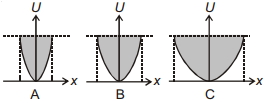
Answerc
(c)
$U=\frac{1}{2} k x^2$
$x^2=\frac{2 U}{k}$
or $x \propto \frac{1}{k}$ (Since $U$ is constant)
Also $T=2 \pi \sqrt{\frac{m}{k}}$
or $T \propto \frac{1}{\sqrt{k}}$
Therefore $x \propto T$
Hence the oscillation with maximum $x$ will have the maximum time period.
View full question & answer→MCQ 1431 Mark
If the particle repeats its motion after a fixed time interval of $8 \,s$ then after how much time its maximum value of $PE$ will be attained after attaining its minimum value is ........... $s$
Answera
(a)
$T=8 \,s$
Maximum value of potential energy is reached two times per oscillation which is $\frac{T}{4}$ time away from mean position which has minimum value at position.
View full question & answer→MCQ 1441 Mark
A simple pendulum of mass $m$ executes $S.H.M.$ with total energy $E$. If at an instant it is at one of extreme positions, then its linear momentum after a phase shift of $\frac{\pi}{3} \,rad$ will be
- A
$\sqrt{2 m E}$
- ✓
$\sqrt{\frac{3 m E}{2}}$
- C
$2 \sqrt{m E}$
- D
$\sqrt{\frac{2 m E}{3}}$
AnswerCorrect option: B. $\sqrt{\frac{3 m E}{2}}$
b
(b)
Energy $=E_0$
After a phase shift of $\frac{\pi}{3}$
$E=E_0 \cos ^2 \frac{\pi}{3}$
$\frac{P^2}{2 m}=\frac{E_0 3}{4}$
$P=\sqrt{\frac{3 m E}{2}}$
View full question & answer→MCQ 1451 Mark
A tunnel has been dug through the centre of the earth and a ball is released in it. It will reach the other end of the tunnel after
- A
$84.6$ minutes
- ✓
$42.3$ minutes
- C
$1$ day
- D
Will not reach the other end
AnswerCorrect option: B. $42.3$ minutes
b
(b) Ball execute $S.H.M.$ inside the tunnel with time period $T = 2\pi \sqrt {\frac{R}{g}} = 84.63\;\min $
Hence time to reach the ball from one end to the other end of the tunnel $t = \frac{{84.63}}{2} = 42.3\;\min .$
View full question & answer→MCQ 1461 Mark
A man measures the period of a simple pendulum inside a stationary lift and finds it to be $T$ sec. If the lift accelerates upwards with an acceleration $\frac{g}{4}$, then the period of the pendulum will be
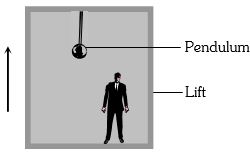
AnswerCorrect option: C. $\frac{{2T}}{{\sqrt 5 }}$
c
(c) In stationary lift $T = 2\pi \sqrt {\frac{l}{g}} $
In upward moving lift $T' = 2\pi \sqrt {\frac{l}{{(g + a)}}} $ ($a = $Acceleration of lift)
$ \Rightarrow \frac{{T'}}{T} = \sqrt {\frac{g}{{g + a}}} = \sqrt {\frac{g}{{\left( {g + \frac{g}{4}} \right)}}} = \sqrt {\frac{4}{5}} $
$ \Rightarrow T' = \frac{{2T}}{{\sqrt 5 }}$
View full question & answer→MCQ 1471 Mark
If the length of second's pendulum is decreased by $2\%$, how many seconds it will lose per day ...... $\sec$
- A
$3927$
- B
$3727$
- C
$3427$
- ✓
$864$
Answerd
(d) $T \propto \sqrt l $
==> $\frac{{\Delta T}}{T} = \frac{1}{2}\frac{{\Delta l}}{l} = \frac{{0.02}}{2} = 0.01$
==>$\Delta T = 0.01\,T$
Loss of time per day $ = 0.01 \times 24 \times 60 \times 60$$ = 864\sec $
View full question & answer→MCQ 1481 Mark
The metallic bob of a simple pendulum has the relative density $\rho$. The time period of this pendulum is $T$. If the metallic bob is immersed in water, then the new time period is given by
- A
$T\frac{{\rho - 1}}{\rho }$
- B
$T\frac{\rho }{{\rho - 1}}$
- C
$T\sqrt {\frac{{\rho - 1}}{\rho }} $
- ✓
$T\sqrt {\frac{\rho }{{\rho - 1}}} $
AnswerCorrect option: D. $T\sqrt {\frac{\rho }{{\rho - 1}}} $
d
(d) When the bob is immersed in water its effective weight = $\left( {mg - \frac{m}{\rho }g} \right) = mg\,\left( {\frac{{\rho - 1}}{\rho }} \right)$
$\therefore {g_{eff}} = g\,\left( {\frac{{\rho - 1}}{\rho }} \right)$
$\frac{{T'}}{T} = \sqrt {\frac{g}{{{g_{eff}}}}} $
$\frac{{T'}}{T} = \sqrt {\frac{\rho}{{\rho -1}}} $
View full question & answer→MCQ 1491 Mark
A pendulum has time period $T$ in air. When it is made to oscillate in water, it acquired a time period $T' = \sqrt 2 T$. The density of the pendulum bob is equal to (density of water $= 1$)
- A
$\sqrt 2 $
- ✓
$2$
- C
$2\sqrt 2 $
- D
Answerb
(b) The effective acceleration of a bob in water
$ = g' = g\,\left( {1 - \frac{\sigma }{\rho }} \right)$ where $\sigma$ and $\rho$ are the density of water and the bob respectively. Since the period of oscillation of the bob in air and water are given as $T = 2\pi \sqrt {\frac{l}{g}} $ and $T' = 2\pi \sqrt {\frac{l}{{g'}}} $
$\therefore $ $\frac{T}{{T'}} = \sqrt {\frac{{g'}}{g}} = \sqrt {\frac{{g(1 - \sigma /\rho )}}{g}} $$ = \sqrt {1 - \frac{\sigma }{\rho }} = \sqrt {1 - \frac{1}{\rho }} $
Putting $\frac{T}{{T'}} = \frac{1}{{\sqrt 2 }}$. We obtain, $\frac{1}{2} = 1 - \frac{1}{\rho }$
$ \Rightarrow \rho = 2$
View full question & answer→MCQ 1501 Mark
A disc of mass $m$ and radius $R$ is attached to celling with the help of ropes of length $l$. Find the time period of small oscillation of disc in the plane of disc.
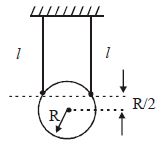
- A
$2\pi \sqrt {\frac{{l + \frac{R}{2}}}{g}} $
- B
$2\pi \sqrt {\frac{{l^2 + (\frac{R}{2})^2}}{g(\frac{R}{2}+ l)}} $
- ✓
$2\pi \sqrt {\frac{l}{g}} $
- D
AnswerCorrect option: C. $2\pi \sqrt {\frac{l}{g}} $
c
translatory motion in radius $l$. Hence case islike simple pendulum (Refer to $H.C. V.$ exercise $S.H.M.$)
View full question & answer→MCQ 1511 Mark
A flat horizontal board moves up and down in $SHM$ of amplitude $\alpha$. Then the shortest permissible time period of the vibration such that an object placed on the board may not lose contact with the board is
- A
$2\pi \sqrt {\frac{g}{\alpha }} $
- ✓
$2\pi \sqrt {\frac{\alpha}{g }} $
- C
$2\pi \sqrt {g \times \alpha } $
- D
$\frac{1}{{2\pi }}\sqrt {\frac{g}{\alpha }} $
AnswerCorrect option: B. $2\pi \sqrt {\frac{\alpha}{g }} $
b
$\mathrm{m} \alpha \omega^{2}=\mathrm{mg}$
$\omega=\sqrt{\frac{g}{\alpha}}$
$\frac{2 \pi}{\mathrm{T}}=\sqrt{\frac{\mathrm{g}}{\alpha}} \quad \text { or } \quad \mathrm{T}=2 \pi \sqrt{\frac{\alpha}{\mathrm{g}}}$
View full question & answer→MCQ 1521 Mark
A solid cylinder of density $\rho_0$, cross-section area $A$ and length $l$ floats in a liquid $\rho(> \rho_0)$ with its axis vertical, as shown. If it is slightly displaced downward and released, the time period will be

- A
$2\pi \sqrt {\frac{l}{g}} $
- ✓
$2\pi \sqrt {\frac{{{\rho _0}l}}{{\rho g}}} $
- C
$2\pi \sqrt {\frac{{{\rho}l}}{{\rho_0 g}}} $
- D
$2\pi \sqrt {\frac{l}{{2g}}} $
AnswerCorrect option: B. $2\pi \sqrt {\frac{{{\rho _0}l}}{{\rho g}}} $
b
Let length of submerged part $=\mathrm{h}$
then $\mathrm{Ah} \rho=\mathrm{A} \ell \rho_{0}$
$\Rightarrow \mathrm{h}=\frac{\rho_{0} \ell}{\rho}$
$\therefore \mathrm{T}=2 \pi \sqrt{\frac{\mathrm{h}}{\mathrm{g}}} \Rightarrow \mathrm{T}=2 \pi \sqrt{\frac{\rho_{0} \ell}{\rho \mathrm{g}}}$
View full question & answer→MCQ 1531 Mark
A block of mass $m$ rests on a platform. The platform is given up and down $SHM$ with an amplitude $d$ . What can be the maximum frequency so that the block never leaves the platform
AnswerCorrect option: B. $\frac{1}{{2\pi }}\sqrt {g/d} $
b
$m w^{2} d=m g$
$w=\sqrt{\frac{g}{d}}=2 \pi t$
$t=\frac{1}{2 \pi} \sqrt{\frac{g}{d}}$
View full question & answer→MCQ 1541 Mark
A circular disc of mass $10 \;kg$ is suspended by a wire attached to its centre. The wire is twisted by rotating the disc and released. The period of torsional oscillations is found to be $1.5 \;s$. The radius of the disc is $15\; cm .$ Determine the torsional spring constant of the wire in $N\;m\;rad^{-1}$. (Torsional spring constant $\alpha$ is defined by the relation $J=-\alpha \theta,$ where $J$ is the restoring couple and $\theta$ the angle of twist).
- ✓
$1.97$
- B
$3.54$
- C
$4.67$
- D
$0.28$
AnswerCorrect option: A. $1.97$
a
Mass of the circular disc, $m=10 \,kg$
Radius of the disc, $r=15 \,cm =0.15\, m$
The torsional oscillations of the disc has a time period, $T=1.5\, s$
The moment of inertia of the disc is:
${I}=\frac{1}{2} m r^{2}$
$={2} \times(10) \times(0.15)^{2}$
$=0.1125 \,kg\, m ^{2}$
$T=2 \pi \sqrt{\frac{I}{\alpha}} a$
Time period,
is the torsional constant.
$\alpha=\frac{4 \pi^{2} I}{T^{2}}$
$=\frac{4 \times(\pi)^{2} \times 0.1125}{(1.5)^{2}}$
$=1.972\, Nm / rad$
Hence, the torsional spring constant of the wire is $1.972\, Nm$ $rad$ $^{-1}$.
View full question & answer→MCQ 1551 Mark
A uniform thin ring of radius $R$ and mass $m$ suspended in a vertical plane from a point in its circumference. Its time period of oscillation is ........
- ✓
$2 \pi \sqrt{\frac{3 R}{2g}}$
- B
$\pi \sqrt{\frac{2 R}{g}}$
- C
$\frac{\pi}{2} \sqrt{\frac{R}{g}}$
- D
$\pi \sqrt{\frac{R}{2 g}}$
AnswerCorrect option: A. $2 \pi \sqrt{\frac{3 R}{2g}}$
a
(a)
The time period of the disc is $2 \pi \sqrt{(3 r / 2 g )}$
We know that the time period of an object,
$T =2 \pi \sqrt{(I / mgL )}$
where,
$I=$ moment of inertia from the suspended point
$L =$ distance of its centre from suspended point $= r$
we know that, the moment of inertia of disc about its centre $= mr ^2 / 2$
using parallel axis theoram the moment of inertia from a point in its periphery,
$I = mr ^2+ mr ^2 / 2=3 mr ^2 / 2$
putting the values in the above equation we get,
$2 \pi \sqrt{\left(3 mr ^2 / 2 mgr \right)}$
$=2 \pi \sqrt{(3 r / 2 g )}$
therefore, the time period of the disc is $2 \pi \sqrt{(3 r / 2 g )}$
View full question & answer→MCQ 1561 Mark
A uniform rod of mass $m$ and length $I$ is suspended about its end, Time period of small angular oscillations is ..........
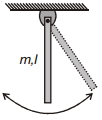
- A
$2 \pi \sqrt{\frac{l}{g}}$
- B
$2 \pi \sqrt{\frac{2 l}{g}}$
- ✓
$2 \pi \sqrt{\frac{2 l}{3 g}}$
- D
$2 \pi \sqrt{\frac{I}{3 g}}$
AnswerCorrect option: C. $2 \pi \sqrt{\frac{2 l}{3 g}}$
c
(c)
This is the case of a physical pendulum.
$T=2 \pi \sqrt{\frac{I_{\text {com }}}{m g L_{\text {com }}}}$
$L_{\text {com }}=\frac{L}{2} I_{ com }=\frac{m L^2}{3}$
$T=2 \pi \sqrt{\frac{2 l}{3 g}}$
View full question & answer→MCQ 1571 Mark
A uniform disc of mass $M$ and radius $R$ is suspended in vertical plane from a point on its periphery. Its time period of oscillation is ........
- A
$2 \pi \sqrt{\frac{3 R}{g}}$
- B
$2 \pi \sqrt{\frac{R}{3 g}}$
- C
$2 \pi \sqrt{\frac{2 R}{3 g}}$
- ✓
$2 \pi \sqrt{\frac{3 R}{2 g}}$
AnswerCorrect option: D. $2 \pi \sqrt{\frac{3 R}{2 g}}$
d
(d)
It is the case of a physical pendulum.
$T=2 \pi \sqrt{\frac{I_{\text {c.o.m. }}}{m g L_{\text {com }}}}$
$I_{\text {com }}=\frac{M R^2}{2}+M R^2=\frac{3}{2} M R^2$
$L_{\text {com }}=R$
$T=2 \pi \sqrt{\frac{3 R}{2 g}}$
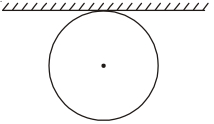
View full question & answer→MCQ 1581 Mark
A particle of mass $m$ in a unidirectional potential field have potential energy $U(x)=\alpha+2 \beta x^2$, where $\alpha$ and $\beta$ are positive constants. Find its time period of oscillation.
- A
$2 \pi \sqrt{\frac{2 \beta}{m}}$
- B
$2 \pi \sqrt{\frac{m}{2 \beta}}$
- ✓
$\pi \sqrt{\frac{m}{\beta}}$
- D
$\pi \sqrt{\frac{\beta}{m}}$
AnswerCorrect option: C. $\pi \sqrt{\frac{m}{\beta}}$
c
(c)
$U(x)=\alpha+2 \beta x^2$
$F=-\frac{d U(x)}{d x}$
$F=-4 \beta x$
$T=2 \pi \sqrt{\frac{m}{k}}$
$T=2 \pi \sqrt{\frac{m}{4 \beta}} \quad \cos [k=\beta]$
$T=\pi \sqrt{\frac{m}{\beta}}$
View full question & answer→MCQ 1591 Mark
A simple pendulum with iron bob has a time period $T$. The bob is now immersed in a non-viscous liquid and oscillated. If the density of liquid is $\frac{1}{12}$ th that of iron, then new time period will be
- A
$T \sqrt{\frac{8}{7}}$
- B
$T \sqrt{\frac{12}{13}}$
- ✓
$T \sqrt{\frac{12}{11}}$
- D
$T \sqrt{\frac{6}{5}}$
AnswerCorrect option: C. $T \sqrt{\frac{12}{11}}$
c
(c)
When bob is inserted, in liquid effective of is reduced because of the force of upthrust.
$\rho_s$ is density of solid.
$\rho_L$ is density of liquid.
$V$ is volume of solid
and $T=2 \pi \sqrt{\frac{1}{g}}$
$T_{\text {new }}=2 \pi \sqrt{\frac{1}{g_{\text {new }}}}$
$T_{\text {new }}=2 \pi \sqrt{\frac{1}{g-\frac{\rho_L}{\rho_S} g}}$
$T_{\text {new }}=2 \pi \sqrt{\frac{1 \times 12}{g \times 11}}$
or $T_{\text {new }}=\sqrt{\frac{12}{11}} T$
View full question & answer→MCQ 1601 Mark
A spring has a certain mass suspended from it and its period for vertical oscillation is $T$. The spring is now cut into two equal halves and the same mass is suspended from one of the halves. The period of vertical oscillation is now
- A
$\frac{T}{2}$
- ✓
$\frac{T}{\sqrt{2}}$
- C
$\sqrt{2}T$
- D
$2T$
AnswerCorrect option: B. $\frac{T}{\sqrt{2}}$
b
(b) $T = 2\pi \sqrt {\frac{m}{k}} $.
Also spring constant $(k) \propto \frac{1}{{{\rm{Length (}}L)}}$, when the spring is half in length, then $k$ becomes twice.
$\therefore T' = 2\pi \sqrt {\frac{m}{{2k}}} $
$\Rightarrow \frac{{T'}}{T} = \frac{1}{{\sqrt 2 }} $
$\Rightarrow T' = \frac{T}{{\sqrt 2 }}$
View full question & answer→MCQ 1611 Mark
Two identical spring of constant $K$ are connected in series and parallel as shown in figure. A mass $m$ is suspended from them. The ratio of their frequencies of vertical oscillations will be
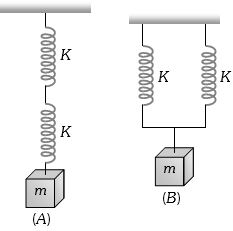
Answerc
(c) $n = \frac{1}{{2\pi }}\sqrt {\frac{k}{m}} $
==> $\frac{{{n_S}}}{{{n_P}}} = \sqrt {\frac{{{k_S}}}{{{k_P}}}} $
$ \Rightarrow \frac{{{n_s}}}{{{n_p}}} = \sqrt {\frac{{\left( {\frac{k}{2}} \right)}}{{2k}}} = \frac{1}{2}$
View full question & answer→MCQ 1621 Mark
A spring is stretched by $0.20\, m$, when a mass of $0.50\, kg$ is suspended. When a mass of $0.25\, kg$ is suspended, then its period of oscillation will be .... $\sec$ $(g = 10\,m/{s^2})$
- A
$0.328$
- ✓
$0.628$
- C
$0.137$
- D
$1.00$
AnswerCorrect option: B. $0.628$
b
(b) Force constant $k = \frac{F}{x} = \frac{{0.5 \times 10}}{{0.2}} = 25\;N/m$
Now $T = 2\pi \sqrt {\frac{m}{k}} = 2\pi \sqrt {\frac{{0.25}}{{25}}} = 0.628\,sec$
View full question & answer→MCQ 1631 Mark
A mass $M$ is suspended from a spring of negligible mass. The spring is pulled a little and then released so that the mass executes simple harmonic oscillations with a time period $T$. If the mass is increased by m then the time period becomes $\left( {\frac{5}{4}T} \right)$. The ratio of $\frac{m}{{M}}$ is
- ✓
$ \frac{9}{16}$
- B
$ \frac{25}{16}$
- C
$ \frac{4}{5}$
- D
$ \frac{5}{4}$
AnswerCorrect option: A. $ \frac{9}{16}$
a
(a) $T = 2\pi \sqrt {\frac{m}{K}} $
==> $m \propto {T^2}$
==> $\frac{{{m_2}}}{{{m_1}}} = \frac{{T_2^2}}{{T_1^2}}$
$ \Rightarrow \frac{{M + m}}{M} = {\left( {\frac{{\frac{5}{4}T}}{T}} \right)^2}$
$ \Rightarrow \frac{m}{M} = \frac{9}{{16}}$
View full question & answer→MCQ 1641 Mark
A weightless spring which has a force constant oscillates with frequency $n$ when a mass $m$ is suspended from it. The spring is cut into two equal halves and a mass $2m $ is suspended from it. The frequency of oscillation will now become
- ✓
$n$
- B
$2n$
- C
$\frac{n}{\sqrt2}$
- D
$n(2)^{1/2}$
Answera
(a) $n = \frac{1}{{2\pi }}\sqrt {\frac{k}{m}} $
==>$\frac{n}{{n'}} = \sqrt {\frac{k}{m} \times \frac{{m'}}{{K'}}} $
$ = \sqrt {\frac{k}{m} \times \frac{{2m}}{{2K}}} = 1$
==> $n' = n$
View full question & answer→MCQ 1651 Mark
A mass $M$ is suspended from a light spring. An additional mass m added displaces the spring further by a distance $x$. Now the combined mass will oscillate on the spring with period
- A
$T = 2\pi \sqrt {\left( {mg/x(M + m)} \right)} $
- ✓
$T = 2\pi \sqrt {\left( {(M + m)x/mg} \right)} $
- C
$T = (\pi /2)\sqrt {\left( {mg/x(M + m)} \right)} $
- D
$T = 2\pi \sqrt {\left( {(M + m)/mgx} \right)} $
AnswerCorrect option: B. $T = 2\pi \sqrt {\left( {(M + m)x/mg} \right)} $
b
(b) As $mg$ produces extension $x$, hence $k = \frac{{mg}}{x}$
$T = 2\pi \sqrt {\frac{{(M + m)}}{k}} = 2\pi \sqrt {\frac{{(M + m)x}}{{mg}}} $
View full question & answer→MCQ 1661 Mark
In the figure, ${S_1}$ and ${S_2}$ are identical springs. The oscillation frequency of the mass $m$ is $f$. If one spring is removed, the frequency will become
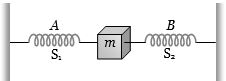
- A
$f$
- B
$f \times 2$
- C
$f \times \sqrt 2 $
- ✓
$f/\sqrt 2 $
AnswerCorrect option: D. $f/\sqrt 2 $
d
(d) For the given figure $f = \frac{1}{{2\pi }}\sqrt {\frac{{{k_{eq}}}}{m}} = \frac{1}{{2\pi }}\sqrt {\frac{{2k}}{m}} $…..(i)
If one spring is removed, then $k_eq = k$ and
$f' = \frac{1}{{2\pi }}\sqrt {\frac{k}{m}} $ ….(ii)
From equation (i) and (ii),
$\frac{f}{{f'}} = \sqrt 2 $
==> $f' = \frac{f}{{\sqrt 2 }}$
View full question & answer→MCQ 1671 Mark
A mass $m =100\, gms$ is attached at the end of a light spring which oscillates on a frictionless horizontal table with an amplitude equal to $0.16$ metre and time period equal to $2 \,sec$. Initially the mass is released from rest at $t = 0$ and displacement $x = - 0.16$ metre. The expression for the displacement of the mass at any time $t$ is
- A
$x = 0.16\cos (\pi t)$
- ✓
$x = - \,0.16\cos (\pi t)$
- C
$x = 0.16\sin (\pi t + \pi )$
- D
$x = - \,0.16\sin (\pi t + \pi )$
AnswerCorrect option: B. $x = - \,0.16\cos (\pi t)$
b
(b) Standard equation for given condition
$x = a\cos \frac{{2\pi }}{T}t$
==> $x = - 0.16\cos (\pi \,t)$ [As $a = -0.16$ meter, $T = 2\, sec$]
View full question & answer→MCQ 1681 Mark
The force constants of two springs are ${K_1}$ and ${K_2}$. Both are stretched till their elastic energies are equal. If the stretching forces are ${F_1}$ and ${F_2}$, then ${F_1}:{F_2}$ is
AnswerCorrect option: C. $\sqrt {{K_1}} :\sqrt {{K_2}} $
c
(c) Given elastic energies are equal i.e., $\frac{1}{2}{k_1}x_1^2 = \frac{1}{2}{k_2}x_2^2$
$ \Rightarrow \frac{{{k_1}}}{{{k_2}}} = {\left( {\frac{{{x_2}}}{{{x_1}}}} \right)^2}$ and using $F = kx$
$ \Rightarrow \frac{{{F_1}}}{{{F_2}}} = \frac{{{k_1}{x_1}}}{{{k_2}{x_2}}} = \frac{{{k_1}}}{{{k_2}}} \times \sqrt {\frac{{{k_2}}}{{{k_1}}}} = \sqrt {\frac{{{k_1}}}{{{k_2}}}} $
View full question & answer→MCQ 1691 Mark
Five identical springs are used in the following three configurations. The time periods of vertical oscillations in configurations (i), (ii) and (iii) are in the ratio
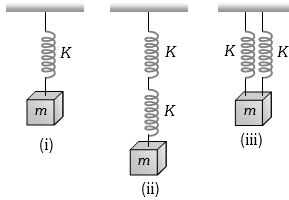
- ✓
$1:\sqrt 2 :\frac{1}{{\sqrt 2 }}$
- B
$2:\sqrt 2 :\frac{1}{{\sqrt 2 }}$
- C
$\frac{1}{{\sqrt 2 }}:2:1$
- D
$2:\frac{1}{{\sqrt 2 }}:1$
AnswerCorrect option: A. $1:\sqrt 2 :\frac{1}{{\sqrt 2 }}$
a
(a) $T \propto \frac{1}{{\sqrt k }}$
==> ${T_1}:{T_2}:{T_3} = \frac{1}{{\sqrt k }}:\frac{1}{{\sqrt {k/2} }}:\frac{1}{{\sqrt {2k} }} = 1:\sqrt 2 :\frac{1}{{\sqrt 2 }}$
View full question & answer→MCQ 1701 Mark
A mass m performs oscillations of period $T$ when hanged by spring of force constant $K$. If spring is cut in two parts and arranged in parallel and same mass is oscillated by them, then the new time period will be
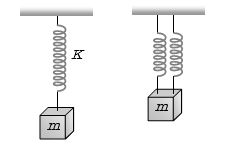
- A
$2T$
- B
$T$
- C
$\frac{T}{{\sqrt 2 }}$
- ✓
$\frac{T}{2}$
AnswerCorrect option: D. $\frac{T}{2}$
d
(d) $T \propto \frac{1}{{\sqrt k }}$
==> $\frac{{{T_2}}}{{{T_1}}} = \sqrt {\frac{{{K_1}}}{{{K_2}}}} $$ = \sqrt {\frac{k}{{4k}}} = \frac{1}{2}$
==> ${T_2} = \frac{{{T_1}}}{2}$
View full question & answer→MCQ 1711 Mark
What will be the force constant of the spring system shown in the figure
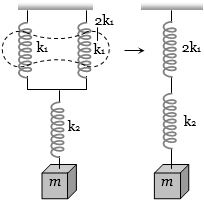
- A
$\frac{{{K_1}}}{2} + {K_2}$
- ✓
${\left[ {\frac{1}{{2{K_1}}} + \frac{1}{{{K_2}}}} \right]^{ - 1}}$
- C
$\frac{1}{{2{K_1}}} + \frac{1}{{{K_2}}}$
- D
${\left[ {\frac{2}{{{K_1}}} + \frac{1}{{{K_1}}}} \right]^{ - 1}}$
AnswerCorrect option: B. ${\left[ {\frac{1}{{2{K_1}}} + \frac{1}{{{K_2}}}} \right]^{ - 1}}$
b
(b)In series combination
$\frac{1}{{{k_S}}} = \frac{1}{{2{k_1}}} + \frac{1}{{{k_2}}}$
==> ${k_S} = {\left[ {\frac{1}{{2{k_1}}} + \frac{1}{{{k_2}}}} \right]^{ - 1}}$
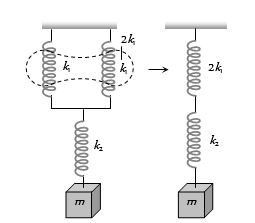
View full question & answer→MCQ 1721 Mark
The scale of a spring balance reading from $0$ to $10 \,kg$ is $0.25\, m$ long. A body suspended from the balance oscillates vertically with a period of $\pi /10$ second. The mass suspended is ..... $kg$ (neglect the mass of the spring)
AnswerCorrect option: B. $0.98$
b
(b) Using $F = kx$
$ \Rightarrow 10g = k \times 0.25$
$\Rightarrow k = \frac{{10g}}{{0.25}} = 98 \times 4$
Now $T = 2\pi \sqrt {\frac{m}{k}}$
$\Rightarrow m = \frac{{{T^2}}}{{4{\pi ^2}}}k$
$ \Rightarrow m = \frac{{{\pi ^2}}}{{100}} \times \frac{1}{{4{\pi ^2}}} \times 98 \times 4 = 0.98\;kg$
View full question & answer→MCQ 1731 Mark
One-forth length of a spring of force constant $K$ is cut away. The force constant of the remaining spring will be
- A
$\frac{3}{4}K$
- ✓
$\frac{4}{3}K$
- C
$K$
- D
$4 K$
AnswerCorrect option: B. $\frac{4}{3}K$
b
(b) By using $K \propto \frac{1}{l}$
Since one fourth length is cut away so remaining length is $\frac{3}{4}th$, hence $k$ becomes $\frac{4}{3}$ times i.e., $k' = \frac{4}{3}x$.
View full question & answer→MCQ 1741 Mark
Infinite springs with force constant $k$, $2k$, $4k$ and $8k$.... respectively are connected in series. The effective force constant of the spring will be
- A
$2K$
- B
$k$
- ✓
$\frac{k}{2}$
- D
$\frac{k}{4}$
AnswerCorrect option: C. $\frac{k}{2}$
c
(c)$\frac{1}{{{k_{eff}}}} = \frac{1}{k} + \frac{1}{{2\,k}} + \frac{1}{{4\,k}} + \frac{1}{{8\,k}} + ....$
$ = \frac{1}{k}\left[ {1 + \frac{1}{2} + \frac{1}{4} + \frac{1}{8} + .....} \right]$$ = \frac{1}{k}\left( {\frac{1}{{1 - 1/2}}} \right)$$ = \frac{2}{k}$
(By using sum of infinite geometrical progression $a + \frac{a}{r} + \frac{a}{{{r^2}}} + ...\infty $ sum (S) $ = \frac{a}{{1 - r}}$)
$\therefore {k_{eff}} = \frac{k}{2}.$
View full question & answer→MCQ 1751 Mark
The springs shown are identical. When $A = 4kg$, the elongation of spring is $1\, cm$. If $B = 6\,kg$, the elongation produced by it is ..... $ cm$
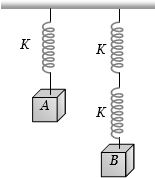
Answerb
b) $F = kx$
==> $mg = kx$
==> $m \propto kx$
Hence $\frac{{{m_1}}}{{{m_2}}} = \frac{{{k_1}}}{{{k_2}}} \times \frac{{{x_1}}}{{{x_2}}}$
==> $\frac{4}{6} = \frac{k}{{k/2}} \times \frac{1}{{{x_2}}}$
$ \Rightarrow {x_2} = 3\,cm$.
View full question & answer→MCQ 1761 Mark
When a body of mass $1.0\, kg$ is suspended from a certain light spring hanging vertically, its length increases by $5\, cm$. By suspending $2.0\, kg$ block to the spring and if the block is pulled through $10\, cm$ and released the maximum velocity in it in $m/s$ is : (Acceleration due to gravity $ = 10\,m/{s^2})$
Answerb
(b) Initially when $1\, kg$ mass is suspended then by using $F = kx$
$ \Rightarrow mg = kx$
$ \Rightarrow k = \frac{{mg}}{x} = \frac{{1 \times 10}}{{5 \times {{10}^{ - 2}}}} = 200\frac{N}{m}$
Further, the angular frequency of oscillation of $2\, kg$ mass is $\omega = \sqrt {\frac{k}{M}} = \sqrt {\frac{{200}}{2}} = 10\,rad/sec$
Hence, ${v_{\max }} = a\omega = (10 \times {10^{ - 2}}) \times 10 = 1\,m/s$
View full question & answer→MCQ 1771 Mark
A mass m oscillates with simple harmonic motion with frequency $f = \frac{\omega }{{2\pi }}$ and amplitude A on a spring with constant $K$ , therefore
- A
The total energy of the system is $\frac{1}{2}K{A^2}$
- B
The frequency is $\frac{1}{{2\pi }}\sqrt {\frac{K}{M}} $
- C
The maximum velocity occurs, when $x = 0$
- ✓
All the above are correct
AnswerCorrect option: D. All the above are correct
View full question & answer→MCQ 1781 Mark
Two masses $m_1$ and $m_2$ are suspended together by a massless spring of constant $K$. When the masses are in equilibrium, $m_1$ is removed without disturbing the system. The amplitude of oscillations is
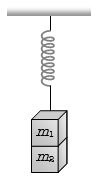
AnswerCorrect option: A. $\frac{{{m_1}g}}{K}$
a
(a)With mass ${m_2}$ alone, the extension of the spring l is given as ${m_2}g = kl$ ...(i)
With mass $({m_1} + {m_2})$, the extension $l'$ is given by
$({m_1} + {m_2})g = k(l + \Delta l)$ ....(ii)
The increase in extension is $\Delta l$ which is the amplitude of vibration. Subtracting (i) from (ii), we get
${m_1}g = k\Delta l$ or $\Delta l = \frac{{{m_1}g}}{k}$
View full question & answer→MCQ 1791 Mark
A spring executes $SHM$ with mass of $10\,kg$ attached to it. The force constant of spring is $10\,N/m$.If at any instant its velocity is $40\,cm/sec$, the displacement will be .... $m$ (where amplitude is $0.5\,m$)
- A
$0.09$
- ✓
$0.3$
- C
$0.03$
- D
$0.9$
Answerb
(b) Angular velocity $\omega = \sqrt {\left( {\frac{k}{m}} \right)} $$ = \sqrt {\left( {\frac{{10}}{{10}}} \right)} = 1$
Now $u = \omega \sqrt {{a^2} - {y^2}} $
==>${y^2} = {a^2} - \frac{{{u^2}}}{{{\omega ^2}}}$$ = {(0.5)^2} - \frac{{{{(0.4)}^2}}}{{{1^2}}}$
==> ${y^2} = 0.9$
$y = 0.3\,m$
View full question & answer→MCQ 1801 Mark
On a smooth inclined plane, a body of mass $M$ is attached between two springs. The other ends of the springs are fixed to firm supports. If each spring has force constant $K$, the period of oscillation of the body (assuming the springs as massless) is
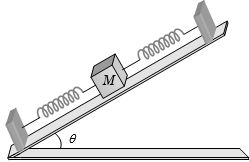
- ✓
$2\pi {\left( {\frac{m}{{2K}}} \right)^{1/2}}$
- B
$2\pi {\left( {\frac{{2M}}{K}} \right)^{1/2}}$
- C
$2\pi \frac{{Mg\sin \theta }}{{2K}}$
- D
$2\pi {\left( {\frac{{2Mg}}{K}} \right)^{1/2}}$
AnswerCorrect option: A. $2\pi {\left( {\frac{m}{{2K}}} \right)^{1/2}}$
a
(a) Slope is irrelevant hence $T = 2\pi {\left( {\frac{M}{{2K}}} \right)^{1/2}}$
View full question & answer→MCQ 1811 Mark
Three masses $700g, 500g$, and $400g$ are suspended at the end of a spring a shown and are in equilibrium. When the $700g$ mass is removed, the system oscillates with a period of $3$ seconds, when the $500 \,gm$ mass is also removed, it will oscillate with a period of ...... $s$
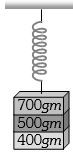
- A
$1$
- ✓
$2$
- C
$3$
- D
$\sqrt {\frac{{12}}{5}}$
Answerb
(b) When mass $700 \,gm$ is removed, the left out mass $(500 + 400)\, gm$ oscillates with a period of $3\, sec$
$3 = t = 2\pi \sqrt {\frac{{(500 + 400)}}{k}} $…...$(i)$
When $500 \,gm$ mass is also removed, the left out mass is $400\, gm.$
$t' = 2\pi \sqrt {\frac{{400}}{k}} $…..$(ii)$
==> $\frac{3}{{t'}} = \sqrt {\frac{{900}}{{400}}} $ ==> $t' = 2\sec $
View full question & answer→MCQ 1821 Mark
A body of mass $0.01 kg$ executes simple harmonic motion $(S.H.M.)$ about $x = 0$ under the influence of a force shown below : The period of the $S.H.M.$ is .... $s$
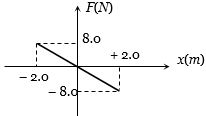
- A
$1.05$
- B
$0.52$
- C
$0.25$
- ✓
$0.30$
AnswerCorrect option: D. $0.30$
d
(d) From graph, slope $K = \frac{F}{x} = \frac{8}{2} = 4$
$T = 2\pi \sqrt {\frac{m}{K}} \Rightarrow T = 2\pi \sqrt {\frac{{0.01}}{4}} = 0.3\sec $
View full question & answer→MCQ 1831 Mark
A man weighing $60\, kg$ stands on the horizontal platform of a spring balance. The platform starts executing simple harmonic motion of amplitude $0.1\, m$ and frequency $\frac{2}{\pi }Hz$. Which of the following statement is correct
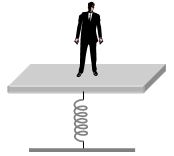
- A
The spring balance reads the weight of man as $60\, kg$
- B
The spring balance reading fluctuates between $60\, kg$. and $70 \,kg$
- C
The spring balance reading fluctuates between $50\, kg$ and $60\, kg$
- ✓
The spring balance reading fluctuates between $50\, kg$ and $70\, kg$
AnswerCorrect option: D. The spring balance reading fluctuates between $50\, kg$ and $70\, kg$
d
(d) The maximum force acting on the body executing simple harmonic motion is
$m{\omega ^2}a = m \times {(2\pi f)^2}a = 60 \times {\left( {2\pi \times \frac{2}{\pi }} \right)^2} \times 0.1\,N$
$ = 60 \times 16 \times 0.1 = 96N = \frac{{96}}{{9.8}} \approx 10\,kgf$ and this force is towards mean position.
The reaction of the force on the platform away from the mean position. It reduces the weight of man on upper extreme i.e. net weight $= (60 -10)\, kgf.$
This force adds to the weight at lower extreme position i.e. net weight becomes $= (60 + 10)\, kgf.$
Therefore, the reading the weight recorded by spring balance fluctuates between $50\, kgf$ and $70\, kgf.$
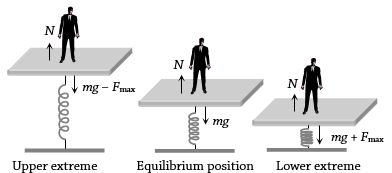
View full question & answer→MCQ 1841 Mark
A force of $6.4\, N$ stretches a vertical spring by $0.1 \,m$. The mass that must be suspended from the spring so that it oscillates with a period of $\left( {\frac{\pi }{4}} \right)sec$. is ... $kg$
Answerb
(b) Force constant of a spring is given by $F = kx$
$6.4 = k(0.1)$ or $k = 64N/m$
$T = 2\pi \sqrt {\frac{m}{k}} $ ==> $\frac{\pi }{4} = 2\pi \sqrt {\frac{m}{{64}}} $; $\frac{m}{{64}} = {\left( {\frac{1}{8}} \right)^2}$; $m = 1kg$
View full question & answer→MCQ 1851 Mark
Four massless springs whose force constants are $2k, 2k, k$ and $2k$ respectively are attached to a mass $M$ kept on a frictionless plane (as shown in figure). If the mass $M$ is displaced in the horizontal direction, then the frequency of oscillation of the system is
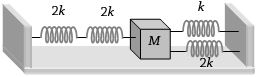
- A
$\frac{1}{{2\pi }}\sqrt {\frac{k}{{4M}}} $
- ✓
$\frac{1}{{2\pi }}\sqrt {\frac{{4k}}{M}} $
- C
$\frac{1}{{2\pi }}\sqrt {\frac{k}{{7M}}} $
- D
$\frac{1}{{2\pi }}\sqrt {\frac{{7k}}{M}} $
AnswerCorrect option: B. $\frac{1}{{2\pi }}\sqrt {\frac{{4k}}{M}} $
b
(b) The two springs on left side having spring constant of $2k$ each are in series, equivalent constant is $\frac{1}{{\left( {\frac{1}{{2k}} + \frac{1}{{2k}}} \right)}} = k$. The two springs on right hand side of mass $M$ are in parallel. Their effective spring constant is $(k + 2k) = 3k$.
Equivalent spring constants of value $k$ and $3k$ are in parallel and their net value of spring constant of all the four springs is $k + 3k = 4k$
$\therefore $ Frequency of mass is $n = \frac{1}{{2\pi }}\sqrt {\frac{{4k}}{M}} $
View full question & answer→MCQ 1861 Mark
Find the ratio of time periods of two identical springs if they are first joined in series $\&$ then in parallel $\&$ a mass $m$ is suspended from them :
Answerb
$\mathrm{T}_{1}=2 \pi \sqrt{\frac{\mathrm{m}}{\mathrm{k}_{\mathrm{eq}}}}(\text { in series })$
$\frac{1}{\mathrm{k}_{\mathrm{eq}}}=\frac{1}{\mathrm{k}}+\frac{1}{\mathrm{k}}=\frac{2}{\mathrm{k}}$
$\therefore \quad k_{e q}=\frac{k}{2}$
$\therefore \quad \mathrm{T}_{1}=2 \pi \sqrt{\frac{2 \mathrm{m}}{\mathrm{k}}}$
$\mathrm{T}_{2}=2 \pi \sqrt{\frac{\mathrm{m}}{\mathrm{k}^{\prime}}}(\text { in parallel })$
But $k^{\prime}=k+k=2 k$
$\mathrm{T}_{2}=2 \pi \sqrt{\frac{\mathrm{m}}{2 \mathrm{k}}}$
$\therefore \frac{\mathrm{T}_{1}}{\mathrm{T}_{2}}=\frac{2 \pi \sqrt{\frac{2 \mathrm{m}}{\mathrm{k}}}}{2 \pi \sqrt{\frac{\mathrm{m}}{2 \mathrm{k}}}}=2$
View full question & answer→MCQ 1871 Mark
In an elevator, a spring clock of time period $T_S$ (mass attached to a spring) and a pendulum clock of time period $T_P$ are kept. If the elevator accelerates upwards
- A
$T_S$ well as $T_P$ increases
- B
$T_S$ remain same, $T_P$ increases
- ✓
$T_S$ remains same, $T_P$ decreases
- D
$T_S$ as well as $T_P$ decreases
AnswerCorrect option: C. $T_S$ remains same, $T_P$ decreases
c
$T_{s}=2 \pi \sqrt{\frac{m}{k}} T_{s}$ doesn't depend on $g .$
$T_{p}=2 \pi \sqrt{\frac{\ell}{g}} ; \quad T_{p} \propto g^{-1 / 2}$
$\therefore T_{p}$ decreases
View full question & answer→MCQ 1881 Mark
Aheavy brass sphere is hung from a light spring and is set in vertical small oscillation with a period $T.$ The sphere is now immersed in a non-viscous liquid with a density $1/10\,th$ the density of the sphere. If the system is now set in vertical $S.H.M.,$ its period will be
- A
$(9/10)T$
- B
$(9/10)^2T$
- C
$(10/9)\, T$
- ✓
$T$
Answerd
$\mathrm{T}=2 \pi \sqrt{\frac{\mathrm{m}}{\mathrm{k}}}$
View full question & answer→MCQ 1891 Mark
$A$ block of mass $M_1$ is hanged by a light spring of force constant $k$ to the top bar of a reverse Uframe of mass $M_2$ on the floor. The block is pooled down from its equilibrium position by $a$ distance $x$ and then released. Find the minimum value of $x$ such that the reverse $U$ -frame will leave the floor momentarily.
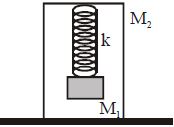
- ✓
$x = (M_1 + M_2)g/k$
- B
$x = (2M_1 + M_2)g/k$
- C
$x = (M_1 + 2M_2)g/k$
- D
$x = M_1g/k$
AnswerCorrect option: A. $x = (M_1 + M_2)g/k$
a
Elongation in spring $\Rightarrow x_{e}=\frac{M_{1} g}{K}$
at equilibrium position
Max. compression $=x-x_{e}$
$\mathrm{K}\left(\mathrm{x}-\mathrm{x}_{\mathrm{e}}\right)=\mathrm{M}_{2} \mathrm{g}$
View full question & answer→MCQ 1901 Mark
An assembly of identical spring-mass systems is placed on a smooth horizontal surface as shown. Initially the springs are relaxed. The left mass is displaced to the left while the right mass is displaced to the right and released. The resulting collision is elastic. The time period of the oscillations of the system is :-
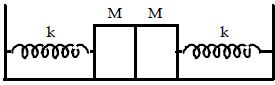
- A
$2\pi \sqrt {\frac{{2M}}{k}} $
- B
$2\pi \sqrt {\frac{M}{{2k}}} $
- C
$2\pi \sqrt {\frac{M}{k}} $
- ✓
$\pi \sqrt {\frac{M}{k}} $
AnswerCorrect option: D. $\pi \sqrt {\frac{M}{k}} $
d
Each block completes half the oscillation
View full question & answer→MCQ 1911 Mark
A force of $6.4\ N$ stretches a vertical spring by $0.1\ m$. The mass that must be suspended from the spring so that it oscillates with a time period of $\pi/4\ second$ is .... $kg$
- A
$\frac{\pi }{4}$
- B
$\frac{4 }{\pi}$
- ✓
$1$
- D
$10$
Answerc
Spring constant $\mathrm{K}=\frac{6.4}{0.1}=64 \mathrm{N} / \mathrm{m}$
Now $\quad \mathrm{T}=2 \pi \sqrt{\frac{\mathrm{m}}{\mathrm{k}}}$
or $\frac{\pi}{4}=2 \pi \sqrt{\frac{\mathrm{m}}{64}}$
$\therefore m=1 \mathrm{kg}$
View full question & answer→MCQ 1921 Mark
A mass hangs from a spring and oscillates vertically. The top end of the spring is attached to the top of a box, and the box is placed on a scale, as shown in the figure. The reading on the scale is largest when the mass is
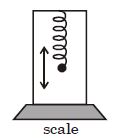
- A
- ✓
- C
At the midpoint of its motion
- D
All points give the same reading.
View full question & answer→MCQ 1931 Mark
Three masses $700g, 500g$ and $400g$ are suspended at the end of a spring a shown and are in equilibrium. When the $700g$ mass is removed, the system oscillates with a period of $3\,seconds$, when the $500g$ mass is also removed, it will oscillate with a period of .... $s$
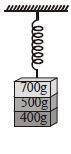
- A
$1$
- ✓
$2$
- C
$\sqrt 3$
- D
$\sqrt{\frac{12}{5}}$
Answerb
$\mathrm{T}=2 \pi \sqrt{\frac{\mathrm{m}}{\mathrm{R}}}$
$\frac{3=2 \pi \sqrt{\frac{0.9}{\mathrm{k}}}}{\mathrm{T}=2 \pi \sqrt{\frac{0.4}{\mathrm{k}}}}$
$\mathrm{T}=2 \mathrm{sec}$
View full question & answer→MCQ 1941 Mark
A block of mass $m$ is at rest on an another block of same mass as shown in figure. Lower block is attached to the spring, then the maximum amplitude of motion so that both the block will remain in contact is
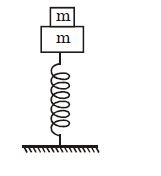
- A
$\frac{{mg}}{{2K}}$
- B
$\frac{{mg}}{{K}}$
- ✓
$\frac{{2mg}}{{K}}$
- D
$\frac{{3mg}}{{K}}$
AnswerCorrect option: C. $\frac{{2mg}}{{K}}$
c
The block will remain in contact till the block do not go above the natural length of spring because after this decleration of lower block becomes more than upper block due to spring force so they will get separated
So, $A=\frac {2mg}{K}$
View full question & answer→MCQ 1951 Mark
Let $T_1$ and $T_2$ be the time periods of two springs $A$ and $B$ when a mass $m$ is suspended from them separately. Now both the springs are connected in parallel and same mass $m$ is suspended with them. Now let $T$ be the time period in this position. Then
AnswerCorrect option: D. $\frac{1}{T^2} =\frac{1}{T_1^2}+\frac{1}{T_2^2}$
d
$\mathrm{T}_{1}=2 \pi \sqrt{\frac{\mathrm{m}}{\mathrm{k}_{1}}} \quad$ or $\mathrm{k}_{1}=\frac{4 \pi^{2} \mathrm{m}}{\mathrm{T}_{1}^{2}}$
${\mathrm{T}_{2}=2 \pi \sqrt{\frac{\mathrm{m}}{\mathrm{k}_{2}}}} {\text { or } \quad \mathrm{k}_{2}=\frac{4 \pi^{2} \mathrm{m}}{\mathrm{T}_{2}^{2}}}$
${\mathrm{Now} \quad \mathrm{T}=2 \pi \sqrt{\frac{\mathrm{m}}{\mathrm{k}_{2}}}} {\text { or } \quad \mathrm{k}=\frac{4 \pi^{2} \mathrm{m}}{\mathrm{T}_{2}^{2}}}$
In parallel $\mathrm{k}=\mathrm{k}_{1}+\mathrm{k}_{2}$
Substituting the values of $\mathrm{k}, \mathrm{k}_{1}$ and $\mathrm{k}_{2}$ we get:
$\frac{1}{\mathrm{T}^{2}}=\frac{1}{\mathrm{T}_{1}^{2}}+\frac{1}{\mathrm{T}_{2}^{2}}$
View full question & answer→MCQ 1961 Mark
The total spring constant of the system as shown in the figure will be
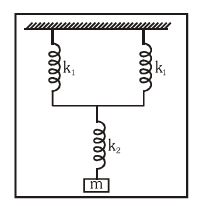
- A
$\frac{{{k_1}}}{2} + {k_2}$
- ✓
${\left[ {\frac{1}{{2{k_1}}} + \frac{1}{{{k_2}}}} \right]^{ - 1}}$
- C
$\frac{1}{{2{k_1}}} + \frac{1}{{{k_2}}}$
- D
${\left[ {\frac{2}{{{k_1}}} + \frac{1}{{{k_2}}}} \right]^{ - 1}}$
AnswerCorrect option: B. ${\left[ {\frac{1}{{2{k_1}}} + \frac{1}{{{k_2}}}} \right]^{ - 1}}$
b
$\frac{1}{\mathrm{k}_{\mathrm{eq}}}=\frac{1}{2 \mathrm{k}_{1}}+\frac{1}{\mathrm{k}_{2}}$
$\mathrm{k}_{\mathrm{eq}}=\left[\frac{1}{2 \mathrm{k}_{1}}+\frac{1}{\mathrm{k}_{2}}\right]^{-1}$
View full question & answer→MCQ 1971 Mark
Three mass and string system is in equilibrium. When $700\,gm$ mass is removed, then the system oscillates with a period of $3\,seconds$ . When the $500\,gm$ mass is also removed, then what will be new time period for system ..... $\sec$
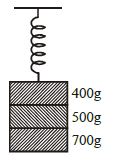
- A
$1$
- ✓
$2$
- C
$3$
- D
$\sqrt {\frac{{12}}{5}}$
Answerb
$\mathrm{T}=2 \pi \sqrt{\frac{\mathrm{m}}{\mathrm{k}}} \Rightarrow \mathrm{T} \propto \sqrt{\mathrm{m}}$
$\therefore \frac{\mathrm{T}_{2}}{\mathrm{T}_{1}}=\sqrt{\frac{\mathrm{m}_{2}}{\mathrm{m}_{1}}}=\sqrt{\frac{400}{900}}$
$\Rightarrow \frac{\mathrm{T}_{2}}{3}=\frac{2}{3} \Rightarrow \mathrm{T}_{2}=2 \mathrm{s}$
View full question & answer→MCQ 1981 Mark
Spring of spring constant $1200\, Nm^{-1}$ is mounted on a smooth frictionless surface and attached to a block of mass $3\, kg$. Block is pulled $2\, cm$ to the right and released. The angular frequency of oscillation is .... $ rad/sec$
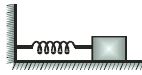
Answerd
Angular frequency
$\omega=\sqrt{\frac{\mathrm{K}}{\mathrm{m}}}=\sqrt{\frac{1200}{3}}=20 \mathrm{rad} / \mathrm{sec}$
View full question & answer→MCQ 1991 Mark
A particle executes $SHM$ with amplitude of $20 \,cm$ and time period is $12\, sec$. What is the minimum time required for it to move between two points $10\, cm$ on either side of the mean position ..... $\sec$ ?
Answerb
$X=A \sin \omega t$
or $10=20 \sin \omega t$
$\therefore \omega t=\left(\frac{\pi}{6}\right) \Rightarrow t=\frac{\pi}{6 \omega}$
The desired time will be $2 t$
or $\frac{\pi}{3 \omega}=\frac{\pi}{3(2 \pi / T)}=\frac{T}{6}=\frac{12}{6}=2 s$
View full question & answer→MCQ 2001 Mark
A block of mass $m$ is attached to two springs of spring constants $k_1$ and $k_2$ as shown in figure. The block is displaced by $x$ towards right and released. The velocity of the block when it is at $x/2$ will be
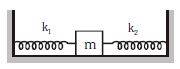
- A
$\sqrt {\frac{{\left( {{k_1} + {k_2}} \right){x^2}}}{{2m}}} $
- ✓
$\sqrt {\frac{3}{4}\frac{{\left( {{k_1} + {k_2}} \right){x^2}}}{m}} $
- C
$\sqrt {\frac{{\left( {{k_1} + {k_2}} \right){x^2}}}{m}} $
- D
$\sqrt {\frac{{\left( {{k_1} + {k_2}} \right){x^2}}}{4m}} $
AnswerCorrect option: B. $\sqrt {\frac{3}{4}\frac{{\left( {{k_1} + {k_2}} \right){x^2}}}{m}} $
View full question & answer→MCQ 2011 Mark
Springs of spring constants $K, 2K, 4K, 8K,$ ..... are connected in series. A mass $40\, gm$ is attached to the lower end of last spring and the system is allowed to vibrate. What is the time period of oscillation ..... $\sec$. (Given $K = 2\, N/cm$)
- ✓
$0.13$
- B
$0.3$
- C
$0.43$
- D
$0.21$
AnswerCorrect option: A. $0.13$
a
$\frac{1}{K_{eq}}=\frac{1}{K}+\frac{1}{2 K}+\frac{1}{4 K}+\frac{1}{8 K}+\ldots \ldots=\frac{1}{K}\left[1+\frac{1}{2}+\frac{1}{4}+\frac{1}{8}+\ldots\right]$
$\frac{1}{K_{e q}}=\frac{1}{K}\left[\frac{1}{1-\frac{1}{2}}\right]=\frac{2}{K} \Rightarrow K_{e q}=\frac{K}{2}$
$\mathrm{T}=2 \pi \sqrt{\frac{\mathrm{m}}{\mathrm{K}_{\mathrm{eq}}}}$
View full question & answer→MCQ 2021 Mark
The springs in figure. $A$ and $B$ are identical but length in $A$ is three times that in $B$. The ratio of period $T_A/T_B$ is
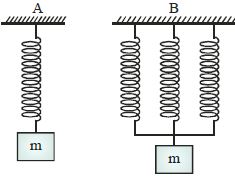
- A
$\sqrt 3 $
- B
$0.33$
- ✓
$3$
- D
$1/\sqrt 3 $
Answerc
$\mathrm{K}_{1} \ell_{1}=\mathrm{K}_{2} \ell_{2}$
let spring constant of spring in figure $A$ is $K.$ now spring constant of each spring in figure $B$ is $3 \mathrm{K}$
in figure, all springs are in parallel so $(K_{eq } ) _ { B }$ $=9 \mathrm{K}$
time period $\mathrm{T}=2 \pi \sqrt{\frac{\mathrm{M}}{\mathrm{K}}}$
$\frac{\mathrm{T}_{\mathrm{A}}}{\mathrm{T}_{\mathrm{B}}}=\sqrt{\frac{\mathrm{K}_{\mathrm{B}}}{\mathrm{K}_{\mathrm{A}}}}=3$
View full question & answer→MCQ 2031 Mark
A mass $m = 8\,kg$ is attahced to a spring as shown in figure and held in position so that the spring remains unstretched. The spring constant is $200\,N/m$. The mass $m$ is then released and begins to undergo small oscillations. The maximum velocity of the mass will be ..... $m/s$ $(g = 10\,m/s^2)$
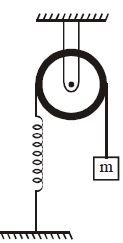
Answerb
$\mathrm{T}=2 \pi \sqrt{\frac{\mathrm{M}}{\mathrm{K}}}$
or $\omega=\sqrt{\frac{\mathrm{K}}{\mathrm{M}}}=5 \mathrm{rad} / \mathrm{sec}$
and $A=m g / K=2 / 5 \mathrm{m}$
$\mathrm{v}_{\max }=\omega \mathrm{A}=2 \mathrm{m} / \mathrm{s}$
View full question & answer→MCQ 2041 Mark
A $5\, kg$ collar is attached to a spring of spring constant $500\, Nm^{-1}$. It slides without friction over a horizontal rod. The collar is displaced from its equillibrium position by $10\, cm$ and released. The time period of oscillation is
- ✓
$\frac{\pi }{5}\,s$
- B
$\frac{\pi }{2}\,s$
- C
$\pi \,s$
- D
$2\pi \,s$
AnswerCorrect option: A. $\frac{\pi }{5}\,s$
a
$\mathrm{T}=2 \pi \sqrt{\frac{\mathrm{m}}{\mathrm{K}}}=\sqrt{\frac{5}{500}}=\frac{2 \pi}{10}=\frac{\pi}{5} \mathrm{s}$
View full question & answer→MCQ 2051 Mark
A block of mass $m$ is having two similar rubber ribbons attached to it as shown in the figure. The force constant of each rubber ribbon is $K$ and surface is frictionless. The block is displaced from mean position by $x\,cm$ and released. At the mean position the ribbons are underformed. Vibration period is
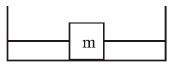
- A
$2\pi \sqrt {\frac{{m(2k)}}{{{k^2}}}} $
- B
$\frac{1}{{2\pi }}\sqrt {\frac{{m(2k)}}{{{k^2}}}} $
- ✓
$2\pi \sqrt {\frac{m}{k}} $
- D
$2\pi \sqrt {\frac{m}{k+k}} $
AnswerCorrect option: C. $2\pi \sqrt {\frac{m}{k}} $
c
Displace the car by distance $x,$ one of the rubber will get stretched by $x$ but another will loose to apply any force as rubber cant be compressed like spring.
$F=k x$
$m a=k x$
$a=\frac{k x}{m}$
$a=\omega^{2} x$
$\omega=\sqrt{\frac{k}{m}}$
$T=\frac{2 \pi}{\omega}$
$T=2 \pi \sqrt{\frac{m}{k}}$
View full question & answer→MCQ 2061 Mark
Two springs of force constant $K$ and $2K$ are connected to a mass as shown below. The frequency of oscillation of the mass is
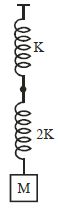
- A
$\frac{{3K}}{M}$
- B
$\pi \,\sqrt {\frac{{6M}}{K}} $
- C
$\frac{1}{{2\pi }}\,\sqrt {\frac{{3K}}{M}} $
- ✓
$\frac{1}{\pi }\,\sqrt {\frac{K}{{6M}}} $
AnswerCorrect option: D. $\frac{1}{\pi }\,\sqrt {\frac{K}{{6M}}} $
d
$\frac{1}{\mathrm{K}_{\mathrm{eq}}}=\frac{1}{\mathrm{K}_{1}}+\frac{1}{\mathrm{K}_{2}}$
$=\frac{1}{\mathrm{K}}+\frac{1}{2 \mathrm{K}}$
$\mathrm{Keq}=\frac{2 \mathrm{K}}{3}$
$\mathrm{n}=\frac{1}{2 \pi} \sqrt{\frac{2 \mathrm{K} / 3}{\mathrm{M}}}=\frac{1}{\pi} \sqrt{\frac{\mathrm{K}}{6 \mathrm{M}}}$
View full question & answer→MCQ 2071 Mark
Two masses $m_1$ and $m_2$ are supended together by a massless spring of constant $k$. When the masses are in equilibrium, $m_1$ is removed without disturbing the system; the amplitude of vibration is
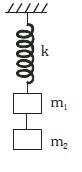
- ✓
$m_1g / k$
- B
$m_2g / k$
- C
$\frac{{\left( {{m_1} + {m_2}} \right)\,g}}{k}$
- D
$\frac{{\left( {{m_2} - {m_1}} \right)\,g}}{k}$
AnswerCorrect option: A. $m_1g / k$
a
In equillibrium $F=\left(\mathrm{m}_{1}+\mathrm{m}_{2}\right) \mathrm{g}$
By removing mass $m_1$
$F^{\prime}=\mathrm{m}_{2} \mathrm{g}$
$F_{\mathrm{r}}=F^{\prime}-F=\mathrm{m}_{2} \mathrm{g}-\left(\mathrm{m}_{1}+\mathrm{m}_{2}\right)$
$\mathrm{kx}=\mathrm{m}_{1} \mathrm{g} \Rightarrow \mathrm{x}=\frac{\mathrm{m}_{1} \mathrm{g}}{\mathrm{k}}$
View full question & answer→MCQ 2081 Mark
The period of oscillation of a mass $M$ suspended from a spring of negligible mass is $T$. If along with it another mass $M$ is also suspended, the period of oscillation will now be
- A
$T$
- B
$T/\sqrt 2$
- C
$2T$
- ✓
$\sqrt 2T$
AnswerCorrect option: D. $\sqrt 2T$
d
$\mathrm{T}=2 \pi \sqrt{\frac{m}{K}} \quad \therefore \frac{T_{1}}{T_{2}}=\sqrt{\frac{M_{1}}{M_{2}}}$
$\mathrm{T}_{2}=\mathrm{T}_{1} \sqrt{\frac{M_{2}}{M_{1}}}=\mathrm{T}_{1} \sqrt{\frac{2 M}{M}}$
$\mathrm{T}_{2}=\mathrm{T}_{1} \sqrt{2}=\sqrt{2} \mathrm{T}\left(\text { where } \mathrm{T}_{1}=\mathrm{T}\right)$
View full question & answer→MCQ 2091 Mark
The frequency of oscillation of a mass $m$ suspended by a spring is $v_1$. If length of spring is cut to one third then the same mass oscillates with frequency $v_2$, then
- A
$v_2=3 v_1$
- B
$3 v_2=v_1$
- ✓
$v_2=\sqrt{3} v_1$
- D
$\sqrt{3} v_2=v_1$
AnswerCorrect option: C. $v_2=\sqrt{3} v_1$
c
(c)
$\omega_{\text {old }}=\sqrt{\frac{k_{\text {old }}}{m}}$
When divided into $3$ parts the spring constant of smaller parts
$\therefore k_{\text {final }}=3 k_{\text {old }}$
$\therefore \omega_{\text {linal }}=\sqrt{3} \omega_{\text {old }}$
$\omega=2 \pi v$
Hence $v_{\text {final }}=\sqrt{3} v_{\text {old }} \Rightarrow v_2=\sqrt{3} v_1$
View full question & answer→MCQ 2101 Mark
Two identical springs have the same force constant $73.5 \,Nm ^{-1}$. The elongation produced in each spring in three cases shown in Figure-$1$, Figure-$2$ and Figure-$3$ are $\left(g=9.8 \,ms ^{-2}\right)$
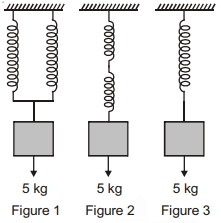
- A
$\frac{1}{6} \,m, \frac{2}{3} \,m, \frac{1}{3} \,m$
- B
$\frac{1}{3} \,m, \frac{1}{3} \,m, \frac{1}{3} \,m$
- C
$\frac{2}{3} \,m, \frac{1}{3} \,m, \frac{1}{6} \,m$
- ✓
$\frac{1}{3} \,m, \frac{4}{3} \,m, \frac{2}{3} \,m$
AnswerCorrect option: D. $\frac{1}{3} \,m, \frac{4}{3} \,m, \frac{2}{3} \,m$
d
(d)
$k=73.5 \,Nm ^{-1} \quad \text { Force }=5 \times 9.8$
In figure $(1)$
$5 \times 9.8=(2 k) x_1$
$\therefore x_1=\frac{5 \times 9.8}{2 \times 73.5}=\frac{1}{3}$
In figure $(2)$
$5 \times 9.8=\frac{k \times k}{k+k} \times x_2$
or $5 \times 9.8=\frac{k}{2} \times x_2$
$x_2=\frac{98}{73.5}=\frac{4}{3}$
In figure $(3)$
$5 \times 9.8=k x_3$
$x_3=\frac{5 \times 9.8}{73.5}=\frac{2}{3}$
View full question & answer→MCQ 2111 Mark
Two masses $m_1=1 \,kg$ and $m_2=0.5 \,kg$ are suspended together by a massless spring of spring constant $12.5 \,Nm ^{-1}$. When masses are in equilibrium $m_1$ is removed without disturbing the system. New amplitude of oscillation will be .......... $cm$
Answerc
(c)
Points of equilibrium of the spring will be when no force acts on it.
$k x=\left(m_1+m_2\right) g$
$x=\frac{\left(m_1+m_2\right) g}{k}$
The new equilibrium position which will be the mean position of $S.H.M.$ will be simply $\frac{m_2 g}{k}$
New amplitude will be maximum displacement from $\frac{m_2 g}{k}$ which is :
$A=\frac{\left(m_1+m_2\right) g}{k}-\frac{m_2 g}{k}$
or $A=\frac{m_1 g}{k}$
or $A=\frac{1 \times 10}{12.5}$
or $A=\frac{4}{5} \,m$
$\therefore A=0.8 \,m$ or $80 \,cm$
View full question & answer→MCQ 2121 Mark
A block of mass $m$ hangs from three springs having same spring constant $k$. If the mass is slightly displaced downwards, the time period of oscillation will be
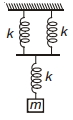
- A
$2 \pi \sqrt{\frac{m}{3 k}}$
- ✓
$2 \pi \sqrt{\frac{3 m}{2 k}}$
- C
$2 \pi \sqrt{\frac{2 m}{3 k}}$
- D
$2 \pi \sqrt{\frac{3 k}{m}}$
AnswerCorrect option: B. $2 \pi \sqrt{\frac{3 m}{2 k}}$
b
(b)
The first two springs are in parallel.
So, $k_{ eq }$ of $1^{\text {st }} 2$ will be $=2 k$
Then it becomes
The springs $2 k$ and $k$ are in series.
$\text { So, }$ $k_{ eq }=\frac{2 k \times k}{2 k+k}$
$=\frac{2 k \times k}{3 k}=\frac{2}{3} k$
$T=2 \pi \sqrt{\frac{m}{k_{e q}}}$
$\Rightarrow T=2 \pi \sqrt{\frac{3 m}{2 k}}$
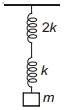
View full question & answer→MCQ 2131 Mark
A clock $S$ is based on oscillations of a spring and a clock $P$ is based on pendulum motion. Both clocks run at the same rate on earth. On a planet having same density as earth but twice the radius then
AnswerCorrect option: B. $P$ will fun faster than $S$
b
(b)
Time period of spring $=2 \pi \sqrt{\frac{k}{m}}$
Time period of pendulum $=2 \pi \sqrt{\frac{l}{g}}$
Time period of spring will not be affected by gravitational acceleration.
Let mass of earth be $m$
Mass of new planet $=\rho \times \frac{4}{3} \pi(2 R)^3=8 m$
$g_2=\frac{G M_2}{\left(R_2\right)^2}=\frac{G \times 8 M}{(2 R)^2}=2 g$
$T_2=2 \pi \sqrt{\frac{I}{2 g}}$
$T_2=\frac{T}{\sqrt{2}}$
Hence $P$ will move faster.
View full question & answer→MCQ 2141 Mark
A $100 \,g$ mass stretches a particular spring by $9.8 \,cm$, when suspended vertically from it. ....... $g$ large a mass must be attached to the spring if the period of vibration is to be $6.28 \,s$.
- A
$1000$
- B
$10^5$
- C
$10^7$
- ✓
$10^4$
AnswerCorrect option: D. $10^4$
d
(d)
At point of equilibrium $k x=m g$
$k \times 9.8 \times 10^{-2}=100 \times 10^{-3} \times 9.8$
$k=100 \times 10^{-1}$
$k=10 \,N / m$
Period of vibration needed $=6.28 \,s$
$T=2 \pi \sqrt{\frac{m}{k}}$
$6.28=2 \times 3.14 \sqrt{\frac{m}{10}}$
$1=\frac{m}{10}$
$m=10 \,kg$ or $10^4 \,g$
View full question & answer→MCQ 2151 Mark
An assembly of identical spring-mass systems is placed on a smooth horizontal surface as shown. At this instant, the springs are relaxed. The left mass is displaced to the/left and theiright mass is displaced to the right by same distance and released. The resulting collision is elastic. The time period of the oscillations of system is
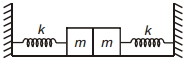
- A
$2 \pi \sqrt{\frac{2 m}{k}}$
- B
$2 \pi \sqrt{\frac{m}{2 k}}$
- ✓
$\pi \sqrt{\frac{m}{k}}$
- D
$2 \pi \sqrt{\frac{m}{k}}$
AnswerCorrect option: C. $\pi \sqrt{\frac{m}{k}}$
c
(c)
If there was no collision each spring will oscillate with period
$T=2 \pi \sqrt{\frac{m}{k}}$
Because of collisions the springs are only compressed but cannot extend beyond their natural length. Hence the perform only half oscillation.
Hence $\quad T=2 \pi \sqrt{\frac{m}{k}} \div 2$
or $T=\pi \sqrt{\frac{m}{k}}$
View full question & answer→MCQ 2161 Mark
When a mass $m$ is attached to a spring it oscillates with period $4 \,s$. When an additional mass of $2 \,kg$ is attached to a spring, time period increases by $1 \,s$. The value of $m$ is ........... $kg$
Answerb
(b)
$\omega_1=\sqrt{\frac{k}{m}}$
$\omega_2=\sqrt{\frac{k}{m+2}}$
$\frac{\omega_1}{\omega_2}=\sqrt{\frac{m+2}{m}}$
Since $\omega=\frac{2 \pi}{T}$
$\frac{T_2}{T_1}=\sqrt{\frac{m+2}{m}}$
$\left(\frac{5}{4}\right)^2=\frac{m+2}{m}$
$\frac{25}{16}=\frac{m+2}{m}$
$25 \,m=16 \,m+32$
$9 \,m=32$
$m=3 \frac{5}{9} \,kg$
$m=3.5 \,kg$
View full question & answer→MCQ 2171 Mark
In the figure shown, there is friction between the blocks $P$ and $Q$ but the contact between the block $Q$ and lower surface is frictionless. Initially the block $Q$ with block $P$ over it lies at $x=0$, with spring at its natural length. The block $Q$ is pulled to right and then released. As the spring - blocks system undergoes $S.H.M.$ with amplitude $A$, the block $P$ tends to slip over $Q . P$ is more likely to slip at
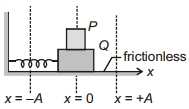
- A
$x=0$
- ✓
$x=+A$
- C
$x=+\frac{A}{2}$
- D
$x=+\frac{A}{\sqrt{2}}$
AnswerCorrect option: B. $x=+A$
b
(b)
The block is most likely to slip when there is maximum acceleration.
This happens when the blocks are at the extremities where the displacement is either $+A$ or $-A$.
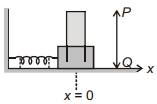
View full question & answer→MCQ 2181 Mark
A $1\,kg$ mass is attached to a spring of force constant $600\,N / m$ and rests on a smooth horizontal surface with other end of the spring tied to wall as shown in figure. A second mass of $0.5\,kg$ slides along the surface towards the first at $3\,m / s$. If the masses make a perfectly inelastic collision, then find amplitude and time period of oscillation of combined mass.
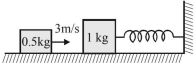
- ✓
$5\,cm , \frac{\pi}{10}\, s$
- B
$5\, cm , \frac{\pi}{5}\,s$
- C
$4\,cm , \frac{2 \pi}{5}\,s$
- D
$4\,cm , \pi / 3\,s$
AnswerCorrect option: A. $5\,cm , \frac{\pi}{10}\, s$
a
(a)
Applying linear momentum conservation,
$0.5 \times 3=(1+0.5) v \text { or } v =1 m / s$
By conversation of energy,
After collision
$\frac{1}{2}(1+0.5) v ^2=\frac{1}{2} kA ^2$
$\Rightarrow A =\sqrt{\frac{1.5}{ k }} \times v$
$\Rightarrow A =\sqrt{\frac{1.5}{600}} \times 1=\frac{1}{20} m =0.05 m$
$A =5 cm$
Time period of oscillation,
$T =2 \pi \sqrt{\frac{ m _1+ m _2}{ k }}=2 \pi \sqrt{\frac{1.5}{600}}=\frac{2 \pi}{20}=\frac{\pi}{10} s$
View full question & answer→MCQ 2191 Mark
A mass $m$ is suspended from a spring of force constant $k$ and just touches another identical spring fixed to the floor as shown in the figure. The time period of small oscillations is
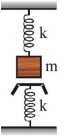
- A
$2 \pi \sqrt{\frac{ m }{ k }}$
- B
$\pi \sqrt{\frac{ m }{ k }}+\pi \sqrt{\frac{ m }{ k / 2}}$
- C
$\pi \sqrt{\frac{ m }{3 k / 2}}$
- ✓
$\pi \sqrt{\frac{ m }{ k }}+\pi \sqrt{\frac{ m }{2 k }}$
AnswerCorrect option: D. $\pi \sqrt{\frac{ m }{ k }}+\pi \sqrt{\frac{ m }{2 k }}$
d
(d)
When the spring undergoes displacement in the downward direction it completes one half oscillation while it completes another half oscillation in the upward direction. The total time period is:
$T =\pi \sqrt{\frac{ m }{ k }}+\pi \sqrt{\frac{ m }{2 k }}$
View full question & answer→MCQ 2201 Mark
Two oscillating systems; a simple pendulum and a vertical spring-mass-system have same time period of motion on the surface of the Earth. If both are taken to the moon, then-
- ✓
Time period of the simple pendulum will be more than that of the spring-mass system.
- B
Time period of the simple pendulum will be equal is that is of the spring-mass system.
- C
Time period of the simple pendulum will be less than of the spring-mass system.
- D
Nothing can be said definitely without observation.
AnswerCorrect option: A. Time period of the simple pendulum will be more than that of the spring-mass system.
a
(a)
For simple pendulum: $T =2 \pi \sqrt{\frac{\ell}{ g }}$ As g will decrease on moon, time period will increase
For spring mass system : $T=2 \pi \sqrt{\frac{m}{k}}$
It will not change and remains the same
View full question & answer→MCQ 2211 Mark
A simple pendulum is made of a body which is a hollow sphere containing mercury suspended by means of a wire. If a little mercury is drained off, the period of pendulum will
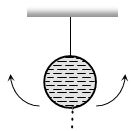
Answerb
(b)When a little mercury is drained off, the position of c.g. of ball falls (w.r.t. fixed and) so that effective length of pendulum increases hence T increase.
View full question & answer→MCQ 2221 Mark
A simple pendulum is set up in a trolley which moves to the right with an acceleration a on a horizontal plane. Then the thread of the pendulum in the mean position makes an angle $\theta $ with the vertical
- A
${\tan ^{ - 1}}\frac{a}{g}$ in the forward direction
- ✓
${\tan ^{ - 1}}\frac{a}{g}$ in the backward direction
- C
${\tan ^{ - 1}}\frac{g}{a}$ in the backward direction
- D
${\tan ^{ - 1}}\frac{g}{a}$ in the forward direction
AnswerCorrect option: B. ${\tan ^{ - 1}}\frac{a}{g}$ in the backward direction
b
(b)In accelerated frame of reference, a fictitious force (pseudo force) ma acts on the bob of pendulum as shown in figure.
Hence, $\tan \theta = \frac{{ma}}{{mg}} = \frac{a}{g}$
$ \Rightarrow \theta = {\tan ^{ - 1}}\left( {\frac{a}{g}} \right)$ in the backward direction.
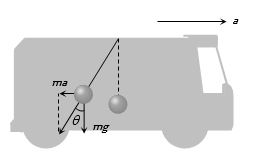
View full question & answer→MCQ 2231 Mark
A pendulum bob has a speed of $3\, m/s$ at its lowest position. The pendulum is $0.5\, m$ long. The speed of the bob, when the length makes an angle of ${60^o}$ to the vertical, will be ..... $m/s$ (If $g = 10\,m/{s^2}$)
Answerd
(d) Let bob velocity be $v$ at point $B$ where it makes an angle of $60^o$ with the vertical, then using conservation of mechanical energy
$K{E_A} + P{E_A} = K{E_B} + P{E_B}$
==> $\frac{1}{2}m \times {3^2} = \frac{1}{2}m{v^2} + mgl(1 - \cos \theta )$
$⇒ 9 = {v^2} + 2 \times 10 \times 0.5 \times \frac{1}{2} $
$⇒ v = 2\,m/s$
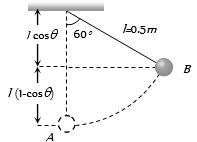
View full question & answer→MCQ 2241 Mark
If the length of simple pendulum is increased by $300\%$, then the time period will be increased by ..... $\%$
Answera
(a) $\frac{{{T_1}}}{{{T_2}}} = \sqrt {\frac{{{l_1}}}{{{l_2}}}} $
$\Rightarrow \frac{{{T_1}}}{{{T_2}}} = \sqrt {\frac{{100}}{{400}}} $ (If ${l_1} = 100$ then ${l_2} = 400$)
$ \Rightarrow {T_2} = 2{T_1}$
Hence $\%$ increase $ = \frac{{{T_2} - {T_1}}}{{{T_1}}} \times 100 = 100\% $
View full question & answer→MCQ 2251 Mark
If the length of the simple pendulum is increased by $44\%$, then what is the change in time period of pendulum ..... $\%$
Answerb
(b) $T = 2\,\pi \sqrt {\frac{l}{g}} $
$ \Rightarrow \frac{{{T_2}}}{{{T_1}}} = \sqrt {\frac{{{l_2}}}{{{l_1}}}} $
$ = \sqrt {\frac{{144}}{{100}}} = \frac{{12}}{{10}}$
==> $T_2 = 1.2\, T_1$
Hence $\%$ increase $ = \frac{{{T_2} - {T_1}}}{{{T_1}}} \times 100 = 20\% $
View full question & answer→MCQ 2261 Mark
A pendulum of length $2\,m$ lift at $P$. When it reaches $Q$, it losses $10\%$ of its total energy due to air resistance. The velocity at $Q$ is .... $m/sec$
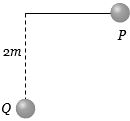
Answera
(a) If $v$ is velocity of pendulum at $Q$
and $10\%$ energy is lost while moving from $P$ to $Q$
Hence, by applying conservation of between $P$ and $Q$
$\frac{1}{2}m{v^2} = 0.9\,(mgh)$
==>${v^2} = 2 \times 0.9 \times 10 \times 2$
==> $v = 6\,m/sec$
View full question & answer→MCQ 2271 Mark
The period of a simple pendulum measured inside a stationary lift is found to be $T$. If the lift starts accelerating upwards with acceleration of $g/3,$ then the time period of the pendulum is
- A
$\frac{T}{{\sqrt 3 }}$
- B
$\frac{T}{3}$
- ✓
$\frac{{\sqrt 3 }}{2}T$
- D
$\sqrt 3 \,T$
AnswerCorrect option: C. $\frac{{\sqrt 3 }}{2}T$
c
(c) For stationary lift ${T_1} = 2\pi \sqrt {\frac{l}{g}} $
For ascending lift with acceleration a, ${T_2} = 2\pi \sqrt {\frac{l}{{g + a}}} $
$ \Rightarrow \frac{{{T_1}}}{{{T_2}}} = \sqrt {\frac{{g + a}}{g}} $
$\Rightarrow \frac{{{T_1}}}{{{T_2}}} = \sqrt {\frac{{g + \frac{g}{3}}}{g}} = \sqrt {\frac{4}{3}}$
$\Rightarrow {T_2} = \frac{{\sqrt 3 }}{2}T$
View full question & answer→MCQ 2281 Mark
Length of a simple pendulum is $l$ and its maximum angular displacement is $\theta$, then its maximum $K.E.$ is
- A
$mgl\sin \theta $
- B
$mgl(1 + \sin \theta )$
- C
$mgl(1 + \cos \theta )$
- ✓
$mgl(1 - \cos \theta )$
AnswerCorrect option: D. $mgl(1 - \cos \theta )$
d
(d) Kinetic energy will be maximum at mean position.
From law of conservation of energy maximum kinetic energy at mean position = Potential energy at displaced position
==> ${K_{\max }} = mgh = mgl(1 - \cos \theta )$
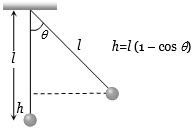
View full question & answer→MCQ 2291 Mark
The time period of a simple pendulum of length $L$ as measured in an elevator descending with acceleration $\frac{g}{3}$ is
- A
$2\pi \sqrt {\frac{{3L}}{g}} $
- B
$\pi \sqrt {\left( {\frac{{3L}}{g}} \right)} $
- ✓
$2\pi \sqrt {\left( {\frac{{3L}}{{2g}}} \right)} $
- D
$2\pi \sqrt {\frac{{2L}}{{3g}}} $
AnswerCorrect option: C. $2\pi \sqrt {\left( {\frac{{3L}}{{2g}}} \right)} $
c
(c)The effective acceleration in a lift descending with acceleration $\frac{g}{3}$ is ${g_{eff}} = g - \frac{g}{3} = \frac{{2g}}{3}$
$T = 2\pi \sqrt {\left( {\frac{L}{{{g_{eff}}}}} \right)} $$ = 2\pi \sqrt {\left( {\frac{L}{{2g/3}}} \right)} $$ = 2\pi \sqrt {\left( {\frac{{3L}}{{2g}}} \right)} $
View full question & answer→MCQ 2301 Mark
Two simple pendulums whose lengths are $100 cm$ and $121 cm$ are suspended side by side. Their bobs are pulled together and then released. After how many minimum oscillations of the longer pendulum, will the two be in phase again
Answerb
(b) Let ${T_1}$ and ${T_2}$ are the time period of the two pendulums ${T_1} = 2\pi \sqrt {\frac{{100}}{g}} $ and ${T_2} = 2\pi \sqrt {\frac{{121}}{g}} $
$({T_1} < {T_2}$ because ${l_1} < {l_2})$.
Let at $t = 0$, they start swinging together. Since their time periods are different, the swinging will not be in unision always.
Only when number of completed oscillation differs by an integer, the two pendulum will again begin to swing together.
Let longer length pendulum complete $n$ oscillation and shorter length pendulum complete $(n+1)$ oscillation, for the unision swinging, then $(n + 1){T_1} = n{T_2}$
$(n + 1) \times 2\pi \sqrt {\frac{{100}}{g}} = n \times 2\pi \sqrt {\frac{{121}}{g}} $$ \Rightarrow n = 10$
View full question & answer→MCQ 2311 Mark
A uniform rod of length $2.0 \,m$ is suspended through an end and is set into oscillation with small amplitude under gravity. The time period of oscillation is approximately .... $\sec$
- A
$1.60$
- B
$1.80$
- C
$2$
- ✓
$2.40$
AnswerCorrect option: D. $2.40$
d
(d)This is the special case of physical pendulum and in this case $T = 2\pi \sqrt {\frac{{2l}}{{3g}}} $
$ \Rightarrow $ $T = 2 \times 3.14\sqrt {\frac{{2 \times 2}}{{3 \times 9.8}}} = 2.31\sec \approx 2.4\sec $
View full question & answer→MCQ 2321 Mark
The period of a simple pendulum, whose bob is a hollow metallic sphere, is $T$.The period is $T_1$ when the bob is filled with sand, $T_2$ when it is filled with mercury and $T_3$ when it is half filled with mercury. Which of the following is true
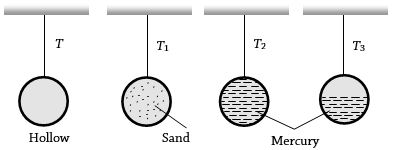
- A
$T = T_1 = T_2 > T_3$
- B
$T_1 = T_1 = T_3 > T$
- C
$T > T_3 > T_1 = T_2$
- ✓
$T = T_1 = T_2 < T_3$
AnswerCorrect option: D. $T = T_1 = T_2 < T_3$
d
(d) Time period of pendulum doesn’t depends upon mass but it depends upon length (distance between point of suspension and centre of mass).
In first three cases length are same so $T = {T_1} = {T_2}$ but in last case centre of mass lowers which in turn increases the length. So in this case time period will be more than the other cases.
View full question & answer→MCQ 2331 Mark
A pendulum clock that keeps correct time on the earth is taken to the moon it will run (it is given that $g_{Moon} = g_{Earth}/6$ )
- A
- B
$6$ time faster
- C
$\sqrt 6 $ times faster
- ✓
$\sqrt 6 $ times slowly
AnswerCorrect option: D. $\sqrt 6 $ times slowly
d
(d) $T = 2\pi \sqrt {\frac{l}{g}} $==>$\frac{{{T_e}}}{{{T_m}}} = \sqrt {\frac{{{g_m}}}{{{g_e}}}} = \sqrt {\frac{{{g_e}/6}}{{{g_e}}}} = \frac{1}{{\sqrt 6 }}$
$ \Rightarrow $ ${T_m} = \sqrt 6 {T_e}$ i.e. clock becomes slower.
View full question & answer→MCQ 2341 Mark
Two simple pendulums of lengths $1.44 \,m$ and $1\, m$ start swinging together. After how many vibrations will they again start swinging together
- A
$5$ oscillations of smaller pendulum
- ✓
$6$ oscillations of smaller pendulum
- C
$4$ oscillations of bigger pendulum
- D
$6$ oscillations of bigger pendulum
AnswerCorrect option: B. $6$ oscillations of smaller pendulum
b
(b) $n \propto \frac{1}{{\sqrt l }}$==> $\frac{{{n_2}}}{{{n_1}}}$$ = \sqrt {\frac{{1.44}}{1}} = \frac{{1.2}}{1}$==> ${n_2} = 1.2\,{n_1}$
For $n2$ be integer minimum value of $n1$ should be $5$ and then $n2 = 6$ i.e., after $6 $ oscillations of smaller pendulum both will be in phase.
View full question & answer→MCQ 2351 Mark
On a planet a freely falling body takes $2 \,sec$ when it is dropped from a height of $8 \,m$, the time period of simple pendulum of length $1\, m$ on that planet is ..... $\sec$
AnswerCorrect option: A. $3.14 $
a
(a) On a planet, if a body dropped initial velocity $(u = 0)$ from a height h and takes time t to reach the ground then $h = \frac{1}{2}{g_P}{t^2}$
$ \Rightarrow {g_P} = \frac{{2\,h}}{{{t^2}}} = \frac{{2 \times 8}}{4} = 4\,m/{s^2}$
Using $T = 2\pi \sqrt {\frac{l}{g}} $ ==> $T = 2\,\pi \sqrt {\frac{1}{4}} = \pi = 3.14\,$sec.
View full question & answer→MCQ 2361 Mark
If a simple pendulum is taken to place where g decreases by $2\%$, then the time period
- A
Decreases by $1\%$
- B
Decreases by $2\%$
- C
Increases by $2\%$
- ✓
Increases by $1\%$
AnswerCorrect option: D. Increases by $1\%$
d
(d) $T = 2\pi \sqrt {\frac{l}{g}} $ ==> $T \propto \frac{l}{{\sqrt g }}$
$ \Rightarrow \frac{{\Delta T}}{T} \times 100 = - \frac{1}{2}\left( {\frac{{\Delta g}}{g}} \right) \times 100$$ = - \frac{1}{2}( - \,2\% ) = 1\% .$
View full question & answer→MCQ 2371 Mark
A mass at the end of a spring executes harmonic motion about an equilibrium position with an amplitude $A.$ Its speed as it passes through the equilibrium position is $V.$ If extended $2A$ and released, the speed of the mass passing through the equilibrium position will be
- ✓
$2V$
- B
$4V$
- C
$\frac{V}{2}$
- D
$\frac{V}{4}$
Answera
At equilibrium position the speed of a pendulum is equal to $A \omega$. If we double the amplitude, the speed will also double. so the correct option is $'A'$
View full question & answer→MCQ 2381 Mark
A simple pendulum with length $L$ and mass $m$ of the bob is vibrating with an amplitude $A$. The maximum tension in the string is
- A
$mg$
- ✓
$mg\left[ {1 + {{\left( {\frac{A}{L}} \right)}^2}} \right]$
- C
$mg\left[ {1 + {{\left( {\frac{A}{2L}} \right)}^2}} \right]$
- D
$mg\left[ {1 - {{\left( {\frac{3A}{L}} \right)}^2}} \right]$
AnswerCorrect option: B. $mg\left[ {1 + {{\left( {\frac{A}{L}} \right)}^2}} \right]$
b
$\mathrm{T}_{\max }-\mathrm{mg}=\frac{\mathrm{mv}^{2}}{\mathrm{L}}$
$\mathrm{T}_{\max }=\mathrm{mg}+\frac{\mathrm{m}(\mathrm{A} \omega)^{2}}{\mathrm{L}^{2}}$
$=m g+\frac{m}{L} A^{2} \frac{g}{L}=m g\left[1+\frac{A^{2}}{L^{2}}\right]$
View full question & answer→MCQ 2391 Mark
Identify the correct statement
AnswerCorrect option: D. The fractional change in the time period of a pendulum on changing the temperature is independent of the length of the pendulum
d
$\mathrm{T}=2 \pi \sqrt{\frac{\ell}{\mathrm{g}}}$
$\mathrm{T}=2 \pi \sqrt{\frac{\ell_{0}(1+\alpha)}{\mathrm{g}}}$
Increase in temperature
$\frac{\Delta \mathrm{T}}{\mathrm{T}}=\frac{1^{1}}{2} \frac{\Delta \theta}{\theta}$ this has no term of lengths
View full question & answer→MCQ 2401 Mark
A pendulum is suspended in a lift and its period of oscillation when the lift is stationary is $T_0$. What must be the acceleration of the lift for the period of oscillation of the pendulum to be $T_0/2$ ?
- A
$2g$ downward
- B
$2g$ upward
- C
$3g$ downward
- ✓
$3g$ upward
AnswerCorrect option: D. $3g$ upward
d
$\mathrm{T}_{0}=2 \pi \sqrt{\frac{\ell}{\mathrm{g}}}$
$\frac{\mathrm{T}_{0}}{2}=2 \pi \sqrt{\frac{\ell}{\mathrm{g}+\mathrm{a}}}$
$\frac{2 \pi \sqrt{\frac{\ell}{\mathrm{g}}}}{2}=2 \pi \sqrt{\frac{\ell}{\mathrm{g}+\mathrm{a}}}$
$\frac{1}{4 g}=\frac{1}{g+a}$
$g+a=4 g$
$a=3 g$ upward
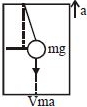
View full question & answer→MCQ 2411 Mark
The graph in figure represents
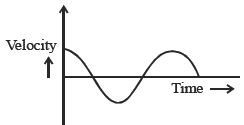
AnswerCorrect option: A. Motion of a simple pendulum starting from mean position
View full question & answer→MCQ 2421 Mark
A lift is descending with acceleration $g/3$ . What will be the time period of a simple pendulum suspended from its ceiling if its time period in staionary life is $'T'$ ?
AnswerCorrect option: B. $\sqrt {\frac{3}{2}} T$
b
$g_{e f f}=g-\frac{g}{3}=\frac{2 g}{3}$
$\mathrm{T}^{\prime}=2 \pi \sqrt{\frac{\ell}{\mathrm{g}_{\mathrm{eff}}}}=2 \pi \sqrt{\frac{\ell}{2 \mathrm{g} / 3}}=2 \pi \sqrt{\frac{3 \ell}{2 \mathrm{g}}}$
$\mathrm{T}^{\prime}=\sqrt{\frac{3}{2}} \mathrm{T}$
View full question & answer→MCQ 2431 Mark
A simple pendulum of frequency $f$ has a metal bob. If bob is charged negatively and is allowed to oscillate with large positive charged plate under it, frequency will be
- A
same as $f$
- B
less than $f$
- ✓
more than $f$
- D
AnswerCorrect option: C. more than $f$
c
$g$ effective will increase due to attraction from the plate
View full question & answer→MCQ 2441 Mark
If pendulum is released from given position find velocity of Bob when it reaches the lowest position
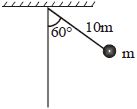
Answerd
$V\, = \,\sqrt {2gl\,(1\, - \,\cos \,\theta )} $
View full question & answer→MCQ 2451 Mark
Two pendulums begins to swing simultaneously. The first pendulum makes $11$ full oscillations when the other makes $9$. The ratio of length of the two pendulums is
- A
$11/9$
- B
$9/11$
- ✓
$81/121$
- D
$121/84$
AnswerCorrect option: C. $81/121$
c
$11 \times 2 \pi \sqrt{\frac{\ell_{s}}{g}}=9 \times 2 \pi \sqrt{\frac{\ell_{\ell}}{g}}$
$121 C_{3}=81 \ell_{\ell}$
$\frac{\ell_{s}}{\ell_{\ell}}=\frac{81}{121}$
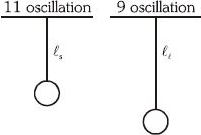
View full question & answer→MCQ 2461 Mark
A heavy small-sized sphere is suspended by a string of length $l$. The sphere rotates uniformly in a horizontal circle with the string making an angle $\theta $ with the vertical. Then the time period of this conical pendulum is
- A
$t = 2\pi \sqrt {\frac{l}{g}} $
- B
$t = 2\pi \sqrt {\frac{{l\,\sin \,\theta }}{g}} $
- ✓
$t = 2\pi \sqrt {\frac{{l\,\cos \,\theta }}{g}} $
- D
$t = 2\pi \sqrt {\frac{l}{{g\,\cos \,\theta }}} $
AnswerCorrect option: C. $t = 2\pi \sqrt {\frac{{l\,\cos \,\theta }}{g}} $
c
Radius of circular path in the horizontal plane
$\mathrm{r}=l \sin \theta$
Forces acting on the bob are.
$(i)$ $\mathrm{T}=$ tension in the string
$(ii)$ $\mathrm{Mg}=$ weight of the bob
Resolving $T$ along the vertical and horizontal
direction, we get
${\mathrm{T} \cos \theta=\mathrm{Mg}}$ $...(1)$
${\mathrm{T} \sin \theta=\mathrm{Mr} \omega^{2}=\mathrm{M}(l \sin \theta) \omega^{2}}$
or ${\mathrm{T}=\mathrm{M} l \omega^{2}}$ $...(2)$
Dividing eq. $(2)$ by eq. $(1)$, we get
$\frac{1}{\cos \theta}=\frac{l \omega^{2}}{g}$
$\mathbf{o r}$ $\omega^{2}=\frac{g}{l \cos \theta}$
$\text { time period } \quad \mathrm{t}=\frac{2 \pi}{\omega}=2 \pi \sqrt{\frac{l \cos \theta}{\mathrm{g}}}$
View full question & answer→MCQ 2471 Mark
Two simple pendulum whose lengths are $1\,m$ and $121\, cm$ are suspended side by side. Their bobs are pulled together and then released. After how many minimum oscillations of the longer pendulum will the two be in phase again
Answerb
$\mathrm{N} \sqrt{\ell_{\ell}}=(\mathrm{N}+1) \sqrt{\ell_{\mathrm{s}}}$
$\Rightarrow \mathrm{N} \sqrt{121}=(\mathrm{N}+1) \sqrt{100}$
$\Rightarrow \mathrm{N}(11)+(\mathrm{N}+1) 10$
$\Rightarrow 11 \mathrm{N}=10 \mathrm{N}+10$
$\Rightarrow \mathrm{N}=10$
View full question & answer→MCQ 2481 Mark
The length of simple pendulum is increased by $44\%$. The percentage increase in its time period will be ..... $\%$
Answerc
$\frac{\mathrm{T}_{1}}{\mathrm{T}_{2}}=\sqrt{\frac{\mathrm{L}_{1}}{\mathrm{L}_{2}}}$
$\Rightarrow \frac{\mathrm{T}}{\mathrm{T}_{2}}=\sqrt{\frac{\mathrm{L}}{1.44 \mathrm{L}}}=\frac{10}{12}$
$\Rightarrow \mathrm{T}_{2}=1.2 \mathrm{T}$
$\Delta \mathrm{T}=0.2 \mathrm{T}$
$\Rightarrow \frac{\Delta \mathrm{T}}{\mathrm{T}} \times 100=20 \%$
View full question & answer→MCQ 2491 Mark
A simple pendulum with a metallic bob has a time period $T$. The bob is now immersed in a non-viscous liquid and oscillated. If the density of the liquid is $1 / 4$ that of metal, the time period of the same pendulum will be ...........
- A
$\frac{T}{\sqrt{3}}$
- ✓
$\frac{2 T}{\sqrt{3}}$
- C
$\frac{4}{3} T$
- D
$\frac{2}{3} T$
AnswerCorrect option: B. $\frac{2 T}{\sqrt{3}}$
b
(b)
Normal time period $T=2 \pi \sqrt{\frac{l}{g}}$
When immersed in a liquid. It experiences an upthrust.
Upthrust $=\frac{\rho}{4} \times$ volume $g$
Upward acceleration $=$ Upward force $/$ mass of ball $=\frac{g}{4}$
$T^{\prime}=2 \pi \sqrt{\frac{I}{g_{e f f}}}$
$g_{\text {eff }}=g-\frac{g}{4}=\frac{3}{4} g$
$T^{\prime}=2 \pi=\sqrt{\frac{1}{3 g} \times 4}=\frac{2 T}{\sqrt{3}}$
View full question & answer→MCQ 2501 Mark
The time period of oscillations of a simple pendulum is $1$ minute. If its length is increased by $44 \%$. then its new time period of oscillation will be ......... $s$
Answerd
(d)
Let initial length be $I_1$
Final length $I_2=I_1 \times \frac{144}{100}$
$T_1=2 \pi \sqrt{\frac{l_1}{g}}$
$T_2=2 \pi \sqrt{\frac{I_1}{g} \times \frac{144}{100}}$
or $T_2=1.2 T_1$
$T_1=60\,s$
So $T_2=72 \,s$
View full question & answer→MCQ 2511 Mark
If the length of a clock pendulum increases by $0.2 \%$ due to atmospheric temperature rise, then the loss in time of clock per day is ........... $s$
- ✓
$86.4$
- B
$43.2$
- C
$72.5$
- D
$32.5$
AnswerCorrect option: A. $86.4$
a
(a)
Time period $=2 \pi \sqrt{\frac{1}{g}}$
$T \propto \sqrt{I}$
$\frac{T^{\prime}}{T} \propto \sqrt{\frac{I^{\prime}}{I}}$
$T=T \sqrt{\frac{1+l \propto \Delta \theta}{I}}$
$T=T\left(1+\frac{1}{2} \propto \Delta \theta\right)[\alpha \Delta \theta=0.002]$
$\Delta T=T-T=\frac{1}{2} T \propto \Delta \theta=T \times 0.001$
Time lost in time $t$ is
$\Delta T=\frac{1}{2} \quad t=1 \text { day }=24 \times 3600 \,s =86400 \,s$
$\Delta T=\left(\frac{\Delta T}{T}\right) \times t$
$\Delta T=0.001 \times 86400$
$\Delta T=86.4 \,s$
View full question & answer→MCQ 2521 Mark
A solid cylinder of density $\rho_0$, cross-section area $A$ and length $l$ floats in a liquid of density $\rho\left( >\rho_0\right)$ with its axis vertical, as shown. If it is slightly displaced downward and released, the time period will be .......
- A
$2 \pi \sqrt{\frac{l}{g}}$
- ✓
$2 \pi \sqrt{\frac{\rho_0 l}{\rho g}}$
- C
$2 \pi \sqrt{\frac{\rho l}{\rho_0 g}}$
- D
$2 \pi \sqrt{\frac{l}{2 g}}$
AnswerCorrect option: B. $2 \pi \sqrt{\frac{\rho_0 l}{\rho g}}$
b
(b)
The time period of a floating uniform cylinder is simply given as $R=l$.
View full question & answer→MCQ 2531 Mark
Amplitude of a wave is represented by $A = \frac{c}{{a + b - c}}$ Then resonance will occur when
- A
$b = - c/2$
- ✓
$b = 0$ and $a = c$
- C
$b = - a/2$
- D
AnswerCorrect option: B. $b = 0$ and $a = c$
b
(b) $A = \frac{c}{{a + b - c}};$ when $b = 0$, $a = c$ amplitude
$A \to \infty $. This corresponds to resonance.
View full question & answer→MCQ 2541 Mark
The amplitude of vibration of a particle is given by ${a_m} = ({a_0})/(a{\omega ^2} - b\omega + c);$ where ${a_0},a,b$ and $c$ are positive. The condition for a single resonant frequency is
- ✓
${b^2} = 4ac$
- B
${b^2} > 4ac$
- C
${b^2} = 5ac$
- D
${b^2} = 7ac$
AnswerCorrect option: A. ${b^2} = 4ac$
a
(a) For resonance amplitude must be maximum which is possible only when the denominator of expression is zero i.e. $a{\omega ^2} - b\omega + c = 0$
$ \Rightarrow \omega = \frac{{ + b \pm \sqrt {{b^2} - 4ac} }}{{2a}}$
For a single resonant frequency, $b^2 = 4ac.$
View full question & answer→MCQ 2551 Mark
The amplitude of a damped oscillator becomes half in one minute. The amplitude after $3$ minute will be $\frac{1}{X}$ times the original, where $X$ is
- A
$2 \times 3$
- ✓
${2^3}$
- C
${3^2}$
- D
$3 \times {2^2}$
AnswerCorrect option: B. ${2^3}$
b
(b) Amplitude of damped oscillator $A = {A_0}{e^{ - \lambda t}};\;\lambda \; = $constant, $t = time$
For $t =1 min$. $\frac{{{A_0}}}{2} = {A_0}{e^{ - \lambda t}} \Rightarrow {e^\lambda } = 2$
For $t = 3 min$ $A = {A_0}{e^{ - \lambda \times 3}} = \frac{{{A_0}}}{{{{({e^\lambda })}^3}}} = \frac{{{A_0}}}{{{2^3}}}$ $ \Rightarrow X = {2^3}$
View full question & answer→MCQ 2561 Mark
A $3\ kg$ sphere dropped through air has a terminal speed of $25\ m/s$. (Assume that the drag force is $-bv$.) Now suppose the sphere is attached to a spring of force constant $k = 300\ N/m$, and that it oscillates with an initial amplitude of $20\ cm$. What is the angular frequencu of its damped $SHM$? ..... $rad/s$
- A
$9. 996$
- ✓
$9. 998$
- C
$10$
- D
$10.01$
AnswerCorrect option: B. $9. 998$
b
$m g=b \times 25$
$\frac{b}{m}=\frac{g}{25}$
$\omega=\sqrt{\frac{\mathrm{k}}{\mathrm{m}}-\frac{\mathrm{b}^{2}}{4 \mathrm{m}^{2}}}=\sqrt{\frac{300}{3}-\frac{1}{4} \times\left(\frac{10}{25}\right)^{2}}$
$=\sqrt{100-\frac{1}{25}}=10\left(1-\frac{1}{2} \times \frac{1}{2500}\right)$
$=9.998 \mathrm{rad} / \mathrm{s}$
View full question & answer→MCQ 2571 Mark
Two damped spring-mass oscillating systems have identical spring constants and decay times. However, system $A's$ mass $m_A$ is twice system $B's$ mass $m_B$ . How do their damping constants, $b$ , compare ?
AnswerCorrect option: D. ${b_A} = \frac{1}{2}{b_B}$
d
Damping coefficient $=2 \sqrt{\mathrm{km}}$
$=2 \mathrm{m} \omega$
$\alpha \mathrm{m}$
$\mathrm{m}_{\mathrm{A}}=\mathrm{m}$ $\mathrm{m}_{\mathrm{B}}=\frac{\mathrm{m}}{2}$
$\frac{b_{A}}{b_{B}}=\frac{1}{2}$
View full question & answer→MCQ 2581 Mark
Which of the diagrams shown in figure represents variation of total mechanical energy of a pendulum oscillating in water as function of time ?
Answerc
$E = {E_0}{e^{ - \gamma t}}$
View full question & answer→MCQ 2591 Mark
A spring mass system executes damped harmonic oscillations given by the equation
$y = A{e^{ - \frac{{bt}}{{2m}}}}\sin (\omega 't + \phi )$
where the symbols have their usual meanings. If a $2\ kg$ mass $(m)$ is attached to a spring of force constant $(K)$ $1250\ N/m$ , the period of the oscillation is $\left( {\pi /12} \right)s$ . The damping constant $‘b’$ has the value. ..... $kg/s$
Answerd
$\omega^{\prime}=\sqrt{\frac{\mathrm{K}}{\mathrm{m}}-\frac{\mathrm{b}^{2}}{4 \mathrm{m}^{2}}}$ and $\omega^{\prime}=\frac{2 \pi}{\mathrm{T}}$
View full question & answer→MCQ 2601 Mark
The amplitude of a damped oscillator decreases to $0.9\,times$ its original magnitude in $5\,s.$ In another $10\,s$ it will decrease to $\alpha $ times its original magnitude, where $\alpha $ equals
- A
$0.7$
- B
$0.81$
- ✓
$0.73$
- D
$0.6$
AnswerCorrect option: C. $0.73$
c
$A=A_{0} e^{-h t}$
$0.9 A_{0}=A_{0} e^{-k t}$
$-k t=\ln (0.9) \Rightarrow-15 k=3 \ln (0.9)$
$A=A_{0} e^{-15 k}=A_{0} e^{-\ln (0.9)^{3}}$
$=(0.9)^{3} A_{0}=0.729 A_{0}$
Hence,
option $(C)$ is correct answer.
View full question & answer→MCQ 2611 Mark
A block of mass $200\, g$ executing $SHM$ under the influence of a spring of spring constant $K=90\, N\,m^{-1}$ and a damping constant $b=40\, g\,s^{-1}$. The time elapsed for its amplitude to drop to half of its initial value is ...... $s$ (Given $ln\,\frac{1}{2} = -0.693$)
Answera
$\mathrm{X}=\mathrm{X}_{0} \mathrm{e}^{-\left(\frac{\mathrm{b}}{2 \mathrm{m}}\right)t}$
$\Rightarrow \frac{\mathrm{X}_{0}}{2}=\mathrm{X}_{0} \mathrm{e}^{-\left(\frac{40}{2\times 200}\right)t}$
$\Rightarrow \frac{1}{2}=\mathrm{e}^{\frac{1}{10} \mathrm{t}}$
$\Rightarrow \log \left(\frac{1}{2}\right)=-\frac{1}{10} \mathrm{t} \Rightarrow \mathrm{t}=10 \times 0.693=7 \mathrm{s}$
View full question & answer→MCQ 2621 Mark
The amplitude of a damped oscillator becomes one third in $2\, sec$. If its amplitude after $6\, sec$ is $1/n$ times the original amplitude then the value of $n$ is
- A
$3^2$
- B
$3\sqrt 2 $
- C
$3\sqrt 3 $
- ✓
$3^3$
Answerd
since $A_{t}=A_{0} e^{\frac{-b t}{2 m}}$
When $t=2$ sec, $\quad \frac{A}{3}=A e^{\frac{-2 b}{2 m}}$
$\frac{1}{3}=e^{-b / m}$
When $t=6$ sec
$\frac{A_{0}}{n}=A_{0} e^{\frac{-6 b}{2 m}}$
$\frac{1}{n}=\left(e^{\frac{-b}{m}}\right)^{3}$
$\frac{1}{n}=\left(\frac{1}{3}\right)^{3}$
$n=3^{3}$
View full question & answer→MCQ 2631 Mark
In case of damped oscillation frequency of oscillation is ............
- A
Greater than natural frequency
- ✓
Less than natural frequency
- C
Equal to natural frequency
- D
Both $(a)$ and $(c)$
AnswerCorrect option: B. Less than natural frequency
b
(b)
The correct option is B less than natural frequency Angular frequency of damped oscillation
$\omega^{\prime}=\sqrt{\omega_0^2-\left(\frac{b}{2 m}\right)^2}$
$\Rightarrow \omega^{\prime} < \omega_0$
Where natural angular frequency $\omega_0=\sqrt{\frac{ k }{ m }}$
Since frequency and angular frequency are related as,
$\omega=2 \pi f$
Hence, frequency of damped oscillation is less than natural frequency.
View full question & answer→MCQ 2641 Mark
In damped oscillations, damping force is directly proportional to speed of oscillator. If amplitude becomes half of its maximum value in $1 \,s$, then after $2 \,s$ amplitude will be $\left(A_0-\right.$ initial amplitude)
- ✓
$\frac{1}{4} A_0$
- B
$\frac{1}{2} A_0$
- C
$A_0$
- D
$\frac{\sqrt{3} A_0}{2}$
AnswerCorrect option: A. $\frac{1}{4} A_0$
a
(a)
$A=A_0 e^{-b t}$
Amplitude becomes half hence
$\frac{A_0}{2} A_0 e^{-b t}[t=1]$
$\therefore e^{-b}=\frac{1}{2}$
$\therefore \text { In two seconds }$
$A=A_0\left(\frac{1}{2}\right)^2$
$A=\frac{A_0}{4}$
View full question & answer→MCQ 2651 Mark
The resultant of two rectangular simple harmonic motions of the same frequency and unequal amplitudes but differing in phase by $\frac{\pi }{2}$ is
Answerc
(c)If first equation is ${y_1} = {a_1}\sin \omega \,t$
==> $\sin \omega \,t = \frac{{{y_1}}}{{{a_1}}}$ ... (i)
then second equation will be ${y_2} = {a_2}\sin \left( {\omega \,t + \frac{\pi }{2}} \right)$
$ = {a_2}\,\left[ {\sin \omega \,t\cos \frac{\pi }{2} + \cos \omega \,t\sin \frac{\pi }{2}} \right] = {a_2}\cos \omega \,t$
==> $\cos \omega \,t = \frac{{{y_2}}}{{{a_2}}}$ ... (ii)
By squaring and adding equation (i) and (ii)
${\sin ^2}\omega \,t + {\cos ^2}\omega \,t = \frac{{y_1^2}}{{a_1^2}} + \frac{{y_2^2}}{{a_2^2}}$
==> $\frac{{y_1^2}}{{a_1^2}} + \frac{{y_2^2}}{{a_2^2}} = 1$; This is the equation of ellipse.
View full question & answer→MCQ 2661 Mark
Two mutually perpendicular simple harmonic vibrations have same amplitude, frequency and phase. When they superimpose, the resultant form of vibration will be
Answerc
(c) If ${y_1} = {a_1}\sin \omega \,t$ and ${y_2} = {a_2}\sin (\omega \,t + 0) = {a_2}\sin \omega \,t$
==> $\frac{{y_1^2}}{{a_1^2}} + \frac{{y_2^2}}{{a_2^2}} - \frac{{2{y_1}{y_2}}}{{{a_1}{a_2}}} = 0$
==> ${y_2} = \frac{{{a_2}}}{{{a_1}}}{y_1}$
This is the equation of straight line.
View full question & answer→MCQ 2671 Mark
A $S.H.M.$ is represented by $x = 5\sqrt 2 (\sin 2\pi t + \cos 2\pi t).$ The amplitude of the $S.H.M.$ is .... $cm$
- ✓
$10$
- B
$20$
- C
$5\sqrt 2 $
- D
$50$
Answera
(a) $x = 5\sqrt 2 \left( {\sin 2\pi \,t + \cos 2\pi \,t} \right)$
$ = 5\sqrt 2 \sin 2\pi \,t + 5\sqrt 2 \cos 2\pi \,t$
$x = 5\sqrt 2 \sin 2\pi t + 5\sqrt 2 \sin \,\left( {2\pi \,t + \frac{\pi }{2}} \right)$
Phase difference between constituent waves $\phi = \frac{\pi }{2}$
$\therefore $ Resultant amplitude $A = \sqrt {{{(5\sqrt 2 )}^2} + {{(5\sqrt 2 )}^2}} \,=10 \,cm.$
View full question & answer→MCQ 2681 Mark
Equations ${y_1} = A\sin \omega t$ and ${y_2} = \frac{A}{2}\sin \omega t + \frac{A}{2}\cos \omega t$ represent $S.H.M.$ The ratio of the amplitudes of the two motions is
- A
$1$
- B
$2$
- C
$0.5$
- ✓
$\sqrt 2 $
AnswerCorrect option: D. $\sqrt 2 $
d
(d) ${y_2} = \frac{A}{2}\sin \omega \,t + \frac{A}{2}\cos \omega \,t$
${y_2} = \frac{A}{2}(\sin \omega \,t + \cos \omega \,t) = \frac{A}{2} \times \sqrt 2 \;[\sin (\omega \,t + {45^o})]$
${y_2} = \frac{A}{{\sqrt 2 }}\sin (\omega \,t + {45^o})$$ \Rightarrow \frac{{{A_1}}}{{{A_2}}} = \frac{A}{{A/\sqrt 2 }} = \sqrt 2 $
View full question & answer→MCQ 2691 Mark
Two particles are in $SHM$ on same straight line with amplitude $A$ and $2A$ and with same angular frequency $\omega .$ It is observed that when first particle is at a distance $A/\sqrt{2}$ from origin and going toward mean position, other particle is at extreme position on other side of mean position. Find phase difference between the two particles
- A
$45^o$
- B
$90^o$
- ✓
$135^o$
- D
$180^o$
AnswerCorrect option: C. $135^o$
c
Consider $2$ circles with radii $A \& 2 A$ and particles moving on them with constant angular velocity $\omega$
Choose $x$ axis to be horizontal on which the projection of the particles are to be taken.
When the projection of the first particle is at a distance $A / \sqrt{2}$ from origin, it is at an angle $45^{0}$ in the first quadrant.
whereas the second particle is at an angle $180^{0}$.
i.e the phase difference is $135^{0}$
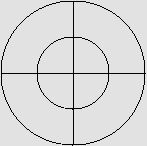
View full question & answer→MCQ 2701 Mark
Two particles are executing $SHM$ of the same amplitude $A$ and frequency $\omega $ along the $x-$ axis. Their mean position is separated by $X_0$ (where $X_0 > A$ ). If maximum separation between them is $X_0 + 2A$ , then the phase difference between their motion is
- A
$\frac {\pi}{2}$
- ✓
$\pi $
- C
$\frac {\pi}{3}$
- D
$\frac {\pi}{4}$
AnswerCorrect option: B. $\pi $
b
One of the particle will at positive extreme while other at negative extreme.
View full question & answer→MCQ 2711 Mark
The displacement of a particle varies according to the relation $x = 3 \ sin\ 100t + 8\ cos^2\ 50t$ . Which of the following is incorrect about this motion
- A
The motion of the particle is $S.H.M.$
- B
The amplitude of the $S.H.M.$ of the particle is $5\ units$
- ✓
The amplitude of the resultant $S.H. M.$ is $\sqrt {73} \ units$
- D
The maximum displacement of the particle from the origin is $9\ units$
AnswerCorrect option: C. The amplitude of the resultant $S.H. M.$ is $\sqrt {73} \ units$
c
$x=3 \sin 100 t+8 \cos ^{2} 50 t$
$=3 \sin 100 t+8\left(\frac{1+\cos 2 \theta}{2}\right)$
$=3 \sin 100 t+4 \cos 100 t+4$
$x=5 \sin (100 t)+4$
$\Rightarrow A=5,$ motion is $5.17 \mathrm{M}$
View full question & answer→MCQ 2721 Mark
The diagram shows two oscillations. What is the phase difference between the oscillations?
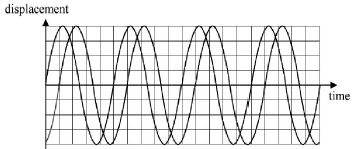
- A
$\frac{\pi}{5} rad$
- ✓
$\frac{2 \pi}{5} rad$
- C
$\frac{3 \pi}{5} rad$
- D
$\frac{4 \pi}{5} rad$
AnswerCorrect option: B. $\frac{2 \pi}{5} rad$
View full question & answer→MCQ 2731 Mark
The displacement of an oscillator is given by $x = a\, \sin \, \omega t + b\, \cos \, \omega t$. where $a, b$ and $\omega$ are constant. Then :-
- A
Motion is simple harmonic but not periodic
- B
Motion is periodic but not simple harmonic
- ✓
Motion is simple harmonic as well as periodic
- D
Motion is neither simple harmonic nor periodic
AnswerCorrect option: C. Motion is simple harmonic as well as periodic
c
$x=\sin \omega t+b \cos \omega t$
$\mathrm{x}=\sqrt{\mathrm{a}^{2}+\mathrm{b}^{2}}\left[\frac{\mathrm{a}}{\mathrm{a}^{2}+\mathrm{b}^{2}} \sin \omega \mathrm{t}+\frac{1}{\sqrt{\mathrm{a}^{2}+\mathrm{b}^{2}}} \cos \omega \mathrm{t}\right]$
$\mathrm{x}=\sqrt{\mathrm{a}^{2}+\mathrm{b}^{2}}[\cos \phi \sin \omega \mathrm{t}+\sin \phi \cos \omega \mathrm{t}]$
Let $\cos \phi=\frac{a}{\sqrt{a^{2}+b^{2}}}$
$\therefore \mathrm{x}_{2} \sqrt{\mathrm{a}^{2}+\mathrm{b}^{2}} \sin (\omega \mathrm{t}+\phi)$ this is condition of $SHM$
View full question & answer→MCQ 2741 Mark
Four simple harmonic vibrations:
${y_1} = 8\,\cos\, \omega t;\,{y_2} = 4\,\cos \,\left( {\omega t + \frac{\pi }{2}} \right)$ ;
${y_3} = 2\cos \,\left( {\omega t + \pi } \right);\,{y_4} = \,\cos \,\left( {\omega t + \frac{{3\pi }}{2}} \right)$ ,
are superposed on each other. The resulting amplitude and phase are respectively;
- ✓
$\sqrt {45} $ and ${\tan ^{ - 1}}(1/2)$
- B
$\sqrt {45} $ and ${\tan ^{ - 1}}(1/3)$
- C
$\sqrt {75} $ and ${\tan ^{ - 1}}(1/2)$
- D
$\sqrt {75} $ and ${\tan ^{ - 1}}(1/3)$
AnswerCorrect option: A. $\sqrt {45} $ and ${\tan ^{ - 1}}(1/2)$
a
$\cos \theta=\hat{i}$
$\sin \theta=\hat{j}$
Result at $=8 \hat{j}-4 \hat{i}-2 \hat{j}+i$
$=-3 \hat{i}+6 j$
Magnitude $=\sqrt{45}$
$\tan \theta=\frac{1}{2}$
$\theta=\tan ^{-1}\left(\frac{1}{2}\right)$
View full question & answer→MCQ 2751 Mark
A vibratory motion is represented by $x = 2A\,\cos \omega t + A\,\cos \,\left( {\omega t + \frac{\pi }{2}} \right) + A\,\cos \,\left( {\omega t + \pi } \right)$ $ + \frac{A}{2}\,\cos \left( {\omega t + \frac{{3\pi }}{2}} \right)$. The resultant amplitude of the motion is
- A
$\frac{{9A}}{2}$
- ✓
$\frac{{\sqrt 5 A}}{2}$
- C
$\frac{{5A}}{2}$
- D
$2A$
AnswerCorrect option: B. $\frac{{\sqrt 5 A}}{2}$
b
$\mathrm{x}=2 \mathrm{Acos} \omega \mathrm{t}+\mathrm{Acos}\left(\omega \mathrm{t}+\frac{\pi}{2}\right)+\mathrm{Acos}(\omega \mathrm{t}+\pi)+$
$\frac{\mathrm{A}}{2} \cos \left(\omega \mathrm{t}+\frac{3 \pi}{2}\right)$
$=2 \mathrm{Acos} \omega \mathrm{t}-\mathrm{A} \sin \omega \mathrm{t}-\mathrm{Acos} \omega \mathrm{t}+\frac{\mathrm{A}}{2} \mathrm{sin} \omega \mathrm{t}$
$=$ $Acos\omega t$ $-\frac{\mathrm{A}}{2} \mathrm{sin} \omega \mathrm{t}$
The amplitude of the resultant motion is
$A_{R}=\sqrt{(A)^{2}\left(-\frac{A}{2}\right)^{2}}=\frac{\sqrt{5} A}{2}$
View full question & answer→MCQ 2761 Mark
A function is represented by equation
$y = A\,\cos \,\omega t\,\cos \,2\omega t + A\,\sin \,\omega t\,\sin \,2\omega t$.
Than the nature of the function is
Answerc
$\begin{array}{l}
y = A\,\cos \,\omega t\,\cos \,2\omega t + A\,\sin \,\omega t\,\sin \,2\omega t\\
\,\,\,\,\, = A\,\cos \,\left( {2\omega t - \omega t} \right) = A\,\cos \,\omega t
\end{array}$
View full question & answer→MCQ 2771 Mark
On the superposition of two harmonic oscillations represented by ${x_1} = a\,\sin \,\left( {\omega t + {\phi _1}} \right)$ and ${x_2} = a\,\sin \,\left( {\omega t + {\phi _2}} \right)$ a resulting oscillation with the same time period and amplitude is obtained. The value of ${\phi _1} - {\phi _2}$ is .... $^o$
Answera
Resultant amplitude $=\sqrt{a_{1}^{2}+a_{2}^{2}+2 a_{1} a_{2} \cos \Delta \phi}$
$\Rightarrow \mathrm{a}^{2}=2 \mathrm{a}^{2}+2 \mathrm{a}^{2} \cos \left(\phi_{1}-\phi_{2}\right)$
$\Rightarrow \cos \left(\phi_{1}-\phi_{2}\right)=-\frac{1}{2}$
$\Rightarrow \phi_{1}-\phi_{2}=120^{\circ}$ or $\frac{2 \pi}{3} \mathrm{rad}$
View full question & answer→MCQ 2781 Mark
A vibratory motion is represented by $x = 2\,A\,\cos \,\omega t + A\,\cos \,\left( {\omega t + \frac{\pi }{2}} \right) + A\,\cos \,\left( {\omega t + \pi } \right) + \frac{A}{2}\,\cos \,\left( {\omega t + \frac{{3\pi }}{2}} \right)$ The resultant amplitude of motion is
AnswerCorrect option: B. $\frac{{\sqrt 5 \,A}}{2}$
b
which leads to
so resultant amplitude is
$=\sqrt{\frac{A^{2}}{4}+A^{2}}=\sqrt{\frac{5 A^{2}}{4}}=\frac{\sqrt{5} A}{2}$
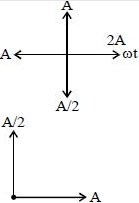
View full question & answer→MCQ 2791 Mark
Two pendulum have time periods $T$ and $5T/4$. They start $SHM$ at the same time from the mean position. After how many oscillations of the smaller pendulum they will be again in the same phase
Answera
$\mathrm{n}_{1} \mathrm{T}_{1}=(\mathrm{n}+1) \mathrm{T}_{2}$
$\mathrm{nT}=\frac{\Sigma \mathrm{T}}{4}(\mathrm{n}+1)$
$\mathrm{nT}=\frac{5 \mathrm{T}}{4} \mathrm{n}-\frac{5 \mathrm{T}}{4}$
$\frac{\mathrm{nT}}{4}=\frac{5 \mathrm{T}}{4}$
$\mathrm{n}=5$
View full question & answer→MCQ 2801 Mark
The amplitude of a wave represented by displacement equation
$y = \frac{1}{{\sqrt a }}\,\sin \,\omega t \pm \frac{1}{{\sqrt b }}\,\cos \,\omega t$ will be
- ✓
$\frac{{\sqrt {a + b} }}{{\sqrt {ab} }}$
- B
$\frac{{\sqrt a + \sqrt b }}{{ab}}$
- C
$\frac{{\sqrt a - \sqrt b }}{{ab}}$
- D
$\frac{{\sqrt {a - b} }}{{\sqrt {ab} }}$
AnswerCorrect option: A. $\frac{{\sqrt {a + b} }}{{\sqrt {ab} }}$
a
Ideal equation
$y=\sqrt{\left(\frac{1}{\sqrt{a}}\right)^{2}+\left(\frac{1}{\sqrt{b}}\right) \sin (\omega t+\phi)}$
$\mathrm{y}=\left(\frac{1}{\mathrm{a}}+\frac{1}{\mathrm{b}}\right) \sin (\omega \mathrm{t}+\phi)$
amplitude $A=\sqrt{\frac{1}{a}+\frac{1}{b}}=\sqrt{\frac{a+b}{a b}}$
View full question & answer→MCQ 2811 Mark
The displacement of a particle is given at time $t$, by:$x=A \sin (-2 \omega t)+B \sin ^2 \omega t \quad$ Then,
- ✓
the motion of the particle is SHM with an amplitude of $\sqrt{A^2+\frac{B^2}{4}}$
- B
the motion of the particle is not SHM, but oscillatory with a time period of $T=\pi / \omega$
- C
the motion of the particle is oscillatory with a time period of $T=\pi / 2 \omega$
- D
the motion of the particle is a periodic.
AnswerCorrect option: A. the motion of the particle is SHM with an amplitude of $\sqrt{A^2+\frac{B^2}{4}}$
a
(a)
The displacement of the particle is given by:
$x =A \sin (-2 \omega t)+B \sin ^2 \omega t$
$=-A \sin 2 \omega t+\frac{B}{2}(1-\cos 2 \omega t)$
$=-\left(A \sin 2 \omega t+\frac{B}{2} \cos 2 \omega t\right)+\frac{B}{2}$
This motion represents SHM with an amplitude: $\sqrt{A^2+\frac{B^2}{4}}$, and mean position $\frac{B}{2}$
View full question & answer→MCQ 2821 Mark
A simple pendulum consisting of a light inextensible string of length $\ell$ attached to a heavy small bob of mass $m$ is at rest. The bob is imparted a horizontal impulsive force which gives it a speed of $\sqrt{4 g \ell}$. The speed of the bob at its highest point is ( $g$ is the accelaration due to gravity)
- A
$0$
- B
$\sqrt{\frac{1}{3} g \ell}$
- C
$\sqrt{\frac{2}{3} g \ell}$
- ✓
$\sqrt{\frac{8}{27} g \ell}$
AnswerCorrect option: D. $\sqrt{\frac{8}{27} g \ell}$
d
(D)
$u =\sqrt{ ng \ell}$
$v =\sqrt{4 g \ell}$
$L =\sqrt{5 g \ell}$
Angle of slack is $\theta$ with vertical
Using energy conservation
$\Rightarrow \frac{1}{2} m u^2=\frac{1}{2} m v^2+m g \ell(1+\cos \theta) \ldots \text { (i) }$
and $m g \cos \theta+7=\frac{m v^2}{\ell} \quad \ldots$ $(ii)$
By $(i)$ and $(ii)$ we get
$\left[\cos \theta=\frac{n-2}{3}\right]=\frac{2}{3}$
$\Rightarrow \frac{2}{3} m g=\frac{ mv ^2}{\ell}$ using $\ldots(ii)$
$v =\sqrt{\frac{2}{3} g \ell}$
At $H _{\max } v ^{\prime}= v \cos \theta=\sqrt{\frac{2}{3} g \ell} \times \frac{2}{3}= v ^{\prime}=\sqrt{\frac{8}{27} g \ell}$
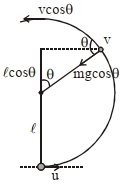
View full question & answer→MCQ 2831 Mark
You are holding a shallow circular container of radius $R$, filled with water to a height $h ( h < < R )$. When yon walk with speed $v$, it is seen that water starts spilling over. This happens due to the resonance of the periodic impulse given to the container (due to walking) with the oscillation of the water in the container. If the time period of water oscillating in the container is inversely proportional to $\sqrt{ h }$, then $v$ is proportional to
- A
$R$
- B
$\sqrt{R}$
- C
$1 / \sqrt{R}$
- ✓
$1 / R$
AnswerCorrect option: D. $1 / R$
d
(D)
At resonance, frequency of walking $=$ Frequency of oscillation
$f _{\text {milking }}=\frac{ v }{\ell}$ (where $\ell$ is length of step \& $v$ is velocity)
$\Rightarrow \frac{ v }{\ell}= f _{ osc. }$
$f _{\text {osc. }}= kh ^5 R ^y g ^2( k$ is dimension less constant)
By question,
$x =\frac{1}{2} \Rightarrow T ^{-1}= L ^{\frac{1}{2}} L ^v\left( LT ^{-2}\right)^{z}$
$\Rightarrow z =\frac{1}{2}, y =-1$
$\Rightarrow \frac{ v }{\ell}= k \sqrt{ h } R ^{-1} g ^{\frac{1}{2}} \Rightarrow v \propto \frac{1}{ R }$
View full question & answer→MCQ 2841 Mark
A point particle is acted upon by a restoring force $-k x^{3}$. The time-period of oscillation is $T$, when the amplitude is $A$. The time-period for an amplitude $2 A$ will be
AnswerCorrect option: B. $T / 2$
b
$(b)$ Using concept of dimensional analysis,
${[F]=k[x]^{3}=\left[ MLT ^{-2}\right]=k\left[ I ^{3}\right]}$
$\Rightarrow \quad\lfloor k]=\left[ ML ^{-2} T ^{-2}\right]$
$\text { Since, } \quad T \propto[ M ]^{a}[ A ]^{b}[k]^{c}$
$\Rightarrow \quad\left[ T ^{\prime}\right]=[ M ]^{a}\left[ L ^{b}\left[ ML ^{-2} T ^{-2}\right]^{c}\right.$
$\text { Comparing powers, we get }$
$a+c=0$ ................$(i)$
$b-2 c=0$ ................$(ii)$
$-2 c=1$ ................$(iii)$
Solving Eqs. $(i), (ii)$ and $(iii)$, we get
$a=\frac{1}{2}, b=-1, c=-\frac{1}{2}$
$\therefore T \propto \frac{1}{L} \sqrt{\frac{M}{k}} \Rightarrow T \propto \frac{1}{L}$
$\therefore \quad \frac{T_{1}-A_{2}-2 A}{T_{2} \frac{A_{1}}{A}} \quad(\because \text { Here } L=A)$
$\Rightarrow$ $\frac{T_{2}-T_{1}-T}{2}$ $\left(\because T_{1}=T\right)$
View full question & answer→MCQ 2851 Mark
A potential is given by $V(x)=k(x+a)^2 / 2$ for $x < 0$ and $V(x)=k(x-a)^2 / 2$ for $x > 0$. The schematic variation of oscillation period $T$ for a particle performing periodic motion in this potential as a function of its energy $E$ is
Answerb
(b)
Given, potential function for the oscillating particle is
$V(x)=\left\{\begin{array}{cl}k(x+a)^2, & x < 0 \\ \frac{k(x-a)^2}{2}, & x > 0 \\ \end{array}\right.$
So, potential energy of the particle (mass $m)$ is
$U(x)=\left\{\begin{array}{cc}\frac{k m(x+a)^2}{2}, & x < 0 \\ \frac{k m(x-a)^2}{2}, & x < 0 \\ \end{array}\right.$
$\frac{d U}{d x}=\left\{\begin{array}{ll}k m(x+a), & x < 0 \\ k m(x-a), & x > 0\end{array}\right.$
If $\frac{d U}{d x}=0$, when $x=\pm a$
Now, $\frac{d^2 U}{d x^2}=k m > 0$
So, particle is in unstable equilibrium at $x=\pm a$.
Hence, particle is unbounded for $-a > x$ and $x > a$.
In region, $-a \leq x \leq a$, time period of particle reduces from a maximum.
So, correct graph is $(b)$.
View full question & answer→MCQ 2861 Mark
Two parallel discs are connected by a rigid rod of length $L=0.5 \,m$ centrally. Each disc has a slit oppositely placed as shown in the figure. A beam of neutral atoms are incident on one of the discs axially at different velocities $v$, while the system is rotated at angular speed of $600 \,rev / second$, so that atoms only with a specific velocity emerge at the other end. Calculate the two largest speeds (in metre/second) of the atoms that will emerge at the other end.
- A
$75,25$
- B
$100,50$
- C
$300,100$
- ✓
$600,200$
AnswerCorrect option: D. $600,200$
d
(d)
Time at which discs gaps are alined,
$t=\frac{\pi}{\omega}, \frac{3 \pi}{\omega}, \frac{5 \pi}{\omega}, \ldots$
So, speeds of atoms that emerges on other side are
$v_1=\frac{0.5}{\frac{\pi}{600} \times 2 \pi}=600 \,ms ^{-1}$
$\text { and } v_2=\frac{0.5}{\frac{3 \pi}{600} \times 2 \pi}=200 \,ms ^{-1}$
View full question & answer→MCQ 2871 Mark
One end of a rod of length $L$ is fixed to a point on the circumference of a wheel of radius $R$. The other end is sliding freely along a straight channel passing through the centre of the wheel as shown in the figure below. The wheel is rotating with a constant angular velocity $\omega$ about $O$. Taking $T=\frac{2 \pi}{\omega}$, the motion of the rod is
- A
simple harmonic with a period of $T$
- B
simple harmonic with a period of $T / 2$
- ✓
not simple harmonic but periodic with a period of $T$
- D
not simple harmonic but periodic with a period of $T / 2$
AnswerCorrect option: C. not simple harmonic but periodic with a period of $T$
c
$(c)$ Rod is connected to wheel, so it oscillates following rotation of pivot $P$. Hence, its motion is forced oscillatory motion with time period $T$.
View full question & answer→MCQ 2881 Mark
A light balloon filled with helium of density $\rho_{ He }$ is tied to a long light string of length $l$ and the string is attached to the ground. If the balloon is displaced slightly in the horizontal direction from the equilibrium and released. Then,
- A
the balloon undergoes simple harmonic motion with period $2 \pi \sqrt{\left(\frac{\rho_{\text {air }}}{\rho_{\text {air }}-\rho_{ He }}\right) \frac{l}{g}}$
- B
the balloon undergoes simple harmonic motion with period $2 \pi \sqrt{\left(\frac{\rho_{ air }-\rho_{ He }}{\rho_{ air }}\right) \frac{l}{g}}$
- ✓
the balloon undergoes simple harmonic motion with period $2 \pi \sqrt{\left(\frac{\rho_{11 e }}{\rho_{\text {air }}-\rho_{ He }}\right) \frac{l}{g}}$
- D
the balloon undergoes conical oscillations with period $2 \pi \sqrt{\left(\frac{\rho_{ air }+\rho_{ He }}{\rho_{ air }-\rho_{ He }}\right) \frac{l}{g}}$
AnswerCorrect option: C. the balloon undergoes simple harmonic motion with period $2 \pi \sqrt{\left(\frac{\rho_{11 e }}{\rho_{\text {air }}-\rho_{ He }}\right) \frac{l}{g}}$
c
$(c)$ When balloon is slightly displaced horizontally component of buoyant force produces a torque about the end of string attached to ground. This torque produces side ways oscillations of balloon.
Restoring torque is
$\tau_1=F_b \sin \theta \times l=V\left(\rho_{ air }-\rho_{ He }\right) g l \sin \theta$
$=V\left(\rho_{ air }-\rho_{ He }\right) g l \theta$
For small angular displacements, $\sin \theta \approx \theta$
And the inertial torque an balloon is
$\tau_2=l \alpha=m l^2 \alpha=V \cdot \rho_{ He } \cdot l^2 \cdot \alpha$
Helium balloon can be viewed as a mass tied to end of a string.
Equating both torques, we have
$V \cdot \rho_{ He } \cdot l^2 \cdot \alpha=-V\left(\rho_{ air }-\rho_{ He }\right) l \theta$
(Negative sign appears as both torques are in opposite directions)
$\alpha=-\left(\frac{\rho_{ air }-\rho_{ He }}{\rho_{ He }}\right) \cdot \frac{g}{l} \cdot \theta$
So, if $\omega$ is angular frequency, then
$\omega^2=\left(\frac{\rho_{ air }-\rho_{ He }}{\rho_{ He }}\right) \cdot \frac{g}{l}$
$\therefore$ Time period of oscillations of balloon is
$T=\frac{2 \pi}{\omega}=2 \pi \sqrt{\left(\frac{\rho_{ He }}{\rho_{ air }-\rho_{ He }}\right) \cdot \frac{l}{g}}$
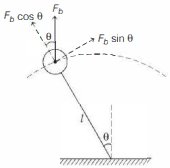
View full question & answer→MCQ 2891 Mark
A simple pendulum of length $l$ is made to oscillate with an amplitude of $45$ degrees. The acceleration due to gravity is $g$. Let $T_0=2 \pi \sqrt{l / g}$. The time period of oscillation of this pendulum will be
AnswerCorrect option: C. slightly more than $T_0$
c
(c)
For a simple pendulum, equation of tangential motion is
$F_T=-m g \sin \theta$
$\Rightarrow m l \alpha=-m g \sin \theta$
$\Rightarrow \frac{d^2 \theta}{d t^2}+g \frac{l}{l} \sin \theta=0$
Now, $\quad \sin \theta=\theta-\frac{\theta^3}{3 !}+\ldots$
Approximately, $\sin \theta \approx \theta\left(1-\frac{\theta^2}{6}\right)$
Now, replacing $\theta_{ av }^2=\frac{1}{2} \theta_0^2$
We have, $\frac{d^2 \theta}{d t^2}+\frac{g}{l}\left(1-\frac{\theta_0^2}{12}\right) \theta=0$
$\therefore \quad \omega=\frac{g}{l}\left(1-\frac{\theta_0^2}{12}\right)$
So, time period of oscillation is
$T=\frac{2 \pi}{\omega}=2 \pi \sqrt{\frac{g}{l}}\left[\left(1-\frac{\theta_0^2}{12}\right)^{-\frac{1}{2}}\right]$
Now, taking binomial approximately
$T \approx 2 \pi \sqrt{\frac{g}{l}} \cdot\left(1+\frac{\theta_l^2}{24}\right)$
Clearly, this is greater than $T_0=2 \pi \sqrt{\frac{g}{l}}$.
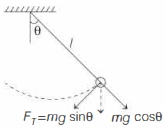
View full question & answer→MCQ 2901 Mark
A simple pendulum is attached to a block which slides without friction down an inclined plane $A B C$ having an angle of inclination $\alpha$ as shown below. While the block is sliding down the pendulum oscillates in such a way that at its mean position the direction of the string is
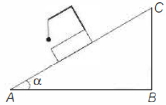
- A
at angle $\alpha$ to the perpendicular to the inclined plane $A C$
- B
parallel to the inclined plane $A C$
- C
- ✓
perpendicular to the inclined plane $A C$
AnswerCorrect option: D. perpendicular to the inclined plane $A C$
d
(d)
As block slides down the plane, pendulum bob is subjected to two forces.
$(i)$ Weight mg perpendicularly downwards to the horizontal.
$(ii)$ Pesudo force $m g \sin \theta$ acting upwards and parallel to the inclined plane.
Resultant of these forces is perpendicular to inclined plane $A C$. So, mean position of pendulum is perpendicular to $A C$.
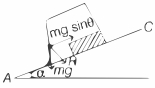
View full question & answer→MCQ 2911 Mark
A ball is rolling without slipping in a spherical shallow bowl (radius $R$ ) as shown in the figure and is executing simple harmonic motion. If the radius of the ball is doubled, then the time period of oscillation
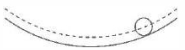
Answerd
(d)
Time period of oscillation of ball (radius $r$ ) in a bowl (radius $R$ ) rolling without slipping is
$T=2 \pi \sqrt{\frac{R-r}{g}}$
So, if $r$ increases, then time period is decreases.
View full question & answer→MCQ 2921 Mark
A body is executing simple harmonic motion of amplitude $a$ and period $T$ about the equilibrium position $x=0$. Large numbers of snapshots are taken at random of this body in motion. The probability of the body being found in a very small interval $x$ to $x+|d x|$ is highest at
AnswerCorrect option: A. $x=\pm a$
a
(a)
In simple harmonic motion, at positions near extreme positions speed of body is less.
So, more time is spend by the body in extreme positions and less near mean position.
Hence, probability of finding the body at extremes is much higher.
So, correct option is $(a)$.
View full question & answer→MCQ 2931 Mark
A simple pendulum is released from rest at the horizontally stretched position. When the string makes an angle $\theta$ with the vertical, the angle $\phi$ which the acceleration vector of the bob makes with the string is given by
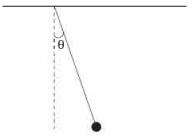
AnswerCorrect option: B. $\phi=\tan ^{-1}\left(\frac{\tan \theta}{2}\right)$
b
(b)
Let $v$ is the velocity of bob at position $\theta$ after being released from horizontal position.
From energy conservation, we have
$m g h=\frac{1}{2} m v^2$
$\Rightarrow m g(l \cos \theta)=\frac{1}{2} m v^2$
$\Rightarrow \quad \frac{v^2}{l}=2 g \cos \theta \quad \dots(i)$
Restoring force on bob is component of weight.
So, tangential component of acceleration is
$a_t=g \sin \theta \quad \dots(ii)$
If total acceleration a makes angle $\phi$ with string. Then,
Tangential component,
$a_t=a \sin \phi$
and radial component, $a_c=a \cos \phi$
So, $\quad \frac{a_t}{a_c}=\frac{a \sin \phi}{a \cos \phi}=\tan \phi$
$\Rightarrow \quad \tan \phi=\frac{a_i}{a_c} \quad \dots(iii)$
Substituting values of $a_t$ and $a_c$ from Eqs.
$(i)$ and $(ii)$ in Eq. $(iii)$, we get
$\tan \phi=\frac{g \sin \theta}{2 g \cos \theta}$
$\Rightarrow \quad \tan \phi=\frac{\tan \theta}{2}$
So, $\quad \phi=\tan ^{-1}\left(\frac{\tan \theta}{2}\right)$
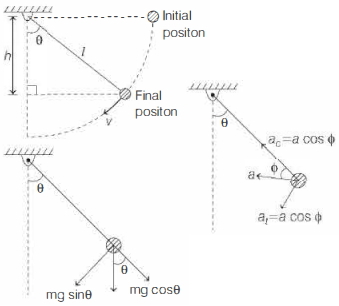
View full question & answer→MCQ 2941 Mark
If the speed $v$ of the bob in a simple pendulum is plotted against the tangential acceleration $a$, the correct graph will be represented by
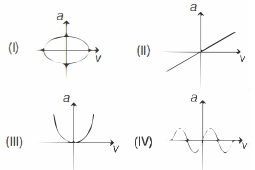
Answera
(a)
For an oscillating simple pendulum,
Acceleration, $a=-\omega^2 x$
and velocity, $v=\omega \sqrt{A^2-x^2}$
$\Rightarrow v^2=\omega^2\left(A^2-x^2\right)$
$\Rightarrow v^2+\omega^2 x^2 =\omega^2 A^2$
$\Rightarrow \quad v^2+\frac{\omega^4 x^2}{\omega^2}=\omega^2 A^2$
$\Rightarrow \quad v^2+\frac{ \alpha ^2}{\omega^2}=\omega^2 A^2$
$\Rightarrow \quad \frac{v^2}{\omega^2 A^2}+\frac{a^2}{\omega^4 A^2}=1$
This is an ellipse $\left(\frac{x^2}{a^2}+\frac{y^2}{b^2}=1\right)$ with centre at origin.
View full question & answer→MCQ 2951 Mark
A simple pendulum oscillates freely between points $A$ and $B$. We now put a peg (nail) at the point $C$ as shown in above figure. As the pendulum moves from $A$ to the right, the string will bend at $C$ and the pendulum will go to its extreme point $D$. Ignoring friction, the point $D$
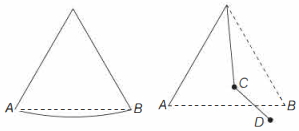
- ✓
will lie on the line $A B$
- B
will lie above the line $A B$
- C
will lie below the line $A B$
- D
will coincide with $B$
AnswerCorrect option: A. will lie on the line $A B$
a
(a)
Total length of a pendulum remains same, so extreme point $D$ lies on the line $A B$, as shown below.
This can be proved by applying energy conservation between extreme positions $A$ and $D$ (its given friction is abscent),
$K_A+U_A=K_B+U_B=K_D+U_D$
$\Rightarrow 0+U_A=0+U_B=0+U_D$
$\Rightarrow U_A=U_B=U_D \Rightarrow h_A=h_B=h_D$
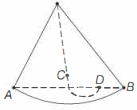
View full question & answer→MCQ 2961 Mark
A book is resting on a shelf that is undergoing vertical simple harmonic oscillations with an amplitude of $2.5 \,cm$. What is the minimum frequency of oscillation of the shelf for .......... $Hz$ the book will lose contact with the shelf? (Assume that, $g=10 \,ms ^{-2}$ )
- A
$20$
- ✓
$3.18$
- C
$125.6$
- D
$10$
AnswerCorrect option: B. $3.18$
b
(b)
Book started to loose contact with shelf when maximum acceleration $a$ of shelf is such that,
$a_{\max } \geq g$
$\Rightarrow \quad \omega^2 A \geq g$
$\Rightarrow \quad \omega^2=\frac{g}{A}$.
So, frequency of oscillations is
$f=\frac{\omega}{2 \pi}=\frac{1}{2 \pi} \sqrt{\frac{g}{A}}$
$\Rightarrow \quad f=\frac{1}{2 \pi} \cdot \sqrt{2.5 \times 10^{-2}}=\frac{2 \times 10}{2 \pi}$
$\Rightarrow \quad f \approx 3.18 \,Hz$
View full question & answer→MCQ 2971 Mark
Two masses $m_1$ and $m_2$ connected by a spring of spring constant $k$ rest on a frictionless surface. If the masses are pulled apart and let go, the time period of oscillation is
- ✓
$T=2 \pi \sqrt{\frac{1}{k}\left(\frac{m_1 m_2}{m_1+m_2}\right)}$
- B
$T=2 \pi \sqrt{k\left(\frac{m_1+m_2}{m_1 m_2}\right)}$
- C
$T=2 \pi \sqrt{\frac{m_1}{k}}$
- D
$T=2 \pi \sqrt{\frac{m_2}{k}}$
AnswerCorrect option: A. $T=2 \pi \sqrt{\frac{1}{k}\left(\frac{m_1 m_2}{m_1+m_2}\right)}$
a
(a)
Let displacements of masses $m_1$ and $m_2$ are $x_1$ and $x_2$, respectively.
Total elongation of spring is $x=x_1+x_2$.
So, when spring snaps back, pull on each of mass is
$F=-k x$
Hence, by second law equation for $m_1$ and $m_2$ are
$m_1 a _1=-k x \Rightarrow m_1 \frac{d^2 x_1}{d t^2}=-k x$
and $m_2 a_2=-k x \Rightarrow m_2 \frac{d^2 x_2}{d t^2}=-k x$
Now, from $x=x_1+x_2$, we have
$\frac{d^2 x}{d t^2}=\frac{d^2 x_1}{d t^2}+\frac{d^2 x_2}{d t^2}$
$\Rightarrow \quad \frac{d^2 x}{d t^2}=\frac{-k}{m_1} x+\frac{-k}{m_2} x$
$\Rightarrow \quad \frac{d^2 x}{d t^2}=-k\left(\frac{1}{m_1}+\frac{1}{m_2}\right) x$
Hence, time period of oscillation is
$T=\frac{2 \pi}{\omega}=2 \pi \sqrt{\frac{1}{k}\left(\frac{m_1 m_2}{m_1+m_2}\right)}$
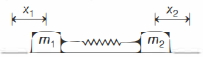
View full question & answer→MCQ 2981 Mark
A particle of mass $m$ undergoes oscillations about $x=0$ in a potential given by $V(x)-\frac{1}{2} k x^2-V_0 \cos \left(\frac{x}{a}\right)$, where $V_0, k, a$ are constants. If the amplitude of oscillation is much smaller than $a$, the time period is given by
- ✓
$2 \pi \sqrt{\frac{m a^2}{k a^2+V_0}}$
- B
$2 \pi \sqrt{\frac{m}{k}}$
- C
$2 \pi \sqrt{\frac{m a^2}{V_0}}$
- D
$2 \pi \sqrt{\frac{m a^2}{k a^2-V_0}}$
AnswerCorrect option: A. $2 \pi \sqrt{\frac{m a^2}{k a^2+V_0}}$
a
(a)
Force on the particle is $F=-\frac{d V}{d x}$
$\Rightarrow \quad F=-\frac{d}{d x}\left(\frac{1}{2} k x^2-V_o \cos \left(\frac{x}{a}\right)\right)$
$=-\left(k x+\frac{V_o}{a} \sin \left(\frac{x}{a}\right)\right)$
As $\quad x << a, \Rightarrow \frac{x}{a} << 1$
So, $\sin \frac{x}{a} \approx \frac{x}{a}$
Hence, $F=-\left(k x+\frac{V_0}{a} \cdot \frac{x}{a}\right)=-\left(k+\frac{V_0}{a^2}\right) \cdot x$
Acceleration $A$ of the particle is
$A=\frac{F}{m}=-\frac{1}{m}\left(k+\frac{V_{0}}{a^2}\right) \cdot x$
As, acceleration $A=-\omega^2 x$, we have
$c 0=\sqrt{\frac{1}{m}\left(k+\frac{V_0}{a^2}\right)}=\sqrt{\left(\frac{k a^2+V_0}{m a^2}\right)}$
$\therefore$ Time period of oscillation is
$T=\frac{2 \pi}{\omega}=2 \pi \sqrt{\left(\frac{m a^2}{k a^2+V_0}\right)}$
View full question & answer→MCQ 2991 Mark
A bead of mass $m$ is attached to the mid-point of a tant, weightless string of length $l$ and placed on a frictionless horizontal table.Under a small transverse displacement $x$, as shown in above figure. If the tension in the string is $T$, then the frequency of oscillation is
- A
$\frac{1}{2 \pi} \sqrt{\frac{2 T}{m l}}$
- ✓
$\frac{1}{2 \pi} \sqrt{\frac{4 T}{m l}}$
- C
$\frac{1}{2 \pi} \sqrt{\frac{4 T}{m}}$
- D
$\frac{1}{2 \pi} \sqrt{\frac{2 T}{m}}$
AnswerCorrect option: B. $\frac{1}{2 \pi} \sqrt{\frac{4 T}{m l}}$
b
(b)
Resolving tension $T$, we have Restoring force on bead $=2 T \cos \theta$
Here, $\cos \theta=\frac{x}{\sqrt{x^2+\left(\frac{l}{2}\right)^2}}$
As $l \gg x, \frac{l^2}{4}+x^2 \approx \frac{l^2}{4}$
So, $\quad \cos \theta=\frac{2 x}{l}$
Now, if $a=$ acceleration of bead. Then,
Restoring force $=$ Mass $\times$ Acceleration
$\Rightarrow \quad 2 T \cos \theta=-m a$
$\Rightarrow \frac{2 T(2 x)}{l} =-m a$
$\Rightarrow a =-\left(\frac{4 T}{m l}\right) \cdot x$
Hence, $\omega^2=\frac{4 T}{m l}$
$\therefore$ Time period of oscillation is
$T=\frac{2 \pi}{\omega}=2 \pi \sqrt{\frac{m l}{4 T}}$
Hence, frequency of oscillation is
$f=\frac{1}{T}=\frac{1}{2 \pi} \sqrt{\frac{4 T}{m l}}$
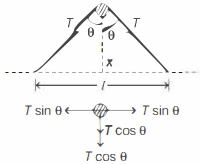
View full question & answer→MCQ 3001 Mark
Consider a one-dimensional potential $V(x)$ as shown in the figure below. A classical particle of mass $m$ moves under its influence and has total energy $E$ as shown below. The motion is
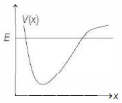
- A
- B
- ✓
periodic but not a simple harmonic
- D
AnswerCorrect option: C. periodic but not a simple harmonic
c
(c)
Given, potential energy curve closely represents potential energy of a simple harmonic oscillator $\left(U=\frac{1}{2} k x^2\right.$, shown in dotted line $)$
In region $r_1 < x < r_2$, the potential energy is less than total energy, so motion of particle in this region is oscillatory.
Also, the potential energy curve is not symmetric about $x=r_{\text {. }}$.
$\therefore$ Motion is not a simple harmonic.
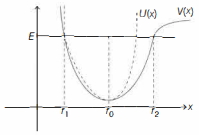
View full question & answer→MCQ 3011 Mark
A simple harmonic oscillator has an amplitude $A$ and time period $6 \pi$ second. Assuming the oscillation starts from its mean position, the time required by it to travel from $x=A$ to $x=\frac{\sqrt{3}}{2} A$ will be $\frac{\pi}{x}$ s, where $x=$__________.
Answera
From phasor diagram particle has to move from $\mathrm{P}$ to $Q$ in a circle of radius equal to amplitude of $SHM.$
$ \cos \phi=\frac{\frac{\sqrt{3} \mathrm{~A}}{2}}{\mathrm{~A}}=\frac{\sqrt{3}}{2} $
$ \phi=\frac{\pi}{6}$
Now, $\frac{\pi}{6}=\omega t$
$\frac{\pi}{6}=\frac{2 \pi}{T} t$
$\frac{\pi}{6}=\frac{2 \pi}{6 \pi} t$
$\mathrm{t}=\frac{\pi}{2}$
So, $\mathrm{x}=2$
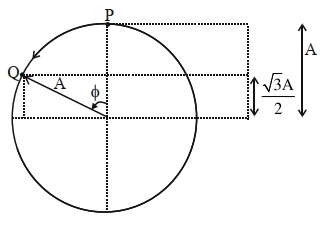
View full question & answer→MCQ 3021 Mark
A particle executes simple harmonic motion with an amplitude of $4 \mathrm{~cm}$. At the mean position, velocity of the particle is $10 \mathrm{~cm} / \mathrm{s}$. The distance of the particle from the mean position when its speed becomes $5 \mathrm{~cm} / \mathrm{s}$ is $\sqrt{\alpha} \mathrm{cm}$, where $\alpha=$____________.
Answerc
$ \mathrm{V}_{\mathrm{at} \text { mann position }}=\mathrm{A} \omega \Rightarrow 10=4 \omega $
$ \omega=\frac{5}{2} $
$ \mathrm{~V}=\omega \sqrt{\mathrm{A}^2-\mathrm{x}^2} $
$ 5=\frac{5}{2} \sqrt{4^2-\mathrm{x}^2} \Rightarrow \mathrm{x}^2=16-4 $
$ \mathrm{x}=\sqrt{12} \mathrm{~cm}$
View full question & answer→MCQ 3031 Mark
A particle performs simple harmonic motion with amplitude A. Its speed is increased to three times at an instant when its displacement is $\frac{2 \mathrm{~A}}{3}$. The new amplitude of motion is $\frac{\mathrm{nA}}{3}$. The value of $\mathrm{n}$ is____.
Answera
$v=\omega \sqrt{A^2-x^2}$
$\text { at } x=\frac{2 A}{3}$
$v=\omega \sqrt{A^2-\left(\frac{2 A}{3}\right)^2}=\frac{\sqrt{5} A \omega}{3}$
New amplitude $=\mathrm{A}^{\prime}$
$\mathrm{v}^{\prime}=3 \mathrm{v}=\sqrt{5} \mathrm{~A} \omega=\omega \sqrt{\left(\mathrm{A}^{\prime}\right)^2-\left(\frac{2 \mathrm{~A}}{3}\right)^2}$
$\mathrm{A}^{\prime}=\frac{7 \mathrm{~A}}{3}$
View full question & answer→MCQ 3041 Mark
The displacement of a particle executing SHM is given by $x=10 \sin \left(\omega t+\frac{\pi}{3}\right) \mathrm{m}$. The time period of motion is $3.14 \mathrm{~s}$. The velocity of the particle at $\mathrm{t}=0$is_________. $\mathrm{m} / \mathrm{s}$.
Answera
Given,
$\mathrm{T}=3.14=\frac{2 \pi}{\omega}$
$\omega=2 \mathrm{rad} / \mathrm{s}$
$\mathrm{x}=10 \sin \left(\omega \mathrm{t}+\frac{\pi}{3}\right)$
$\mathrm{v}=\frac{\mathrm{dx}}{\mathrm{dt}}=10 \omega \cos \left(\omega \mathrm{t}+\frac{\pi}{3}\right)$
$\text { at } \mathrm{t}=0$
$\mathrm{v}=10 \omega \cos \left(\frac{\pi}{3}\right)=10 \times 2 \times \frac{1}{2}[\text { using } \omega=2 \mathrm{rad} / \mathrm{s}]$
$\mathrm{v}=10 \mathrm{~m} / \mathrm{s}$
View full question & answer→MCQ 3051 Mark
A particle is doing simple harmonic motion of amplitude $0.06 \mathrm{~m}$ and time period $3.14 \mathrm{~s}$. The maximum velocity of the particle is. . . . .. . $\mathrm{cm} / \mathrm{s}$.
Answera
We know
$\mathrm{V}_{\max } =\omega \mathrm{A} \quad \text { at mean position }$
$=\frac{2 \pi}{\mathrm{T}} \mathrm{A}=\frac{2 \pi}{\pi} \times 0.06=0.12 \mathrm{~m} / \mathrm{sec}$
$\mathrm{V}_{\max } =12 \mathrm{~cm} / \mathrm{sec}$
View full question & answer→MCQ 3061 Mark
The position, velocity and acceleration of a particle executing simple harmonic motion are found to have magnitudes of $4 \mathrm{~m}, 2 \mathrm{~ms}^{-1}$ and $16 \mathrm{~ms}^{-2}$ at a certain instant. The amplitude of the motion is $\sqrt{\mathrm{x}} \mathrm{m}$ where $\mathrm{x}$ is. . . . . . .
Answera
$x=4 \mathrm{~m}, \mathrm{~V}=2 \mathrm{~m} / \mathrm{s}, \mathrm{a}=16 \mathrm{~m} / \mathrm{s}^2$
$|\mathrm{a}|=\omega^2 \mathrm{x}$
$\Rightarrow 16=\omega^2(4)$
$\omega=2 \mathrm{rad} / \mathrm{s}$
$\mathrm{v}=\omega \sqrt{\mathrm{A}^2-\mathrm{x}^2}$
$A=\sqrt{\frac{\mathrm{v}^2}{\omega^2}+\mathrm{x}^2} \Rightarrow \mathrm{A}=\sqrt{\frac{4}{4}+16}$
$A=\sqrt{17} \mathrm{~m}$
View full question & answer→MCQ 3071 Mark
When the displacement of a simple harmonic oscillator is one third of its amplitude, the ratio of total energy to the kinetic energy is $\frac{x}{8}$, where $x=$_____________.
Answerd
$ \text { Let total energy }=\mathrm{E}=\frac{1}{2} \mathrm{KA}^2 $
$ \mathrm{U}=\frac{1}{2} \mathrm{~K}\left(\frac{\mathrm{A}}{3}\right)^2=\frac{\mathrm{KA}^2}{2 \times 9}=\frac{\mathrm{E}}{9} $
$ \mathrm{KE}=\mathrm{E}-\frac{\mathrm{E}}{9}=\frac{8 \mathrm{E}}{9} $
$ \text { Ratio } \frac{\text { Total }}{\mathrm{KE}}=\frac{\mathrm{E}}{\frac{8 \mathrm{E}}{9}}=\frac{9}{8} $
$ \mathrm{x}=9$
View full question & answer→MCQ 3081 Mark
In simple harmonic motion, the total mechanical energy of given system is E. If mass of oscillating particle $P$ is doubled then the new energy of the system for same amplitude is:
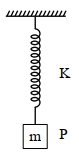
- A
$\frac{E}{\sqrt{2}}$
- ✓
$\mathrm{E}$
- C
$\mathrm{E} \sqrt{2}$
- D
$2 \mathrm{E}$
AnswerCorrect option: B. $\mathrm{E}$
b
$\text { T.E. }=\frac{1}{2} \mathrm{kA}^2$
since $A$ is same $T.E.$ will be same correct option $(2)$
View full question & answer→MCQ 3091 Mark
An object of mass $0.2 \mathrm{~kg}$ executes simple harmonic motion along $\mathrm{x}$ axis with frequency of $\left(\frac{25}{\pi}\right) \mathrm{Hz}$. At the position $\mathrm{x}=0.04 \mathrm{~m}$ the object has kinetic energy $0.5 \mathrm{~J}$ and potential energy $0.4 \mathrm{~J}$ The amplitude of oscillation is ............ cm.
Answerc
$\text { Total energy }=\text { K.E. }+ \text { P.E. }$
$\text { at } \mathrm{x}=0.04 \mathrm{~m}, \text { T.E. }=0.5+0.4=0.9 \mathrm{~J}$
$\text { T.E }=1 \mathrm{~m}^2 \mathrm{~A}^2=0.9$
$\quad=\frac{1}{2} \times 0.2\left(2 \pi \times \frac{25}{\pi}\right)^2 \times \mathrm{A}^2=0.9$
$\Rightarrow \mathrm{A}=0.06 \mathrm{~m}$
$\mathrm{~A}=6 \mathrm{~cm}$
View full question & answer→MCQ 3101 Mark
To find the spring constant $(k)$ of a spring experimentally, a student commits $2 \%$ positive error in the measurement of time and $1 \%$ negative error in measurement of mass. The percentage error in determining value of $\mathrm{k}$ is :
- A
$3 \%$
- B
$1 \%$
- C
$4 \%$
- ✓
$5 \%$
AnswerCorrect option: D. $5 \%$
d
$\mathrm{T}=2 \pi \sqrt{\frac{\mathrm{m}}{\mathrm{k}}}$
$\mathrm{T}^2 \propto \frac{\mathrm{m}}{\mathrm{k}}$
$\frac{2 \Delta \mathrm{T}}{\mathrm{T}} \%=\frac{\Delta \mathrm{m}}{\mathrm{m}} \%-\frac{\Delta \mathrm{k}}{\mathrm{k}} \%$
$\frac{\Delta \mathrm{k}}{\mathrm{k}} \%=\frac{\Delta \mathrm{m}}{\mathrm{m}} \%-\frac{2 \Delta \mathrm{T}}{\mathrm{T}} \% $
$\frac{\Delta \mathrm{k}}{\mathrm{k}} \%=(-1) \%-2(2) \%=|-5 \%|=5 \%$
View full question & answer→MCQ 3111 Mark
A particle of mass $0.50 \mathrm{~kg}$ executes simple harmonic motion under force $\mathrm{F}=-50\left(\mathrm{Nm}^{-1}\right) \mathrm{x}$. The time period of oscillation is $\frac{x}{35} s$. The value of $x$ is . . . . .(Given $\pi=\frac{22}{7}$ )
Answerb
$\mathrm{m}=0.5 \mathrm{~kg}$
$\mathrm{~F}=-50(\mathrm{x})$
$\mathrm{ma}=(-50 \mathrm{x})$
$0.5 \mathrm{a}=-50 \mathrm{x}$
$\mathrm{a}=(-100 \mathrm{x})$
$\mathrm{W}^2=100 \Rightarrow(\mathrm{w}=10)$
$\mathrm{T}=\frac{2 \pi}{10}=\left(\frac{\pi}{5}\right)=\frac{22}{7 \times 15}=\left(\frac{22}{35}\right)$
$\frac{\pi}{35}=\frac{22}{35} \Rightarrow \mathrm{x}=22$
View full question & answer→MCQ 3121 Mark
The time period of simple harmonic motion of mass $\mathrm{M}$ in the given figure is $\pi \sqrt{\frac{\alpha M}{5 K}}$, where the value of $\alpha$ is____.
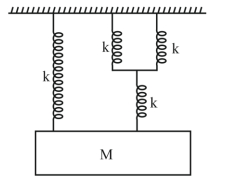
Answera
$\mathrm{k}_{\mathrm{eq}}=\frac{2 \mathrm{k} \cdot \mathrm{k}}{3 \mathrm{k}}+\mathrm{k}=\frac{5 \mathrm{k}}{3}$
Angular frequency of oscillation $(\omega)=\sqrt{\frac{\mathrm{k}_{\mathrm{eq}}}{\mathrm{m}}}$
$(\omega)=\sqrt{\frac{5 \mathrm{k}}{3 \mathrm{~m}}}$
Period of oscillation $(\tau)=\frac{2 \pi}{\omega}=2 \pi \sqrt{\frac{3 \mathrm{~m}}{5 \mathrm{k}}}$
$=\pi \sqrt{\frac{12 \mathrm{~m}}{5 \mathrm{k}}}$
View full question & answer→MCQ 3131 Mark
A mass $\mathrm{m}$ is suspended from a spring of negligible mass and the system oscillates with a frequency $f_1$. The frequency of oscillations if a mass $9 \mathrm{~m}$ is suspended from the same spring is $f_2$. The value of $\frac{f_1}{f_{.2}}$ is_____________.
Answera
$\mathrm{f}_1=\frac{1}{2 \pi} \sqrt{\frac{\mathrm{k}}{\mathrm{m}}}$
$\mathrm{f}_2=\frac{1}{2 \pi} \sqrt{\frac{\mathrm{k}}{9 \mathrm{~m}}}$
$\frac{\mathrm{f}_1}{\mathrm{f}_2}=\sqrt{\frac{9}{1}}=\frac{3}{1}$
View full question & answer→MCQ 3141 Mark
A ball suspended by a thread swings in a vertical plane so that its magnitude of acceleration in the extreme position and lowest position are equal. The angle $(\theta)$ of thread deflection in the extreme position will be :
- A
$\tan ^{-1}(\sqrt{2})$
- ✓
$2 \tan ^{-1}\left(\frac{1}{2}\right)$
- C
$\tan ^{-1}\left(\frac{1}{2}\right)$
- D
$2 \tan ^{-1}\left(\frac{1}{\sqrt{5}}\right)$
AnswerCorrect option: B. $2 \tan ^{-1}\left(\frac{1}{2}\right)$
b
Loss in kinetic energy $=$ Gain in potential energy
$ \Rightarrow \frac{1}{2} \mathrm{mv}^2=\mathrm{mg} \ell(1-\cos \theta)$
$ \Rightarrow \frac{\mathrm{v}^2}{\ell}=2 \mathrm{~g}(1-\cos \theta)$
Acceleration at lowest point $=\frac{\mathrm{v}^2}{\ell}$
Acceleration at extreme point $=g \sin \theta$
Hence, $\frac{\mathrm{v}^2}{\ell}=\mathrm{g} \sin \theta$
$ \therefore \sin \theta=2(1-\cos \theta) $
$ \Rightarrow \tan \frac{\theta}{2}=\frac{1}{2} \Rightarrow \theta=2 \tan ^{-1}\left(\frac{1}{2}\right)$
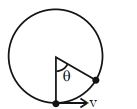
View full question & answer→MCQ 3151 Mark
The bob of a pendulum was released from a horizontal position. The length of the pendulum is $10 \mathrm{~m}$. If it dissipates $10 \%$ of its initial energy against air resistance, the speed with which the bob arrives at the lowest point is : [Use, $\mathrm{g}: 10 \mathrm{~ms}^{-2}$ ]
- ✓
$6 \sqrt{5} \mathrm{~ms}^{-1}$
- B
$5 \sqrt{6} \mathrm{~ms}^{-1}$
- C
$5 \sqrt{5} \mathrm{~ms}^{-1}$
- D
$2 \sqrt{5} \mathrm{~ms}^{-1}$
AnswerCorrect option: A. $6 \sqrt{5} \mathrm{~ms}^{-1}$
a
$ \ell=10 \mathrm{~m} $
$ \text { Initial energy }=\mathrm{mg} \ell $
$ \text { So, } \frac{9}{10} \mathrm{mg} \ell=\frac{1}{2} \mathrm{mv}^2 $
$ \Rightarrow \frac{9}{10} \times 10 \times 10=\frac{1}{2} \mathrm{v}^2 $
$ \mathrm{v}^2=180 $
$ \mathrm{v}=\sqrt{180}=6 \sqrt{5} \mathrm{~m} / \mathrm{s}$
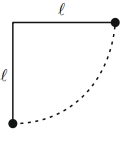
View full question & answer→MCQ 3161 Mark
A simple pendulum is placed at a place where its distance from the earth's surface is equal to the radius of the earth. If the length of the string is $4 \mathrm{~m}$, then the time period of small oscillations will be ____ $s$. $\left[\right.$ take $\left.\mathrm{g}=\pi^2 \mathrm{~ms}^{-2}\right]$
Answerd
Acceleration due to gravity $\mathrm{g}^{\prime}=\frac{\mathrm{g}}{4}$
$T=2 \pi \sqrt{\frac{4 \ell}{g}}$
$T=2 \pi \sqrt{\frac{4 \times 4}{g}}$
$T=2 \pi \frac{4}{\pi}=8 s$
View full question & answer→MCQ 3171 Mark
A particle executes simple harmonic motion between $x =- A$ and $x =+ A$. If time taken by particle to go from $x=0$ to $\frac{A}{2}$ is $2 s$; then time taken by particle in going from $x =\frac{ A }{2}$ to $A$ is $.........\,s$
Answerd
Let time from 0 to $A / 2$ is $t _1$
from $A / 2$ to $A$ is $t _2$ then $\omega t _1=\pi / 6$
$\omega t _2=\pi / 3$
$\frac{ t _1}{ t _2}=\frac{1}{2}$
$t _2=2 t _1=2 \times 2=4\,sec$
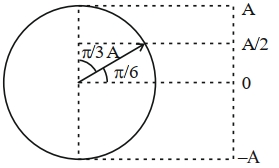
View full question & answer→MCQ 3181 Mark
A particle executes $S.H.M.$ of amplitude A along $x$-axis. At $t =0$, the position of the particle is $x=\frac{A}{2}$ and it moves along positive $x$-axis the displacement of particle in time $t$ is $x=A \sin (\omega t+\delta)$, then the value $\delta$ will be
- ✓
$\frac{\pi}{6}$
- B
$\frac{\pi}{3}$
- C
$\frac{\pi}{4}$
- D
$\frac{\pi}{2}$
AnswerCorrect option: A. $\frac{\pi}{6}$
a
$X = A \sin (\omega t +\delta)$ $V = A \omega \cos (\omega t +\delta)$
$\frac{ A }{2}= A \sin (\omega t +\delta)$ $\therefore V \text { is tve, } \delta \text { must be }$
$\text { At } t =0$ $\text { in } 1^{\text {st }} \text { quadrant or } 4^{\text {th }}$
$\sin \delta=\frac{1}{2} \Rightarrow \delta=\frac{\pi}{6}, \frac{5 \pi}{6}$ $\text { quadrant }$
$\therefore \text { Common solution is } \delta=\frac{\pi}{6}$
View full question & answer→MCQ 3191 Mark
The velocity of a particle executing SHM varies with displacement $( x )$ as $4 v ^2=50- x ^2$. The time period of oscillations is $\frac{x}{7} s$. The value of $x$ is $............$ $\left(\right.$ Take $\left.\pi=\frac{22}{7}\right)$
Answerc
$4 v ^2=50- x ^2$
$\Rightarrow \quad v =\frac{1}{2} \sqrt{50- x ^2}$
$\omega=\frac{1}{2}$
$T =\frac{2 \pi}{\omega}=4 \pi=\frac{88}{7}$
$x =88$
View full question & answer→MCQ 3201 Mark
A particle of mass $250\,g$ executes a simple harmonic motion under a periodic force $F =(-25\,x) N$. The particle attains a maximum speed of $4\,m / s$ during its oscillation. The amplitude of the motion is $...........cm$.
Answerb
$\frac{1}{4} a =-25 x \quad ; \quad a =-100 x$
$\omega^2=100 \quad \omega=10$
$\omega A =4$ $\quad A=\frac{4}{10}=0.4\,m$
$A =40\,cm$
View full question & answer→MCQ 3211 Mark
A rectangular block of mass $5\,kg$ attached to a horizontal spiral spring executes simple harmonic motion of amplitude $1\,m$ and time period $3.14\,s$. The maximum force exerted by spring on block is $.......N$.
Answerc
$\therefore T =3.14=\pi$
$T =\pi=\frac{2 \pi}{\omega} \Rightarrow \omega=2$
$F _{\max }= ma _{\max }$
$= m \left( A \omega^2\right)$
$= mA (2)^2$
$=5 \times 1 \times 4$
$=20\,N$
View full question & answer→MCQ 3221 Mark
In a linear simple harmonic motion $(SHM)$
$(A)$ Restoring force is directly proportional to the displacement.
$(B)$ The acceleration and displacement are opposite in direction.
$(C)$ The velocity is maximum at mean position.
$(D)$ The acceleration is minimum at extreme points.
Choose the correct answer from the options given below :
- ✓
$(A), (B)$ and $(C)$ only
- B
$(C)$ and $(D)$ only
- C
$(A), (B)$ and $(D)$ only
- D
$(A), (C)$ and $(D)$ only
AnswerCorrect option: A. $(A), (B)$ and $(C)$ only
a
$F =- kx \text { A true }$
$a=-\omega^2 x B \text { true }$
$\text { Velocity is maximum at mean position } C \text { true }$
$\text { Acceleration is maximum at extreme } D \text { false }$
$\text { points }$
View full question & answer→MCQ 3231 Mark
The amplitude of a particle executing $SHM$ is $3\,cm$. The displacement at which its kinetic energy will be $25 \%$ more than the potential energy is: $.............cm$.
Answerb
$K E=P E+\frac{P E}{4}$
$K E=\frac{5}{4} P E$
$\frac{1}{2} m \omega^2\left(A^2-x^2\right)=\frac{5}{4} \times \frac{1}{2} m \omega^2 x^2$ ${\left[ v =\omega \sqrt{ A ^2- x ^2}\right]}$
$A^2-x^2=\frac{5}{4} x^2$
$\frac{9 x^2}{4}=A^2$
$x=\frac{2}{3} A$
$\therefore x=\frac{2}{3} \times 3\,cm$
$x=2\,cm$
View full question & answer→MCQ 3241 Mark
The variation of kinetic energy $(KE)$ of a particle executing simple harmonic motion with the displacement $(x)$ starting from mean position to extreme position $(A)$ is given by
Answerd
For a particle executing SHM
$KE =\frac{1}{2} m \omega^2\left( A ^2- x ^2\right)$
When $x =0, KE$ is maximum and when $x = A , KE$ is zero and $KE V / S x$ graph is parabola.
View full question & answer→MCQ 3251 Mark
A particle is executing Simple Harmonic Motion $(SHM)$. The ratio of potential energy and kinetic energy of the particle when its displacement is half of its amplitude will be
- A
$1: 1$
- B
$2: 1$
- C
$1: 4$
- ✓
$1: 3$
AnswerCorrect option: D. $1: 3$
d
$x =\frac{ A }{2}, \quad \text { P.E. }=\frac{1}{2} kx ^2$
$K . E .=\frac{1}{2} kA ^2-\frac{1}{2} kx ^2$
$\frac{ P . E }{ K . E }=\frac{ x ^2}{ A ^2- x ^2}=\frac{ A ^2}{4\left(\frac{3 A ^2}{4}\right)}=\frac{1}{3}$
View full question & answer→MCQ 3261 Mark
Which graph represents the difference between total energy and potential energy of a particle executing $SHM$ Vs it's distance from mean position?
Answerd
$\text { TE. }-P . E=K E$
$K E .=\frac{1}{2} m \omega^2\left(A^2-x^2\right)$
Which is the equation of downward parabola.
View full question & answer→MCQ 3271 Mark
A particle executes SHM of amplitude A. The distance from the mean position when its's kinetic energy becomes equal to its potential energy is on
- A
$\sqrt{2\,A }$
- B
$2\,A$
- ✓
$\frac{1}{\sqrt{2}}\,A$
- D
$\frac{1}{2}\,A$
AnswerCorrect option: C. $\frac{1}{\sqrt{2}}\,A$
c
$KE = PE$
$\frac{1}{2} M \omega^2\left( A ^2- x ^2\right)=\frac{1}{2} M \omega^2 x ^2$
$A ^2- x ^2= x ^2 \Rightarrow A ^2=2 \times 2$
$\Rightarrow x = \pm \frac{ A }{\sqrt{2}}$
View full question & answer→MCQ 3281 Mark
A mass $m$ attached to free end of a spring executes SHM with a period of $1\; s$. If the mass is increased by $3\; kg$ the period of oscillation increases by one second, the value of mass $m$ is $..............kg$.
Answerc
$T =2 \pi \sqrt{\frac{ m }{ k }}=1$
$T ^{\prime}=2 \pi \sqrt{\frac{ m +3}{ k }}=2$
$\frac{ T }{ T ^{\prime}}=\sqrt{\frac{ m }{ m +3}}=\frac{1}{2}$
$\Rightarrow \frac{ m }{ m +3}=\frac{1}{4}$
$m =1$
View full question & answer→MCQ 3291 Mark
Assume that the earth is a solid sphere of uniform density and a tunnel is dug along its diameter throughout the earth. It is found that when a particle is released in this tunnel, it executes a simple harmonic motion. The mass of the particle is $100 g$. The time period of the motion of the particle will be (approximately) (take $g =10\,ms ^{-2}$, radius of earth $=6400\,km$ )
- A
$24$ hours
- ✓
$1$ hour $24$ minutes
- C
$1$ hour $40$ minutes
- D
$12$ hours
AnswerCorrect option: B. $1$ hour $24$ minutes
b
Let at some time particle is at a distance $x$ from centre of Earth, then at that position field
$E=\frac{G M}{R^3} x$
$\therefore \text { Acceleration of particle }$
$\vec{a}=-\frac{ GM }{ R ^3} \overrightarrow{ x }$
$\Rightarrow \omega=\sqrt{\frac{ GM }{ R ^3}}=\sqrt{\frac{ g }{ R }}$
$\text { Now } T =\frac{2 \pi}{\omega}=2 \pi \sqrt{\frac{ R }{ g }}$
$\Rightarrow T =2 \times 3.14 \times \sqrt{\frac{6400 \times 10^3}{10}}$
$=2 \times 3.14 \times 800\,sec \approx 1 \text { hour } 24 \text { minutes }$
View full question & answer→MCQ 3301 Mark
A block of mass $2\,kg$ is attached with two identical springs of spring constant $20\,N / m$ each. The block is placed on a frictionless surface and the ends of the springs are attached to rigid supports (see figure). When the mass is displaced from its equilibrium position, it executes a simple harmonic motion. The time period of oscillation is $\frac{\pi}{\sqrt{x}}$ in SI unit. The value of $x$ is $..........$
Answera
$F =-2 kx , a =-\frac{2 kx }{ m }, \omega=\sqrt{\frac{2 k }{ m }}=\sqrt{\frac{2 \times 20}{2}}$
$=\sqrt{20}\,rad / s$
$T =\frac{2 \pi}{\omega}=\frac{2 \pi}{\sqrt{20}}=\frac{\pi}{\sqrt{5}}$
$x =5$
View full question & answer→MCQ 3311 Mark
In the figure given below. a block of mass $M =490\,g$ placed on a frictionless table is connected with two springs having same spring constant $\left( K =2 N m ^{-1}\right)$. If the block is horizontally displaced through ' $X$ 'm then the number of complete oscillations it will make in $14 \pi$ seconds will be $.........$
Answera
$Keff = K + K$ as both springs are in use in parallel
$=2\,k$
$=2 \times 2=4\,N / m \quad m =490\,gm$
$=0.49\,kg$
$T =2 \pi \sqrt{\frac{ m }{ Keff }}=2 \pi \sqrt{\frac{0.49\,kg }{4}}$
$=2 \pi \sqrt{\frac{49}{400}}=2 \pi \frac{7}{20}=\frac{7 \pi}{10}$
No. of oscillation in the $14 \pi$ is
$N =\frac{\text { time }}{ T }=\frac{14 \pi}{7 \pi / 10}=20$
View full question & answer→MCQ 3321 Mark
A mass $m$ is attached to two springs as shown in figure. The spring constants of two springs are $K _1$ and $K _2$. For the frictionless surface, the time period of oscillation of mass $m$ is
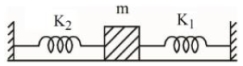
- A
$\frac{1}{2 \pi} \sqrt{\frac{ K _1+ K _2}{ m }}$
- B
$\frac{1}{2 \pi} \sqrt{\frac{ K _1- K _2}{ m }}$
- ✓
$2 \pi \sqrt{\frac{ m }{ K _1+ K _2}}$
- D
$2 \pi \sqrt{\frac{m}{K_1-K_2}}$
AnswerCorrect option: C. $2 \pi \sqrt{\frac{ m }{ K _1+ K _2}}$
c
On displacing $m$ to right by $x$
$F =-\left( k _1 x+ k _2 x \right)=-\left( k _1+ k _2\right) x$
$a =\frac{ F }{ m }=-\left(\frac{ k _1+ k _2}{ m }\right) x =-\omega^2 x$
$\therefore \omega=\sqrt{\frac{ k _1+ k _2}{ m }} \Rightarrow T=\frac{2 \pi}{\omega}=2 \pi \sqrt{\frac{ m }{ k _1+ k _2}}$
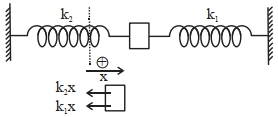
View full question & answer→MCQ 3331 Mark
Two simple harmonic waves having equal amplitudes of $8\,cm$ and equal frequency of $10\,Hz$ are moving along the same direction. The resultant amplitude is also $8\,cm$. The phase difference between the individual waves is $..................$ degree.
Answera
$2 A \cos \left(\frac{\Delta \phi}{2}\right)= A$
$\cos \left(\frac{\Delta \phi}{2}\right)=\frac{1}{2}$
$\frac{\Delta \phi}{2}=60^{\circ}$
View full question & answer→MCQ 3341 Mark
The maximum potential energy of a block executing simple harmonic motion is $25\,J$. A is amplitude of oscillation. At $A / 2$, the kinetic energy of the block is $...............$
- A
$37.5$
- B
$9.75$
- ✓
$18.75$
- D
$12.5$
AnswerCorrect option: C. $18.75$
c
$u _{\max }=\frac{1}{2} m \omega^2 A ^2=25\,J$
$KE \text { at } \frac{ A }{2}=\frac{1}{2} mv _1^2=\frac{1}{2} m \omega^2\left( A ^2-\frac{ A ^2}{4}\right)$
$KE =\frac{1}{2} m \omega^2 \frac{3 A ^2}{4}=\frac{3}{4}\left(\frac{1}{2} m \omega^2 A ^2\right)$
$KE =\frac{3}{4} \times 25=18.75\,J$
View full question & answer→MCQ 3351 Mark
For a simple harmonic motion in a mass spring system shown, the surface is frictionless. When the mass of the block is $1\,kg$, the angular frequency is $\omega_1$. When the mass block is $2\,kg$ the angular frequency is $\omega_2$. The ratio $\omega_2 / \omega_1$ is
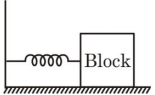
- A
$\sqrt{2}$
- ✓
$\frac{1}{\sqrt{2}}$
- C
$2$
- D
$\frac{1}{2}$
AnswerCorrect option: B. $\frac{1}{\sqrt{2}}$
b
$\omega=\sqrt{\frac{ k }{ m }}$
$\frac{\omega_2}{\omega_1}=\sqrt{\frac{ m _1}{ m _2}}=\sqrt{\frac{1}{2}}$
View full question & answer→MCQ 3361 Mark
Choose the correct length $( L )$ versus square of time period $\left( T ^2\right)$ graph for a simple pendulum executing simple harmonic motion.
Answerc
$T =2 \pi \sqrt{\frac{\ell}{ g }}$
$T ^2=\frac{4 \pi^2}{ g } \times \ell$
$T ^2 \propto \ell$
View full question & answer→MCQ 3371 Mark
For a periodic motion represented by the equation $Y=\sin \omega t+\cos \omega t$ The amplitude of the motion is
- A
$0.5$
- ✓
$\sqrt{2}$
- C
$9$
- D
$6$
AnswerCorrect option: B. $\sqrt{2}$
b
$y=\sin \omega t+\cos \omega t$
$y=\sin \omega t+\sin \left(\omega t+\frac{\pi}{2}\right)$
$\Delta \phi=\frac{\pi}{2}$
$A _{\text {net }}=\sqrt{1^2+1^2+2 \times 1 \times 1 \times \cos (\Delta \phi)}$
$A _{\text {met }}=\sqrt{2}$
View full question & answer→MCQ 3381 Mark
The general displacement of a simple harmonic oscillator is $x = A \sin \omega t$. Let $T$ be its time period. The slope of its potential energy (U) - time (t) curve will be maximum when $t=\frac{T}{\beta}$. The value of $\beta$ is $.........$
Answerd
$x = A \sin (\omega t )$
$U _{( x )}=\frac{1}{2} kx ^2$
$\frac{ dU }{ dt }=\frac{1}{2} k 2 x \frac{ dx }{ dt }$
$= kA ^2 \omega \sin \omega t\,\cos \omega t \times \frac{2}{2}$
$\left(\frac{ dU }{ dt }\right)_{\max }=\frac{ kA ^2 \omega}{2}(\sin 2 \omega t )_{\max }$
$2 \omega t =\frac{\pi}{2} \Rightarrow t =\frac{\pi}{4} \omega=\frac{ T }{8} \Rightarrow \beta=8$
View full question & answer→MCQ 3391 Mark
At a given point of time the value of displacement of a simple harmonic oscillator is given as $y = A \cos \left(30^{\circ}\right)$. If amplitude is $40\,cm$ and kinetic energy at that time is $200\, J$, the value of force constant is $1.0 \times 10^{ x }\,Nm ^{-1}$. The value of $x$ is ......
Answerc
General equation for displacement is given by
$x=A \sin (\omega t+\phi)$
$\text { at given time }$
$\Rightarrow \omega t+\phi=30^{\circ}$
$\Rightarrow x=40 \times \frac{\sqrt{3}}{2} \Rightarrow 20 \sqrt{3}\,cm$
$\Rightarrow A=40\,cm$
$\Rightarrow K . E=\frac{1}{2} k\left(A^2-x^2\right)=200$
$200=\frac{1}{2} k\left(\frac{1600-1200}{100 \times 100}\right)$
$400 \times 100 \times 100=k \times 400$
$k=10^4$
$x=4$
View full question & answer→MCQ 3401 Mark
A simple pendulum with length $100\,cm$ and bob of mass $250\,g$ is executing S.H.M. of amplitude $10\,cm$. The maximum tension in the string is found to be $\frac{x}{40}\,N$. The value of $x$ is $..........$.
Answerc
$\sin \theta_0=\frac{A}{l}=\frac{10}{100}=\frac{1}{10}$
From conservation of energy
$\frac{1}{2} m v^2=m g l(1-\cos \theta)$
Maximum tension occurs at mean position.
$\therefore T-m g=\frac{m v^2}{l}$
$\Rightarrow T=m g+\frac{m v^2}{l}$
$\therefore T=m g+2 m g(1-\cos \theta)$
$=m g\left[1+2\left(1-\sqrt{1-\sin ^2 \theta}\right)\right]$
$=m g\left[3-2 \sqrt{1-\frac{1}{100}}\right]$
$=\frac{250}{1000} \times 9.8\left[3-2\left(1-\frac{1}{200}\right)\right]=\frac{99}{40}$
$\therefore x=99$
View full question & answer→MCQ 3411 Mark
The displacement equations of two interfering waves are given by
$y_1 =10 \sin \left(\omega t+\frac{\pi}{3}\right) cm$
$y_2 =5[\sin (\omega t)+\sqrt{3} \cos \omega t] \;cm$ respectively.
The amplitude of the resultant wave is $.............cm$.
View full question & answer→MCQ 3421 Mark
The displacement of simple harmonic oscillator after $3$ seconds starting from its mean position is equal to half of its amplitude. The time period of harmonic motion is $\dots \; s$
Answerd
$X=A \sin \omega t\left(t=3, X=\frac{A}{2}\right)$
$\Rightarrow \frac{A}{2}=A \sin 3 \omega$
$\Rightarrow \sin 3 \omega=\frac{1}{2}$
$\Rightarrow 3 \omega=\frac{\pi}{6}$
$\Rightarrow \omega=\frac{\pi}{18}=\frac{2 \pi}{T}$
$\Rightarrow T=36 \; s$
View full question & answer→MCQ 3431 Mark
A particle executes simple harmonic motion. Its amplitude is $8 \,cm$ and time period is $6 \,s$. The time it will take to travel from its position of maximum displacement to the point corresponding to half of its amplitude, is ............. $s$
Answerc
$t =\frac{\Delta \phi}{\omega}=\frac{\pi / 2-\pi / 6}{2 \pi / 6}=\frac{\pi / 3}{\pi / 3}=1 \,sec$
View full question & answer→MCQ 3441 Mark
Two waves executing simple harmonic motion travelling in the same direction with same amplitude and frequency are superimposed. The resultant amplitude is equal to the $\sqrt{3}$ times of amplitude of individual motions. The phase difference between the two motions is $.....(degree)$
Answerc
$A _{\text {resultrant }}=\sqrt{ A _{1}^{2}+ A _{2}^{2}+2 A _{1} A _{2} \cos \phi}$
$\sqrt{3} A =\sqrt{ A ^{2}+ A ^{2}+2 A ^{2} \cos \phi}$
$3 A ^{2}=2 A ^{2}+2 A ^{2} \cos \phi$
$\cos \phi=\frac{1}{2}$
$\therefore \phi=60^{\circ}$
$\therefore \text { Phase difference }=60 \text { degree }$
View full question & answer→MCQ 3451 Mark
The equation of a particle executing simple harmonic motion is given by $x =\sin \pi\left( t +\frac{1}{3}\right) m$. At $t =1 \,s$, the speed of particle will be .......... $cm s ^{-1}$ (Given : $\pi=3.14$ )
Answerb
$x =\sin \pi\left( t +\frac{1}{3}\right)$
$x =\sin \left(\pi t +\frac{\pi}{3}\right)$
$V =\frac{ dx }{ dt }=\cos \left(\pi t +\frac{\pi}{3}\right) \pi$
$=-\pi \times \frac{1}{2}=157 \,cm / s$
View full question & answer→MCQ 3461 Mark
When a particle executes simple Harmonic motion, the nature of graph of velocity as function of displacement will be.
Answerb
For a particle in SHM, its speed depends on position as
$v=\omega \sqrt{A^{2}-x^{2}}$
Where $\omega$ is angular frequency and $A$ is amplitude Now $v ^{2}=\omega^{2} A ^{2}-\omega^{2} x ^{2}$
So, $\frac{ v ^{2}}{(\omega A )^{2}}+\frac{ x ^{2}}{( A )^{2}}=1$
So graph between $v$ and $x$ is elliptical
View full question & answer→MCQ 3471 Mark
In figure $(A),$ mass ' $2 m$ ' is fixed on mass ' $m$ ' which is attached to two springs of spring constant $k$. In figure $(B),$ mass ' $m$ ' is attached to two spring of spring constant ' $k$ ' and ' $2 k$ '. If mass ' $m$ ' in $(A)$ and $(B)$ are displaced by distance ' $x$ ' horizontally and then released, then time period $T_{1}$ and $T_{2}$ corresponding to $(A)$ and $(B)$ respectively follow the relation.
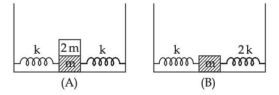
- ✓
$\frac{T_{1}}{T_{2}}=\frac{3}{\sqrt{2}}$
- B
$\frac{ T _{1}}{ T _{2}}=\sqrt{\frac{3}{2}}$
- C
$\frac{ T _{1}}{ T _{2}}=\sqrt{\frac{2}{3}}$
- D
$\frac{ T _{1}}{ T _{2}}=\frac{\sqrt{2}}{3}$
AnswerCorrect option: A. $\frac{T_{1}}{T_{2}}=\frac{3}{\sqrt{2}}$
a
$T _{1}=2 \pi \sqrt{\frac{3 m }{2 k }}$
$T _{2}=2 \pi \sqrt{\frac{ m }{3 k }}$
$\frac{ T _{1}}{ T _{2}}=\frac{2 \pi \sqrt{\frac{3 m }{2 k }}}{2 \pi \sqrt{\frac{ m }{3 k }}}=\frac{3}{\sqrt{2}}$
View full question & answer→MCQ 3481 Mark
As per given figures, two springs of spring constants $K$ and $2\,K$ are connected to mass $m$. If the period of oscillation in figure $(a)$ is $3 s$, then the period of oscillation in figure $(b)$ will be $\sqrt{ x }$ s. The value of $x$ is$.........$
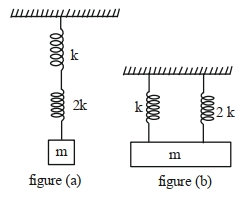
Answerd
For figure $(a):$
$K _{\text {oq }}=\frac{ K \times 2 K }{ K +2 K }=\frac{2 K }{3}$
$T =2 \pi \sqrt{\frac{ m }{ K _{ eq }}}=2 \pi \sqrt{\frac{ m }{2 K / 3}}=2 \pi \sqrt{\frac{3 m }{2 K }}$
For figure $(b):$
$K _{ eq }=3 K , T ^{\prime}=2 \pi \sqrt{\frac{ m }{3 K }}$
$\frac{ T ^{\prime}}{ T }=\sqrt{\frac{ m \times 2 K }{3 K \times 3 m }}=\frac{\sqrt{2}}{3}$
$T ^{\prime}=\sqrt{2}$
$x =2$
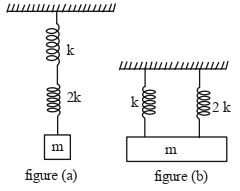
View full question & answer→MCQ 3491 Mark
Time period of a simple pendulum in a stationary lift is ' $T$ '. If the lift accelerates with $\frac{ g }{6}$ vertically upwards then the time period will be .....
(where $g =$ acceleration due to gravity)
- A
$\sqrt{\frac{6}{5}} T$
- B
$\sqrt{\frac{5}{6}} T$
- ✓
$\sqrt{\frac{6}{7}} T$
- D
$\sqrt{\frac{7}{6}} T$
AnswerCorrect option: C. $\sqrt{\frac{6}{7}} T$
c
$T =2 \pi \sqrt{\frac{\ell}{ g _{\text {eff }}}}$
$(a)$ when $a =0, T =2 \pi \sqrt{\frac{\ell}{ g }}$
$(b)$ when $a =\frac{ g }{6}, T ^{\prime}=2 \pi \sqrt{\frac{\ell}{ g +\frac{ g }{6}}}$
$\therefore T ^{\prime}=\sqrt{\frac{6}{7}} T$

View full question & answer→MCQ 3501 Mark
A pendulum is suspended by a string of length $250\,cm$. The mass of the bob of the pendulum is $200\,g$. The bob is pulled aside until the string is at $60^{\circ}$ with vertical as shown in the figure. After releasing the bob. the maximum velocity attained by the bob will be________ $ms ^{-1}$. (if $g=10\,m / s ^{2}$ )
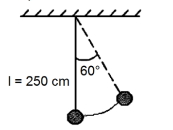
Answera
$V _{\max }=\sqrt{2 gh }$
The speed will be highest at the lowest position.
$h =\left(\ell-\ell \cos 60^{\circ}\right)=\frac{\ell}{2}$
$V _{\max }=\sqrt{2 \times g \times \frac{\ell}{2}}=\sqrt{10 \times 2.5}=5\,m / s$
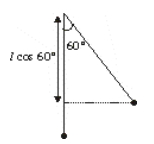
View full question & answer→MCQ 3511 Mark
The motion of a simple pendulum excuting $S.H.M$. is represented by following equation.
$Y = A \sin (\pi t +\phi)$, where time is measured in $second$.
The length of pendulum is .............$cm$
- A
$97.23$
- B
$25.3$
- ✓
$99.4$
- D
$406.1$
AnswerCorrect option: C. $99.4$
c
$\omega=\sqrt{\frac{ g }{\ell}}=\pi$
$\frac{ g }{\ell}=\pi^{2} \Rightarrow \ell=\frac{ g }{\pi^{2}}$
$\ell=\frac{980}{\pi^{2}} \approx 99.4 \,cm$
View full question & answer→MCQ 3521 Mark
The length of a seconds pendulum at a height $h=2 R$ from earth surface will be.(Given: $R =$ Radius of earth and acceleration due to gravity at the surface of earth $g =\pi^{2}\,m / s ^{-2}$ )
- A
$\frac{2}{9}\,m$
- B
$\frac{4}{9}\,m$
- C
$\frac{8}{9}\,m$
- ✓
$\frac{1}{9}\,m$
AnswerCorrect option: D. $\frac{1}{9}\,m$
d
$T =2 \pi \sqrt{\frac{ L }{ g }}, \quad g ^{\prime}=\frac{ GM }{9 R ^{2}}=\frac{ g }{9}=\frac{\pi^{2}}{9}$
$2=2 \pi \sqrt{\frac{ L }{\pi^{2}} \times 9}$
$1=\pi \sqrt{ L } \times \frac{3}{\pi} \Rightarrow L =\frac{1}{9}\,m$
View full question & answer→MCQ 3531 Mark
The metallic bob of simple pendulum has the relative density $5$. The time period of this pendulum is $10\,s$. If the metallic bob is immersed in water, then the new time period becomes $5 \sqrt{ x } s$. The value of $x$ will be.
Answerb
$g^{\prime}=\frac{m g-F_{B}}{m}$
$=\frac{\rho_{B} V g-\rho_{\pi} V g}{\rho_{B} V}$
$=\left(\frac{\rho_{B}-\rho_{\pi}}{\rho_{B}}\right) g \quad T=2 \pi \sqrt{\frac{\ell}{g}}$
$=\frac{5-1}{5} \times g$
$=\frac{4}{5} g$
$\frac{T^{\prime}}{T^{\prime}}=\sqrt{\frac{g}{g^{\prime}}}=\sqrt{\frac{g}{5} g}=\sqrt{\frac{5}{4}}$
$T^{\prime}=T \sqrt{\frac{5}{4}}=\frac{10}{2} \sqrt{5}$
$T^{\prime}=5 \sqrt{5}$
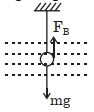
View full question & answer→MCQ 3541 Mark
Two massless springs with spring constants $2\,k$ and $2\,k$, carry $50\, g$ and $100 \,g$ masses at their free ends. These two masses oscillate vertically such that their maximum velocities are equal. Then, the ratio of their respective amplitudes will be
- A
$1: 2$
- ✓
$3: 2$
- C
$3: 1$
- D
$2: 3$
AnswerCorrect option: B. $3: 2$
b
$V _{\max }=\omega A$
$\Rightarrow \frac{ A _{1}}{ A _{2}}=\frac{\omega_{2}}{\omega_{1}}=\sqrt{\frac{9}{2} \times \frac{1}{2}}=\frac{3}{2}$
View full question & answer→MCQ 3551 Mark
A body is performing simple harmonic with an amplitude of $10 \,cm$. The velocity of the body was tripled by air Jet when it is at $5 \,cm$ from its mean position. The new amplitude of vibration is $\sqrt{ x } \,cm$. The value of $x$ is________
Answerd
$A =10 \,cm$
$\therefore$ Total Energy $=\frac{1}{2} KA ^{2}$
By energy conservation we can final $v$ at $x =5$
$\frac{1}{2} K (10)^{2}=\frac{1}{2} K (5)^{2}+\frac{1}{2} mv ^{2}$
$V =\sqrt{\frac{75 K }{ m }}$
Now, velocity is tripled through external mean so the amplitude of $SHM$ will charge and so the total energy, (but potential) energy at this moment will remain same)
$\therefore \frac{1}{2} K (5)^{2}+\frac{1}{2} m \left(3 \sqrt{\frac{75 K }{ m }}\right)^{2}=\frac{1}{2} KA ^{2}$
$\Rightarrow 25 K +675 K = KA ^{2}$
$\therefore A =\sqrt{700}$
$\therefore x =700$
View full question & answer→MCQ 3561 Mark
A mass $0.9\,kg$, attached to a horizontal spring, executes $SHM$ with an amplitude $A _{1}$. When this mass passes through its mean position, then a smaller mass of $124\,g$ is placed over it and both masses move together with amplitude $A _{2}$. If the ratio $\frac{ A _{1}}{ A _{2}}$ is $\frac{\alpha}{\alpha-1}$, then the value of $\alpha$ will be$......$
Answerc
$\frac{1}{2} kA ^{2}=\frac{ p ^{2}}{2\,m }$
$\Rightarrow\left(\frac{ A _{1}}{ A _{2}}\right)^{2}=\frac{ m _{2}}{ m _{1}}=\frac{1024}{900}$
$\Rightarrow \frac{ A _{1}}{ A _{2}}=\frac{32}{30}=\frac{16}{15}=\frac{16}{16-1}$
$\therefore \alpha=16$
View full question & answer→MCQ 3571 Mark
The potential energy of a particle of mass $4\,kg$ in motion along the $x$-axis is given by $U =4(1-\cos 4 x )\,J$. The time period of the particle for small oscillation $(\sin \theta \simeq \theta)$ is $\left(\frac{\pi}{ K }\right)\,s$. The value of $K$ is .......
Answera
$U =4(1-\cos 4 x )$
$F =-\frac{ dU }{ dx }=-4(+\sin 4 x ) 4=-16 \sin (4 x )$
For small $\theta$
$\sin \theta \approx \theta$
$F=-64\,x$
$a=-64\,x / m=-16\,x$
$\omega^{2}=16$
$T =\frac{2 \pi}{\omega}=\frac{\pi}{2}$
View full question & answer→MCQ 3581 Mark
A particle performs simple harmonic motion with a period of $2$ second. The time taken by the particle to cover a displacement equal to half of its amplitude from the mean position is $\frac{1}{ a } s .$ The value of $'a'$ to the nearest integer is.........
Answera
$t =\frac{2}{12}=\frac{1}{6}$
$\therefore$ Correct answer $=6.00$
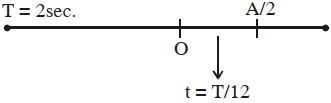
View full question & answer→MCQ 3591 Mark
When a particle executes $SHM$ the nature of graphical representation of velocity as a function of displacement is :
Answerb
For a particle executing SHM,
$x = A \sin (\omega t +\phi)$
$v =\omega A \cos (\omega t +\phi)$
$\Rightarrow \frac{ v ^{2}}{\omega^{2} A ^{2}}+\frac{ x ^{2}}{ A ^{2}}=1 \Rightarrow$ equation of ellipse between $v$ and $x.$
View full question & answer→MCQ 3601 Mark
A particle executes $S.H.M.,$ the graph of velocity as a function of displacement is :-
Answerc
$v ^{2}=\omega^{2}\left( A ^{2}- x ^{2}\right)$
$\frac{ v ^{2}}{\omega^{2}}+ x ^{2}= A ^{2}$
$\frac{ v ^{2}}{(\omega A )^{2}}+\frac{ x ^{2}}{ A ^{2}}=1$
This is an equation of an ellipse.
View full question & answer→MCQ 3611 Mark
A particle executes $S.H.M.$ with amplitude $'a'$ and time period $V$. The displacement of the particle when its speed is half of maximum speed is $\frac{\sqrt{ x } a }{2} .$ The value of $x$ is $\ldots \ldots \ldots$
Answerd
$V =\omega \sqrt{ A ^{2}- x ^{2}} \quad V _{\max }= A\omega$
$\frac{ A\omega }{2}=\omega \sqrt{ A ^{2}- x ^{2}}$
$\frac{ A ^{2}}{4}= A ^{2}- x ^{2}$
$x ^{2}=\frac{3 A ^{2}}{4}$
$x =\frac{\sqrt{3}}{2} \,A$
View full question & answer→MCQ 3621 Mark
A particle executes simple harmonic motion represented by displacement function as $x(t)=A \sin (\omega t+\phi)$
If the position and velocity of the particle at $t=0\, {s}$ are $2\, {cm}$ and $2\, \omega \,{cm} \,{s}^{-1}$ respectively, then its amplitude is $x \sqrt{2} \,{cm}$ where the value of $x$ is ..... .
Answerc
As given
$v(t)=A \omega \cos (\omega t+\phi)$
$2=A \sin \phi.....(1)$
$2 \omega=A \omega \cos \phi.....(2)$
From $(1)$ and $(2)$
$\tan \phi=1$
$\phi=45^{\circ}$
Putting value of $\phi$ in equation $(1)$
$2=A\left\{\frac{1}{\sqrt{2}}\right\}$
$A=2 \sqrt{2}$
$x=2$
View full question & answer→MCQ 3631 Mark
The kinetic energy and potential energy of a particle executing simple harmonic motion will be equal, when displacement (amplitude = $a$) is
- A
$\frac{a}{2}$
- B
$a\sqrt 2 $
- ✓
$\frac{a}{{\sqrt 2 }}$
- D
$\frac{{a\sqrt 2 }}{3}$
AnswerCorrect option: C. $\frac{a}{{\sqrt 2 }}$
c
(c) Suppose at displacement $y$ from mean position potential energy = kinetic energy
==> $\frac{1}{2}m({a^2} - {y^2}){\omega ^2} = \frac{1}{2}m{\omega ^{\rm{2}}}{y^2}$
==> ${a^2} = 2{y^2}$
==> $y = \frac{a}{{\sqrt 2 }}$
View full question & answer→MCQ 3641 Mark
A particle starts simple harmonic motion from the mean position. Its amplitude is $a$ and total energy $E$. At one instant its kinetic energy is $3E/4.$ Its displacement at that instant is
- A
${y}={a}$
- ✓
$y=\frac{a}{2}$
- C
$y=\frac{a \sqrt{3}}{2}$
- D
$y=\frac{a}{\sqrt{2}}$
AnswerCorrect option: B. $y=\frac{a}{2}$
b
(b) $\frac{K}{E} = \frac{{\frac{1}{2}m{\omega ^2}({a^2} - {y^2})}}{{\frac{1}{2}m{\omega ^2}{a^2}}}$
$= \frac{{{a^2} - {y^2}}}{{{a^2}}} $
$= 1 - \frac{{{y^2}}}{{{a^2}}}$
So, $\frac{{\left( {\frac{{3E}}{4}} \right)}}{E} = 1 - \frac{{{y^2}}}{{{a^2}}}$
$\Rightarrow \frac{{{y^2}}}{{{a^2}}} = 1 - \frac{3}{4} = \frac{1}{4}$
$ \Rightarrow y = \frac{a}{2}$.
View full question & answer→MCQ 3651 Mark
The variation of displacement with time of a particle executing free simple harmonic motion is shown in the figure. The potential energy ${U}({x})$ versus time $({t})$ plot of the particle is correctly shown in figure:
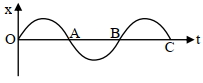
Answerd
Potential energy is maximum at maximum distance from mean.
View full question & answer→MCQ 3661 Mark
For a body executing $S.H.M. :$
$(a)$ Potential energy is always equal to its $K.E.$
$(b)$ Average potential and kinetic energy over any given time interval are always equal.
$(c)$ Sum of the kinetic and potential energy at any point of time is constant.
$(d)$ Average $K.E.$ in one time period is equal to average potential energy in one time period.
Choose the most appropriate option from the options given below:
- ✓
$(c)$ and $(d)$
- B
only $(c)$
- C
$(b)$ and $(c)$
- D
only $(b)$
AnswerCorrect option: A. $(c)$ and $(d)$
a
In $S.H.M.$ total mechanical energy remains constant and also $<{K} . {E} .>=<{P} . {E}>=\frac{1}{4} {KA}^{2}$
(for $1$ time period)
View full question & answer→MCQ 3671 Mark
In a simple harmonic oscillation, what fraction of total mechanical energy is in the form of kinetic energy, when the particle is midway between mean and extreme position.
- A
$\frac{1}{4}$
- B
$\frac{1}{3}$
- ✓
$\frac{3}{4}$
- D
$\frac{1}{2}$
AnswerCorrect option: C. $\frac{3}{4}$
c
$K =\frac{1}{2} m \omega^{2}\left( A ^{2}- x ^{2}\right)$
$=\frac{1}{2} m \omega^{2}\left( A ^{2}-\frac{ A ^{2}}{4}\right)$
$=\frac{1}{2} m \omega^{2}\left(\frac{3 A ^{2}}{4}\right)$
$K =\frac{3}{4}\left(\frac{1}{2} m \omega^{2} A ^{2}\right)$
View full question & answer→MCQ 3681 Mark
An object of mass $0.5\, {kg}$ is executing simple harmonic motion. Its amplitude is $5\, {cm}$ and time period (T) is $0.2\, {s} .$ What will be the potential energy of the object at an instant $t=\frac{T}{4}$ s starting from mean position. Assume that the initial phase of the oscillation is zero. (In ${J}$)
- A
$1.2$
- ✓
$0.62$
- C
$6.2$
- D
$620$
AnswerCorrect option: B. $0.62$
b
by using formula of time period
$T=2 \pi \sqrt{\frac{m}{k}}$
$0.2=2 \pi \sqrt{\frac{0.5}{k}}$
$k=50 \pi^{2}$
$\approx 500$
$x=A\, \sin (\omega t+\phi)$
$=5\, c m\, \sin \left(\frac{\omega t}{4}+0\right)$
$=5\, {cm} \sin \left(\frac{\pi}{2}\right)$
$=5 \,{cm}$
$P E=\frac{1}{2} k x^{2}$
$=\frac{1}{2}(500)\left(\frac{5}{100}\right)^{2}$
$=0.6255$
View full question & answer→MCQ 3691 Mark
Consider two identical springs each of spring constant $k$ and negligible mass compared to the mass $M$ as shown. Fig. $1$ shows one of them and Fig. $2$ shows their series combination. The ratios of time period of oscillation of the two $SHM$ is $\frac{ T _{ b }}{ T _{ a }}=\sqrt{ x },$ where value of $x$ is
(Round off to the Nearest Integer)
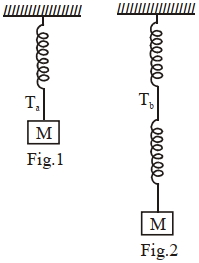
Answerb
$T _{ a }=2 \pi \sqrt{\frac{ M }{ K }}$
$T _{ b }=2 \pi \sqrt{\frac{ M }{ K / 2}}$
$\frac{ T _{ b }}{ T _{ a }}=\sqrt{2}=\sqrt{ x }$
$\Rightarrow x =2$
View full question & answer→MCQ 3701 Mark
Two particles $A$ and $B$ of equal masses are suspended from two massless springs of spring constants $K _{1}$ and $K _{2}$ respectively.If the maximum velocities during oscillations are equal, the ratio of the amplitude of $A$ and $B$ is
- A
$\frac{ K _{2}}{ K _{1}}$
- B
$\frac{ K _{1}}{ K _{2}}$
- C
$\sqrt{\frac{ K _{1}}{ K _{2}}}$
- ✓
$\sqrt{\frac{ K _{2}}{ K _{1}}}$
AnswerCorrect option: D. $\sqrt{\frac{ K _{2}}{ K _{1}}}$
d
$A _{1} \omega_{1}= A _{2} \omega_{2}$
$A_{1} \sqrt{\frac{k_{1}}{m}}=A_{2} \sqrt{\frac{k_{2}}{m}}$
$\frac{ A _{1}}{ A _{2}}=\sqrt{\frac{ k _{2}}{ k _{1}}}$
View full question & answer→MCQ 3711 Mark
In the given figure, a mass $M$ is attached to a horizontal spring which is fixed on one side to a rigid support. The spring constant of the spring is $k$. The mass oscillates on a frictionless surface with time period $T$ and amplitude $A$. When the mass is in equilibrium position, as shown in the figure, another mass $m$ is gently fixed upon it. The new amplitude of oscillation will be
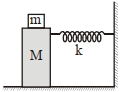
- A
$A \sqrt{\frac{M-m}{M}}$
- ✓
$A \sqrt{\frac{M}{M+m}}$
- C
$A \sqrt{\frac{M+m}{M}}$
- D
$A \sqrt{\frac{M}{M-m}}$
AnswerCorrect option: B. $A \sqrt{\frac{M}{M+m}}$
b
Momentum of system remains conserved.
$p_{i}=p_{i}$
$MA \omega=( m + M ) A ^{\prime} \omega^{\prime}$
$M A \sqrt{\frac{k}{M}}=(m+M) A^{\prime} \sqrt{\frac{k}{m+M}}$
$A ^{\prime}= A \sqrt{\frac{ M }{ M + m }}$
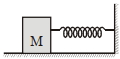
View full question & answer→MCQ 3721 Mark
If two similar springs each of spring constant $K _{1}$ are joined in series, the new spring constant and time period would be changed by a factor
- ✓
$\frac{1}{2}, \sqrt{2}$
- B
$\frac{1}{4}, \sqrt{2}$
- C
$\frac{1}{4}, 2 \sqrt{2}$
- D
$\frac{1}{2}, 2 \sqrt{2}$
AnswerCorrect option: A. $\frac{1}{2}, \sqrt{2}$
a
$\frac{1}{k_{e q}}=\frac{1}{k_{1}}+\frac{1}{k_{2}}$
$\frac{1}{k_{e q}}=\frac{1}{k}+\frac{1}{k} \Rightarrow k_{e q}=\frac{k}{2}$
$k^{\prime}=\frac{k}{2}$
$T =2 \pi \sqrt{\frac{ M }{ k }} \quad T ^{\prime}=2 \pi \sqrt{\frac{ M }{ k ^{\prime}}}$
$\Rightarrow T ^{\prime}=2 \pi \sqrt{\frac{ M }{ k }} \times \sqrt{2}$
$T^{\prime}=\sqrt{2} T$
View full question & answer→MCQ 3731 Mark
Two identical springs of spring constant $'2k'$ are attached to a block of mass $m$ and to fixed support (see figure). When the mass is displaced from equilibrium position on either side, it executes simple harmonic motion. The time period of oscillations of this sytem is ...... .
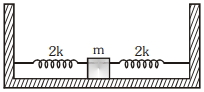
- A
$2 \pi \sqrt{\frac{ m }{ k }}$
- B
$\pi \sqrt{\frac{ m }{2 k }}$
- C
$2 \pi \sqrt{\frac{ m }{2 k }}$
- ✓
$\pi \sqrt{\frac{ m }{ k }}$
AnswerCorrect option: D. $\pi \sqrt{\frac{ m }{ k }}$
d
For parallel combination $k _{ eq }= k _{1}+ k _{2}$
$k_{e q}=4 k$
$T =2 \pi \sqrt{\frac{ m }{ k _{ eq }}}$
View full question & answer→MCQ 3741 Mark
Time period of a simple pendulum is $T$ inside a lift when the lift is stationary. If the lift moves upwards with an acceleration $g / 2,$ the time period of pendulum will be
- A
$\sqrt{3} T$
- B
$\frac{ T }{\sqrt{3}}$
- C
$\sqrt{\frac{3}{2}} T$
- ✓
$\sqrt{\frac{2}{3}} T$
AnswerCorrect option: D. $\sqrt{\frac{2}{3}} T$
d
When lift is stationary
$T =2 \pi \sqrt{\frac{ L }{ g }}$
When lift is moving upwards $\Rightarrow$ Pseudo force acts downwards
$\Rightarrow g _{ eff }= g +\frac{ g }{2}=\frac{3 g }{2}$
$\Rightarrow$ New time period
$T ^{4}=2 \pi \sqrt{\frac{ L }{ g _{ eff }}}=2 \pi \sqrt{\frac{2 L }{3 g }}$
$T ^{\prime}=\sqrt{\frac{2}{3}} T$
View full question & answer→MCQ 3751 Mark
If the time period of a two meter long simple pendulum is $2\, s$, the acceleration due to gravity at the place where pendulum is executing $S.H.M.$ is
- A
$\pi^{2}\, ms ^{-2}$
- B
$9.8\, ms ^{-2}$
- ✓
$2 \pi^{2}\, ms ^{-2}$
- D
$16\, m / s ^{2}$
AnswerCorrect option: C. $2 \pi^{2}\, ms ^{-2}$
c
$T =2 \pi \sqrt{\frac{l}{ g }}$
$2=2 \pi \sqrt{\frac{2}{ g }}$
$\Rightarrow g =2 \pi^{2}$
View full question & answer→MCQ 3761 Mark
Given below are two statements:
Statement $I :$ A second's pendulum has a time period of $1$ second.
Statement $II :$ It takes precisely one second to move between the two extreme positions.
In the light of the above statements, choose the correct answer from the options given below:
- A
Both Statement $I$ and Statement $II$ are false.
- ✓
Statement $I$ is false but Statement $II$ is true
- C
Statement $I$ is true but Statement $II$ is false
- D
Both Statement $I$ and Statement $II$ are true.
AnswerCorrect option: B. Statement $I$ is false but Statement $II$ is true
b
Second pendulum has a time period of $2\, sec$ so statement $1$ is false but from one extreme to other it takes only half the time period so statement $2$ is true.
View full question & answer→MCQ 3771 Mark
A pendulum bob has a speed of $3\, {m} / {s}$ at its lowest position. The pendulum is $50 \,{cm}$ long. The speed of bob, when the length makes an angle of $60^{\circ}$ to the vertical will be $ .......\,{m} / {s}$ $\left(g=10 \,{m} / {s}^{2}\right)$
Answerd
Applylng work energy theorem
$w _{ g }+ w _{ T }=\Delta K$
$- mgl \left(1-\cos 60^{\circ}\right)=\frac{1}{2} mv ^{2}-\frac{1}{2} mu ^{2}$
$v ^{2}= u ^{2}-2 gl \left(1-\cos 60^{\circ}\right)$
$v ^{2}=9-2 \times 10 \times 0.5\left(\frac{1}{2}\right)$
$v ^{2}=4$
$v =2 m / s$
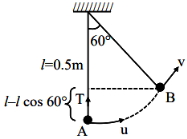
View full question & answer→MCQ 3781 Mark
Two simple harmonic motions are represented by the equations
${x}_{1}=5 \sin \left(2 \pi {t}+\frac{\pi}{4}\right)$ and ${x}_{2}=5 \sqrt{2}(\sin 2 \pi {t}+\cos 2 \pi {t})$
The amplitude of second motion is ....... times the amplitude in first motion.
Answerb
${x}_{2}=5 \sqrt{2}\left(\frac{1}{\sqrt{2}} \sin 2 \pi {t}+\frac{1}{\sqrt{2}} \cos 2 \pi {t}\right) \sqrt{2}$
$=10 \sin \left(2 \pi {t}+\frac{\pi}{4}\right)$
$\therefore \frac{{A}_{2}}{{A}_{1}}=\frac{10}{5}=2$
View full question & answer→MCQ 3791 Mark
Two simple harmonic motion, are represented by the equations ${y}_{1}=10 \sin \left(3 \pi {t}+\frac{\pi}{3}\right)$
$y_{2}=5(\sin 3 \pi t+\sqrt{3} \cos 3 \pi t)$
Ratio of amplitude of ${y}_{1}$ to ${y}_{2}={x}: 1$. The value of ${x}$ is ...... .
Answerb
${y}_{1}=10 \sin \left(3 \pi {t}+\frac{\pi}{3}\right) \Rightarrow \text { Amplitude }=10$
${y}_{2}=5(\sin 3 \pi {t}+\sqrt{3} \cos 3 \pi {t})$
${y}_{2}=10\left(\frac{1}{2} \sin 3 \pi {t}+\frac{\sqrt{3}}{2} \cos 3 \pi {t}\right)$
${y}_{2}=10\left(\cos \frac{\pi}{3} \sin 3 \pi {t}+\sin \frac{\pi}{3} \cos 3 \pi {t}\right)$
${y}_{2}=10 \sin \left(3 \pi {t}+\frac{\pi}{3}\right) \Rightarrow \text { Amplitude }=10$
So ratio of amplitudes $=\frac{10}{10}=1$
View full question & answer→MCQ 3801 Mark
${T}_{0}$ is the time period of a simple pendulum at a place. If the length of the pendulum is reduced to $\frac{1}{16}$ times of its initial value, the modified time
- A
$8 \pi {T}_{0}$
- B
$4 {T}_{0}$
- C
${T}_{0}$
- ✓
$\frac{1}{4} T_{0}$
AnswerCorrect option: D. $\frac{1}{4} T_{0}$
d
Time period of a simple pendulum
${T}_{0}=2 \pi \sqrt{\frac{\ell}{{g}}}$
New time period ${T}=\sqrt[2 \pi]{\frac{\ell / 16}{{g}}}=\frac{2 \pi}{4} \sqrt{\frac{\ell}{{g}}}$
${T}=\frac{{T}_{0}}{4}$
View full question & answer→MCQ 3811 Mark
$Y = A \sin \left(\omega t +\phi_{0}\right)$ is the time-displacement equation of a SHM. At $t=0$ the displacement of the particle is $Y =\frac{ A }{2}$ and it is moving along negative $x$ -direction. Then the initial phase angle $\phi_{0}$ will be ...... .
- A
$\frac{\pi}{6}$
- B
$\frac{\pi}{3}$
- ✓
$\frac{5 \pi}{6}$
- D
$\frac{2 \pi}{3}$
AnswerCorrect option: C. $\frac{5 \pi}{6}$
c
initial phase $\frac{\pi}{2}+\frac{\pi}{3}=\frac{5 \pi}{6}$
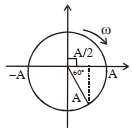
View full question & answer→MCQ 3821 Mark
The point $A$ moves with a uniform speed along the circumference of a circle of radius $0.36\, m$ and covers $30^{\circ}$ in $0.1\, s$. The perpendicular projection $'P'$ from $'A'$ on the diameter $MN$ represents the simple harmonic motion of $'P'.$ The restoration force per unit mass when $P$ touches $M$ will be ...... $N$
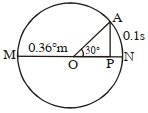
- A
$100$
- B
$0.49$
- C
$50$
- ✓
$9.87$
AnswerCorrect option: D. $9.87$
d
$30^{\circ} \rightarrow 0.1\, s$
$360^{\circ} \rightarrow 1.2 \,s = T$
$\omega=\frac{2 \pi}{ T }=\frac{5 \pi}{3}$
At $M , F = m \omega^{2}\, A \Rightarrow \frac{ F }{ m }=\omega^{2}\, A$
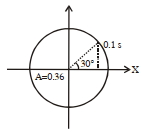
View full question & answer→MCQ 3831 Mark
Time period of a simple pendulum is $T$. The time taken to complete $5 / 8$ oscillations starting from mean position is $\frac{\alpha}{\beta} T$. The value of $\alpha$ is ..... .
Answerc
$\frac{5}{8}$ th of oscillation $=\left(\frac{1}{2}+\frac{1}{8}\right)^{\text {th }}$ of oscillation
$\pi+\theta=\omega t$
$\pi+\frac{\pi}{6}=\left(\frac{2 \pi}{T}\right) t$
$\frac{7 \pi}{6}=\left(\frac{2 \pi}{T}\right) t$
$t=\frac{7 T}{12}$
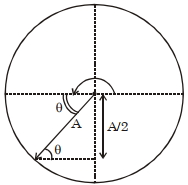
View full question & answer→MCQ 3841 Mark
A particle of mass $1\, {kg}$ is hanging from a spring of force constant $100\, {Nm}^{-1 .}$ The mass is pulled slightly downward and released so that it executes free simple harmonic motion with time period ${T}$. The time when the kinetic energy and potential energy of the system will become equal, is $\frac{{T}}{{x}}$. The value of ${x}$ is ..... .
Answerc
${KE}={PE}$
${y}=\frac{{A}}{\sqrt{2}}={A} \sin \omega {t}$
${t}=\frac{{T}}{8}=\frac{{T}}{{x}}$
$x=8$
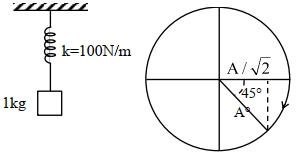
View full question & answer→MCQ 3851 Mark
The function of time representing a simple harmonic motion with a period of $\frac{\pi}{\omega}$ is :
- A
$\sin (\omega t)+\cos (\omega t)$
- B
$\cos (\omega t)+\cos (2 \omega t)+\cos (3 \omega t)$
- C
$\sin ^{2}(\omega t)$
- ✓
$3 \cos \left(\frac{\pi}{4}-2 \omega t\right)$
AnswerCorrect option: D. $3 \cos \left(\frac{\pi}{4}-2 \omega t\right)$
d
Time period $T =\frac{2 \pi}{\omega^{\prime}}$
$\frac{\pi}{\omega}=\frac{2 \pi}{\omega^{\prime}}$
$\omega^{\prime}=2 \omega \rightarrow$ Angular frequency of $SHM$
Option $(3):$
$\sin ^{2} \omega t=\frac{1}{2}\left(2 \sin ^{2} \omega t\right)=\frac{1}{2}(1-\cos 2 \omega t)$
Angular frequency of $\left(\frac{1}{2}-\frac{1}{2} \cos 2 \omega t\right)$ is $2 \omega$
Option $(4):$
Angular frequency of $SHM$
$3 \cos \left(\frac{\pi}{4}-2 \omega t\right)$ is $2 \omega$
So option $(3)\, \& (4)$ both have angular frequency $2 \omega$ but option $(4)$ is direct answer.
View full question & answer→MCQ 3861 Mark
Assume that a tunnel is dug along a chord of the earth, at a perpendicular distance $( R / 2)$ from the earth's centre, where $'R'$ is the radius of the Earth. The wall of the tunnel is frictionless. If a particle is released in this tunnel, it will execute a simple harmonic motion with a time period
AnswerCorrect option: D. $2 \pi \sqrt{\frac{ R }{ g }}$
d
Force along the tunnel
$F =-\left(\frac{ GMmr }{ R ^{3}}\right) \cos \theta$
$F =-\frac{ gm }{ R } x \left(\frac{ GM }{ R ^{2}}= g , r \cos \theta= x \right)$
$a=-\frac{g}{R} x$
$\omega^{2}=\frac{g}{R} \quad T=2 \pi \sqrt{\frac{R}{g}}$
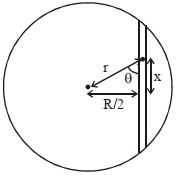
View full question & answer→MCQ 3871 Mark
In the given figure, a body of mass $M$ is held between two massless springs, on a smooth inclined plane. The free ends of the springs are attached to firm supports. If each spring has spring constant $k,$ the frequency of oscillation of given body is :
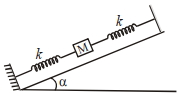
- A
$\frac{1}{2 \pi} \sqrt{\frac{ k }{2 M }}$
- B
$\frac{1}{2 \pi} \sqrt{\frac{2 k }{ Mg \sin \alpha}}$
- ✓
$\frac{1}{2 \pi} \sqrt{\frac{2 k }{ M }}$
- D
$\frac{1}{2 \pi} \sqrt{\frac{ k }{ Mg \sin \alpha}}$
AnswerCorrect option: C. $\frac{1}{2 \pi} \sqrt{\frac{2 k }{ M }}$
c
$K _{ eq }= K _{1}+ K _{2}= K + K =2 K$
$T =2 \pi \sqrt{\frac{ m }{ K _{ eq }}}=2 \pi \sqrt{\frac{ m }{2 K }}$
$f =\frac{1}{ T }=\frac{1}{2 \pi} \sqrt{\frac{2 K }{ m }}$
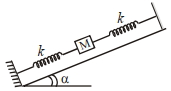
View full question & answer→MCQ 3881 Mark
A mass of $5\, {kg}$ is connected to a spring. The potential energy curve of the simple harmonic motion executed by the system is shown in the figure. A simple pendulum of length $4\, {m}$ has the same period of oscillation as the spring system. What is the value of acceleration due to gravity on the planet where these experiments are performed? (In ${m} / {s}^{2}$)
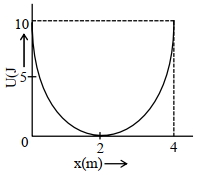
Answerc
From potential energy curve
${U}_{\max }=\frac{1}{2} {kA}^{2} \Rightarrow 10=\frac{1}{2} {k}(2)^{2}$
$\Rightarrow {k}=5$
Now ${T}_{\text {spring }}={T}_{\text {pendulum }}$
$2 \pi \sqrt{\frac{5}{5}}=2 \pi \sqrt{\frac{4}{g}}$
$\Rightarrow 1=\sqrt{\frac{4}{g}} \Rightarrow g=4 \text { on planet }$
View full question & answer→MCQ 3891 Mark
The motion of a mass on a spring, with spring constant ${K}$ is as shown in figure. The equation of motion is given by $x(t)= A sin \omega t+ Bcos\omega t$ with $\omega=\sqrt{\frac{K}{m}}$ Suppose that at time $t=0$, the position of mass is $x(0)$ and velocity $v(0)$, then its displacement can also be represented as $x(t)=C \cos (\omega t-\phi)$, where $C$ and $\phi$ are
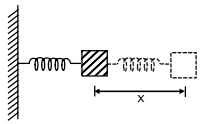
- A
${C}=\sqrt{\frac{2 {v}(0)^{2}}{\omega^{2}}+{x}(0)^{2}}, \phi=\tan ^{-1}\left(\frac{{x}(0) \omega}{2 {v}(0)}\right)$
- B
${C}=\sqrt{\frac{{v}(0)^{2}}{\omega^{2}}+{x}(0)^{2}}, \phi=\tan ^{-1}\left(\frac{{x}(0) \omega}{{v}(0)}\right)$
- C
$C=\sqrt{\frac{2 v(0)^{2}}{\omega^{2}}+x(0)^{2}}, \phi=\tan ^{-1}\left(\frac{v(0)}{x(0) \omega}\right)$
- ✓
${C}=\sqrt{\frac{{v}(0)^{2}}{\omega^{2}}+{x}(0)^{2}}, \phi=\tan ^{-1}\left(\frac{{v}(0)}{{x}(0) \omega}\right)$
AnswerCorrect option: D. ${C}=\sqrt{\frac{{v}(0)^{2}}{\omega^{2}}+{x}(0)^{2}}, \phi=\tan ^{-1}\left(\frac{{v}(0)}{{x}(0) \omega}\right)$
d
$x={A} \sin \omega {t}+{B} \sin \omega {t}$
${v} ={A} \sin \omega {t}+{Bcos} \omega {t}$
${{dt}}={A} \omega \cos \omega {t}-{B} \omega \sin \omega {t}$
${At} {t}=0, {x}(0)={B}$
${v}(0)={A} \omega$
${x}={A} \sin \omega {t}+{B} \sin \left(\omega {t}+90^{\circ}\right)$
$A_{\text {net }}=\sqrt{A^{2}+B^{2}}$
$\tan \alpha=\frac{B}{A} \Rightarrow \cot \alpha=\frac{A}{B}$
$\Rightarrow \quad x=\sqrt{A^{2}+B^{2}} \sin (\omega t+\alpha)$
$\Rightarrow \quad x=\sqrt{A^{2}+B^{2}} \cos (\omega t-(90-\alpha))$
$x=C \cos (\omega t-\phi)$
$\Rightarrow C=\sqrt{A^{2}+B^{2}}$
$C= \sqrt{\frac{[v(0)]^{2}}{\omega^{2}}+[x(0)]^{2}}$
$\phi= 90-\alpha$
$\tan \alpha=\cos \alpha=\frac{A}{B}$
$\Rightarrow \tan \phi=\frac{v(0)}{x(0) \cdot \omega}$
$\phi= \tan ^{-1}\left(\frac{v(0)}{x(0) \omega}\right)$
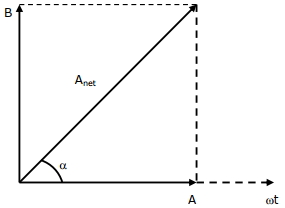
View full question & answer→MCQ 3901 Mark
In the reported figure, two bodies $A$ and $B$ of masses $200\, {g}$ and $800\, {g}$ are attached with the system of springs. Springs are kept in a stretched position with some extension when the system is released. The horizontal surface is assumed to be frictionless. The angular frequency will be $.....\,{rad} / {s}$ when ${k}=20 \,{N} / {m} .$

Answerc
$\omega=\sqrt{\frac{k_{\text {eq }}}{\mu}}$
$\mu=$ reduced mass
springs are in series connection
$k _{eq}=\frac{ k _{1} k _{2}}{ k _{1}+ k _{2}}$
$k _{ eq }=\frac{ k \times 4 k }{5 k }=\frac{4 k }{5}$
$k _{ eq }=\frac{4 \times 20}{5} N / m =16 N / m$
$\mu=\frac{ m _{1} m _{2}}{ m _{1}+ m _{2}}=\frac{0.2 \times 0.8}{0.2+0.8}=0.16 kg$
$\omega=\sqrt{\frac{16}{0.16}}=\sqrt{100}=10$
View full question & answer→MCQ 3911 Mark
A bob of mass $'m'$ suspended by a thread of length $l$ undergoes simple harmonic oscillations with time period ${T}$. If the bob is immersed in a liquid that has density $\frac{1}{4}$ times that of the bob and the length of the thread is increased by $1 / 3^{\text {rd }}$ of the original length, then the time period of the simple harmonic oscillations will be :-
- A
${T}$
- B
$\frac{3}{2} {T}$
- C
$\frac{3}{4} {T}$
- ✓
$\frac{4}{3} {T}$
AnswerCorrect option: D. $\frac{4}{3} {T}$
d
${T}=2 \pi \sqrt{\ell / {g}}$
When bob is immersed in liquid
${mg}_{{eff}}={mg}-$ Buoyant force
${mg}_{{eff}} ={mg}-{v} \sigma {g} \quad(\sigma=\text { density of liquid })$
$={mg}-{v} \frac{\rho}{4} {g}$
$={mg}-\frac{{mg}}{4}=\frac{3 {mg}}{4}$
$\therefore {g}_{{eff}} =\frac{3 {g}}{4}$
${T}_{1}= 2 \pi \sqrt{\frac{\ell_{1}}{{g}_{{eff}}}} \quad \ell_{1}=\ell+\frac{\ell}{3}=\frac{4 \ell}{3}, \quad \ell_{{eff}}=\frac{3 {g}}{4}$
By solving
${T}_{1}=\frac{4}{3} 2 \pi \sqrt{\ell / {g}}$
${T}_{1}=\frac{4 {T}}{3}$
View full question & answer→MCQ 3921 Mark
Amplitude of a mass-spring system, which is executing simple harmonic motion decreases with time. If mass $=500\, g$, Decay constant $=20 \,g / s$ then ...... $s$ time is required for the amplitude of the system to drop to half of its initial value ? $(\ln 2=0.693)$
- ✓
$34.65$
- B
$17.32$
- C
$0.034$
- D
$15.01$
AnswerCorrect option: A. $34.65$
a
$A = A _{0} e ^{-\gamma t }= A _{0} e ^{-\frac{ bt }{2 m }}$
$\frac{ A _{0}}{2}= A _{0} e ^{-\frac{ bt }{2 m }}$
$\frac{ bt }{2 m }=\ln 2$
$t =\frac{2 m }{ b } \ln 2=\frac{2 \times 500 \times 0.693}{20}$
$t =34.65\, second.$
View full question & answer→MCQ 3931 Mark
A block of mass $1 \,kg$ attached to a spring is made to oscillate with an initial amplitude of $12\, cm$. After $2\, minutes$ the amplitude decreases to $6\, cm$. Determine the value of the damping constant for this motion. (take In $2=0.693$ )
- A
$0.69 \times 10^{2}\, kg s ^{-1}$
- B
$3.3 \times 10^{2}\, kg s ^{-1}$
- C
$5.7 \times 10^{-3}\, kg s ^{-1}$
- ✓
$1.16 \times 10^{2} \,kg s ^{-1}$
AnswerCorrect option: D. $1.16 \times 10^{2} \,kg s ^{-1}$
d
$A = A _{0} e ^{-\gamma\, t}$
$\ln 2=\frac{ b }{2 m } \times 120$
$\frac{0.693 \times 2 \times 1}{120}= b$
$1.16 \times 10^{-2} \,kg / sec$
View full question & answer→MCQ 3941 Mark
An object of mass $m$ is suspended at the end of a massless wire of length $L$ and area of cross$-$section, $A$. Young modulus of the material of the wire is $Y$. If the mass is pulled down slightly its frequency of oscillation along the vertical direction is
- ✓
$f =\frac{1}{2 \pi} \sqrt{\frac{ YA }{ mL }}$
- B
$f=\frac{1}{2 \pi} \sqrt{\frac{Y L}{m A}}$
- C
$f=\frac{1}{2 \pi} \sqrt{\frac{m A}{Y L}}$
- D
$f =\frac{1}{2 \pi} \sqrt{\frac{ mL }{ YA }}$
AnswerCorrect option: A. $f =\frac{1}{2 \pi} \sqrt{\frac{ YA }{ mL }}$
a
An elastic wire can be treated as a spring with
$K =\frac{ Y A }{\ell}$
$T =2 \pi \sqrt{\frac{ m }{ k }}$
$f=\frac{1}{2 \pi} \sqrt{\frac{k}{m}}=\frac{1}{2 \pi} \sqrt{\frac{Y A}{m \ell}}$
View full question & answer→MCQ 3951 Mark
A block of mass $m$ attached to massless spring is performing oscillatory motion of amplitude $'A'$ on a frictionless horizontal plane. If half of the mass of the block breaks off when it is passing through its equilibrium point, the amplitude of oscillation for the remaining system become $fA.$ The value of $f$ is
- A
$\frac{1}{2}$
- B
$\frac{1}{\sqrt{2}}$
- C
$1$
- ✓
$\sqrt{2}$
AnswerCorrect option: D. $\sqrt{2}$
d
At equilibrium position
$V _{0}=\omega_{0} A =\sqrt{\frac{ K }{ m }} A....(i)$
$V =\omega A '=\sqrt{\frac{ K }{\frac{ m }{2}}} A '...(ii)$
$\therefore \quad A'= \sqrt{2} A$
$P_{i}=P_{f}$
$mV_0=\frac m{2} V$
$m(A \omega)=\frac{m}{2}\left(A^{\prime} \omega^{\prime}\right)$
$m A \sqrt{\frac{k}{m}}=\frac{m}{2} A^{\prime} \sqrt{\frac{k}{m / 2}}$
$m^{2} A^{2}\left[\frac{K}{m}\right]=\frac{m^{2}}{42}\left(A^{\prime}\right)^{2} \frac{k}{m} \times v$
$2 A^{2}=\left(A^{\prime}\right)^{2} \Rightarrow A^{\prime}=\sqrt{2}$
View full question & answer→MCQ 3961 Mark
The displacement time graph of a particle executing $S.H.M.$ is given in figure: (sketch is schematic and not to scale) Which of the following statements is are true for this motion?
$(A)$ The force is zero $t=\frac{3 T}{4}$
$(B)$ The acceleration is maximum at $t=T$
$(C)$ The speed is maximum at $t =\frac{ T }{4}$
$(D)$ The $P.E.$ is equal to $K.E.$ of the oscillation at $t=\frac{T}{2}$
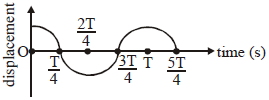
- A
$( A ),( B )$ and $( D )$
- B
$( B ),( C )$ and $( D )$
- C
$(A)$ and $(D)$
- ✓
$( A ),( B )$ and $( C )$
AnswerCorrect option: D. $( A ),( B )$ and $( C )$
d
Sol. $(A)$ $F =$ ma $\quad a =-\omega^{2} x$
at $\frac{3 T }{4}$ displacement zero $( x =0),$ so $a =0$
$F=0$
$(B)$ at $t=T \quad$ displacement $(x)=A$ $x$ maximum, So acceleration is maximum.
$(C)$ $V =\omega \sqrt{ A ^{2}- x ^{2}}$
$V _{\max }$ at $x =0$
$V _{\max }= A \omega$
at $t =\frac{ T }{4}, x =0, \quad$ So $V _{ max }$
$(D)$ $KE = PE$
$\therefore$ at $x=\frac{A}{\sqrt{2}}$
at $t=\frac{T}{2} \quad x=-A \quad$ (So not possible)
View full question & answer→MCQ 3971 Mark
A ring is hung on a nail. It can oscillate, without slipping or sliding $(i)$ in its plane with a time period $T_{1}$ and, $(ii)$ back and forth in a direction perpendicular to its plane, with a period $T _{2}$. the ratio $\frac{ T _{1}}{ T _{2}}$ will be
- ✓
$\frac{2}{\sqrt{3}}$
- B
$\frac{\sqrt{2}}{3}$
- C
$\frac{2}{3}$
- D
$\frac{3}{\sqrt{2}}$
AnswerCorrect option: A. $\frac{2}{\sqrt{3}}$
a
Moment of inertia in case $(i)$ is $I _{1}$
Moment of inertia in case $(ii)$ is $I_{2}$
$I_{1}=2 M R^{2}$
$I _{2}=\frac{3}{2} MR ^{2}$
$T _{1}=2 \pi \sqrt{\frac{ I _{1}}{ Mgd }} ; T _{2}=2 \pi \sqrt{\frac{ I _{2}}{ Mgd }}$
$\frac{ T _{1}}{ T _{2}}=\sqrt{\frac{ I _{1}}{ I _{2}}}=\sqrt{\frac{2 MR ^{2}}{\frac{3}{2} MR ^{2}}}=\frac{2}{\sqrt{3}}$
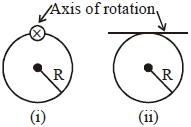
View full question & answer→MCQ 3981 Mark
When a particle of mass $m$ is attached to a vertical spring of spring constant $k$ and released, its motion is described by $y ( t )= y _{0} \sin ^{2} \omega t ,$ where $'y'$ is measured from the lower end of unstretched spring. Then $\omega$ is
- A
$\sqrt{\frac{g}{y_{0}}}$
- ✓
$\sqrt{\frac{g}{2 y_{0}}}$
- C
$\frac{1}{2} \sqrt{\frac{g}{y_{0}}}$
- D
$\sqrt{\frac{2 g}{y_{0}}}$
AnswerCorrect option: B. $\sqrt{\frac{g}{2 y_{0}}}$
b
$y = y _{0} \sin ^{2} \omega t$
$y =\frac{ y _{0}}{2}(1-\cos 2 \omega t )$
$y -\frac{ y _{0}}{2}=-\frac{ y _{0}}{2} cos 2 \omega t$
Amplitude : $\frac{y_{0}}{2}$
$\frac{y_{0}}{2}=\frac{m g}{K}$
$2 \omega=\sqrt{\frac{K}{m}}=\sqrt{\frac{2 g}{y_{0}}}$
$\omega=\sqrt{\frac{g}{2 y_{0}}}$
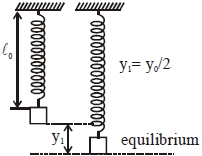
View full question & answer→MCQ 3991 Mark
A $LCR$ circuit behaves like a damped harmonic oscillator. Comparing it with a physical springmass damped oscillator having damping constant $\mathrm{b}$, the correct equivalence would be:
- ✓
$\mathrm{L} \leftrightarrow \mathrm{m}, \mathrm{C} \leftrightarrow \frac{1}{\mathrm{k}}, \mathrm{R} \leftrightarrow \mathrm{b}$
- B
$\mathrm{L} \leftrightarrow \frac{1}{\mathrm{b}}, \mathrm{C} \leftrightarrow \frac{1}{\mathrm{m}}, \mathrm{R} \leftrightarrow \frac{1}{\mathrm{k}}$
- C
$\mathrm{L} \leftrightarrow \mathrm{m}, \mathrm{C} \leftrightarrow \mathrm{k}, \mathrm{R} \leftrightarrow \mathrm{b}$
- D
$\mathrm{L} \leftrightarrow \mathrm{k}, \mathrm{C} \leftrightarrow \mathrm{b}, \mathrm{R} \leftrightarrow \mathrm{m}$
AnswerCorrect option: A. $\mathrm{L} \leftrightarrow \mathrm{m}, \mathrm{C} \leftrightarrow \frac{1}{\mathrm{k}}, \mathrm{R} \leftrightarrow \mathrm{b}$
a
By $kVL$
$-\mathrm{L} \frac{\mathrm{di}}{\mathrm{dt}}-\frac{\mathrm{q}}{\mathrm{C}}-\mathrm{iR}=0$
$\mathrm{L} \frac{\mathrm{d}^{2} \mathrm{q}}{\mathrm{dt}^{2}}+\frac{1}{\mathrm{C}} \mathrm{q}+\mathrm{R} \frac{\mathrm{dq}}{\mathrm{dt}}=0$
for damped oscillator
net force $=-\mathrm{kx}-\mathrm{bv}=\mathrm{ma}$
$\frac{m d^{2} x}{d t^{2}}+k x+\frac{b d x}{d t}=0$
by comparing : Equivalence is
$\mathrm{L} \rightarrow \mathrm{m}: \mathrm{C} \rightarrow \frac{1}{\mathrm{K}} ; \mathrm{R} \rightarrow \mathrm{b}$
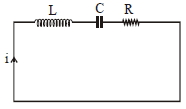
View full question & answer→MCQ 4001 Mark
The position co-ordinates of a particle moving in a $3-D$ coordinates system is given by $x = a\,cos\,\omega t$ , $y = a\,sin\,\omega t$ and $z = a\omega t$ The speed of the particle is
- ✓
$\sqrt 2 \,a\omega$
- B
$a\omega $
- C
$\sqrt 3 \,a\omega$
- D
$2\,a\omega $
AnswerCorrect option: A. $\sqrt 2 \,a\omega$
a
$\mathrm{v}_{\mathrm{x}}=\frac{\mathrm{d} \mathrm{x}}{\mathrm{dt}}=-\mathrm{a} \omega \sin \omega \mathrm{t}$
$\mathrm{v}_{\mathrm{y}}=\frac{\mathrm{dy}}{\mathrm{dt}}=\mathrm{a\omega} \cos \omega \mathrm{t}$
$\mathrm{v}_{\mathrm{z}}=\frac{\mathrm{d} z}{\mathrm{dt}}=\mathrm{a} \omega$
$\therefore \quad \mathrm{v}=\sqrt{\mathrm{v}_{\mathrm{x}}^{2}+\mathrm{v}_{\mathrm{y}}^{2}+\mathrm{v}_{\mathrm{z}}^{2}}=\mathrm{a} \omega \sqrt{2}$
View full question & answer→MCQ 4011 Mark
A particle executes simple harmonic motion with an amplitude of $5\, cm$. When the particle is at $4\, cm$ from the mean position, the magnitude of its velocity is $SI\,units$ is equal to that of its acceleration. Then, its periodic time in seconds is
- A
$\frac{4\pi}{3}$
- B
$\frac{3}{8}\pi$
- ✓
$\frac{8\pi}{3}$
- D
$\frac{7}{3}\pi$
AnswerCorrect option: C. $\frac{8\pi}{3}$
c
$\left|v_{4}\right|=\left|a_{4}\right|$
$\Rightarrow \quad(w \sqrt{A^{2}-x^{2}})_{4}=\left(w^{2} x\right)_{4}$
$\Rightarrow \quad w \sqrt{25-16}=w^{2} \times 4$
$\Rightarrow \quad w=\frac{3}{4}$
$T=\frac{2 \pi}{w}=2 \pi \frac{4}{3}=\frac{8 \pi}{3}$
View full question & answer→MCQ 4021 Mark
A particle is executing simple harmonic motion $(SHM)$ of amplitude $A,$ along the $x-$ axis, about $x = 0.$ When its potential energy $(PE)$ equals kinetic energy $(KE),$ the position of the particle will be
- A
$\frac {A}{2}$
- B
$\frac {A}{2\sqrt 2}$
- ✓
$\frac {A}{\sqrt 2}$
- D
$A$
AnswerCorrect option: C. $\frac {A}{\sqrt 2}$
c
$\mathrm{PE}=\mathrm{KE}$
$\Rightarrow \quad \frac{1}{2} m \omega^{2}\left(A^{2}-x^{2}\right)=\frac{1}{2} m \omega^{2} x^{2}$
$\Rightarrow \quad x=\frac{A}{\sqrt{2}}$
View full question & answer→MCQ 4031 Mark
A particle undergoing simple harmonic motion has time dependent displacement given by $x(t)\, = \,A\,\sin \,\frac{{\pi t}}{{90}}$. The ratio of kinetic to potential energy $o$ the particle at $t=210\,s$ will be
AnswerCorrect option: D. $0.33$
d
$\mathrm{K}=\frac{1}{2} \mathrm{mv}^{2} ; \mathrm{U}=\frac{1}{2} \mathrm{k} \mathrm{x}^{2}=\frac{1}{2} \mathrm{m}^{2} \mathrm{x}^{2}$
$\begin{aligned} \therefore \quad \frac{\mathrm{k}}{\mathrm{U}}= \frac{\mathrm{v}^{2}}{\omega^{2} \mathrm{x}^{2}}=\left(\frac{\cos (\mathrm{wt})}{\sin (\mathrm{wt})}\right)^{2} \\ =\cot ^{2}\left(\frac{\pi}{90} \times 210\right) \\= \cot ^{2}\left(2 \pi+\frac{\pi}{3}\right) \\=\left(\frac{1}{\sqrt{3}}\right)^{2}=\frac{1}{3} \end{aligned}$
View full question & answer→MCQ 4041 Mark
A pendulum is executing simple harmonic motion and its maximum kinetic energy is $K_1$. If the length of the pendulum is doubled and it performs simple harmonic motion with the same amplitude as in the first case, its maximum kinetic energy is $K_2$ then
AnswerCorrect option: A. ${K_2} = 2{K_1}$
a
Maximum kinetic energy at lowest point $B$ is given by
$\mathrm{K}=\mathrm{mg} \ell(1-\cos \theta)$
where $\theta=$ angular amp.
$\mathrm{K}_{1}=\mathrm{mg} \ell(1-\cos \theta)$
$\mathrm{K}_{2}=\mathrm{mg}(2 \ell)(1-\cos \theta)$
$\mathrm{K}_{2}=2 \mathrm{K}_{1}$
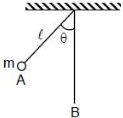
View full question & answer→MCQ 4051 Mark
A spring whose unstretched length is $\ell $ has a force constant $k$. The spring is cut into two pieces of unstretched lengths $\ell_1$ and $\ell_2$ where, $\ell_1 = n\ell_2$ and $n$ is an integer. The ratio $k_1/k_2$ of the corresponding force constants, $k_1$ and $k_2$ will be
- A
$n$
- B
$\frac{1}{n^2}$
- C
$n^2$
- ✓
$\frac{1}{n}$
AnswerCorrect option: D. $\frac{1}{n}$
d
$\begin{array}{l}
{k_1} = \frac{C}{{{\ell _1}}}\\
{k_2} = \frac{C}{{{\ell _2}}}\\
\frac{{{k_1}}}{{{k_2}}} = \frac{{C{\ell _2}}}{{{\ell _1}C}} = \frac{{{\ell _2}}}{{n{\ell _2}}} = \frac{1}{n}
\end{array}$
View full question & answer→MCQ 4061 Mark
A simple pendulum of length $1\, m$ is oscillating with an angular frequency $10\, rad/s$. The support of the pendulum starts oscillating up and down with a small angular frequency of $1\, rad/s$ and an amplitude of $10^{-2}\, m$. The relative change in the angular frequency of the pendulum is best given by
- ✓
$10^{-3} rad/s$
- B
$1\,rad/s$
- C
$10^{-1} rad/s$
- D
$10^{-5} rad/s$
AnswerCorrect option: A. $10^{-3} rad/s$
a
Angular frequency of pendulum
$\omega \propto \sqrt{\frac{g_{e f f}}{\ell}}$
$\therefore \quad \frac{\Delta \omega}{\omega}=\frac{1}{2} \frac{\Delta g_{e f f}}{g_{e f f}}$
$\Delta \omega=\frac{1}{2} \frac{\Delta g}{g} \times \omega$
$[ \omega_{s}=$ angular frequency of support]
$\frac{\Delta \omega}{\omega}=\frac{1}{2} \times \frac{\Delta g}{g}$
$=\frac{1}{2} \times \frac{2\left(\mathrm{A} \omega_{5}^{5}\right)}{10}$
$\Rightarrow \frac{\Delta \omega}{\omega}=\frac{1 \times 10^{-2}}{10}=10^{-3}$
View full question & answer→MCQ 4071 Mark
The displacement of a damped harmonic oscillator is given by $x\left( t \right) = {e^{ - 0.1\,t}}\,\cos \left( {10\pi t + \varphi } \right)$ The time taken for its amplitude of vibration to drop to half of its initial value is close to .... $s$
Answerd
$A=A_{0} e^{-0.1 t}=\frac{A_{0}}{2}$
$\ln 2=0.1 \mathrm{t}$
$t=10\, \mathrm{ln} 2=6.93 \approx 7 \mathrm{sec}$
View full question & answer→MCQ 4081 Mark
A simple harmonic motion is represented by $y\, = 5\,(\sin \,3\pi t\, + \,\sqrt 3 \,\cos \,3\pi t)\,cm$ The amplitude and time period of the motion are
- ✓
$10\,\,cm\,,\,\frac{2}{3}\,s$
- B
$10\,\,cm\,,\,\frac{3}{2}\,s$
- C
$5\,\,cm\,,\,\frac{3}{2}\,s$
- D
$5\,\,cm\,,\,\frac{2}{3}\,s$
AnswerCorrect option: A. $10\,\,cm\,,\,\frac{2}{3}\,s$
a
$y=5(\sin 3 \pi t+\sqrt{3} \cos 3 \pi t) \mathrm{cm}$
$\Rightarrow \quad y=10 \sin (3 \pi t+\phi)$
$\Rightarrow A=10 \mathrm{cm}$
$\Rightarrow \quad T=\frac{2}{3} \sec$
View full question & answer→MCQ 4091 Mark
A particle of mass $m$ is moving along a trajectory given by
$x = x_0 + a\, cos\,\omega_1 t$
$y = y_0 + b\, sin\,\omega_2t$
The torque, acing on the particle about the origin, at $t = 0$ is
- ✓
$m{y_0}a\omega _1^2\hat k$
- B
$m\left( { - {x_0}b + {y_0}a} \right)\omega _1^2\hat k$
- C
$ - m\left( { - {x_0}b\omega _2^2 + {y_0}a\omega _1^2} \right)\hat k$
- D
AnswerCorrect option: A. $m{y_0}a\omega _1^2\hat k$
a
$\overrightarrow{\mathrm{F}}=\mathrm{m} \overrightarrow{\mathrm{a}}=\mathrm{m}\left[-\mathrm{a} \omega_{1}^{2} \cos \omega, \mathrm{t} \hat{\mathrm{i}}-\mathrm{b} \omega_{2}^{2} \sin \omega_{2} \mathrm{t} \hat{\mathrm{j}}\right.$
$\overrightarrow{\mathrm{f}}_{\mathrm{t}-0}=-\mathrm{ma} \omega_{1}^{2} \hat{\mathrm{i}}$
$\overrightarrow{\mathrm{r}}_{\mathrm{t}-0}=\left(\mathrm{x}_{0}+\mathrm{a}\right) \hat{\mathrm{i}}+\mathrm{y} \hat{\mathrm{j}}$
$\vec{\tau}=\overrightarrow{\mathrm{r}} \times \overrightarrow{\mathrm{F}}=\mathrm{my}_{0} \mathrm{a} \omega_{1}^{2} \hat{\mathrm{k}}$
View full question & answer→MCQ 4101 Mark
A massless spring $(k = 800\, N/m)$, attached with a mass $(500\, g)$ is completely immersed in $1\, kg$ of water. The spring is stretched by $2\, cm$ and released so that it starts vibrating. What would be the order of magnitude of the change in the temperature of water when the vibrations stop completely? (Assume that the water container and spring receive negligible heat and specific heat of mass $= 400\, J/kg\, K$, specific heat of water $= 4184\, J/kg\, K$)
- A
$10^{-3}\,K$
- B
$10^{-4}$
- C
$10^{-1}\,K$
- ✓
$10^{-5}\,K$
AnswerCorrect option: D. $10^{-5}\,K$
d
By law of conservation of energy
$\frac{1}{2} \mathrm{kx}^{2}=\left(\mathrm{m}_{1} \mathrm{s}_{1}+\mathrm{m}_{2} \mathrm{s}_{2}\right) \Delta \mathrm{T}$
$\Delta T=\frac{16 \times 10^{-2}}{4384}=3.65 \times 10^{-5}$
View full question & answer→MCQ 4111 Mark
A rod of mass $‘M’$ and length $‘2L’$ is suspended at its middle by a wire. It exhibits torsional oscillations; If two masses each of $‘m’$ are attached at distance $‘L/2’$ from its centre on both sides, it reduces the oscillation frequency by $20\%$. The value of ratio $m/M$ is close to
- A
$0.77$
- B
$0.57$
- ✓
$0.37$
- D
$0.17$
AnswerCorrect option: C. $0.37$
c
$\mathrm{f}=\frac{1}{2 \pi} \sqrt{\frac{\mathrm{C}}{\left(\frac{\mathrm{ML}^{2}}{3}\right)}} \& 0.8 \mathrm{f}=\frac{1}{2 \pi} \sqrt{\frac{\mathrm{C}}{\left(\frac{\mathrm{ML}^{2}}{3}+\frac{\mathrm{mL}^{2}}{2}\right)}}$
$\Rightarrow \quad \frac{25}{16}=\frac{\frac{\mathrm{ML}^{2}}{3}+\frac{\mathrm{mL}^{2}}{2}}{\frac{\mathrm{ML}^{2}}{3}}$
$\Rightarrow \quad \frac{25}{16}=1+\frac{3 \mathrm{m}}{2 \mathrm{M}}$
$\Rightarrow \quad \frac{9}{16}=\frac{3 \mathrm{m}}{2 \mathrm{M}}$
$\Rightarrow \quad \frac{\mathrm{m}}{\mathrm{M}}=\frac{3}{8}=0.37$
View full question & answer→MCQ 4121 Mark
A cylindrical plastic bottle of negligible mass of filled with $310\, ml$ of water and left floating in a pond with still water. If pressed downward slightly and released, it starts performing simple harmonic motion at angular frequency $\omega $. If the radius of the bottle is $2.5\, cm$ then $\omega $ is close to ..... $rad\, s^{-1}$ (density of water $= 10^3\, kg/m^3$)
- A
$3.75$
- ✓
$1.25$
- C
$2.50$
- D
$5.00$
AnswerCorrect option: B. $1.25$
b
$A\rho gx = {F_{restoring}}$
$\pi {r^2}\rho gx = n{\omega ^2}x$
$\therefore \omega \sqrt {\frac{{\pi {r^2}\rho g}}{{\rho v}}} $
$ = r\sqrt {\frac{{\pi g}}{v}} = 2.5 \times {10^{ - 2}}\sqrt {\frac{{3.14 \times 10}}{{310 \times {{10}^{ - 6}}}}} $
$ = 2.5 \times {10^{ - 2}} \times {10^2}\sqrt {10} $
$\omega = 2.5 \times \sqrt {10} $
$\therefore f = \frac{{2.5 \times \sqrt {10} }}{{2\pi }} = 1.25$
View full question & answer→MCQ 4131 Mark
Two light identical springs of spring constant $k$ are attached horizontally at the two ends of a uniform horizontal rod $AB$ of length $l$ and mass $m$. the rod is pivoted at its centre $‘O’$ and can rotate freely in horizontal plane. The other ends of the two springs are fixed to rigid supports as shown in figure. The rod is gently pushed through a small angle and released. The frequency of resulting oscillation is
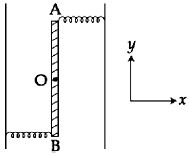
- A
$\frac{1}{{2\pi }}\sqrt {\frac{{3k}}{m}} $
- B
$\frac{1}{{2\pi }}\sqrt {\frac{{2k}}{m}} $
- ✓
$\frac{1}{{2\pi }}\sqrt {\frac{{6k}}{m}} $
- D
$\frac{1}{{2\pi }}\sqrt {\frac{{k}}{m}} $
AnswerCorrect option: C. $\frac{1}{{2\pi }}\sqrt {\frac{{6k}}{m}} $
c
Torque on rod at displacement $\theta$ from mean position $\theta$ is very small. $x=\frac{L}{2} \theta$
$\tau=2 k x \frac{L}{2}=2 k \frac{L^{2}}{4} \theta=\frac{k L^{2}}{2} \theta$
Now, $\tau=1 \alpha$
$\frac{\mathrm{kL}^{2}}{2} \theta=\frac{\mathrm{mL}^{2}}{12} \alpha \quad ; \quad \alpha=\frac{6 \mathrm{k}}{\mathrm{m}} \theta$
$\tau=\frac{\omega}{2 \pi}=\frac{1}{2 \pi} \sqrt{\frac{6 k}{m}}$
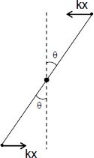
View full question & answer→MCQ 4141 Mark
A simple pendulum oscillating in air has period $T.$ The bob of the pendulum is completely immersed in a non-viscous liquid. The density of the liquid is $\frac {1}{16}$ of the material of the bob. If the bob is inside liquid all the time, its period of oscillation in this liquid is
- A
$2T\sqrt {\frac {1}{10}}$
- B
$2T\sqrt {\frac {1}{14}}$
- ✓
$4T\sqrt {\frac {1}{15}}$
- D
$4T\sqrt {\frac {1}{14}}$
AnswerCorrect option: C. $4T\sqrt {\frac {1}{15}}$
c
For a simple pendulum $\mathrm{T}=2 \pi \sqrt{\frac{\mathrm{L}}{\mathrm{g}_{\mathrm{err}}}}$
Situation $1$: when pendulum is in air $\rightarrow g_{\text {eff }}=g$
Situation $2$ :when pendulum is in liquid
$\rightarrow g_{e f}=g\left(1-\frac{\rho_{\text {liquid }}}{\rho_{\text {body }}}\right)=g\left(1-\frac{1}{16}\right)=\frac{15 g}{16}$
So, $\frac{\mathrm{T}^{\prime}}{\mathrm{T}}=\frac{2 \pi \sqrt{\frac{\mathrm{L}}{15 \mathrm{g} / 16}}}{2 \pi \sqrt{\frac{\mathrm{L}}{\mathrm{g}}}}$
$\Rightarrow \mathrm{T}^{\prime}=\frac{4 \mathrm{T}}{\sqrt{15}}$
View full question & answer→MCQ 4151 Mark
A person of mass $M$ is, sitting on a swing of length $L$ and swinging with an angular amplitude $\theta_0$. If the person stands up when the swing passes through its lowest point, the work done by him, assuming that his centre of mass moves by a distance $l\, ( l < < L)$, is close to
- ✓
$Mgl\,\left( {1 + \theta _0^2} \right)$
- B
$Mgl\,\left( {1 - \theta _0^2} \right)$
- C
$Mgl$
- D
$Mgl\,\left( {1 + \frac{{\theta _0^2}}{2}} \right)$
AnswerCorrect option: A. $Mgl\,\left( {1 + \theta _0^2} \right)$
a
Angular momentum conservation
$\mathrm{MV}_{0} \mathrm{L}=\mathrm{MV}_{1}(\mathrm{L}-\ell)$
$V_{1}=V_{0}\left(\frac{L}{L-\ell}\right)$
$\mathrm{w}_{\mathrm{g}}+\mathrm{w}_{\mathrm{p}}=\Delta \mathrm{KE}$
$-m g \ell+w_{p}=\frac{1}{2} m\left(V_{1}^{2}-V_{0}^{2}\right)$
$w_{p}=m g \ell+\frac{1}{2} m V_{0}^{2}\left(\left(\frac{L}{L-\ell}\right)^{2}-1\right)$
$=m g \ell+\frac{1}{2} m V_{0}^{2}\left(\left(1-\frac{L}{L-\ell}\right)^{-2}-1\right)$
Now, $\ell<<\mathrm{L}$
By, Binomial approximation
$=m g \ell+\frac{1}{2} m V_{0}^{2}\left(\left(1+\frac{L}{L-\ell}\right)^{-2}-1\right)$
$=m g \ell+\frac{1}{2} m V_{0}^{2}\left(\frac{2 \ell}{L}\right)$
$\mathrm{W}_{\mathrm{P}}=\mathrm{mg} \ell+\mathrm{mV}_{0}^{2} \frac{\ell}{\mathrm{L}}$
Here, $\mathrm{V}_{0}=$ maximum velocity $=\omega \times \mathrm{A}=(\sqrt{\frac{\mathrm{g}}{\mathrm{L}}})\left(\theta_{0} \mathrm{L}\right)$
$\mathrm{So}, \mathrm{w}_{\mathrm{p}}=\mathrm{mg} \ell+\mathrm{m}\left(\theta_{0} \sqrt{\mathrm{gL}}\right)^{2} \frac{\ell}{\mathrm{L}}$
$=m g \ell\left(1+\theta_{0}^{2}\right)$
View full question & answer→MCQ 4161 Mark
A damped harmonic oscillator has a frequency of $5$ oscillations per second. The amplitude drops to half its value for every $10$ oscillations. The time it will take to drop to $\frac{1}{1000}$ of the original amplitude is close to .... $s$
Answerd
$A=A_{0} e^{-\gamma t}$
$A=\frac{A_{0}}{2}$ after $10$ oscillations
$\because$ After 2 seconds
$\frac{A_{0}}{2}=A_{0} e^{-\gamma(2)} \quad ; \quad 2=e^{2 \gamma}$
$ \ell n 2=2 \gamma \quad ; \quad \gamma=\frac{\ell n 2}{2}$
$\because A=A_{0} e^{-\gamma t}$
$\ell n \frac{\mathrm{A}_{0}}{\mathrm{A}}=\gamma \mathrm{t} ; \quad \ell \mathrm{n} 1000 \frac{\ell n 2}{2} \mathrm{t}$
$2\left(\frac{3 \ell n 10}{\ell n 2}\right)=t ; \quad \frac{6 \ell n 10}{\ell n 2}=t$
$t=19.931 \mathrm{sec}$
$t \approx 20 \mathrm{sec}$
View full question & answer→MCQ 4171 Mark
silver atom in a solid oscillates in simple harmonic motion in some direction with a frequency of $10^{12} /sec$. What is the force constant of the bonds connecting one atom with the other? ................ $\mathrm{N/m}$ (Mole wt. of silver $= 108 $ andAvagadro number $= 6.02 \times 10^{23}$ $gm \ mole^{ -1}$ )
- ✓
$7.1$
- B
$2.2 $
- C
$5.5 $
- D
$6.4 $
Answera
As we know, frequency in $SHM$
$\mathrm{f}=\frac{1}{2 \pi} \sqrt{\frac{\mathrm{k}}{\mathrm{m}}}=10^{12}$ where $\mathrm{m}=\mathrm{mass}$ of one atom
Mass of one atom of silver, $=\frac{108}{\left(6.02 \times 10^{23}\right)} \times 10^{-3} \mathrm{kg}$
$\frac{1}{2 \pi} \sqrt{\frac{\mathrm{k}}{108 \times 10^{-3}} \times 6.02 \times 10^{23}}=10^{12}$
Solving we get, spring constant, $\mathrm{K}=7.1 \mathrm{N} / \mathrm{m}$
View full question & answer→MCQ 4181 Mark
A particle executes simple harmonic motion and is located at $x = a, b$ and $c$ at times $t_0, 2t_0$ and $3t_0$ respectively. The frequency of the oscillation is
- A
$\frac{1}{{2\pi {t_0}}}\cos {\,^{ - 1}}\left( {\frac{{a + b}}{{2c}}} \right)$
- B
$\frac{1}{{2\pi {t_0}}}\cos {\,^{ - 1}}\left( {\frac{{a + b}}{{3c}}} \right)$
- C
$\frac{1}{{2\pi {t_0}}}\cos {\,^{ - 1}}\left( {\frac{{2a + 3c}}{{b}}} \right)$
- ✓
$\frac{1}{{2\pi {t_0}}}\cos {\,^{ - 1}}\left( {\frac{{a + c}}{{2b}}} \right)$
AnswerCorrect option: D. $\frac{1}{{2\pi {t_0}}}\cos {\,^{ - 1}}\left( {\frac{{a + c}}{{2b}}} \right)$
d
Using $\mathrm{y}=\mathrm{A} \sin \omega \mathrm{t}$
$\mathrm{a}=\mathrm{A} \sin \omega \mathrm{t}_{0}$
$b=A \sin 2 \omega t_{0}$
$c=A \sin 3 \omega t_{0}$
$\mathrm{a}+\mathrm{c}=\mathrm{A}\left[\sin \omega \mathrm{t}_{0}+\sin 3 \omega t_{0}\right]$$=2 \mathrm{A} \sin 2 \omega \mathrm{t}_{0}\cos \omega t_{0}$
$\frac{a+c}{b}=2 \cos \omega t_{0}$
$\Rightarrow \omega=\frac{1}{t_{0}} \cdot \cos ^{-1}\left(\frac{a+c}{2 b}\right)$
$ \Rightarrow f=\frac{1}{2 \pi t_{0}} \cos ^{-1}\left(\frac{a+c}{2 b}\right)$
View full question & answer→MCQ 4191 Mark
An oscillator of mass $M$ is at rest in its equilibrium position in a potential $V\, = \,\frac{1}{2}\,k{(x - X)^2}.$ A particle of mass $m$ comes from right with speed $u$ and collides completely inelastically with $M$ and sticks to it . This process repeats every time the oscillator crosses its equilibrium position .The amplitude of oscillations after $13$ collisions is: $(M = 10,\, m = 5,\, u = 1,\, k = 1 ).$
- A
$\frac {1}{2}$
- ✓
$\frac {1}{\sqrt 3}$
- C
$\frac {2}{3}$
- D
$\sqrt {\frac {3}{5}}$
AnswerCorrect option: B. $\frac {1}{\sqrt 3}$
b
In first collision $mu$ momentum will be imparted to system, in second collision when momentum of $(\mathrm{M}+\mathrm{m})$ is in opposite direction $mu$ momentum of particle will make its momentum zero.
On $13^{\text {th }}$ collision,
$\mathrm{m} \rightarrow {\mathrm{M}+12} ; \quad \mathrm{M}+13 \mathrm{m} \rightarrow \mathrm{V}$
$\mathrm{mu}=(\mathrm{M}+13 \mathrm{m}) \mathrm{v} \Rightarrow \mathrm{v}=\frac{\mathrm{mu}}{\mathrm{M}+13 \mathrm{m}}=\frac{\mathrm{u}}{15}$
$v=\omega A \Rightarrow \frac{u}{15}=\sqrt{\frac{K}{M-13 m}} \times A$
Putting value of $M, m, u$ and $K$ we get amplitude
$A=\frac{1}{15} \sqrt{\frac{75}{1}}=\frac{1}{\sqrt{3}}$
View full question & answer→MCQ 4201 Mark
Two simple harmonic motions, as shown, are at right angles. They are combined to form Lissajous figures
$x\left( t \right) = A\,\sin \,\left( {at + \delta } \right)$
$y\left( t \right) = B\,\sin \,\left( {bt} \right)$
Identify the correct match below
- A
Parameters: $A\, = B$, $a\, = 2b$; $\delta = \frac{\pi }{2}$; Curve : Circle
- B
Parameters: $A\,= B$, $a\, = b$; $\delta = \frac{\pi }{2}$ ; Curve : Line
- ✓
Parameters: $A \ne B$, $a\, = b$; $\delta = \frac{\pi }{2}$; Curve : Ellipse
- D
Parameters: $A \ne B$, $a\, = b$; $\delta\, = 0$; Curve : Parabola
AnswerCorrect option: C. Parameters: $A \ne B$, $a\, = b$; $\delta = \frac{\pi }{2}$; Curve : Ellipse
c
From the two mutually perpendicular $S.H.M. 's$, the general equation of Lissajous figure
$\frac{{{x^2}}}{{{A^2}}} + \frac{{{y^2}}}{{{B^2}}} - \frac{{2xy}}{{AB}}\cos \,\delta = {\sin ^2}\,\delta$
$x = A\,\sin \,\left( {at + \delta } \right)$
$y = B\,\sin \,\left( {bt + r} \right)$
Clearly $A\ne B$ hence ellipse
View full question & answer→MCQ 4211 Mark
A particle is executing simple harmonic motion with a time period $T.$ At time $t = 0$, it is at its position of equilibrium. The kinetic energy-time graph of the particle will look like
Answerd
For a particle executing $SHM$
At mean position; $t=0, \omega t=0, y=0, V=V_{\max }=a \omega$
$K . E .=K E_{\max }=\frac{1}{2} m \omega^{2} a^{2}$
At extreme position $: t=\frac{T}{4}, \omega t=\frac{\pi}{2}, y=A, V=V_{\min }=0$
$\therefore \quad K . E .=K E_{\min }=0$
Kinetic energy in $S H M, K E=\frac{1}{2} m \omega^{2}\left(a^{2}-y^{2}\right)$
$=\frac{1}{2} m \omega^{2} a^{2} \cos ^{2} \omega t$
View full question & answer→MCQ 4221 Mark
A $1 \,kg$ block attached to a spring vibrates with a frequency of $1\, Hz$ on a frictionless horizontal table. Two springs identical to the original spring are attached in parallel to an $8\, kg$ block placed on the same table. So, the frequency of vibration of the $8\, kg$ block is ..... $Hz$
Answerc
Frequency of spring $(f)=\frac{1}{2 \pi} \sqrt{\frac{k}{m}}=1 \mathrm{Hz}$
$\Rightarrow 4 \pi^{2}=\frac{\mathrm{k}}{\mathrm{m}}$
If block of mass $\mathrm{m}=1 \mathrm{kg}$ is attached then, $k=4 \pi^{2}$
Now, identical springs are attached in parallel with mass
$\mathrm{m}=8 \mathrm{kg}$, Hence, $k_{e q}=2 k$
$f^{\prime}=\frac{1}{2 \pi} \sqrt{\frac{\mathrm{k} \times 2}{8}}=\frac{1}{2} \mathrm{Hz}$
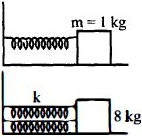
View full question & answer→MCQ 4231 Mark
The ratio of maximum acceleration to maximum velocity in a simple harmonic motion is $10\,s^{-1}$. At, $t = 0$ the displacement is $5\, m$. What is the maximum acceleration ? The initial phase is $\frac{\pi }{4}$
- A
$500\, m/s^2$
- ✓
$500\,\sqrt 2 \,m/{s^2}$
- C
$750\, m/s^2$
- D
$750\,\sqrt 2 \,m/{s^2}$
AnswerCorrect option: B. $500\,\sqrt 2 \,m/{s^2}$
b
Maximum velocity in $\mathrm{SHM}, \mathrm{v}_{\max }=\mathrm{a} \omega$
Maximum acceleration in $\mathrm{SHM}, \mathrm{A}_{\max }=\mathrm{a} \omega^{2}$
where $a$ and $\omega$ are maximum amplitude and angular frequency.
Given that, $\frac{A_{\max }}{v_{\max }}=10$
i.e., $\omega=10 \mathrm{s}^{-1}$
Displacement is given by
$x=a \sin (\omega t+\pi t 4)$
at $t=0, x=5$
$5=a \sin \pi / 4$
$5=a \sin 45^{\circ} \Rightarrow a=5 \sqrt{2}$
Maximum acceleration $\mathrm{A}_{\mathrm{max}}=\mathrm{a} \omega^{2}$
$=500\sqrt{2}\,m/s^2$
View full question & answer→MCQ 4241 Mark
A block of mass $0.1\, kg$ is connected to an elastic spring of spring constant $640\, Nm^{-1}$ and oscillates in a damping medium of damping constant $10^{-2}\, kg\,s^{-1}$ . The system dissipates its energy gradually. The time taken for its mechanical energy of vibration to drop to half of its initial value, is closest to ..... $s$
Answerb
Since system dissipates its energy gradually, and hence amplitude will also decreases with time according to
$a=a_{0} \mathrm{e}^{-\mathrm{bt/m}}$ $...(i)$
Energy of vibration drop to half of its in itial value $\left(\mathrm{E}_{0}\right),$ as $\mathrm{E} \propto \mathrm{a}^{2} \Rightarrow \mathrm{a} \propto \sqrt{\mathrm{E}}$
$a=\frac{a_{0}}{\sqrt{2}} \Rightarrow \frac{b t}{m}=\frac{10^{-2} t}{0.1}=\frac{t}{10}$
From $eq^n(i),$
$\frac{a_{0}}{\sqrt{2}}=a_{0} e^{-t / 10}$
$\frac{1}{\sqrt{2}}=e^{-t / 10}$ or $\sqrt{2}=e^{\frac{t}{10}}$
$\ln \sqrt{2}=\frac{t}{10} \quad \therefore t=3.5$ seconds
View full question & answer→MCQ 4251 Mark
In an experiment to determine the period of a simple pendulum of length $1\, m$, it is attached to different spherical bobs of radii $r_1$ and $r_2$ . The two spherical bobs have uniform mass distribution. If the relative difference in the periods, is found to be $5\times10^{-4}\, s$, the difference in radii, $\left| {{r_1} - {r_2}} \right|$ is best given by .... $cm$
Answerb
As we know, Time-period of simple
pendulum, T $\propto \sqrt{l}$
$5 \times {10^{ - 4}} = \frac{1}{2}\frac{{{r_1} - {r_2}}}{1}$
$\because$ change in length $\Delta l=r_{1}-r_{2}$
$5 \times {10^{ - 4}} = \frac{1}{2}\frac{{{r_1} - {r_2}}}{1}$
$r_{1}-r_{2}=10 \times 10^{-4}$
$10^{-3} \mathrm{m}=10^{-1} \mathrm{cm}=0.1 \mathrm{cm}$
View full question & answer→MCQ 4261 Mark
In an engine the piston undergoes vertical simple harmonic motion with amplitude $7\, cm$ . A washer rests on top of the piston and moves with it. The motor speed is slowly increased. The frequency of the piston at which the washer no longer stays in contact with the piston, is close to ...... $Hz$
Answerb
Washer contact with piston $\Rightarrow \mathrm{N}=0$
Given Amplitude $\mathrm{A}=7 \mathrm{cm}=0.07 \mathrm{m}$
$a_{\max }=g=\omega^{2} A$
The frequency of piston
$\mathrm{f}=\frac{\omega}{2 \pi}=\sqrt{\frac{\mathrm{g}}{\mathrm{A}}} \frac{1}{2 \pi}=\sqrt{\frac{1000}{7}} \frac{1}{2 \pi}=1.9 \mathrm{Hz}$
View full question & answer→MCQ 4271 Mark
A particle performs simple harmonic motion with amplitude $A$. Its speed is trebled at the instant that it is at a distance $\frac{{2A}}{3}$ from equilibrium position. The new amplitude of the motion is
AnswerCorrect option: B. $\;\frac{{7A}}{3}$
b
Let new amplitude is $A'$
initial velocity
$v^{2}=\omega^{2}\left(A^{2}-\left(\frac{2 A}{3}\right)^{2}\right)$ $...(1)$
Where $A$ is initial amplitude $\&\, \omega$ is angular frequency.
Final velocity
$(3 v)^{2}=\omega^{2}\left(A^{\prime 2}-\left(\frac{2 A}{3}\right)^{2}\right)$ $...(2)$
From equation $\&$ equation $( 2)$
$\frac{1}{9}=\frac{A^{2}-\frac{4 A^{2}}{9}}{A^{2}-\frac{4 A^{2}}{9}}$
$A^{\prime}=\frac{7 A}{3}$
View full question & answer→MCQ 4281 Mark
A pendulume clock loses $12\;s$ a day if the temperature is $40^oC$ and gains $4\;s$ a day if the temperature is $20^oC$. The temperature at which the clock will show correct time, and the coeffecient of linear expansion $(\alpha)$ of the metal of the pendulum shaft are respectively
- A
$30^o $ $C$ ,$\;\alpha $ $= 1.85 \times 10^{-3}/^o C$
- B
$55^o C$ ,$\;\alpha $ $= 1.85 \times 10^{-2}/^o C$
- ✓
$25^o C$ ,$\;\alpha $$ = 1.85 \times 10^{-5}/^o C$
- D
$60^o $ $C$ ,$\;\alpha $ = $1.85 \times10^{-4}/^o C$
AnswerCorrect option: C. $25^o C$ ,$\;\alpha $$ = 1.85 \times 10^{-5}/^o C$
c
$\mathrm{T}=2 \pi \sqrt{\frac{\ell}{\mathrm{g}}}$
$\frac{\Delta \mathrm{T}}{\mathrm{T}}=\frac{1}{2} \frac{\Delta \ell}{\ell}$
When clock gain $12\, sec$
$\frac{12}{\mathrm{T}}=\frac{1}{2} \alpha(40-\theta)$ $...(1)$
When clock lose $4\, sec.$
$\frac{4}{\mathrm{T}}=\frac{1}{2} \alpha(\theta-20)$ $...(2)$
From equation $( 1)\&(2)$
$3=\frac{40-\theta}{\theta-20}$
$3 \theta-60=40-\theta$
$4 \theta=100$
$\theta=25^{\circ} \mathrm{C}$
from equation $( 1 )$
$\frac{12}{\mathrm{T}}=\frac{1}{2} \alpha(40-25)$
$\frac{12}{24 \times 3600}=\frac{1}{2} \alpha \times 15$
$\alpha=\frac{24}{24 \times 3600 \times 15}$
$\alpha=1.85 \times 10^{-15} /^{\circ} \mathrm{C}$
View full question & answer→MCQ 4291 Mark
Two particles are performing simple harmonic motion in a straight line about the same equilibrium point. The amplitude and time period for both particles are same and equal to $A$ and $T,$ respectively. At time $t=0$ one particle has displacement $A$ while the other one has displacement $\frac {-A}{2}$ and they are moving towards each other. If they cross each other at time $t,$ then $t$ is
- A
$\frac{{5T}}{6}$
- B
$\frac{{T}}{3}$
- C
$\frac{{T}}{4}$
- ✓
$\frac{{T}}{6}$
AnswerCorrect option: D. $\frac{{T}}{6}$
d
Angle covered to meet $\theta=60^{\circ}=\frac{\pi}{3} \mathrm{rad}$
If they cross each other at time $t$ then
$t=\frac{\theta}{2 \pi}=\frac{\pi}{3 \times 2 \pi} \mathrm{T}=\frac{\mathrm{T}}{6}$
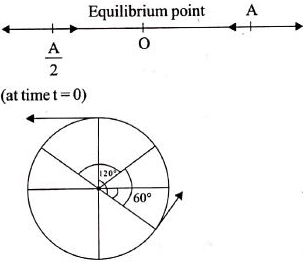
View full question & answer→MCQ 4301 Mark
For a simple pendulum, a graph is plotted between its kinetic energy $(KE)$ and potential energy $(PE)$ against its displacement $d$. Which one of the following represents these correctly? (graphs are schematic and not drawn to scale)
Answerd
$\mathrm{K} \cdot \mathrm{E}=\frac{1}{2} k\left(A^{2}-d^{2}\right)$
and $\mathrm{P.E.}=\frac{1}{2} k d^{2}$
At mean position $d=0 .$ At extremes positions $d=\mathrm{A}$
View full question & answer→MCQ 4311 Mark
A pendulum with time period of $1\, s$ is losing energy due to damping. At certain time its energy is $45\, J$. If after completing $15\,oscillations$ , its energy has become $15\, J$, its damping constant (in $s^{-1}$ ) is
- A
$\frac{1}{2}$
- B
$\frac{1}{{30}}\ln \,3$
- C
$2$
- ✓
$\frac{1}{{15}}\ln \,3$
AnswerCorrect option: D. $\frac{1}{{15}}\ln \,3$
d
As we know, $E=E_{0} e^{-\frac{b t}{m}}$
$15=45 e^{-\frac{b 15}{m}}$
[As no. of oscillations $=15 \text { so } t=15 \mathrm{sec}]$
$\frac{1}{3}=e^{-\frac{b 15}{m}}$
Taking log on both sides
$\frac{b}{m}=\frac{1}{15} \ell \mathrm{n} 3$
View full question & answer→MCQ 4321 Mark
A cylindrical block of wood (density $= 650\, kg\, m^{-3}$), of base area $30\,cm^2$ and height $54\, cm$, floats in a liquid of density $900\, kg\, m^{-3}$ . The block is depressed slightly and then released. The time period of the resulting oscillations of the block would be equal to that of a simple pendulum of length ..... $cm$ (nearly)
Answerc
Required equivalent length
$=\frac{\rho_{\text {wood }}}{\rho_{\text {liquid }}} \times$ height of block
$=\frac{650}{900} \times 54 \times 10^{-2}$
$\Rightarrow l=0.39 \mathrm{m}=39 \mathrm{cm}$
View full question & answer→MCQ 4331 Mark
$x$ and $y$ displacements of a particle are given as $x(t) = a\,sin\,\omega t$ and $y(t) = a\,sin\,2\omega t.$ Its trajectory will look like
Answerc
$\frac{x}{a}=\sin \omega t$
$\Rightarrow \cos \omega t=\sqrt{1-\left(\frac{x_{2}}{a^{2}}\right)}$
$\frac{y}{a}=\sin 2 \omega t$
$=2 \sin \omega t \times \cos \omega t$
$=2 \frac{x}{a} \times \sqrt{1-\left(\frac{x^{2}}{a^{2}}\right)}$
$ \Rightarrow y = \frac{{2x}}{{{a^2}}}\sqrt {\left( {a - x} \right)\left( {a + x} \right)} $
Hence trajectory of particle will look like as $(\mathrm{c})$
View full question & answer→MCQ 4341 Mark
A simple harmonic oscillator of angular frequency $2\,rad\,s^{-1}$ is acted upon by an external force $F = sin\,t\,N .$ If the oscillator is at rest in its equilibrium position at $t = 0,$ its position at later times is proportional to
- A
$\sin \,t\, + \,\frac{1}{2}\,\cos \,2t$
- B
$\cos \,t\, - \,\frac{1}{2}\,\sin \,2t$
- ✓
$\sin \,t\, - \,\frac{1}{2}\,\sin \,2t$
- D
$\sin \,t\, + \,\frac{1}{2}\,\sin \,2t$
AnswerCorrect option: C. $\sin \,t\, - \,\frac{1}{2}\,\sin \,2t$
c
As we know,
$F=m a \Rightarrow a \propto F$
or, $a \propto \sin t$
$\Rightarrow \frac{d v}{d t} \propto \sin t$
$\Rightarrow \int_{0}^{0} d V \propto \int_{0}^{t} \sin t d t$
$V \propto-\cos t+1$
$\int_{0}^{x} d x=\int_{0}^{t}(-\cos t+1) d t$
$x=\sin t-\frac{1}{2} \sin 2 t$
View full question & answer→MCQ 4351 Mark
pendulum made of a uniform wire of cross sectional area $A$ has time period $T$. When an additional mass $M$ is added to its bob, the time period changes to $T_M$. If the Young's modulus of the material of the wire is $Y$ then $\frac{1}{Y}$ is equal to : ($g$ = gravitational acceleration)
- A
$\left[ {{{\left( {\frac{{{T_M}}}{T}} \right)}^2} - 1} \right]\frac{{Mg}}{A}\;\;\;\;\;\;$
- B
$\;\left[ {1 - {{\left( {\frac{{{T_M}}}{T}} \right)}^2}} \right]\frac{A}{{{M_g}}}$
- C
$\;\left[ {1 - {{\left( {\frac{T}{{{T_M}}}} \right)}^2}} \right]\frac{A}{{{M_g}}}$
- ✓
$\;\left[ {{{\left( {\frac{{{T_M}}}{T}} \right)}^2} - 1} \right]\frac{A}{{{M_g}}}$
AnswerCorrect option: D. $\;\left[ {{{\left( {\frac{{{T_M}}}{T}} \right)}^2} - 1} \right]\frac{A}{{{M_g}}}$
d
As we know, time period, $T=2 \pi \sqrt{\frac{\ell}{g}}$
$ When\, additional \,mass \mathrm\,{M}$ is added then
$\mathrm{T}_{\mathrm{M}}=2 \pi \sqrt{\frac{\ell+\Delta \ell}{\mathrm{g}}}$
$T_{\frac{M}{T}}=\sqrt{\frac{\ell+\Delta \ell}{\ell}}$ or $\left(\frac{T_{M}}{T}\right)^{2}=\frac{\ell+\Delta \ell}{\ell}$
or, $\left(\frac{T_{M}}{T}\right)^{2}=1+\frac{M g}{A y}\left[\because \Delta \ell=\frac{M g \ell}{A y}\right]$
$\therefore \frac{1}{y}=\left[\left(\frac{T_{M}}{T}\right)^{2}-1\right] \frac{A}{M g}$
View full question & answer→MCQ 4361 Mark
An $LCR$ circuit is equivalent to a damped pendulum. In an $LCR$ circuit the capacitor is charged to $Q_0$ and then connected to the $L$ and $R$ as shown below.
If a student plots graphs of the square of maximum charge $( Q_{Max} ^2 )$ on the capacitor with time$(t)$ for two different values $L_1$ and $L_2 (L_1 > L_2)$ of $L$ then which of the following represents this graph correctly? (plots are schematic and not drawn to scale)
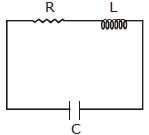
Answerd
From $KVL$ at any time :
$\frac{q}{c}-i R-I \cdot \frac{d i}{d t}=0$
$\mathrm{i}=-\frac{\mathrm{d} q}{\mathrm{dt}} \Rightarrow \frac{\mathrm{q}}{\mathrm{c}}+\frac{\mathrm{dq}}{\mathrm{dt}} \mathrm{R}+\frac{\mathrm{Ld}^{2} \mathrm{q}}{\mathrm{dt}^{2}}=0$
$\frac{d^{2} q}{d t^{2}}+\frac{R}{I} \frac{d q}{d t}+\frac{q}{I c}=0$
From damped harmonic oscillator, the amplitude is given by $\mathrm{A}=\mathrm{A}_{0} \mathrm{e}-\frac{\mathrm{dt}}{2 \mathrm{m}}$
Double differential equation $\frac{\mathrm{d}^{2} \mathrm{x}}{\mathrm{dt}^{2}}+\frac{\mathrm{b}}{\mathrm{m}} \frac{\mathrm{dx}}{\mathrm{dt}}+\frac{\mathrm{k}}{\mathrm{m}} \mathrm{x}=0$
$\mathrm{Q}_{\max }=\mathrm{Q}_{\mathrm{o}} \mathrm{e}-\frac{\mathrm{Rt}}{2 \mathrm{L}} \Rightarrow \mathrm{Q}_{\max }^{2}=\mathrm{Q}_{\mathrm{o}}^{2} \mathrm{e}-\frac{\mathrm{Rt}}{\mathrm{L}}$
Hence damping will be faster for lesser self inductance
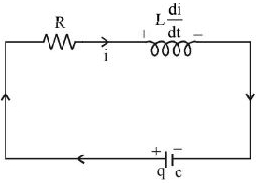
View full question & answer→MCQ 4371 Mark
Which of the following expressions corresponds to simple harmonic motion along a straight line, where $x$ is the displacement and $a, b, c$ are positive constants?
- A
$a + bx - cx^2$
- B
$bx^2$
- C
$a - bx + cx^2$
- ✓
$-bx$
Answerd
In linear $S.H.M$., the restoring force acting on particle should always be proportional to the displacement of the particle and directed towards the equilibrium position.
i.e., $\mathrm{F} \propto x$
or $\mathrm{F}=-\mathrm{bx}$ where $\mathrm{b}$ is a positive constant
View full question & answer→MCQ 4381 Mark
A body is in simple harmonic motion with time period half second $(T\, = 0.5\, s)$ and amplitude one $cm\, (A\,= 1\, cm)$. Find the average velocity in the interval in which it moves form equilibrium position to half of its amplitude .... $cm/s$
Answerc
Given: Time period, $T=0.5$ sec
Amplitude, $\mathrm{A}=1 \mathrm{cm}$
Average velocity in the interval in which body moves from equilibrium to half of its amplitude, $\mathrm{v}=?$
Time taken to a displacement $A/2$ where $A$ is the amplitude of oscillation from the
mean position $^{\prime} \mathrm{O}^{\prime}$ is $\frac{\mathrm{T}}{12}$
Therefore, time, $t=\frac{0.5}{12} \mathrm{sec}$
Displacement, $s=\frac{A}{2}=\frac{1}{2} c m$
Average velocity, $v=\frac{\frac{A}{2}}{t}=\frac{\frac{1}{2}}{\frac{0.5}{12}}=12 \mathrm{cm} / \mathrm{s}$
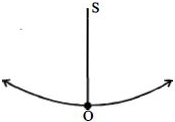
View full question & answer→MCQ 4391 Mark
In an experiment for determining the gravitational acceleration $g$ of a place with the help of a simple pendulum, the measured time period square is plotted against the string length of the pendulum in the figure. What is the value of $g$ at the place? ...... $m/s^2$
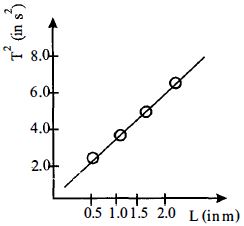
- A
$9.81$
- ✓
$9.87$
- C
$9.91$
- D
$10$
AnswerCorrect option: B. $9.87$
b
From graph it is clear that wher
$\mathrm{L}=1 \mathrm{m}, \mathrm{T}^{2}=4 \mathrm{s}^{2}$
As we know,
$\mathrm{T}=2 \pi \sqrt{\frac{\mathrm{L}}{\mathrm{g}}}$
$\Rightarrow \mathrm{g}=\frac{4 \pi^{2} \mathrm{L}}{\mathrm{T}^{2}}$
$=4 \times\left(\frac{22}{7}\right)^{2} \times \frac{1}{4}=\left(\frac{22}{7}\right)^{2}$
$\therefore \mathrm{g}=\frac{484}{49}=9.87 \mathrm{m} / \mathrm{s}^{2}$
View full question & answer→MCQ 4401 Mark
The amplitude of a simple pendulum, oscillating in air with a small spherical bob, decreases from $10\, cm$ to $8\, cm$ in $40\, seconds$ . Assuming that Stokes law is valid, and ratio of the coefficient of viscosity of air to that of carbon dioxide is $1.3$ . The time in which amplitude of this pendulum will reduce from $10\, cm$ to $5\, cm$ in carbon dioxide will be close to ..... $s$ $(ln\, 5 = 1.601,ln\, 2 = 0 .693)$
Answerd
As we know,
$x=x_{0} e^{-b t/ 2 m}$
From question,
$8=10 \mathrm{e}^{-\frac{40 \mathrm{b}}{2 \mathrm{m}}}$ $...(i)$
Similarly, $5=10 e^{-\frac{b t}{2 m}}$ $...(ii)$
Solving eqns $(i)$ and $(ii)$ we get
$t \cong 142 s$
View full question & answer→MCQ 4411 Mark
The angular frequency of the damped oscillator is given by, $\omega = \sqrt {\left( {\frac{k}{m} - \frac{{{r^2}}}{{4{m^2}}}} \right)} $ where $k$ is the spring constant, $m$ is the mass of the oscillator and $r$ is the damping constant. If the ratio $\frac{{{r^2}}}{{mk}}$ is $8\%$, the change in time period compared to the undamped oscillator is approximately as follows
- ✓
increases by $1\%$
- B
increases by $8\%$
- C
decreases by $1\%$
- D
decreases by $8\%$
AnswerCorrect option: A. increases by $1\%$
a
The change in time period compared to the undamped oscillator increases by $1\%$
View full question & answer→MCQ 4421 Mark
A particle which is simultaneously subjected to two perpendicular simple harmonic motions represented by; $x = {a_1}\,\cos \,\omega t$ and $y = {a_2}\,\cos \,2\,\omega t$ traces a curve given by
Answera
Two perpendicular $S.H.Ms$ are
$x=a_{1} \cos \omega t$ $...(1)$
and $y=a_{2} \cos 2 \omega t$ $...(2)$
From eqn $( 1 )$
$\frac{x}{a_{1}}=\cos w t$
and from eqn $(2)$
$\frac{y}{a_{2}}=\cos 2 \omega t=2 \cos ^{2} \omega t-1$
$y=2 \frac{a_{2}}{a_{1}^{2}} x^{2}-1$
View full question & answer→MCQ 4431 Mark
particle moves with simple harmonic motion in a straight line. In first $\tau\ s$, after starting from rest it travels a distance $a$, and in next $\tau\ s$ it travels $2a$, in same direction, then
- A
time period of oscillations is $8\tau$
- ✓
time period of oscillations is $6\tau$
- C
amplitude of motion is $4a$
- D
amplitude of motion is $3a$
AnswerCorrect option: B. time period of oscillations is $6\tau$
b
In simple harmonic motion, starting from rest,
At $t=0, x=A$
$x= Acos\omega t$ $...(i)$
$ When\,\,\, t=\tau, x=A-a$
When $t=2 \tau, x=A-3 a$
From equation $( i )$
$A-a=A \cos \omega \tau$ $...(ii)$
$A-3 a=A \cos 2 \omega \tau$ $...(iii)$
As $\cos 2 \omega \tau=2 \cos ^{2} \omega \tau-1 \ldots(\mathrm{iv})$
From equation $(ii),$ $(iii)$ and $(iv)$
$\frac{A-3 a}{A}=2\left(\frac{A-a}{A}\right)^{2}-1$
$\Rightarrow \quad \frac{A-3 a}{A}=\frac{2 A^{2}+2 a^{2}-4 A a-A^{2}}{A^{2}}$
$\Rightarrow A^{2}-3 a A=A^{2}+2 a^{2}-4 A a$
$\Rightarrow \quad 2 a^{2}=a A \Rightarrow \quad A=2 a$
$\Rightarrow \quad \frac{a}{A}=\frac{1}{2}$
Now, $A-a=A \cos \omega \tau$
$\Rightarrow \quad \cos \omega \tau=\frac{A-a}{A} \Rightarrow \quad \cos \omega \tau=\frac{1}{2}$
or, $\quad \frac{2 \pi}{T} \tau=\frac{\pi}{3} \Rightarrow \quad \mathrm{T}=6 \tau$
View full question & answer→MCQ 4441 Mark
Two bodies of masses $1\, kg$ and $4\, kg$ are connected to a vertical spring, as shown in the figure. The smaller mass executes simple harmonic motion of angular frequency $25\, rad/s$, and amplitude $1.6\, cm$ while the bigger mass remains stationary on the ground. The maximum force exerted by the system on the floor is ..... $N$ ( take $g = 10\, ms^{-2}$)
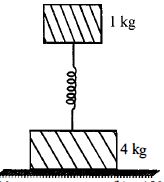
Answerc
Mass of bigger body $M=4 \mathrm{kg}$
Mass of smaller body $\mathrm{m}=1 \mathrm{kg}$
Smaller mass $(\mathrm{m}=1 \mathrm{kg})$ $executes \,S.H.M \,of$
angular frequency $\omega=25$ rad $/ \mathrm{s}$
Amplitude $x=1.6 \mathrm{cm}=1.6 \times 10^{-2}$
As we know,
$\mathrm{T}=2 \pi \sqrt{\frac{\mathrm{m}}{\mathrm{K}}}$
$\boldsymbol{\alpha}, \quad \frac{2 \pi}{\omega}=2 \pi \sqrt{\frac{\mathrm{m}}{\mathrm{K}}}$
or, $\quad \frac{1}{25}=\sqrt{\frac{1}{\mathrm{K}}}[\because \mathrm{m}=1 \mathrm{kg} ; \omega=25 \mathrm{rad} / \mathrm{s}]$
or, $\quad \mathrm{K}=625 \mathrm{Nm}^{-1}$
The maximum force exerted by the system on the floor
$=\mathrm{Mg}+\mathrm{Kx}+\mathrm{mg}$
$=4 \times 10+625 \times 1.6 \times 10^{-2}+1 \times 10$
$=40+10+10$
$=60 N$
View full question & answer→MCQ 4451 Mark
A mass $m = 1.0\,kg$ is put on a flat pan attached to a vertical spring fixed on the ground. The mass of the spring and the pan is negligible. When pressed slightly and released, the mass executes simple harmonic motion. The spring constant is $500\,N/m.$ What is the amplitude $A$ of the motion, so that the mass $m$ tends to get detached from the pan ? (Take $g = 10\,m/s^2$ ). The spring is stiff enough so that it does not get distorted during the motion.
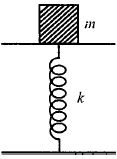
- A
$A\,<\,2.0\,cm$
- B
$A\,=\,2.0\,cm$
- ✓
$A\,>\,2.0\,cm$
- D
$A\,=\,1.5\,cm$
AnswerCorrect option: C. $A\,>\,2.0\,cm$
c
As $F = -kx$
$mg=-kx$
$1\times 10=500\;A$
$A=2\;cm$
for not gettingdistorted $A > 2\;cm$
View full question & answer→MCQ 4461 Mark
The amplitude of a damped oscillator decreases to $0.9$ times its original magnitude in $5\ s$. In another $10\ s$ it will decrease to $\alpha $ times its original magnitude, where $\alpha $ equals
- A
$0.6$
- B
$0.7$
- C
$0.81$
- ✓
$0.73$
AnswerCorrect option: D. $0.73$
d
$\because A=A_{0} e^{-\frac{b t}{2 m}}\left(\text { where }, A_{0}=\text { maximum amplitude }\right)$
$ According \,to \,the\, questions,\, after\, 5\, second, $
$0.9 \mathrm{A}_{0}=\mathrm{A}_{0} \mathrm{e}^{-\frac{\mathrm{b}(5)}{2 \mathrm{m}}}$ $...(i)$
$After\, 10 \,more\, second,$
$A=A_{0} \mathrm{e}^{-\frac{\mathrm{b}(15)}{2 \mathrm{m}}}$ $...(ii)$
From eq"s $(i)$ and $(ii)$
$A=0.729 A_{0} \therefore \alpha=0.729$
View full question & answer→MCQ 4471 Mark
Two springs of force constants $300\, N/m$ (Spring $A$) and $400\, N/m$ (Spring $B$) are joined together in series . The combination is compressed by $8.75\, cm$. The ratio of energy stored in $A$ and $B$ is $\frac{{{E_A}}}{{{E_B}}}$. Then $\frac{{{E_A}}}{{{E_B}}}$ is equal to
- ✓
$\frac{4}{3}$
- B
$\frac{16}{9}$
- C
$\frac{3}{4}$
- D
$\frac{9}{16}$
AnswerCorrect option: A. $\frac{4}{3}$
a
$\mathrm{k}_{\mathrm{A}}=300 \mathrm{N} / \mathrm{m}, \quad \mathrm{k}_{\mathrm{B}}=400 \mathrm{N} / \mathrm{m}$
Let when the combination of springs is compressed by force $\mathrm{F}$. Spring $A$ is compressed by $x$. Therefore compression in spring $\mathrm{B}$
$x_{B}=(8.75-x) c m$
$\mathrm{F}=300 \times x=400(8.75-x)$
Solving we get, $x=5 \mathrm{cm}$
$x_{B}=8.75-5=3.75 \mathrm{cm}$
$\frac{E_{A}}{E_{B}}=\frac{\frac{1}{2} k_{A}\left(x_{A}\right)^{2}}{\frac{1}{2} k_{B}\left(x_{B}\right)^{2}}=\frac{300 \times(5)^{2}}{400 \times(3.75)^{2}}=\frac{4}{3}$
View full question & answer→MCQ 4481 Mark
An ideal gas enclosed in a vertical cylindrical container supports a freely moving piston of mass $M$. The piston and the cylinder have equal cross sectional area $A$. When the piston is in equilibrium, the volume of the gas is $V_0$ and its pressure is $P_ 0$. The piston is slightly displaced from the equilibrium position and released. Assuming that the system is completely isolated from its surrounding, the piston executes a simple harmonic motion with frequency
- A
$\frac{1}{{2\pi }}\sqrt {\frac{{M{V_0}}}{{A\gamma {P_o}}}} \;\;\;\;\;\;\;\;\;\;\;\;\;\;\;$
- B
$\;\frac{1}{{2\pi }}\sqrt {\frac{{A\gamma {P_o}}}{{{V_0}M}}} $
- ✓
$\;\frac{1}{{2\pi }}\sqrt {\frac{{{A^2}\gamma {P_o}}}{{M{V_0}}}} $
- D
$\;\frac{1}{{2\pi }}\frac{{{V_o}M{P_o}}}{{{A^2}\gamma }}$
AnswerCorrect option: C. $\;\frac{1}{{2\pi }}\sqrt {\frac{{{A^2}\gamma {P_o}}}{{M{V_0}}}} $
c
${\frac{M g}{A}=P_{0}}$ $ {P_{0} V_{0}^{\gamma}=P V^{\gamma}}$
${\mathrm{Mg}=\mathrm{P}_{0} \mathrm{A}}{\ldots(1)}$ $ {P_{0} A x_{0}^{\gamma}=P A\left(x_{0}-x\right)^{\gamma}}$
$P=\frac{P_{0} x_{0}^{\gamma}}{\left(x_{0}-x\right)^{\gamma}}$
Let piston is displaced by distance $x$
$M g-\left(\frac{P_{0} x_{0}^{\gamma}}{\left(x_{0}-x\right)^{\gamma}}\right) A=F_{\text {restoring }}$
$P_{0} A\left(1-\frac{x_{0}^{\gamma}}{\left(x_{0}-x\right)^{\gamma}}\right)=F_{\text {restoring }} \quad\left[x_{0}-x \approx x_{0}\right]$
$F=-\frac{\gamma P_{0} A x}{x_{0}}$
Frequency with which piston executes $SHM.$
$f=\frac{1}{2 \pi} \sqrt{\frac{\gamma P_{0} A}{x_{0} M}}=\frac{1}{2 \pi} \sqrt{\frac{\gamma P_{0} A^{2}}{M V_{0}}}$
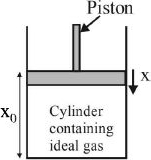
View full question & answer→MCQ 4491 Mark
A uniform cylinder of length $L$ and mass $M$ having cross-sectional area $A$ is suspended, with its length vertical, from a fixed point by a massless spring, such that it is half submerged in a liquid of density $\sigma $ at equilibrium position. When the cylinder is given a downward push and released, it starts oscillating vertically with a small amplitude. The time period $T$ of the oscillations of the cylinder will be
- ✓
Smaller than $2\pi {\left[ {\frac{M}{{\left( {k + A\sigma g} \right)}}} \right]^{1/2}}$
- B
$2\pi \sqrt {\frac{M}{k}} $
- C
Larger than $2\pi {\left[ {\frac{M}{{\left( {k + A\sigma g} \right)}}} \right]^{1/2}}$
- D
$2\pi {\left[ {\frac{M}{{\left( {k + A\sigma g} \right)}}} \right]^{1/2}}$
AnswerCorrect option: A. Smaller than $2\pi {\left[ {\frac{M}{{\left( {k + A\sigma g} \right)}}} \right]^{1/2}}$
a
If $x$ is the displacement then,
$M{\omega ^2}x = \left[ {\rho Ag + k} \right]x$
$ \Rightarrow \omega = {\left[ {\frac{{\rho Ag + k}}{m}} \right]^{1/2}}$
$ \Rightarrow T=2\pi {\left[ {\frac{M}{{\left( {k + A\sigma g} \right)}}} \right]^{1/2}}$
It Should be less than $2\pi {\left[ {\frac{M}{{\left( {k + A\sigma g} \right)}}} \right]^{1/2}}$
View full question & answer→MCQ 4501 Mark
Two simple pendulums of length $1\, m$ and $4\, m$ respectively are both given small displacement in the same direction at the same instant. They will be again in phase after the shorter pendulum has completed number of oscillations equal to
Answera
Let $\mathrm{T}_{1}$ and $\mathrm{T}_{2}$ be the time period of the two
pendulums $T_{1}=2 \pi \sqrt{\frac{1}{g}}$ and $T_{2}=2 \pi \sqrt{\frac{4}{g}}$
As $\ell_{1}<\ell_{2}$ therefore $\mathrm{T}_{1}<\mathrm{T}_{2}$
Let at $t=0$ they start swinging together. since their time periods are different, the swinging will not be in unison always. Only when number of completed oscillations
differ by an integer, the two pendulums will again begin to swing together
Let longer length pendulum complete $n$ oscillation and shorter length pendulum complete $(\mathrm{n}+1)$ oscillation. For unison swinging
$(n+1) T_{1}=n T_{2}$
$(n+1) \times 2 \pi \sqrt{\frac{1}{g}}=(n) \times 2 \pi \sqrt{\frac{4}{g}}$
$\Rightarrow n=1$
$\therefore n+1=1+1=2$
View full question & answer→MCQ 4511 Mark
On a frictionless horizontal plane, a bob of mass $m=0.1 kg$ is attached to a spring with natural length $l_0=0.1 m$. The spring constant is $k_1=0.009 Nm ^{-1}$ when the length of the spring $I > l_0$ and is $k_2=0.016 Nm ^{-1}$ when $ I < l_0$. Initially the bob is released from $l=0.15 m$. Assume that Hooke's law remains valid throughout the motion. If the time period of the full oscillation is $T=(n \pi) s$, then the integer closest to $n$ is. . . . .
Answera
$\ell > \ell_0 \rightarrow k=k_1$
$\ell < \ell_0 \rightarrow k=k_2$
Time period of oscillation,
$T=\pi \sqrt{\frac{ m }{ k _1}}+\pi \sqrt{\frac{ m }{ k _2}}$
$T=\pi \sqrt{\frac{0.1}{0.009}}+\pi \sqrt{\frac{0.1}{0.016}}$
$T =\frac{\pi}{0.3}+\frac{\pi}{0.4} \Rightarrow T=\frac{0.7}{0.12} \pi \Rightarrow T=5.83 \pi$
$T\approx 6 \pi$
So, $n=6$
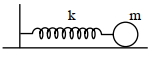
View full question & answer→MCQ 4521 Mark
A stationary tuning fork is in resonance with an air column in a pipe. If the tuning fork is moved with a speed of $2 ms ^{-1}$ in front of the open end of the pipe and parallel to it, the length of the pipe should be changed for the resonance to occur with the moving tuning fork. If the speed of sound in air is $320 ms ^{-1}$, the smallest value of the percentage change required in the length of the pipe is. . . . . .
- A
$0.63$
- ✓
$0.62$
- C
$0.70$
- D
$0.75$
AnswerCorrect option: B. $0.62$
b
$f \propto \frac{1}{\ell_1} \Rightarrow f =\frac{ k }{\ell_1}$ $. . . . . . (1)$
$\left(\ell_1 \Rightarrow \text { initial length of pipe }\right)$
$\left(\frac{ V }{ V - V _{ T }}\right) f =\frac{ k }{\ell_2}\left\{ V _{ T }\right.$ Speed of tuning fork, $\ell_2 \rightarrow$ new length of pipe $\}$
$\text { (1) } \div(2)$
$\frac{ V - V _{ T }}{ V }=\frac{\ell_2}{\ell_1}$
$\frac{\ell_2}{\ell_1}-1=\frac{ V - V _{ T }}{ V }-1$
$\frac{\ell_2-\ell_1}{\ell_1}=\frac{- V _{ T }}{ V }$
$\frac{\ell_2-\ell_1}{\ell_1} \times 100=\frac{-2}{320} \times 100=-0.625$
Therefore smallest value of percentage change required in the length of pipe is $0.625$
View full question & answer→MCQ 4531 Mark
A block with mass $M$ is connected by a massless spring with stiffiess constant $k$ to a rigid wall and moves without friction on a horizontal surface. The block oscillates with small amplitude $A$ about an equilibrium position $x_0$. Consider two cases: ($i$) when the block is at $x_0$; and ($ii$) when the block is at $x=x_0+A$. In both the cases, a perticle with mass $m$ is placed on the mass $M$ ?
($A$) The amplitude of oscillation in the first case changes by a factor of $\sqrt{\frac{M}{m+M}}$, whereas in the second case it remains unchanged
($B$) The final time period of oscillation in both the cases is same
($C$) The total energy decreases in both the cases
($D$) The instantaneous speed at $x_0$ of the combined masses decreases in both the cases
- A
$A,B$
- B
$B,D$
- ✓
$A,B,D$
- D
$A,B,C$
AnswerCorrect option: C. $A,B,D$
c
In case $I$,
From Conservation of momentum,
$MV _1=( M + m ) V _2$
$\frac{ MV _1}{ M + m }= V _2$
$\sqrt{\frac{k}{M+m}} A_2=\frac{M}{M+m} \sqrt{\frac{k}{M}} A_1$
$A_2=\sqrt{\frac{M}{M+m}} A_1$
In case $II$,
$A_2=A_1$
$T =2 \pi \sqrt{\frac{\overline{M+m}}{k}}$ in both the cases.
Total energy decreases in first case where as remain same in $2$ nd case. Instantaneous speed at $x_0$ decreases in both case.
Answer is $A , B$ and $D$ .
View full question & answer→MCQ 4541 Mark
Two independent harmonic oscillators of equal mass are oscillating about the origin with angular frequencies $\omega_1$ and $\omega_2$ and have total energies $E_1$ and $E_2$, respectively. The variations of their momenta $p$ with positions $x$ are shown in the figures. If $\frac{a}{b}= n ^2$ and $\frac{ a }{ R }= n$, then the correct equation$(s)$ is(are) $Image$
$(A)$ $E_1 \omega_1=E_2 \omega_2$ $(B)$ $\frac{\omega_2}{\omega_1}=n^2$ $(C)$ $\omega_1 \omega_2= n ^2$ $(D)$ $\frac{E_1}{\omega_1}=\frac{E_2}{\omega_2}$
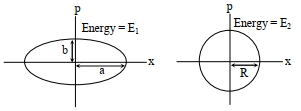
- ✓
$(B,D)$
- B
$(B,C)$
- C
$(A,C)$
- D
$(A,D)$
AnswerCorrect option: A. $(B,D)$
a
For first oscillator
$E_1=\frac{1}{2} m \omega_1^2 a^2 \text {, and } p = mv = m \omega_1 a = b \Rightarrow \frac{ a }{ b }=\frac{1}{ m \omega_1} .$ $............(i)$
For second oscillator
$E_2=\frac{1}{2} m \omega_2^2 R^2 \text {, and } m \omega_2=1$ $............(ii)$
$\left(\frac{a}{b}\right)=\frac{\omega_2}{\omega_1}=n^2$
$\frac{E_1}{\omega_1^2 a^2}=\frac{E_2}{\omega_2^2 R^2} \Rightarrow \frac{E_1}{\omega_1}=\frac{E_2}{\omega_2}$
View full question & answer→MCQ 4551 Mark
Four harmonic waves of equal frequencies and equal intensities $I_0$ have phase angles $0, \pi / 3,2 \pi / 3$ and $\pi$. When they are superposed, the intensity of the resulting wave is $nI _0$. The value of $n$ is
Answerc
First and fourth wave interfere destructively. So from the interference of $2^{\text {nd }}$ and $3^{\text {rd }}$ wave only,
$\Rightarrow I _{2 e \varepsilon}= I _0+ I _0+2 \sqrt{ I _0} \sqrt{ I _0} \cos \left(\frac{2 \pi}{3}-\frac{\pi}{3}\right)=3 I _0$
$\Rightarrow n =3$
View full question & answer→MCQ 4561 Mark
A particle of unit mass is moving along the $x$-axis under the influence of a force and its total energy is conserved. Four possible forms of the potential energy of the particle are given in column $I$ (a and $U _0$ are constants). Match the potential energies in column $I$ to the corresponding statement$(s)$ in column $II.$
| column $I$ |
column $II$ |
| $(A)$ $U _1( x )=\frac{ U _0}{2}\left[1-\left(\frac{ x }{ a }\right)^2\right]^2$ |
$(P)$ The force acting on the particle is zero at $x = a$. |
| $(B)$ $U _2( x )=\frac{ U _0}{2}\left(\frac{ x }{ a }\right)^2$ |
$(Q)$ The force acting on the particle is zero at $x=0$. |
| $(C)$ $U _3( x )=\frac{ U _0}{2}\left(\frac{ x }{ a }\right)^2 \exp \left[-\left(\frac{ x }{ a }\right)^2\right]$ |
$(R)$ The force acting on the particle is zero at $x =- a$. |
| $(D)$ $U _4( x )=\frac{ U _0}{2}\left[\frac{ x }{ a }-\frac{1}{3}\left(\frac{ x }{ a }\right)^3\right]$ |
$(S)$ The particle experiences an attractive force towards $x =0$ in the region $| x |< a$. |
| |
$(T)$ The particle with total energy $\frac{ U _0}{4}$ can oscillate about the point $x=-a$. |
- A
$( A ) \rightarrow( P , Q , R , S ) ;( B ) \rightarrow( Q , T ) ;( C ) \rightarrow( P , Q , R , T ) ;( D ) \rightarrow( P , R , S )$
- ✓
$( A ) \rightarrow( P , Q , R , T ) ;( B ) \rightarrow( Q , S ) ;( C ) \rightarrow( P , Q , R , S ) ;( D ) \rightarrow( P , R , T )$
- C
$( A ) \rightarrow( P , R , S , T ) ;( B ) \rightarrow( Q , R ) ;( C ) \rightarrow( P , R , S , T ) ;( D ) \rightarrow( P , Q , T )$
- D
$( A ) \rightarrow( Q , R , S , T ) ;( B ) \rightarrow( S , T ) ;( C ) \rightarrow( Q , R , S , T ) ;( D ) \rightarrow( Q , R , T )$
AnswerCorrect option: B. $( A ) \rightarrow( P , Q , R , T ) ;( B ) \rightarrow( Q , S ) ;( C ) \rightarrow( P , Q , R , S ) ;( D ) \rightarrow( P , R , T )$
b
Second Method
$(A)$ $\overrightarrow{ F }=-\frac{ dU }{ dx } \hat{ i }=-\frac{ U _0}{2} 2\left(1-\left(\frac{ x }{ a }\right)^2\right) \times\left[-2\left(\frac{ x }{ a }\right) \times \frac{1}{ a }\right] \hat{ i }=2 U _0\left[1-\left(\frac{ x }{ a }\right)^2\right]\left[\frac{ x }{ a ^2}\right] \hat{ i }$
If $x=0 \Rightarrow \vec{F}=\frac{ U _0}{2}[2(1) \times 0]=\overrightarrow{0}, U =\frac{ U _0}{2}$
If $x=a \Rightarrow \vec{F}=\overrightarrow{0}, \& U=0$
If $x=-a \Rightarrow \vec{F}=\overrightarrow{0}, \& U=0$
$(B)$ $\overrightarrow{ F }=-\frac{ U _0}{2} \times 2\left(\frac{ x }{ a }\right) \times \frac{1}{ a } \hat{ i }=-\frac{ U _0 x }{ a ^2} \hat{ i }$
If $x=0 \Rightarrow \overrightarrow{ F }=0$ and $U =0$
If $x = a \Rightarrow \overrightarrow{ F }=-\frac{ U _0}{ a } \hat{ i }$ and $U =\frac{ U _0}{2}$
If $x=-a \Rightarrow \vec{F}=+\frac{U_0}{a} \hat{i}$ and $U=\frac{U_0}{2}$
For $(C)$ and $(D)$, similarly we can solve
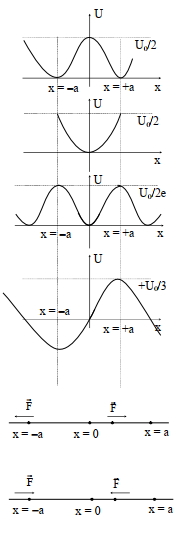
View full question & answer→MCQ 4571 Mark
A particle of mass $m$ is attached to one end of a mass-less spring of force constant $k$, lying on a frictionless horizontal plane. The other end of the spring is fixed. The particle starts moving horizontally from its equilibrium position at time $t=0$ with an initial velocity $u_0$. When the speed of the particle is $0.5 u_0$, it collies elastically with a rigid wall. After this collision :
$(A)$ the speed of the particle when it returns to its equilibrium position is $u_0$.
$(B)$ the time at which the particle passes through the equilibrium position for the first time is $t=\pi \sqrt{\frac{ m }{ k }}$.
$(C)$ the time at which the maximum compression of the spring occurs is $t =\frac{4 \pi}{3} \sqrt{\frac{ m }{ k }}$.
$(D)$ the time at which the particle passes througout the equilibrium position for the second time is $t=\frac{5 \pi}{3} \sqrt{\frac{ m }{ k }}$.
- A
$(B,D)$
- B
$(B,C)$
- C
$(A,C)$
- ✓
$(A,D)$
AnswerCorrect option: D. $(A,D)$
d
Displacement $x = A \sin \omega t$
Velocity $v = A \omega \cos \omega t =\frac{\omega A }{2}$
At the time of collision
$\cos \omega t=\frac{1}{2} $
$\omega t=\frac{\pi}{3} \Rightarrow t=\frac{2 \pi}{3}=\frac{\pi}{3} \sqrt{\frac{m}{k}}$
$Image$
for $(C)$ $ \quad time$$ =\frac{2 \pi}{3} \sqrt{\frac{m}{k}}+\frac{\pi}{2} \sqrt{\frac{m}{k}} $
$ =\frac{5 \pi}{6} \sqrt{\frac{m}{k}}$(So it is incorrect)
for $(D)$ $\quad time \quad=\frac{2 \pi}{3} \sqrt{\frac{m}{k}}+\pi \sqrt{\frac{m}{k}} $
$ =\frac{5 \pi}{3} \sqrt{\frac{m}{k}} \text { (So it is correct). }$
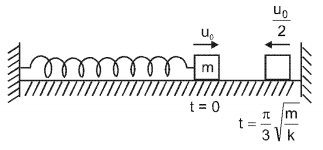
View full question & answer→MCQ 4581 Mark
A small block is connected to one end of a massless spring of un-stretched length $4.9 \ m$. The other end of the spring (see the figure) is fixed. The system lies on a horizontal frictionless surface. The block is stretched by $0.2$ $m$ and released from rest at $t =0$. It then executes simple harmonic motion with angular frequency $\omega=\frac{\pi}{3} \ rad / s$.
Simultaneously at $t=0$, a small pebble is projected with speed $v$ from point $P$ at an angle of $45^{\circ}$ as shown in the figure. Point $P$ is at a horizontal distance of $10 \ cm$ from $O$. If the pebble hits the block at $t=1 \ s$, the value of $v$ is (take $g =10 \ m / s ^2$ )
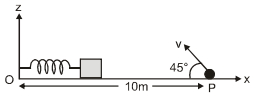
- ✓
$\sqrt{50} \ m / s$
- B
$\sqrt{51} \ m / s$
- C
$\sqrt{52} \ m / s$
- D
$\sqrt{53} \ m / s$
AnswerCorrect option: A. $\sqrt{50} \ m / s$
a
Time of flight for projectile
$T =\frac{2 u \sin \theta}{ g }=1 sec . $
$\frac{2 u \sin 45}{g}=1 sec \text {. } $
$u=\frac{g}{\sqrt{2}} $
$u=\sqrt{50} \ m / s $
View full question & answer→MCQ 4591 Mark
A point mass is subjected to two simultaneous sinusoidal displacements in x-direction, $x_1(t)=A \sin \omega t $ and $ x_2(t)=A \sin \left(\omega t+\frac{2 \pi}{3}\right)$. Adding a third sinusoidal displacement $x_3(t)=B \sin (\omega t+\phi)$ brings the mass to a complete rest. The values of $B$ and $\phi$ are
- A
$\sqrt{2} A, \frac{3 \pi}{4}$
- ✓
$A, \frac{4 \pi}{3}$
- C
$\sqrt{3} A, \frac{5 \pi}{6}$
- D
$A, \frac{\pi}{3}$
AnswerCorrect option: B. $A, \frac{4 \pi}{3}$
b
$x_1+x_2==A \sin \omega t+A \sin \left(\omega t+\frac{2 \pi}{3}\right)$
$=A \sin \left(\omega t+\frac{\pi}{3}\right)$
Since, $x _1+ x _2+ x _3=0$
$x_3=A \sin \left(\omega t+\frac{4 \pi}{3}\right)$
So, $B=A$ and $\phi=\frac{4 \pi}{3}$
View full question & answer→MCQ 4601 Mark
A metal rod of length ' $L$ ' and mass ' $m$ ' is pivoted at one end. A thin disk of mass ' $M$ ' and radius $'R'$ $( < L)$ is attached at its center to the free end of the rod. Consider two ways the disc is attached: (case $A$) The disc is not free to rotate about its center and (case $B$) the disc is free to rotate about its center. The rod-disc system performs $SHM$ in vertical plane after being released from the same displaced position. Which of the following statement$(s)$ is (are) true? $Image$
$(A)$ Restoring torque in case $A =$ Restoring torque in case $B$
$(B)$ Restoring torque in case $A < $ Restoring torque in case $B$
$(C)$ Angular frequency for case $A > $ Angular frequency for case $B$.
$(D)$ Angular frequency for case $A < $ Angular frequency for case $B$.
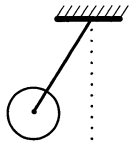
- ✓
$(A,D)$
- B
$(B,D)$
- C
$(C,D)$
- D
$(A,B)$
AnswerCorrect option: A. $(A,D)$
a
Restoring torque is same in both cases,
$\propto=\frac{ T }{ I }=-\omega^2 \theta$
In case $A$ the moment of Inertia is more as compared to $B$ , So
$\omega_{ B } > \omega_{ A }$
$A$ and $D$ are correct answer
View full question & answer→MCQ 4611 Mark
Phase space diagrams are useful tools in analyzing all kinds of dynamical problems. They are especially useful in studying the changes in motion as initial position and momentum are changed. Here we consider some simple dynamical systems in one-dimension. For such systems, phase space is a plane in which position is plotted along horizontal axis and momentum is plotted along vertical axis. The phase space diagram is $x(t)$ vs. $p(t)$ curve in this plane. The arrow on the curve indicates the time flow. For example, the phase space diagram for a particle moving with constant velocity is a straight line as shown in the figure. We use the sign convention in which position or momentum upwards (or to right) is positive and downwards (or to left) is negative. $Image$
$1.$ The phase space diagram for a ball thrown vertically up from ground is
mcq $Image$
$2.$ The phase space diagram for simple harmonic motion is a circle centered at the origin. In the figure, the two circles represent the same oscillator but for different initial conditions, and $E_1$ and $E_2$ are the total mechanical energies respectively. Then $Image$
$(A)$ $ E_1=\sqrt{2} E_2$ $(B)$ $ E_1=2 E_2$
$(C)$ $ E_1=4 E_2$ $(D)$ $ E_1=16 E_2$
$3.$ Consider the spring-mass system, with the mass submerged in water, as shown in the figure. The phase space diagram for one cycle of this system is $Image$
mcq $Image$
Give the answer question $1,2$ and $3.$
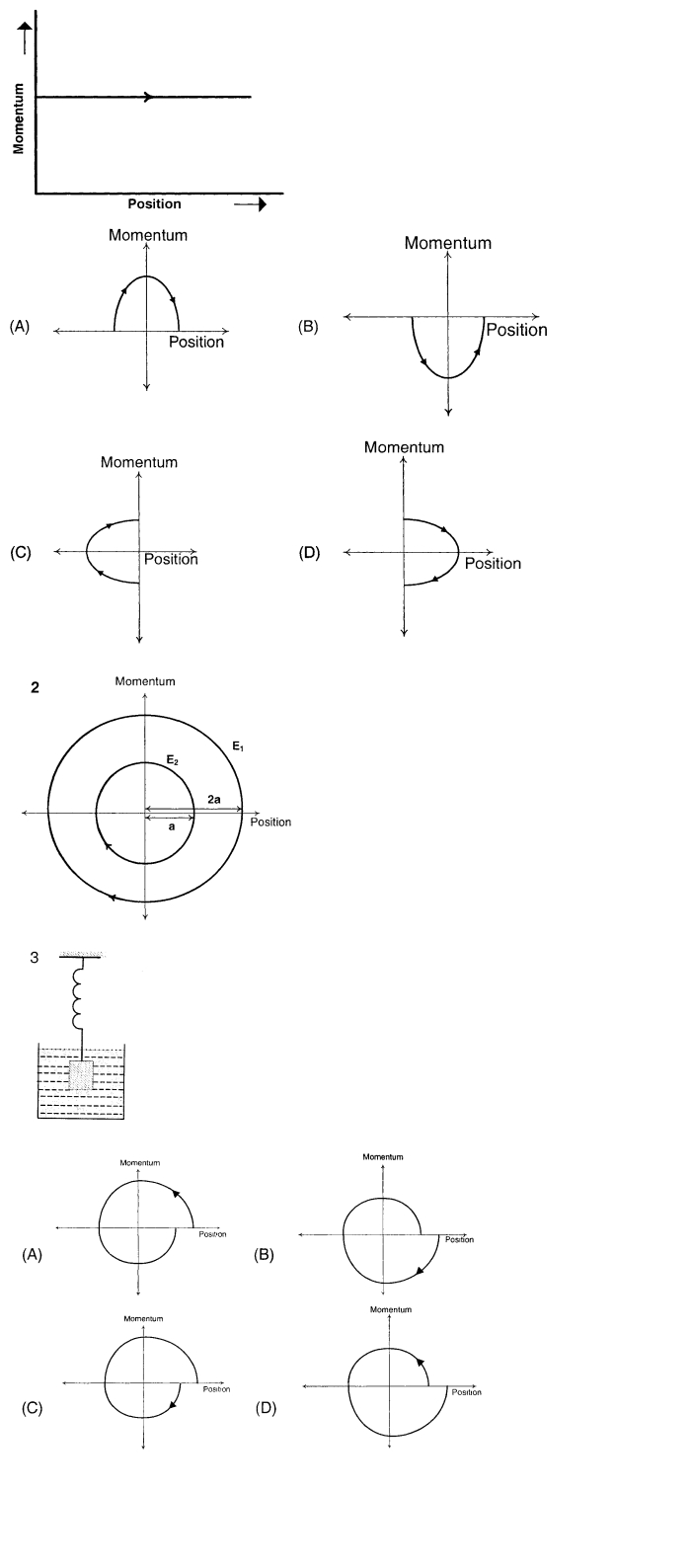
- ✓
$(D,C,B)$
- B
$(A,B,C)$
- C
$(B,B,D)$
- D
$(D,A,D)$
AnswerCorrect option: A. $(D,C,B)$
a
$2.$ From diagram, Amplitude of oscillator $1=2 \times$ (Amplitude of oscillator $2$ )
$\Rightarrow E _1=4 E _2$
View full question & answer→MCQ 4621 Mark
When a particle of mass $m$ moves on the $x$-axis in a potential of the form $V(x)=\mathrm{kx}^2$ it performs simple harmonic motion. The corresponding time period is proportional to $\sqrt{\frac{\mathrm{m}}{\mathrm{k}}}$, as can be seen easily using dimensional analysis. However, the motion of a particle can be periodic even when its potential energy increases on both sides of $\mathrm{x}=0$ in a way different from $\mathrm{kx}^2$ and its total energy is such that the particle does not escape to infinity. Consider a particle of mass $\mathrm{m}$ moving on the $x$-axis. Its potential energy is $V(x)=\alpha x^4(\alpha>0)$ for $|x|$ near the origin and becomes a constant equal to $\mathrm{V}_0$ for $|x| \geq X_0$ (see figure). $Image$
$1.$ If the total energy of the particle is $E$, it will perform periodic motion only if
$(A)$ $E$ $<0$ $(B)$ $E$ $>0$ $(C)$ $\mathrm{V}_0 > \mathrm{E}>0$ $(D)$ $E > V_0$
$2.$ For periodic motion of small amplitude $\mathrm{A}$, the time period $\mathrm{T}$ of this particle is proportional to
$(A)$ $\mathrm{A} \sqrt{\frac{\mathrm{m}}{\alpha}}$ $(B)$ $\frac{1}{\mathrm{~A}} \sqrt{\frac{\mathrm{m}}{\alpha}}$ $(C)$ $\mathrm{A} \sqrt{\frac{\alpha}{\mathrm{m}}}$ $(D)$ $\mathrm{A} \sqrt{\frac{\alpha}{\mathrm{m}}}$
$3.$ The acceleration of this particle for $|\mathrm{x}|>\mathrm{X}_0$ is
$(A)$ proportional to $\mathrm{V}_0$
$(B)$ proportional to $\frac{\mathrm{V}_0}{\mathrm{mX}_0}$
$(C)$ proportional to $\sqrt{\frac{\mathrm{V}_0}{\mathrm{mX}_0}}$
$(D)$ zero
Give the answer qustion $1,2$ and $3.$
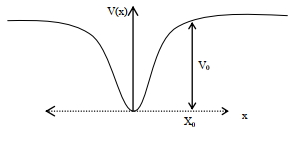
- A
$(A,B,C)$
- ✓
$(C,B,D)$
- C
$(C,B,A)$
- D
$(A,C,D)$
AnswerCorrect option: B. $(C,B,D)$
b
$1.$ Energy must be less than $\mathrm{V}_0$
$2.$ $[\alpha]=\mathrm{ML}^{-2} \mathrm{~T}^{-2}$
Only $(B)$ option has dimension of time Alternatively
$ \frac{1}{2} \mathrm{~m}\left(\frac{\mathrm{dx}}{\mathrm{dt}}\right)^2+\mathrm{kx}^4=\mathrm{kA}^4 $
$ \left(\frac{\mathrm{dx}}{\mathrm{dt}}\right)^2=\frac{2 \mathrm{k}}{\mathrm{m}}\left(\mathrm{A}^4-\mathrm{x}^4\right) $
$ 4 \sqrt{\frac{\mathrm{m}}{2 \mathrm{k}}} \int_0^{\mathrm{A}} \frac{\mathrm{dx}}{\sqrt{\mathrm{A}^4-\mathrm{x}^4}}=\int \mathrm{dt}=\mathrm{T} $
$ 4 \sqrt{\frac{\mathrm{m}}{2 \mathrm{k}}} \frac{1}{\mathrm{~A}} \int_0^1 \frac{\mathrm{du}}{\sqrt{1-\mathrm{u}^4}}=\mathrm{T} \quad \text { Substitute } \mathrm{x}=\mathrm{Au}$
$3.$ As potential energy is constant for $|\mathrm{x}|>\mathrm{X}_0$, the force on the particle is zero hence acceleration is zero.
View full question & answer→MCQ 4631 Mark
The $x$-t graph of a particle undergoing simple harmonic motion is shown below. The acceleration of the particle at $t=4 / 3 \mathrm{~s}$ is
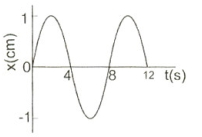
- A
$\frac{\sqrt{3}}{32} \pi^2 \mathrm{~cm} / \mathrm{s}^2$
- B
$\frac{-\pi^2}{32} \mathrm{~cm} / \mathrm{s}^2$
- C
$\frac{\pi^2}{32} \mathrm{~cm} / \mathrm{s}^2$
- ✓
$-\frac{\sqrt{3}}{32} \pi^2 \mathrm{~cm} / \mathrm{s}^2$
AnswerCorrect option: D. $-\frac{\sqrt{3}}{32} \pi^2 \mathrm{~cm} / \mathrm{s}^2$
d
The correct option is $D -\frac{\sqrt{3} \pi^2}{32} cm / s ^2$ From the $x-t$ graph of the particle,
At, $t =0$, the particle is at $x =0$.
Hence, the particle is starting $SHM$ from its mean position.
The equation of $SHM$ of particle will be, $x=A \sin \omega t$ $\qquad$
From the graph, one oscillation has been completed in time, $T =8 s$ and maximum displacement, $A=1 cm$
So, angular frequency, $\omega=\frac{2 \pi}{T}=\frac{2 \pi}{8}=\frac{\pi}{4} rad / s$
On putting above data in $(1)$
$x=1 \sin \left(\frac{\pi t}{4}\right)$
At, $t=\frac{4}{3} s$
$x=1 \sin \left(\frac{\pi}{4} \times \frac{4}{3}\right)=\frac{\sqrt{3}}{2} cm$
Now,
Acceleration of the particle at $t=\frac{4}{3} s$,
$a=-\omega^2 x=-\left(\frac{\pi}{4}\right)^2 \times \frac{\sqrt{3}}{2}$
$\Rightarrow a=-\frac{\sqrt{3} \pi^2}{32} cm / s ^2$
View full question & answer→MCQ 4641 Mark
The mass $M$ shown in the figure oscillates in simple harmonic motion with amplitude $A$. The amplitude of the point $P$ is
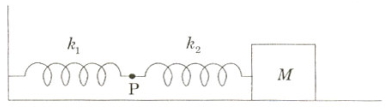
- A
$\frac{k_1 A}{k_2}$
- B
$\frac{k_2 A}{k_1}$
- C
$\frac{k_1 A}{k_1+k_2}$
- ✓
$\frac{k_2 A}{k_1+k_2}$
AnswerCorrect option: D. $\frac{k_2 A}{k_1+k_2}$
d
$F = k _1 x _1 \text { and } F = k _2 x _2$
$\text { tehn } A = x _1+ x _2= F \left(\frac{1}{ k _1}+\frac{1}{ k _2}\right)$
$F =\frac{ k _1 k _2}{ k _1+ k _2} A$
So the amplitude of the point is $x _1=\frac{ F }{ k _1}=\frac{k_2}{k_1+k_2} A$
View full question & answer→MCQ 4651 Mark
A uniform rod of length $L$ and mass $M$ is pivoted at the centre. Its two ends are attached to two springs of equal spring constants $k$. The springs are fixed to rigid supports as shown in the figure, and the rod is free to oscillate in the horizontal plane. The rod is gently pushed through a small angle $\theta$ in one direction and released. The frequency of oscillation is
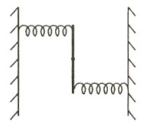
- A
$\frac{1}{2 \pi} \sqrt{\frac{2 k}{M}}$
- B
$\frac{1}{2 \pi} \sqrt{\frac{k}{M}}$
- ✓
$\frac{1}{2 \pi} \sqrt{\frac{6 k}{M}}$
- D
$\frac{1}{2 \pi} \sqrt{\frac{24 k}{M}}$
AnswerCorrect option: C. $\frac{1}{2 \pi} \sqrt{\frac{6 k}{M}}$
c
The correct option is $C \frac{1}{2 \pi}, \frac{\overline{6 k}}{ M }$
ANSWER:
Spring force acting at the end gives restoring torque
$\tau=r F \sin \theta$
$\Rightarrow \tau_0=-\left(k x \frac{L}{2} \cos \theta\right) \times 2$
Value of displacement of spring,
$x=\frac{L}{2} \sin \theta$
For the value of angular displacement tends to zero,
$\theta \rightarrow 0$
$\Rightarrow \cos \theta \cong 1, \sin \theta \cong \theta$
Then torque,
$\Rightarrow \tau=-k \frac{L}{2} \times \frac{L}{2} \theta=-\frac{k L^2}{2} \theta \ldots$
From equation $(i)$,
$\Rightarrow \tau=1 a=\frac{k L^2}{2} \theta$
$\Rightarrow \frac{M L^2}{12} a=-\frac{k L^2}{2} \theta$
$\Rightarrow a=-\frac{6 k}{M} \theta=-\omega^2 \theta$
$\Rightarrow \omega=\sqrt{\frac{6 k}{M}}$
Time period,
$T =\frac{2 \pi}{\omega}$
$\Rightarrow T=2 \pi \sqrt{\frac{M}{6 k}}$
Frequency,
$f=\frac{1}{T}=\frac{1}{2 \pi} \sqrt{\frac{\overline{M k}}{M}}$
Final answer: $(c)$
View full question & answer→MCQ 4661 Mark
Column $I$ gives a list of possible set of parameters measured in some experiments. The variations of the parameters in the form of graphs are shown in Column $II$. Match the set of parameters given in Column $I$ with the graph given in Column $II$. Indicate your answer by darkening the appropriate bubbles of the $4 \times 4$ matrix given in the $ORS$.
| Column $I$ |
Column $II$ |
| $(A)$ Potential energy of a simple pendulum (y axis) as a function of displacement ( $\mathrm{x}$ axis) |
$Image$ |
| $(B)$ Displacement (y axis) as a function of time (x axis) for a one dimensional motion at zero or constant acceleration when the body is moving along the positive $\mathrm{x}$-direction |
$Image$ |
| $(C)$ Range of a projectile (y axis) as a function of its velocity ( $\mathrm{x}$ axis) when projected at a fixed angle |
$Image$ |
| $(D)$ The square of the time period (y axis) of a simple pendulum as a function of its length ( $\mathrm{x}$ axis) |
$Image$ |
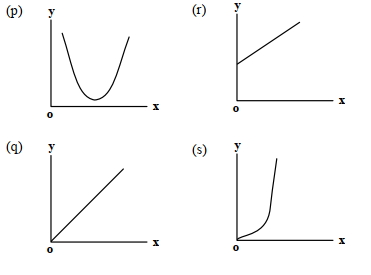
- A
(A) $\rightarrow r$, (B) $\rightarrow \mathrm{p} \& \mathrm{~s}$, (C) $\rightarrow q$, (D) $\rightarrow q$
- B
(A) $\rightarrow q$, (B) $\rightarrow \mathrm{s} \& \mathrm{~r}$, (C) $\rightarrow s$, (D) $\rightarrow q$
- C
(A) $\rightarrow s$, (B) $\rightarrow \mathrm{r} \& \mathrm{~s}$, (C) $\rightarrow r$, (D) $\rightarrow s$
- ✓
(A) $\rightarrow s$, (B) $\rightarrow \mathrm{q} \& \mathrm{~s}$, (C) $\rightarrow s$, (D) $\rightarrow q$
AnswerCorrect option: D. (A) $\rightarrow s$, (B) $\rightarrow \mathrm{q} \& \mathrm{~s}$, (C) $\rightarrow s$, (D) $\rightarrow q$
View full question & answer→MCQ 4671 Mark
Column $I$ describe some situations in which a small object moves. Column $II$ describes some characteristics of these motions. Match the situation in Column $I$ with the characteristics in Column $II$ and indicate your answer by darkening appropriate bubbles in the $4 \times 4$ matrix given in the $ORS$.
| Column $I$ |
Column $II$ |
| $(A)$ The object moves on the $\mathrm{x}$-axis under a conservative force in such a way that its "speed" and "position" satisfy $v=c_1 \sqrt{c_2-x^2}$, where $\mathrm{c}_1$ and $\mathrm{c}_2$ are positive constants. |
$(p)$ The object executes a simple harmonic motion. |
| $(B)$ The object moves on the $\mathrm{x}$-axis in such a way that its velocity and its displacement from the origin satisfy $\mathrm{v}=-\mathrm{kx}$, where $\mathrm{k}$ is a positive constant. |
$(q)$ The object does not change its direction. |
| $(C)$ The object is attached to one end of a massless spring of a given spring constant. The other end of the spring is attached to the ceiling of an elevator. Initially everything is at rest. The elevator starts going upwards with a constant acceleration a. The motion of the object is observed from the elevator during the period it maintains this acceleration. |
$(r)$ The kinetic energy of the object keeps on decreasing. |
| $(D)$ The object is projected from the earth's surface vertically upwards with a speed $2 \sqrt{\mathrm{GM}_e / R_e}$, where, $M_e$ is the mass of the earth and $R_e$ is the radius of the earth. Neglect forces from objects other than the earth. |
$(s)$ The object can change its direction only once. |
- ✓
$A \rightarrow(p), B \rightarrow(q) \&(r), C \rightarrow(p), D \rightarrow(r) \&(q)$
- B
$A \rightarrow(r), B \rightarrow(q) \&(r), C \rightarrow(p), D \rightarrow(p) \&(q)$
- C
$A \rightarrow(q), B \rightarrow(r) \&(r), C \rightarrow(p), D \rightarrow(q) \&(r)$
- D
$A \rightarrow(s), B \rightarrow(q) \&(s), C \rightarrow(p), D \rightarrow(s) \&(r)$
AnswerCorrect option: A. $A \rightarrow(p), B \rightarrow(q) \&(r), C \rightarrow(p), D \rightarrow(r) \&(q)$
View full question & answer→MCQ 4681 Mark
A simple pendulum has time period $T_1$. The point of suspension is now moved upward according to equation $y = k{t^2}$ where $k = 1\,m/se{c^2}$. If new time period is $T_2$ then ratio $\frac{{T_1^2}}{{T_2^2}}$ will be
Answerc
(c) $y = K{t^2}$
==>$\frac{{{d^2}y}}{{d{t^2}}} = {a_y} = 2K= 2 \times 1 = 2\,m/s^2 (K= 1\,m/s^2)$
Now, ${T_1} = 2\pi \sqrt {\frac{l}{g}} $ and ${T_2} = 2\pi \sqrt {\frac{l}{{(g + {a_y})}}} $
Dividing, $\frac{{{T_1}}}{{{T_2}}} = \sqrt {\frac{{g + {a_y}}}{g}}= \sqrt {\frac{6}{5}} $
==> $\frac{{T_1^2}}{{T_2^2}} = \frac{6}{5}$
View full question & answer→MCQ 4691 Mark
For a particle executing $S.H.M.$ the displacement $x$ is given by $x = A\cos \omega t$. Identify the graph which represents the variation of potential energy $(P.E.)$ as a function of time $t$ and displacement $x$
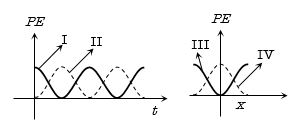
- ✓
$I, III$
- B
$II, IV$
- C
$II, III$
- D
$I, IV$
AnswerCorrect option: A. $I, III$
a
(a) Potential energy is minimum (in this case zero) at mean position ($x = 0$) and maximum at extreme position $(x = \pm A).$
At time $t = 0, x = A,$ hence potential should be maximum.
Therefore graph $I$ is correct. Further in graph $III.$ Potential energy is minimum at $x = 0,$ hence this is also correct.
View full question & answer→MCQ 4701 Mark
An ideal spring with spring-constant $K$ is hung from the ceiling and a block of mass $M$ is attached to its lower end. The mass is released with the spring initially unstretched. Then the maximum extension in the spring is
- A
$4 Mg/K$
- ✓
$2 Mg/K$
- C
$Mg/K$
- D
$Mg/2K$
AnswerCorrect option: B. $2 Mg/K$
b
(b) Let $x$ be the maximum extension of the spring. From energy conservation
Loss in gravitational potential energy = Gain in potential energy of spring
$Mgx = \frac{1}{2}K{x^2}$
$ \Rightarrow x = \frac{{2Mg}}{K}$
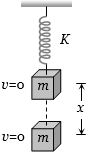
View full question & answer→MCQ 4711 Mark
A particle executes simple harmonic motion (amplitude $= A$) between $x = - A$ and $x = + A$. The time taken for it to go from $0$ to $A/2$ is ${T_1}$ and to go from $A/2$ to $A$ is ${T_2}$. Then
- ✓
${T_1} < {T_2}$
- B
${T_1} > {T_2}$
- C
${T_1} = {T_2}$
- D
${T_1} = 2{T_2}$
AnswerCorrect option: A. ${T_1} < {T_2}$
a
(a)Using $x = A\sin \omega t$
For $x = A/2,\;\;\sin \omega {T_1} = 1/2 \Rightarrow {T_1} = \frac{\pi }{{6\omega }}$
For $x = A,\;\sin \omega ({T_1} + {T_2}) = 1 \Rightarrow {T_1} + {T_2} = \frac{\pi }{{2\omega }}$
$ \Rightarrow {T_2} = \frac{\pi }{{2\omega }} - {T_1} = \frac{\pi }{{2\omega }} - \frac{\pi }{{6\omega }} = \frac{\pi }{{3\omega }} $
$i.e.\;{T_1} < {T_2}$
Alternate method : In S.H.M., velocity of particle also oscillates simple harmonically. Speed is more near the mean position and less near the extreme position. Therefore the time taken for the particle to go from $0$ to $\frac{A}{2}$ will be less than the time taken to go from $\frac{A}{2}$ to $A$.
Hence ${T_1} < {T_2}.$
View full question & answer→MCQ 4721 Mark
The period of oscillation of a simple pendulum of length $L$ suspended from the roof of a vehicle which moves without friction down an inclined plane of inclination $\alpha$, is given by
- ✓
$2\pi \sqrt {\frac{L}{{g\cos \alpha }}} $
- B
$2\pi \sqrt {\frac{L}{{g\sin \alpha }}} $
- C
$2\pi \sqrt {\frac{L}{g}} $
- D
$2\pi \sqrt {\frac{L}{{g\tan \alpha }}} $
AnswerCorrect option: A. $2\pi \sqrt {\frac{L}{{g\cos \alpha }}} $
a
(a) See the following force diagram. Vehicle is moving down the frictionless inclined surface so, it's acceleration is $g\sin \theta $. Since vehicle is accelerating, a pseudo force $m(g\sin \theta )$ will act on bob of pendulum which cancel the $\sin \theta $ component of weight of the bob.
Hence net force on the bob is $F_{net} = mg\cos \theta $ or net acceleration of the bob is ${g_{eff}} = g\cos \theta $
$\therefore $ Time period $T = 2\pi \sqrt {\frac{l}{{{g_{eff}}}}} = 2\pi \sqrt {\frac{l}{{g\cos \theta }}} $
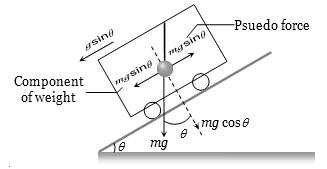
View full question & answer→MCQ 4731 Mark
A spring of force constant $k$ is cut into two pieces such that one piece is double the length of the other. Then the long piece will have a force constant of
- A
$(2/3)k$
- ✓
$(3/2)k$
- C
$3k$
- D
$6k$
AnswerCorrect option: B. $(3/2)k$
b
(b) Force constant $(k) \propto \frac{1}{{{\rm{Length}}\,{\rm{of}}\,{\rm{spring}}}}$
$ \Rightarrow \frac{K}{{{K_1}}} = \frac{{{l_1}}}{l} = \frac{{\frac{2}{3}l}}{l}$
$ \Rightarrow {K_1} - \frac{3}{2}K$.
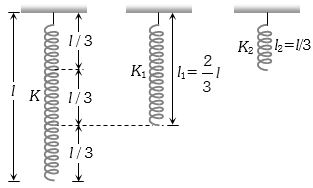
View full question & answer→MCQ 4741 Mark
Three simple harmonic motions in the same direction having the same amplitude a and same period are superposed. If each differs in phase from the next by ${45^o}$, then
- A
The resultant amplitude is $(1 + \sqrt {2)} a$
- B
The phase of the resultant motion relative to the first is $90^°$
- C
The energy associated with the resulting motion is $(3 + 2\sqrt {2)} $ times the energy associated with any single motion
- ✓
Answerd
(d) Let simple harmonic motions be represented by
${y_1} = a\sin \,\left( {\omega \,t - \frac{\pi }{4}} \right)$; ${y_2} = a\sin \omega \,t$ and
${y_3} = a\sin \,\left( {\omega \,t + \frac{\pi }{4}} \right)$.
On superimposing, resultant SHM will be $y = a\;\left[ {\sin \,\left( {\omega \,t - \frac{\pi }{4}} \right) + \sin \omega \,t + \sin \,\left( {\omega \,t + \frac{\pi }{4}} \right)} \right]$
$ = a\;\left[ {2\sin \omega \,t\cos \frac{\pi }{4} + \sin \omega \,t} \right]$
$ = a\;[\sqrt 2 \sin \omega t + \sin \omega t] = a\;(1 + \sqrt 2 )\sin \omega \,t$
Resultant amplitude =$(1 + \sqrt 2 )a$
Energy is $S.H.M.$ $\propto$ (Amplitude)$^2$
$\frac{{{E_{{\rm{Resultant}}}}}}{{{E_{{\rm{Single}}}}}} = {\left( {\frac{A}{a}} \right)^2} = {(\sqrt 2 + 1)^2} = (3 + 2\sqrt 2 )$
==> ${E_{{\rm{Resultant}}}} = (3 + 2\sqrt 2 ){E_{{\rm{Single}}}}$
View full question & answer→MCQ 4751 Mark
A particle free to move along the $x-$axis has potential energy given by $U(x) = k[1 - \exp {( - x)^2}]$ for $ - \infty \le x \le + \infty $, where k is a positive constant of appropriate dimensions. Then
- A
At point away from the origin, the particle is in unstable equilibrium
- B
For any finite non-zero value of $ x,$ there is a force directed away from the origin
- C
If its total mechanical energy is $ k/2,$ it has its minimum kinetic energy at the origin
- ✓
For small displacements from $ x = 0,$ the motion is simple harmonic
AnswerCorrect option: D. For small displacements from $ x = 0,$ the motion is simple harmonic
d
(d)Potential energy of the particle $U = k(1 - {e^{ - {x^2}}})$
Force on particle$F = \frac{{ - dU}}{{dx}} = - k[ - {e^{ - {x^2}}} \times ( - 2x)]$
F$ = \, - 2kx{e^{ - {x^2}}}$$ = - 2kx\left[ {1 - {x^2} + \frac{{{x^4}}}{{2\,!}} - ......} \right]$
For small displacement $F = - 2kx$
$⇒$ $F(x) \propto - x$ i.e. motion is simple harmonic motion.
View full question & answer→MCQ 4761 Mark
A particle of mass m is executing oscillations about the origin on the $X-$axis. Its potential energy is $U(x) = k{[x]^3}$, where $k$ is a positive constant. If the amplitude of oscillation is $a$, then its time period $T$ is
- ✓
Proportional to $\frac{1}{{\sqrt a }}$
- B
Independent of $a$
- C
Proportional to $\sqrt a $
- D
Proportional to ${a^{3/2}}$
AnswerCorrect option: A. Proportional to $\frac{1}{{\sqrt a }}$
a
(a) $U = k|x{|^3} $
$\Rightarrow F= - \frac{{dU}}{{dx}} = - 3k|x{|^2}$ ...(i)
Also, for $SHM $ $x = a\sin \omega \,t$ and $\frac{{{d^2}x}}{{d{t^2}}} + {\omega ^2}x = 0$
$ \Rightarrow $ acceleration $ = \frac{{{d^2}x}}{{d{t^2}}} = - {\omega ^2}x$
$\Rightarrow F = ma$
$ = m\frac{{{d^2}x}}{{d{t^2}}} = - m{\omega ^2}x$ ...(ii)
From equation (i) & (ii) we get $\omega = \sqrt {\frac{{3kx}}{m}} $
$ \Rightarrow T = \frac{{2\pi }}{\omega } = 2\pi \sqrt {\frac{m}{{3kx}}} = 2\pi \sqrt {\frac{m}{{3k(a\sin \omega \,t)}}} $
$ \Rightarrow T \propto \frac{1}{{\sqrt a }}$.
View full question & answer→MCQ 4771 Mark
A light pointer fixed to one prong of a tuning fork touches a vertical plate. The fork is set vibrating and the plate is allowed to fall freely. If eight oscillations are counted when the plate falls through $10 cm$, the frequency of the tuning fork is .... $Hz$
Answerd
Time of fall $=$ $\sqrt {\frac{{2h}}{g}} $$ = \sqrt {\frac{{2 \times 10}}{{1000}}} = \frac{1}{{\sqrt {50} }}$
In this time number of oscillations are eight.
So time for $1$ oscillation =$\frac{1}{{8\sqrt {50} }}$
Frequency $=$ $8\sqrt {50} \,Hz= 56 \,Hz$
View full question & answer→MCQ 4781 Mark
Two blocks $A$ and $B$ each of mass m are connected by a massless spring of natural length L and spring constant $K$. The blocks are initially resting on a smooth horizontal floor with the spring at its natural length as shown in figure. A third identical block $C$ also of mass $m$ moves on the floor with a speed $v$ along the line joining $A$ and $B$ and collides with $A$. Then
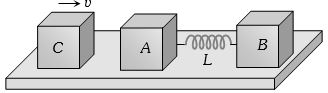
- A
The kinetic energy of the $A-B$ system at maximum compression of the spring is zero
- B
The kinetic energy of the $ A-B$ system at maximum compression of the spring is $\frac{m{v^2}}{4}$
- C
The maximum compression of the spring is $v\sqrt {m/2K} $
- ✓
Answerd
(d) Let the velocity acquired by $A$ and $B$ be $V$, then
$mv = mV + mV $
$\Rightarrow V = \frac{v}{2}$
Also $\frac{1}{2}m{v^2} = \frac{1}{2}m{V^2} + \frac{1}{2}m{V^2} + \frac{1}{2}k{x^2}$
Where $ x$ is the maximum compression of the spring. On solving the above equations, we get $x = v{\left( {\frac{m}{{2k}}} \right)^{1/2}}$
At maximum compression, kinetic energy of the
$A -B$ system $ = \frac{1}{2}m{V^2} + \frac{1}{2}m{V^2} = m{V^2} = \frac{{m{v^2}}}{4}$
View full question & answer→MCQ 4791 Mark
One end of a long metallic wire of length $L$ is tied to the ceiling. The other end is tied to massless spring of spring constant $K$. A mass $ m$ hangs freely from the free end of the spring. The area of cross-section and Young's modulus of the wire are $A$ and $Y$ respectively. If the mass is slightly pulled down and released, it will oscillate with a time period $T$ equal to
- A
$2\pi \left( {\frac{m}{K}} \right)$
- ✓
$2\pi {\left\{ {\frac{{(YA + KL)m}}{{YAK}}} \right\}^{1/2}}$
- C
$2\pi \frac{{mYA}}{{KL}}$
- D
$2\pi \frac{{mL}}{{YA}}$
AnswerCorrect option: B. $2\pi {\left\{ {\frac{{(YA + KL)m}}{{YAK}}} \right\}^{1/2}}$
b
(b) The wire may be treated as a string for which force constant
${k_1} = \frac{{Force}}{{Extension}} = \frac{{YA}}{L}\;\;\;\left( {\because Y = \frac{F}{A} \times \frac{L}{{\Delta L}}} \right)$
Spring constant of the spring ${k_2} = K$
Hence spring constant of the combination (series) ${k_{eq}} = \frac{{{k_1}{k_2}}}{{{k_1} + {k_2}}} $
$= \frac{{(YA/L)K}}{{(YA/L) + K}}$
$= \frac{{YAK}}{{YA + KL}}$
Time period $T = 2\pi \sqrt {\frac{m}{k}} = 2\pi {\left[ {\frac{{(YA + KL)m}}{{YAK}}} \right]^{1/2}}$
View full question & answer→MCQ 4801 Mark
The displacement y of a particle executing periodic motion is given by $y = 4{\cos ^2}(t/2)\sin (1000t)$. This expression may be considered to be a result of the superposition of ........... independent harmonic motions
Answerb
(b)$y = 4{\cos ^2}\left( {\frac{t}{2}} \right)\sin 1000\;t$
$ \Rightarrow y = 2(1 + \cos t)\sin 1000\;t$
$ \Rightarrow y = 2\sin 1000\;t + 2\cos t\;\sin 1000t$
$ \Rightarrow y = 2\sin 1000\;t + \sin 999\;t + \sin 1001\;t$
It is a sum of three $S.H.M.$
View full question & answer→MCQ 4811 Mark
A linear harmonic oscillator of force constant $2 \times {10^6}N/m$ and amplitude $0.01\, m$ has a total mechanical energy of $160$ joules. Its
- A
Maximum potential energy is $100 \,J$
- B
Maximum K.E. is $100 \,J$
- C
Maximum P.E. is $160\, J$
- ✓
Answerd
(d) Harmonic oscillator has some initial elastic potential energy and amplitude of harmonic variation of energy is $\frac{1}{2}K{a^2} = \frac{1}{2} \times 2 \times {10^6}{(0.01)^2} = 100\,J$
This is the maximum kinetic energy of the oscillator. Thus ${K_{\max }} = 100J$
This energy is added to initial elastic potential energy may give maximum mechanical energy to have value $160J$.
View full question & answer→MCQ 4821 Mark
A simple pendulum of length $L$ and mass (bob) $M$ is oscillating in a plane about a vertical line between angular limits $ - \varphi $ and $ + \varphi $. For an angular displacement $\theta (|\theta | < \varphi )$, the tension in the string and the velocity of the bob are $T$ and $ v$ respectively. The following relations hold good under the above conditions
- A
$T\cos \theta = Mg$
- B
$T - Mg\cos \theta = \frac{{M{v^2}}}{L}$
- C
The magnitude of the tangential acceleration of the bob $|{a_T}|\, = g\sin \theta $
- ✓
Answerd
(d) From following figure it is clear that
$T - Mg\cos \theta = $Centripetal force
$ \Rightarrow T - Mg\cos \theta = \frac{{M{v^2}}}{L}$
Also tangential acceleration $|{a_r}| = g\sin \theta $.
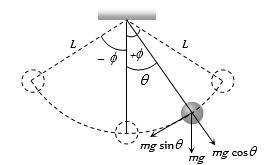
View full question & answer→MCQ 4831 Mark
A cylindrical piston of mass $M$ slides smoothly inside a long cylinder closed at one end, enclosing a certain mass of gas. The cylinder is kept with its axis horizontal. If the piston is disturbed from its equilibrium position, it oscillates simple harmonically. The period of oscillation will be
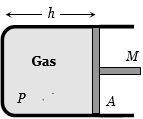
- ✓
$T = 2\pi \sqrt {\left( {\frac{{Mh}}{{PA}}} \right)} $
- B
$T = 2\pi \sqrt {\left( {\frac{{MA}}{{Ph}}} \right)} $
- C
$T = 2\pi \sqrt {\left( {\frac{M}{{PAh}}} \right)} $
- D
$T = 2\pi \sqrt {MPhA} $
AnswerCorrect option: A. $T = 2\pi \sqrt {\left( {\frac{{Mh}}{{PA}}} \right)} $
a
(a) Let the piston be displaced through distance $x$ towards left, then volume decreases, pressure increases. If $\Delta P$ is increase in pressure and $\Delta V$ is decrease in volume, then considering the process to take place gradually (i.e. isothermal) ${P_1}{V_1} = {P_2}{V_2}$
$ \Rightarrow PV = (P + \Delta P)(V - \Delta V)$
$ \Rightarrow PV = PV + \Delta PV - P\Delta V - \Delta P\Delta V$
$ \Rightarrow \Delta P.V - P.\Delta V = 0$ (neglecting $\Delta P.\Delta V)$
$\Delta P(Ah) = P(Ax)$
$ \Rightarrow \Delta P = \frac{{P.x}}{h}$
This excess pressure is responsible for providing the restoring force $(F)$ to the piston of mass $M$.
Hence $F = \Delta P.A = \frac{{PAx}}{h}$
Comparing it with $|F| = kx$
$\Rightarrow k = M{\omega ^2} = \frac{{PA}}{h}$
$ \Rightarrow \omega = \sqrt {\frac{{PA}}{{Mh}}} $
$\Rightarrow T = 2\pi \sqrt {\frac{{Mh}}{{PA}}} $
Short trick : by checking the options dimensionally. Option (a) is correct.
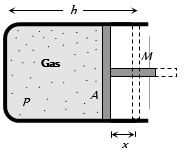
View full question & answer→MCQ 4841 Mark
The mass and diameter of a planet are twice those of earth. The period of oscillation of pendulum on this planet will be (If it is a second's pendulum on earth)
AnswerCorrect option: B. $2\sqrt 2 \,sec$
b
(b) As we know $g = \frac{{GM}}{{{R^2}}}$
$\Rightarrow \frac{{{g_{{\rm{earth}}}}}}{{{g_{{\rm{planet}}}}}} = \frac{{{M_e}}}{{{M_p}}} \times \frac{{R_\rho ^2}}{{R_e^2}} $
$\Rightarrow \frac{{{g_e}}}{{{g_p}}} = \frac{2}{1}$
Also $T \propto \frac{1}{{\sqrt g }} $
$\Rightarrow \frac{{{T_e}}}{{{T_p}}} = \sqrt {\frac{{{g_p}}}{{{g_e}}}}$
$\Rightarrow \frac{2}{{{T_p}}} = \sqrt {\frac{1}{2}} $
$ \Rightarrow $ ${T_p} = 2\sqrt 2 \,\sec $.
View full question & answer→MCQ 4851 Mark
A particle executes simple harmonic motion with a frequency $f$. The frequency with which its kinetic energy oscillates is
Answerc
(c) Kinetic energy $K = \frac{1}{2}m{v^2} = \frac{1}{2}m{a^2}{\omega ^2}{\cos ^2}\omega \,t$
$ = \frac{1}{2}m{\omega ^2}{a^2}(1 + \cos 2\omega \,t)$
hence kinetic energy varies periodically with double the frequency of $S.H.M$. i.e. $2\omega $.
View full question & answer→MCQ 4861 Mark
The equation of $S.H.M.$ is $y = a\sin (2\pi nt + \alpha )$, then its phase at time $t$ is
- A
$2\pi nt$
- B
$\alpha $
- ✓
$2\pi nt + \alpha $
- D
$2\pi t$
AnswerCorrect option: C. $2\pi nt + \alpha $
c
(c) $y = a\sin (2\pi nt + \alpha )$. Its phase at time $t = 2\pi nt + \alpha $
View full question & answer→MCQ 4871 Mark
Which of the following expressions represent simple harmonic motion
- A
$x = A\sin (\omega \,t + \delta )$
- B
$x = B\cos (\omega \,t + \phi )$
- C
$x = A\sin \omega \,t\cos \omega \,t$
- ✓
Answerd
(d) $x = a\sin \omega \,t\cos \omega \,t = \frac{a}{2}\sin 2\omega \,t$
View full question & answer→MCQ 4881 Mark
The phase (at a time $t$) of a particle in simple harmonic motion tells
- A
Only the position of the particle at time $t$
- B
Only the direction of motion of the particle at time $t$
- ✓
Both the position and direction of motion of the particle at time $t$
- D
Neither the position of the particle nor its direction of motion at time $t$
AnswerCorrect option: C. Both the position and direction of motion of the particle at time $t$
c
The phase (at a time $t)$ of a particle in $SHM$ is a physical quantity that wholly expresses the position and direction of motion of that particle of time $t$
View full question & answer→MCQ 4891 Mark
A particle is moving with constant angular velocity along the circumference of a circle. Which of the following statements is true
- A
The particle so moving executes S.H.M.
- B
The projection of the particle on any one of the diameters executes S.H.M.
- ✓
The projection of the particle on any of the diameters executes S.H.M.
- D
AnswerCorrect option: C. The projection of the particle on any of the diameters executes S.H.M.
c
Take radius of circle $=r$
$\therefore$ circumference $=2 \pi r$.
Given: Constant angular welocity$(u)$
$\therefore$ Time period $=\frac{2 \pi}{w}$ also remains same.
For an object moving in a ircle, when light is shown on it, its shadow falls on the centre part and moves. along diameter as particle moves along eircumference
View full question & answer→MCQ 4901 Mark
Which of the following equation does not represent a simple harmonic motion
AnswerCorrect option: D. $y = a\tan \omega \,t$
d
(d) Standard equation of $S.H.M.$ $\frac{{{d^2}y}}{{d{t^2}}} = \, - \,{\omega ^2}y,$ is not satisfied by $y = a\tan \omega \,t$.
View full question & answer→MCQ 4911 Mark
A particle executing simple harmonic motion along $Y- $axis has its motion described by the equation $y = A\sin (\omega \,t) + B$. The amplitude of the simple harmonic motion is
- ✓
$A$
- B
$B$
- C
$A + B$
- D
$\sqrt {A + B} $
Answera
(a)The amplitude is a maximum displacement from the mean position.
View full question & answer→MCQ 4921 Mark
A system exhibiting S.H.M. must possess
- A
- ✓
Elasticity as well as inertia
- C
Elasticity, inertia and an external force
- D
AnswerCorrect option: B. Elasticity as well as inertia
b
(b) System should be elastic and must possess inertia
View full question & answer→MCQ 4931 Mark
Which of the following is a necessary and sufficient condition for S.H.M.
- A
- B
- C
Proportionality between acceleration and displacement from equilibrium position
- ✓
Proportionality between restoring force and displacement from equilibrium position
AnswerCorrect option: D. Proportionality between restoring force and displacement from equilibrium position
d
(d)$F = - \,kx$
View full question & answer→MCQ 4941 Mark
To make the frequency double of an oscillator, we have to
- A
- B
- C
- ✓
Reduce the mass to one-fourth
AnswerCorrect option: D. Reduce the mass to one-fourth
d
$\omega = \sqrt {\frac{k}{m}} $
$\Rightarrow \frac{{{\omega _2}}}{{{\omega _1}}} = \sqrt {\frac{{{m_1}}}{{{m_2}}}} $
$\Rightarrow 2 = \sqrt {\frac{{{m_1}}}{{{m_2}}}} $
$\Rightarrow {m_2} = \frac{{{m_1}}}{4}$
View full question & answer→MCQ 4951 Mark
What is constant in S.H.M.
Answerd
The only thing that remains constant for one particle performing SHM is its periodic time or simply time period.
View full question & answer→MCQ 4961 Mark
The equation of a simple harmonic motion is $X = 0.34\cos (3000t + 0.74)$ where $X$ and $t$ are in $mm$ and $sec$. The frequency of motion is
- A
$3000$
- ✓
$3000/2\pi $
- C
$0.74/2\pi $
- D
$3000/\pi $
AnswerCorrect option: B. $3000/2\pi $
b
From given equation $\omega = 3000,$
==> $n = \frac{\omega }{{2\pi }} = \frac{{3000}}{{2\pi }}$
View full question & answer→MCQ 4971 Mark
The displacement $x$ (in metre) of a particle in, simple harmonic motion is related to time t (in seconds) as
$x = 0.01\cos \left( {\pi \,t + \frac{\pi }{4}} \right)$
The frequency of the motion will be
- ✓
$0.5\, Hz$
- B
$1.0 \,Hz$
- C
$\frac{\pi }{2}\,Hz$
- D
$\pi \,Hz$
AnswerCorrect option: A. $0.5\, Hz$
a
(a) Comparing given equation with standard equation, $x = a\cos \,(\omega t + \phi )$
we get, $a = 0.01$ and $\omega = \pi $
$ \Rightarrow 2\pi n = \pi \Rightarrow n = 0.5\,Hz$
View full question & answer→MCQ 4981 Mark
A simple harmonic wave having an amplitude a and time period $T$ is represented by the equation $y = 5\sin \pi (t + 4)m.$ Then the value of amplitude $(a)$ in $(m)$ and time period $(T) $ in second are
- A
$a = 10,\,T = 2$
- B
$a = 5,\,T = 1$
- C
$a = 10,T = 1$
- ✓
$a = 5,\,T = 2$
AnswerCorrect option: D. $a = 5,\,T = 2$
d
(d) $y = 5\sin (\pi \,t + 4\pi )$, comparing it with standard equation
$y = a\sin (\omega \,t + \phi ) = a\sin \left( {\frac{{2\,\pi \,t}}{T} + \phi } \right)$
$a = 5\,m$ and $\frac{{2\,\pi \,t}}{T} = \pi \,t$
==> $T = 2\, sec.$
View full question & answer→MCQ 4991 Mark
The displacement $x$ (in metres) of a particle performing simple harmonic motion is related to time $t$ (in seconds) as $x = 0.05\cos \left( {4\,\pi \,t + \frac{\pi }{4}} \right)$. The frequency of the motion will be ..... $Hz$
Answerd
(d) From the given equitation $\omega = 2\pi n = 4\pi $
==> $n = 2\,Hz$
View full question & answer→MCQ 5001 Mark
If the displacement equation of a particle be represented by $y = A\sin PT + B\cos PT$, the particle executes
- A
A uniform circular motion
- B
A uniform elliptical motion
- ✓
- D
Answerc
(c) $y = A\sin PT + B\cos PT$
Let $A = r\cos \theta ,$ $B = r\sin \theta $
$ \Rightarrow y = r\sin (PT + \theta )$ which is the equation of $SHM.$
View full question & answer→