Questions

1 Marks Question

🎯

Test yourself on this topic

30 questions · timed · auto-graded

Question 21 Mark
In which of the gases, liquids or solids is the speed of sound heighest?
Answer
The velocity of sound is maximum in solids.
View full question & answer
Question 31 Mark
A tunning frok produce resonance in a closed tube, but it can't produce resonance in an open tube of the same length. why?
Answer
In same length's open or close tube because the fundamental frequency of resonance is different.
View full question & answer
Question 51 Mark
Why is a woman's voice sweeter than a man?
Answer
Because the frequency of a woman's voice is higher than that of a man.
View full question & answer
Question 61 Mark
What is the nature of ultrasonic waves and frequency?
Answer
Ultrasonic waves are longitudinal waves and frequency is 20000 Hz or greater.
View full question & answer
Question 71 Mark
Relation between phase difference and path difference.
Answer
Phase difference $=\frac{2 \pi}{\lambda} \times$ path difference
View full question & answer
Question 81 Mark
An observer on the seashore sees waves reaching the shore, what type of waves does the observer see? Why?
Answer
Eliptic waves, while transverse wave occurs at the surface of water, but longitudinal wave occurs just below the water surface. Hence the resulting waves will be eliptical
View full question & answer
Question 91 Mark
The weight hanging from the sonometer wire is increased by a factor of weight. Will the frequencies of the wire increase by exactly a factor of two? Explain your answer.
Answer
No, there will be a very slight increase in length of the wire, so the frequency will be slightly less by a factor of two.
View full question & answer
Question 111 Mark
Why does light come before sound in the under storm?
Answer
Speed of light is greater than speed of sound.
View full question & answer
Question 151 Mark
You can create waves in any pond by throughing any stone then source of energy of waves.
Answer
Stones kinetic energy is source of wave energy.
View full question & answer
Question 161 Mark
What will effect on wave length and frequency when we increase diameter of resonance tube?
Answer
Wave length will increase and frequency will decrease due to decreasing diameter.
View full question & answer
Question 171 Mark
What is the reason that generated sound in air can't be heared or less heares in water to the observer?
Answer
Because at surface of water interferance is significantly greater then reflection
View full question & answer
Question 191 Mark
When stationary waves can be generated?
Answer
When there are two waves with different- different amplitude
View full question & answer
Question 221 Mark
Tone of open pipe is softer then tune of close pipe, why?
Answer
Close pipe have only odd harmonic while open pipe have both (odd and even) harmonic. Generated harmonic in open pipe is greater then generated harmonic in close pipe. So it has soft tone.
View full question & answer
Question 261 Mark
Relation between phase difference and path difference.
Answer
$\Delta \phi=\frac{2 \pi}{\lambda} \Delta x$
View full question & answer
Question 271 Mark
What is the formula of velocity of sound in gases according to Laplace's correction?
Answer
$\text v =\sqrt{\frac{\gamma P }{d}}$
View full question & answer
Question 291 Mark
The wave equation is $y=5 \sin 2 \pi\left(\frac{t}{0.02}-\frac{x}{20}\right)$
Find the frequency and time periodic.
Answer
$y=5 \sin \left(\frac{2 \pi t}{0.02}-\frac{2 \pi x}{20}\right)$
It is clear from equation
$\omega t=\frac{2 \pi}{0.02} t$
$\therefore \quad \omega=\frac{2 \pi}{0.02}$
$\frac{2 \pi}{T}=\frac{2 \pi}{0.02} \quad \therefore T=0.02$ second
Frequency $\quad n=\frac{1}{T}=\frac{1}{0.02}=\frac{100}{2}=50 Hz$
View full question & answer
Question 301 Mark
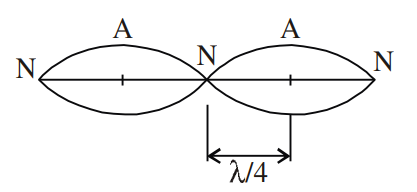
Between the first and fifth nodes is 40 cm then find wavelength of wave?
Answer
We know that distance between two consecutive nodes is $\frac{\lambda}{2}$.
So first and fifth between distance $\frac{4 \times \lambda}{2}$ Means it is equal to $2 \lambda$.
$\therefore \quad 2 \lambda=40 \quad \therefore \lambda=\frac{40}{2}=20 cm$
View full question & answer
1 Marks Question - Physics STD 11 Science Questions - Vidyadip