State the probability that the normal variable assumes a value in the interval $(\boldsymbol{\mu}-\boldsymbol{\sigma} ; \boldsymbol{\mu}+\boldsymbol{\sigma})$ of the normal distribution.
Answer
The probability that the normal variable assumes a value in the interval $(\mu - \sigma ; \mu + \sigma )$ is $0.6826$
When it is said that “Probability distribution is normal probability distribution”?
Answer
If the curve of the probability density function of a random variable $X$ is bell shaped, then the probability distribution $X$ is called the normal distribution.
Mean and variance of random variable $X$ are $\mu$ and 1 respectively, if $X$ is normal distribution then find the value of $P$ ( $X \geq \mu$ ) and $P(X \leq \mu)$
Answer
Mean $= \mu$ and variance $= 1,$
therefore $P(x \geq \mu ) = 0.5$ and $P(x \leq \mu )= 0.5.$
Why is the total area of the region bounded by the normal curve and $X-$axis taken as $1?$
Answer
The normal curve is a probability curve and total probability is $1.$
Hence, the total area of the region bounded by the normal curve and $X-$axis is taken as $1.$
State the relationship among the quartiles in normal distribution.
Answer
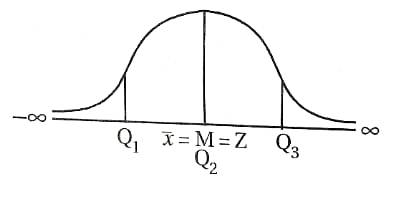
In normal distribution two quartiles $Q _1$ and $Q _3$ are equidistant from the second quartile $Q _2= M$. That means $Q_3-M=M-Q_1 \Longrightarrow Q_3+Q_1=2 M$.
The extreme quartiles of normal distribution are 20 and 30. Find its mean.
Answer
In a normal distribution, the mean is equal to the median. The median is exactly in the center of the extreme quartiles $Q_{1}$ and $Q_{3}$. $Mean (\mu) = \frac{Q_{1} + Q_{3}}{2} = \frac{20 + 30}{2} = 25$.