Questions

2 Marks Each

🎯

Test yourself on this topic

20 questions · timed · auto-graded

Question 12 Marks
A normal variable $X$ has following probability density function: $f(x)=\frac{1}{\sqrt{5000 \pi}} e^{-\frac{1}{5000}(x-75)^{2}},-\infty \leq x \leq \infty$ From this, answer the following questions: $(1)$ If $P \left[60 \leq X \leq x_{2}\right]=0.5670$, then find $x_{2}$. $(2)$ If $P \left[x_{1} \leq X \leq 125\right]=0.3979$, then fmd $x_{1}$. $(3)$ Find $P[\mid X-50 I \leq 10]$
Answer
Here,
$\mathrm{f}(\mathrm{x})=\frac{1}{\sqrt{5000 \pi}} e^{-\frac{1}{5000}(x-75)^2},-\infty<\mathrm{x}<\infty$
$ =\frac{1}{50 \sqrt{2 \pi}} e^{-\frac{1}{2}\left(\frac{x-T_5}{50}\right)^2},-\infty<\mathrm{x}<\infty$
$ \therefore \mu=75, \sigma=50$
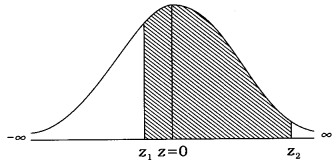
$(1)$ If $P\left[60 \leq X \leq x_2\right]=0.5670$
$\mathrm{z}_1=\frac{60-\mu}{\sigma}=\frac{60-75}{50}=\frac{-15}{50}=-0.3$
$ \mathrm{z}_2=\frac{x_2-\mu}{\sigma}=\frac{x_2-75}{50}$
Image
$\mathrm{P}\left[60 \leq \mathrm{X} \leq \mathrm{x}_2\right]=0.5670$
$ \therefore \mathrm{P}\left[-0.3 \leq \mathrm{Z} \leq \mathrm{z}_2\right]=0.5670$
$ \therefore \mathrm{P}\left[0 \leq \mathrm{Z} \leq \mathrm{z}_2\right]=\mathrm{P}\left[-0.3 \leq \mathrm{Z} \leq \mathrm{z}_2\right]-\mathrm{P}[-0.3 \leq \mathrm{Z} \leq 0]$
$ =0.5670-0.1179$
$ =0.4491$
$ \therefore \text { For area } 0.4484, \mathrm{z}_2=1.63 \text { and for area } 0.4495, \mathrm{z}_2=1.64$
$ \therefore \text { For area } 0.4491 \mathrm{z}_2=\frac{1.63+1.64}{2}=1.635$
$ \text { Now, } z_2=\frac{x_2-75}{50}$
$ \therefore 1.635=\frac{x_2-75}{50}$
$ \therefore 50 \times 1.635=\mathrm{x}_2-75$
$ \therefore 81.75=\mathrm{x}_2-75$
$ \therefore \mathrm{x}_2=81.75+75$
$ \therefore \mathrm{x}_2=156.75$
Hence, $x_2$ obtained is $\approx 157$.
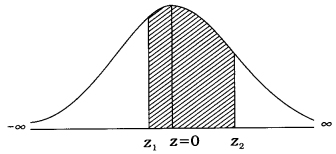
$\text { (2) If } \mathrm{P}\left[\mathrm{x}_1 \leq \mathrm{X} \leq 125\right]=0.3979$
$ \mathrm{z}_1=\frac{x_1-\mu}{\sigma}=\frac{x_1-75}{50}$
$ \mathrm{z}_2=\frac{125-\mu}{\sigma}=\frac{125-75}{50}=\frac{50}{50}=-0.3$
Image
$P\left[x_1 \leq X \leq 125\right]=0.3979$
$ \therefore P\left[z_1 \leq Z \leq 1\right]=0.3979$
$ \therefore P\left[z_1 \leq Z \leq 0\right]=P\left[z_1 \leq Z \leq 1\right]-p[0 \leq Z \leq 1]$
$ =0.3979-0.3413$
$ =0.0566$
For area $0.0557, \mathrm{z}_1=-0.14$
and for area $0.0596 . \mathrm{z}_1=-0.15$
$\therefore$ For area $0.0566 z_1=\frac{(-0.14)+(-0.15)}{2}=-0.145$
Now, $z_1=\frac{x_1-75}{50}$
$-0145=\frac{x_1-75}{50}$
$ \therefore-0.145 \times 50=\mathrm{x}_1-75$
$ \therefore-7.25=\mathrm{x}_1-75$
$ \therefore \mathrm{x}_1=75-7.25=67.75 \approx 68$
Hence, $x_1$ obtained is $\approx 68$.
$(3)$ Find $P[|X-50| \leq 10]$
$P[|X-50| \leq 10]=P[40 \leq X \leq 60]$
For $x_1=40$,
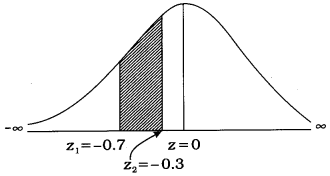
$z_1=\frac{x_1-\mu}{\sigma}=\frac{40-75}{50}=\frac{-35}{50}=-0.7$
For $x_2=40$,
$\mathrm{z}_2=\frac{x_2-\mu}{\sigma}=\frac{60-75}{50}=\frac{-15}{50}=-0.3$
Image
$ P[40 \leq X \leq 60]$
$ =P[-0.7 \leq Z \leq-0.3]$
$ =[-0.7 \leq Z \leq 0]-P[-0.3 \leq Z \leq 0]$
$ =0.2580-0.1179$
$ =0.1401$
View full question & answer
Question 22 Marks
For a normal variable, mean deviation is $48$ and its third quartile is $120.$ Estimate its first quartile.
Answer
Here, Mean deviation $=48 ; Q_3=120$
Now, mean deviation $=\frac{4}{5} \sigma$
$\therefore 48=\frac{4}{5} \sigma$
$ \therefore c=48 \times \frac{4}{5} \approx 60$
Quartile deviation $\approx \frac{2}{3} \sigma$
$\therefore$ Quartile deviation $\approx \frac{2}{3} \times 60$
$\therefore \frac{Q_3-Q_1}{2} \approx 40$
$ \therefore \mathrm{Q}_3-\mathrm{Q}_1 \approx 80$
Putting, $\mathrm{Q}_3=120$
$120-Q_1 \approx 80$
$ \therefore Q_1 \approx 120-80 \approx 40$
Hence, the first quartile obtained is $40.$
View full question & answer
Question 32 Marks
The extreme quartile of a normal variable are $10$ and $30.$ Find its mean deviation.
Answer
Here, $Q_1=10 ; Q_3=30$
$\therefore$ Quartile deviation $=\frac{Q_3-Q_1}{2}=\frac{30-10}{2}=10$
Now, Quartile deviation $=\frac{2}{3} \sigma$
$\therefore 10=\frac{2}{3} \sigma$
$ \therefore \sigma=10 \times \frac{3}{2}=15$
Mean deviation $=\frac{4}{5} \sigma$
$\therefore$ Mean deviation $=\frac{4}{5} \times 15=12$
Hence, the mean deviation obtained is $12 .$
View full question & answer
Question 42 Marks
A normal variable $X$ has the probability density function as, $f(x)=$ constant $\times e^{-\frac{1}{50}(x-10)^2} ;-\infty$
Answer
$\mathrm{f}(\mathrm{x})=\text { constant } \times e^{-\frac{1}{30}(x-10)^2},-\infty<\mathrm{x}<\infty$
$ =\text { constant } \times e^{-\frac{1}{2}\left(\frac{x-10}{5}\right)^2}$
$ \text { Hence, } \mu=10, \sigma=5$
Hence, $\mu=10, \sigma=5$
First Quartile $Q_1$ :
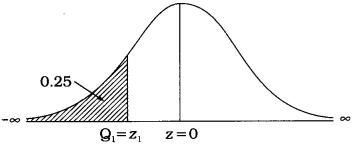
$25 \%$ of observations of the distribution is less than $Q_1$.
$\therefore \mathrm{P}\left[\mathrm{X} \leq \mathrm{Q}_1\right]=\frac{25}{100}=0.25$
Now, $\mathrm{z}_1=\frac{\mathrm{Q}_1-\mu}{\sigma}=\frac{Q_1-10}{5}$
Image
$P\left[Z \leq z_1\right]=0.25$
$ =P[-\infty =P[0 \leq Z<\infty]-P\left[0 \leq Z \leq z_1\right]$
$ \therefore P\left[0 \leq Z \leq z_1\right]=0.5000-0.2500$
$ =0.2500$
From the table, corresponding to probability $0.2486 ,$ the value of $\mathrm{z}_1=-0.67$ and corresponding to probability $0.2518 ,$ the value of $z_1=-0.68$
$\therefore$ For probability 0.25
$z_1=\frac{(-0.67)+(-0.68)}{2}=-0.675$
Now, $z_1=\frac{Q_1-10}{5}$
$\therefore-0.675=\frac{Q_1-10}{5}$
$ \therefore-0.675 \times 5=Q_1-10$
$ \therefore-3.375=Q_1-10$
$ \therefore 10-3.375=Q_1$
$ \therefore Q_1=6.625 \approx 6.63$
Hence, first quartile obtained is $6.83 .$
View full question & answer
Question 52 Marks
Define standard normal variable and write its probability density function.
Answer
If $X$ is normal variable with mean $=\mu$ and standard deviation $=\sigma$, then the random variable $Z=\frac{X-\mu}{\sigma}$ is called the standard normal variable. It is free from units of measurement.
The probability density function of $Z$ is as follows :
$
f(z)=\frac{1}{\sqrt{2 \pi}} e^{-\frac{1}{2} z^2},-\infty$
View full question & answer
Question 62 Marks
What is the shape of standard normal curve? To which value of variable it is symmetric ?
Answer
The shape of standard normal curve is completely bell shaped.
It is symmetric about $z=0$.
Hence,
$P\left[-z_1 \leq z \leq 0\right]=P\left[0 \leq z \leq z_1\right]$
View full question & answer
Question 72 Marks
Define probability density function for normal variable.
Answer
Probability density function for normal variable is defined as follows;
$
\mathrm{f}(\mathrm{x})=\frac{1}{\sigma \sqrt{2 \pi}} e^{-\frac{1}{2}\left(\frac{z-\mu}{\sigma}\right)^2},-\infty<\mathrm{X}<\infty
$
Where, $x=$ Value of normal variable $X$
$\mu=$ Mean of normal distribution
$\sigma=$ Standard deviation of normal distribution
$\pi=$ Constant $=3.1416$
$e=$ Constant $=2.7183$
View full question & answer
Question 82 Marks
How is normal curve drawn?
Answer
A curve drawn by considering different values of normal random variable $X$ and its respective values of probability density function $f(x)$ is called normal curve and it is completely bell shaped.
View full question & answer
Question 92 Marks
Write the conditions for probability density function for continuous variable.
Answer
The conditions for probability density function for continuous variable are as follows :
$(1)$ The probability that the value of random variable lies within the specified interval is non-negative.
$(2)$ The total probability that the random variable assumes any value within the specified intervals is one.
View full question & answer
Question 102 Marks
The probability that the value of standard normal variable lies between $0$ and $Z$-score $\left(z_1\right)$ is $0.4950 .$ Find the possible values of $Z-$score.
Answer
Here, $\mathrm{P}\left[0 \leq \mathrm{Z} \leq \mathrm{z}_1\right)=0.4950$
From the table of area under the standard normal curve, corresponding to probability $0.4949 ($which is near to $0.4950 )$ the value of $Z$-score $=2.57$. Also corresponding to probability $0.4951 ($which is also near to $0.4950 ),$ the value of $Z-$score $=2.58$.
$\therefore$ Corresponding to probability $0.4950 ,$ the value of $Z$-score $=$
$\frac{2.57+2.58}{2}=2.575$
Hence, the possible value of $Z-$score obtained is $2.575 .$
View full question & answer
Question 112 Marks
A normal variable $X$ has the probability density function as,
$f(x) = \frac{1}{10 \sqrt{2 \pi}} e^{-\frac{1}{2}\left(\frac{x-100}{10}\right)^{2}}, – \infty < X < \infty $
For this distribution, obtain the limits which include middle $68.26 \%$ of the observations.
Answer
$f(x)=\frac{1}{10 \sqrt{2 \pi}} e^{-\frac{1}{2}\left(\frac{x-100}{10}\right)^2},-\infty$
$\therefore \mu=100, \sigma=10$
Now, the limits that include middle $68.26 \%$ of the
observations $=\mu \pm \sigma$
$=(\mu-\sigma) \text { to }(\mu+\sigma)$
$ =(100-10) \text { to }(100+10)$
$ =90 \text { to } 110$
Hence, the limits that include middle $68.26 \%$ of the observations obtained is $90$ to $110 .$
View full question & answer
Question 122 Marks
Define probability density function of continuous random variable.
Answer
A function for obtaining probability that a continuous random variable assumes value between specified interval is called probability density function of that variable.
View full question & answer
Question 132 Marks
For a normal distribution, mean deviation is $12$ and its first quartile is $30 $. Estimate its third quartile.
Answer
$50$
View full question & answer
Question 142 Marks
The extreme quartiles of a normal variabl $X$ are $12$ and $18$ respectively. Find mean deviation of the distribution of $X.$
Answer
$8 / 5$
View full question & answer
Question 162 Marks
Quartile deviation of a normal distribution is $6 .$ Find standard deviation and mean deviation of the distribution.
Answer
Standard deviation $=9$, mean deviation $=7.2$
View full question & answer
Question 172 Marks
The mean and standard deviation of a normal distribution are $55$ and $15$ respectively. Obtain the following probabilities:
Answer
$(1) P[40 \leq X \leq 70]$
$(2) P[19 \leq X \leq 91]$
$(3) P[34 \leq X \leq 46]$
$(4) P[73 \leq X \leq 88]$
View full question & answer
Question 182 Marks
If the mean and standard deviation of a normal distribution are $120$ and $25$ respectively, obtain the following probabilities:
$(1) P[X \leq 145]$
$(2) P[X \geq 180]$
$(3)P[X \leq 85]$
$(4) P[X \geq 80]$
Answer
$(1) 0.8413$
$(2) 0.0082$
$(3) 0.0808$
$(4) 0.9452$
View full question & answer
Question 192 Marks
Variable $X$ is normally distributed. Mean of the distribution is $50$ and its standard deviation is $10 .$ Find the following probabilities:
$(1) P[50 \leq X \leq 60] $
$(2) P[35 \leq X \leq 50] $
$(3) P[55 \leq X \leq 70] $
$(4) P[30 \leq X \leq 40]$
Answer
$(1) 0.3413$
$(2) 0.4332$
$(3) 0.2857$
$(4) 0.1359$
View full question & answer
Question 202 Marks
In each of the following $Z$ is a standard normal variate. Using the table of area under normal curve obtain the probabilities of the following: $($Diagram is necessary.$)$
$(1) P[0 \leq Z \leq 2.3] $
$(2) P[0 \leq Z \leq 0.75] $
$(3) P[-1.52 \leq Z \leq 01] $
$(4) P[-0.30 \leq Z \leq 01] $
$(5) P[1.48 \leq Z \leq 2.35] $
$(6) P[0.62 \leq Z \leq 1.931] $
$(7) P[-1.1 \leq Z \leq-0.72] $
$(8) P[-2.45 \leq Z \leq 1.1]$
Answer
$(1)\ 0.4893 $
$(2 )\ 0.2734 $
$(3 )\ 0.4357 $
$(4)\ 0.1179 $
$(5 )\ 0.0600 $
$(6 )\ 0.2408 $
$(7)\ 0.1001 $
$(8 )\ 0.1286$
View full question & answer
2 Marks Each - Statistics STD 12 Commerce Questions - Vidyadip