Question 13 Marks
If the probability that value of standard normal variable $Z$ lies between 0 and $Z$-score $\left(z_{1}\right)$ is $0.3925$ then obtain the possible values of $Z$-score $\left(z_{1}\right)$.
View full question & answer→Question 23 Marks
The number of vehicles arriving at toll station during busy hours of national highway follows normal distribution. The mean of this distribution is ,u and its standard deviation is $0'.$ The number of vehicles arriving at two different busy time periods are $88$ and $64$ and if the respective values of $Z-$score for these values are $0.8$ and $-0.4$ then find mean and standard deviation of number of vehicles arriving at the toll station during busy period.
View full question & answer→Question 33 Marks
For a normal distribution, the first quartile and the mean deviation are $20$ and $24$ respectively. Obtain an estimate of the value of mode.
View full question & answer→Question 43 Marks
The extreme quartiles for a normal distribution are $20$ and $50$ respectively. Obtain the limits which include $95\%$ of the observations of the distribution.
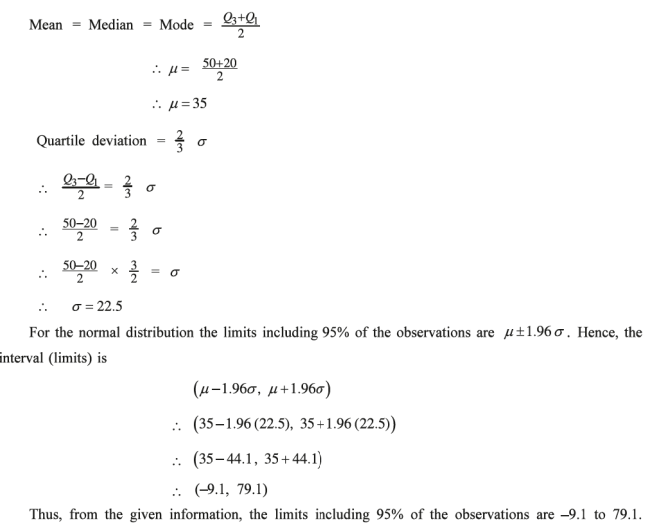
AnswerHere, $Q_{1}=20$ and $Q_{3}=50$. For the normal distribution
View full question & answer→Question 53 Marks
The probability density function of a normal variable $X$ is defined as under $ f(x)=\text { constant } \cdot e^{-\frac{1}{2}\left(\frac{x-25}{10}\right)^{2}}; -∞ < x < ∞ $ From this normal distribution estimate the values of the following : $(1)$ Third quartile $(2)$ Quartile deviation $(3)$ Mean deviation
View full question & answer→Question 63 Marks
The bill amount of purchase by the customers in departmental store follows normal distribution and its mean is ? $800$ and standard deviation is $Rs. 200.$ On a day, $57$ customers had the bill amount more than ? $1200.$ Estimate the number of customers who visited the store on that day.
View full question & answer→Question 73 Marks
If $Z$ is a standard normal variable and $z_{1}$ represents the $Z$-score, then estimate the value of $z_{1}$ so that the following conditions are satisfied $: (i)\ P\left[-2 \leq Z \leq z_{1}\right]=0.2857\ (ii)\ P\left[z_{1} \leq Z \leq 1.75\right]=0.10$
Answer$(i) P[- 2 \leq Z \leq z_1] = 0.2857$
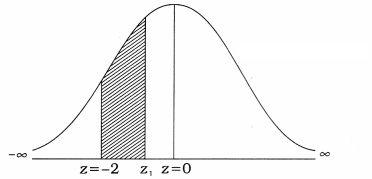
$\therefore P[z_1 \leq Z \leq 0] = 0.75$
$= p[ – 2 \leq Z \leq 0] – p[- 2 \leq Z \leq z_1]$
$= 0.4772 – 0.2857$
$= 0.1915$
From the table, for area $0.1915, z_1 = – 0.5$
$(ii) P [z_1 \leq Z \leq 1.75] = 0.10$
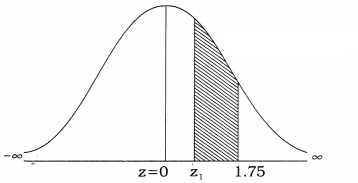
$\therefore P[0 \leq Z \leq z_1]$
$= p[ 0 \leq Z \leq 1.75] – p[z_1 \leq Z \leq 1.75]$
$= 0.4599 – 0.10$
$= 0.3599$
From the table, for area $0.3599, z_1 = 1.08$ View full question & answer→Question 83 Marks
If $Z$ is a standard normal variable then estimate the value of $Z-$score $(zx)$ such that the following conditions are satisfied :
$(i)$ Area to the left of $Z = z_1$ is $0,15$.
AnswerArea to the left of $Z = z_1$ is $0.15$
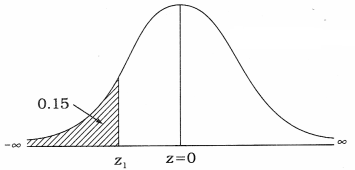
$P[Z \leq z_1] = 0.15$
$\therefore P [z_1 \leq Z \leq 0] = P [- \infty < Z \leq 0] – P [- \infty < Z \leq z_1]$
$= 0.5000 – 0.15$
$= 0.3500$
From the table, for area $0.3485, z_1=-1.03$ and for area $0.3508, z_1=-1.04$
$\therefore $ For area $0.3500,$
$z_1 =$
$\frac{(-1.03)+(-1.04)}{2}$
$= \frac{-2.07}{2}$
$= – 1.035$
$(ii)$ Area to the right of $Z = z_1$ is $0.75.$
Answer:
Area to the right of $Z=z_1$ is $0.75 .$
$P[Z \geq z_1] = 0.75$
$\therefore P [z_1 \leq Z \leq 0] = P [z_1 \leq Z < \infty ] – P [0 \leq Z < \infty ]$
$= 0.75 – 0.50$
$= 0.25$
From the table, for area $0.2486, z_1=-0.67$ and for area $0.2518, z_1=-0.68$
$\therefore $ For area $0.25,$
$z_1 =\frac{(-0.67)+(-0.68)}{2}$
$= \frac{-1.35}{2}$
$= – 0.675$ View full question & answer→Question 93 Marks
If probabilities for the value of standard normal variable $Z$ are as under, then estimate the value of $Z-$score$ (z_1) (i)$ Area to the left of $Z = (z_1)$ is $0.9928$. $(ii)$ Area to the right of $Z = (z_1)$ is $0.0250.$
Answer
(i) Area to the left of $Z = z_1 $ is $0.9928.$
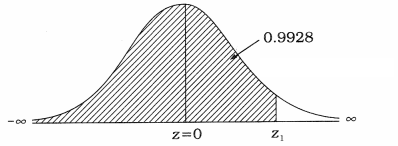
$ P\left[Z \leq z_1\right]=0.9928 $
$ \therefore P [0 \leq Z \leq z_1 ]=P [-\infty] $
$=0.9928-0.5000$
$ =0.4928$
From the table, for the probability $0.4927, z_1=2.44$ and for the probability
$0.4929, z_1=2.45 \text {. }$
For average probability $=\frac{0.4927+0.4929}{2}$
$ =0.4928 $
$ z_1=\frac{2.44+2.45}{2}=2.445$
(ii) Area to the right of $Z = z_1$ is $0.0250.$
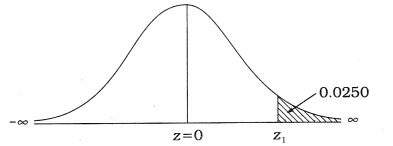
$P [Z \geq z_1] = 0.0250$
$\therefore P [0 \leq Z \leq z_1] = 0.5000 – 0.0250$
$= 0.4750$
From the table, for $0.4750, z_1 = 1.96$ View full question & answer→Question 103 Marks
The weight of randomly selected $500$ adult persons from a region of a city follows normal distribution. The average weight of these persons is $55 \ kg$ and Its standard deviation is $7 \ kg.$
$(i)$ Estimate the number of persons having weight between $41\ kg$ to $62 \ kg.$
$(ii)$ Estimate the number of persons having weight less than $41 \ kg.$
AnswerHere, $N=500 ; \mu=55 ; \sigma=7$
$(i)\ P[41 \leq X \leq 62]$
For $x_1=41, z_1=\frac{x_1-\mu}{\sigma}=\frac{41-55}{7}=\frac{-14}{7}=-2$
For $x_2=62, z_2=\frac{x_1-\mu}{\sigma}=\frac{62-55}{7}=\frac{7}{7}=1$
$\therefore P[41 \leq X \leq 62]=\mathrm{p}[-2 \leq Z \leq 1]$
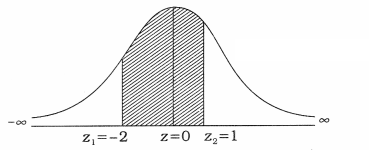
Now, $P [- 2 \leq Z \leq 1] = P[-2 \leq Z \leq 0] + P[0 \leq Z \leq 1]$
$= P[0 \leq Z \leq 2] + P[0 \leq Z \leq 1]$
$= 0.4772 + 0.3413$
$= 0.8185$
Hence, the number of persons having weight between $41 \ kg$ to $62 \ kg$
$= N \times P [- 2 \leq Z \leq 1]$
$= 500 \times 0.8185$
$(ii)\ P[X \leq 41]$
For $x=41, z=\frac{x-\mu}{\sigma}=\frac{-14}{7}=2$
$\therefore P[X \leq 41]=P[Z \leq-2]$
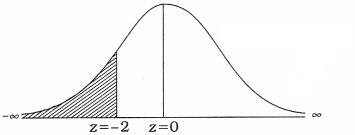
Now, $P [Z \leq – 2] = P [- \infty < Z \leq – 2]$
$= P [- \infty < Z \leq 0] – P[- 2 \leq Z \leq 0]$
$= 0.5000 – P[0 \leq Z \leq 2]$
$= 0.5000 – 0.4772$
$= 0.0228$
Hence, the number of persons having weight less than 4$1 \ kg$
$= N \times P [Z \leq – 2]$
$= 500 \times 0.0228$
$= 11$ View full question & answer→Question 113 Marks
If $X$ Is a normal variable with mean $100$ and standard deviation $15,$ then find the percentage of observations $(i)$ Having value more than $85.\ (ii)$ Having value less than $130.$
AnswerHere, $\mu=100 ; \sigma=15$
$(i)\ \mathrm{P}[\mathrm{X} \geq 85]$
For $\mathrm{x}=85, \mathrm{z}=\frac{x-\mu}{\sigma}=\frac{85-100}{15}=\frac{-15}{15}=-1$
$\therefore P[X \geq 85]=[Z \geq-1]$
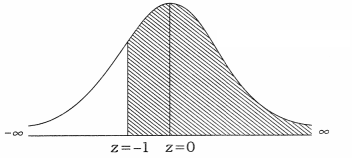
Now, $P[z \geq-1]=P[-1 \leq z \leq 0]+P[0 \leq z \leq \infty]$
$ =P[0 \leq Z \leq 1]+0.5000$
$ =0.3413+0.5000=0.8413 $
Hence, the value of $0.8413 \times 100=84.13 \%$
observations is more than $85 .$
$(ii)\ P[X \leq 130]$ For $x=130, z=\frac{x-\mu}{\sigma}=\frac{130-100}{15}=\frac{30}{15}=2$
$\therefore P[X \leq 85]=[Z \leq 2]$
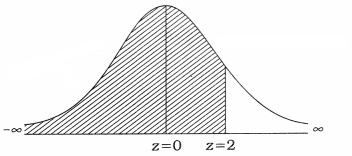
Now,
$P[z \leq 2] = P[- \infty < Z \leq 0] + P[0 \leq z \leq 2]$
$= 0.5000 + 0.4772 = 0.9772$
Hence, the value of $0.9772 \times 100 = 97.72 \%$ observations is less than $130.$ View full question & answer→Question 123 Marks
A normal distribution has mean $50$ and variance $9.$ Find the probability that $(I)$ The value of normal variable $X$ lies between $50$ and $53.\ (Ii)$ The value of normal variable $X$ lies between $47$ and $53.$
AnswerHere, $\mu=50 ; \sigma^2=9 \therefore \sigma=3$
$(i)\ \mathrm{P}[50 \leq \mathrm{X} \leq 53]$
For $\mathrm{x}_1=50, \mathrm{z}_1=\frac{x_1-\mu}{\sigma}=\frac{50-50}{3}=0$
For $x_2=53, z_2=\frac{x_2-\mu}{\sigma}=\frac{53-50}{3}=1$
$\therefore P[50 \leq X \leq 53]=P[0 \leq Z \leq 1]=0.3413$
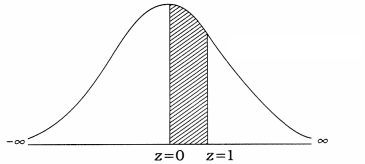
$(ii)\ P[47 \leq X \leq 53]$
For $x_1=47, z_1=\frac{x_1-\mu}{\sigma}=\frac{47-50}{3}=\frac{-3}{3}=-1$
For $x_2=53, z_2=\frac{x_2-\mu}{\sigma}=\frac{53-50}{3}=\frac{3}{3}=1$
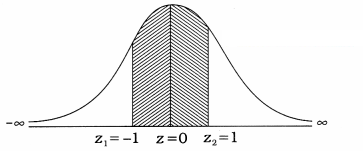
$\therefore P [47 \leq X \leq 53] = P [- 1\leq Z \leq 1]$
$= 2P[0 \leq Z \leq 1]$
$= 2 [0.3413]$
$= 0.6826$ View full question & answer→Question 133 Marks
State the properties of standard normal distribution.
AnswerSome important properties of standard normal distribution are as follows :
$(1)$ It is a distribution of continuous random variable.
$(2)$ The curve of this distribution is completely bell-shaped.
$(3)$ The tails of the curve of this distribution are asymptotic to $X$-axis, i.e., they never touch $X$-axis.
$(4)$ The mean of this distribution is $0 ($zero$)$ and its variance and standard deviation is $1 .$
$(5)$ In this distribution the values of mean, median and mode are zero.
$(6)$ In this distribution the estimated values of $Q_{1}$ and $Q_{3}$ are as under: $Q_{1} \approx-0.675, Q_{3} \approx 0.675$
$(7)$ The curve of this distribution is completely symmetric about $Z=0$ and its skewness is zero.
$(8)$ The area of the curve of this distribution bounded by $X$-axls and on both sides of $Z=0$ is equal to $0.5 .$
$(9)$ In this distribution, $(i)$ Quartile deviation $\approx \frac{2}{3}$ $(ii)$ Mean deviation $\approx \frac{4}{5}$
$(10)$ The important areas related to standard normal curve are as follows: $(i)$ The area under the curve between $z=\pm 1$ is $0.6826$ $(ii)$ The area under the curve between $z=\pm 2$ is $0.9545$ $(iii)$ The area under the curve between $z=\pm 3$ $(iv)$ The area under the curve between $z=\pm 1.96$ is $0.95$ $(v)$ The area under the curve between $z=\pm 2.575$ is $0.99$
View full question & answer→Question 143 Marks
State the properties of normal distribution.
AnswerThe normal distribution possesses the following properties:
$(1)$ The normal distribution is a probability distribution of continuous random variable.
$(2)\ \mu$ and $\sigma$ are its parameters.
$(3)$ The graph of density function of this distribution is continuous graph of bell- shape.
$(4)$ The normal curve is symmetric abou $x=\mu$
$(5)$ The total area under normal curve is and the area of the region of normal curve o both sides of $X=\mu$ is equal and $0.5$.
$(6)$ The mean, median and mode of the distribution are equal, i.e., $\mu=M=M_{0}$
$(7)$ The skewness of this distribution is zero.
$(8)$ The first quartile $Q_{1}$ and third quartile $Q_{3}$ are equidistant from the second quartile $Q_{2}$ in this distribution, i.e., $Q_{3}-Q_{2}=Q_{2}-Q_{1}$ and $M =\frac{Q_{3}+Q_{1}}{2}$.
$(9)$ In the form of $\mu$ and $\sigma$ the estimate values of $Q_{1}$ and $Q_{3}$ are obtained as follows: $Q_{1}=\mu-0.675 \sigma$ and $Q_{3}=\mu+0.675 \sigma$
$(10)$ Two tails of the curve of normal distribution are asymptotic to $X$-axis, i.e., they never touch $X$-axis.
$(11)$ In this distribution, $(i)$ Quartile deviation $=\frac{2}{3} \sigma$ $(ii)$ Mean deviation $=\frac{2}{3} \sigma$
$(12)$ The important areas under normal curve are as follows: $(i)$ The area under the normal curve between $\mu \pm \sigma=0.6826$ $(ii)$ The area under the normal curve between $\mu \pm 2 \sigma=0.9545$ $(iii)$ The area under the normal curve between $\mu \pm 3 \sigma=0.9973$ $(iv)$ The area under the normal curve between $\mu \pm 1.96 \sigma=0.95$ $(v)$ The area under the normal curve between $\mu \pm 2.575 \sigma=0.99$
View full question & answer→Question 153 Marks
A normal variable $X$ has mean $200$ and variance $100 .$
$(i)$ Estimate the values of extreme quartiles.
$(ii)$ Find the approximate value of quartile deviation.
$(III)$ Find the approximate value of mean deviation.
AnswerHere, $\mu=200, \sigma^2=100,$
$\therefore \sigma=10$
$(i)$ Extreme quartiles $Q_1 Q_3$ :
$25 \%$ of the observations of the distribution is less than $Q_1$ and $25 \%$ of observations of the distribution Is more than $\mathrm{Q}_3$.
For $\mathrm{Q}_1, \mathrm{z}_1=\frac{Q_1-\mu}{\sigma}=\frac{Q_1-200}{10}$ and
For $\mathrm{Q}_3, \mathrm{z}_3=\frac{Q_3-\mu}{\sigma}=\frac{Q_3-200}{10}$
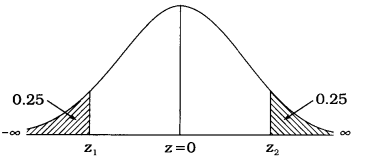
$P\left[X \leq Q_1\right]=P\left[Z \leq z_1\right]=0.25 \text { and }$
$ P\left[X \geq Q_3\right]=P\left[Z \geq z_2\right]=0.25$
$ \therefore P\left[z_1 \leq Z \leq 0\right]=0.50-0.25=0.25 \text { and }$
$ P\left[0 \leq Z \leq z_2\right]=0.50-0.25=0.25$
$ \text { For area } 0.2486, z_1=-0.67 \text { and for area } 0.2518, z_1=-0.68$
$ \text { For area } 0.25, z_1=\frac{(-0.67)+(-0.68)}{2}$
$ =-0.675$
$ \text { and for area } 0.25 \text {. }$
$ z_2=\frac{0.67+0.68}{2}=0.675$
$ \text { Now, } z_1=\frac{Q_1-200}{10}$
$ \therefore-0.675=\frac{Q_1-200}{10}$
$ \therefore-6.75=Q_1-200$
$ \therefore Q_1=200-6.75$
$ \therefore Q_1=193.25$
$ \text { Now, } z_2=\frac{Q_3-200}{10}$
$ \therefore 0.675=\frac{Q_3-200}{10}$
$ \therefore 6.75=\mathrm{Q}_3-200$
$ \therefore Q_3=200+6.75$
$ \therefore Q_3=206.75$
$(ii)$ The approximate value of quartile deviation: In normal distribution, quartile deviation $\approx \frac{2}{3} \sigma$
Putting, $\sigma=10$ Quartile deviation $\approx \frac{2}{3} \times 10=\frac{20}{3} \approx 6.67$
Hence, the approximate value of quartile deviation obtained is $6.67 .$
$(iii)$ Approximate value of mean deviation: In normal distribution, mean deviation $\approx \frac{4}{5} \sigma$
Putting, $\sigma=10$ Mean deviation $\approx \frac{4}{5} \times 10 \approx 8$
Hence, the approximate value of mean deviation obtained is $8 .$ View full question & answer→Question 163 Marks
For a normal distribution, the third quartile and quartile deviations are $36$ and $24$ respectively. Find the mean of the distribution.
AnswerHere, $\mathrm{Q}_3=36$ and mean deviation $=24$.
Now, mean deviation $=\frac{4}{5} \sigma$
$\therefore 24=\frac{4}{5} \sigma$
$ \therefore 24 \times \frac{5}{4}=\sigma$
$ \therefore \sigma=30$
$ Q_3=36$
$\therefore 25 \%$ of the observations of the distributions are more than $36 .$
For $x=36, z_1=\frac{36-\mu}{\sigma}=\frac{36-\mu}{30}$
Now, $P[X \geq 36]=0.25$
$\therefore P\left[Z \geq Z_1\right]=0.25$
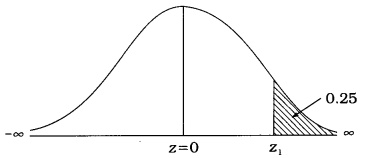
$\therefore P\left[0 \leq Z \leq z_1\right]=0.50-0.25=0.25$
From the table, for area $0.2486, z_1=0.67$ and for area $0.2518, z_1=0.68$
$\therefore$ For area $0.25 ,$
$z_1=\frac{0.67+0.68}{2}=0.675$
Now, $z_1=\frac{36-\mu}{30}$
$\therefore 0.675=\frac{36-\mu}{30}$
$ \therefore 0.675 \times 30=36-\mu$
$ \therefore 20.25=36-\mu$
$ \therefore \mu=36-20.25$
$ \therefore \mu=15.75$
Hence, the mean of the distribution obtained is $15.75 .$ View full question & answer→Question 173 Marks
For a normal distribution, the first quartile is $35$ and its third quartile is $65 .$ Estimate the limits that includes exactly middle $95.45 \%$ of the observations.
AnswerHere, $\mathrm{Q}_1=35 ; \mathrm{Q}_3=65$
$\therefore \mathrm{M}=\frac{Q_3+Q_1}{2}=\frac{65+35}{2}=\frac{100}{2}=50$
$ \text { and quartile deviation }=\frac{Q_3-Q_1}{2}$
$ =\frac{65-35}{2}$
$ =\frac{30}{2}=15$
Now, in normal distribution $\mu=\mathrm{M}$
$\therefore \mu=50$
Quartile deviation $=\frac{2}{3} \sigma$
$\therefore 15 x=\frac{2}{3} \sigma$
$ \therefore 15 \times \frac{3}{2}=\sigma$
$ \therefore \sigma=\frac{45}{2}=22.5$
The limits that include exactly middle $95.45 \%$ of the observations $= µ ± 2\sigma $
$= (µ – 2\sigma )$ to $(µ + 2\sigma )$
Putting, $µ = 50$ and $\sigma = 22.5$
The limits that include exactly middle $95.45 \%$ of the observations
$= [50 – 2(22.5)]$ to $(50 + 2(22.5)]$
$=(50 – 45)$ to $(50 + 45)$
$= 5$ to $95$
Hence, the limits that include exactly middle $95.45 \%$ of the observations for a normal distribution obtained is $(5, 95).$
View full question & answer→Question 183 Marks
A normal variable $X$ has the following probability density function :
$f(x) = \frac{1}{6 \sqrt{2 \pi}} e^{-\frac{1}{72}(x-100)^{2}}, – \infty < x < \infty $
For this distribution, obtain the estimated limits for the exact middle $50 \%$ of the observations.
Answer$f(x)=\frac{1}{6 \sqrt{2 \pi}} e^{-\frac{1}{72}(x-100)^2},-\infty =\frac{1}{6 \sqrt{2 \pi}} e^{-\frac{1}{2} \frac{(x-100)^2}{6^2}},-\infty$
$\therefore \mu=100, \sigma=6$
The limits for the exact middle $50 \%$ of the observation is $\mathrm{Q}_1$ to $\mathrm{Q}_3$.
$25 \%$ of observations of distribution are less than $Q_1$ and $25 \%$ observations are more than $\mathrm{Q}_3$.
$\therefore \mathrm{P}\left[\mathrm{X} \leq \mathrm{Q}_1\right]=0.25 \text { and } \mathrm{P}\left(\mathrm{X} \geq \mathrm{Q}_3\right]=0.25$
$ \mathrm{z}_1=\frac{\mathrm{Q}_1-\mu}{\sigma}=\frac{Q_1-100}{6} \text { and } \mathrm{z}_2=\frac{\mathrm{Q}_3-\mu}{\sigma}=\frac{Q_3-100}{6}$
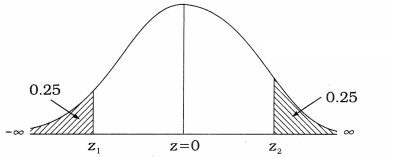
$\therefore P\left[X \leq Q_1\right]=P\left[Z \leq z_1\right]=0.25$
$ P\left[Z \leq z_1\right]=0.25$
$ \therefore P\left[z_1 \leq Z \leq 0\right]=0.50-0.25=0.25$
From the table, for area $0.2486, z_1=-0.67$ and for area $0.2518, z_1=-0.68$
$\therefore$ For area $0.25 ,$
$z_1=\frac{(-0.67)+(-0.68)}{2}=-0.675$
Now, $\mathrm{z}_1=\frac{Q_1-100}{6}$
$\therefore 0.675=\frac{Q_1-100}{6}$
$ \therefore-4.05=Q_1-100$
$ \therefore Q_1=-4.05+100$
$ \therefore Q_1=95.95$
Similarly, $P\left[Z \geq z_2\right]=0.25$
$\therefore P\left[0 \leq Z \leq z_2\right]=0.50-0.25=0.25$
As above, for area $0.25, z_2=0.675$
$\text { Now, } \mathrm{z}_2=\frac{Q_3-100}{6}$
$ \therefore 0.675=\frac{Q_3-100}{6}$
$ \therefore 4.05=Q_2-100$
$ \therefore Q_2=104.05$
Hence, the limits for exact middle $50 \%$ of the observations obtained is $95.95$ to $104.05 .$ View full question & answer→Question 193 Marks
The monthly production of units in a factory is normally distributed with mean $\mu$ and standard deviation $\sigma$. The $Z-$scores corresponding to the production of $2400$ units and $1800$ units are $1$ and $-0.5$ respectively. Find its mean and standard deviation.
AnswerHere, $x_1=2400, x_2=1800: z_1=1, z_2=-0.5$
Now, $Z=\frac{x-\mu}{\sigma}$
$\therefore 1=\frac{2400-\mu}{\sigma}$
$ \therefore \sigma=2400-\mu \ldots \ldots \ldots(1)$
$ \text { and }-0.5=\frac{1800-\mu}{\sigma}$
$ \therefore-0.5 \sigma=1800-\mu \ldots \ldots \ldots \ldots(2)$
Subtracting equation $(2)$ from the $(1)$
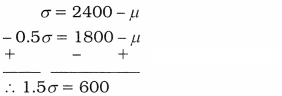
$\therefore \sigma=\frac{600}{1.5}=400 $
Putting $\sigma=400$ in equation $(1),$
$400=2400-\mu$
$ \therefore \mu=2400-400=2000 $
Hence, the mean and standard deviation of the distribution obtained are $2000$ and $400$ respectively. View full question & answer→Question 203 Marks
Define normal distribution and state the characteristics of normal curve.
AnswerThe distribution of a normal variable $X$ is called Normal distribution. It is denoted by $N\left(\mu, \sigma^{2}\right)$ The characteristics of normal curve:
$(1)$ It is completely bell-shaped.
$(2)$ It is asymptotic to $X$-axis, I.e., the tails of the curve never touch $X$-axis.
$(3)$ The total area of the region bounded by normal curve and $X$-axis $=$ Total probability $1$
$(4)$ It is symmetric about the sides of meai p of normal variate. So the area of the regiol of normal curve on both the sides of $X=\mu$ is equal to $0.5$.
$(5)\ P[\mu \leq X \leq a]$ is the area of region bounde by $X$-axis and two perpendicular lines at $X=$ and $X=a$.
$(6)$ To find the area under the normal curve the normal variable is transformed to standan normal variable $Z$ and readymade table is used.
View full question & answer→Question 213 Marks
For a normal distribution, the first quartile and mean deviation are $28$ and $4$ respectively. Find the mean, mode and $P[X \leq 36.33]$.
View full question & answer→Question 223 Marks
For a normal distribution, the mode and mean deviation are $32$ and $1.6$ respectively. $(1)$ Obtain an estimate of the value of extreme quartiles. $(2)$ Find $P[31 \leq X \leq 33]$. and $(3)$ Obtain the limit that includes exactly middle $95 \%$ of the observations of the distribution.
Answer$(1)\ Q_{1}=30.67, Q_{2}=33.33$
$(2)\ 0.3830$
$(3)\ 28.08$ to $35.92$
View full question & answer→Question 233 Marks
For a normal distribution of variable $x$, the mean deviation and third quartile are $2.4$ and $9$ respectively. Estimate the limits that includes exactly middle $99.73 \%$ of the observations.
Answer$\overline{\sigma=3}$, quartile deviation $=2 . M=\mu=7$, limts: $-2$ to $16$
View full question & answer→Question 243 Marks
For a normal distribution, $3 Q_{1}=2 Q_{3}=150$. Estimate the limits that includes exactly middle $68.26 \%$ of the observations.
View full question & answer→Question 253 Marks
The distribution of a data is normal, whose mean is $\mu$ and S.d. is $\sigma$. What percentage of observations are greater than $\mu-1.5 \sigma$ ?
View full question & answer→Question 263 Marks
The distribution of a random variable $X$ follows normal distribution. What percentage observations will be less than $\mu+1.2 \sigma$ ?
View full question & answer→Question 273 Marks
A normal variable $x$ has the following probability density function: $f(x)=\frac{1}{\sqrt{450 \pi}} e^{-\frac{(x-72)^{2}}{450}}$What percentage of observations of this distribution will be between $60$ and $81 ?$
View full question & answer→Question 283 Marks
The mean of a normal distribution is $55$ and its $S.d.$ is $15 .$ If $(1)\ P\left[50 \leq X \leq k_{1}\right]=$
Answer$k_{1}=70, k_{2}=73$
View full question & answer→Question 293 Marks
The distribution of monthly income of persons of a group is normal, whose mean $= Rs.750$ and $S.d.=Rs.100 .$
$(1)$ Find the value $x_{1}$ of $x$ if the percentage of persons whose monthly income is less than $Rs.x_{1}$ is $38.21 \%$.
$(2)$ If the monthly income of $305$ persons out of $2000$ persons is between $k_{1}$ and $Rs.1000 ,$ find the value of $k_{1}$
Answer$x_{1}=720$
$k_{1}=850$
View full question & answer→Question 303 Marks
For a normal distribution $\mu=50$ and $\sigma=15$. If $ (1)\ P\left[X \leq k_{1}\right]=0.9332$ and $(2)\ P\left[X \geq k_{2}\right]=0.6915$, find the values of $k_{1}$ and $k_{2} .$
Answer$k_{1}=72.5, k_{2}=42.5$
View full question & answer→Question 313 Marks
The mean of a normal distribution is $150$ and Its variance is $625 .$ If $(1)\ P\left[X \leq k_{1}\right]=$ $0.7257$, $(2)\ P\left[k_{2} \leq X \leq 140\right]=0.3218$ and $(3)\ P\left[X \geq k_{3}\right]=0.1038$, find the values of $k_{1}, k_{2}$ and $k_{3}$.
Answer$k_{1}=165, k_{1}=100, k_{1}=181.5$
View full question & answer→Question 323 Marks
For a normal distribution having mean $p$ and variance is $4.$ Find the value of $(1)\ P[X \geq \mu+1]$ and $(2)\ P[X \geq \mu-1]$
Answer$(1)\ 0.3185$
$(2)\ 0.6915$
View full question & answer→Question 333 Marks
For the standard normal variable $Z, P[Z \leq 3 K]=0.9641$, find the value of the constant $K.$
View full question & answer→Question 343 Marks
For the standard normal variable $Z$. if $P[Z \geq(1+2 C)]=0.9918$, find the value of the constant $C$.
View full question & answer→Question 353 Marks
Find $P[1 \leq x \leq 3]$.
View full question & answer→Question 363 Marks
$X$ Is a normal variate. The mean and the variance of the distribution of $X$ are $52$ and $36$ respectlvely. State the probability density function of the distribution. Find the value of third quartile.
View full question & answer→Question 373 Marks
$X$ is a normal variate such that for its value $x_{1}=90$ and $x_{2}=126$ the corresponding $z$-values are $z_{1}=-0.6$ and $z_{2}=1.2$. Obtain the values of the parameters of normal distribution. State the probability density function of $X$.$f(x)=\frac{1}{20 \sqrt{2 \pi}} e^{-\frac{1}{2}\left(\frac{x-102}{20}\right)^{2}}$
Answer$f(x) = \frac{1}{20\sqrt{2 π}}e^{-\frac{1}{2}(\frac{x-102}{20})^2}$
View full question & answer→Question 383 Marks
In a normal distribution, for $x=90, z=-0.6$. If $\mu=102$, find $\sigma$ and $P[90 \leq X \leq 114].$
Answer$\sigma=20, P[90 \leq X \leq 114]=0.4514$
View full question & answer→Question 393 Marks
The variance of the distribution of a normal variate $X$ is $400 .$ If for some value $x_{1}= 225$ of $X$, the corresponding value of standard normal variate $Z$ is $z_{1}=-1.25$, find the mean of the distribution and $P[210 \leq X \leq 290]$.
Answer$M=250, P[210 \leq X \leq 290]=0.9544$
View full question & answer→Question 403 Marks
The distribution of monthly income of $1000$ employees is normal. The monthly income of two of the employees are $3800$ and $2.72$ respectively. Find the average monthly income of the employees and the standard deviation of the monthly income. Also, find the expected number of employees whose monthly income is less than $Rs. 4000 .$
Answer$\mu=\operatorname{Rs} 3288, \sigma=\operatorname{Rs} 400$, expected number of employees whose monthly income is less than $Rs.4000=963$
View full question & answer→Question 413 Marks
The distribution of height of students of a group Is normal. The height of two students are $125 cm$ and $140 cm$ respectively. If the values of standard normal variate $Z$ corresponding to these two observations are $-0.15$ and $1.35$ respectively, find the mean and the standard deviation of the distribution and $P[x \geq 130]$.
Answer$\mu=126.5, \sigma=10 P[x \geq 130]=0.3632$
View full question & answer→