Question 15 Marks
If $Z$ is standard normal variable and $z_{1}$ is $Z$-score then obtain the values of $z_{1}$ satisfying the following conditions
$(1) P\left(-1 \leq Z \leq z_{1}\right)=0.5255$
$(2) P\left(z_{1} \leq Z \leq 2\right)=0.7585$
View full question & answer→Question 25 Marks
The probability density function of a normal variable is as under $ f(x)=\frac{1}{4 \sqrt{2 \pi}} \quad e^{-\frac{1}{32}(x-50)^{2}} ; \quad-\infty < x < \infty $ Obtain parameters of this distribution and find the values of following : $(1) P(52 \leq X \leq 58) \ (2)\ P(|X-45| \leq 4)$
View full question & answer→Question 35 Marks
The maximum temperature of a city during summer follows normal distribution. On a particular day, the probability that the maximum temperature of the city is more than $31^\circ $ Celsius is $0.3085,$ whereas the probability that during some other day, the maximum temperature is less than $2?^\circ $ is $0.0668.$ Find mean and standard deviation of the maximum temperature of the city.
View full question & answer→Question 45 Marks
The monthly income of a group of employees follows normal distribution. The mean of the distribution is $₹ 15,000$ and its standard deviation is $₹ 4000 .$ From this information, $(1)$ obtain range of monthly income for middle $60 \%$ of the employees. $(2)$ if monthly income of $250$ employees is between $₹ 15000$ apd certain fixed income $₹ x_{1}$ then find the value of $x_{1}$.
View full question & answer→Question 55 Marks
$200$ students are selected from all the students of a school and the marks obtained by them in an examination of $100$ marks follows normal distribution. The mean marks of the distribution is $60$ and its standard deviation is $8.$
$(1)$ If $70$ or more marks are required for the special scholarship then obtain the number of students getting special scholarship.
$(2)$ Obtain the minimum marks of $10\%$ of the students getting maximum marks. Here, $X =$ marks obtained by a student
View full question & answer→Question 65 Marks
In a city, daily sale of petrol at a petrol pump follows normal distribution and its mean and standard deviation are $33,000$ litre and $3000$ litre respectively. $(1)$ Obtain the percentage of days of a month during which the daily sales of petrol is less than $30,000$ litre. $(2)$ During the month of May, how many days are expected so that the sale of petrol is between $32,000$ litre to $35,000$ litre?
View full question & answer→Question 75 Marks
A normal variable $X$ has following probability density function :
$f (x) =\frac{1}{\sqrt{5000 \pi}} e^{-\frac{1}{5000}(x-75)^{2}}, – \infty \leq x \leq \infty $
From this, answer the following questions :
$(1)$ If $P [60 \leq X \leq x_2] = 0.5670,$ then find $x_2.$
$(2)$ If $P [x_1 \leq X \leq 125] = 0.3979,$ then find $x_1$
$(3)$ Find $P[|X – 50| \leq 10].$
AnswerHere,
$f (x) = \frac{1}{\sqrt{5000 \pi}} e^{-\frac{1}{5000}(x-75)^{2}}, – \infty < x < \infty $
$= \frac{1}{50 \sqrt{2 \pi}} e^{-\frac{1}{2}\left(\frac{x-75}{50}\right)^{2}}, – \infty < x < \infty $
$\therefore µ = 75, \sigma = 50$
$(1) If P [60 \leq X \leq x_2] = 0.5670$
$z_1 = \frac{60-\mu}{\sigma} = \frac{60-75}{50} = \frac{-15}{50} = – 0.3$
$z_2 = \frac{x_{2}-\mu}{\sigma} = \frac{x_{2}-75}{50}$
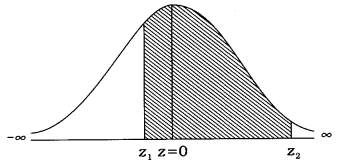
$P[60 \leq X \leq x_2] = 0.5670$
$\therefore P [- 0.3 \leq Z \leq z_2] = 0.5670$
$\therefore P [0 \leq Z \leq z_2] = P [- 0.3 \leq Z \leq z_2] – P[- 0.3 \leq Z \leq 0]$
$= 0.5670 – 0.1179$
$= 0.4491$
$\therefore $ For area $0.4484, z_2 = 1.63$ and for area $0.4495, z_2 = 1.64$
$\therefore $ For area $0.4491 z_2 = \frac{1.63+1.64}{2} = 1.635$
Now, $z_2 = \frac{x_{2}-75}{50}$
$\therefore 1.635 = \frac{x_{2}-75}{50}$
$\therefore 50 \times 1.635 = x_2 – 75$
$\therefore 81.75 = x_2 – 75$
$\therefore x_2 = 81.75 + 75$
$\therefore x_2 = 156.75$
Hence, $x_2 $ obtained is $≈ 157.$
$(2)$ If $P [x_1 \leq X \leq 125] = 0.3979,$
$z_1 = \frac{x_{1}-\mu}{\sigma} = \frac{x_{1}-75}{50}$
$z_2 = \frac{125-\mu}{\sigma} = \frac{125-75}{50} = \frac{50}{50} = – 0.3$
$>P[x_1 \leq X \leq 125] = 0.3979$
$\therefore P[z_1 \leq Z \leq 1] = 0.3979$
$\therefore P[z_1 \leq Z \leq 0] = P[z_1 \leq Z \leq 1] – p[o \leq Z \leq 1]$
$= 0.3979 – 0.3413$
$= 0.0566$
For area $0.0557, z_1 = – 0.14$
and for area $0.0596. z_1 = – 0.15$
$\therefore$ For area $0.0566 z_1 = \frac{(-0.14)+(-0.15)}{2} = – 0.145$
Now, $z_1 = \frac{x_{1}-75}{50}$
$– 0145 = \frac{x_{1}-75}{50}$
$\therefore – 0.145 \times 50 = x_1 – 75$
$\therefore – 7.25 = x_1 – 75$
$\therefore x_1 = 75 – 7.25 = 67.75 ≈ 68$
Hence, $x_1 $ obtained is $≈ 68.$
$(3)$ Find $P[|X – 50| \leq 10]$
$P[|X – 50| \leq 10] = P[40 \leq X \leq 60]$
For $x_1 = 40,$
$z_1 =\frac{x_{1}-\mu}{\sigma} = \frac{40-75}{50} = \frac{-35}{50} = – 0.7$
For $x_2 = 40,$
$z_2 =\frac{x_{2}-\mu}{\sigma} = \frac{60-75}{50} = \frac{-15}{50} = – 0.3$
$P[40 \leq X \leq 60]$
$= P[- 0.7 \leq Z \leq – 0.3]$
$= [- 0.7 \leq Z \leq 0] – P [- 0.3 \leq Z \leq 0]$
$= 0.2580 – 0.1179$
$= 0.1401$ View full question & answer→Question 85 Marks
A normal variable $X$ has following probability density function: $ f(x)=\text { constant } \cdot e^{-\frac{1}{200}(x-50)^2},-\infty 0$
Answer$ f(x)=\text { constant } \times e^{-\frac{1}{200}(x-50)^2},-\infty $ $ =\text { constant } \times e^{-\frac{1}{2}}\left(\frac{x-50}{10}\right)^2,-\infty$$ \therefore \mu=50, \sigma=10$
$(1)$ Median:
$M=\mu=50$
$(2)$ Extreme quartiles $Q_1$ and $Q_3 :$
$25 \%$ observations are less than $\mathrm{Q}_1$ and $25 \%$ of observations are more than $\mathrm{Q}_3.$
$ \therefore \mathrm{P}\left[\mathrm{X} \leq \mathrm{Q}_1=0.25 \text { and } \mathrm{P}\left[\mathrm{X} \geq \mathrm{Q}_3\right]=0.25\right. $
$ \mathrm{z}_1=\frac{Q_1-\mu}{\sigma}=\frac{Q_1-50}{10} \text { and } $
$ \mathrm{z}_2=\frac{Q_3-\mu}{\sigma}=\frac{Q_3-50}{10}$
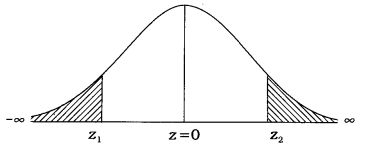
$P[Z \leq z_1] = 0.25$ and $P [Z \geq z_2] = 0.25$
$\therefore P [z_1 \leq Z \leq 0] = P [- \infty < Z \leq 0] – P [- \infty < Z \leq z_1]$
$= 0.50 – 0.25$
$= 0.25$
and $P [0 \leq Z \leq z_2] = P [0 \leq Z < \infty ] – P [z_2 \leq Z < \infty ]$
$= 0.50 – 0.25$
$= 0.25$
For area $0.2486 ,$
$z_1=-0.67 $ and $z_2=0.68$
For area $0.2518 ,$
$z_1=-0.68$ and $z_2=0.68$
$\therefore$ For area $0.25 ,$
$z_1=\frac{-0.67-0.68}{2}=-0.675$ and
$z_2=\frac{0.67+0.68}{2}=-0.675 $ and
Now, $z_1=\frac{Q_1-50}{10}$
$ \therefore-0.675=\frac{Q_1-50}{10}$
$ \therefore-0.675 \times 10=Q_1-50$
$ \therefore-6.75=Q_1-50 $
$ \therefore Q_1=43.25$
$ \text { and } \mathrm{z}_2=\frac{Q_3-50}{10} $
$ \therefore 0.675=\frac{Q_3-50}{10} $
$ \therefore 0.675 \times 10=\mathrm{Q}_3-50 $
$ \therefore 6.75=Q_3-50 $
$ \therefore \mathrm{Q}_3=50+6.75 $
$ \therefore \mathrm{Q}_3=43.25$
Hence, the extreme quartiles $\mathrm{Q}_1$ and $\mathrm{Q}_3$ obtained are $43.25$ and $56.75$ respectively.
$(3)$ Quartile deviation:
In normal distribution,
Quartile deviation $\approx \frac{2}{3} \sigma$
Putting $\sigma=10,$
Quartile deviation $\approx \frac{2}{3} \times 10 \approx \frac{20}{3} \approx 6.67$
$(4)$ Mean deviation:
In normal distribution,
Mean deviation $\approx \frac{4}{5} \sigma$
Putting $\sigma=10,$
Quartile deviation $ \approx \frac{4}{5} \times 10 \approx 8$ View full question & answer→Question 95 Marks
The monthly bill amount of regular customers of a provision store follows normal distribution. If $7.78 \%$ customers have monthly bill amount less than $Rs.3590$ and $94.52 \%$ customers have bill amount less than $Rs.5100$, then determine the parameters of the normal distribution. Also determine the interval for monthly bill amount of exactly middle $95 \%$ customers.
AnswerHere, $X=$ Monthly bill amount of customers
The bill of $7.78 \%$ of customers is less than $₹ 3590.$
$\therefore P[X \leq 3590]=\frac{7.78}{100}=0.0778$
Here, $x_1=3590$
$\therefore z_1=\frac{x_1-\mu}{\sigma}=\frac{3590-\mu}{\sigma}$
The bill of $94.58 \%$ of customers is less than $₹ 5100.$
$\therefore P[X \leq 5100]=\frac{94.52}{100}=0.9452$
Here, $x_2=5100$
$\therefore z_2=\frac{x_{21}-\mu}{\sigma}=\frac{5100-\mu}{\sigma}$
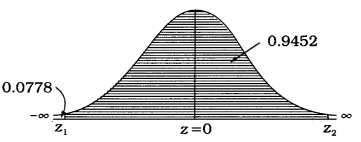
$\therefore P [Z \leq z_1] = 0.0778 P$
$\therefore [z_1 \leq Z \leq 0] = P [- \infty < Z \leq 0] – P [Z \leq z_1]$
$= 0.5000 – 0.0778$
$= 0.4222$
$\text { For area }=0.4222, z_1=1.42=-1.42$
$\text { Now, } z_1=\frac{x_1-\mu}{\sigma}=\frac{3590-\mu}{\sigma}$
$\therefore-1.42=\frac{3590-\mu}{\sigma}$
$\therefore-1.42 \sigma=3590-\mu \ldots \ldots \ldots . .(1)$
$P\left[Z \leq z_2\right]=0.9452$
$\therefore P\left[0 \leq Z \leq z_2\right]=P\left[Z \leq z_2\right]-P[-\infty =0.9452-0.5000]$
$=0.4452$
For area $0.4452, z_2=1.60$}
$z_1=\frac{x_2-\mu}{\sigma}=\frac{5100-\mu}{\sigma}$
$\therefore 1.60=\frac{5100-\mu}{\sigma}$
$\therefore 1.60 \sigma=5100-\mu$
Subtracting equation $(2)$ from equation $(1),$
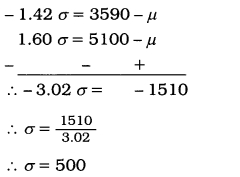
Putting $\sigma = 500$ in equation $(2),$
$1.60 \times 500 = 5100 – \mu$
$800 = 5100 – \mu$
$\therefore \mu = 5100 – 800$
$\therefore \mu = 4300$
Hence, the mean and standard deviation of normal distribution obtained are $₹ 4300$ and $₹ 500$ respectively.
Interval for monthly bill amount of exactly middle $95 \% $ customers :
$\mu = 4300, \sigma = 500$
Interval for the monthly bill amount of exactly middle $95 \%$ customers
$=\mu ± 1.96 \sigma $
$= (\mu – 1.96 \sigma )$ to $(\mu + 1.96\sigma )$
$= (4300 – 1.96 \times 500)$ to $(4300 + 1.96 \times 500)$
$= (4300 – 980)$ to $(4300 + 980)$
$= (3320, 5280)$
View full question & answer→Question 105 Marks
Analysis of result of $12th$ standard students of a school is as under:
Pass with distinction: $15 \%$ of total students
Pass without distinction : $75 \%$ of total students
Fail: $10 \%$ of total students
For passing the examination, minimum $40 \%$ of the total makes amd for distinction minimjum $80 \%$ marks are required. if the percentege of result of the students follows normal distribution then find mean and standard deviation and by using it determine the percentage marks for which $75 \%$ of the students have less than that percentage marks.
Answer
Here, $X$ = Percentage of marks obtained
Let, $µ$ = Mean of normal distribution
$\sigma $ = Standard deviation of normal distribution
Suppose, an examination is conducted of $100$ marks. For passing minimum $40 \%$ of the total marks, i.e., $40$ marks is required. So the students getting less than $40$ marks fails. Now, $10 \%$ of total students fail.
$ \therefore P[X \leq 40]=\frac{10}{100}=0.1$
$ \text { For } x_1=40, z_1=\frac{x_1-\mu}{\sigma}=\frac{40-\mu}{\sigma}$
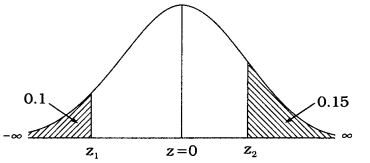
Now, $P [Z \leq z_1] = 0.1$
$\therefore P[z_1 \leq Z \leq 0] = P[- \infty < z \leq 0] – P[Z \leq z_1]$
$= 0.5000 – 0.1000$
$= 0.4000$
For area $0.3997 \approx 0.4000, z_1=-1.28$
$ \mathrm{z}_1=\frac{x_1-\mu}{\sigma}$
$ \therefore-1.28=\frac{40-\mu}{\sigma}$
$ \therefore-1.28 \sigma=40-\mu .$
Now, for distinction $80 \%$ of marks, i.e., $80$ marks are required. So, the students getting more than $80$ marks pass with distinction. Now, the percentage of students who pass with distinction is $15 \%$ of total students.
$\therefore P[x>80]=\frac{15}{100}=0.15$
$ \text { For } \mathrm{x}_2=80, \mathrm{z}_2=\frac{x_2-\mu}{\sigma}=\frac{80-\mu}{\sigma}$
$ \text { Now, } P\left[Z \geq z_2\right]=0.15$
$ \therefore P\left[0 \leq Z \leq Z_2\right]=P[0 \leq Z<\infty]-P\left[Z \geq Z_2\right]$
$ =0.5000-0.1500$
$ =0.3500$
For area $0.3485, z_2=1.03$ and for area $0.3508, z_2=1.04$
$ \therefore \text { For area } 0.35, z_2=\frac{1.03+1.04}{2}=1.035$
$ \therefore z_2=1.035$
Now, $z_2=\frac{80-\mu}{\sigma}$
$\therefore 1.035=\frac{80-\mu}{\sigma}$
$ \therefore 1.035 \sigma=80-\mu$
Subtracting equation $(2)$ from the equation $(1),$
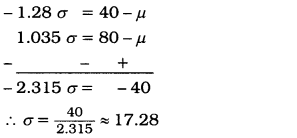
Putting $\sigma = 17.28$ in the equation $(1),$
$– 1.28(17.28) = 40 – µ$
$\therefore µ = 40 + 22.12$
$= 62.12$
Hence, the mean marks of the distribution and its standards deviation obtained are $62.12$ and $17.28$ marks respectively.
Percentage marks for $75 \%$ of the students:
Suppose, the result of $75 \%$ of student is less than $x_1$ percentage.
$ \therefore P\left[X \leq \mathrm{x}_1\right]=\frac{75}{100}=0.75$
$ \text { For } \mathrm{x}_1, \mathrm{z}_1=\frac{x_1-62.12}{17.28}$
$ \therefore P\left[Z \leq z_1\right]=0.75$
$ \therefore P\left[0 \leq Z \leq z_1\right]=P\left[Z \leq z_1\right]-P[-\infty =0.75-0.50$
$=0.25$
For area $0.2486, z_1=0.67$ and for area $0.2518, z_1=0.68$
$\therefore$ For area $0.2500, z_1=\frac{0.67+0.68}{2}=0.675$
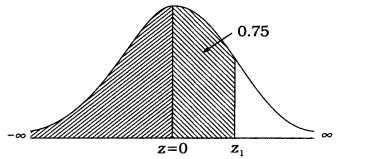
$ \text { Now, } z_1=\frac{x_1-62.12}{17.28}$
$ \therefore 0.675=\frac{x_1-62.12}{17.28}$
$\therefore 0.675 \times 17.28=\mathrm{x}_1-62.12$
$ \therefore 11.664+62.12=\mathrm{x}_1$
$ \therefore \mathrm{x}_1=73.78$
Hence, the result of $75 \%$ of student is less than $73.78$ percentage. View full question & answer→Question 115 Marks
The monthly income of a group of persons follows normal distribution with mean ? $20000$ and standard deviation $5000.$ If the minimum monthly income of $50$ richest person is Rs $31625$, then how many persons are in the group? Also, what Is the maximum Income of $50$ persons having lowest monthly income ?
AnswerHence, $µ = 20000; σ = 5000;$
$X =$ Monthly income
The minimum monthly income of $50$ persons having maximum income is ₹$ 31625.$
$∴ P[X ≥ 31625] = ?$
$\begin{equation}
\text { For } x_2=31625, z_2=\frac{31625-20000}{5000}=\frac{11625}{5000}=2.325 \approx 2.33
\end{equation}$
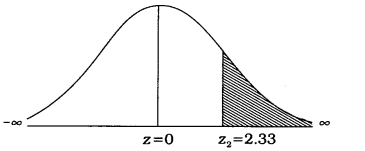
Now,
$
\begin{aligned}
& P\left[Z_2 \geq 2.33\right]=P[0 \leq Z<\infty]-P[0 \leq Z \leq 2.33] \\
& =0.5000-0.4901 \\
& =0.0099 \\
& \therefore \text { For area }=0.0099, \text { the number of persons }=50 \\
& \text { For area }=1.00, \text { the number of persons } \\
& =\frac{50}{0.0099} \\
& \approx 5051
\end{aligned}
$
Hence, the total number of persons in a group will be $5051 .$
Suppose, the maximum income of $50$ persons $=₹ x_1$
$
\begin{aligned}
& \therefore P\left[X \leq \mathrm{X}_1\right]=\frac{50}{5051} \approx 0.01 \\
& \text { For } \mathrm{X}_1, \mathrm{z}_1=\frac{x_1-20000}{5000}
\end{aligned}
$
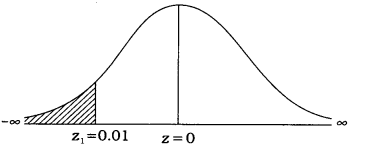
Now, $P[Z \leq z_1] = 0.01$
$\therefore P[z_1 \leq Z \leq 0] = P[- \infty < Z \leq 0] – P[Z \leq z_1]$
$= 0.5000 – 0.01$
$= 0.4900$
For area $0.4901 \approx 0.49, z_1=-2.33$
Now, $z_1=\frac{x_1-20000}{5000}$
$\therefore-2.33=\frac{x_1-20000}{5000}$
$\therefore-2.33 \times 5000=\mathrm{x}_1-20000$
$\therefore-11650=\mathrm{x}_1-20000$
$\therefore \mathrm{x}_1=20000-11650$
$\therefore \mathrm{x}_1=8350$
Hence, the maximum income of $50$ persons having lowest income obtained is $₹ 8350.$ View full question & answer→Question 125 Marks
An entrance test of $200$ marks is conducted for higher studies. $20,000$ students remain present in the examination and the marks obtained by them follows normal distribution with mean $120$ and standard deviation $20.$
The rules for the result are as under:
$(1)$ Students who acquire less than $40$ per cent marks are failed.
$(2)$ An additional test is conducted for the students acquiring marks between $40$ per cent and $48$ per cent.
$(3)$ Students who acquire marks between $48$ per cent and $75$ per cent are called for personal interview.
$(4)$ Students who acquire marks more than $75$ per cent get direct admission for the higher studies.Find approximate number of students who :
$(i)$ failed In test,
$(ii)$ appeared for additional $100$ marks test,
$(iii)$ appeared for personal interview and
$(iv)$ got direct admission for the higher studies.
AnswerHere, $Z = 20000: µ = 120; \sigma = 20;$
Total marks $= 200: X =$ Marks
$(1)$ Students acqire less than $40$ per cent of marks are failed:
$40$ per cent of 200 marks $=\frac{200 \times 40}{100}=80$ marks
$\therefore$ students acqire less than $80$ marks are failed.
$\therefore P[X \leq 80]= ?$
For $x_1=80$,
$z_1=\frac{x_1-\mu}{\sigma}=\frac{80-120}{20}=\frac{-40}{20}=-2$
$\therefore P[X \leq 80]=P[Z \leq-2]$
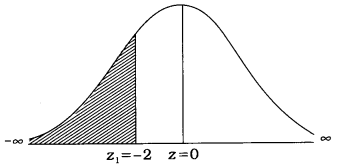
$P[Z \leq – 2] = P[- \infty < Z \leq 0] – P[- 2 \leq Z \leq 0]$
$= P[0 \leq Z < \infty ] – P[0 \leq Z \leq – 2]$
$= 0.5000 – 0.4772$
$= 0.0228$
Hence, the approximate number of students who fail N $P[Z \leq – 2]$
$= 20000 \times 0.0228$
$= 456$ students
$(2)$ An additional test is conducted for the students acquiring marks between $40$ per cent and $48$ per cent:
$40$ per cent of $200$ marks is $80$ marks and $48$ per cent of $200$ marks is $=\frac{200 \times 48}{100}=96$ marks
So, an additional test of 100 marks is conducted for the students acquiring marks between $80$ and $96 .$
$P[80 \leq X \leq 96]=?$
For $x_1=80$,
$Z_1=\frac{x_1-\mu}{\sigma}=\frac{80-120}{20}=\frac{40}{20}=-2$
For $x_2=96$,
$Z_2=\frac{x_2-\mu}{\sigma}=\frac{96-120}{20}=-\frac{24}{20}=-1.2$
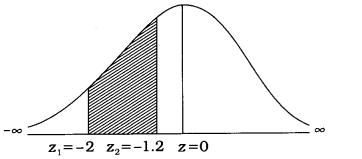
$\therefore P[z_1 \leq Z \leq z_2] = P[- 2 \leq Z \leq – 1.2]$
$= P[- 2 \leq Z \leq 0] – P[- 1.2 \leq Z \leq 0]$
$= P[0 \leq Z \leq 2] – P[0 \leq Z \leq 1.2]$
$= 0.4772 – 0.3849$
$= 0.0923$
Hence, the approximate number of students who appeared for the additional test of $100$ marks $= N∙P[- 2 \leq Z \leq – 1.2]$
$= 20000 \times 0.0923$
$= 1846$ students
$(3)$ Students who acqire marks between $48$ per cent to $75$ per cent are called for personal interview:
$48$ per cent of $200$ marks is $96$ and $75$ per cent of $200$ marks is $150$ marks.
So, the students who acquire marks between $96$ marks and $150$ marks are called for personal interview.
$P[96 \leq X \leq 150] = ?$
$z_1=-1.2 \text { and } z_2=\frac{x_2-\mu}{\sigma}=\frac{150-120}{20}=1.5$
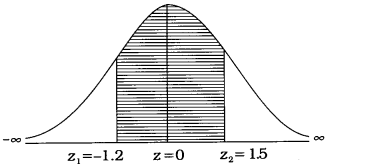
$P[96 \leq X \leq 150] = P[- 1.2 \leq Z \leq 1.5]$
$= P[- 1.2 \leq Z \leq 0] + P[0 \leq Z \leq 1.5]$
$= P[0 \leq Z \leq 1.2] + P[0 \leq Z \leq 1.5]$
$= 0.3849 + 0.4332 = 0.8181$
Hence, the approximate number of students who are called for personal interview
$= N∙P[- 1.2 \leq Z \leq 1.5]$
$= 20000 \times 0.8181$
$= 16362$ students
$(4)$ Students acquire more than $75$ per cent of marks are directly admitted for higher studies:
$75$ per cent marks of $200$ marks $=150$ marks
$\therefore P[X \geq 150] = ?$
$Z_1 = 1.5$
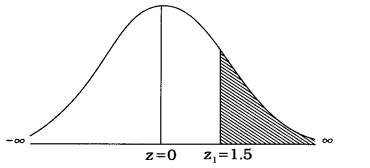
$\therefore P[X \geq 150] = P[Z \geq 1.5]$
$= P[0 \leq Z < \infty ] – P[0 \leq Z \leq 1.5]$
$= 0.5000 – 0.4332$
$= 0.0668$
Hence, the approximate number of students who are directly admitted for higher studies
$= N∙P[Z \geq 1.5]$
$= 20000 \times 0.0668$
$= 1336$ students View full question & answer→Question 135 Marks
Age of $500$ employees working in a private company follows normal distribution with mean $40$ years and standard deviation $6$ years. The company wants to reduce its staff by $25 \%$ in the following manner: $(1 )$ To retrench $5 \%$ of the employees having minimum age. $(2 )$ After retrenching $5 \%$ of employees having minimum age, next $10\%$ of the employees are to be transferred to another company. $(3 )$ To retire $10 \%$ of employees having maximum age. From this information, find the age of employees who are to be retrenched, transferred and retired from the company.
AnswerHere, $X = $ Age; $µ = 40; \sigma = 6$
$(1)$ To retrench $5 \%$ of the employees having minimum age.
Suppose, this age is $x_1$.
$\therefore P\left[X \leq \mathrm{X}_1\right]=\frac{5}{100}=0.05$
For $x_1, z_1=\frac{x_1-40}{6}$
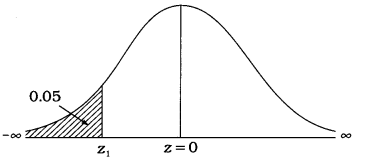
$P[Z \leq Z_1] = 0.05$
$\therefore P[0 \leq Z \leq z_1] = P[0 \leq Z < \infty ] – P[Z \leq z_1]$
$= 0.5000 – 0.05$
$= 0.4500$
For area $0.4495, z_1 = – 1.64$ and for area $0.4505, z_1 = – 1.65$
$\therefore $ For area $0.45,$
$z_1=\frac{(-1.64)+(-1.65)}{2}$
$ \text { Now, } z_1=\frac{x_1-40}{6}$
$ \therefore-1.645=\frac{x_1-40}{6}$
$ \therefore-1.645 \times 6=x_1-40$
$ \therefore-9.87=x_1-40$
$ \therefore 40-9.87=x_1=30.13$
$ \therefore x_1=30.13 \text { years }$
Hence, the minimum age of employees retrenched obtained is $30.13$ years.
$(2)$ After retrenchment next $10 \%$ of the employees to be transferred to another company:
Answer:
$5 \%$ of the employees having minimum age, is retrenched and next $10 \%$ of the employees are transferred to another company. Thus, total percentage of employees comes to $15 \%.$
$\therefore P\left[X \leq x_2\right]=\frac{15}{100}=0.05$
For $x_2, z_2=\frac{x_2-40}{6}$
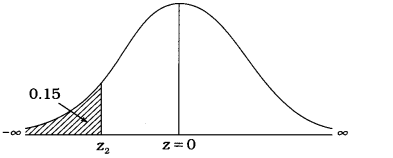
$P\left[Z \leq Z_2\right]=0.15$
$ \therefore P\left[0 \leq Z \leq z_2\right]=P[-\infty =0.5000-0.05$
$ =0.3500$
For area $0.3485, z_2=-1.03$ and for area $0.3508, z_2=-1.04$
$\therefore$ For area $0.35 ,$
$\mathrm{z}_2=\frac{(-1.03)+(-1.04)}{2}$
Now, $z_2=\frac{x_2-40}{6}$
$\therefore-1.035=\frac{x_2-40}{6}$
$ \therefore-1.035 \times 6=\mathrm{x}_2-40$
$ \therefore-6.21=\mathrm{x}_2-40$
$ \therefore 40-6.21=\mathrm{x}_2=33.79$
$ \therefore \mathrm{x}_2=30.13 \text { years }$
Hence, the age of the employees taking transfer to another companies obtained is $33.79$ years.
$(3)\ 10 \%$ of the employees having maximum age are retired:
$\therefore \mathrm{P}\left[\mathrm{X} \geq \mathrm{x}_1\right]=\frac{10}{100}=0.1$
For $x_1, z_1=\frac{x_2-40}{6}$
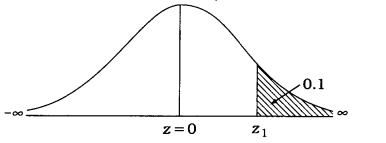
$P\left[Z \geq Z_1\right]=0.1$
$ \therefore P\left[0 \leq Z \leq z_1\right]=P[0 \leq Z<\infty]-P\left[Z \leq z_1\right]$
$ =0.5000-0.1000$
$ =0.4000$
For area $0.3997 \approx 40000, z_1=1.28$
Now, $z_1=\frac{x_1-40}{6}$
$\therefore 1.28=\frac{x_1-40}{6}$
$ \therefore 1.28 \times 6=\mathrm{x}_1-40$
$ \therefore 7.68=\mathrm{x}_1-40$
$ \therefore 7.68+40=\mathrm{x}_1$
$ \therefore \mathrm{x}_1=47.68 \text { years }$
Hence, the maximum age of $10 \%$ of employees who retire is obtained $47.68$ years. View full question & answer→Question 145 Marks
An Intelligence test is conducted for $500$ children and it is found that the average marks are $68$ and standard deviations is $22.$ If the marks obtained by the children is normally distributed, then $(1 )$ Find the number of children getting marks more than $68.\ (2 )$ Find the percentage of children getting marks between $70$ and $90.\ (3)$ Find the minimum score of most intelligent $50$ children.
AnswerHere, $N = 500; µ = 68; σ = 22$
$(1) $ Number of children getting marks more than $68 :$
$\text { For } x=68, z_1=\frac{x_1-\mu}{\sigma}=\frac{68-68}{22}=0$
$P[X \geq 68]=P\left[Z \geq z_1\right]=P[Z \geq 0]$
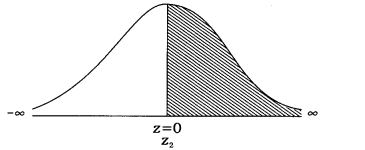
$P[Z ≥ 0] = 0.5$
Hence, the number of children getting marks more than $68$
$= N × P[Z ≥ 0]$
$= N × P[Z ≥ 0]$
$= 500 × 0.5$
$= 250$
$(2)$ Find the percentage of children getting marks between $70$ and $90 .$
For $x_1=70, z_1=\frac{70-68}{22}=\frac{2}{22}=\frac{1}{11}=0.09$
For $\mathrm{x}_2=90, \mathrm{z}_2=\frac{90-68}{22}=\frac{22}{22}=1$
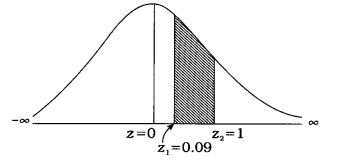
Now, $P[70 ≤ Z ≤ 90]$
$= P[0.091 ≤ Z ≤ 1]$
$= P[0 ≤ Z ≤ 1] – p[0 ≤ Z ≤ 0.09]$
$= 0.3413 – 0.0359$
$= 0.3054$
Hence, the percentage of children getting marks between $70$ and $90$
$= 0.3054 × 100$
$= 30.54%$
$(3)$ Minimum score of most Intelllgent $50$ children:
Suppose, minimum score of $50$ chlldren is $=x_1$
$\therefore \mathrm{P}\left(\mathrm{X} \geq \mathrm{x}_1\right]=\frac{50}{500}=0.1$
For $x_1, z_1=\frac{x_1-68}{22}$
$\therefore \mathrm{P}\left(\mathrm{Z} \geq \mathrm{Z}_1\right]=0.1$
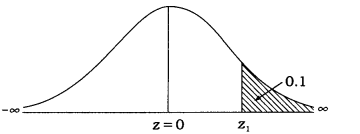
Now,
$P\left[0 \leq Z \leq z_1\right]=P[0 \leq Z<\infty]-P\left[Z \geq z_1\right]$
$ =0.5-0.1$
$ =0.4$
For area $0.3997 \approx 0.4, z_1=1.28$
Now, $\mathrm{z}_1=\frac{x_1-68}{22}$
$\therefore 1.28=\frac{x_1-68}{22}$
$ \therefore 1.28 \times 22=\mathrm{x}_1-68$
$ \therefore 28.16=\mathrm{x}_1-68$
$ \therefore \mathrm{x}_1=28.16+68$
$ \therefore \mathrm{x}_1=96.16$
$ \approx 96 \text { marks }$
Hence, the minimum score of most intelligent $50$ children is approximately $96$ marks. View full question & answer→Question 155 Marks
The distribution of the monthly wages of $1000$ employees is normal with the mean equal to $Rs.5000$ and the variance equal to $62,500.$ Find the range of the monthly wages of $80 \%$ of the employees located in the middle of the distribution.
Answer$Rs.4678.75$ to $Rs.5321.25$
View full question & answer→Question 165 Marks
The distribution of daily profit of a shopkeeper is normal. Its mean is $Rs.300$ and S.d. is $Rs.30.$ In how many days out of $365$ days of a year his daily profit will be less than $Rs.240?$ In how many days it will be found that his daily profit more than $Rs.330?$
Answer$8$ days, $58$ days
View full question & answer→Question 175 Marks
Torrent Power Limited supplies $500$ electric bulbs during a year in an area. The distribution of life of electric bulbs is normal. If the average life of electric bulbs is $1500$ hours and its variance is $62500,$ then how many electric bulbs will defuse in first $1000$ hours?
View full question & answer→Question 185 Marks
The distribution of monthly income of $2000$ persons of a group is normal. Its mean is $Rs.8000$ and S.d. is $400.$ What is the minimum monthly income of $20$ persons having maximum income?
View full question & answer→Question 195 Marks
The mean of daily income of members of a group is $625$ and its S.d. is ? $30.$ If the distribution of daily Income is normal, find $(1)$ the dafly income of the member whose daily income is more than the daily income of $40\%$ of employees and $(2)$ the percentage of members whose daily income is less than $Rs .700$
Answer$(1)\ Rs.617.35\ (2)\ $Approximate $99\%$
View full question & answer→Question 205 Marks
$3000$ students appeared at a test. The mean of their marks is $42$ marks and the standard deviation is $24$ marks. If the distribution of marks is normal, find the maximum marks of a student among $720$ students scoring least marks.
View full question & answer→Question 215 Marks
The mean and the standard deviation of daily wages of $5000$ employees are $Rs.45$ and $Rs.5$ respectively. If the distribution of daily wages is normal, $(1)$ find the maximum wages of an employee belonging to $25.78\%$ employees receiving least wages, $(2)$ find the minimum wages of an employee among $510$ employees receiving maximum wages.
Answer$(1)\ Rs.41.75\ (2)\ Rs.51.35$
View full question & answer→Question 225 Marks
A group of $700$ workers has normal distribution of monthly income. Mean of distribution $= Rs.700$ and Standard deviation $= Rs.20\ (1)$ Find the maximum Income of a worker belonging to $10\%$ of the workers having least income. $(2)$ Find the range of monthly income for the middlemost $70\%$ of the workers.
Answer$(1)\ Rs.674.30\ (2)\ Rs.679.30$ to $Rs.720.70$
View full question & answer→Question 235 Marks
The frequency distribution of marks obtained by $5000$ students in the examination of the subject Statistics out of $100$ marks is normal. Its mean $=60$ marks and $S.d. = 10$ marks. If $(1)$ at least $36\%$ of marks Is required to pass. $(2)$ for second class the marks required are between is required for distinction, find the number of students who fail, placed in pass class, second class, first class and in distinction.
AnswerFail : $41$ students, $(1)$ Pass class : $535$ students, $(2)$ Second class: $1924$ students, $(3)$ First class: $1707$ students, $(4)$ Distinction: $793$ students.
View full question & answer→Question 245 Marks
The frequency distribution of marks obtained by $10000$ students of Third B.Com. of a university in the examination of $70$ marks for the subject Statistics is normal. Its mean $= 30$ marks and standard deviation $= 10$ marks. Find the estimated number of students scoring less than $25$ marks.
View full question & answer→Question 255 Marks
$1000$ students appeared at a test. The mean and standard deviation of the marks scored by the students are $42$ and $24$ respectively. Under the assumption that the distribution of marks is normal, $(1 )$ Find the number of students scoring between $20$ marks and $40$ marks. $(2 )$ Find the number of students scoring more than $60$ marks.
Answer$(1)\ 289$ students $(2)\ 227$ students
View full question & answer→Question 265 Marks
The distribution of the salary of a group of employees is normal. The mean of the distribution Is $Rs.500$ and the standard deviation is $Rs.50.\ (1 )$ Find the percentage of employees whose salary lies between $550$ and $650.\ (2 )$ Find the probability that the salary of an employee is greater than $600.\ (3 )$ Find the probability that the salary of an employee Is less than $Rs.450.$
Answer$(1)\ 15.74\%\ (2)\ 0.0228\ (3)\ 0.1587$
View full question & answer→Question 275 Marks
For the data of a frequency distribution, mean $= 50$ and standard deviation $= 10.$ If the distribution of the data is normal, then $(1)$ Find the probability that an observation of the data lies between $40$ and $60.\ (3 )$ Find the probability that an observation of the data is smaller than $35.\ (2 )$ What percentage of observations are greater than $55?$
Answer$(1)\ 0.6826\ (2)\ 30.85\%\ (3)\ 0.0668$
View full question & answer→Question 285 Marks
The distribution of height of $500$ students of a group is normal. The height of $15.87\%$ of students is more than $165 \ cm$ and the height of $30.85\%$ of students is more than $160 \ cm.$ Find the mean height of the students and the standard deviation of height. How many students have height less than $150 \ cm?$
AnswerAverage height $= 155 \ cm, S. d. = 10 \ cm, 33$ students
View full question & answer→Question 295 Marks
The distribution of monthly income of persons of a certain group is normal. If the monthly income of $30.5\%$ of persons is less than $Rs.4500$ and the monthly income of $6.55\%$ of persons is less than $4000,$ find the mean and the standard deviation of the monthly income of the persons of that group. Determine the interval for monthly income of exactly middle $95\%$ persons.
AnswerAverage Income $Rs.4755, S. d. = Rs.500,$ Interval: $Rs.3755$ to $Rs.5735$
View full question & answer→Question 305 Marks
The probability density function of a normal variable of $X$ of distribution is as under: $f(x)=\frac{5}{\sqrt{8 \pi}} e^{-\frac{-25(2-90)^{2}}{8}},-\infty < x < \infty$
For the variable $X$, obtain the estimated limits which include middle $99.73 \%$ of the observations.
View full question & answer→Question 315 Marks
D is a standard normal variate. From the following probability find the values of $z: $
$(1)P \left[0 \leq Z \leq z_{1}\right]=0.3554 $
$(2) P\left[z_{1} \leq Z \leq 0\right]=0.4671 $
$(3) P\left[0 \leq Z \leq z_{1}\right]=0.3100$
$(4) P\left[z_{1} \leq Z \leq 0\right]=0.4700 $
$(5) P\left[Z \geq z_{1}\right]=0.40 $
$(6) P\left[Z \geq z_{1}\right]=0.0401 $
$(7) P\left[Z \leq z_{1}\right]=0.27 $
$(8) P\left[Z \leq z_{1}\right]=0.1660 $
$(9) P\left[Z \leq z_{1}\right)=0.9406 $
$(10) P\left[Z \geq z_{1}\right]=0.8708 $
$(11) P\left[z_{1} \leq Z \leq z_{2}\right]=0.1218$
$(12) P\left[z_{1} \leq Z \leq z_{2}\right]=0.1970$ and $z_{1}=1.1$ and $z_{2}=2.7$
Answer$(1)\ 1.06\ (2)\ -1.84\ (3)\ 0.875\ (4)\ - 1.885\ (5)\ 0.255\ (6)\ 1.75\ (7)\ -0.615\ (8)\ -0.97$$(9)\ 1.56\ (10)\ -1.13\ (11)\ 2.2\ (12)\ 0.84$
View full question & answer→Question 325 Marks
A normal variable $X$ has following probability density function: $f(x)=$ constant. $e^{-\frac{1}{200}(x-50)^{2}} ;-\infty < x < \infty$ From this distribution, answer the following questions: $(1)$ Find median. $(2)$ Find estimated values of the extreme quartiles. $(3)$ Find approximate value of quartile deviation. $(4)$ Find approximate value of mean deviation.
Answer$(1)\ 50\ (2)\ 43.25,56.75\ (3)\ 6.67\ (4)\ 8$
View full question & answer→