Questions · Page 1 of 3

2 Marks Questions

🎯

Test yourself on this topic

50 questions · timed · auto-graded

Question 12 Marks
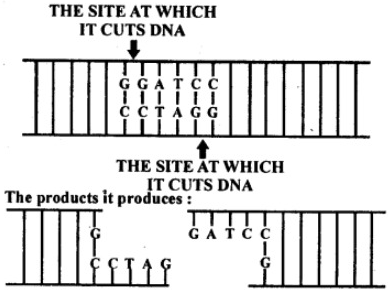
Make a chart (with diagrammatic representation) showing a restriction enzyme, the substrate DNA on which it acts, the site at which it cuts DNA and the product it produces.
Answer
Name of the Restriction enzyme-Bam HI.
The substrate DNA on which it acts-
View full question & answer
Question 22 Marks
Explain briefly:
PCR
Answer
PCR = Polymerase chain reaction (in vitro method) is a molecular biological technique for enzymatically replicating DNA without using a living organism, such as E. coli or yeast.
3 steps in PCR are-
  1. Denaturation of desired double strand DNA-to ssDNA
  2. Annealing of primer to ssDNA (single standard).
  3. Extension of primer by Taq DNA polymerase isolated form Thermits aquaticus.
Uses- Amplification of desired gene/ gene cloning.

Advantage- More output, greater efficiency, less error prone, less human interference and cyclic and automated.
View full question & answer
Question 32 Marks
Discuss with your teacher and find out how to distinguish between:
Plasmid DNA and Chromosomal DNA
Answer
Plasmid DNA and Chromosomal DNA
Plasmid DNA is an extra-chromosomal DNA molecule in bacteria that is capable of replicating, independent of chromosomal DNA.
Chromosomal DNA is the entire DNA of an organism present inside chromosomes.
View full question & answer
Question 42 Marks
Describe briefly the following:
Bioreactors
Answer
Bioreactors: Bioreactors are vessels in which raw materials are biologically converted into specific products, individual enzymes etc. using microbial plant, animal or human cells. A bioreactor provides the optimal conditions for achieving the desired product by providing optimum growth conditions (temperature, pH, substrate, salts, vitamins, oxygen). The most commonly used bioreactors are of stirring type. A biogas plant is a good example of a bioreactor.
View full question & answer
Question 52 Marks
Describe briefly the following:
Downstream processing
Answer
Downstream processing: After completion of the biosynthetic stage, the product is subjected through a series of processes before it is ready for marketing as a finished product. The processes include separation and purification, which are collectively referred to as downstream processing. The product has to be formulated with suitable preservatives. Such formulation has to undergo thorough clinical trials as in the case of drugs. Strict quality control testing for each product is also required. Downstream processing and quality control testing vary from product to product.
View full question & answer
Question 62 Marks
From what you have learnt, can you tell whether enzymes are bigger or DNA is bigger in molecular size? How did you know?
Answer
Enzymes are smaller in size than DNA molecules. This is because DNA contains genetic information for the development and functioning of all living organisms. It contains instructions for the synthesis of proteins and DNA molecules. while, enzymes are proteins which are synthesized from a small strend of DNA known as 'genes', which are involved in the formatoin of the polypeptide chain.
View full question & answer
Question 72 Marks
Describe briefly the following:
Origin of replication
Answer
Origin of replication (ori): This is a sequence from where replication starts and any piece of DNA when linked to this sequence can be made to replicate within the host cells. This sequence is also responsible for controlling the copy number of the linked DNA. So, if one wants to recover many copies of the target DNA it should be cloned in a vector whose origin supports a high copy number.
View full question & answer
Question 82 Marks
Collect 5 examples of palindromic DNA sequences by consulting your teacher. Better try to create a palindromic sequence by following base-pair rules.
Answer
Some palindromic DNA sequences and the restriction enzymes which act on them are:
  1. 5'- AGCT-3' Alul (Arthrobacter luteus) 3'-TCGA-5'
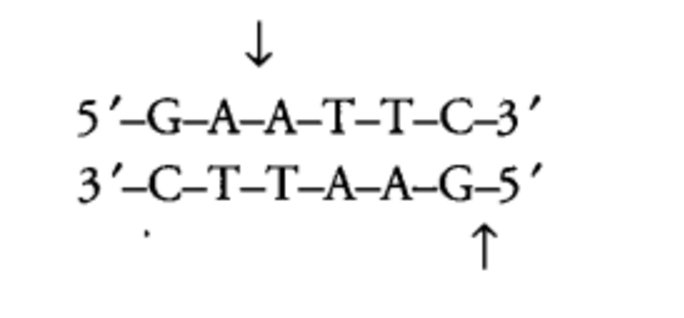
  2. 5'-GAATTC-3' EcoRI (Escherichia colt) 3'-CTTAAG-5'
  3. 5'-AAGCTT-3' Hindlll (Haemophilus influenzae) 3'-TTCGAA-5'
  4. 5'-GTCGAC-3' Sall (Streptomyces albus) 3'-CAGCTG-5'
  5. 5'-CTGCAG-3' Pstl (Providencia stuartif] 3'-GACGTC-5'
View full question & answer
Question 92 Marks
What would be the molar concentration of human DNA in a human cell? Consult your teacher.
Answer
The average molecular weight of a nucleotide in human DNA is 130.86. The molecular weight of human DNA will therefore be $6 × 10^9$ nucleotides (based on the human genome project)$ × 130.86 = 784.56 × 10⁹$ gm/mol. The molar concentration of DNA can be calculated accordingly.
View full question & answer
Question 102 Marks
Explain briefly:
Chitinase
Answer
Chitinase- Chitinase is a enzyme to digest or breakdown glycosidic bonds in chitin cell wall of fungal cell to facilitate its transformation.
View full question & answer
Question 112 Marks
Do eukaryotic cells have restriction endonucleases? Justify your answer.
Answer
No, eukaryotic cells do not have restriction endonuclease because DNA molecules of eukaryotes are heavily methylated. All the restriction endonucleases have been isolated from various strain of bacteria.
View full question & answer
Question 122 Marks
Discuss with your teacher and find out how to distinguish between:
RNA and DNA
Answer
RNA and DNA
RNA is a single stranded molecule.
DNA is a double stranded molecule.
It contains ribose sugar.
It contains deoxyribose sugar.
The pyrimidines in RNA are adenine and uracil.
The pyrimidines in DNA are adenine and thymine.
RNA cannot replicate itself.
DNA molecules have the ability to replicate.
It is a component of the ribosomes.
It is a component of the chromosomes.
View full question & answer
Question 132 Marks
Discuss with your teacher and find out how to distinguish between:
Exonuclease and Endonuclease
Answer
Exonuclease and Endonuclease
It is a type of restriction enzyme that removes the nucleotide from 5' or 3' ends of the DNA molecule.
It is a type of restriction enzyme that makes a cut within the DNA at a specific site to generate sticky ends.
View full question & answer
Question 142 Marks
Explain briefly:
Restriction enzymes and DNA
Answer
Restriction enzymes and DNA- Restriction enzymes is a group of enzymes used to cleave or cut DNA strands each having a characteristics base sequence at which it cleaves.
  1. lt restricts foreign DNA from entering normal cell by digesting it at various recognition site. Recognition site is palindromic.
  2. They are endonuclease and exonuclease both types.
  3. They produces sticky ends. Cleavage site and recognition site are different from each other. Restriction enzymes therefore are believed to be a mechanism evolved by bacteria to resist viral attack and to help in the removal of viral sequences.
View full question & answer
Question 152 Marks
How does a restriction nuclease function? Explain.
Answer
Restriction nuclease cut DNA at specific sites exonuclease cuts DNA at the ends, endonuclease cuts at specific position within DNA./Restriction endonuclease cuts the DNA at specific pallindromic sequence.
View full question & answer
Question 162 Marks
Name the source of the DNA polymerase used in PCR technique. Mention why it is used.
Answer
The most commonly used matrix is agarose which is natural polymer extracted from sea weeds. The DNA fragments separate according to their size through sieving effect provided by the agarose gel.
View full question & answer
Question 172 Marks
Write any four ways used to introduce a desired DNA segment into a bacterial cell in recombinant technology experiments.
Answer
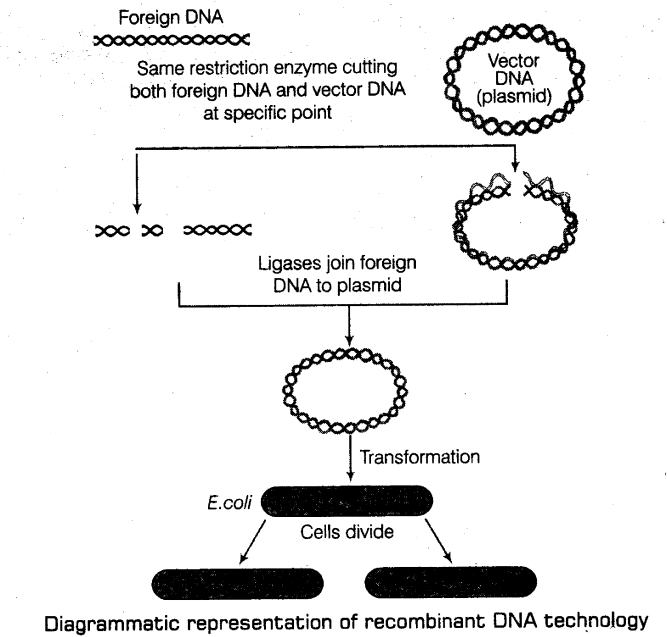
Recombinant DNA technology involves the steps are:
Restriction enzymes, polymerare enzymes, ligases, vectors, and the host organisms.
  1. Isolation of DNA.
  2. Fragmentation of DNA by restriction endonucleases.
  3. Isolation of the desired DNA fragment.
  4. Amplification of the gene of interest.
  5. Ligation of the DNA fragment into a vector using DNA ligase.
  6. Transfer of becombinant DNA into the host.
  7. Culturing the host cells on a suitable medium on a large scale.
  8. Extraction of the desired product.
  9. Downstream processing of the product as a finished product ready for marketing.
View full question & answer
Question 182 Marks
  1. A recombinant vector with a gene of interest inserted within the gene of $\alpha$ -galactosidase enzyme is introduced into a bacterium. Explain the method that would help in selection of recombinant colonies from non-recombinant ones.
  2. Why is this method of selection referred to as “insertional inactivation”?
Answer
  1. Bacteria is grown in a medium with chromogenic substrate, colonies formed show blue colour no recombinants, no blue colour-presence of recombinants.
  2. Gene for the enzyme is inactivated by insertion.
View full question & answer
Question 192 Marks
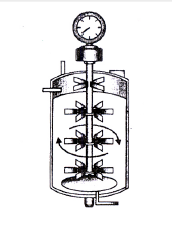
Name the type of bioreactor shown.Write the purpose for which it is used.
Answer
Simple stirred tank bioreactor,
Large scale production of recombinant protein/Raw materials are biologically converted into specific products or enzymes, using microbial plants/animals/human cells.
View full question & answer
Question 202 Marks
  1. Mention the number of primers required in each cycle of polymerase chain reaction (PCR). Write the role of primers and DNA polymerase in PCR.
  2. Give the characteristic feature and source organism of the DNA polymerase used in PCR.
Answer
  1. 2 sets of primers, DNA polymerisation/extends the primers using the nucleotides.
  2. Thermostable/remain active during high temperature induced denaturation of DNA, Thermus aquaticus.
View full question & answer
Question 212 Marks
How is DNA isolated in purified form from a bacterial cell?
Answer
Lysozyme added to remove the cell wall; Ribonuclease added to remove RNAs; Proteases added to remove proteins, chilled ethanol added to precipitate DNA.
View full question & answer
Question 222 Marks
What are recombinant proteins? How do bioreactors help in their production?
Answer
Any protein produced by genetically altered gene in a host.Bioreactors can be thought of as vessels in which raw materials are biologically converted into specific products// A bioreactor provides the optimal conditions for achieving the desired product by providing optimum growth conditions (temperature, pH, substrate, salts, vitamins, oxygen).
View full question & answer
Question 232 Marks
How can DNA segments, separated by gel electrophoresis, be visualised and isolated?
Answer
Visualised by staining the DNA fragments with ethidium bromide, exposing them to UV radiation (Appear as bright orange bands).Bands are cut out from agarose gel, extracted from gel piece.
View full question & answer
Question 242 Marks
  1. Name the nematode that infests and damages tobacco roots.
  2. How are transgenic tobacco plants produce to solve this problem?
Answer
  1. Meloidegyne incognita.
  2. Nematode specific genes isolated cloned and introduced into tobacco plants, ds RNA are produced and RNAi interference initiated, mRNA translation silenced, survival of the nematode not possible in the host plant.
View full question & answer
Question 252 Marks
Explain with the help of a suitable example the naming of a restriction endonuclease.
Answer
EcoRI.
Eco stands for the genus and species of the prokaryotic cell from which the enzyme was isolated, i.e. E.coli.
R stands for strain.
‘I’ follows order in which enzyme was isolated.
View full question & answer
Question 262 Marks
How are ‘sticky ends’ formed on a DNA strand? Why are they so called?
Answer
Restriction enzymes cut the strands of the DNA, a little away from the centre of the palindromic sites, but between the same two bases on opposite strands.
They form hydrogen bonds with their complementary cut counterparts.
View full question & answer
Question 272 Marks
Write the role of 'Ori' and 'restriction’ site in a cloning vector pBR322.
Answer
Ori- Site where replication starts, responsible for controlling copy number.
Restriction site- Site of ligation of alien/foreign DNA, in one of the two antibiotic resistance site/coding sequence of galactosidase.
View full question & answer
Question 282 Marks
Expand the following and mention one application of each:
  1. PCR.
  2. ELISA.
Answer
  1. PCR: Polymerase chain reaction
  1. PCR is used to alter a particular template sequence for production of newer and desired "DNA by getting sample number of DNA copies.
  2. PCR is also used for DNA sequencing. It can be used to detect naturally occurring mutations.
  3. It is used in DNA finger printing technique.
  1. ELISA {Enzyme-Linked Immuno-sorbant Assay) is an immune chemical test.
  1. It is useful in the early diagnosis of diseases using antigen–antibody interactions
  2. Used in food industry when detecting potential food allergens.
View full question & answer
Question 292 Marks
Name two commonly used bioreactors. State the importance of using a bioreactor.
Answer
The two most commonly used bioreactors are simple stirred-tank bioreactor. The importance of using bioreactors is as follows:
  1. It provides large volume for cultures. Thus, products are obtained in high quantity.
  2. It provides optimal like temperatures and pH for growth of desired product.
View full question & answer
Question 302 Marks
  1. Mention the difference in the mode of action of exonuclease and endonuclease.
  2. How does restriction endonuclease function?
Answer
  1. Exonucleases remove nucleotides from the ends of the DNA, whereas Endonucleases make cuts at specific positions within the DNA.
  2. Each restriction endonuclease inspects the DNA molecule in search of a specific recognition sequence. When it gets its specific recognition sequence, it binds to the site and cuts each of the two strands of the double helix at specific points by hydrolysing the phosphodiester backbones.
View full question & answer
Question 312 Marks
  1. State the role of DNA ligase in biotechnology.
Answer
Linking of DNA fragment is done by DNA ligase/linking of Okazaki fragments or discontinuous synthesis fragments/linking of desired genewith plasmid to form recombinant DNA.
View full question & answer
Question 322 Marks
Explain the work carried out by Cohen and Boyer that contributed immensely in biotechnology.
Answer
Cohen and Boyer isolated the antibiotic resistant gene, from the plasmid of a bacterium that was resistant to the antibiotic drug, and then linked this gene with the plasmid of Salmonella typhimurium, construction of artificial recombinant DNA molecule.
View full question & answer
Question 332 Marks
List the key tools used in recombinant DNA technology.
Answer
Restriction enzymes/Polymerase enzymes/Ligase enzymes/Vectors/Host organizms/E.coli/Agrobacterium.
View full question & answer
Question 342 Marks
Why is the introduction of genetically engineered lymphocytes into an ADA deficiency patient not a permanent cure? Suggest a possible permanent cure.
Answer
Lymphocytes not immortal/short lived, hence patient requires periodic infusion of such genetically engineered lymphocytes, however if a gene producing ADA is isolated from marrow cells, and introduced into the cells at early embryonic stages it could be a permanent cure.
View full question & answer
Question 352 Marks
Explain the contribution of Thermus aquaticus in the amplification of a gene of interest.
Answer
Thermus aquaticus produces a thermostable, DNA polymerase, when DNA is denatured at high temperature, this enzyme remains active.
View full question & answer
Question 362 Marks
Describe the responsibility of GEAC, set up by the Indian Government.
Answer
(Genetic Engineering Approval Committee) GEAC checks the validity of genetic engineering research and checks the safety of introducing any GMO (genetically modified organisms) because sometimes the GMO results could be unpredictable.
View full question & answer
Question 372 Marks

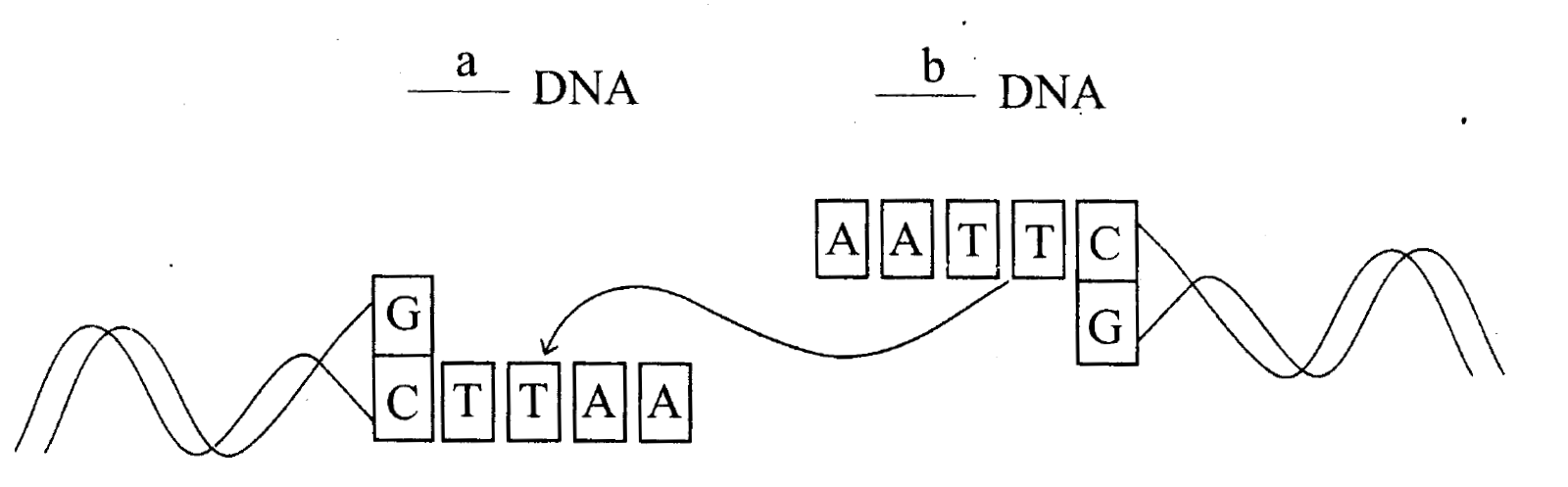
Study the linking of DNA fragments shown above.
  1. Name ‘a’ DNA ‘b’ DNA.
  2. Name the restriction enzyme that recognises this palindrome.
  3. Name the enzyme that can link these two DNA fragments.
Answer
  1. ‘a’ - Vector DNA, ‘b’ - Foreign DNA.
  2. - EcoRI.
  3. - DNA ligase.
View full question & answer
Question 382 Marks
  1. What is a plasmid?
  2. What is meant by ADA deficiency? How is gene therapy a solution to this problem? Why is it not a permanent cure?
Answer
  1. Plasmid is an autonomously replicating circular extra chromosomal DNA of a bacterium.
  2. Adenosine deaminase deficiency, ADA cDNA IS Introduced into these lymphocytes, subsequently returned to the patient Cell could now produce ADA, deficiency overcome, Because these genetically engineered lymphocytes are not immortal.
View full question & answer
Question 392 Marks
  1. Mention the role of vectors in recombinant DNA technology. Give any two example.
  2. With the help of diagrammatic representation only, show the steps of recombinant DNA technology.
Answer
  1. To deliver alien/foreign/desired piece of DNA into the host organism,so that the foreign gene can be amplified,
Example - Plasmids, Viruses.

View full question & answer
Question 402 Marks
How is a continuous culture system maintained in bioreactors and why?
Answer
For maintaining continuous culture system in bioreactors, they are continuously and regularly fed with the growth culture medium steadily, maintaining the appropriate temperature, pressure, pH and other parameters within the bioreactors. From the other end of the bioreactor, finished product generated as a result of microbial action is continuously or periodically withdrawn in specified amounts.
Continuous culture system is maintained in bioreactors because the cells can be maintained in a constant physiological state which ensures continuous and regular outflow of desired products from the bioreactor.
View full question & answer
Question 412 Marks
How is DNA isolated in purified form from a bacterial cell?
OR
List the four steps to isolate DNA from a bacterium.
Answer
  • The bacterial cells are treated with lysozyme, to remove the cell wall.
  • The proteins associated with the DNA are removed by treatment with proteases and the associated RNAs are removed by treatment with RNases.
  • Similarly other molecules (if any) are removed by appropriate treatments.
  • The purified DNA is precipitated by the addition of chilled ethanol.
View full question & answer
Question 422 Marks

Study the linking of DNA fragments shown above.

  1. Name 'a' DNA and 'b' DNA.
  2. Name the restriction enzyme that recognizes this palindrome.
  3. Name the enzyme that can link these two DNA fragments.
Answer
  1. a- Vector/ plasmid DNA.
b- Foreign DNA.
  1. EcoRI.
  2. DNA ligase.
View full question & answer
Question 432 Marks
Explain gene cloning.
Answer
This ability to multiply and to produce multiple copies of antibiotic resistance gene E. coli was called cloning of antibiotic resistance gene.
View full question & answer
Question 442 Marks
How are the DNA fragments separated by gel electrophoresis visualised and separated for use in constructing recombinant DNA.
Answer
A compound called Ethidium Bromide (EtBr) stains DNA, which on exposure with ultraviolet radiations gives orange light. Hence, DNA fragments appear as orange bands.
View full question & answer
Question 452 Marks
How and why is the bacterium Thermus aquaticus employed in DNA technology? Explain.
Or
Name the source of the DNA polymerase used in PCR technique. Mention why it is used?

Or
Give the name of the organism from where the thermostable DNA polymerase is isolated. State its role in genetic engineering.
Answer
Bacterium Thermus aquaticus is a source of enzyme tag polymerase, As it is a thermostable enzyme and work at high temperature, it is used to amplify DNA in vitro by PCR. The amplified fragment of desired DNA can be used to ligate with the vector for further cloning
View full question & answer
Question 462 Marks
What modification is done in the Ti plasmid of Agrobacterium tumefaciens to convert it into a cloning vector?
Answer
T-DNA is the only essential part required to make Ti plasmid a cloning vector. The plasmid is disarmed by deleting the tumour inducing genes in the plasmid so that it becomes an effective cloning vector and remove it harmful effect.
View full question & answer
Question 472 Marks
Illustrate briefly downstream processing.
Answer
Downstream processing:
  • All the processes to which a product is subjected to before being marketed as a finished product are called downstream processing.
  • It includes:
  1. Separation of the product from the reactor.
  2. Purification of the product.
  3. Formulation of the product with suitable preservatives.
  4. Quality control testing and clinical trials in case of drugs.
View full question & answer
Question 482 Marks
While doing a PCR, ‘denaturation’ step is missed. What will be its effect on the process?
Answer
If denaturation of double-stranded DNA does not take place, then primers will not be able to anneal to the template, no extension will take place, hence no amplification will occur.
View full question & answer
Question 492 Marks
Do biomolecules (DNA, protein) exhibit biological activity in anhydrous conditions?
Answer
Biomolecules do not exhibit biological activity in anhydrous conditions. DNA may get damaged under anhydrous condition but has the ability to repair later on. Protein molecule may get denatured under anhydrous conditions.
View full question & answer
Question 502 Marks
Explain giving reasons why an alien piece of DNA needs to be integrated to a specific sequence of host DNA for its cloning.
Answer
  • The specific DNA sequence, where the replication of DNA is initiated, is called origin of replication (Ori).
  • For the multiplication of the alien DNA in the host, it has to be integrated to the origin of replication (Ori).
View full question & answer
2 Marks Questions - BIOLOGY STD 12 Science Questions - Vidyadip