Question 14 Marks
Give an account of energy flow in an ecosystem.
Answer
View full question & answer→→ Sun is the only source of energy for all ecosystems on Earth, except for the deep sea hydro-thermal ecosystem.
→ Of the incident solar radiation less than 50 per cent of it is photosynthetically active radiation (PAR).
→ We know that plants and photosynthetic bacteria (autotrophs), fix Sun's radiant energy to make food from simple inorganic materials.
→ Plants capture only 2-10 per cent of the PAR and this small amount of energy sustains the entire living world.
→ So, it is very important to know how the solar energy captured by plants flows through different organisms of an ecosystem.
→ All organisms are dependent for their food on producers, either directly or indirectly.
→ The flow of energy from the sun to producers and then to consumer is unidirectional.
→ In ecosystem, flow of energy follows two important principles.
→ According to the first law of Thermodynamics, energy can neither be destroyed nor can it be created. Thus the quantum of energy is constant. Energy can be converted from one form into another.
→ According to the second law 'whenever energy is converted from one form into another, some energy is dissipated in the form of heat'.
→ Producers can only convert solar energy in to chemical energy.
→ They need a constant supply of energy to synthesise the molecules they require, to counter act the universal tendency toward increasing disorderliness.
→ The green plant in the ecosystem are called producers. In a terrestrial ecosystem, major producers are herbaceous and woody plants. Likewise, producers in an aquatic ecosystem are various species like phytoplankton, algae and higher plants.
→ The chain or web is formed because of this interdependency. The energy trapped by the producer, hence, is either passed on to a consumer at different trophic levels.
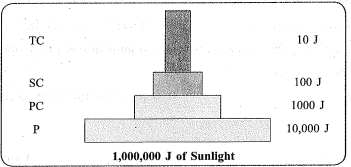
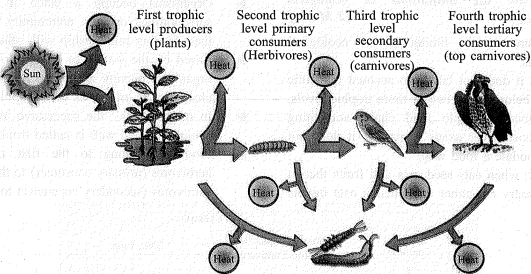
→ During conversation of energy in trophic levels, certain amount of energy is lost as a heat.
→ Of the incident solar radiation less than 50 per cent of it is photosynthetically active radiation (PAR).
→ We know that plants and photosynthetic bacteria (autotrophs), fix Sun's radiant energy to make food from simple inorganic materials.
→ Plants capture only 2-10 per cent of the PAR and this small amount of energy sustains the entire living world.
→ So, it is very important to know how the solar energy captured by plants flows through different organisms of an ecosystem.
→ All organisms are dependent for their food on producers, either directly or indirectly.
→ The flow of energy from the sun to producers and then to consumer is unidirectional.
→ In ecosystem, flow of energy follows two important principles.
→ According to the first law of Thermodynamics, energy can neither be destroyed nor can it be created. Thus the quantum of energy is constant. Energy can be converted from one form into another.
→ According to the second law 'whenever energy is converted from one form into another, some energy is dissipated in the form of heat'.
→ Producers can only convert solar energy in to chemical energy.
→ They need a constant supply of energy to synthesise the molecules they require, to counter act the universal tendency toward increasing disorderliness.
→ The green plant in the ecosystem are called producers. In a terrestrial ecosystem, major producers are herbaceous and woody plants. Likewise, producers in an aquatic ecosystem are various species like phytoplankton, algae and higher plants.
→ The chain or web is formed because of this interdependency. The energy trapped by the producer, hence, is either passed on to a consumer at different trophic levels.
→ During conversation of energy in trophic levels, certain amount of energy is lost as a heat.