Question
Differentiate between following.

Answer

(a) Grazing food chain and Detritus food chain
Grazing food chainDetritus food chain
It starts from green plants-producers which are placed at first trophic level.It starts with the decomposers which degrade detritus like dead animals or fallen leaves etc.
In this food chain energy is obtained directly from sun light.In this food chain energy is derived from the decomposition of detritus material.
It is controlled by higher organisms.This is controlled by microbes.
The rate of energy flow is less.The rate of energy flow is high.
(b) Production and Decomposition
ProductionDecomposition
The food which is produced in the form of organic matter by producers is called production.Organic matter is decomposed by decomposers is called decomposition.
It depends on the photosynthesis of plants.It depends on the rate of decomposition by decomposers.
e.g. Plantse.g bacteria, fungi, earthworm
(c) Upright pyramid and Inverted pyramid
Upright pyramidInverted pyramid
In this type of pyramid, the number, biomass, energy level and productivity is higher which decreases in successive trophic level.In this type of pyramid, the number, biomass and productivity is less but at other trophic level increases.
Pyramid of energy is always upright.Pyramid of number and biomass can be inverted. e.g. dessert and polar region
At the base of pyramid there is always producers.At the base of this pyramid, the producers numbers are less.
(d) Food chain and Food web
Food chainFood web
It is the linear sequence of organisms.It forms by linkage of many food chain.
Energy flow can be easily understood.To understand energy flow is complex.
Organisms from higher trophic level only consumes one organism.One organism has many options for food.
It has simple structure.It is more complex structure.
(e) Litter and Detritus
LitterDetritus
Litter contains bio-degradable and non bio degradable things.Detritus contains only degradable matter.
e.g. leaves, metal, plastic things.Dead body or organs of organism.
(f) Primary productivity and Secondary productivity
Primary productivitySecondary productivity
Primary production is defined as the amount of biomass or organic matter produced per unit area over a time period by plants during photosynthesis.Secondary productivity is defined as the rate of formation of new organic matter by consumers.
It depends upon green plants.It depends upon heterotrophs
It has two types: gross primary productivity and net primary productivityIt has no types.
It is in a large amount.It is in a small amount.

Need a full question paper?

Generate a complete, print-ready paper with questions like this in minutes — across 16+ boards, with answer keys.
Start Generating Free

Similar questions

Read the following and answer any four questions from (i) to (v) given below:
Excessive exploitation of species, whether a plant or animal reduces the size of its population so it becomes vulnerable to extinction. Such as Dodo and passenger pigeon have become extinct due to over exploitation by humans. Thus the world is facing accelerated rates of species extinctions, largely due to human interference.
  1. Which of the following cause of biodiversity loss is not included in evil quartet?
  1. Coextinction.
  2. Pollution.
  3. Alien species invasion.
  4. Habitat loss and fragmentation.
  1. Identify the species that have become extinct due to over exploitation.
  1. Stellar sea cow.
  2. Yucca moth.
  3. Blatta orientalis.
  4. Nile Perch.
  1. Factors which make species susceptible to extinction are:
  1. Large population size.
  2. Lack of genetic variability.
  3. Ower status of trophic level.
  4. Ability to switch over to ahem ate foods.
  1. Assertion: Pollution reduces species biodiversity.
Reason: Spill over of oil in sea causes death of several marine animals.
  1. Both assertion and reason are true and reason is the correct explanation of assertion.
  2. Both assertion and reason are true but reason is not the correct explanation of assertion.
  3. Assertion is true but reason is false.
  4. Both assertion and reason are false.
  1. ________ is the first major cause of species extinction.
  1. Coextinction.
  2. Over exploitation.
  3. Habitat destruction.
  4. Alien species invasion.
Read the following and answer any four questions from (i) to (v) given below:
A 23 year old Sahil has been diagnosed with an infection of reproductive tract caused by bacteria. He complains about burning sensation during urination, pus-containing discharge and pain around genitalia. This infection has incubation period of 2-5 days but can be cured.
  1. From which disease is Sahil suffering?
  1. Chlamydiasis.
  2. Herpes.
  3. Gonorrhoea.
  4. Syphilis.
  1. Which among the following reproductive tract infections is transmitted by bacteria?
  1. Trichomoniasis.
  2. Chancroid.
  3. Genital warts.
  4. Both (a) and (b).
  1. Which mode of treatment would be useful for Sahil?
  1. Cryosurgery.
  2. Use of Podophyllum preparation.
  3. Use of antibiotic ampicillin.
  4. It cannot be treated.
  1. What technique was used to diagnose Sahil's disease?
  1. Gram staining of discharge and culture.
  2. ELISA Test.
  3. Antibody detection.
  4. Antigen test.
  1. Find the odd one out.
  1. Treponema pallidum.
  2. Neisseria gonorrhoeae.
  3. Haernophilus ducreyi.
  4. Trichomonas vaginalis.
Read the following and answer any four questions from (i) to (v) given below:
Embryo develops at the micropylar end of the embryo sac, where the zygote is situated. Most zygotes divided only after certain amount of endosperm is formed. The early stages of embryo development are similar in both monocotyledons and dicotyledons. The zygote gives rise to the proembryo and subsequently to the globular heart-shaped and mature embryo. A typical dicotyledonous embryo consists of an embryonal axis and two cotyledons. Embryo of monocotyledons possess only one cotyledon.
  1. True embryo develops as a result of fusion of:
  1. Two polar nuclei of embryo sac.
  2. An egg cell and a male gamete.
  3. Synergid and male gamete.
  4. A male gamete and antipodals.
  1. Refer to the given diagram of the embryo of an angiospermous plant with parts labelled P, Q and R. Select the correct statement(s) regarding this.
  1. Part 'P' supplies nutrition to the developing embryo.
  2. Part 'Q' is the protective sheath of radicle and root cap.
  3. Part 'R' is the protective sheath of shoot apex and leaf primordia.
  4. The embryo shown in the diagram is present in members of Family Poaceae.
  1. (IV) only.
  2. (II) and (III) only.
  3. (I) and (IV) only.
  4. (I), (II), (III) and (IV).
  1. Which of the given statements are true?
  1. During the development of a dicot embryo, heart-shaped embryo is followed by globular embryo.
  2. The part of embryonal axis above the level of cotyledons is epicotyl, while the part below the level of cotyledons is hypocotyl.
  3. Monocot seeds possess a single cotyledon, represented by scutellum.
  1. (I) and (II).
  2. (II) and (III).
  3. (I) and (III).
  4. (I), (II) and (III).
  1. Consider the following parts of an embryonal axis of a dicot seed.
  1. Hypocotyl.
  2. Epicotyl.
  3. Radicle.
  4. Plumule.
In which of the following the above parts are correctly arranged from top to base?
  1. (III) → (I) → (II) → (IV).
  2. (II) → (I) → (III) → (IV).
  3. (IV) → (II) → (I) → (III).
  4. (III) → (IV) → (II) → (I).
  1. In grass family, the cotyledon, is called:
  1. Epiblast.
  2. Plumule.
  3. Scutellum.
  4. Perisperm.
How is a transgenic tobacco plant protected against Meloidogyne incognita? Explain the procedure.
Read the following and answer any four questions from (i) to (v) given below:
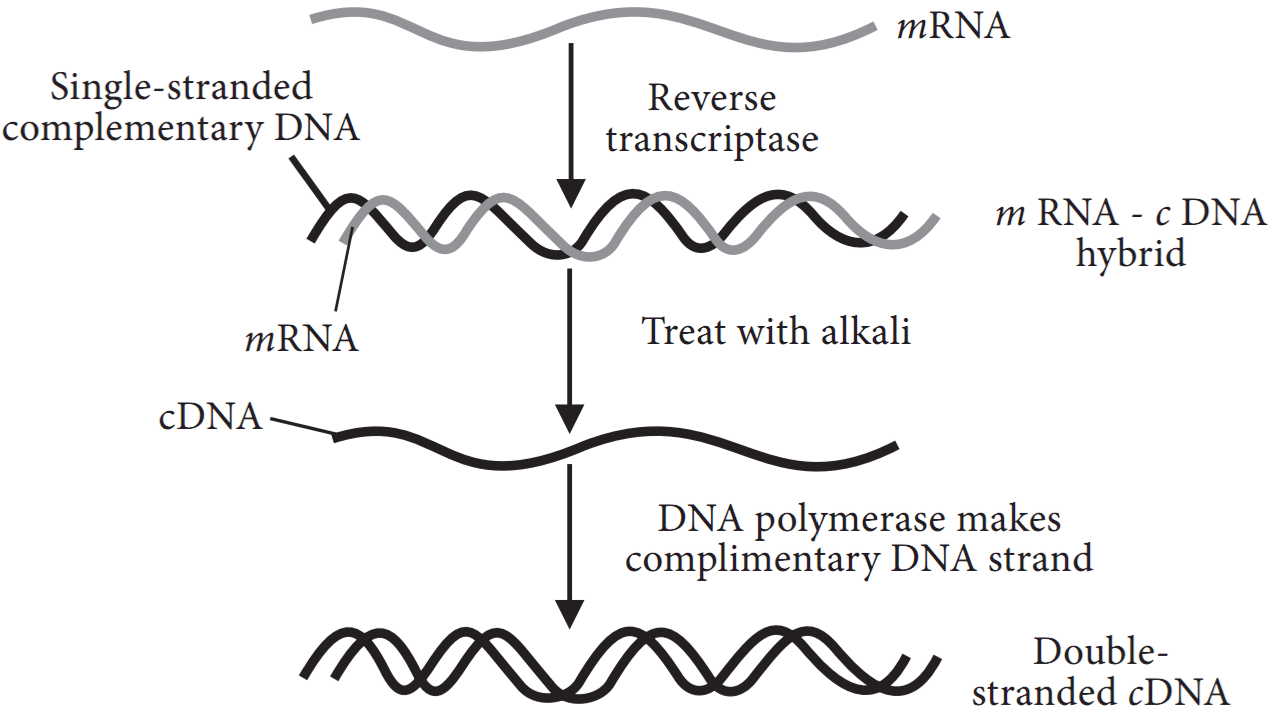
The DNA, which is transferred from one organism into another by joining it with the vehicle DNA is called passenger or foreign DNA. Generally three types of passenger DNAs are used. These are complementary DNA (cDNA), synthetic DNA (sDNA) and random DNA. Complementary DNA (cDNA) is synthesized on RNA template (usually mRNA) with the help of reverse transcriptase. Synthetic DNA (sDNA) is synthesized on DNA template or without a template. Random DNA are small fragments fanned by breaking a chromosome of an organism in the presence of restriction endonucleases.
  1. Reverse transcriptase enzyme was discovered by:
  1. Temin and Baltimore.
  2. Cohen and Boyer.
  3. Arber and Nathan.
  4. Paul Berg.
  1. During cDNA formation, what would happen if DNA formed by reverse transcriptase is not treated with the alkali?
  1. cDNA will not be digested.
  2. mRNA will not be digested.
  3. Hydrogen bonds will not form between base pairs.
  4. rnRNA will not be formed.
  1. Enzyme that helps in the formation of double stranded cDNA is:
  1. DNA synthetase
  2. Ligase
  3. DNA polymerase
  4. Helicase.
  1. DNA polymerase can be obtained form:
  1. Retrovirus.
  2. Agrobacteriurn.
  3. Tobacco mosaic virus.
  4. Thermus aquaticus.
  1. DNA synthesised without a template is referred to as:
  1. Complementary DNA.
  2. Random DNA.
  3. Synthetic DNA.
  4. Z-DNA..
Explain exponential growth equation with well labeled diagram.###Explain exponential growth.
Read the following and answer any four questions from (i) to (v) given below:
RNA or ribonucleic acid is a single chain polyribonucleotide which functions as carrier of coded genetic or hereditary information from DNA to cytoplasm for taking part in protein and enzyme synthesis. Six types of RNAs are ribosomal, transfer, messenger, genomic, small nuclear and small cytoplasmic RNA. Out of these, rRNA, mRNA and tRNA are major classes of RNAs that are involved in gene expression.
  1. Which one is referred to a soluble RNA?
  1. mRNA
  2. tRNA
  3. rRNA
  4. hnRNA
  1. The RNA that picks up specific amino acid from amino acid pool in the cytoplasm to ribosome during protein synthesis is?
  1. rRNA
  2. hnRNA
  3. mRNA
  4. tRNA
  1. Which of the following is found in both DNA and messenger RNA?
  1. Double helix structure
  2. Ribose
  3. Sugar-phosphate chain
  4. Thymine
  1. Which of the following statements regarding RNA is correct?
  1. Messenger RN As carries coded information for synthesis of polypeptide.
  2. Ribosomal RNAs bind with tRNA to catalyse the formation of phosphodiester bonds.
  3. Genomic RNA is always single stranded.
  4. Synthesis of rRNA occurs in cytoplasm by RNA polymerase III
  1. In studying a virus, you find the following proportions of nitrogenous bases present: adenine 23%, guanine 37%, cytosine 23% uracil 17%. Which of the following statement(s) regarding this virus is/are correct?
  1. It probably uses RNA as its genetic material.
  2. The genetic material of this virus is probably single stranded.
  3. Base pairing rules in virus in this virus include adenine: cytosine.
  1. I only
  2. I and II only
  3. II and III only
  4. All of these.
Explain Mutualism as a population interaction with suitable examples.###Explain Mutualism with examples
For food related services, granting patent for transgenic organisms is becoming complicated. Explain with example.
Read the following text carefully and answer the questions that follow:
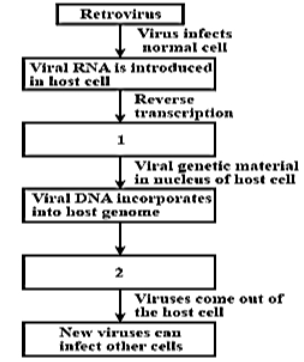
The diagram shows the replication of the retrovirus in the host.
Image

i. Fill in the missing data in boxes labelled 1 & 2. (1)
ii. Why is it named as retrovirus? (1)
iii. While the virus is being replicated and released, does the infected cell survive and why the virus infected cells prevent spreading of virus to healthy cells? (2)
OR
What is the effect of HIV infection on immune system? (2)