Questions

2 Marks Questions

Take a timed test

17 questions · self-marked practice — reveal the answer and mark yourself.

Question 12 Marks
When mammals took over the earth write the character and continental drift of the mammals of that time?
Answer
→ The first mammals were like shrews.
→ Their fossils are small sized. Mammals were viviparous and protected their unborn young inside the mother's body.
→ Mammals were more intelligent in sensing and avoiding danger at least.
→ When reptiles came down mammals took over this earth.
→ There were in South America mammals resembling horse, hippopotamus, bear, rabbit, etc. Due to continental drift, when South America joined North America, these animals were overridden by North American fauna.
→ Due to the same continental drift pouched mammals of Australia survived because of lack of competition from any other mammal.
View full question & answer
Question 22 Marks
Can we call human evolution as adaptive radiation ?
Answer
→ Human evolution can be referred to as adaptive radiation because adaptive radiation is an evolutionary process which gives rise to new species from a single common ancestor.
→ But in the case of human evolution, although we share a common ancestor, we humans have undergone an eventual but progressive alteration in the eating preferences, structure of body etc.
→ The evolution of humans does not include diversification and radiating into different species, which in fact, is a distinguishing feature of adaptive radiation.
View full question & answer
Question 32 Marks
Match Ten modern animals with their ancient fossils using internet resources. Name both.
Answer
Modern Animals Fossils
1.Modern Humans (Homo Sapiens)1.Chromogonon man
2.A horse2.Eohippus
3.Amphibians3.Dinosaurs
4.Elephant4.Labyrinthiodont
5.Whales5.Poebrotherium
6.Arthritis (Strokes etc.)6.Mauritherium
7.Bird7.Protocytes
8.The camel8.Trilobites
View full question & answer
Question 42 Marks
Find out through the internet and popular science articles whether animals other than man have self-consciousness.
Answer
→ Apart from humans, there are many other animals that possess self-consciousness.
→ One such example is the Dolphin.
→ They are believed to have a high level of intelligence. Also, they have a sense of self and can identify themselves amongst others. They whistle, tail-slap and exhibit body movements to communicate with each other. → Some other animals that exhibit self- consciousness are parrots, crows, gorillas, orangutans, chimpanzees etc.
View full question & answer
Question 52 Marks
Find the developmental stages of an animal by using various resources like school library or internet and discuss with your teacher.
Answer
→ During the Eocene period, the horse evolved from Eohippus.
→ Eohippus - Mesohippus - Marichippus - Pliohippus - Iccus
→ Changes during development:
→ Gradual increase in height (28 cm to 150 cm)
→ Gradual reduction in fingers (4 to 1)
→ Increase in length of head and neck
→ Increase in length of anterior and posterior appendages
→ Brain and sensory organs developed
View full question & answer
Question 62 Marks
Explain antibiotic resistance observed in bacteria in light of Darwinian selection theory.p
Answer
→ When a colony of bacteria is grown in agar culture medium supplemented with tetracycline antibiotics, the tetracycline-sensitive colonies die.
→ Darwinian selection theory suggests that the environment selects organisms with useful variation over those which do not have useful variations.
→ It is mainly because, in a dynamic environment, these organisms are better adapted to survive.
→ A well-defined example for Darwin's theory is antibiotic resistance in bacteria.
→ When bacteria were grown on tetracycline containing agar medium, all the bacteria died. However, the ones having variations conferring tetracycline resistance survived. Later, these bacteria multiplied and increased their number.
→ As a result of this, tetracycline-resistant bacteria evolved and survived because of the environment that selected these over the others.
View full question & answer
Question 72 Marks
For the $MN-$blood group system, the frequencies of $M$ and $N$ alleles are $0.7$ and $0.3,$ respectively. The expected frequency of $MN-$blood group bearing organisms is likely to be:
Answer
$(p + q)^2 = p^2 + 2pq + q^2$
Where; $M = p$ and $N = q$
So, $(p+q)^2 = p^2 + 2pq + q^2$
$= (0.7)^2 + 2(0.7)(0.3) + (0.3)^2$
$= 0.49 \ MM +0.42 \ MN+ 0.09 \ NN$
Thus, in this equation the value of $2pq$ is $0.42$ or $42\%.$
View full question & answer
Question 82 Marks
Explain the factors affecting the Hardy- Weinberg equilibrium.
Answer
→ When any part of the population (members) migrates to another part of population, the gene frequency of the original and the new population changes. New genes / alternative factors are added to the new population and removed from the old population.
(1) Genetic Drift: If such migratory changes are acquired by chance, it is called genetic drift.
(2) Mutation:
→ Pre-existing beneficial mutations result in species formation.
(3) Genetic Recombination :
→ Generation meanwhile happening recombination is effective.
(4) Gene Flow (Gene migration):
→ If gene migration occurs frequently, it is called genetic flow.
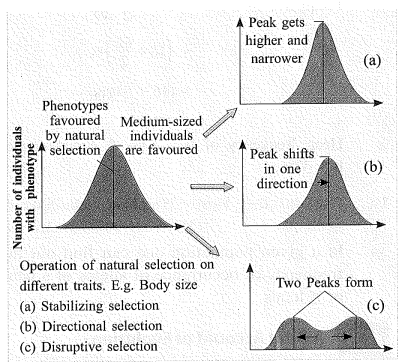
(5) Natural selection: It is 3 types.
→ Stabilizing selection: Here, more individuals acquire mean character value and variation is reduced.
→ Directional selection: Individuals of one extreme (value other than mean character value) are more favoured.
→ Disruptive selection: Individuals of both extremes (peripheral character value at both ends of the distribution curve) are more favoured.
Image
View full question & answer
Question 92 Marks
Give information about the theories of Hugo-de-Vries.
Answer
→Hugo-de-Vries's theory is called Mutation theory. New traits i.e.
→ new variation in traits suddenly comes into existence is called accidental variation (mutation).
→ Once a mutation is created, it becomes permanent immediately. It means that it continues to appear thereafter.
→ In the first decade of the 20th century, Hugo-de-Vries worked on evening primrose (Oenothera lamarckiana) plants to disfigure.
→ Here it is presented the idea that mutation means a sudden big difference in the population.
→He believed that mutation is the main cause for development.
→ According to him mutation is random and non-directional.
→ According to Darwin, variation is small and directional.
View full question & answer
Question 102 Marks
State the views of Thomas Malthus on natural selection.
Answer
→ Natural resources are finite, their size is constant except for seasonal variations.
→ Members of a population, though outwardly similar, show differences in characteristics.
→ Most of the variations are hereditary.
→ If this is the reality and if every organism reproduces at the maximum rate then theoretically the population will grow like explosives and it is equally true that realistically the population size is limited.
→ It means that there is competition for resources.
→ Some were able to survive and thrive at the expense of others, while some could not be promoted.
View full question & answer
Question 112 Marks
State the Lamarck's observation on biological evolution.
Answer
→ Lamarck's theory is "Theory of Inheritance of Acquired Traits".
→ Naturalist Lamarck said that, living forms evolved, they evolved organs, but they were communicated through the use and disuse of those organs.
→ Development of organs is created and maintained in organisms under environmental pressure.
→ Lamarck gave the example of giraffe.
→ Giraffes adapted by lengthening their necks to reach edible leaves of tall trees.
→ This acquired trait of long neck was inherited in its subsequent generations.
→ Over the years the giraffe gradually acquired a long neck.
→ In this way, the characteristics acquired by the organism are inherited by its offspring.
→ In this way the development of the trait increases or decreases from generation to generation.
View full question & answer
Question 122 Marks
Write a note on fossil evidence. State the method by which age of fossils is calculated.
Answer
→ Evidence of the emergence and development of life on earth is obtained from many directions.
→ Fossils are the hard parts of life forms in rocks.
→ Rocks, sediments and layers of the Earth's layers indicate the layering of organic elements over Earth's long history.
→ Sedimentary rocks of different ages contain fossils of different life forms that must have died out during the formation of these particular rocks.
→ Some of them show similarities with modern organisms. They represent extinct organisms.
→ This study shows that life-forms change with time. And some life-forms do not change for certain planetary periods.
→ Therefore, new life-forms have come into existence at different times in the history of the earth.
→ All this is called fossil evidence.
The age of fossils can be known by the method of radioactivity-dating.
View full question & answer
Question 132 Marks
Explain the embryological basis of development.
Answer
→ Ernst Haeckel gave the embryological basis of development.
→ Based on his observation some traits are common in all lineages during the embryonic stage, but absent in the adult organism.
→ For example, in the embryos of all vertebrates including humans, there is a row of vestigial folds behind the head, but it is only functional in fish, not in other adult vertebrates.
→ However, the proposed embryological basis of this development was rejected in a careful study by Karl Ernst von Baer.
→ He noted that embryos sometimes do not pass through the adult stages of other animals.
View full question & answer
Question 142 Marks
What are homologons organs? Explain with example.
Answer
→ The organs of animals which have similar internal structure but different functions are called homologous organs.
→ For example whales, bats, leopards and humans (all mammals) have similarities in the internal structure of the forelimbs.
→ In the forelimbs of all these animals there are humerus, metatarsals, posterior metatarsals and ankles.
→ In these animals, organs with the same structure developed, but they were adapted in different directions and according to their needs. This is the evolution of divergence.
→ This structure is homologous.
→ Equivalence indicates common ancestors.
→ Other examples are the hearts and brains of vertebrates.
→ Thorn and tendrils of Bougainvillae and cucurbita represents homology.
View full question & answer
Question 152 Marks
Explain divergent & convergent evolution with example.
Answer
→ Divergent evolution:
→ Organisms which have the same structure (formation) have developed, but are adapted in different directions and according to their different needs is known as divergent development.
→ This structure is called equivalent or structure similar.
→ Equivalence indicates common ancestors.
Example:
(1) Vertebrate Heart and Brain
(2) In plants, the thorn of Bougainvillae and Cucurbita represents homology.
(3) Whales, bats, leopards and humans have similarities in the bones of the forelimbs.
→ Convergent evolution:
→ Organisms in which the vision of the internal structure is not the same, but are adapted to perform the same function, such development is called convergent evolution.
→ These structures are also called functional structures.
Example:
(1) The wing of a butterfly and a bird look the same. But they are not anatomically similar.
(2) Eye of Octopus and Mammals
(3) Flippers of penguins and dolphins
(4) Roots of sweet potatoes and tubers of potatoes.
View full question & answer
Question 162 Marks
State three possibilities for evolution of living forms according to specific creationism?
Answer
→ Traditional religious literature informs us of a particular creationism.
(1) According to the first possibility, all organisms seen today must have originated in this form.
(2) According to second possibility, the same biodiversity as it was at the time of origin will also be in the future.
(3) A third possibility is that the earth is about 4000 years old.
View full question & answer
Question 172 Marks
State the opinion of Russian scientist Operin and English scientist Haldane about the origin of first life.
Answer
→ The opinion of Russian scientist Operin and English scientist Haldane is as follows:
→ First life must have come from pre-existing non-living organic molecules (RNA, proteins etc.).
→ The structure of life must have been formed after chemical evolution, i.e. organic matter must have come into existence by the aggregation of inorganic molecules.
→ These substances must have been transformed into a colloidal system to produce life.
→ At that time the conditions on earth were very high temperature, volcanic storms, degenerate type of atmosphere which contained water, methane, ammonium etc.
→ The next step in molecular evolution was the creation of molecules.
View full question & answer