Questions

Case study (4 Marks)

🎯

Test yourself on this topic

5 questions · timed · auto-graded

Question 14 Marks
Microbes can be used to decrease the use of chemical fertilizers and pesticides. Explain how this can be accomplished.###How biofertilizers increase fertility of soil?
Answer
→ Due to our present day life styles, environmental pollution is a major cause of concern.
→ The use of chemical fertilizers to meet the ever-increasing demand of agricultural produce has contributed significantly to this pollution.
→ There are problems associated with the overuse of chemical fertilizers and there is a large pressure to switch to organic farming the use of biofertilizers.
→ Biofertilizers are organisms that enrich the nutrient quality of the soil.
→ The main sources of biofertilizers are bacteria, fungi and cyanobacteria.
→ The nodules on the roots of leguminous plants are formed by the symbiotic association of Rhizobium.
→ These bacteria fix atmospheric nitrogen into organic forms, which is used by the plant as nutrient.
→ Other bacteria can fix atmospheric nitrogen while free-living in the soil Azospirillum and Azotobacter, enriching the nitrogen content of the soil.
→ Fungi are also known to form symbiotic associations with plants(mycorrhiza).
→ Many members of the genus Glomus form mycorrhiza.
→ The fungal symbiont in these associations absorbs phosphorus from soil and passes it to the plant.
→ In paddy fields, cyanobacteria serve as an important biofertilizer.
→ Currently, in our country, a number of biofertilizers are available commercially in the market and farmers use these regularly in their fields to replenish soil nutrients and to reduce dependence on chemical fertilizers.
→ In agriculture, there is a method of controlling pests that relies on natural predation rather than introduced chemicals.
→ The use of biocontrol measures will greatly reduce our dependence on toxic chemicals and pesticides.
→ A biological control being developed for use in the treatment of plant disease is the fungus Trichoderma. Trichoderma species are free-living fungi.
→ Trichoderma is a biocontrol agent of several plant pathogens.
View full question & answer
Question 24 Marks
Bacteria cannot be seen with the naked eyes, but these can be seen with the help of a microscope. If you have to carry a sample from your home to your biology laboratory to demonstrate the presence of microbes with the help of a microscope, which sample would you carry and why?
Answer
→ Curd can be used as a sample for the study of microbes. Curd contains numerous lactic acid bacteria (LAB) or Lactobacillus. These bacteria produce acids that coagulate and digest milk proteins. A small drop of curd is carried to the biology laboratory because it contains contains multitude of bacteria, which can be easily observed under a microscope which are of various shapes and sizes.
View full question & answer
Question 34 Marks
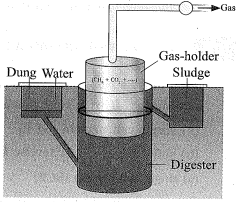
Explain structure and working of biogas plant with diagram.
Answer

Image
→ 10-15 feet deep concrete tank is prepared for biogas plant.
→ This tank is fed by collected bio-waste and a slurry.
→ A floating cover is placed over the slurry.
→ Due to microbial activity (Methanogens) this slurry keeps rising as the gas is produced.
→ The biogas plant has an outlet.
→ This is connected to a pipe to supply biogas to nearby houses.
→ The spent slurry is removed through another outlet and may be used for as a fertiliser.
→ The biogas plants are more often built in rural areas.
→ The biogas thus produced is used for cooking and lighting.
→ In biogas plant, bacteria produce a mixture of gases from biogas such as carbon dioxide, methane and hydrogen.
→ These bacteria are collectively called as methanobacterium.
View full question & answer
Question 44 Marks
What is sewage? Describe secondary treatment (biological treatment) in Sewage Treatment plant.
Answer
→ Large quantities of waste water are generated everyday in cities and towns. A major component of this waste water is human excreta. This municipal waste water is also called sewage
→ It contains large amounts of organic matter and microbes, many of which are pathogenic.
→ This cannot be discharged into natural water bodies like rivers and streams directly.
→ Before disposal, hence, sewage is treated in Sewage Treatment Plant (STPs) to make it less polluting.
→ Treatment of waste water is done by heterotrophic microbes naturally present in the sewage.
→ There are two stages of the process:
(1) Primary treatment
(2) Secondary treatment (biological treatment)
→ The following sequential treatment is done in secondary treatment.
→ The primary effluent is passed into large aeration tanks, Where it is constantly agitated mechanically and air is pumped into it.
→ This allows vigorous growth of useful aerabic microbes into flocs (masses of bacterial associated with fungal filaments to form mesh like structures).
→ While growing, these microbes consume the major part of the organic matter in the effluent.
→ This results in significant reduction of the BOD (Biochemical Oxygen Demand) of the effluent.
→ The greater the BOD of waste water, the more is its polluting potential.
→ Once the BOD of sewage or waste water is reduced significantly, the effluent is then passed into a settling tank.
→ Where bacterial 'flocs' are allowed to sediment. This sediment is called activated sludge.
→ A small part of the activated sludge is pumped back into the aeration tank to serve as the inoculum.
→ The remaining major part of the sludge is pumped into large tanks called anaerobic sludge digesters.
→ Here, other kinds of bacteria, which grow anaerobically, digest the bacteria and the fungi in the sludge.
→ During this digestion, bacteria produce a mixture of gases from biogas such as carbon dioxide, methane and hydrogen. These gases from biogas and can be used as source of energy as it is inflammable.
View full question & answer
Question 54 Marks
Microbes are useful in household products. Explain this with suitable examples
Answer
We use microbes. Our products are derived from them everyday.
(1) Curd: LABs are lactic acid bacteria.
→ They grow in milk and convert it to curd.
→ During growth, the LAB produce acids that coagulate and partially digest the milk proteins.
→ A small amount of a curd added to the fresh milk as inoculum or starter contain millions of LAB, which at suitable temperatures multiply, thus converting milk to curd.
→ LAB improves milk quality by increasing vitamin B12.
→ In our stomach too, the LAB play very beneficial role in checking diseases causing microbes.
2. Cheese:
→ Cheese is an edible substance. Microbes are used at different stages of cheese. making.
→ Different varieties of cheese are known by their characteristic texture, flavour and taste which is given by specific microbes used in the cheese production.
→ The large holes in "swiss cheese" are due to production of a large amount of carbon dioxide by a bacterium named Propionibacterium sharmanii.
→ The "Roquefort cheese" are ripened by growing a specific fungi on them, which gives them a particular flavour.
3. Batter:
→ The batter of dosa and idli is fermented by using bacteria. This batter looks puffed because of the production of carbon dioxide.
→ The dough, which is used for making bread, is fermented using saccharomyses cerevisiae- baker's yeast.
4. Toddy:
→ Some traditional drink and food is also produced by the help of microbes through fermentation.
→ In South India, traditional drink toddy is made by fermenting sap from palms.
5. Other food items:
→ To produce different food items fish, soyabean, bamboo etc. are passed through fermentation.
View full question & answer
Case study (4 Marks) - BIOLOGY STD 12 Science Questions - Vidyadip