Question types

MODEL PAPER 10 question types

38 questions across 6 question groups — pick any mix to generate a BIOLOGY paper with step-by-step answer keys.

38
Questions
6
Question groups
5
Question types
Sample Questions

MODEL PAPER 10 questions

One sample from each question group in this chapter. Select any group above to see the full set with answer keys.

An interesting property of restriction enzymes is molecular cutting and pasting. Restriction enzymes typically recognize a symmetrical sequence of DNA.
Image
Notice that the top strand is same as the bottom strand, but reads backward. When the enzyme cuts the strand between G and A, it leaves overhanging chains:
  • A
    Jointed end
  • B
    Both sticky & blunt ends
  • C
    Sticky ends
  • D
    Blunt ends
View full solution
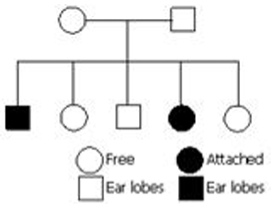
Given below is a pedigree chart of a family with five children. It shows the inheritance of attached ear lobes as opposed to the free ones. The squares represent the male individuals and circles the female individuals. Which one of the following conclusions drawn is correct?
Image
  • A
    The parents are homozygous recessive
  • B
    The parents are heterozygous
  • C
    The trait is Y-linked
  • D
    The parents are homozygous dominant
View full solution
In a particular climatic condition, decomposition rate is slower if:
  • A
    Detritus is rich in sugars.
  • B
    Detritus is rich in lignin and chitin.
  • C
    Detritus is rich in humus
  • D
    Detritus is rich in nitrogen.
View full solution
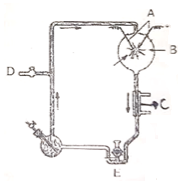
The diagram represents miller's experiment. Choose the correct combination of labelling.
Image
  • A
    $A-$electrodes, $B-NH_3 + H_2O, C-$hot water, $D-$tap, $E-U$ trap
  • B
    $A-$electrodes, $B-NH_4 + H_2 + CO_2 +CH_3, C -$hot water, $D-$vacuum, $E-U$ trap
  • $A-$electrodes, $B-NH_3 + H_2 + H_2O+CH_2, C- $cold water, $D-$vacuum, $E-U$ trap
  • D
    $A-$electrodes, $B-NH_3 + H_2 + H_2O+CH_4, C-$ steam, $D-$vacuum, $E-U$ trap

Answer: C.

View full solution
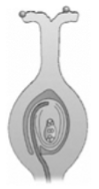
In the diagram given below, show the path of a pollen tube from the pollen on the stigma into the embryo sac.
Name the components of egg apparatus.
Image
View full solution
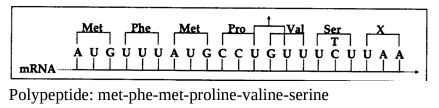
Read the sequence of the nucleotides in the given segment of mRNA and the respective amino acid sequence in the polypeptide chain.
Image
i. Provide the triplet of bases (codon) for
a. valine
b. proline
ii. Write the nucleotide sequence of the DNA strand from which this mRNA was transcribed
iii. What does the last codon of this RNA stand for?
View full solution
Q 123 Marks Question3 Marks
Prabha has seen huge garbage dumps outside your school which are not being regularly disposed of by MCD. Prabha discusses the problems with school mates and decide to organize rally to spread awareness among local people about public hygiene.
→ Prepare two slogans for rally
→ Name any two infectious diseases which may spread due to such unhygienic conditions at public place
View full solution
Q 133 Marks Question3 Marks
i. Why is the collection of white-winged moths and dark-winged moths made in England between 1850-1920 considered a good example of natural selection?
ii. Evolution is based on chance events in nature and chance mutations in organisms. Justify the statement.
View full solution
Q 143 Marks Question3 Marks
A species-area curve is drawn by plotting the number of species against the area. How is it that when a very large area is considered the slope is steeper than that for smaller areas?
View full solution
Q 153 Marks Question3 Marks
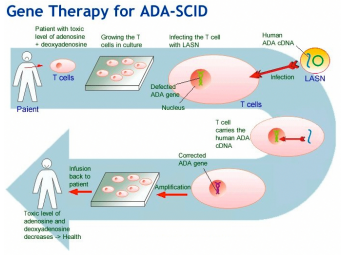
This image highlights the process of Gene Therapy of ADA-SCID.
Image
i. Mention the cause of ADA deficiency in humans.
ii. How has genetic engineering helped patients suffering from it?
View full solution
For the selection of recombinants, insertional inactivation of the antibiotic marker has been superseded by insertional inactivation of a marker gene coding for a chromogenic substrate. Give reasons.
View full solution
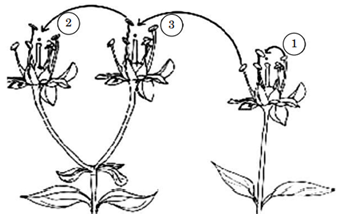
Study the diagram given below showing the modes of pollination. Answer the questions that follow.
Image
i. The given diagram shows three methods of pollen transfer in plants. What are the technical terms used for pollen transfer methods 1, 2 and 3?
ii. How do the following plants achieve pollination successfully?
1. Water lily
2. Vallisneria
iii. Flowering plants have developed many devices to avoid inbreeding depression. Explain one hereditary and one physiological device which helps plants to achieve this target.
View full solution
Recombinant DNA (rDNA) is a technology that uses enzymes to cut and paste together DNA sequences of interest. The recombined DNA sequences can be placed into vehicles called vectors that ferry the DNA into a suitable host cell where it can be copied or expressed.
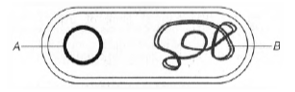
i. A bacterial cell is shown in the figure given below. Label the part 'A' and 'B'. Also, mention the use of part A in rDNA technology.
Image
ii. Suppose a linear DNA fragment and a plasmid has three restriction sites for EcoRI. How many fragments will be produced from linear DNA and plasmid, respectively?
View full solution
Assertion: Gene flow increases genetic variations.
Reason : The random introduction of new alleles into the recipient population and their removal from the donor population affects allele frequency.
  • A
    Assertion and reason both are correct statements and reason is correct explanation for assertion.
  • B
    Assertion and reason both are correct statements but reason is not correct explanation for assertion.
  • C
    Assertion is correct statement but reason is wrong statement.
  • D
    Assertion is wrong statement but reason is correct statement.
View full solution
Assertion (A): The rate of decomposition is controlled by the chemical composition of detritus and climatic factors.
Reason (R): Warm and moist environment does not favour decomposition.
  • A
    Both A and R are true and R is the correct explanation of A.
  • B
    Both A and R are true but R is not the correct explanation of A.
  • C
    A is true but R is false.
  • D
    A is false but R is true.
View full solution
Assertion: Organ transplantation patients are given immunosuppressive drugs.
Reason : Transplanted tissue has antigens, which stimulate the specific immune response of the recipient.
  • A
    Assertion and reason both are correct statements and reason is correct explanation for assertion.
  • B
    Assertion and reason both are correct statements but reason is not correct explanation for assertion.
  • C
    Assertion is correct statement but reason is wrong statement.
  • D
    Assertion is wrong statement but reason is correct statement
View full solution
Assertion (A): Generally, a woman does not conceive during the lactation period.
Reason (R): The hormone 'prolactin initiates and maintains lactation in a postpartum woman.
  • A
    Both A and R are true and R is the correct explanation of A.
  • B
    Both A and R are true but R is not the correct explanation of A.
  • C
    A is true but R is false
  • D
    A is false but R is true
View full solution
Read the following text carefully and answer the questions that follow:
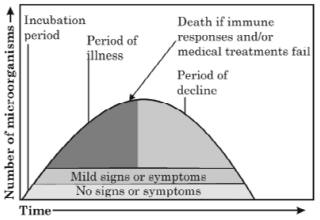
When a microorganism invades a host, a definite sequence of events usually occur leading to infection and disease, causing suffering to the host. This process is called pathogenesis. Once a microorganism overcomes the defense system of the host, development of the disease follows a certain sequence of events as shown in the graph. Study the graph given below for the sequence of events leading to appearance of a disease and answer the questions that follow:
Image
i. In which period, according to the graph there are maximum chances of a person transmitting a disease/infection and why? (1)
ii. Study the graph and write what is an incubation period. Name a sexually transmitted disease that can be easily transmitted during this period. Name the specific type of lymphocytes that are attacked by the pathogen of this disease. (1)
iii. Draw a schematic labelled diagram of an antibody. (2)
OR
In which period, the number of immune cells forming antibodies will be the highest in a person suffering from pneumonia?
Name the immune cells that produce antibodies. (2)

View full solution
Read the following text carefully and answer the questions that follow:
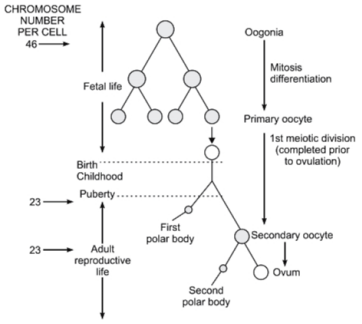
The process of formation of a mature female gamete is called oogenesis which is markedly different from spermatogenesis. A schematic representation of Oogenesis is shown below study the flow chart carefully.

Image
i. How is a primary oocyte different from a secondary oocyte? (1)
ii. Mention the changes taking place during the transition of a secondary follicle to Graafian follicle in the oogonia. (1)
iii. How many primary follicles are left in each ovary in a human female at puberty? (2)
OR
What happen to graafuan follicle after ovulation? (2)
View full solution

Generate a MODEL PAPER 10 paper free

Pick question groups from the list above, set marks and difficulty, and export a branded PDF with step-by-step answer keys. First 3 chapters free — no signup.

Download App