Question
Define an operon. Giving an example, explain an Inducible operon.

Answer

A functioning unit of genomic DNA containing a cluster of genes under the control of a single promoter is called an operon. An operon is generally transcribed into polycistronic mRNA. A single mRNA which codes for more than one protein is called polycistronic mRNA. An operon is made up of 3 basic DNA components:
i. Promoter: A nucleotide sequence that enables a gene to be transcribed is called a promoter. It is recognized by RNA polymerase, which then initiates transcription.
ii. Operator: A segment of DNA to which a repressor binds is called the operator.
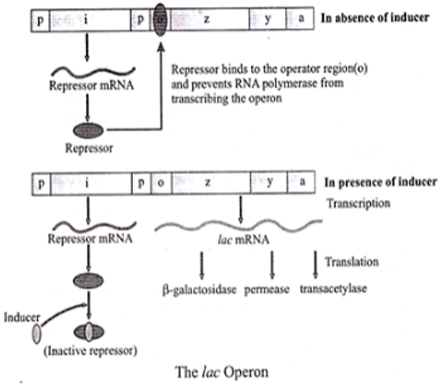
iii. Structural genes: The genes that are co-regulated by the operon are called structural genes. Inducible Operon: When the operon is regulated by an inducer, it is called an inducible operon. An inducer can switch on or off the operon. Lac operon is an example of an inducible operon. Lactose is a substrate of enzyme beta-galactosidase and is the inducer of the lac operon.
Image
The given diagram shows the working of the lac operon. In the absence of an inducer, the repressor binds to the operator region and prevents transcription.
In the presence of an inducer, repressor becomes inactive. This allows transcription in the operator region which results in the release of mRNA. Subsequently, mRNA promotes translation and protein synthesis is accomplished
Need a full question paper?

Generate a complete, print-ready paper with questions like this in minutes — across 16+ boards, with answer keys.

Start Generating Free

Similar questions

For selection of recombinants, insertional inactivation of antibiotic marker has been superceded by insertional inactivation of a marker gene coding for a chormogenic substrate. Give reasons.
Mention any two autosomal genetic disorders with their symptoms.
What is the Human Genome Project? Write the features of the Human Genome Project. Give a diagram representing the Human Genome Project.
Categorise the following plants into hydrophytes, halophytes, mesophytes and xerophytes. Give reasons for your answers.
  1. Salvinia.
  2. Opuntia.
  3. Rhizophora.
  4. Mangifera.
Study the illustration given and answer the questions that follow:
Name and state the function of ‘c’.
  1. Explain the process of microsporogenesis in angiosperms.
  2. Draw a labelled diagram of a mature pollen grain.
Answer the following questions:
Why is banana called a parthenocarpic fruit? Would you call banana a true fruit? Give reason in support of your answer.
Explain the process of fertilisation in human female, and trace the postfertilisation events in a sequential order up to implantation of the embryo.
OR
Explain the process of fertilisation and implantation in humans.
In a biology class, teacher was telling the students that the structures/components and their functions in a watch can be compared with various levels of organisation we find in nature. Radhika was surprised and asked teacher to explain it. Teacher got impressed with Radhika's interest and explained that there is a systematic arrangement of smaller and simpler components into larger one in a hierarchy or pyramid having different levels where each level is formed of components of lower level and itself becomes part of higher level for achieving a common goal.
(i) What are the four levels of biological organisation found in nature?
(ii) What is the basic unit of ecological organisation?
(iii) Define community.
(iv) What values are shown by Radhika?
Answer the following questions:
Draw a schematic diagram of a human sperm and label the cellular components. Give the functions of any three parts.