Question types

MODEL PAPER 4 question types

38 questions across 6 question groups — pick any mix to generate a BIOLOGY paper with step-by-step answer keys.

38
Questions
6
Question groups
5
Question types
Sample Questions

MODEL PAPER 4 questions

One sample from each question group in this chapter. Select any group above to see the full set with answer keys.

Which of the given statements is correct in the context of visualizing DNA molecules separated by agarose gel electrophoresis?
  • A
    DNA can be seen in visible light.
  • B
    Ethidium bromide-stained DNA can be seen under exposure to UV light.
  • C
    Ethidium bromide-stained DNA can be seen in visible light.
  • D
    DNA can be seen without staining in visible light.
View full solution
Single cell protein refers to:
  • A
    A specific protein extracted from a single cell.
  • B
    Proteins extracted from a single cell.
  • C
    Sources of mixed proteins extracted from pure or mixed culture of cells.
  • D
    A specific protein extracted from pure culture of single type of cells.
View full solution
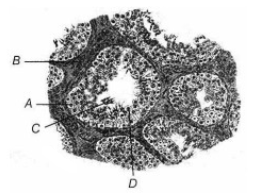
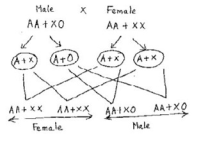
What does the chart give below represent?
Image
  • A
    XX - XO type of sex determination
  • B
    XX - XY type of sex determination
  • C
    XO - XX type of sex determination
  • D
    xy - xx type of sex determination
View full solution
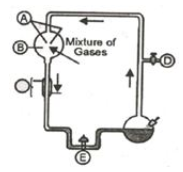
What was the mixture of gases used in chamber marked $A$ ?
Image
  • A
    Oxygen $O_2,$ ammonia $(NH_3),$ hydrogen $H_2,$ and water $H_2O$
  • Methane $(CH_4) v,$ ammonia $(NH_3),$ hydrogen $H_2$ and water $H_2O$
  • C
    Oxygen $O_2,$ ozone $O_3,$ hydrogen $H_2,$ and water $H_2O$
  • D
    Oxygen $O_2,$ ozone $O_3,$ hydrogen $H_2$

Answer: B.

View full solution
Effluent from the primary treatment of the sewage is passed through large aeration tanks for biological treatment.
Explain the complete process that follows till the water is ready to be released into the natural water bodies.
View full solution
Study the mRNA segment given below, which is complete and to be translated into a polypeptide chain and answer the following questions:
Image
i. Write codons 'A' and 'B'.
ii. What do they code for?
iii. How is the peptide bond formed between two amino acids in the ribosome?
View full solution
Q 123 Marks Question3 Marks
Mention the chemical nature of an antibody and name the type of cells they are produced by. Write the difference between active and passive immune responses on the basis of antibodies.
View full solution
Q 153 Marks Question3 Marks
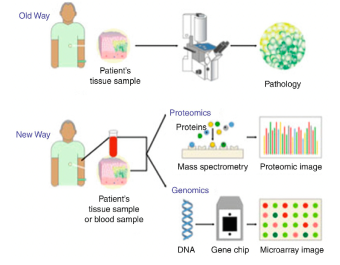
The image below describes the molecular diagnostic procedures.
Image
i. Write any two biochemical/molecular diagnostic procedures for early detection of viral infection.
ii. Explain the principle of any one of them.
View full solution
Restriction enzymes are found in bacteria (and other prokaryotes). They recognize and bind to specific sequences of DNA, called restriction sites. Each restriction enzyme recognizes just one or a few restriction sites.
When it finds its target sequence, a restriction enzyme will make a double-stranded cut in the DNA molecule.
i. Write the palindromic nucleotide sequence for the following DNA segment.
5'-GAATTC-3'
ii. Name the restriction endonuclease that recognises this sequence.
iii. How are sticky ends produced? Mention their role.
View full solution
i. How and why is charging of tRNA essential in the process of translation?
ii. State the function of ribosome as a catalyst in bacteria during the process of translation.
iii. Explain the process of binding of ribosomal units to mRNA during protein synthesis.
View full solution
Assertion (A): Evolution is a continuous process that takes millions of years for speciation.
Reason (R): During evolution, small variation accumulates guided by natural selection that leads to speciation.
  • A
    Both A and R are true and R is the correct explanation of A.
  • B
    Both A and R are true but R is not the correct explanation of A.
  • C
    A is true but R is false.
  • D
    A is false but R is true.
View full solution
Assertion (A): Decomposition process is slower if detritus is rich in lignin and cutin.
Reason (R): Decomposition is largely an oxygen requiring process.
  • A
    Both (A) and (R) are true and (R) is the correct explanation of (A).
  • B
    Both (A) and (R) are true, but (R) is not the correct explanation of (A).
  • C
    (A) is true, but (R) is false.
  • D
    (A) is false, but (R) is true.
View full solution
Assertion (A): Large holes in Swiss cheese are due to the production of a large amount of carbon dioxide by specific microbe.
Reason (R): The specificity of characteristic texture, flavour and taste of Swiss cheese is due to the use of bacterium Propionibacterium shermanii.
  • A
    Both Assertion and Reason are true, and Reason is the correct explanation of the Assertion.
  • B
    Both Assertion and Reason are true, but Reason is not the correct explanation of the Assertion.
  • C
    Assertion is true but Reason is false.
  • D
    Both Assertion and Reason are false.
View full solution
Assertion (A): In India, there is rapid decline in infant mortality rate and MMR.
Reason (R): In India, more and more attention is being given to RCH programmes.
  • A
    Both A and R are true and R is the correct explanation of A.
  • B
    Both A and R are true but R is not the correct explanation of A.
  • C
    A is true but R is false.
  • D
    A is false but R is true.
View full solution
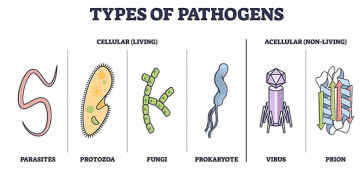
Read the following text carefully and answer the questions that follow:
The pathogen of a disease depends on RBCs of human for growth and reproduction. The person with this
pathogen suffers with chill and high fever.
Image
i. Identify the disease. (1)
ii. Name the pathogen. (1)
iii. What is the cause of fever? (2)
OR
Represent the life cycle of the pathogen diagrammatically. (2)
View full solution
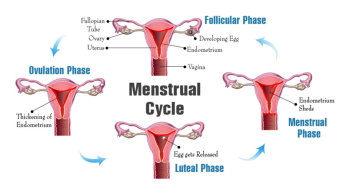
Read the following text carefully and answer the questions that follow:
The image below shows the menstrual cycle of a human female. On the basis of this cycle:
Image
i. Explain the menstrual phase in a human female. State the level of ovarian and pituitary hormones during this phase. (1)
ii. Why is follicular phase in the menstrual cycle also referred as proliferative phase? Explain. (1)
iii. Explain the events that occur in a Graafian follicle at the time of ovulation and thereafter. (2)
OR
Draw a Graafian follicle and label antrum and secondary oocyte. (2)
View full solution

Generate a MODEL PAPER 4 paper free

Pick question groups from the list above, set marks and difficulty, and export a branded PDF with step-by-step answer keys. First 3 chapters free — no signup.

Download App