Questions

2 Marks Questions

Take a timed test

6 questions · self-marked practice — reveal the answer and mark yourself.

Question 12 Marks
Effluent from the primary treatment of the sewage is passed through large aeration tanks for biological treatment.
Explain the complete process that follows till the water is ready to be released into the natural water bodies.
Answer
During treatment (after adding small amount of inoculum) primary effluent is constantly agitated mechanically and air is pumped into it.
- This allows the vigorous growth of useful microbes into flocs.
- The microbes consume the major part of the organic matter in the effluent.
- It reduces the BOD of the effluent.
- The effluent is then passed into settling tank where the bacterial flocs are allowed to sediment.
- A Major part of the activated sludge is pumped into an aerobic sludge digester.
View full question & answer
Question 22 Marks
Name the enzyme produced by Streptococcus bacterium. Explain its importance in medical sciences.
Answer
Enzyme produced by Streptococcus bacterium is streptokinase.
It is used as a 'clot buster' for removing clots from the blood vessels of patients who have undregone myocardial infraction leading to heart attack.
View full question & answer
Question 32 Marks
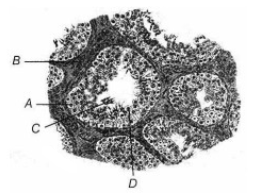
Study the sectional view of human testis showing seminiferous tubules given below.
Image
i. Identify A, B and C.
ii. Write the function of A and D.
Answer
1. A-Spermatogonia,
B-Interstitial cells
C-Spermatozoa.
2. A-Spermatogonia produces a spermatogonium (plural: spermatogonia) is an undifferentiated male germ cell. Spermatogonia undergo spermatogenesis to form mature spermatozoa in the seminiferous tubules of the testes.
D-Sertoli cells provide nutrition to sperms.
View full question & answer
Question 42 Marks
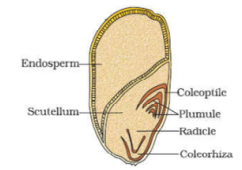
Draw a vertical section of maize grain and label its endosperm, plumule, coleoptile, scutellum, radicle and coleorhiza.
Answer
Vertical section of maize grain:
Image
View full question & answer
Question 52 Marks
Study the mRNA segment given below, which is complete and to be translated into a polypeptide chain and answer the following questions:
Image
i. Write codons 'A' and 'B'.
ii. What do they code for?
iii. How is the peptide bond formed between two amino acids in the ribosome?
Answer
i. A-AUG, B-UAA/UAG/UGA
ii. AUG codes for methionine. UAA/UAG/UGA does not code for any amino acid, but brings about termination of polypeptide
synthesis.
iii. In the large subunit of ribosome, there are two sites in which subsequent amino acids bind to and come close enough for the formation of peptide bond. It is catalysed by the enzyme called peptidyl transferase.
View full question & answer
Question 62 Marks
Micro-organisms play an important role for the biological treatment of sewage. Justify.
Answer
Micro-organisms play an important role in the biological treatment of sewage as these microbes use the organic matter present in wastewater and reduce the BOD (Biological oxygen demand). BOD is the amount of oxygen that aerobic bacteria utilise to break down biodegradable organic matter into end products such as water and Carbon dioxide.
View full question & answer
2 Marks Questions - BIOLOGY STD 12 Science Questions - Vidyadip