Questions

Case study (4 Marks)

Take a timed test

7 questions · self-marked practice — reveal the answer and mark yourself.

Question 14 Marks
Explain exponential growth equation with well labeled diagram.###Explain exponential growth.
Answer
→ Resource (food and space) availability is obviously essential for the growth of a population.
→ Ideally, when resources in the habitat are unlimited, each species has the ability to realise fully its innate potential to grow in number, as Darwin observed while developing his theory of natural selection.
→ Then the population grows in an exponential or geometric fashion.
→ If in a population of size N, the birth rates (not total number but per capita births) are represented as band death rates (again, per capita death rates) as d, then the increase or decrease in N during a unit time period t
(dN/dt) will be
dN/dt = (b - d) × N
Let (b - d) = r,
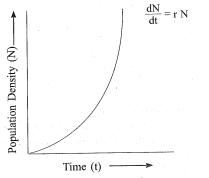
Then dN/dt=rN
→ The r in this equation is called the 'intrinsic rate of natural 'increase' and is a very important parameter chosen for assessing impacts of any. biotic or abiotic factor on population growth.
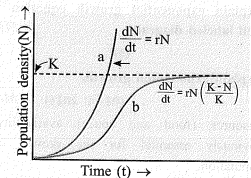
→ The above equation describes the exponential or geometric growth pattern of a population and results in a J-shaped curve when we plot N in relation to time.
Image
→ The integral form of the exponential growth equation as $Nt = N _0 e ^{ rt }$
Image
Where $N_t$ Population density after time t
$N _0$ = Population density at time zero
r = intrinsic rate of natural increase
e = the base of natural logarithms (2.71828)
→ Any species growing exponentially under unlimited resource conditions can reach enormous population densities in a short time.
→ Darwin showed how even a slow growing animal like elephant could reach enormous numbers in the absence of checks.
→ The following is an anecdote popularly narrated to demonstrate dramatically how fast a huge population could build up when growing exponentially.
→ r values, for the Norway rat the r is 0.015, and for the flour beetle it is 0.12.
→ In 1981, the r value for human population in India was 0.0205 and in 2011 r = 0.0135
View full question & answer
Question 24 Marks
Explain Mutualism as a population interaction with suitable examples.###Explain Mutualism with examples
Answer
→ This interaction confers benefits on both the interacting species.
Lichen : It is a mutualistic relationship between a fungus & photosynthesizing algae or cyanobacteria.
Mycorrhizae : Associations between fungi & the roots of higher plants. The fungi help the plant in the absorption of essential nutrients from the soil while the plant provides the fungi with carbohydrates.
Mutualism between plant & animal through pollination and seed dispersion :
Examples :
(1) Fig trees & wasps : The fig species is pollinated only by its 'partner' wasp species.
→ Female wasp pollinates the fig inflorescence  while searching for suitable egg-laying sites in fruits.
→ The fig offers the wasp some developing seeds, as food for the wasp larvae.
(2) Orchids : show diversity of floral patterns. They can attract the right pollinator insect (bees & bumblebees) to ensure pollination. Not all orchids offer rewards.
(3) 'Sexual deceit of Ophrys :  (Mediterranean orchid). One petal of its flower resembles female bee in size, colour & markings.
→ So male bee 'pseudocopulates' with the flower and is dusted with pollen. When this bee 'pseudocopulates' with another flower, it transfers pollen to it.
→ If the female bee's colour patterns change. slightly during evolution, pollination success will be reduced unless the orchid flower co- evolves to maintain the resemblance of its petal to the female bee.
View full question & answer
Question 34 Marks
The size of a population for any species is not a static parameter. Explain.###Explain population growth###Explain in brief - population growth.
Answer
→ The size of a population for any species is not a static parameter. It keeps changing with time, depending on various factors including food availability, predation pressure and adverse weather.
→ In fact, it is these changes in population density that give us some idea of what is happening to the population whether it is flourishing or declining.
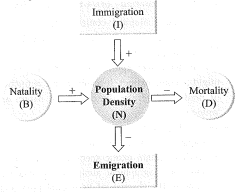
→ Whatever might be the ultimate reasons, the density of a population in a given habitat during a given period, fluctuates due to changes in four basic processes, two of which (natality and immigration) contribute to an increase in population density and two (mortality and emigration) to a decrease.
(I) Natality : refers to the number of births during a given period in the population that are added to the initial density.
(ii) Mortality : is the number of deaths in the population during a given period.
(iii) Immigration : is the number of individuals of the same species that have come into the habitat from elsewhere during the time period under consideration.
(iv) Emigration : is the number of individuals of the population who left the habitat and gone elsewhere during the time period under consideration.
→ So, if N is the population density at time t, then its density at time t + 1 is
Nt + 1 = Nt + [(B + I) - (D + E)]
→ Population density will increase if the number of births plus the number of immigrants (B + 1) is more than the number of deaths plus the number of emigrants (D+E).
→ Under normal conditions, births and deaths are the most important factors influencing population density, the other two factors assuming importance only under special conditions.
→ For instance, if a new habitat is just being colonized, immigration may contribute more significantly to population growth than birth rates.
Image+
View full question & answer
Question 44 Marks
Explain parasitism as population interaction with examples.
Answer
→ Many parasites are host-specific (they can parasitize only a single host species). They tend to co-evolve. i.e., if the host evolves special mechanisms against the parasite, the parasite also evolves mechanisms to counteract them to remain with the same host species.
Adaptations of parasites : Loss of sense organs, presence of adhesive organs or suckers to cling on to the host, loss of digestive system, high reproductive capacity etc.
→ Life cycles of parasites are often complex. E.g.
→ Human liver fluke depends on 2 intermediate hosts (a snail & a fish) to complete its life cycle.
→ Malarial parasite needs mosquito to spread to other hosts.
→ Parasites harm the host. They may reduce the survival, population density, growth and reproduction of the host. They may make the host physically weak and more vulnerable to predation.
Types of parasites :
1. Ectoparasites
→ Parasites that feed on the external surface of host. E.g.
→ Lice on humans, Ticks on dogs, Copepods on many marine fishes, Cuscuta plant on hedge plants.
→ Cuscuta has no chlorophyll and leaves. It derives its nutrition from the host plant.
→ Female mosquito is not considered a parasite, because it needs our blood only for reproduction, not as food.
2. Endoparasites
→ Parasites that live inside the host body at different sites (liver, kidney, lungs, RBC etc).
→ The life cycles of endoparasites are more complex.
→ They have simple morphological & anatomical features and high reproductive potential.
Brood parasitism in birds :
→ Here, the parasitic birds lay eggs in the nest of its host and lets the host incubate them.
→ During evolution, eggs of the parasitic bird have evolved to resemble the host's egg in size and colour. So the host bird cannot detect and eject the foreign eggs easily.
E.g. Brood parasitism between cuckoo and crow.
View full question & answer
Question 54 Marks
Explain Competition as a population Interaction with suitable examples.
Answer
→ It is a process in which fitness of one species ('r'value) is significantly lower in presence of another species.
→ Interspecific competition is a potent force in organic evolution.
→ Competition occurs when closely related species compete for the same limited resources.
→ Unrelated species can also compete for the resource. E.g. Flamingoes & fishes in some shallow South American lakes compete for zooplankton.
→ Competition occurs in abundant resources also. E.g. In interference competition, the feeding efficiency of one species is reduced due to the interfering and inhibitory presence of other species, even if resources are abundant.
Evidences for competition :
→ The Abingdon tortoise in Galapagos Islands became extinct within a decade after goats were introduced on the island, due to greater browsing efficiency of the goats.
→ Competitive release : It is the expansion of distributional range of a species when the competing species is removed.
→ Connell's field experiments : On the rocky sea coasts of Scotland, there are 2 barnacle species: Balanus (lager & competitively superior) & Chthamalus (smaller). Balanus dominates intertidal area and excludes Chthamalus. When Connell experimentally removed Balanus, Chthamalus colonized the intertidal zone.
→ Gause's 'Competitive Exclusion Principle' :
→ It states that two closely related species competing for the same resources cannot co- exist indefinitely and the competitively inferior one will be eliminated eventually. This may be true in limited resources, but not otherwise.
→ Species facing competition may evolve mechanisms for co-existence rather than exclusion. E.g. resource partitioning.
→ Resource partitioning : It is the division of limited resources by species to avoid competition. For this, they choose different feeding times or different foraging patterns. E.g. MacArthur showed that five closely related species of warblers living on a tree could avoid competition and co-exist due to behavioural differences in their foraging activities.
View full question & answer
Question 64 Marks
Explain Predation as population interaction with different example.
Answer
→ In a broad ecological context, all carnivores, herbivores etc. are predators. About 25% insects are phytophagous.
→ If a predator overexploits its prey, then the prey might become extinct. It results in the extinction of predator. Therefore, predators in nature are 'prudent'.
Importance of predators :
→ Predators control prey populations.
→ When certain exotic species are introduced into a geographical area, they spread fast due to the absence of its natural predators.
E.g. Prickly pear cactus introduced into Australia (1920's) caused havoc by spreading. Later, it was controlled by introducing a cactus-feeding predator moth.
→ Predators are used in Biological control methods.
→ Predators maintain species diversity in a community by reducing competition among prey species.
E.g. the predator starfish Pisaster in the rocky intertidal communities of American Pacific Coast. In an experiment, all these starfishes were removed from an enclosed intertidal area. It caused extinction of over 10 invertebrate species within a year, due to interspecific competition.
View full question & answer
Question 74 Marks
Explain population attributes.
Answer
→ A population has certain attributes whereas, an individual organism does not.
→ An individual may have births and deaths, but a population has birth rates and death rates.
→ In a population these rates refer to per capita births and deaths. The rates, hence, expressed are change in numbers (increase or decrease) with respect to members of the population
Birth rates : Refer to per capita births. E.g. In a pond, there are 20 lotus plants last year Through reproduction 8 new plants are added. Hence, the current population 28 The birth rate 8/20-0.4 offspring per lotus per year.
Death rates : Refer to per capita deaths.
E.g. 4 individuals in a laboratory population of 40 fruit flies died during a week. Hence, the death rate-4/40-0.1 individuals per fruit fly per week.
→ Sex ratio : A population has a sex ratio.
E.g. 60% of the population is females and 40% males
→ Age pyramid : It is the structure obtained when the age distribution (% individuals of a given age or age group) is plotted for the population.
→ For human population, age pyramids generally show age distribution of males and females in a combined diagram.
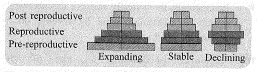
Image
Population size or population density (N) : It is the number of individuals of a species per unit area or volume.
→ E.g. population density of Siberian cranes at Bharatpur wetlands in any year is <10. It is millions for Chlamydomonas in a pond.
Growth status Expanding (growing) Representation of age pyramids for human population, population size is also measured in % cover or biomass.
→ E.g. In an area, 200 Parthenium plants and a huge banyan tree are seen. In such cases, measuring % cover or biomass is meaningful to show importance of banyan tree.
Total number is a difficult measure for a huge population. In such cases, relative population density (without knowing absolute population density) is used.
→ E.g. Number of fish caught per trap indicates its total population density in the lake.
→ In some cases, indirect estimation of population sizes is performed. E.g. Tiger census in national parks & tiger reserves based on pug marks & fecal pellets.
View full question & answer