Question
Explain exponential growth equation with well labeled diagram.###Explain exponential growth.

Answer

→ Resource (food and space) availability is obviously essential for the growth of a population.
→ Ideally, when resources in the habitat are unlimited, each species has the ability to realise fully its innate potential to grow in number, as Darwin observed while developing his theory of natural selection.
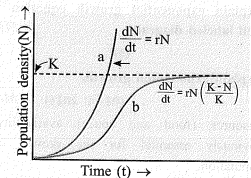
→ Then the population grows in an exponential or geometric fashion.
→ If in a population of size N, the birth rates (not total number but per capita births) are represented as band death rates (again, per capita death rates) as d, then the increase or decrease in N during a unit time period t
(dN/dt) will be
dN/dt = (b - d) × N
Let (b - d) = r,
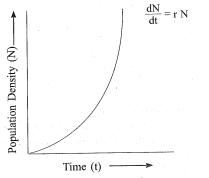
Then dN/dt=rN
→ The r in this equation is called the 'intrinsic rate of natural 'increase' and is a very important parameter chosen for assessing impacts of any. biotic or abiotic factor on population growth.
→ The above equation describes the exponential or geometric growth pattern of a population and results in a J-shaped curve when we plot N in relation to time.
Image
→ The integral form of the exponential growth equation as $Nt = N _0 e ^{ rt }$
Image
Where $N_t$ Population density after time t
$N _0$ = Population density at time zero
r = intrinsic rate of natural increase
e = the base of natural logarithms (2.71828)
→ Any species growing exponentially under unlimited resource conditions can reach enormous population densities in a short time.
→ Darwin showed how even a slow growing animal like elephant could reach enormous numbers in the absence of checks.
→ The following is an anecdote popularly narrated to demonstrate dramatically how fast a huge population could build up when growing exponentially.
→ r values, for the Norway rat the r is 0.015, and for the flour beetle it is 0.12.
→ In 1981, the r value for human population in India was 0.0205 and in 2011 r = 0.0135

Need a full question paper?

Generate a complete, print-ready paper with questions like this in minutes — across 16+ boards, with answer keys.

Start Generating Free

Similar questions

Give a detailed description of human male reproductive system. (Diagram required)
A patient is suffering from ADA deficiency. Can he be cured? How?
Read the following and answer any four questions from (i) to (v) given below:
Priya was 4 years old when she contracted chicken pox. It took her around 15 days to recover completely. Now Priya is 5 years old, so her mother got her vaccinated few days back for DPT ($5^{th}$ dose) as per immunisation program. Recently she was playing with her friend in the park when her friend accidently fell on iron pipe and badly bruised her knee. She was taken to the hospital where doctor gave her ATS injection and painkillers. Based on the above information, answer the following questions.
  1. Select the correct statement.
  1. Priya has developed natural active immunity against chicken pox.
  2. Priya has developed artificial active immunity against DPT.
  3. Priya's friend has developed artificial passive immunity against tetanus.
  4. All of these
  1. Which of the following do you think is an example of natural passive immunity?
  1. Administration of AGS (anti gas gangrene serum) in a person.
  2. Transfer of IgA antibodies from mother to baby through mother's milk.
  3. A person recovered from viral infection.
  4. A child vaccinated for polio.
  1. Which of the following is true for active immunity?
  1. It provides immediate relief.
  2. It is temporary, not long lasting
  3. It has no side effects.
  4. None of these
  1. Select the incorrect match.
  1. Passive immunity-IgG antibodies crossing placental barrier to reach fetus.
  2. Active immunity-Vaccination against corona virus.
  3. Active immunity-Administration of antidiphtheria serum in patient.
  4. Passive immunity-Fetus having mother's milk.
  1. Assertion: A person recovered from measles develops an active immunity against this infection.
Reason: In active immunity, person's own cells develop antibodies in response to infection.
  1. Both assertion and reason are true and reason is the correct explanation of assertion.
  2. Both assertion and reason are true, but reason is not the correct explanation of assertion.
  3. Assertion is true, but reason is false.
  4. Both assertion and reason are false.
Read the following and answer any four questions from (i) to (v) given below:
X and Y are communicable diseases, whereas Wand Z are non-communicable diseases.X is transmitted through vectors whereas Y is transmitted through droplet infection. Wis caused due to a hormone deficiency, whereas Z is a degenerative disease. Based on the above information, answer the following questions.
  1. Identify W, X, Y and Z.
 
W
X
Y
Z
(a)
Coronary artery disease
Cholera
Chikungunya
Chikungunya
(b)
Diabetes
Malaria
Rhinitis
Alzheimer's disease
(c)
Alzheimer's disease
AIDS
Shigella
Plague
(d)
Gonorrhea
Diphtheria
Pertussis
Anthrax
  1. Select the correct statement.
  1. If X is sleeping sickness then its vector is Leishrnania.
  2. If Y is diphtheria then it is caused by Bacillus anthracis.
  3. If W is hypothyroidism then it is caused by deficiency of thyroxine hormone.
  4. If Z is myocardial infarction then patient develops acute rheumatic fever, joint pain and throat infection.
  1. If X and Y both are usual diseases then which of the following holds true?
  1. X could be dengue caused by flavivirus and Y could be AIDS caused by HIV.
  2. X could be chikungunya whereas Y could be rhinitis.
  3. X could be hepatitis whereas Y could be rabies.
  4. X could be chicken pox caused by Va rice/la zoster virus whereas Y could be yellow fever caused by flavivirus
  1. If X and Y both are bacterial diseases then select the correct match from the following.
  1. X- Bubonic plague-Yersinia pestis
  2. Y-Leprosy- Mycobacteriurn leprae
  3. X-Whooping cough-Bordetella pertussis
  4. Y-Botulism-Clostridiurn botulinum
  1. Assertion: Communicable diseases could be contagious or non-contagious.
Reason: Diseases that spread through vectors are non-contagious disease.
  1. Both assertion and reason are true, and reason is the correct explanation of assertion.
  2. Both assertion and reason are true, but reason is not the correct explanation of assertion.
  3. Assertion is true, but reason is false.
  4. Both assertion and reason are false.
Draw a schematic diagram of typical anatropous ovule and describe structure of megasporangium in detail.###With a neat, labelled diagram, describe the parts of a typical angiosperm ovule.
For food related services, granting patent for transgenic organisms is becoming complicated. Explain with example.
Read the following and answer any four questions from (i) to (v) given below:
Growth of a population with time shows specific and predictable patterns. Two types of growth pattern of population are exponential and logistic growth. When resources in the habitat are unlimited each species has the ability to realise fully its innate potential to grow in number. Then the population grows in exponential fashion. When the resources are limited growth curve shows an initial slow rate and then it accelerates and finally slows giving the growth curve which is sigmoid.
  1. Which of the following statement is incorrect?
  1. Exponential growth occurs in organism such as lemmings.
  2. Logistic growth is more realistic.
  3. Exponential growth has two phases lag and log.
  4. ln logistic growth, population passes well beyond the carrying capacity of ecosystem.
  1. Which of the following equations correctly represents the exponential population growth curve?
  1. $\text{dN}/\text{dt}=\text{rN}$
  2. $\text{dN}/\text{dt}=\text{rN}\Big(\frac{\text{K-N}}{\text{K}}\Big)$
  3. $\text{N}_\text{t}=\text{N}_\text{o}\text{e}^\text{rt}$
  4. Both (a) and (c).
  1. Which of the following equations correctly represents Verhulst-Pearl logistic growth?
  1. $\text{dN}/\text{dt}=\text{rN}\Big(\frac{\text{K-N}}{\text{K}}\Big)$
  2. $\text{dN}/\text{dt}=\frac{\text{rN}}{\text{K}}$
  3. $\text{dN}/\text{dt}=\frac{\text{N}(\text{K}-\text{N})}{\text{K}}$
  4. $\text{dN}/\text{dt}=\frac{\text{r}(\text{K}-\text{N})}{\text{K}}$
  1. The population growth is generally described by the following equation:
$\frac{\text{dN}}{\text{dt}}=\text{rN}\Big(\frac{\text{K}-\text{N}}{\text{K}}\Big)$

What does 'r' represent in the given equation?
  1. Population density at time 't'.
  2. Intrinsic rate of natural increase.
  3. Carrying capacity.
  4. The base of natural logarithm.
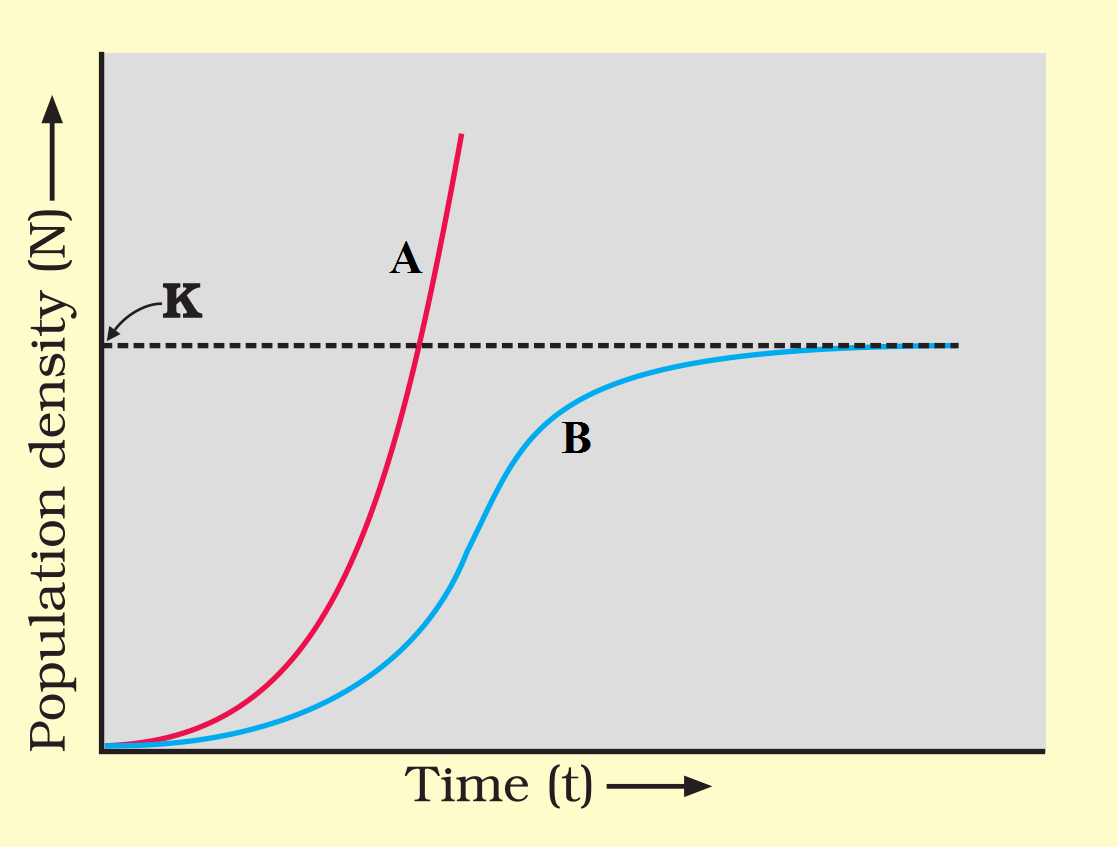
  1. Study the population growth curves (A and B) in the given graph and select the incorrect option.
  1. Curve 'A: shows exponential growth, represented by equation $\frac{\text{dN}}{\text{dt}}=\text{rN}$.
  2. Curve 'B' shows logistic growth, represented by equation $\frac{\text{dN}}{\text{dt}}=\text{rN}\Big(\frac{\text{K}-\text{N}}{\text{K}}\Big)$
  3. Exponential growth curve is considered as more realistic than the logistic growth curve.
  4. Curve 'A' can also be represented by equation $\text{N}_\text{t}=\text{N}_\text{o}\text{e}^\text{rt}$.
Read the following and answer any four questions from (i) to (v) given below:
Intrauterine devices are most widely accepted methods of contraception. These are used by females and are inserted by doctor or nurses in the uterus through vagina. However, these devices are not recommended for those who eventually intend to conceive.
  1. How does CuT prevent conception?
  1. Cu ions make uterus unsuitable for implantation.
  2. Cu ions make cervix hostile to the sperms.
  3. Cu ions suppress sperms motility.
  4. Cu ions inhibit ovulation.
  1. Which of the following IUDs makes uterus unsuitable for implantation?
  1. LNG-20.
  2. Multiload 375.
  3. Cu7.
  4. Lippes loop.
  1. Identify the correct statement for IUDs.
  1. They slowly release synthetic progesterone in the body.
  2. They increase phagocytosis of sperms within the uterus.
  3. They block entry of sperms through the cervix.
  4. Both (b) and (c).
  1. Select the correct matched pair.
  1. Hormone releasing IUD - LNG-20.
  2. Non-medicated IUD - Progestasert.
  3. Copper releasing IUD - Lippes loop.
  4. None of these.
  1. Assertion: IUDs can cause excess menstrual bleeding and pain.
Reason: IUDs can perforate uterus.
  1. Both assertion and reason are true, and reason is the correct explanation of assertion.
  2. Both assertion and reason are true, but reason is not the correct explanation of assertion.
  3. Assertion is true, but reason is false.
  4. Both assertion and reason are false.
Read the following and answer any four questions from (i) to (v) given below:
The first menstruation is called menarche, that usually occurs between 12 and 15 years. In human females, menstruation is repeated at an average interval of about 28/29 days and is called menstrual cycle. It is regulated by certain hormones, as pituitary gland is stimulated by releasing factors produced in the hypothalamus. The hormones produced by pituitary gland influence the ovaries. The hormones secreted by the ovaries affect the walls of the uterus.
  1. The breakdown of endometrium is characteristic of:
  1. Proliferative phase.
  2. Luteal phase.
  3. Ovulatory phase.
  4. Menstrual phase.
  1. Which days of the menstrual cycle marks the proliferative phase?
  1. 1-5
  2. 15-28
  3. 6-13
  4. 10-14
  1. Which of the following occurs during secretory phase?
  1. Empty Graafian follicle changes into corpus luteum.
  2. Primary follicle changes into Graafian follicle.
  3. Endometrium rebuilds and estrogen secretion increases.
  4. LH surge, inducing release of an ovum.
  1. Identify the hormones that attain peak level during ovulatory phase.
  1. FSH.
  2. Progesterone.
  3. LH.
  4. Both (a) and (c).
  1. Withdrawal of which hormone causes degeneration of corpus luteum?
  1. FSH.
  2. LH.
  3. Progesterone.
  4. Estrogen.
Read the following and answer any four questions from (i) to (v) given below:
Biosphere reserves are multipurpose protected areas which are meant for preserving genetic diversity in representative ecosystems of various natural biomes and unique biological communities by protecting wild populations, traditional life style of tribals and domesticated plant/animal genetic resources. Each biosphere reserve has three zones-core, buffer and transition zone.
  1. Which of the following is similar to biosphere reserve in terms of conservation?
  1. Gene banks.
  2. Offsite collection.
  3. Orchards.
  4. Hotspots.
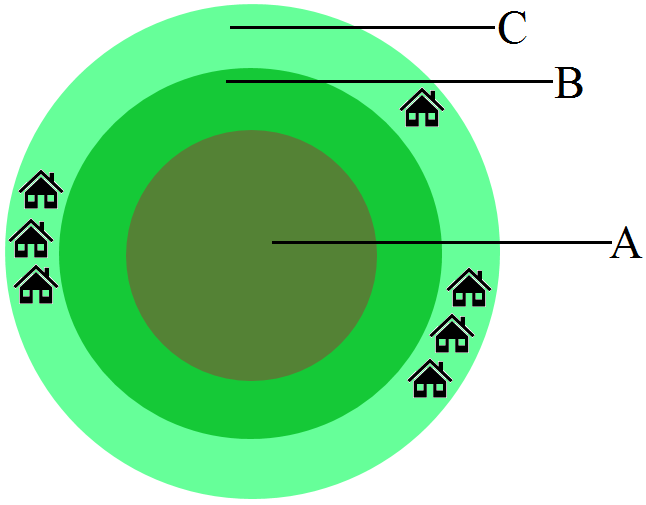
  1. Refer to the given figure representing different zones of a biosphere reserve and select the correct option regarding it.
  1. A-Limited human activity is allowed such as for research and education.
  2. B-An active co-operation occurs between reserve management and local people for activities like cropping, settlements, etc.
  3. C-No human activity is allowed.
  4. None of these.
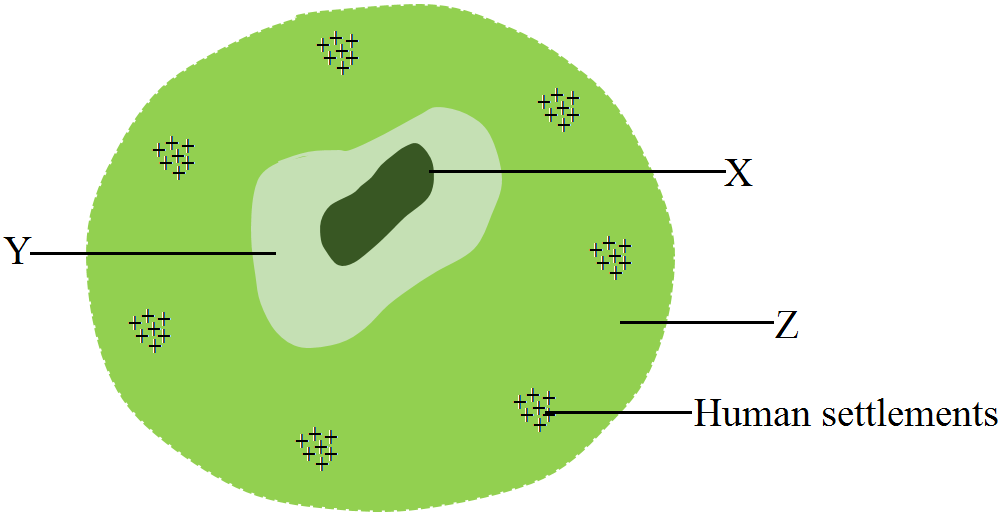
  1. Refer to the given diagrammatic representation of a biosphere reserve.


Select the incorrect statement regarding X, Y and Z.
  1. X is devoted to strict protection of wildlife and no human activity is allowed in this zone.
  2. In Y, only limited human activity (compatible with conservation) is allowed.
  3. In Z, commercial exploitation of natural resources is allowed.
  4. Tourism is allowed in Z zone only.
  5. Zone Y helps to maintain the lifestyle of the tribal people living in the area.
  1. (iii), (iv) and (v) only
  2. (ii), (iii) and (v) only
  3. (i), (iii) and (iv) only
  4. (ii), (iii) and (iv) only
  1. Biosphere reserves differ from national parks and wildlife sanctuaries because in the former.
  1. Human beings are not allowed to enter
  2. People are an integral part of the system
  3. Plants are paid greater attention than the animals
  4. Living organisms are brought from all over the world and preserved for posterity.
  1. MAB Programme means.
  1. Man and biosphere programme.
  2. Man and biodiversity conservation programme.
  3. Manually aided biosphere conservation programme.
  4. None of these.