Questions · Page 3 of 8

M.C.Q (1 Marks)

MCQ 1011 Mark
Amphibia first appeared in which of the following period?
  • A
    Permian
  • B
    Carboniferous
  • Devonian
  • D
    Silurian
Answer
Correct option: C.
Devonian
c
First amphibians originated is devonian period and age of amphibians is carboniferous period.
View full question & answer
MCQ 1021 Mark
The flowering plants originated in which of the following periods?
  • Cretaceous
  • B
    Tertiary period
  • C
    Triassic
  • D
    Carboniferous
Answer
Correct option: A.
Cretaceous
a
Origin of angiosperms $\rightarrow$ cretaceous period.
View full question & answer
MCQ 1031 Mark
Cretaceous period of the Mesozoic era is characterised by which of the following?
  • A
    Gymnosperms are dominant plants and first birds appear
  • Dinosaurs become extinct and angiosperms appear
  • C
    Flowering plants disappear
  • D
    Radiation of reptiles and origin of mammal-like reptiles
Answer
Correct option: B.
Dinosaurs become extinct and angiosperms appear
b
First birds appeared in jurassic period.
View full question & answer
MCQ 1041 Mark
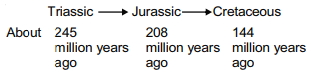
Which of the following arrangement of periods of the mesozoic era gives a correct sequence from the earliest to the latest?
  • A
    Jurassic, triassic, cretaceous
  • Triassic, jurassic, cretaceous
  • C
    Permian, jurassic, triassic
  • D
    Devonian, permian, jurassic
Answer
Correct option: B.
Triassic, jurassic, cretaceous
b

View full question & answer
MCQ 1051 Mark
First mammals appeared around
  • A
    $459\; million$ years back
  • $220\; million$ years back
  • C
    $1600 \;million$ years back
  • D
    $3800\; million$ years back
Answer
Correct option: B.
$220\; million$ years back
b
Mammals first appeared in triassic period of mesozoic era.
View full question & answer
MCQ 1061 Mark
The first mammals were like ...$A$... Their fossils are small sized. Mammals were ...$B$... and protected their unborn young inside the mother's body

Choose the correct option for $A$ and $B$ to complete the given $NCERT$ statement

  • $A-$shrews, $B-$viviparous
  • B
    $A-$monkeys, $B-$viviparous
  • C
    $A-$monkeys, $B-$oviparious
  • D
    $A-$shrews, $B-$oviparious
Answer
Correct option: A.
$A-$shrews, $B-$viviparous
a
View full question & answer
MCQ 1071 Mark
First dinosaurs and first egg-laying mammals were originated in
  • A
    Jurassic period
  • Triassic period
  • C
    Permian period
  • D
    Cambrian period
Answer
Correct option: B.
Triassic period
b
View full question & answer
MCQ 1081 Mark
Which phenomena confined the pouched mammals of Australia survived because of lack of competition from any other mammals?
  • A
    Continental origination
  • B
    Continental shifting
  • Continental drifting
  • D
    Continental evolution
Answer
Correct option: C.
Continental drifting
c
Continental drift pouched mammals of Australian survived because of lack of competition from other mammals or animals
View full question & answer
MCQ 1091 Mark
The animal called ........ evolved into the first amphibians that lived on both land and water.

Complete the given statement by choosing an appropriate option

  • A
    Invertebrate
  • Coelacanth
  • C
    Amphioxus
  • D
    All of these
Answer
Correct option: B.
Coelacanth
b
View full question & answer
MCQ 1101 Mark
Which era is called the age of angiosperms?
  • Cenozoic era
  • B
    Mesozoic era
  • C
    Proterozoic era
  • D
    Palaeozoic era
Answer
Correct option: A.
Cenozoic era
a
View full question & answer
MCQ 1111 Mark
Give the name of the first organism who invaded land
  • Plants
  • B
    Consumers
  • C
    Animal
  • D
    Carnivores
Answer
Correct option: A.
Plants
a
Plants were the first who invaded land. They prominanted modern era
View full question & answer
MCQ 1121 Mark
Age of gymnosperm is
  • A
    Cenozoic era
  • Mesozoic era
  • C
    Palaeozoic era
  • D
    Proterozoic era
Answer
Correct option: B.
Mesozoic era
b
View full question & answer
MCQ 1131 Mark
The first cellular form of life could have originated
  • $2000$ million years back
  • B
    $11000$ million years back
  • C
    $1500$ million years back
  • D
    $500$ million years back
Answer
Correct option: A.
$2000$ million years back
a
$2000$ million years.

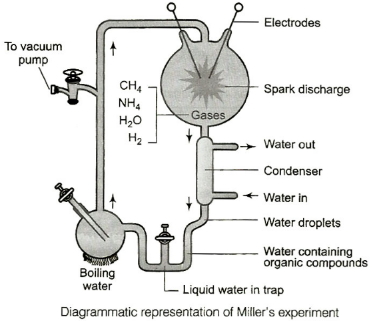
Experimental Evidences of Chemical Evolution

Experi ik mentally chemical theory of evolution performed by SL Miller and HC Uray in $1953 .$

He created electric discharge in a closed flask containing $CH _{4}, H _{2}, N H _{3}$ and water vapour at $800\, C .$ He observed formation of amino acids. In similar experiments other the observed, formation of sugar, nitrogen bases, pigments and fats

The first non-cellular forms of life could have originated-$3$ billion years back. The first cellular form of life did not possibly originated till about $2$ billion years ago because the conditions were non-biogenic at that time. This version of biogenesis, $i.e.,$ the first form of life arose slowly through evolutionary forces from non-living molecule was accepted by majority

View full question & answer
MCQ 1141 Mark
Match the following columns.

Column- $I$

Column- $II$

$A.$ $500$ million years ago

$1.$ Sea weeds and few plants

$B.$ $350$ million years ago

$2.$ Jawless fishes

$C.$ $320$ million years ago.

$3.$ Inverbebrates

  • A
    $A-1, B-2, C-3$
  • B
    $A-1, B-3, C-2$
  • C
    $A-2, B-3, C-1$
  • $A-3, B-2, C-1$
Answer
Correct option: D.
$A-3, B-2, C-1$
d
View full question & answer
MCQ 1151 Mark
Ichtyhyosaurs were
  • A
    Land reptiles
  • B
    Aquatic amphibians
  • C
    First mammal
  • First like reptiles
Answer
Correct option: D.
First like reptiles
d
View full question & answer
MCQ 1171 Mark
What is false for Tyranosaurus rex ?
  • A
    Dagger like teeth
  • B
    Biggest
  • $30$ feet in height
  • D
    Land reptiles
Answer
Correct option: C.
$30$ feet in height
c
View full question & answer
MCQ 1181 Mark
-They were land reptiles.

- They had huge fearsome dagger like teeth.

  • A
    Ichthyoscauras
  • B
    Shrew
  • C
    Lobe fins
  • Tyranosauras Rex.
Answer
Correct option: D.
Tyranosauras Rex.
d
View full question & answer
MCQ 1191 Mark
Invertebrates were formed and active by thetime of...
  • A
    $100$ mya
  • B
    $1000$ mya
  • $500$ mya
  • D
    $2000$ mya
Answer
Correct option: C.
$500$ mya
c
View full question & answer
MCQ 1211 Mark
They all fell to form coal deposits.
  • Pteridophytes
  • B
    Dianosaur
  • C
    Lobefins
  • D
    All given
Answer
Correct option: A.
Pteridophytes
a
View full question & answer
MCQ 1221 Mark
Dicotyledons first appeared during ....... period
  • A
    Jurassic period
  • B
    Carboniferous period
  • C
    Devonin
  • Cretaceous
Answer
Correct option: D.
Cretaceous
d
View full question & answer
MCQ 1231 Mark
The first mammals arose
  • A
    After the extinction of dinosaurs
  • B
    Before the origin of dinosaurs
  • Alongwith the dinosaurs
  • D
    From the dinosaurs
Answer
Correct option: C.
Alongwith the dinosaurs
c
It's Obvious
View full question & answer
MCQ 1241 Mark
Which were dominant during mesozoic era
  • A
    Pisces
  • Ruling reptiles
  • C
    Birds
  • D
    Ruling mammals
Answer
Correct option: B.
Ruling reptiles
b
It's Obvious
View full question & answer
MCQ 1251 Mark
Ancestors of mammals belongs to
  • A
    Ornithischia
  • Therapsida
  • C
    Silusidea
  • D
    Chelonia
Answer
Correct option: B.
Therapsida
b
It's Obvious
View full question & answer
MCQ 1261 Mark
Dinosaurs became extinct in
  • A
    Silurian period
  • B
    Jurassic period
  • C
    Triassic age
  • Cretaceous period
Answer
Correct option: D.
Cretaceous period
d
(d)The giant reptiles became extinct in cretaceous period mainly because of their lack of adaptability, depleted supply of food, predation and large scale destruction of their eggs.
View full question & answer
MCQ 1271 Mark
Archeopteryx, a transitional fossil between birds and reptiles was discovered from the rocks of following period
  • Jurassic
  • B
    Archeozoic era
  • C
    Cretaceous
  • D
    Triassic
Answer
Correct option: A.
Jurassic
a
(a)Archaeopteryx, intermediate between reptiles and birds, originated towards the close of Jurassic period.
View full question & answer
MCQ 1281 Mark
The dinosaurs were maximum during the period of
  • Jurassic
  • B
    Triassic
  • C
    Cretaceous
  • D
    Palaeocene
Answer
Correct option: A.
Jurassic
a
(a)The dominant animals during the Jurassic period were dinosaurs.
View full question & answer
MCQ 1291 Mark
Ancestral amphibians were tetrapods that evolved during
  • A
    Jurassic period
  • B
    Cretaceous period
  • Devonian period
  • D
    Carboniferous period
Answer
Correct option: C.
Devonian period
c
(c)The first amphibians originated in the Devonian period.
View full question & answer
MCQ 1301 Mark
Dinnosaurs originated in which era
  • A
    Paleozoic
  • B
    Archeozoic
  • C
    Cenozoic
  • Mesozoic
Answer
Correct option: D.
Mesozoic
d
It's Obvious
View full question & answer
MCQ 1311 Mark
Birds are evolved from
  • A
    Non-chordates
  • Reptiles
  • C
    Amphibians
  • D
    Fishes
Answer
Correct option: B.
Reptiles
b
(b)Reptiles have given rise to aves and mammals.
View full question & answer
MCQ 1321 Mark
Which of the following were abundant in mesozoic era
  • A
    Mammals
  • Reptiles
  • C
    Insects
  • D
    Fishes
Answer
Correct option: B.
Reptiles
b
It's Obvious
View full question & answer
MCQ 1331 Mark
Correct sequence is
  • Palaeozoic $ \to $ Mesozoic $ \to $ Coenozoic
  • B
    Mesozoic $ \to $ Archaeozoic $ \to $ Proterozoic
  • C
    Palaeozoic $ \to $ Archaeozoic $ \to $ Coenozoic
  • D
    Archaeozoic $ \to $ Palaeozoic $ \to $ Proterozoic
Answer
Correct option: A.
Palaeozoic $ \to $ Mesozoic $ \to $ Coenozoic
a
It's Obvious
View full question & answer
MCQ 1341 Mark
In which period giant reptiles dominated the earth
  • A
    Triasic
  • Jurassic
  • C
    Cretaceous
  • D
    Tertiary
Answer
Correct option: B.
Jurassic
b
It's Obvious
View full question & answer
MCQ 1351 Mark
First mammals appeared in the period
  • Triassic
  • B
    Jurassic
  • C
    Cretaceous
  • D
    Tertiary
Answer
Correct option: A.
Triassic
a
It's Obvious
View full question & answer
MCQ 1361 Mark
Earliest reptiles evolved in the period
  • A
    Ordovician
  • B
    Silurian
  • C
    Devonian
  • Carboniferous
Answer
Correct option: D.
Carboniferous
d
It's Obvious
View full question & answer
MCQ 1371 Mark
Which one of the following is the age of amphibians, fishes and invertebrates
  • A
    Archaeozoic era
  • B
    Proterozoic era
  • Palaeozoic era
  • D
    Mesozoic era
Answer
Correct option: C.
Palaeozoic era
c
It's Obvious
View full question & answer
MCQ 1381 Mark
The existence of marsupials in Australia and New Zealand prove
  • A
    Genetic drift
  • B
    Geological period
  • C
    Continental drift
  • Both $ (b) $ and $(c)$
Answer
Correct option: D.
Both $ (b) $ and $(c)$
d
It's Obvious
View full question & answer
MCQ 1391 Mark
Primates originated about
  • A
    $100$ million years ago
  • $65$ million years ago
  • C
    $10$ million years ago
  • D
    $30$ million years agow
Answer
Correct option: B.
$65$ million years ago
b
It's Obvious
View full question & answer
MCQ 1401 Mark
The cenozoic era is known as
  • Age of mammals and modern flora
  • B
    Age of reptiles and gymnosperms
  • C
    Age of amphibia and lycopods
  • D
    Age of marine invertebrates
Answer
Correct option: A.
Age of mammals and modern flora
a
It's Obvious
View full question & answer
MCQ 1411 Mark
Which of the following dominated in palaeozoic era
  • A
    Reptiles
  • Fishes
  • C
    Birds
  • D
    Mammals
Answer
Correct option: B.
Fishes
b
It's Obvious
View full question & answer
MCQ 1421 Mark
Birds and mammals in geological development of earth arose in period
  • A
    Permian
  • B
    Carboniferous
  • Jurassic
  • D
    Oligocene and eocene
Answer
Correct option: C.
Jurassic
c
It's Obvious
View full question & answer
MCQ 1431 Mark
Reptiles were dominant during
  • A
    Permian period
  • Cretaceous period
  • C
    Oligocene period
  • D
    Cambrian period
Answer
Correct option: B.
Cretaceous period
b
It's Obvious
View full question & answer
MCQ 1441 Mark
In which era mammals and birds evolved
  • A
    Mesozoic
  • Cenozoic
  • C
    Palaeozoic
  • D
    Procambrian
Answer
Correct option: B.
Cenozoic
b
It's Obvious
View full question & answer
MCQ 1451 Mark
Hardy-Weinberg equilibrium is not affected by which of the following factors?
  • Random mating
  • B
    Genetic recombination during gametogenesis
  • C
    Natural selection
  • D
    Variations due to mutation
Answer
Correct option: A.
Random mating
a
Equilibrium is not disturbed if there is random mating among people of the population.
View full question & answer
MCQ 1461 Mark
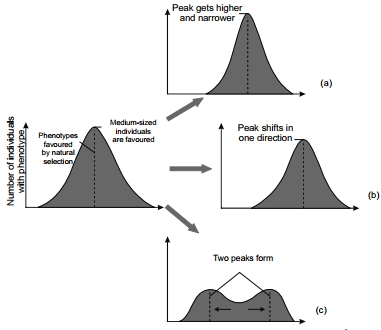
Natural selection in which more individuals acquire peripheral character value at both the ends of the distribution curve is
  • A
    Stabilising natural selection
  • Disruptive natural selection
  • C
    Directional natural selection
  • D
    The curve never shows the formation of two peaks
Answer
Correct option: B.
Disruptive natural selection
b

View full question & answer
MCQ 1471 Mark
If gene migration happens multiple times, it would lead to
  • A
    Mutation
  • Gene flow
  • C
    Chemical evolution
  • D
    Genetic drift
Answer
Correct option: B.
Gene flow
b
Genetic drift causes the change in gene frequency by chance in a small population.
View full question & answer
MCQ 1481 Mark
Factor affecting the Hardy-Weinberg principles are

$I.$ gene flow

$II.$ genetic drift

$III.$ mutation

$IV.$ genetic recombination

$V.$ natural selection

The correct combination is

  • A
    $I$ and $II$
  • B
    $II, III$ and $IV$
  • C
    $III, IV$ and $V$
  • $I, II, III, IV$ and $V$
Answer
Correct option: D.
$I, II, III, IV$ and $V$
d
Stability of the population and species over the number of generations is met under the following conditions

$(i)$ No Mutation Sudden appearance of variations are called mutations. There should not be either gene or chromosomal mutation. Mutation causes changes in gene frequency

$(ii)$ No Gene flow (Gene Migration) Within the gene pool of a given breeding population there is a continuous interchange of alleles between organisms. Gene flow refers to the movement of alleles from one population to another as a result of interbreeding between the members of two population. There must not be gene flow between the population

$(iii)$ No Genetic Drift Genetic drift is also known as 'Sewall Wright Effect' (named after its discoverer). It is random in gene (allele) frequency. It occurs only by chance. It is non directional. Genetic drift can cause elimination of certain alleles or fixation of the other alleles in the population. Genetic drift refers to a change in the population of alleles in the gene pool. So genetic drift must not occur

$(iv)$ No Genetic Recombination The alleles of the parental linkage groups separates and new associations of alleles are formed in the gamate cells, this process is known as genetic recombination. Thus, crossing over during meiosis is a major source of genetic variation within population.

Offspring formed from these gametes showing 'new' combination of the characteristics are called recombinants. There is no genetic recombination

$(v)$ No Natural Selection Pressure There must be no natural selection pressure with respect to the alleles in question.

According to Hardy-Weinberg Principle, gene frequencies will remain constant if all above five conditions are met
View full question & answer
MCQ 1491 Mark
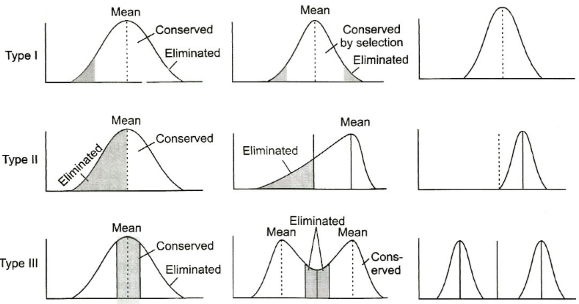
Name the type of natural selection depicted in the given diagram (type $I,$ type $II$ and type $III$)

$[Image]$

Type $I$ Type $II$ Type $III$

  • A
    Disruptive, Directional, Stabilising
  • B
    Directional, Disruptive, Stabilising
  • Stabilizing, Directional, Disruptive
  • D
    Stabilising, Disruptive, Directional
Answer
Correct option: C.
Stabilizing, Directional, Disruptive
c
Selection process in natural selection are

$[Image]$

$(i)$ Stabilizing Selection (Balancing selections) This type of selection favours average sized individuals, while eliminates small sized individuals. It reduces variation and hence, do not promote evolutionary changes. It maintains the mean value from generation to generation. If we draw a graphical curve of population, it is bell-shaped

$(ii)$ Directional Selection (Progressive Selection) In this selection, the population changes towards one particular direction. It means this type of selection favours small or large-sized individuals and more individuals of that type will be present in new generation. The mean size of the population changes

$(iii)$ Disruptive Selection (Diversifying selection) This type of selection favours both small-sized and large-sized individuals. It eliminates most of the members with mean expression, so as to produce two peaks in the distribution of the trait that may lead to the development of two different populations. This kind of selection is opposite of stabilizing selection and is rare nature but is very important in bringing about evolutionary changes

View full question & answer
MCQ 1501 Mark
If frequency, of ' $A$ ' allele is $0.4$ than, find out the frequency of ' $B$ ' allele and heterozygous genotype in a random mating population at equilibria
  • A
    $0.6$ and $0.24$
  • B
    $0.6$ and $0.96$
  • $0.6$ and $0.48$
  • D
    $0.6$ and $0.50$
Answer
Correct option: C.
$0.6$ and $0.48$
c
HW Principle $=p+q=1$

$p^{2}+2 p q+q^{2}=1$

Here, $p=A$ and $q$ is $=B$

Allele frequency of $B=1-0.4=0.6$

Allele frequency of heterozygous is $=2 \times 0.6 \times 0.4$

$\therefore 0.48$

View full question & answer